Transcripts
1. Welcome! :): Hey, are you drawing
people with hands behind their backs or in their pockets because you hate drawing hands? Your secret is safe with me. Hi, I'm Giovana, I'm an illustrator
and today we're going to kill your
fear of drawing hands. I hope you're ready
because this class will definitely bring your drawing
skills to the next level. Together we're going to
understand human hands anatomy, how to shade with pencil, ink and colored pencils, and how to draw proportional
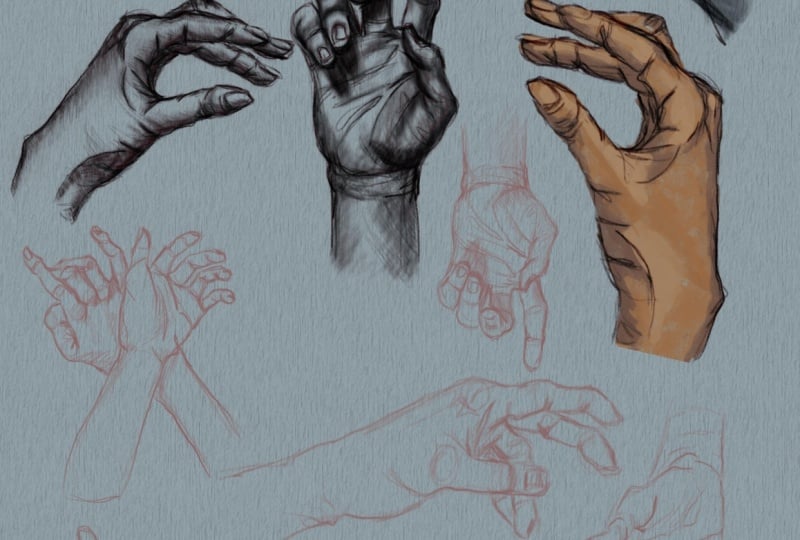
realistic hands in any position you want so you can make them your own style later. The hands can be a
really powerful symbol in an illustration. By looking at a
character's hands, you can tell sometimes how they're feeling
or it could even indicate their actions or what they're thinking
about doing next. Maybe this character is
tense, relaxed, angry, scared, and the hands can really help you create that
feeling in your artwork. Your hands are so hard though. Who is that? You can call
me your imaginary student. Well, welcome to class. We are just about to start. You don't understand. I don't think I can do this. Drawing hands is
really, really hard. I used to think that too, but now I learned a
way that made it super easy for me and I actually
loved drawing hands. I'm actually about to
teach it right now. I don't know. It sounds
a little boring. Hey, don't say that in front of my real students,
they're right here. I'm so sorry, we're going to start
in just a minute. What? We're in a hurry here. Can I draw by hand
with a wedding ring and then send it to my
boyfriend and be like, "Look what I learned how
to draw on Skillshare. Isn't this amazing?"
I don't know, I think it's pretty subtle. I don't think
that's a good idea. It's a great idea. I'm literally ready to start. Well, now that
everyone is ready, grab your art materials
and your favorite drink, and I will see you in
the next video. Bye.
2. Art Supplies: Hello my friends. In this
class you're welcomed to use any art materials that you want and that you have
available to you. But in case you want to
go art supply shopping, which I don't blame you I'm going to show you what
I'm going to be using. To sketch., I always
use a 4H pencil, the H means hard. The higher the
number next to the H means that it's a harder pencil, it's going to be easier
for you to erase. If you have an HB pencil
and an AH pencil, and if you erase the
B and erase the H, you're going to see
that the H one, is going to be completely clean, your paper's going to be
completely neat and clean, and the B is going to
leave something behind. It's really hard to
erase B pencils. For sketching, I always use the H especially if you're
going to use ink on top or colored pencils
or watercolors because then you can erase whenever you need
and your paper is going to be really
clean after and the eraser I use is the basic
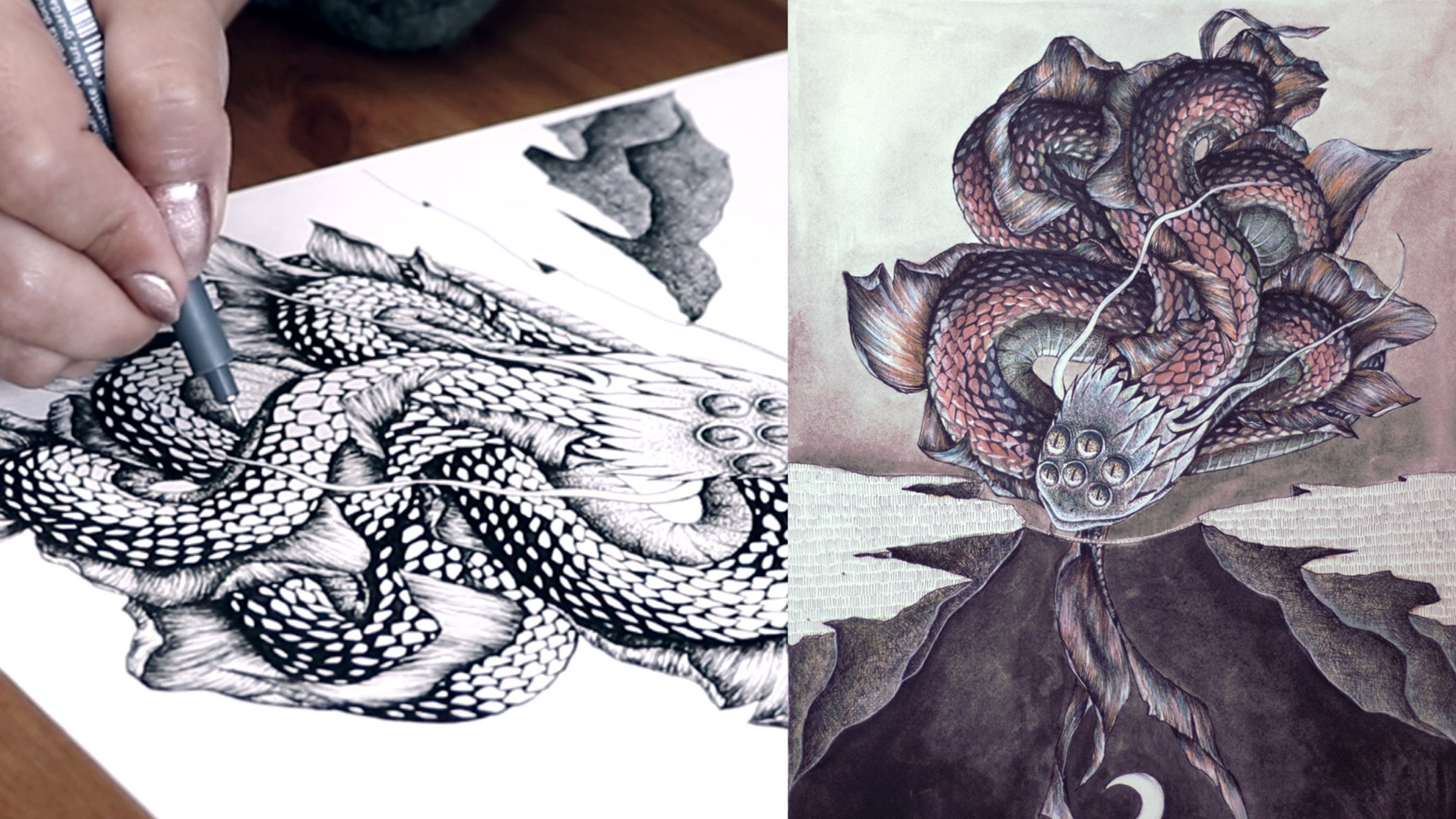
plastic eraser, like this. [NOISE] For the ink part, I'm going to be using ink pens. I have a ton of ink pens here. [NOISE] I'm going
to be using a 003, I'm going to be using a 005, and I'm going to be
using a 01 sometimes. For some super dark areas, I'm going to be
using a 08 or a 05. If you're going art
supplies shopping, grab yourself some
005s, do the best. For colored pencils, I have this super awesome
Prismacolor box. I barely never use it. I love this brand, it's affordable and good. I'm now an expert in
two colored pencils so if you want to go
deeper into that, I'm sure you can find amazing
colored pencil artists here on Skillshare for you
to go watch your classes. But this is what I'm using for this class and for paper for
the most part, if you can, just like a random sketch
book that you have, don't need to use any
expensive drawing paper. If you want to step up
your game and really work with nice paper you
can use Bristol paper, especially for the inking part, this is a grade type of
paper for ink pens because it's not too observant so
your pens would last longer. It's very smooth, can get
a lot of details on it. It's very different from like a watercolor paper, for example, where you're going
to have those, the paper's like this and this
paper is like this period. [NOISE] The other paper
I'm going to use, which is this toned
blue mixed media paper. Obsessed. You guys, have you seen anything
aren't beautiful here? Anyway, you don't need this. You don't need any of this
fancy papers. Oh my God. If you want to experiment with drawing starting
from the mid tone, which I will explain later on. But basically when you're
drawing with a white paper, you're drawing from the light to the dark and when you're using a colored paper that
is not black or white, you're working from the mid tone to the dark and to the white and this is really helpful for
us to make that part feel. Make it look like
really realistic in 3D, but excuse me. May loves color. Yeah. Oh, last but not least, I almost forgot
the white gel pen. My BFF forever. We're bound for life this
my soulmate right here. This is your best friend if
you're working with ink pens. Especially if you're working on the white paper because
you can fix mistakes, you can add some extra light if you went a little
overboard with your ink. If you're working on
the colored paper, if you're working
from the mid tones, this can be your light. You can use the black for the dark and the
white for the light. So get one of these, cheap, amazing, and you
will fall in love. These are the materials
we're using today. Yeah let's start drawing [MUSIC]
3. Class Project: For today's class,
I invite you to complete a little
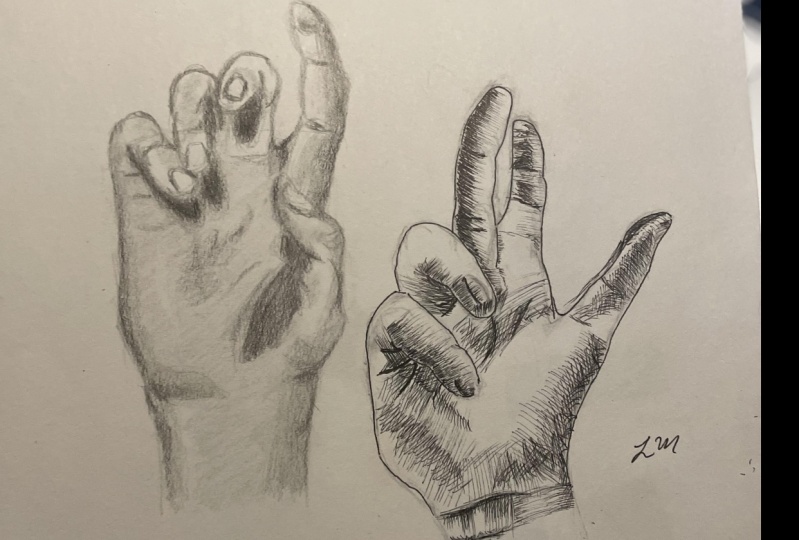
project with me. I want you to draw a hand from reference using the techniques you learned from this class. You can use one of the
references that I'm attaching in the "Project & Resources"
tab down below or you can look for
your reference or even make a reference picture. You can take a picture
of your own hand in whatever position you would like and then try to draw that. The technique you're going to
use to shade is up to you. Feel free to use
colored paper or a white paper or even a black paper if you
want to challenge yourself, and if you want to use ink or pencil or
a colored pencil, it is totally up to you. I can't wait to see your
drawings so don't forget to post them on the project section down below when you're done. I comment on all the projects
so you're definitely going to get some personalized
feedback from me. If you have any questions,
feel free to ask when you post with your
project together, or you can even post questions
in the discussions board down below too and I will
answer you right away. I can't wait to see
what you guys create, and let's start this class.
4. Drawing Hands (Step By Step): Hey friends. [MUSIC]
In this lesson, I'm going to show
you a basic system for you to follow
when you draw hands. When we're not super
familiar with the subject, it's always easier to
break things down into geometrical shapes
and just follow the main angles you
see in your reference. To start, let's try the shape
of the back of the hand. It's not exactly
a square because the side that's closest
to the risks is smaller. And once you have this shape, you can draw the knuckles of the hands in little
circles like this, and then draw the
baselines for each finger. [MUSIC] Notice that the top of the
fingers follow a curve where the middle finger would
be the longest one and the curve drops towards
the pinky like this. To draw the thumb, start by making a
circle where the thumb should start on the
side of the hand, starting around the middle of the back of the hand, like this. From this circle, you can draw this sections of the thumb and then outline the whole hand
following this proportion. [MUSIC] By using this system, you can draw hands
in any position. As you can see, this looks quite basic and a little mechanical. So let's work with some
real examples of hands in different positions so
you can know how to apply this method to
your future drawings.
5. Drawing Hands In Different Positions: To learn how to draw
hands in any position, let's work with a
few reference photos of hands in different positions. Before we start, go visit the projects and
resources tab down below, so you can download
all these pictures and draw as many of
them as you want. The more you practice
drawing from reference, the better you will be at drawing from imagination
whenever you want. Drawing from reference is amazing when you're
learning to draw, especially if you're learning
how to draw a new subject. I totally recommend you download these references so you
can practice with me. Right now we're not
getting too detailed yet, so this is going to
be a quick exercise. We're just sketching the hands to get the proportions right. To start, let's work
with this hand. You can see the hand is
tilted on a 45-degree angle, and you can start by drawing the main shape of
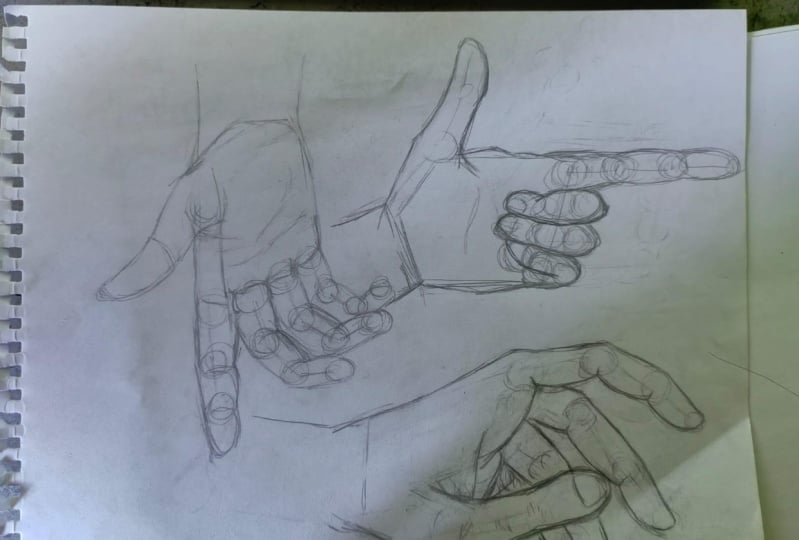
the hand like this. I'm drawing it like a box to make it easier
to add the fingers later. When you're ready, you can end the knuckles in little circles like this and then break each finger into
little sections. As you can see if you
look at your hand, each one of our
four fingers have three sections each and our
thumb has two sections. By breaking the fingers
intersections like this, you'll be able to draw
proportional fingers. To do that, all you
have to do is draw the main angles for
each section of finger. Just draw a little line
in the direction that you think each section
is going towards. Now, I'm just drawing this
oval shapes for each section. Once you have the main
positions for each finger, you can add a little
bit more detail contouring the hand
and each finger, so it looks more like
a hand, basically. Always come back to
your reference to check if the positions
are making sense. If you feel like something
could be improved, feel free to just erase
it and start again. The more you practice, the more this is going to
come naturally to you. When you're ready, you can
add the thumb as well. Doing just the same process, break it into sections and
draw first the angles, then the geometrical shapes, and then you can turn
that into a finger. [MUSIC] Let's move on
to a second example. In this one, we can only
see one side of the hand. I'm going to start by drawing the main shape like
we did before. In this case, it's
like a rectangle. Now you can add the knuckles of each finger the same
way we did before. But in this case, it's
different because we can't really
see the knuckles. There is a lot of things
hidden in this picture, but you should draw it anyway, so you know where
things should be. Then you can just erase the extra lines that you're
not supposed to see. Draw the knuckles anyway, even if you can't
really see them, draw them as you think
they should be by looking at your reference
and thinking like, where does this finger start? When you draw what's invisible, it's easier to make
the proportions right. Draw each part of the hand, and then you can erase anything that you're
not going to use later. After you have the
main angles of each finger broken
into sections, you can draw each section
into oval shapes like this, like I did before,
and as you can see, it's starting to
look like a hand. [MUSIC] Our third example is this one. The difference here
is that we have three folded fingers
in this one. It might look easier, but when we can't see
what's really going on, it's easier to mess up
the proportions and end up with a drawing that
looks like a drawing, and it's not 3D, it's
not proportional. You know what I mean? Let's see how we
can work with this. Again, we're going to
start the same way. Draw the main shape of the
palm of the hand in this case. Again, draw the knuckles where they would be if
you could see them. From here, since the
fingers are not extended, and we don't have many
angles to work with. I'm going to skip to the
oval shapes part where we draw an oval shape to
represent a section of finger. Again, I'm always
following my reference. I'm looking at the reference and going back to the paper to draw. I'm still breaking the
fingers down into sections and drawing each section
into oval shapes, trying to follow the
angle and size that would make sense according
to my reference. Let's move on to another
super cool hand position. Again, you draw the shape
of the palm of the hand, the knuckles, breaking
finger intersections, and draw the oval shapes for each section following the angle in which each finger is on your reference photo. I
think you've got the idea. Now, I'm just going to draw two more examples
for you to see. This method is very
reliable in my experience, and I've been drawing hands
using this system for years, and it just made
it so easy for me. I use it to avoid drawing hands. I used to draw
people with hands in their pockets or hide their
hands behind their back. Those little tricks where you don't want to
draw something, and then he just make it
as you don't have to. But now I love drawing hands
because it always makes me feel a little proud of
myself for being able to draw something that is
difficult in general. Like drawing hands is hard guys, don't be sad if this is hard for you because it's
honestly hard for everyone. It's such an intricate
part of our body that changes a lot
from person to person. I just really hope this method helps you feel
proud of yourself, and then you start loving
drawing hands from now on. Now I'm going to show
you another tip that was a complete game-changer
for me when drawing hands.
6. Pro Tip: Fingers Are Cylinders: Now that you understood
how to draw hands in any position using the
shapes and angles technique, let's try to make our drawings
a little more organic and natural by drawing their
fingers as cylinders. We're going to bring a
little bit of perspective and a 3D concept
to our drawings. I'm using this reference photo
and I'll start by drawing the main shape of the
palm of the hand like we did before, the knuckles, and then here I'm breaking
the fingers intersections and drawing simple lines like this just to mark
the main angles. Now each section of each
finger is a cylinder. To draw the three-dimensional
cylinder for each section, you draw an oval shape
in the beginning and end of each section
of the finger like this, and then you can mark
these curves like this, following the movement of the cylinder to shape the
finger in perspective. Is this making sense? Just think of a cylinder, like the toilet paper tube. That's a perfect
cylinder. Think of that. If you move that around
in a diagonal position, what does it look like? You're going to draw that for
each section of the finger. This is honestly super helpful when you
have the fingers in a weird position
like when you have the hand flat where you
can see everything, you don't really
need this technique. But if your hand is
in a weird position, your fingers are positioned in a way that in two dimensions, one finger is a lot
shorter than the other. But you know it's
not because in 3D, you know that the
finger is in a position where it has a normal size. Is this making sense? The cylinder technique
will help you show that you're not drawing the proportions
completely off when you have a hand in
weird positions. It also helps you a lot
when you're shading, even if you're going to erase
most of these lines later, it helps you know
where to shade, in what direction to shade, but we will look
into that later. Take this middle
finger, for example, it's in a position
that makes it hard to show exactly what's
happening with this finger. It's a bit difficult to
make it seem like a finger. When you draw the cylinders, the finger starts making
sense and then makes it easier and more natural
in your drawing later on. This will help you
really understand the movement of each finger
and each part of the hand. Also, this is a great
sketching practice for you to really get good with the proportions and
depth in your drawings and just get really familiar
with drawing hands. I usually draw the
cylinders like this when the position of the
fingers are too difficult. This is also really helpful
to draw arms and legs in weird positions as well [MUSIC]. Let's see a second example. We're drawing the main
shape of the hand. The knuckles, the
angles of the fingers, breaking them into sections
and now I'm going to mark the cylinder shapes for
each section of that finger. I'm also drawing the curves to make the cylinder very clear. Same thing with this other
hand, as you can see, it's so much easier to draw proportional hands
using this method, even though it looks a lot messier and there's
a lot more lines, there's a lot more going on. It's okay. When
you're starting out, it's fine to have
a messy drawing. Honestly, I am not starting out and all my drawings
are really messy. You don't need to be
starting out to be okay at having messy drawings. Now that we learned how
to sketch hands properly, let's jump to the next level and work on our shading skills.
7. Shading Basics: Value Scale (Part I): Hey guys. We're getting
to the fun part now. Let's learn how to shade hands. It's exciting. To do that, we
need to understand the values and their
roles in your drawing. What are values? To make it really simple, value is the lightness
or darkness of a color. You change the value of a color when you add
black or white to it. Let's work with an example. I'm going to break this hand
and chose three values, which means I'm going
to have a light tone, a middle tone, and
then a dark tone. The dark pink will
represent a darkness, the light pink will
represent the midtone, and the white from the paper
will represent the light. I'm just using two markers
here to make this exercise. When we look at this
reference picture, where do you see light, and where do you see darkness? To me, I see darkness here, the midtones around here, and the light here. Let's put that into our drawing. A good way to do this
exercise is to just print the reference
pictures you find in the Projects and
Resources tab down below, and just paint the
different values you see on top of them just
to practice the shading. This is going to
help you understand where to put the shade, how to identify what's dark, what's less dark. You
know what I mean? Here, I'm just doing some simple hatching with
this marker to place the shadows and
lights of this hand using only the three values. Each value has its own purpose. In drawing or painting, the values help us create a
focal point in the artwork, which means if you have
a drawing that is all in one color and no difference
in lightness or darkness, you're going to have zero depth. It's not going to look 3D. It's not going to
look real at all. It's going to look really flat. Visually, we tend to focus
where the light spots are, but the light only exists
if there is darkness. Quote me on this life lesson
later guys, I'm so wise. Anyway, I'm getting destructed my philosophical thoughts. Basically, all you
need to remember is that you have the
power to guide where the attention should be
directed in your artwork by creating contrast so
that the light is clear. If you want your viewer to look at a specific place
in your artwork, or if you have a
specific part of your artwork that is
the most important one, you can direct the light
towards this little spots, and you're only
going to know that that's light if there
is darkness around it. Like so, the darkness is
really what makes the light. Especially if you're
working on a white page, like we are right now, you need the darkness. Otherwise, there's
nothing there. If you only have light, you have a blank page. That's why I just love drawing with some
deep darks around it. Enough with the
motivational speeches. Let's move on and
practice how to shade in more detail
using ink pens now.
8. Shading Basics: Value Scale (Part II): In this lesson,
we're going to draw this same hand using
multiple values this time, which means our
drawing move look more realistic and natural. We are going to use
a fine line ink pen. But first, let's sketch. Grab your pencils and
use that system I taught you before to get
the proportions right. When you're ready, you can
just erase the extra lines. [MUSIC] For this exercise, I'm going to use a
05 pen and we're going to shade using the
crosshatching technique. Remember that you can
change the weight of your lines by tilting
your pen to an angle. If you hatch with your pen in a vertical position
perpendicular to your paper, more ink will be released and your lines will
look pretty heavy. If you hatch with your
pen on a 45 degree angle, for example, your lines will
look lighter and smoother. Just move your pen
around a little bit, maybe play on a
side paper first, just to understand
how to control your pen and the weight
of your lines better. This takes practice, so don't
worry about it too much. For now, all you
have to do is create some short strokes like
this where the shadows are, and this time we're going
to build the shadows or the different values in our drawing by
layering these sets of lines in different
directions until we have all the different tones of black and gray that
we want to create. Basically, you draw a set of lines in
the same direction. Then if you want to
make that darker, you're going to draw
another set of lines in another direction on
top of the first one. When you draw those lines,
remember they're still in their concept and that the
hand is three-dimensional. Instead of drawing the
lines in random directions, try to follow the
direction of the cylinder, like the movement of the cylinder as you
imagine in your head. The more lines you add
in different angles, the darker your
shadows will look, and the more contrast and depth
you'll be able to create. Try this method
and let me know in the discussion down
below how you like it. This is a very popular
line art technique that is super-useful to draw simple sketches or even the most realistic
and detailed drawings. It's so versatile and you can do so much
with this technique. If you want to dive deeper
into line art techniques, go to my profile and look for the fundamentals class that I published earlier this year. [MUSIC] As you can see, we have different values in
this version of the hand. It makes it so much more realistic compared
to the pink one. This one is more detailed. It has more depth, it has more contrast, and it has more values. When we focus more on details
and work with smoother, more delicate lines, and of course, when we spend more time
on a drawing and do it with more attention and care, it will look more realistic, if that's what
you're looking for. You know what I mean?
Now we're going to shift our mindset a little bit and
shade using graphite. [MUSIC]
9. Realistic Shading With Pencils: In this lesson, we're going
to stay with our pencils to practice blending
the shadows together to create the values you
need in your drawing. After you sketch and have
your main lines on paper, you can use a B pencil to create the different shadows and
values in your drawing. B pencils are soft pencils and H pencils are hard pencils. For sketching, always use
the hardest pencil you can because it's easier to erase and it won't create a
mess on your paper, and just shade and to
create those deep, dark, graphite, darkness spots, you need very soft
pencils like a 6B or an 8B or even a 9B if you have that
available to you. I'm going to use an 8B
to create some deep, nice dark shadows on my drawing. I'm also using a
small piece of paper underneath my hands to
keep the drawing clean. If you draw with your
hand directly on paper as you move it on
top of the graphite, it will be really messy especially if your hands
are sweaty like mine, do not recommend so just put
a piece of paper underneath your hand just to
protect your paper from grease and moisture. Is that gross? I'm sorry guys. This is just who I am. I was born this way. Let's talk about shading now. When you're working with pencil, we're not focusing on lines to create the
shadows as we were with the ink pens because the graphite can be
spread on the paper. We are going to just smudge
and spread the graphite in a much smoother way that is
nothing to do with lines. We're going to do the
same thing we did with the ink and move from
shadow to light. Where you see your
darkest shadows in your reference photo, that's where you add the
graphite first and from there you can start drawing
lighter towards the light. Remember to never
press your pencil on paper too much just to
not harm the paper. Just add layers and
layers of graphite and the more confidence you
started feeling as you draw, the more you're going to want to add more darkness to be able to create that beautiful
contrast that makes your drawing really
pop from the paper. Once you have a good amount
of graphite on paper, you can smudge it should
create the smoother effect and I'm also going to
use this smudging stick. I hope that's what it's called. I googled it and this
tool has different sizes. If you go to the art store, it has different sizes for more delicate one or a larger one
like this one that I'm using and this will help you smooth the graphite on your paper
and blend it together. You don't really need this
tool but it helps you create a clean and
smooth shuttle. The more you do this, it
makes it a little lighter. You can just keep adding
shadows and then smudging them, adding more shadows,
smudging them until you're happy
with the results. I wanted to show you
guys this process using a different medium because
the more you practice using different mediums the
deeper is going to be your understanding of
lights and shadows.
10. Realistic Shading With Ink Pens: Hey everyone. Let's do another hand
now using ink pens. But now I really want
to try to make this as realistic as possible
and show you how I do it. I'm sure other artists
do it different, but I wanted to show
you how I do it. First, you have to
be in the mindset of detailed and complex ink
work, which means patience. Don't tell yourself
that you going to draw a realistic
hand in one hour. Don't do that to yourself. Give yourself endless time
to create realistic work. There is no deadlines for realistic work. You
know what I mean? One could be working on a realistic drawing
forever if they want to. We're not going to be
doing this forever, but it takes a lot of time until you're happy
with the results. If you rush the process, you're not focused
and that means your lines won't be as
precise as they should be, and you just won't reach
the result that you want. If you think about it, when you look at your
drawing skills at the moment and you see what you want to improve or what you need to improve in your drawing skills, how much of that would
actually improve if you had all the time in the
world to draw and no pressure to finish
at a certain time? Honestly, ask yourself how much of your
drawing skills would improve if you just had all the patients you need?
You know what I mean? I dare to say that a lot of your drawing skills
would improve if you just were more patient. I know we want immediate
results. Am I right? I do t. O my friends, but the ink pens are just
not about that at all. It's an old school
way of doing things and I like it. You like it. We're here. We can do this. I actually like to
think that the pens are telling me to slow
down and I like it. When I'm stressed, the
ink pens are like, "It's okay, no rush. We have nowhere to be, no one to be with." You know what I mean?
This this beautiful. Take it as a meditation, take it as self-care. Don't rush, take your time, and if you need a break, give yourself a break,
come back tomorrow. I love breaks. Breaks are
artist's best friends. You can quote me
again on this one. I think this one is a good one. Yeah, this is the motivational
hand class of 2022. Now, let's go back to
drawing. Shall we? As you can see, I'm using the same crosshatching technique that I showed you before, but this time I'm
using a 003 pen, before I used a 05. As you could see, this pen
is much, much thinner, the lines are much more delicate and lighter
and smoother, and this is amazing for realism. The lighter you see the lines, the more realistic your
drawing is going to be. The smoother, the
more delicate you can be with your
strokes, the better. It helps making your shadows
smoother and more natural. If you really want to work
on realistic shading, try working with a
thinner tip pen. Buy a 003 or even a 002
and tilt the pen on an angle when you're working on the paper so you can make the
lines even more delicate. In the process of the shading, I'm doing the same thing. Just always starting from the darkest shadows and then
moving towards the light. I'm layering the
strokes of the pen and I I add more
and more layers, keeping in mind the
shape of the hand and the three-dimensional
perspective of this hand, you notice that we can barely see the lines if you
look at from afar. This is the effect that
you want to create. They always blend together. The more delicate
your lines are, they become just one big shadow. If I was working with
a heavier line like the 05 pin that I
was using before, I wouldn't be able to
achieve this effect. Also, remember that when we
are working on a white page, we are adding shadows
and mid tones. The lights are already there. The lights are the
white from the paper. Remember to leave
enough empty spaces so that the light can
shine in your drawing. Sometimes, especially
when you're drawing for a long time, it's very easy to
get carried away and end up adding
too much shadow. Just be careful with that. With more practice,
you're going to develop a better
control of your pens and you're going to
be able to create beautiful and smooth shadows. Remember that you can
download this picture in the Projects and Resources
tab down below as well. You can work on the
same project as I am. I also loved his
reference photo too because the shadows are
so dramatic and deep, like it's just great
drastic lighting. This is great for a
drawing purposes, A lot of information
to work with. Just keep shading following
your reference photo. When you're ready you can use a white gel pen to
enhance the light spots. I absolutely love
this part because this is the immediate
results sensation that you get when you add super quick details that create just a massive difference
in the final result. I just love it. What am I doing here? You just grab your
white gel pen to cover up a few lines that
went over the drawing. You can also add some extra light spots
whenever you need. You can't really
fix massive areas, you could really create a big white spot on
top of the black using this pen
because it's going to look really gross, dirty. What's the word? Nasty?
I'm joking too much. Anyway, just focus on fixing little things and adding little bits of light
here and there. I don't know if you can see, but it just makes
it more realistic. It creates more depth and makes your drawing totally
pop from the paper. Now in the next lesson, I'm going to show
you how to work on a colorful paper instead
of a white paper, and how to use that in our advantage when creating realistic drawings.
See you there.
11. Shading From The Midtone With Ink: Now that we learned how to do the proportions and
the shading with ink, I want to offer you
an extra challenge. [MUSIC] Let's try drawing a handy using colored
paper like this one. If you go to the art store, you can find gray paper, you can find a
toned brown paper, but I really loved his blue. When you have a different
tone, to start with, you can play with the values of the drawing in a different way. Since this is not
white or black, we're basically
starting the drawing from a mid-value standpoint. Where before, when we were
working on a white page, we were starting from the light and then
adding the shadows. If you are working
on a black page, like when you see artists
doing scratch paper, for example, you're
starting from the dark and then
adding just a light. When you're working on a
colored paper like this, you're starting from the middle. We're going to add
dark and light. Let's start by sketching the hands as you normally
would and here Here drawing two of the
same hand just to show you how to
add color later. But first things first, let's start with three colors, black, white, and the
color of the page. We're going to do
different values using these three colors. [MUSIC] Once you
finish your sketch, you can start shading
the drawing with your black fine liner ink
pen as we did before. [MUSIC] Now keep in mind that when we are working
on a white page, we were painting
the darker values all the way to almost white. In this case, since we are
working from the mid-tone, the mid-tones are already there. Instead of painting
the mid-tones like we were doing
with the white page, we are leaving the
mid-tones empty, so the color of
the page appears, and that can be our mid-tone, and then later we're going to paint the lights using white. This means you're adding less
black ink to your drawing because you're only drawing
the darkest shadows. Just focus on the
darkest spots in your reference picture
and keep following the same technique we
were doing before. Start from the darkest and
move towards the light. [MUSIC] As you can see, the hatching works blending the black with the
blue from the paper. When you have the
shading part done, we can start adding
the whites using a simple white colored pencil. You could also do this part using a white gel pen like
we were doing before. But I find that the
white gel pen creates a thicker line than what I like. I prefer to have a smoother
more delicate effect, so I'm going to use a wide colored pencil
to do the lights. Now you just follow
the reference photo to re-create the lightest
spots on your drawing. This part is super fun and satisfying because as you
start adding the lights, you will see your drawing
coming to life my friends. It's just going to feel
more three-dimensional, it's going to create depth, create that sense that this is not a vapor anymore,
it's a hand. The more values you're able
to create in your drawing, the more three-dimensional
your drawing will look like and this is it. I hope you liked this
version of the hand. [MUSIC] Now let's experiment with color a little bit
on the next lesson.
12. Coloring With Colored Pencils: Hey, guys. Now
that we understood how to draw starting
from the mid-tone, let's add an extra
challenge and try to create a realistic coloring
using colored pencils. You will see that the
idea is the same, but now instead of thinking
only about the values scale, which means the lightness and
darkness of your drawing, we are considering
colors and hues as well. First, let's look
at this reference. Our brain tends to group all the colors that are in a
picture or whatever you're looking at and create a general main color for
anything we look at. In this case, we may
look at this picture and maybe we see some light pinks, maybe we see a beach colors, some light oranges, some gray. But when we isolate the
colors in this reference, we might get some
colors that are not super clearly visible
like this one. By blending them together, we will be able to create this final colors that
we see in this picture. Let's start by erasing
the extra pencil lines on your sketch and leaving only some light
marks to guide you, then you can start
using one color that you think is the main
color of your drawing. Don't press the
pencil too hard on the paper because you can harm the paper and
then you won't be able to add another color on top, so start slow and smooth so we can be able to blend
the colors well later. Coloring with colored pencils
is all about layering. You can color the paper by
creating little strokes with the pencil or drawing in
a little circular motion, always very smooth and soft. [MUSIC] Next, I'm going to start
adding one of my shadow tones. In this case, I chose
this darker brown, just start creating some depth. Always remember to keep coming back to your reference picture and asking yourself
should this be darker? Should this be lighter? Should this be more yellow? Should it be more pink? Just keep comparing
your drawing to your original colors in
your original reference and look for colors
that might help you reach the right original
coloring of your picture. [MUSIC] In my case, I noticed that the original
colors are much lighter, so now I'm adding this
light beige color. [MUSIC] As I was doing it, I started noticing that
it looks too light now, this person looks a little dead, it's missing some warmth, it's missing some life, so I decided to add some deep reds in this hand
to make it look more human. Then I was actually thinking how deep red would
be the same color as the blood that runs through the veins on the hand and
makes it look more alive. It just made me
think like what if the colors of the things
that exist inside of our hand like the bones and the muscles and whatever
else, I don't know guys, I failed biology, but what if the colors
of the real things that exist inside of a hand are the colors that actually make
the hand look like a hand. No, am I going crazy? I'm totally overthinking
this, I know. Anyway, just follow your
reference picture. [MUSIC] Now, I'm going to use some
of the previous colors to blend all the
layers together. [MUSIC] I'm also using
this dark brown to define my shadows
a little better, so I'm just creating
some dark lines where the wrinkles are, and all the spaces
between each finger, basically, all the dark
spots in your hand. Notice how this creates a beautiful contrast
and the hand starts to take form and look less
flat and more tridimensional. Basically, this is
what we're doing : we're starting from
the mid-tone and then adding lighter colors
to create the lights and then darker colors
to create the shadows, always following our
reference picture. [MUSIC] If you're having
trouble baking the colors, try squinting your eyes when you looking
at your reference. In the case of this picture, when I squint my eyes, I see this bright orange that I'm not seeing
in my drawing, so I'm going to try
adding that as well. [MUSIC] As you can see, the hand is starting
to look a little more natural as I mix up the colors
and I blend them together. With the white pencil, I can enhance the lights and
creates some light spots that really help us create
the 3D effect that we want, makes it look like it has depth, and just makes it
look more real. [MUSIC] I also see a very clear, dark gray tone that makes up the darker parts of the hand, so I'm just going to keep
following the reference, looking for those darker spots, and then just add some
dark gray to them. [MUSIC] If I really look at it, I see some blue
where the veins are. Again, you guys, I'm not making this up, like the blue, blood, blue veins, it just makes sense. What the **** are
you talking about? I'm going to add some
blue to my drawing to create these blood flow vibes. Now, when you want to add some deeper more
contrasting shadows, you can use a black pencil, and even the black ink pen, if you want to
create some deeper lines in shadows
in your drawing. Just remember that
the black ink pen won't blend with
the colored pencil, so you should only
use it to create wrinkles or maybe some
lines in between fingers, or just some really
dark shadows. Whatever else there is, even if it's a really dark
shadow that's a larger area, maybe go for the black pencil. Unless you want to
create something more creative and just mix some line art style with
some coloring style, super creative, go
for it, I support it. But since I wanted
to do something more traditional, realistic maybe, I just use the black ink
pen for extra details. This is all we have
for today, everyone. I hope this class really helps you upgrade your drawing skills, it makes you feel
more confident, and just makes drawing hands more fun and easier
thing for you. Now, meet me on the next
lesson so we can wrap this up.
13. Thank You!: Oh my God, everyone reads it, one more class to the list. Congratulations on finishing another awesome Scotia class. I hope you learned
useful things in this class and that it
empowered you with your art. I hope to see you very
soon in my next class. I have so many awesome classes
in the open for you guys, I can't wait to share. Also, if you like
this class and you want to check out
my other classes, you can click on my
profile right here. You're going to see all of my other amazing drawing classes that I have for you guys. Don't forget to follow
me here so you can be the first one to know
when I post a new one. Also, if you went to enjoy them more bite-sized content, more like shorter
tutorials, arch business, tips, and the art lifestyle, you can follow me on YouTube. I just started a channel
a few months ago, it's a baby channel, I could definitely
use your support. Lastly, don't forget
to post your project, even if it's unfinished, you can complete it later. We would love to see
your process and whatever you're creating
with this class. Whenever you share your art
to definitely inspiring other people and
you're motivating people to do the same, and this is how we create this amazing community of line artists here on Skillshare, so don't be shy. Now that's all for today guys. Thank you so much again, and I'm going to see
you next time. Bye. In case I don't see
you, good afternoon, good evening and goodnight. [LAUGHTER]. Hey guys, this is my project. I hope you like it. I spent hours and hours
doing it, I'm so exhausted. [MUSIC] I think it looks really good and I'm going to post it in the
project section, and then one of you
guys can just send anonymously to my
boyfriend's email. Thank you. Bye.
 Gio Vescovi, Visual Artist