DRAW COLOR WHEELS - Draw charts with no angle math and enjoy the process | Dena Adams | Skillshare

Playback Speed


1.0x


  • 0.5x
  • 0.75x
  • 1x (Normal)
  • 1.25x
  • 1.5x
  • 1.75x
  • 2x

DRAW COLOR WHEELS - Draw charts with no angle math and enjoy the process

teacher avatar Dena Adams

Watch this class and thousands more

Get unlimited access to every class
Taught by industry leaders & working professionals
Topics include illustration, design, photography, and more

Watch this class and thousands more

Get unlimited access to every class
Taught by industry leaders & working professionals
Topics include illustration, design, photography, and more

Lessons in This Class

    • 1.

      Introduction

      1:53

    • 2.

      Materials and Framework

      3:10

    • 3.

      Dividing And Erasing

      2:27

    • 4.

      Labeling and Extras

      2:33

    • 5.

      Project and Wrapping Up

      2:27

  • --
  • Beginner level
  • Intermediate level
  • Advanced level
  • All levels

Community Generated

The level is determined by a majority opinion of students who have reviewed this class. The teacher's recommendation is shown until at least 5 student responses are collected.

53

Students

4

Projects

About This Class

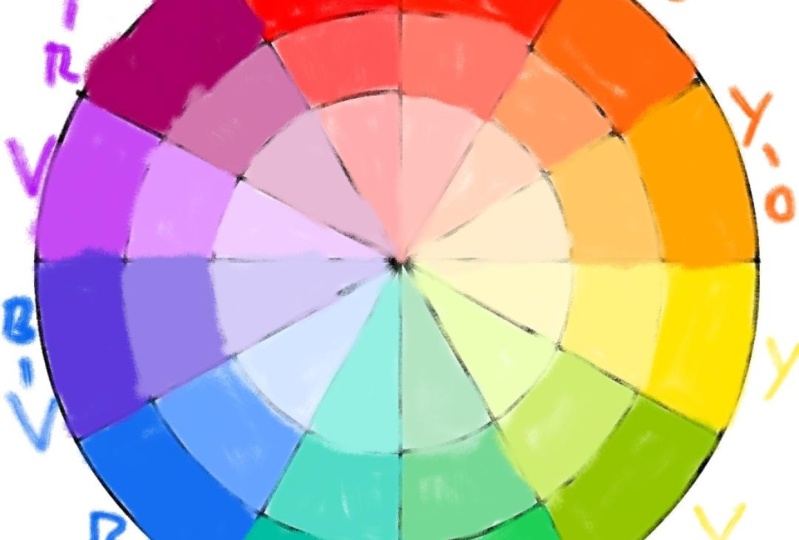
In this class we're going to focus on the drawing before the painting and DRAW the framework for color wheels by hand. Why? Well...

When you paint, color exploration and color management is really more fun and more helpful with consistent and clean charting.  It's tempting to skip it, but you'll be happy you didn't! (I stopped skipping it and MIND BLOWN it helped.)

If you're like me - and you'd rather get out the paint, get messy and get to the good parts - check this out.

You can create evenly-spaced color charts with a serene compass-and-ruler method that feels calm and cool, and works perfectly each time. Let's do it!

This is a beginner class with beginner drawing - BUT the color possibilities and potential is definitely ALL LEVEL.

Whether you're a beginner in painting

whether you're team CMY or RBY

whether you're a realist deep into Munsell

or whether you're drawing a color wheel for your kid's first art lesson

- you'll love the sweet simplicity of a clean chart on a fresh sheet!

All you need is a compass, a ruler, a straightedge, and your intended work surface.

The end result is total color-mixing READINESS.

Meet Your Teacher

Teacher Profile Image

Dena Adams

Teacher

Hi there! I'm an artist and maker in Minneapolis, MN. I've worked in a variety of media for over two decades, from kinetic painted cut outs, to landscape in oil and monotype, to quirky watercolors for greeting cards and posters. I truly believe that anyone can make something amazing, and I love to design art learning projects and processes that embed many small wins on the road to exciting results.

I'd love to see what you do on social media, so feel free to reach out via instagram or join my creative community on facebook.

See full profile

Level: Beginner

Class Ratings

Expectations Met?
    Exceeded!
  • 0%
  • Yes
  • 0%
  • Somewhat
  • 0%
  • Not really
  • 0%

Why Join Skillshare?

Take award-winning Skillshare Original Classes

Each class has short lessons, hands-on projects

Your membership supports Skillshare teachers

Learn From Anywhere

Take classes on the go with the Skillshare app. Stream or download to watch on the plane, the subway, or wherever you learn best.

Transcripts

1. Introduction: Hi and welcome. In this class, we're going to focus on creating an evenly spaced, consistent, clearly labeled and super useful color wheel chart. This is going to give you the repeatable capability of drawing this framework for exploring color in your sketch books, in your notes to yourself, and in small experimental paintings. Being able to line up color charts comparatively near each other and next to each other. And to work with color in a consistent experimental format has been an incredibly game changing and helpful aspect of my painting practice. And I truly believe it will be the same for you. Rather than being a class on color theory itself. This class aims to do one thing, only. Set you up with an even and consistent legible chart for color mixing and experimentation success. Join me now as we use some simple tools and no calculations whatsoever to draw even and consistent color wheel charts. 2. Materials and Framework: So there are lots of ways to draw a color wheel and you may not care about perfectly even wedges within your wheel, but it is possible to get them even without having to do a lot of measuring or calculation. So I'm going to share the way that I do this today. To draw this image, you will need a compass, a pencil. Any pencil is fine. Just a simple mechanical pencil is what I have on hand. A straight edge, clear ones are better, but whatever is straight and a ruler is fine. And an eraser, those implements are all you need. You do not need to do any calculations, any angle measurements. This is actually a great deal of fun, kind of meditative, and really easy once you know a few tricks. So a kneaded eraser is really good because it can get into those little areas, but a standard eraser on the bag of events all is fine for this. We're going to start by sizing our compass to draw a circle that fits comfortably on our page. And simply drawing that circle all the way around. You're not going to move or change your size of circle throughout this process, you want to keep it nice and consistent. So a compass that locks or that at least stays put, is really going to be helpful for this process. Once I've drawn my circle, I take the point of the compass and I move it. And I place it anywhere along the edge of the circle and draw a completely identically sized arc from any point to any other point. After I've made that arc, I lift and move the point of my compass again. And I put it where those arcs touch an intersect on the line of my main circle. And I repeat that arc. I keep moving my point to the last intersection of my arc and my circle. And I draw another arc. So as I continue this process across my circle, I'm going to repeat this process. And what you'll notice is that a very even and consistent little flower petal motif starts to show up in the middle of my circle. So I continue moving my compass to touch the intersection of the new point along that edge and drawing in new arc until I've completed that little flower motif of all of those intersecting arcs that go all the way around. 3. Dividing And Erasing: So at this point, this is the motif that we should all be seeing, this flower in a circle. What we're going to do now is take our straight edge and we're going to search out each point on opposite ends of our circle. So the point of one of these petals, the point of the petal opposite. And we're going to use our pencil and our straight edge just to join up those two points. Each petal, each blade of this motif should come to a single point, should be nice and closed. So seeking out those points where your petal meets the edge of the circle and connecting them should be simple and straightforward. And this is what you will wind up with. So we've got this initial division. All of the flower petals are split in half. If we look at the center of our motif, we notice that the spaces in-between these petals form a straight line. I'm taking the time to, but my straight edge up along these diagonal lines in the middle. And using them as guidelines to draw a second set of straight lines all the way across my circle. And these three divisions are going to cut the divisions in half once again. So we're looking to the center of the motif, taking time to really line that ruler up with the implied diagonal line and just connecting it to either side of the circle. This is the image that we should wind up with. And once we do, we could form some kind of design-based around this and it would look great. But for the color wheel, what I do is I just go in with my eraser and take the time to erase all of those actual pedal marks. This leaves me with a completed circular pie chart of equally divided triangular wedges. Once all my lines are erased. 4. Labeling and Extras: So I'm not here to advocate for any one system over another. I just wanted to show that I label these charts. This keeps me on track. I put yellow up at 12:00. I searched out my 08:00 position and I designate that for red or magenta. And I search out my 04:00 position and I designate that for blue or cyan. And I label these red and blue whether I'm using cyan or magenta or not, this just helps me stay on track. I then go on and fill in my intended mixes. Yellow, orange, orange, red orange, skipping over my actual red, red, violet, violet opposite my yellow directly. So if that is not in that position, you need to adjust to make that happen. And then violet mixed with blue or cyan, saying itself, green mixed with cyan or blue, green itself, yellow green circling all the way back up to yellow. Once my chart is labeled again, I could use it just like this and have a great time, but I like to draw one or two extra smaller diameter circles on my chart. I take my compass and align it with that little pinprick where I initially placed my compass point. And I make the diameter of the circle just a bit smaller, about a half an inch to an inch. In this outermost ring, I'm going to place my unmixed colors, colors right out of the tube, colors at full strength and saturation. On that next ring on the inside, that actually gives me a bit more room to work. This is where I can mix tones or tints or shades. I can even add a really small circle in the middle. And what I like to do here is explore neutralization by literally mixing all of the colors that I'm working with together and seeing what type of black, brown, or gray I get as a result. 5. Project and Wrapping Up: Congratulations. You now have everything you need in order to create some consistent, flexible, and useful charts for your sketch books. I highly recommend prepping several of these charts in advance in different parts within your sketchbook. This will get you ready to go and ready to paint the next time you have your paints out and you want to explore some color mixing. For the purposes of our class project, what I'd like you to do in the projects tab is to just share your favorite three to four color palette. You can just type out the color names. You can share, recommended brands and types of paint. And you can certainly also put in some scans and some photos. Bonus points for pics of your colors. Nicely mixed out and nicely painted out with in one of your new color wheel charts. I want to take a moment and thank you so very much for joining me for this short but hopefully very useful class. If you have found this technique to be useful and helpful, I urge you to consider following the Skillshare channel for more art lessons. This really is helpful and helps things grow and expand. You can also follow me on social and at me when you would like for me to notice some of your creations, I love to swing by, give things a heart and at a thumbs up. My app is denied, draws on Facebook, Instagram, and YouTube. Additionally, feel free to get in touch with me and let me know what it is exactly that you would like to learn next. I have been a painter for many, many years and there are so many things that I love to share with eager students, just like you. It's been so much fun sharing this simple tool with you today. And I cannot wait to create with you in the studio again, sometime in the near future. Till then, take care and create happy.