Transcripts
1. Introduction and Supplies You Will Need: Hi, friends. How are you? I hope you're having
a great day today. I'm excited about sharing
this project with you. This is a drawing
and painting project that I designed,
especially for kids. Students do not need to have any drawing or
painting experience at all to be successful
with this project. I will guide students step by step through all the steps
that they need to take. Today, we are going
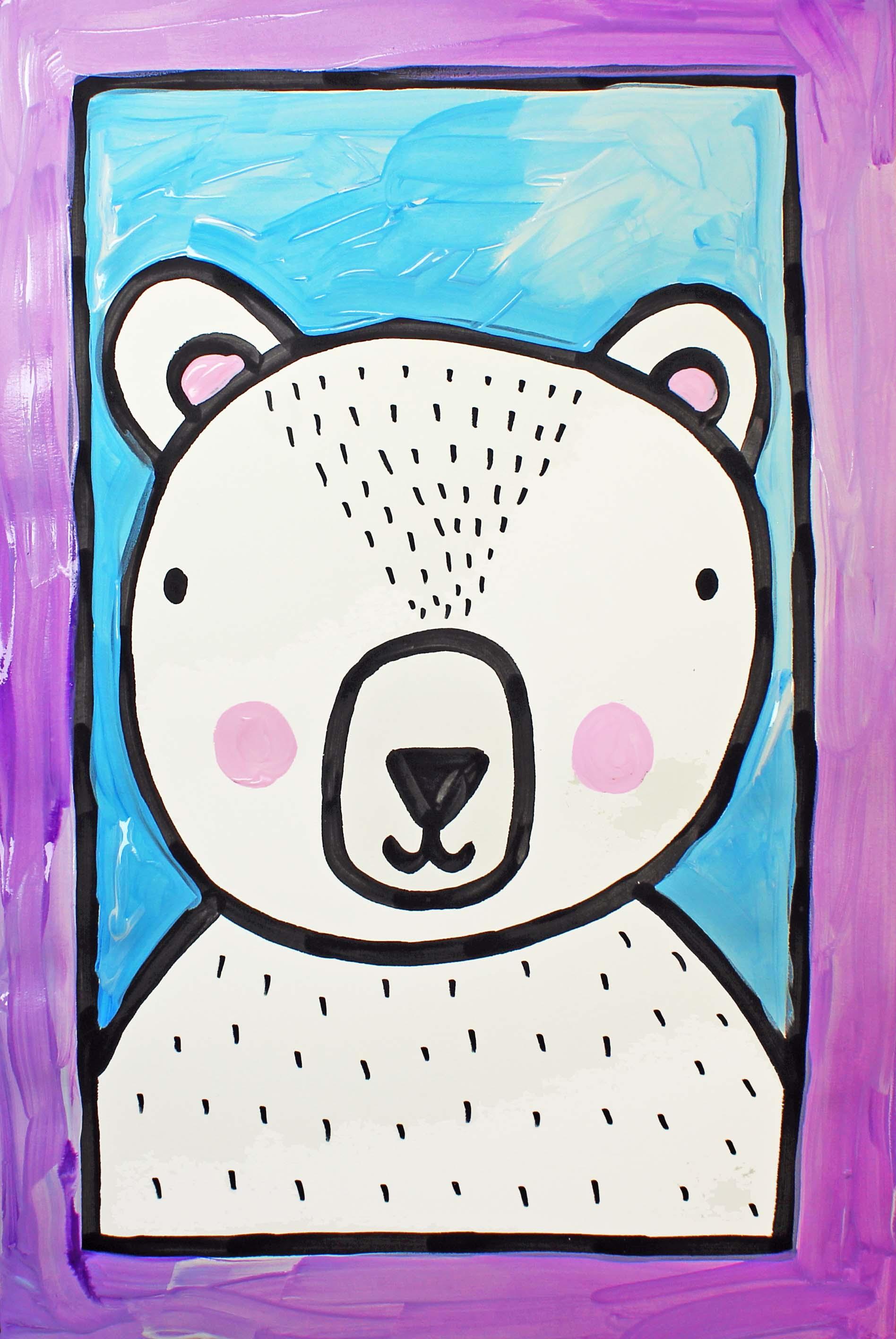
to be creating this cute little polar bear. Let's talk about
the supplies and the materials that you will
need for this project. The first thing
that you'll need is a sheet of thick white paper. You will need some paints. I'm going to be using
these tempera paints, and I'm going to be
using the colors black, red, purple, blue, and white. And the only colors that you will need are black
for the outline, and then white to mix
with the other colors. But you can use any other
colors that you like. Another thing that you'll
need if you'd like, is a cup of clean water. I'm not going to be
using a lot of water for this project, but
you might want to. You will need something
to put your paint on, so you'll need some sort
of a paint palette. I'm going to be
using a paper plate. You will need some
paint brushes. I like to use these
size paint brushes. One of them's a
little bit larger and one's a little bit smaller. The smaller one is
for the outline, and the larger one is
for the actual painting. Will need a pencil with an
eraser and a permanent marker, and then you'll also
need a paper towel to wipe your paint
brushes off on. So go ahead and gather all of those supplies
and materials, and I'll see you back
here in the next video.
2. Step 1: Draw a Polar Bear Portrait: And in this step, we are going to draw
our polar bear design. So let's get started. The first thing
that we're going to do is we're going to
pick up our pencil, and we're going to draw a frame around the edge of
our piece of paper. I'm going to go in about
an inch and a half or so. That would be maybe about
two or 3 centimeters. And I'm going to make
some straight lines. Going to start up here
at the top left corner. And then I'm just
going to make a line coming down almost
to the bottom, but not quite come over. Come back up. Notice how I'm
going slowly and carefully, so I'm doing my best work, and then I'm going to
close up that frame. Now, as you can see, my lines are not perfectly
straight, and that's okay. I'm human and besides, it looks better if it's
not perfectly straight. All right. So now
what we're going to do is on the inside
of our frame, we are going to draw
our polar bear. So let's get started on that. We're going to move almost to the top of our
piece of paper, but not all the way
about right here. And we're going to
make a large circle. Remember, your circle might
not be exactly like mine. I've had a lot of
practice drawing circles, and maybe you haven't
had as much practice, but keep practicing, and you'll get better
and better in time. So here we have our circle. This is going to be the
face of our polar bear. Now we need to make some ears, and they have pretty small ears. So those are just
curve lines like this, one on this side, and then
one over here on this side. And if they're not exactly
the same size, that's okay. Don't worry about that. And then here we're going to
make the nose area. It's going to be a
shape like this. So it almost looks like an oval, but it does have a little
bit of square angle to it. Alright. Inside of this area, we're going to make a nose. So I'm going to make
a straight line and then curve line
coming down and backup, and then a little smile. So that's going to be
the nose in the mouth. Then I'm going to make
some eyes right here, and this is a very
simple design. Remember, if you add a lot of detail with this
type of project, then then your details might get lost
underneath the paint. So our lines need to
be pretty simple. I'm also going to or I'm planning to make some
cheeks right here. So I'm going to make
some very light circles. I'm not going to cover
those with the black paint. I'm not going to cover those pencil lines with
the black paint, but I do want to remember that I want to
put some pink here for some pink cheeks because this is more of a cartoon
polar bear. Alright. Now we're going to make the
polar bear's body down here. So they have pretty big bodies. I'm just going to
make a curve line here coming out from the head, and then another
curve line over here. So you can see that the body
is fairly large. All right. That's it for the
drawing portion of our polar bear design. So when we come back
in the next step, we will start adding some black
paint to our pencil line. So I'll see you back
here in the next video.
3. Step 2: Outline the Design: In this step, we
are going to add some black paint to our design. So let's get started. As I mentioned
before, I'm going to be using a Tempa paint, but you can use acrylic
paint or poster paint. That would work fine, as well. We do not need that much
paint on our palette. I'm using my paper
plate for my palette. I'm using just a small
amount of black paint. Remember, we all
have this job and responsibility to use as
little resources as possible. And a little bit of this black paint goes
a long ways. Okay? So what we're going to do
first is we are going to take our paint brush and load
it with some black paint. And we're going to start here at the top of our
piece of paper, and we're just
going to carefully cover those pencil lines, and you will run out of paint
on your paintbrush so you need to keep loading and
reloading over and over again. So be aware that
that will happen. So I'm going to go
slowly and carefully, so I do my best work. And I do encourage
students to start at the top of their piece of
paper, and this is why. Because if you started
here, let's say, on the nose and you had
black paint on the nose, and by accident, you set
your hand down on the nose, then that paint would
smear all around. I've seen that happen before. So now I encourage my
students to start at the top of their piece of
paper and work their way down. What I'm going to do is
speed up this video, and I'll see you back
here in just a minute. Alrighty, friends, I'm finished covering most of
my pencil lines. I am now going to cover the
eyes with some black paint. And to do that, I am
going to wipe off this paint that's on my paint brush onto my
handy dandy paper towel. And then I am going to
use the back this part, the tip back tip
of my paintbrush, and I'm going to dip
it into the paint, and I am going to create some nice round ovals with
the back of my paintbrush. I find that this is
a really good way to make round circles
or even ovals. It's a nice way for
them to be very even. Now I'm going to take off that black paint off of my paint brush with my
handy dandy paper towel. And as I mentioned before, I'm not going to cover these cute little cheeks
with my black paint. I'm going to wait until
I can use my pink paint, and I will paint
those little cheeks. And what we're going to do
now is we are going to allow our entire painting to dry
before we start the next step. So make sure that your
painting is completely dry. And then in the next step, what we're going to do
is we are going to add some detail to our polar bear. So I will see you
in the next video.
4. Step 3: Add Details: A in this step, we are going to add some
detail to our polar bear, and we're going to
add that detail with this permanent marker. So what we're going to do
is we're just going to add a little bit of detail
that represents fur. And what we're going to do is just make some little marks like this on the body
of our polar bear, some little hairs
here and there, not too close together,
but not too far. And then we'll go up to the face and we'll
do the same thing. There we go. Now, I'm
just going to put some little hairs
along the top here. Then I'm going to
travel down the face, and I'm going to add
little tiny lines, and they're going to
turn into a triangle. So I'm making sure
that they're kind of getting a little bit more
narrow as we go down. I might add a little bit more
over on this side because it looks like it's a
little bit lopsided. There we go. Perfect. Alrighty. There we go. That was short and sweet. Make sure that you get that cap back on to your marker so
it doesn't get dried out. In the next step, what
we're going to do is we are going to start
painting our design.
5. Step 4: Paint the Design: Alrighty friends.
So in this step, what we're going to do is we are going to paint our design. So let's get started. I have my colors here. I have some red and some blue, some white, and some purple. You don't have to have
these exact colors. Just use what you have
available to you. If you do have white available, I would suggest that because we're going to be mixing it with other colors to make them a little bit lighter. All right. I also have a little bit
of a larger paintbrush and a smaller paint
brush so that I can paint larger areas
on my painting. I'm going to be putting some of my paint onto my palette,
which is right here. I've already used
it for the black, and I am going to use it
also for these other colors. I'm going to start
out by painting the cheeks and the
inside of the ears, going to paint those
a little bit of red, but it's going to turn into pink because I'm going
to add white to it. So I'm going to add some
white onto my palette. There we go. And then I will add these other
colors in just a moment. So I'm going to take my smaller paint brush
and I'm going to mix a little bit of my white
with a tiny bit of my red. That's why I didn't need
a big amount of red. I just needed a
little dot because I'm just mixing a
very small amount. Alright, now I'm going to
use this pink to paint the inside of the
ears and the cheeks. Alright, I'm finished
painting the cheeks and the inside of the ears
with my pink paint. So I'm going to clean
that off. There we go. Now what I'm going to do is I am going to keep my bear white. I'm not going to be
painting my bear. I'm going to paint this part of the background right here. I'm going to paint that blue, and then I'm going to
paint the frame purple. And with the blue
and the purple, I'm going to mix those with
a little bit of white. I like to shake up my paints, just to make sure they're
all nice and mixed up. Now, if you feel like at anytime you need to
rinse your brush, you have your water
here as well. So because this is
a bigger space, I'm going to use my
larger paint brush, this one right here. You may or may not
have one that looks exactly like this,
and that's okay. Just use what you have
available to you. I'm going to start with the part inside the frame that's
touching the polar bear, and I'm going to use blue, as I mentioned, and I'm going
to mix that with white. So I'm going to take some white, move it by my blue, and pull some of that
blue into the white. And if I get it mixed
up a little bit, if I get a little bit of
blue inside my white, that's okay. No problem. No, I'm just going
to start painting. Actually, I like that to
be a little bit lighter. And I like it when it's
a little bit streaky, so I'm not going
to mix it really, really well because I like to see a little
bit of that white. Alright, friends, it
looks like I have all of my frame painted. I have the area around
my polar bear painted. I have the cheeks,
and I have the ears, the inside of the ears painted, and I'm really happy with the way that my
artwork turned out. I hope that you had a lot
of fun with this project. I will see you next time.
 Em Winn, Teacher, Art Instructor, Artist