Transcripts
1. Introduction: Do you want to make a comic? Welcome to this
class called create an action plan for your comic. My name is gonna get extra
and I make a teach comics. You might know me from my
work comic recollection city, or my YouTube channel or blog about making
your own comics. If you've ever wanted
to make a comic, but you're overwhelmed
by the complexity of starting such a
large creative project. Or if you have multiple
ideas for comics, but you don't know
what kind of comic too big then this is
the class for you. This class will help
you to come up with a full plan to help you decide on what kind
of comment to make, how you're going to
work on this comic. The planning of such a
large creative project like a comic can
be very daunting. I noticed all too well
from experience when I first started to
work on my own comic. Over the years,
I've done a ton of research about
project management, about productivity in general, and especially how to apply
that to a creative project. The lessons will break down all of the steps
that you need to go through to come up with
this plan for your comic, so that your comic
will become doable for us so that it feels
doable for you. And then you can use this
framework for any kind of creative project that you do or any comics that
you do afterwards. It's action plan will help
you set big creative goals. Choose a very specific
comment project that serves that goal. Create milestones for your
comic journey to work towards. Decide what to work on next, like practically day-to-day
what to work on next and make a plan on how to
work on your comic regularly. You're also going
to learn how not to work based on how motivated
you feel in the moment. How to get rid of distraction
and procrastination. How to keep a project
fun in the long run, and how to celebrate
your process. Follow along steps in this
class and you will end up with a finished action
plan that you can use for your next
comic projects. All you need is your
favorite writing tool. And I would love to
see all of your plans in the class projects. So my hope for this class
is that it gives you the confidence to
start your own comic. In my opinion,
there's nothing like telling your own
stories through comics. So have fun and good luck.
2. What Is Your Ultimate Creative Goal?: What is your ultimate
creative goal? To figure out what
kind of comic to make or to be able
to make a choice. What story to work on. If you have multiple
ideas for comics, is to focus on the
big picture for a bit when you think
of your comic career. And with career, I mean, in the broadest sense, it can be paid job or
can be passion project. But when you want to make comics and when you think about that, what is your ultimate goal? What is the outcome you want to have for all the
effort that you're going to put in or that
you're already putting in. Please note that this
can be anything, dream big and dream something
that you really want to do. For me. It was to create
successful web comics, post them online for
a large audience, and then crowdfund the
comics to be printed. You can get even more specific, like with a large audience, I can say hundreds of comments each month and getting fan art, for example, please note that I don't want to get published. I'm going to
self-publishing route, but it can be a goal, of course, to get published. Maybe you want to work
for a certain company or you want to become a
freelance comic artist. Not everything about this
goal is in your control. Ultimately, I can
have control if I get Fan Art or
comments or not. But knowing this is
a dream of mine, I can at least put everything
in place so that I increase my chances of
making it to this goal. And I know that one of my
focus points should be to increase my audience
as much as I can. You can have control
if you'll be hired by a certain publisher or
by web tunes either. But knowing that's a goal
that you want to shoot for, you can do your research. You can work towards
a good portfolio or a comic that people might look at and think that's
interesting for them. So now that you know
the large outcome that you will be
working towards, outline the broad
steps that you need to take to reach that
big creative goal. And then you can choose to
work backwards if you want. So what will be the step
before your big goal? And what is the step
that you need to take before that step, et cetera. So my case is this. My goal is to have a
successful web comic on my own website with hundreds of recurring readers each month. And a sub goal that
I also have is to become a better
artist in the process. So what I need for
my goal is a comic, a website to put the comic on and an audience
that reads the comic. So if I think create my
sub-steps and I work backwards, that means that if I wanted to get an audience to read
the comics that I've made, I need to have his social media promotional calendar
for my comic. So I need to put our images
and work in progress. Stuff that interests people
to come and read my comic. I can also choose to make, add images that I can
use on top-up comics to maybe get some people
in the door that way. Then of course, in order for
people to read my comic, I have to have a WordPress
website that I can post a comment on so
people have a place to go. That will be step before that. Before that, I of course need a comic and for that I need
a buffer of 20 pages. It's always good to
have some extra pages in case that you
get sick or there's unforeseen circumstances
which prevents you from creating a page and then
being able to upload it. And every week then, of course, before I can create my 20 pages, I need to develop the comic. So I need to create
a story finishes, story outline, decide on an
art style for the comic. Comic needs a title and I need some first designs and then I need to design
the clinic as well, like how the page
is going to look, but also character designs, world design, that
kind of stuff. So these are some broad steps when I work backwards
that I noted I'm going to need down the line if I want to reach my
big creative goal. And as a node, all of your
goals are allowed to change. It can be done over the years, you get different aspirations, you want to make different
kinds of stories. So don't be too rigid
with yourself and allow your goals to change
if they need to. Now this big creative goal, even the smaller steps that we just defined that are going to take you towards the goal is all way too big to focus on, on a day-to-day basis. And you still don't really know what to work on when you
see these big steps. They're not practical and
they're not actionable. And this is why we will
break down this goal and the sub-steps over the
course of the next lessons. So with this large goal in mind and having worked
your way backwards, what kind of comment do you
want to make right now? What kind of comic will help
you get closer to your goal? That is what the next
lesson will be all about.
3. What Kind of Comic Will You Make?: What kind of comic
will you make? Now your big goal probably involves making a comic or else, I don't think you would
have clicked on this class. We will focus our next lessons purely on making your
action plan for your comic. But the principles behind
them will also apply to making things like a
website or portfolio. So if those are steps
towards your big goal, make separate action
plans for these as well. Using the principles
from this class. This comic you're
making should get you closer to your big
creative goal. Remember the question that I posed at the end of
the last lesson, thinking about what kind of
comics you want to make. Well, it should be a
comic that would help you get closer to your
big creative goal. And this is a lesson where
we think about that. So my big goal was having
my own web comics on my own website that attracts
a regular audience. So I can crowdfund printing
my comic in the long run. And a comic is a way for me to become a better artist as well. So the kind of comment that
I want to make is one, a long form comic to be able to build an audience over
time for this comic, an adventure story, because
I love quest stories, using as many elements as
I can that I love to draw. This is a long project and
it's published for free. It's made in my free time. It's my passion project. So I want to increase my
chances that I will finish it. And half the most fun
working on this comic. I'm going to make the comic
in color because color is attractive and I also want to improve my
coloring as well. And I will use my own
regular art style for it so I can focus on
getting better at drawing. Since this style is
my comfort zone, adult also have to worry about stylization
and all that stuff. So I will use my
regular art style. So if you don't know
where to start from, what kind of comic
project you should make. I found that these
kinds of questions are important to answer before
you start your comic. One, where will you post your comic online or what will you do with it if you
don't post it online? Remember, this needs to feed
into your big creative goal. To will you post it on
other platforms as well? For example, if you choose
web tunes to post on, we also post on social media, or will you post on tap S? Those kinds of things? Three, what will the
art style B and an art stock can be really simple and it can be
really elaborate. And this will definitely
have an impact on how long you are going to
be working on his comic. For. How will you break up the story? Are you going to create episodes for platforms like web tune? Overly work with chapters if
your comic is larger and you post it on maybe your own
website or on another platform? Or are you going to break
it up in another way? This is an important question. How long do you want
to work on this? You have control over this. Do you want to be done
before a certain time, then that might
influence the length and the art style of your
comment that you can afford. Six, are there any other things that you want to do
with your comic? Like documenting the process of making it and posting
that on line. So you can already start
building your audience. So these questions in mind, you can decide to make
a whole portfolio, short comics or a large
comic that you will work on for years to come
and everything in between. So you know the end
goal for your comic, what it will look like, how big the project is going to be. This is the part of
the comics process where I would encourage
you to really start thinking about the length
of your story and to start working on your
comics story outline. This class won't go
into how to create a comic or write a
good comic story. That's where future classes,
but just as with this, action plans start outlining
too broad strokes of your story first and then get more and more
detailed as you go. Making a comic as a goal is still to larger
goal to focus on, on a day-to-day basis, which is why we will work
towards smaller milestones. And that is what the next
lesson will be all about.
4. Your Comic's Milestones: Your comics milestones, especially when you
make a large comic, it can be satisfying to work
towards smaller milestones. Milestones, I mean things like these chapters are finishing a certain step of the process, like finishing the outline for your story or finishing
a volume footprint. Those are just examples. You can also create
smaller milestones to break it down even further, like finishing the
outline for one scene, finishing a character design, finishing your buffer of
pages so you can start posting online or finishing just an episode
for your web tune. So why are we doing this? The point of milestones is to increase your sense
of progression. They give you something
to celebrate, especially when you
work on a comic for a long period of
time, you need them. So maybe you already see
some natural milestones in the comic that you want to make based on the previous lesson. Think about this, but
if you're not sure yet, you will get clear on this as you start
making your comic, you will start
seeing the natural milestones that you run into. Keep this lessening
mind and start working towards these milestones
when you know about them, we will focus on one of the smallest milestones
in the next lesson, which is finishing
a batch of work. And speaking of
reaching milestones, it's important to keep track
of your progress as well. And those two things is what the next lesson
will be all about.
5. Batching and Tracking: Get a sense of progress
through batching and tracking. Batching is a term that
means a group of things that are dealt with or
produced at the same time. And this comes from the
Cambridge dictionary. Make a batch of multiple pages or episodes
if they're not too long. And then finished the
various steps for that batch one-by-one until all
the pages are finished before you start
a new batch will finish the thumbnails
first and the drawings than the inking,
the coloring, etc. We all know that feeling
of being in the zone. It's always strive towards you're working on
a task and it just goes really well and
you don't want to stop. When you create a
page one at a time, you have to switch
tasks relatively fast. And with tasks, I mean, sometimes you're writing,
then you're doing a layout, you're doing paneling,
you're doing word balloons, sketching,
inking, coloring. Those are all different
kinds of tasks. So not only do you have to maybe switch some of
your tools around, you will also have to get into a different mindset
for the new task, because inking requires a different concentration
than drawing, for example, it's just
more time-consuming. There has been studies
on this as well. If you constantly
have to switch tasks, that it will take time for
you to get into it again. And that will be time-consuming. Over in the long run. You will have to start
over from a blank page. More often when you start to
work on the next page again, if you're doing the
one-by-one page thing. Many comic artists work in batches of pages
for this reason, they will finish a
certain amount of pages before moving on
to the next batch. If you create a small comic, then you can also batch the
entire comic and then finish the steps of making a
comic page one by one. By this, I mean first finished all of the thumbnails
for the page, then the lettering
than the drawings, than the inks, etc, until the comic has done. But if you take this approach that I just mentioned
for a larger comic, it will take a long while before finishing it in one
step of the process, like thumbnailing and that
can be really demotivating. Another point is that when
you work in smaller batches, you will have some variety and nothing should
do so you won't be just sketching for months and months
and months on end. You will be able to alternate some of the things that you do. For example, I personally don't like inking all that much. So the whole idea
of me having to ink hundreds of pages in a
row before I'm allowed, quote, quote unquote, allowed to move on to the next step. That would not be fun for me. You will always have favorite
and less favorite steps in the comic process. So when you work into
smaller batches, that's where you
have more variety. I personally often have a batch of a maximum of seven pages. If I work on more pages
than seven at once, I get overwhelmed
this difference for everyone, of course. So you will have to find
your own ideal batch. And I'm working on pages and various stages
of completion. So I start with seven thumbnails and then I start working
on the drawings. But sometimes I just wanted
to take a break from drawing seven pages and I will
just ink one in-between. It really depends on my
mood and I always keep my batch in a folder on my
computer called current. So I see only my batch of pages and I don't see any other
files that I need to work on. A batch is a small
milestone that you can work towards finishing these
seven pages in my case, would be a small milestone and I hit and what's really
helpful and what also can be really motivating and a good way to see
your sense of progress. It's tracking your
comic work visually. This is an example for when I was working on Chapter
One of my comic, I was still working on my
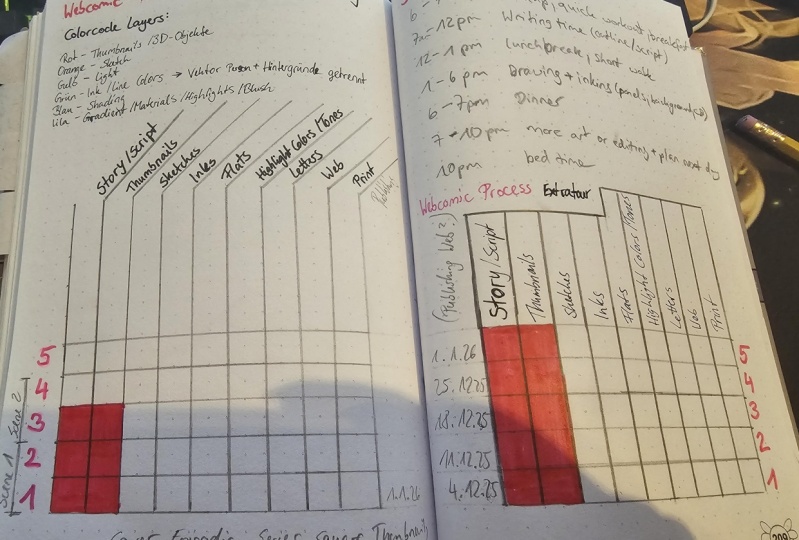
buffer for my launch date, which was in 2017. And this is how I do it. I use a simple table with the various steps of the
comic processes, columns. Like you see here. I've script stage, thumbnail
stage text and layout, which is balloons and
lettering and paneling. Then I draw the comic,
I ink the comic, I lay in flat color
and then I do shading and lighting
and all the good stuff. So those are the columns and
then the pages are my rows. And I love to hatch in these
blocks on paper for me, it feels the most satisfying
to do it like this. You can also just use checkboxes
in apps or you can make a spreadsheet to track
your comics process. But for me this is
the most satisfying. For some reason,
this feels so much better to me than
doing it digitally, but it might be totally
different for you. And I checked my
natural milestones on one page like this. And then you can
also see that I have more natural milestones
like the scenes. On the right side. You can do this too. Like just put all the
pages of one chapter on one of these striking pages or make a few batches of scenes. And this is how you
can track your more natural milestones as well. So for this lesson, start to think about
how you want to batch your work and
how you want to track your work when you eventually start making
your comic pages, refer back to your action plan. Look at how you
want to batch and track and create this
system for your work. In the next lesson, we're
going to break down these models stones in
batches even further. So we have actual
actionable steps.
6. Next Actions: What will you work on? Now? This lesson is
about next. Actions. Like I mentioned before, making a comic is not
an actionable thing. To put on your to-do list. In the day-to-day, we can
only do small actions. In the previous lessons, we talked about working towards milestones and about
batching your work. Now we will talk about how
we can break this batch of work down into
small next actions that we can do immediately. I define a next action as a clearly defined tasks
that you need to do next, that brings you closer
to a larger outcome. And is larger outcome can be a goal like a next milestone
that you're working towards. The next section is
something you can put on your to-do list and
for which there can be no doubt as to what it is that you need to be
doing for the day. The more specific this next
action is, the better. I prefer them really small, something that you can
knock out in a day or a week as an example, something like, alright,
the first act of the comic story is
still a bit vague. What is the next smallest step in writing an entire first act? I would say it's to create a bullet point
list of all that's happening in the first
act of the story. So everything that
you've already thought about listed out as
a bullet point list. And then you can create
an action to edit these bullet points so the
story flows naturally. And then you can create a
new next action again to expand on those
bullet points and to write a little
paragraph for each one, and so on and so on. You should do the
same thing for making actual comic pages as well. Also the actions gets smaller. The busier I am, or if I'm overwhelmed
by the work. For example, if you're
really pressed for time, inking one panel a day can
ensure that you still make progress and have
finished inking at the end of the week,
instead of putting, inking this entire page
on your next action list, if a step is still
intimidating to you or if you are not quite clear on what it is that
you need to do, you heighten the chances of
resisting to do the work. So if that's the case, breakdown the action further
until you're not overwhelmed anymore or until it is become clear what you
actually need to do. It's an actual action that you can put on
your to-do list. In order for you to be able
to define these next actions, you need to know the steps
of the comic process. And again, this is something
for future lessons. So I decided to put a really rough overview of
making comics in this lesson. And that's this first
is writing the story. And I like to write the story as an outline in bullet points, you need to decide
what art style you're going to use
for your comic. It needs to design your main
characters, your villains, and the very first side
characters that will appear in the first few scenes. Designing some of
the first locations that you're going to
visiting your comic. And the last one is
very important as well. You need to decide
how your comic pages themselves will look. And with that, I mean, what are the dimensions
of your page? What is going to be the
look of your balloons? What fonts will you use? How will your panel sit on the page and how
will they look, gives us some more technical
stuff that I actually recommend you do a lot
of test pages for. Just throw some art onto
a page and put it inside panels and put balloons on
there that you think will fit your comic and see if
that's good way of working. I suggest to work on
story, your comics style, and your main character
and world designs first and 40s large steps
that are more nebulous. Think of the very, very first step that
you need to be taking. And only that step, for example, gather reference for my
character's facial features. You can do the same
for clothing or draw five test comic panels
in different styles. Or brainstorm two
bullet points for the story for 15 minutes
a day until it's done. So for your action plan defined the first three next
actions that you will be taking for your new comic and
now for your action taking, all that's left to do is to plan these next actions
into your schedule. And that is what the
next lesson is about.
7. Work Schedule: Work schedule when it comes to how much time you
can put in this comic. I want to start off by saying that in order
to make a comic, you don't need massive
amounts of time. In fact, what if I told you the ten to 20 minutes a day is all you need to get started. Think about this
scenario for a second. What if you wait for having
a lot of time and you managed to spend two hours on your comic on
Wednesday night, you finally found the time and that's what you
were able to do versus working on your
comic for 15 minutes a day, for five days, and then
one hour in the weekend. In the latter scenario, you worked on your comic for
two hours and 15 minutes. That's not that much of
a difference, is it? But the advantage of
working with your comic for little small blocks
of time is that you can get back into your comic
work much faster because you interact with your story
and art every single day. So if two hours a week and totals all you can do right now, I would recommend making
a simple short comic, but you can still make a comic. So in this lesson, I
encourage you to actively plan your comic time in
your schedule because the chances that you
will work on it are then much higher than
if you're waiting for a larger bit of
time and then having to remember in the time to actually start working
on your comic. So simply look at
your schedule and estimate when you can
work on your comic. And this is a very
important point that I always like
to make as well. Make sure not to plan your entire free time
full with comic work. You need to make
sure that you rest inbetween and let you have a
social life for otherwise, you will get fatigued with
the comic pretty fast. And also you need to
downtime, you need to rest. So if you're pressed for time, the advantage of the
ten-minute blocks is that you can probably find multiple 10-minute
gaps in your day in which you can do
small comic tasks. I recommend having
a small notebook or sketchbook at hand so that you can do some
quick sketches or writing when you're
waiting somewhere, for example, when you
have the time or when your planned comic
time has arrived, It's helpful to know
immediately what to do. So make sure you always
keep your list of next actions up-to-date
so you can dive right in, knowing when to work on
your comic is one thing. In the next lesson
we will look at how you're going to
work on your comic.
8. Motivation, Discipline and Fun: Motivation, discipline, and fun. I think the number
one reason that people procrastinate
is because they have this idea that they don't have any motivation or inspiration
in a given moment. And I personally know
that feeling well. You sit in front
of a blank page or a difficult panel or a piece
of writing that you did. It has some problems and
nothing is coming out and you don't know what to draw or
how to solve your issue. I have also found that
when you keep sitting down and you just throw
something at the wall, often, you will do at least
some little work that day. It might not be your best
work or it might be, but at least you did something. The initial feeling of
not being motivated, it's often just add,
it's a feeling. To combat it, you
need to take action. This requires a
bit of discipline, but discipline is like a
muscle that can be trained. If you sit through that
initial resistance often enough and
just sit through it, it is eventually not
a matter of, well, will I work on my comic
right now or not? You know that you will. It's a given. And the key is to keep sitting in that
uncomfortable feeling. And eventually, you
will learn that that feeling says nothing
about you as an artist. It says nothing
about the quality of the work that you're
going to make. It's just an initial feeling, especially for those
who want to become professional comic artists or be it consistent web comic creator
deadlines need to be made. In that point, you don't have the luxury of only working
when you feel like it. You have to train that discipline muscle and
it will get easier for sure. Eventually, you will learn
to trust the process. Notice your inspiration and
motivation will eventually show up and you can
actually get into the zone. There will still
be days when it's hard, It's only logical. And even though you don't make
your best work every day, putting out consistent work will always help
you move forward and it helps you to build that confidence in your
ability to make comics. And ironically, often
motivation will come when you start
working, knocked before. And sometimes it comes even
after you start working because sometimes it can take a little while for
you to get into it. But you can certainly do
things to help you to have a higher chance of having
more motivation in a moment because it does
help when you have it. And I would ask these
kinds of questions, how do you work best? And what puts you
in a good mood? And are there
certain things that you can do to make yourself comfortable and create
some excitement to start working today. For example, you can ask
yourself questions like these. What does your
workspace look like? Is that workspace
inspiring to you? Do you listen to
music when you work? What puts you in an
active or creative mood? What are some of the things
that you love to draw? And what is the best part of the scene that you're
now working on? So for this lesson,
also think about what environment motivates
you to get working. Give yourself the best
chance of getting your work done when you're not feeling it. Start by training your
discipline muscles for ten minutes a day. And it means that you sit down and work for at
least ten minutes despite how you feel and then built that out to
a longer period. Eventually, you will sit down at the time that you set
for your comic and you'll get to work
and working on your comic is not an
optional to do anymore. It has become a habit. Like mentioned, you still
might have off days. So what do you do
when you'd rather procrastinate and
work on your comic? And what do you do
with distractions? That is what the next
lesson will be about.
9. Distraction and Procrastination: Distraction and procrastination. We are all human. We will always struggle with distractions
and procrastination. But in this lesson are some of my best tips to combat this. First of all, we often procrastinate and distract
ourselves when we experience either
difficulties or unclarity before to difficulties when you run into
story or arc problems. Please note that this is normal. Your job as an artist is to come up with a solution
to these problems in your own unique way that you might've
heard it said before that making art is
basically problem-solving. You do that in your unique way. That is your style, that is
your way of telling a story that all contributes to what we will eventually
call your art. For a long time, I was drawing in
my comfort zone, especially when I
was in my teens. And I eventually wanted to get
out of their comfort zone. And making comics is one of the best ways to
do that because it forces you to draw all kinds of things that you've
never drawn before. And that can be intimidating, but running into
your own limitations is not a sign of trouble. This is the work
and artists dust. This is how we improve. No good drawing a story comes without
challenging yourself, pushing yourself
to become better. This is something that I
personally like to keep in mind. For every difficulty,
there is a solution. I just decided that there
is a solution out there. I just need to find it. And it's often
really helps me to just sit down regularly, keep working at it until
I find that solution. In case of art, you often need to find some reference or study a
certain subject a little bit more before diving back into the comic page and sometimes indicates
of character design. For example, you just need to search for a little bit
longer for that right? Kind of look. In the case of writing, it's often a matter of sitting
down every day flinging new ideas at the wall until you fix that
persistent plot hole. So when you experienced
difficulty, not if, but when, step back for a bit, think about what you need in
order to solve the issue, then go and do that. Try and see the problem as data. Something that is
a neutral thing, something that you can solve. It doesn't say anything
about you as an artist. It doesn't say anything about your ability to
solve this problem. The solution is there. Eventually, you will find something that you need and you can finish
what you're doing. Then about unclarity,
when you are not entirely clear on
what to work on, your brain will naturally
start resisting the work. So make your next actions as
clear as possible so there's no subconscious doubts about
what you need to be doing. And this is something that
helps me a lot when you're overwhelmed by all
that you need to do, there's a lot of
distractions around you. There's other things
that you could be doing them sometimes
your mind feels like this jumble of thoughts that
all scream for attention. And at what always helps
me to do is a brain dump. But what does it brain dump? Writing a quick list, everything that's on your mind. So literally everything that's, that's fine for
your attention and put it on paper so
it's out of your head. And then I usually circle is three most important
things on the list that I actually really want
to be doing as soon as possible or that
are really important. And then I pick the
most important one of the three and go do that. If you're in your
comic making time, if you scheduled this time as come with making time
in your schedule, then that should be a big
priority at the moment. Then when you've picked your one thing and
you're doing that, all the other things are
safely stored on paper. You don't have to worry about
that right now because you made a conscious decision
of what you're going to do. Now. The other thing is
you won't forget because they are written down. So when you still
get distracted with thoughts or to-dos
while you are working, have a sheet of paper next
to you and just write your thoughts down so you can put it out of
your mind for now, then come back to it when
you're done working for today, you can even write
down things like, oh, this panel's
really hard to dry. I would love to go watch a
YouTube video right now, write that down and then
get back to work again. Vent for a little bit, but makes sure that all the
distractions that are on the paper and you
don't act on them. Lastly, you often know
yourself pretty well. You know what your pitfalls are, what your weaknesses
are when you want to start procrastinating. And you notice
situations where you're most likely to procrastinate. And if you don't know, you
will soon figure them out when you start working
on a comic project. And by knowing this,
you can already make plans for those
instances in advance. You can use this structure
for that when i, and then add your
procrastination activity, then I will then put
your solution in there. You can brainstorm solutions
for yourself in advance. As an example, when I want to watch YouTube during
my comic making time, then I will switch on aside blocker that prevents me
from accessing YouTube. I can also delete the app from my phone at the time
said I'm working on my comic or when I see an
interesting website or picture, when I'm looking at reference, that makes me want to go and read articles and
get distracted. Then I will save the link on
an ocean board to look at later so I can continue my research for
reference right now. So come up with some scenarios
where you're likely to procrastinate and brainstorm
some possible solutions. So now that we have set
our goals and milestones, we've come up with our
list of actions you have planned or come a
time in our schedule. You thought about how we work best and can increase
our motivation. We looked at our pitfalls. It's now time to work on the comic and that will eventually
lead to finish work. In other words, wins. And in the next lesson we will
decide how we're going to celebrate for that extra
layer of motivation and fun.
10. Celebrate Your Wins: Celebrate your wins. We've come to the good part, so you have finished
some smaller milestones, or maybe even a
bigger milestone. Congratulations. It's very important
to take a moment and acknowledging your wins. Otherwise, you run
the risk of just rushing through to
your next goal, you lose that satisfying sense of progress
and accomplishment. You worked hard and
you achieved a goal. This is major. One is very rewarding
in general. And you can look at
these whenever you want, is to screenshot
every nice comments and encouragement about
your comic that you get. It can be really
helpful to have them altogether in a folder for you to look at on holidays or
just when you feel like it. So in advance, think about how you're going to
celebrate your wins. I personally like
to share the way, not only with my followers, but also with real life or online friends who know
me a little bit better. So the last time I
reach a milestone, I went out with a friend
and had some cake. You can also reward
yourself with buying something that you
have in saving money for. While you're working
on your comic, you can save up tiny
amounts of money and then eventually
use that money to buy something
nice for yourself. The point is to stand
still for a little bit and look back at all the
work that she did. So think about how you can
celebrate your progress and winds before you dive headfirst into another
spread of comic work, you've come to the end
of the class, well done. We will close up in
the next lesson.
11. Conclusion: Conclusion. Congratulations, you've
finished this class. I really hope it has been
helpful to you and maybe you even found a new insight that you hadn't
thought of before. Please share with us the part of your comic action
plan that has your biggest insight in
the class project section. As a reminder, does
an example project in there that I made about
a fictional comic. You can also see how I
would approach putting that plan on one page so
I can hang it on my wall. I also would like to ask you
to please review the class. It really helps me build out my classes on
Skillshare and it can help other people decide if they want to do this class as well. Thank you so much for
watching this class. I can't wait to see your
comic action plans. And I would love to see you
again in future classes.
 Henrike Dijkstra, I make and teach comics