Transcripts
1. About the Class: [MUSIC] Hey, I'm Laura Adams. Imagine shopping at your favorite furniture
store and seeing your design on the
beautiful fabric a family is considering
purchasing. What if you walked into your
neighbor's home only to find a fabric you designed on
their living room chairs. Can't you just see your
fabric on decorative pillows, bedding, drapery, and more? I've been a surface pattern
and textile designer for the last 28 years and I've seen this scenario happen in my
own life again and again. It's so exciting. I've created original artwork, purchased artwork, and
developed it into product, created home decor lines, led teams of designers
and worked intimately with customers to discover
what they need most. My career has essentially been split between two major markets, residential and
commercial textiles. Our focus in this
class will be on residential textiles and how you can create a pattern
that would be appropriate for home
decor upholstery. I'll explain the ins and
outs of the process, how trends are involved, what your role is as a
designer and give you examples of the types of
things that this market needs. This class is for surface
pattern designers or aspiring textile
designers who would like to understand the home decor
upholstery market better, as well as the possibilities of getting their designs
into the market. I truly believe there's a need for fresh points of
view in this market, and many designers already have the basic skill sets
they need to enter it. However, there are insider tips that they
need to understand, like how to prep and size files, how to color patterns, what language to use, and more. After this class, you'll
have a basic understanding of how to discover trend
that speaks to your style, build a home decor pattern, and the basic manufacturing restrictions you need to follow. We'll focus on digital designs versus hand-painted designs. I recommend Photoshop,,
Illustrator, Procreate, EAT or NedGraphics. Our class handout will provide
the proper file setups, repeats, and manufacturing
parameters to keep in mind. Are you ready to get started? It's going to be fun. Come join me. I'll
walk you through it. I'll see you soon. [MUSIC]
2. Class Project Overview: [MUSIC] Our class project, we'll be creating a surface
pattern design that's well suited for the
current home decor market. You'll have a class
handout to reference. It gives examples
of styles used in the market with some
language around those, manufacturing
requirements for artwork, and places to research trends. Once you have your idea in mind, you'll create a feature pattern using the guidelines given in the handout and
discussed in class, so that the end result makes manufacturing requirements
is sized correctly, uses the correct
number of colors, is formatted for the industry, and repeats properly
for this market. I invite you to share your
work in the project gallery. I would love to give you some feedback and
encouragement as you start your journey into a marketplace you're
going to love. I'll see you in the next video
where we'll get started. [MUSIC]
3. Market Overview: [MUSIC] Before we start, I thought you might
find it helpful to understand that there are actually two markets for
this type of product. The first is the
one we all know, because we all use
it in our own homes. That's the residential market. It's our couches,
soft chairs, drapery, rugs, essentially anything we use to create a
space in our homes. The second market is one you
may be less familiar with, but I'd like for
you to be aware of. Thus the commercial market, often referred to as the contract and hospitality
market in the industry. It's hotels, restaurants,
office spaces, public spaces, health
care and more. Essentially, anywhere
outside of your home that uses fabric falls
into this category. For this class, we'll focus on the residential
upholstery market or home decor upholstery market. But, it's always good to understand the full
breadth of opportunity. The residential
upholstery market is a $188 billion industry
in the US alone. It runs yearly cycles
that work like this. Twice a year, fabric
company showcase their new products in High
Point, North Carolina. Furniture manufacturers
meet there, and go from showroom to
showroom looking for the next exciting fabric
to put on their products. Orders are placed, deals are made and samples are requested. This twice a year
event is held in May and November and is
called Showtime. Five months after each
Showtime in October and April, another event is held
again in High Point, North Carolina called
Furniture Market. During this event, the items that were purchased
during Showtime by the furniture
manufacturers have been put onto their newest
furniture collections, and are then shown to
retailers to purchase and place in retail stores for buyers like you and
me to choose from. Five months is actually a really short turnaround time
for fabric to make it from being shown at Showtime to being on Furniture or the
following Furniture Market. But, that's what keeps
us in history fresh fashion forward and an exciting
thing to be a part of. When fabric manufacturers show their fabrics at showtime, they are prepped and
ready for orders, hoping that furniture
manufacturers will chase several of
their fabrics as fabric placements or the new
and upcoming furniture lines that will be sold to retailers. There are literally thousands of fabric shown during Showtime. That means thousands
of ideas, concepts, and pieces of artwork that have to be translated into fabrics. It happens again and again twice a year in an
industry that continues, because of people's love
of decorating their homes. From upholstered couches and
chairs to accent pillows, throws, accent pieces and more. This industry [MUSIC]
is thriving and waiting on the next
exciting idea. Could that be yours? Let's get you started. [MUSIC]
4. Basic Trend Research: [MUSIC] As you can tell from the
way the market moves, ideas are constantly evolving. Furniture and fabric
manufacturers are always looking for the next exciting
thing to lead the market. Everyone wants to be on
the forefront of style, design, and the next trend. This takes research
and knowledge on the furniture and
manufacturing side to keep abreast of
what's up and coming, and that takes a
constant eye on trends. Now, a little side note here. Beyond trends, there's
designs that are known as classics that are almost
always acceptable. Those are the most
basic designs, like herringbones,
plaids, twills, plains. But even those evolve and
are affected by trends. In a market that sells
to the mass consumer, being aware of trends
and what the customer wants is the key
to your success. But it's not some
impossible thing to attain. All it takes is a keen eye and a discerning point of view. If you refer to
our class handout, you'll see several places I've
listed for trend research just in case you're interested in researching on your own. For our purposes here, I'm going to walk you
through an example of how I would use one resource to look at the trends and
then choose an idea that I can interpret
into my own style. You can either use the
same inspiration as mine or choose something on your
own for our class project. Now we're going to go
online and I'm going to show you how I would research a trend and then translate it into my
own personal style. This segment will be about
researching the trend, and then next we will develop the pattern so you can see
how those work together. I've gone onto Google
and I've typed in 2022 Residential
Upholstery Trends. There's other search terms
that you can put in, but this is just the
one that came to mind. As you can see, there's tons
of things that come up. The Spruce, Household Beautiful, New Decor Trends, Apartment Therapy, Decorilla,
there's just a ton. I have other places that
I've listed in your handout that are also good places to look for trends and
ones that I use regularly. But for our purposes here, I thought we would just Google something and then
just choose one. We are going to choose
Apartment Therapy, nine of the biggest
living room trends to look out for in 2022. We click on that. You can read the full article, or you can just flip through
and get the major points. They're saying here that curvy, organic-shaped furniture
is going to be important. That's coming from
the pandemic and the need for people to feel comforted and almost like a hug. You're starting to see
rounded furniture, any furniture that has really just plush fabrics
that are very comfortable. Multifunctional, airy spaces, warm tones and accents,
lived in finishes. You can see here in
this furniture with the beautiful gray hound on
it that everything is curved. It's a boho style, everything is eclectic and
comfortable and familiar. Bringing the outdoor in is another very important
trend right now. You'll see outdoor fabric
that can be used indoors, and then indoor fabrics
that can be used outdoors. Then inside, you'll also
see, on the patterns, nature elements, things that
tie to nature, indoors. Then outdoors on those fabrics, they will feel more
like indoor fabrics. They may be plush, they may have more
decorative elements, or maybe even colors that were typically used indoor
versus outdoor. Its basically people trying
to open up their spaces and make their homes bigger by utilizing their
outdoor space as well. Vintage furniture,
I love this trend. It's also, you'll see, maybe they'll speak
to it here later, but you see a lot of wallpapers, very decorative wallpapers
and deep comforting colors. I think this also is a result of the pandemic and people
looking into their history, getting to know their
families better through different ways of
communicating with them. They probably told each
other a lot more stories, maybe asked deeper questions than they would
have in the past. There's a real connection to our personal family
histories right now, which is speaking to this
trend with vintage furniture. Modern retro, reupholstery,
upholstered chairs. I guess they're saying
accent chairs here. You see the little purple ones, it brings an interest
into that room. That's just one
example of a place that is speaking to trends. When I do trend research, I actually try to pull
from multiple places. Then I'll try to find commonalities between
those places and then use those common trends to maybe find one trend
that I want to design to. Now, because I do trend
research regularly, I know that, let me get back up here, that the retro, the vintage furniture
and just retro, not even retro, more
like historical, like family history, I know that that's a
big trend right now, and I also know that bringing the outdoors inside is
a big trend right now. Having patterns that have
natural elements in them, both of those are important. Those are the two things
that I'm going to think about when I'm
designing my pattern. Now one last thing to note. In an industry where
trends matter, there's no room for ego. While you may have
a strong sense of style and uniqueness
in your work, and that's a beautiful thing, you have to be open
to the fact that what you like may not be what sells. You have to be able
to look at trends, find something that
sparks your interest, and then bring it down
to a sellable design. If you love unicorns and
rainbows, for example, but that isn't trending in residential
upholstery and buyers are therefore not
interested in it, they won't be interested
in your artwork no matter how amazing
or creative it is. You have to work within the wants and needs
of the industry, and remember that it's about
serving your in-customer. Through the years, I've found
that I'm actually the most creative when given
restraints to design within, like a trend. In these cases, you
push yourself to show your design point of view
through the product, giving them something unique and different within the trend. The rest is just ego. To thrive in this market, you have to let that go. [MUSIC]
5. Design a Feature Pattern: [MUSIC] This is where the fun begins. You understand the
market a little better. We've done our research and we have a starting point
for our design. Now let's work out our pattern. Home décor collections from fabric manufacturers
are often quite large but typically they're created in sets of
three patterns; the feature, the
coordinate, and the plane. We're starting with the feature because it's the one
piece that speaks the most to the trend and the other two are
typically built from. I'll talk through
some possibilities for these as we build the feature so that you understand how they
come together. When designing for the feature
for the home décor market, we need to start with
the end in mind. There are industry
standards that exist that got fabric
manufacturers to create fabrics that will best work for the furniture
manufacturers. Feature patterns can go
anywhere from an accent pillow, to a side chair, to
a full size couch. Since we want the pattern
to be flexible in it's use we have to consider
that it might go anywhere. Now, let's look at our handout. The typical cushion
measurements for chairs, love seats, and sofas
are the following. It's an extensive list. On top of that, we know
that the backside of chairs and other furniture is
at least 14 inches high. This means that anything we do needs to fit into all
of these parameters. Now, without going
into a ton of details, I'll just point out that the industry standard
repeat sizes used to accommodate all of these
needs are nine inch repeats, 13.5 repeats, and
27 inch repeats. The most common and
the one we'll use today is the 13.5 inch repeat. Let's also assume that the
final pattern will be a print. While many of today's
prints are digital, let's assume that it could be a rotary print and limit the
colors to no more than 12. I actually tend to use no more than eight but that's just me. We're also going to
take a closer look at repeat issues than we
might for other products because there's a chance that
our repeat could end up on a large item like
a 62 inch sofa, we have to be more aware of
repeat lines, holes, etc, than if we were making
fabric for quilting squares or wrapping
paper for example. Now we're going to start
working on our feature pattern. Just as a reminder,
the two trends that spoke to me were bringing the outdoors in and what I'm going to call
family history. I found these motifs that
I have not used before so I thought they might work well here so I've dropped them in. I'm using Procreate
and I just wanted to show you how I
set the file up. This is a 13.5 inch by 13.5 inch repeat and
since it's a print, we're going to do it
at 300 dots per inch and if you do the math
there it works out to 40, 50 picks in both directions. I'm just going to start dropping these motifs,
placing them around. I'm doing this on
the fly so I hope you guys will show
me some grace here. [MUSIC] Just trying to eyeball it. I like how this is creating
sort diamond effect. I'm going to take
some of my other motifs and drop them in, try to scale them more closely to what I've
scaled the least. Now, normally I would
probably create multiple little motifs
here but for the sake of time I'm just taking these
two and moving them around. If I were to do the
same motif I would try to rotate them or flip them or do something to make them
a little bit different. But typically I would probably just create additional ones. It's looking pretty good
and we're going to drop in a couple of more to fill in holes and take a look. I'm liking how that's come
together pretty well. I'm going to go ahead and
combine all these into one layer so that we can
move it around a little bit. Just wanted to point out and
I had to keep in mind that this is 13.5 inch by
13.5 inch repeat. If this were to go on
a couch for example, one of these rows with the leaves area would probably
be about four inches wide. So you have to really visualize that and think about is that appropriate to have something that large all over the couch? Sometimes the scale,
you might need to go up or down depending on
what your overall look is. If you're not real clear, a good practice is
to print that out on just a regular piece of paper and just place it
on the couch to see if you think the scale is right or if it needs to go up or down. But I think that's a
bit much for a flower, so I'm going to refer these flowers anyway,
they're [inaudible]. I'm going to make
it a little bit smaller and also
because I want to show you about ones and holes. I'm just going to
drop in about where I think it repeated. Then right away you can see that we've got
a line right here. It's very obvious. I didn't do a very good job bringing the repeats
together but that would be a problem
if you had that on a couch every 13.5 inches, you would absolutely
notice that. Actually it's both
repeat points, so it's here and here. That's something that
you would need to be aware of and work out before your pattern
is considered complete. Now, there's a couple of
things we could do here. We could try to pick this
up and maybe move it over a little bit but then
it's not going to look quite right with
the rest of the repeat. Another way to take care
of issues like this, you can come in sometimes
and move certain elements. You just have to
remember that if it is repeating exactly, then if you move an
element here you would need to move it
throughout the pattern. But you can see how just moving that stem into the line area, moving this here into this
area starts to break that up. You could do that again
on the other side with this other one. You're getting into that space where it's going to help
break that line up. Now, also I wanted to
talk to you about holes. If we were to take one
of these elements, let's just say this [inaudible] and move it out
of the way, like down here. Your eye already sees that there's a structure to
this pattern so when it's looking at the pattern
is automatically going to recognize that there's
a weird space right here. Your eye wants it to be here. Just when you're doing your pattern after
you're done you need to repeat it out in both directions and just look out for
things like that. Look out for lines, look out for holes
and fix all of those before you complete
your pattern and color it. I'm going to stop
here and then I will finish this pattern
and show you what the end product looks like but for now that's
all we need to see. Okay, and here it is. This is the somewhat finished
version of this pattern. I would probably go in and
where the little rose is with the leaves I probably
would do several of those motifs so that it
doesn't look quite the same, it would make it
more interesting. But you can see how the
layout worked out and how I colored it to
tie into that trend. Then also I added some texture
in the background to try to help with the line
issue that was occurring. Then the final thing I
wanted to point out, we talked about
feature patterns, coordinates, and planes. Throughout this lesson I've
sprinkled those in there, I don't know if you
noticed that or not. But this is just a more
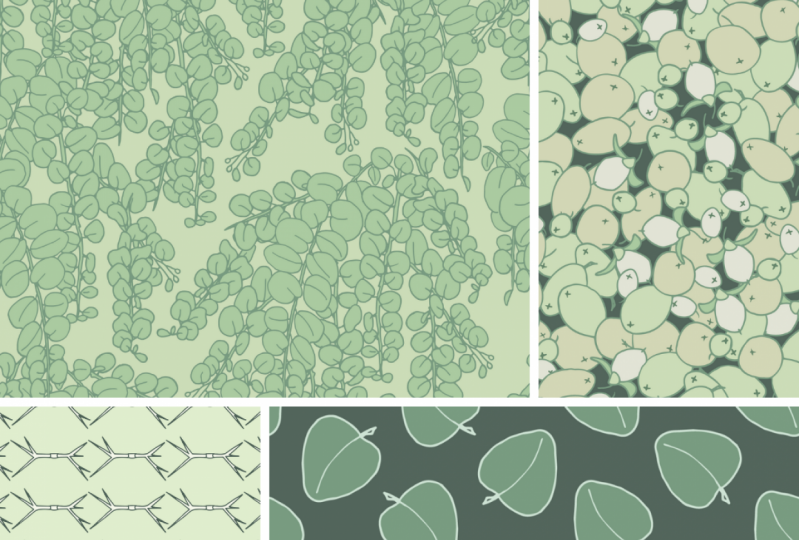
straightforward example of what I'm talking about. You can see here two examples
of feature patterns, coordinates, and planes. The feature pattern tends
to be the most interesting, it's usually the largest
scale but not always, but typically it is
the largest scale. The coordinate is typically a medium-scale that would
work well with the feature. Then a plane can
literally be a plane like a plane wave or
it could be just a tiny pattern that's
more textural or looks like a plane from afar. I will say that as
time has gone on, the coordinates have changed. It used to be that
you would pull an element from the feature
pattern to make a coordinate and that still happens
today but with a more eclectic style that's occurring in
the market right now. You also see elements like this, like in both of these examples the coordinate was
not pulled from the feature but
you could see how those might go
together in a room. I tend to do that right now when I'm designing my feature
coordinates and planes, I tried to take a more eclectic view point
and you can do either. I just wanted to point that out.
6. Conclusion: [MUSIC] Wow, we've covered a lot together. I hope you've
learned a ton about the home decor
upholstery market, and how your unique
style might fit into it. At the end of the day, understanding the market and the end-users needs
will give you a serious advantage over other surface pattern designers looking to get into
the same marketplace. Creating artwork that works
for both the fabric and furniture manufacturers
as well as speaks to the trends that consumers
demand is a win-win. When you approach possible
buyers for your art, you'll be so appreciated for the work you've done to
understand their needs. Have your creative
juices been flowing? Can you envision your art on the newest line of furniture? You've got everything
you need now. You've walked through
the basic trend research and have an idea to pursue. You understand the market, and the parameters
to work within. You know how to look out for repeat issues as you design
your feature pattern. So now it's your turn. Get started on your project. When you're done, load it into the project gallery for
feedback and encouragement. I can't wait to see what
you do and to cheer you on. Thanks again so much
for joining me. If you haven't already, download your class handout at @textiledesignpro.com/homedecorupholsteryhandout. While you're there,
say hello or stop by my social links
and connect with me. I would love to hear from you. [MUSIC]
 Laura Adams, Surface Pattern & Textile Design Pro