Transcripts
1. Introduction: Hello dear friends, good after such a beauty for beauty for after. Today, we learn Chinese painting, particularly bamboo and all kit. So in Chinese painting we have a saying, Shu Ha Moon, which means calligraphy and painting comes from the same root. In my previous class, I had Chinese calligraphy, which we learn to hold the brass, the gesture, the method, the poster. And with that as a foundation, you can develop into these much free flow or strands for it's a practice of Chinese calligraphy stroke in the style of painting. So let's get started. It's important about the practice. Nothing else is, as he put it. I hope you enjoy this class. Let's go.
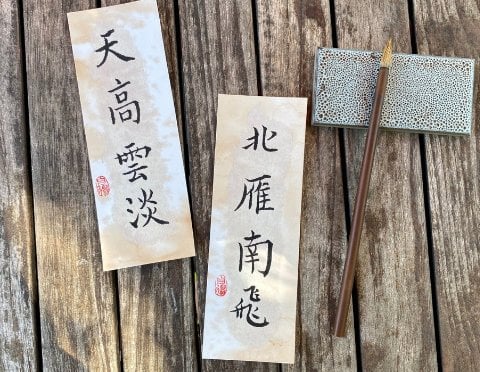
2. Knowing the materials: Okay, so I will start from preparing the ink. And you can see this is very dry. My inc steak is very dry. And let's have some fun. I really love it. Ok. I get sufficient amount of workload. I always find doing legal fees a fun activity. Now, it does not come out. When I release my hand, it comes out. Put it aside. As you can see, I always have this kitchen tower paper is actually not kitchen tower. Tower paid for. And I will explain you why I use that. You can soak the ink for a couple of minutes. You do not need to have these offenses stuff. You can just use this score to get some water. And at the very beginning, it good. The sound is not good. You need to let it rest a little bit. The shape does not look good, but the ink is good, which is important. Okay, I prepare, put it aside. As you can see, I use this felt and you can find this felt. I have some friends. Use just the normal felt, normal piece of clothes or be good. Construction paper will be good. You would like to protect your table surface right? Now, I put this one aside and we can start with trusted this paper. I have a roll of it. Just keep on practicing, practicing. At the end. When you feel you are more comfortable, you are good. You have a graph of your hand. You have control of your hand. You use a better paper.
3. Paint bamboo: Okay, let's try. I will do a life. A lot of faith. So remember, we have learned how to write shoe. It's this, this is the triode increase, not good. We need to continue to grind. And this happens in, in painting very often, Sometimes you feel you're ink is not good. You will keep on grinding, grinding, grinding. Okay, let's try it again. And instead of trying to Chinese painting, Chinese calligraphy stroke. And oh, I like, okay, there is something blob on the side. I will do it again. So you can know how to do this practice. So let's go to detail. The ink can be any ink, can be lead, can be less condensed, can be more condensed. Eats. Okay. When we have, let's say we have a piece of paper here and we want to do then bull painting. So it's not right in the middle. You come from left, top to almost a middle to the end. So I will go here. And your brush sided way, sided way. So it uses the tip and Tammy of the brush. Quick movement. At the beginning as we do Chinese calligraphy, stay, go, stay, stay, go, stay. Da da da da da da da da, da da, da. Right now. Then bu the junction part. Check, check, check, check, check, check, check. Okay. And the bamboo little branch, if you have one to the side, you go one step up to the left. It's alternating. The bamboo is so sin does not have too much energy to do to afford every single two right side or every single two left aside. So is alternating. You feel have a bamboo tree, bamboo plant in your home. Take a look. It's always our alternating. Okay, so we ride come from the middle and very senior, very street. And the movement is quick. Sometimes you'll have these wide. We call it a fee by free by it's a flying white. When you do the movement quick, sometimes the ink is not there, but the idea is there. So your, your idea, your spirit extend beyond the ink. C, a little bit dot ta, ta. Let's go to this one. We go. And this one on the bottom, we have only one. So here, the bamboo leave the bottom. We can make it a young sprout going up. This way we do to ta, ta, ta, ta, ta, ta. Okay, so the bamboo is almost too good. Take a look a little bit. Just to, to balanced, right? We put some more here and make a big leave here. Da, da, da, da. How about a baby leaf here? The, the, the, the, the, the, the, the. So it looks left to right, balanced and not balanced. More interesting.
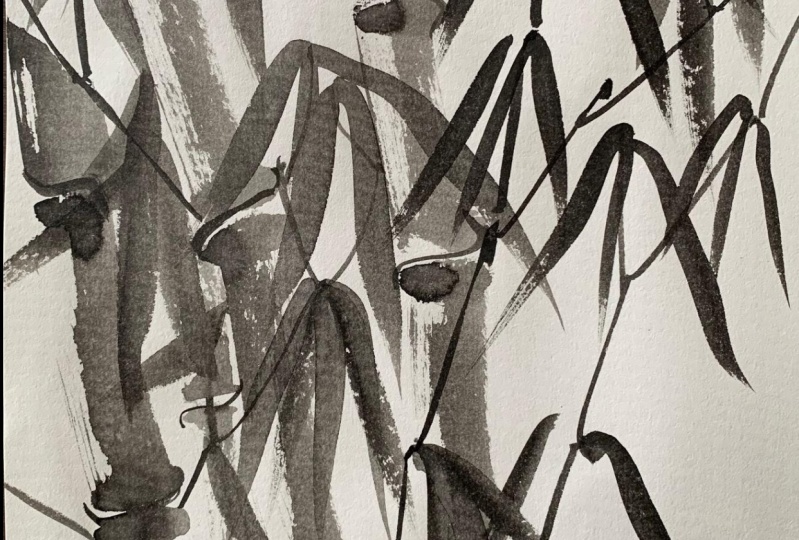
4. Bamboo trunk: Since we have a whole roll of paper, we do not want to waste it, right? We want to keep on practicing tourist practice until your hand has, has a feeling of of the ink, of the brush off your spirit. Okay, so let's go to the bamboo. Plant, the steep, the beep, beep. Bamboo trunk. Sorry for the noise. Okay. So rest your brush here. You can just so relaxed. You can see it, right? So relaxed, almost not holding shh, shh, shh, shh, shh, shh, shh. I like it. We still texture here too. To chew, chew, chew, chew. Keep practicing, practice a 100 of it. And then we will put the junction part, make it. What do I do here to, to, to, to, to, to to, to do to do that. In the the, the the the the the the Linda, Linda, Linda, Linda. It's okay to be a little bit exaggerated. It's all okay. As long as you get this movement and you get that, that, that reason. 83, so-called so fun chapter, chapter. So for the upper part you go Jean Jacques, check up for the lower part of Jean Jacques Jacques going down. Okay, so this is the sticks.
5. Bamboo branch: So as you can see, we are using a lot of ink. You can use a mixture of ink, grinded ink, or liquid ink. This way. You once, once you are in the movement of this Tinkercad in data, reason, you do not want to stay there, right? You do not want to stop. The ink is not good. It is. Ok. It's not important. We have fun, is more important. Foo, it's factually better. So today we do only one Ben Bu Hao about it. We have done the big one, the big chunky one, we do the little branch. So zhao, zhao, zhao, zhao. So it's like connected. So pretty I want to finish it. Ok, so the little branch to not get too much into my fun pieces a class. Okay. Tap, tap, tap, tap, tap, tap. Okay, we do the small branch, okay, start from here. Continuous view. This one is a little bit to make your hand a bit lighter. Doo Doo Doo, Doo, Doo, Doo, Doo, Doo, Doo, Doo, Doo, Doo Doo. The movement is, it's like, it's like the bone, right? Very, very fluid, very, very quick. Now, this is a branch how we connected vk branch. Okay? That is the branch.
6. Bamboo leaf 01: Okay, now we work on leaves. You know, Chinese painting, Chinese calligraphy, bamboo. This is a bamboo drew. This is a how to write the word. Bamboo is very much like Bembo leave. So what do we do here? Left, middle, right, left, middle, right. And when you do it very, very beginning, at the very beginning stage, you do like this. And when you do more, you just get the reason. Ta, ta, ta, ta, ta, ta, ta, ta. Big, medium, small laugh. So you want to have these bamboo leave, have different size. They are not always the same, right? This does not look good. You want it to have a size difference. Actually for your hand. Have a reason. At the beginning, use the tip and then press you have more volume on the brush and then lift up. See you need to see a close up. Right? That is it. And I see a lot of people do. Now. I will do. And some correction or some demystifying some, the, some of the problem. Some people do know this is not bamboo. Bamboo is a sharp, straight. The blade is like a sword, like a knife. It has strings, goes straight. You go from beginning to the end, one direction, one direction, not all the direction. Only one direction to the right, one direction, one direction. See your brush.
7. Bamboo leaf 02: Okay, let's see the barrage. Light, press, lift, light, Press leaved. You feel if you go this side, left, press, lift. Left. Light, press leaved like this. Ok, your, your hand need to lift up so that you'll have enough freedom. You feel hand does not lift. This is why, because you're a 100. So this is the radius. You always walk on this side. So that is not good. You have a decision.
8. Bamboo leaf 02: You have a decision in our life, there are so many times we cannot decide anything. This time. You are the boss of this piece of paper. Just do it. There is no right or wrong. Just do it. Okay? So we know the basic stroke, left, middle or right, right. Now you want to do for us more in the middle. Okay, let's do the Tao, Tao da da da da da da da. Your hand movement is connected. And this one is like this is, so k is even better because you do not want everything look the same.
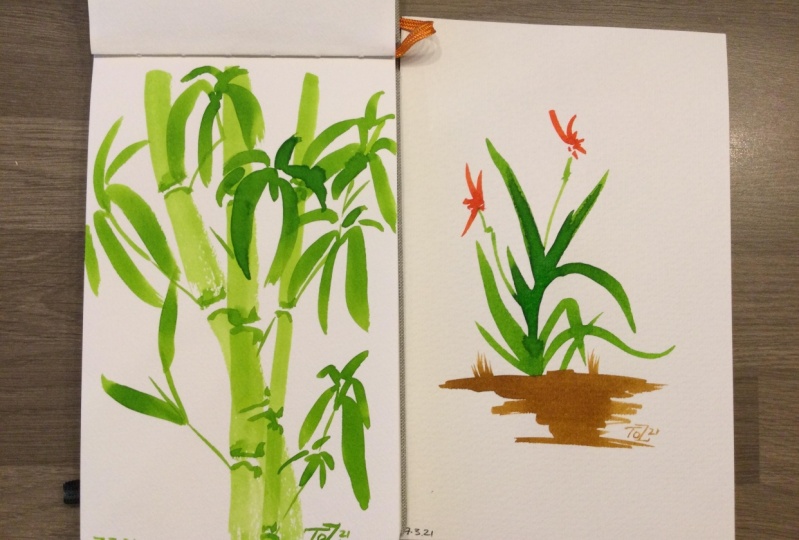
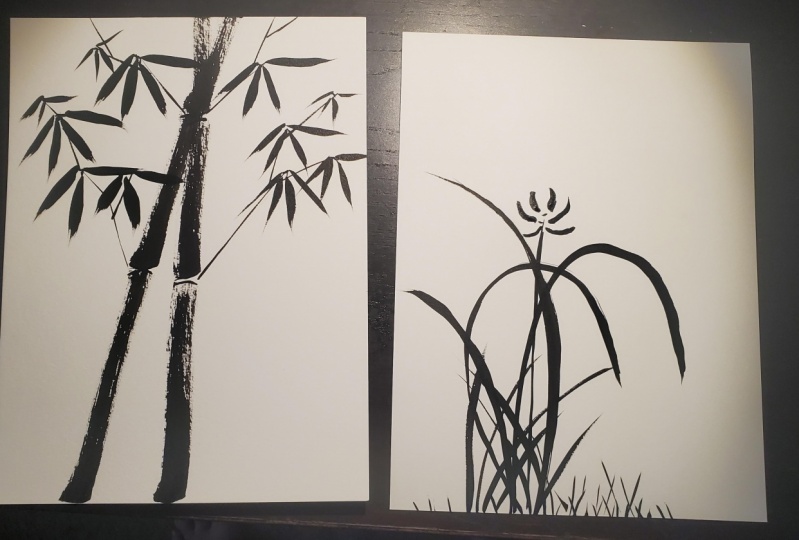
9. Bamboo large: Oh, okay. Up to now we have learned everything about bamboo. Now we graduate with a piece of work and how we do the trunk, like your brush. Choo, Choo, Choo, suck. We make four. Okay. And now we will do the little junction to do, do, do, do, do, do, do, do, do, do, do, do, do, do, do, do. Okay. Now we do the small branch, right? Then. Let's do this from here. One is good. Now we do the leave. Left, me though, right? The, the the the, the almost the same direction. Not good. Ok. Break it. You do not have to be always. Leave room. Did the real Branch, the Rio leave the real bamboo, the overlapping each other so you can overlap. Now we do this one. I do not want my failed to get dirty. That's good. Now, these one shall we do a baby one? Okay. The last on the bottom, this is the young sprout. Left. Right? And that he said, if you have two bamboos, we do the first one, very, very light. I will use. So light. Not bad. Ooh, this is a three more. This is a water EEG and this is a majority of the brush is water. And only tip, get, only tip, get some ink bad enough. Our Bamboo this direction. So the background. Let's do this. Now we use the DAG MOOC. Can you see it? A little bit high volume? Okay. This is a little bit too dark, but utah Okay. Now we do these branch over, SWOT it. Overlapping. Shh, shh, shh, shh, Oh, I love it. It's not even very straight. That is, this bamboo has carried her. You know, it's just a piece of paper. You are here to have fun. You are not to be bothered by your mistake, by the imperfection. Who cares? I do not. Three, the daga, daga, daga, daga, dum, dum, dum, dum, dum. And this one. All, I have so much fun doing it.
10. Bamboo long: I think you maybe not yet seen it. Okay. I stand up and give a very light water rate. This one very motoring. You are the owner, right? You can not see it. Now I get some very light. Very light. I love it. That's it. Two sides seems needs.
11. Bamboo on Chinese painting paper: Okay, hello dear friends. We had quite some fun. Now, let's get serious. Theatre piece after beautiful, elegant calligraphy paper. And here, oh, this is so light, you can see it so light. And only the tip gets some. Oh, that's good. I love it. Okay, let's do it. To light. More water. There is no mistake in ad remember, a little bit too light, much lighter than I expected. Now, we do use interwoven dairy, some mistake, these two are almost the same lens. So let's just do a wrong button so that we can evaluate what is right, what is wrong? How good is it? Even your teacher make mistake. That's very encouraging, right? Don't be afraid, nobody's perfect. I personally need to do things fast. And that's it. So okay, let's evaluate. It's better to go to the end, right? Go to the end from beginning to the end. Let's do it again. All over again. Good. Some more water. More water. I feel even more water almost to the tip. You stack. This is a relatively Why. Good. Okay, now we have we need some more ink. Not promise. You are not interact. This is time well spent. Laugh myself. Because you need to encourage yourself. Night.
12. Orchid leaf: Ok. Hello dear friends. So this one we learned to draw or kit leave. I will use a bamboo or kid brush. So this one in Chinese is written that drew, LAN is all queued. Drew is bamboo. So it's perfect for painting bendable. And this one, I soak in water and press dry a little bit very lightly and deep in the Ink, does not have to be complete. With ink. I will put some more water. Okay. This is just an exercise, so you do not need to, to be so stressed out if you make mistake is only a piece of paper, right? Do not vary. So you start with using the tip. Let me see. The ink is unlit of it to march to its only exercise. So don't worry. And your hand is always do this as a preparation. There's movement as preparation when you have excess water. I think this video is more relaxing than education. Okay. So not talking about any place, we just do. Oh, too much. I'm sorry. Another good news. Your teacher. Make it not good. So why I make it not good? Let me explain my excuse. So here's my excuse. I am sitting in a kitchen stool and its very long. It's very tall. And the ink is a little bit too, too much water. So we can adjust it by grinding the ink or puts them more condensed ink. Bows will be good. Now, I will change a shorter not you know, it is important that in a comfortable situation, a little bit shorter. Okay, let's see. See if I do better. If I do not do better, I in trouble. Okay, so we are here starting from here. See your hand very relaxed. A little bit better. Prayers. Go. Go. Still the ink East tomorrow. How do I make the ink better? Keep practice until you get the right Inc get read off the excess water. Okay. Yeah. So when I teach class, I ask students before you start to do anything to some of these movements until you get comfortable. Now, I will explain why I do this and the particular structure of Chinese. So in Chinese we call it phony phoenix eyes. Let's see. Restart from here. Start from here. Go up to the right. And you can lift up and press and see if the market is flowing, is turning. Ok. And the second one follow it and then bend down. Okay, almost the same place and then bend down. So here there is, if this is a Phoenix I, this is an I pour from your break up. These Felix I so oh, so these Phoenix I, you break up in the middle in a little bit outside. Anyway. Whichever way you do it is there is something starting from 1 and then break up. You have only three strokes to make the old kid completely settled and completely side that direction, the lay out of the orchid leaves. So there is three directions, right, left, and down. And also it's, it's everywhere. Just three simple strokes. There is going apps struggling, going up. There is flowing to the right, and there is going up, up, up, up, oh, bend down. So there is all these spirit in it. And then the side, you just do some on the side. And that's it. That's it. Those are not important. There's three main skeleton of it is more important. And then you use some water to do cover it up and do some dogs do some leaves here, there. Your choice, or just dark ink when it's dried up, you can see a little bit better when we use better paper. Okay, so here is your turn to practice. Go. Break it. Follow up, turn, go. It's okay. Sometimes it's inside, sometimes is outside, but you want to have different directions, different energy, different force. May the force be with you? Ok, so that's the main structure. Now we see the strengths of it. See my hand. Now you can see a little bit better, right? So my hand light, Press Tao Lai. Press light pres ou. And this you can just use as if you are cleaning up the ink. Used the Tammy path. Again. Stat nine. Praise. Press even more. Turn line. O, C, you want to make different kind of structure. And the small ones interested filled in so that it does not feel so strange. Right? So these are the leaves. I have too much ink in my brush. So it's a little bit to, to expanded. Make sure you have the right amount of OK. Let's do it again. Or mod. So light, light, Shh. So the blade is sharp, like sort. Just do this movement. Ok. Do another one, a whole roll of paper. And if you finish the whole role of paper, you might become, you might be a professional trainees artist already. Okay. Each is different. Okay? Now we will learn to draw up the flowers.
13. Orchid flower: So I will draw first flower. Make sure all the brush tip is not good. Listen to me. Brush tip. You need to be in good shape, okay, now, I could choose six of them. Stem. And then you use extremely dark ink. We call it Jiang more. So the flower, you use very light Inc. Better, wash my barrage. You see how light it is now it's alive, right? And those, so I use these particular paper is for me to exercise, exercise what the control of my hand, because it's a so dispersing. So when there is an opportunity or when there is a reason to be lied, I need to move very fast. So see. Oh, I love this. So the flower is a holding in. And one of these little, little paddle goes out and then it's all open up. S3, small, three big. Then you use GO more. Ga Hammond Inc.. It's so DAC, three dots. I better change a new brush so their title not confuse. Oh, that's too dark. The color, the stem. Okay, let's do it again. Jomo, back. Do it again. That's good. And I got friends. Laugh at me, people laugh at me. I see she's using this kitchen tower paper. It helps me to be free Nassim wrong. Okay, one more. Okay.
14. Orchid structure: Oh, okay. Hello dear friends. Let's do i am trying a different kind of of kitchen tower. Paper. Towel, paper to write. My goodness, whoa. So paper are created not equal. This fuel spread may pull from you. So it's not a, it's not totally going through it. But the idea, stare. Ok. We are not doing something by the rule. Only. See this and this. They are two parallel. You'll need to break it up. So I break it up. Break it off. Not you. You can choose whatever you like to do. Not my problem. One flower, you see enough. Let's paint a piece of rock. You paint a piece of rock. That's a baby. Ok. Why not? Right. I am having fun with it. I will do it and make it safe. Sorry, before ok. Now you want to see the rock right to you. Oh, oh, oh, not direct. That's it.
15. Orchid practice: Now I will combine all these to make a complete piece. Let's see. Okay, the, the leaves usually is long and slender under US, doc and you can see it right. Good. She seems too small. We need some. The longer you decide. Ok. Now our ink is light enough. One flower this way, another flower this way. Doc, I just do not want to make the brush tool many times changed color. If you change color many times, you just need to change the water, changed the ink. It's equally fine to another one. It's as if when due to bit messy. If we can make it right. So I will use a Chinese painting paper to do it.
16. Project: Okay, hello, via class. So for these, we come to the end of our lesson. And this one is about our project. This chapter is our project. Our project is to showcase your artwork. When you learn a new art form or human, you reveal an old art form which you have already done. It's very important to record your process. So take some picture of your exercise, your exercise, and photocopy paper on recycled paper, on kitchen tower paper. An old newspaper recorded. Because it's very intuitive, very authentic when you are told wholly free. That's when you have the best to control. When I paint on a piece of recycled paper, I do not have any fear when they use expensive paper. I kinda scared. I have this old, have this respect spirit. Kinda for less, less free. So showcase your artwork. Don't be afraid. We are at the beginning of this class, not so many subscribers. Later on, I'm sure we will have, a lot of students will be a big community. So we will have a lot of criticism and a lot of suggestions. We can learn from each other and we can help each other. Your idea might be the goal for the other people to improve. And another scene. When you showcase your work, who knows? One of our students? Classmates might be a recruiter, might be a graphic designer and particularly need your inspiration or particularly looking for you. How good is that in the way? Whichever kind of work. Sometimes if you want to showcase yourself, some other works do not vary because art is all interval. Would we get inspired from each others? Do not fix yourself into one particular style. Or I paint being bamboo, only bamboo. And I paint Augie here. I paint only our kid. I cannot make cars. No. Do anything. It's your time. It's your investment. Make the best of it. Thank you. So so so very much. I saw you enjoy it. Thank you.
17. Paint cherry blossoms : Okay, hello dear friends. Let's paint together. This video is a real
time recording. So you will see the
decision-making, the confusion, the imperfection, until finally you get
something unique. Okay? This is kind
of frustrating. I always feel that I do not know what I'm doing. Let's try it. It's sauce you saucer. How about that? There's a cluster. Okay. No. Dog. Add some more flowers. No, we don't. Good. Just keep doing No. Okay, so here is the painting and
you'll just need to practice time and again until
you get the spirit of it. You get comfortable
with painting it. And, uh, beyond the layout, beyond the, the, the
painting technique. There is one thing that is very, very unique for cherry
blossom painting. That is color, the
contrast of color and the brightness of the
intensity of color. Red, pure red. And you think, you can imagine the ink gets the red a little bit dirty, right? No. But he's actually
that intensified the red and make it so impactful. In enjoy
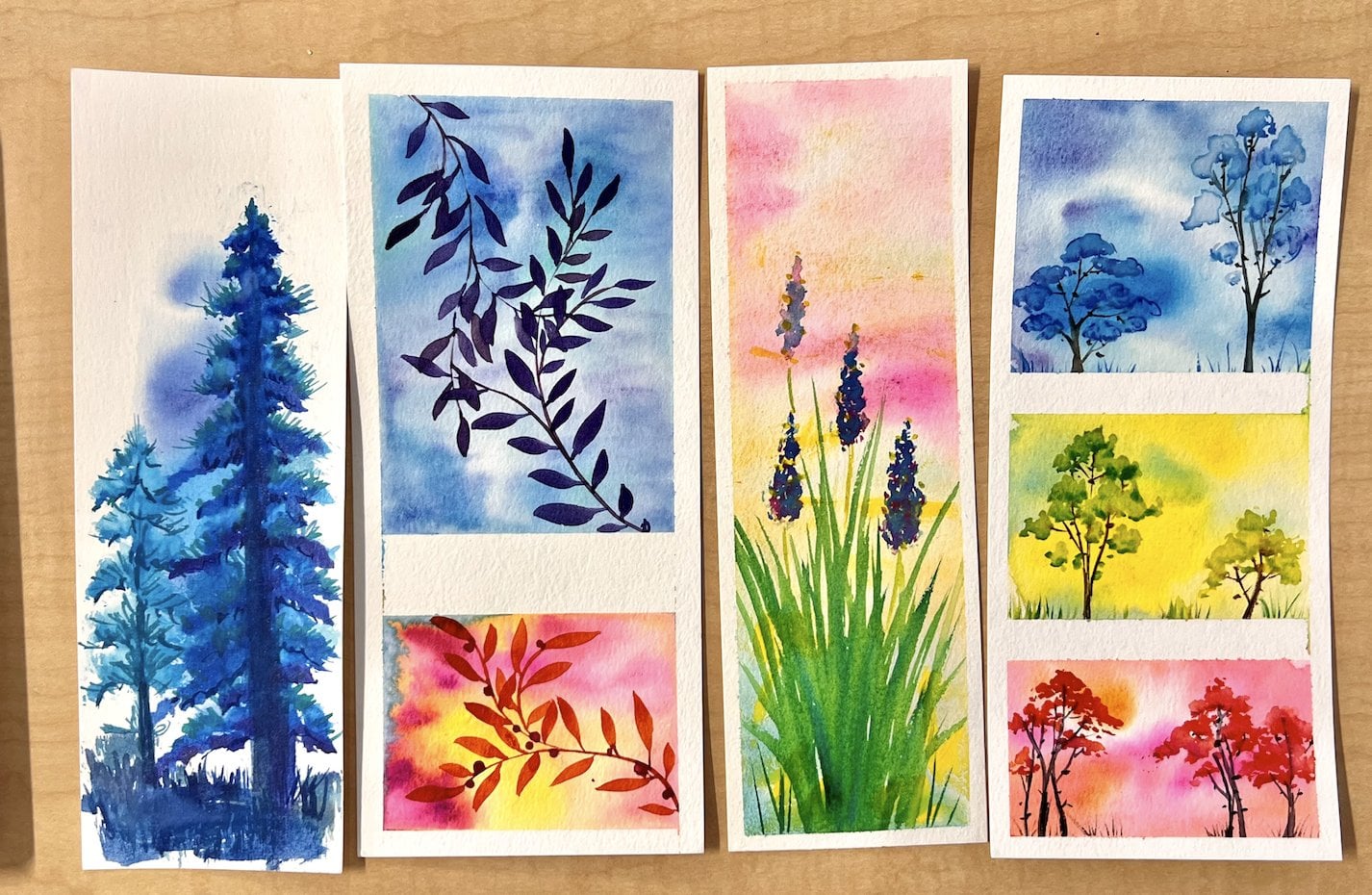
18. Paint rose 01: Okay, hello dear friends. Let's try these Valentine's
special bookmark. Me first. Use themes to the center. Too much what I'm choosing. Try it, I'm having fun. Here's a light color. The stone. Maybe I jumped. Takes practice. Okay, series. Let's do it. I need to go for it She will be better. You choose why. She knew how to
get too confused. She can use the stamp. Okay. Lack for the staff. Okay. No. Shou Xi. Good. Good, good, good, good. Good. Okay. So as you can see, sometimes I get lost
in my own world. It's kind of meditating to
do these painting exercise. And especially when, when I was doing these
background, put water, just plain water, tap water, and then put some color and see the color flow and see
the color move around, mingle with another color. It's so, so inspiring,
it's so relaxing. We do not need to
control too much. Water has its way. Color has its way. Every thing has a spirit. Spirit has its own way. There are time. We make an effort, we force, we fought, our skill. We force a way into something. And there are times we
just a formal follow the natural way and and not
who struggle too much when, when you respect the nature
of that particular scene. Now, that particular
nature to express, it's very empowering and it's
very, it's very majestic. You cannot, you
cannot force you all sinking into an already,
already existed perfect. Dc. Let it be nature. Let it be natural. It's already perfect. Don't you think so?
19. Paint rose 02: Let's go to show you how fun She she she she she shoe, True? True. That's a good pen tool. Due to the two. Show you. Who can say lunch. No. Need. Chine. D, d t to the to show from bom, bom, bom. To know gigi, gigi, gigi. He can show rather than changing
jing, jing, jing, jing, jing. Neutral. Third party. That's wild nuff. A very deep way
20. Closing remark: Ok. Hello dear friends. So with this, I conclude, I will ben boo or keyed class. And there is something I would like to explain. I use these very cheap paper. I intentionally use these very cheap paper and there is no result. It's about the journey. It's about the journey to find your freedom, to find your ways to practice until you get it. In any art form. Not only in Chinese painting, Chinese calligraphy, in any art form. It is the process. It is the journey that brings us the joy, which is much more, much beyond the final result. Use an old newspaper use of recycled photocopy paper. Not important. Anything. You can use, anything. As long as you put your hand paper, you practice your hand and your, practice your hat. And eventually you will find that your hand can make magic. Can talk. What you want to say. Can talk the very bottom of your hat, your desire, your wish, your role man's your strengths. I feel so good. Thank you very, very much. Enjoy.
 Haiying Yang, Artist, Educator