Transcripts
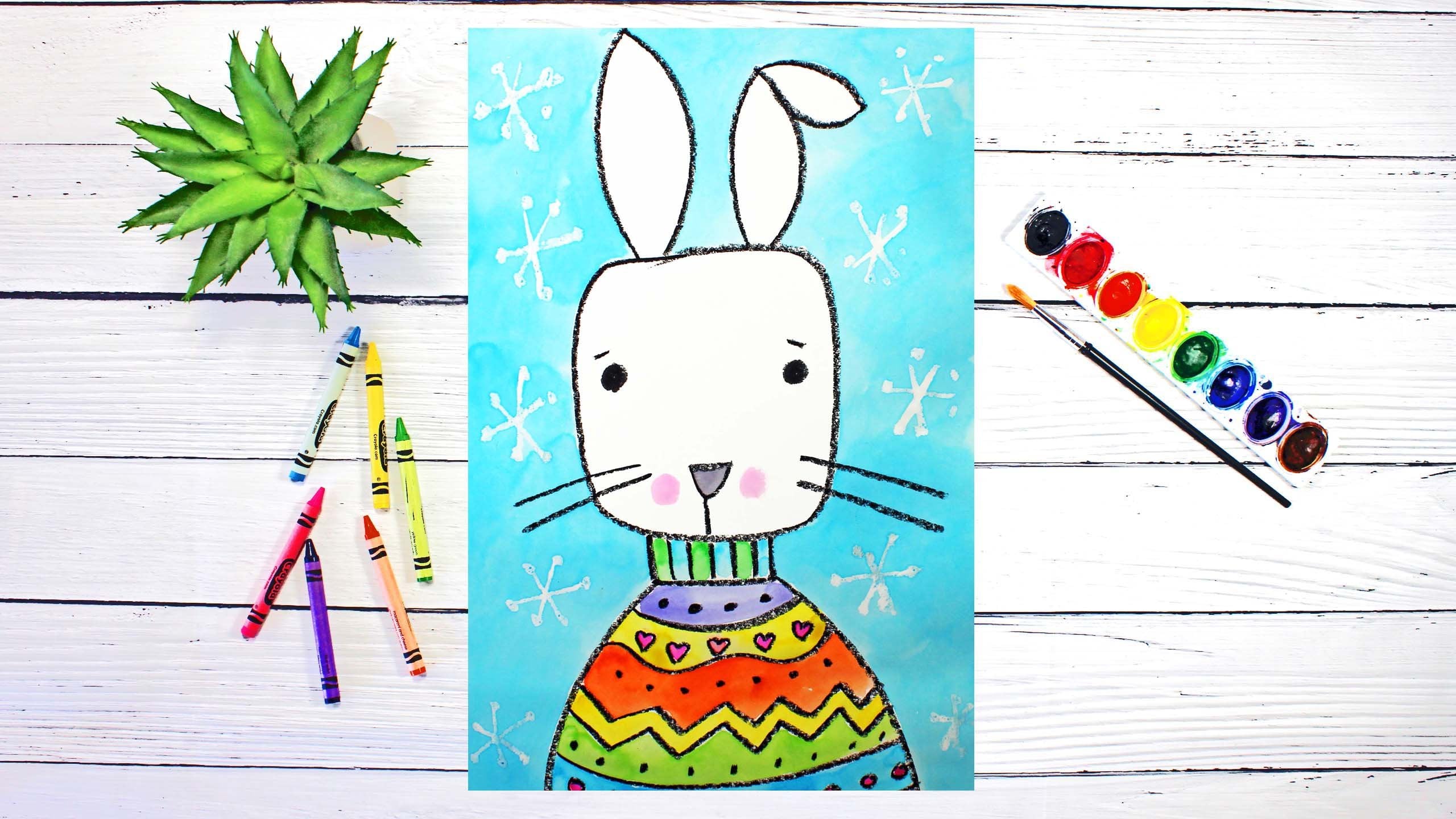
1. Introduction and Supplies You Will Need: I Hi, friends. How are you? I hope you're having
a great day today. I'm excited about sharing
this project with you. This is a drawing and
watercolor painting project that I designed,
especially for kids. Students do not need to have any drawing or
painting experience at all to be successful
with this project. I will guide students step by step through all the steps
that they need to take. Today, we are going to
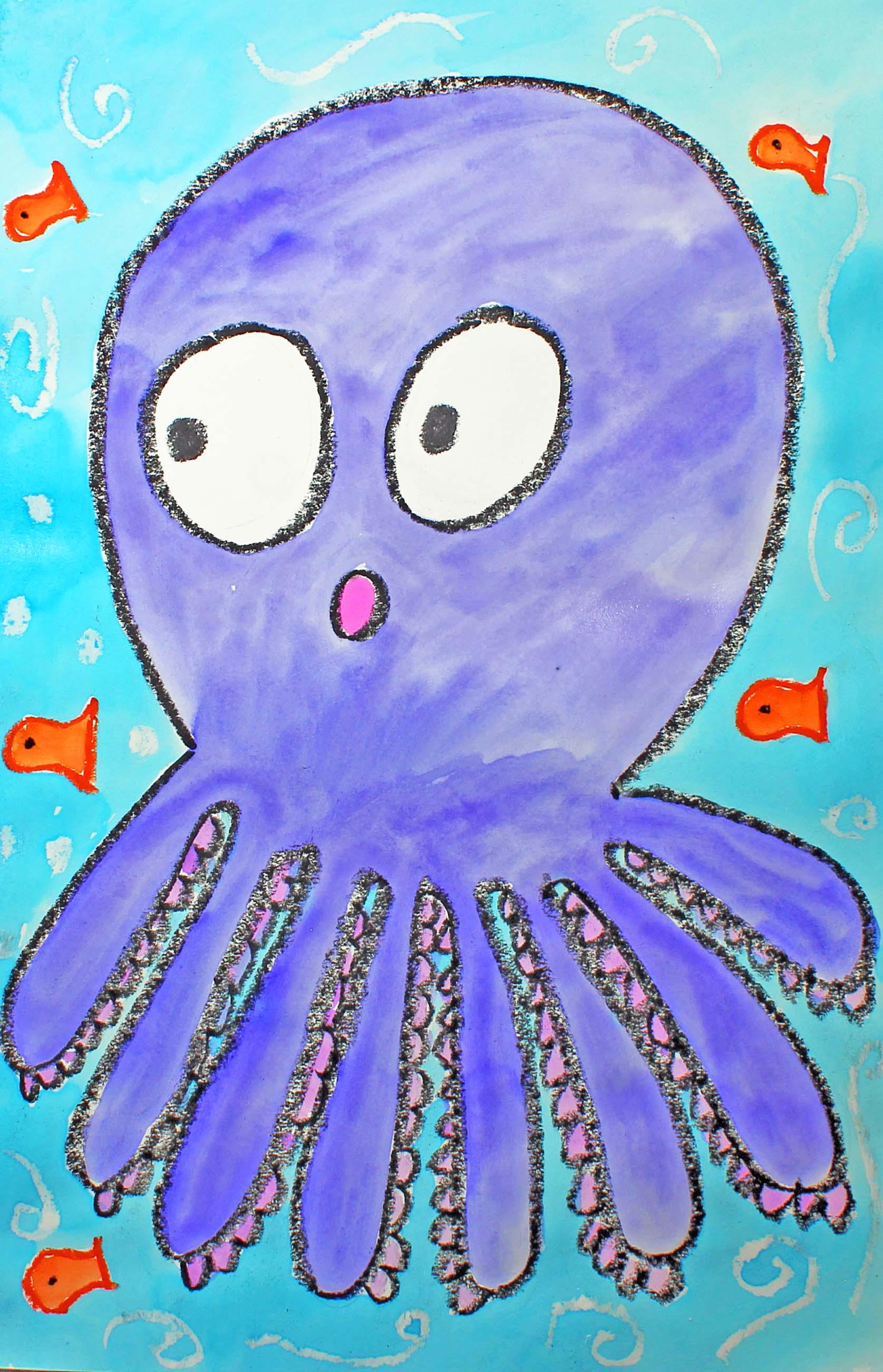
create this octopus design, and this octopus is swimming in the sea with
some fishy friends. Let's talk about
the supplies and materials that you will
need for this project. The first thing
that you'll need is a sheet of watercolor paper. You will need a set of watercolor painting
and a paintbrush. You will also need a cup
oil bowl with clean water. A set of oil pastels or crayons
will work just as well, and you will also
need a paper towel. So go ahead and gather all of those supplies
and materials, and I'll see you back
here in the next video.
2. Step 1: Draw an Octopus Design: In this step, we are going
to draw our octopus design. So let's get started. So the main thing
that I'd like you to remember for this project is that we're going to fill up the entire space
with our octopus. You're going to make sure that your octopus is so
big on your piece of paper that you'll be
able to see it from across the room if you
look at it on the wall. Alright, so just
keep that in mind. The first thing that
we're going to do is choose a dark color. You can choose any dark
color that you like. I'm going to choose
the color black, but you can use purple or
dark blue or a dark green. It's completely up to you. Once you choose your color, what we're going to do is go to about the middle of
our piece of paper. The middle of my piece
of paper is right here. What we're going to do is
we are going to create the head in this space at the top of this line,
this imaginary line. And we're going to
create the legs down here underneath the line. Alright, let's start
with the head. So we're going to
go in a few inches. That would be about 3 " or 4 ". That would be about
five or 6 centimeters, and we're going to end
up about right here on the same side on the right
side of the piece of paper. So we're going to make a really big upside down, letter C. Yours might not look exactly
like mine, and that's okay. We want your artwork to look
like your artwork, right? Alright, now that
we have our head, let's move to some eyes. So let's make some big circles for the eyes of our octopus. So there's one, and then I'm going to make
my other one right here. If you'd like to space them
differently, that's okay. I'm just going to have my
octopus looking this way, so that's why I put
them in these spots. If you'd like to
put your other eye over here, that would be fine. And I'm going to make
some pupils right here. Just like that. I want my pupils to be
roughly the same size. Alright. The next thing
that we're going to do is we're going to make a mouth
right here between the eyes. Going to make a small oval. Kind of like he's surprised. Alright, now what we're going to do is we're going to create the legs down here at the
bottom of our piece of paper, and we're going to
attach the legs to the head of our octopus. One thing that I'd like
you to remember is that we're going to
make eight legs. You may think that we don't have that much space for eight legs, but if you try, you'll be
able to fit eight on there. If for some reason
you can't fit eight, you can only fit seven
or six, that's okay. We can just pretend like the extra two legs are
hiding behind the octopus, okay? So I'm going
to start here. I'm going to come down
and then come back up, and that's going to
be leg number one. Curve around, come
down, come back up. M. Come down, come back up, and I'm just going to keep
repeating until I get a legs. I better stop there because I don't know how
many legs I have. One, two, three,
four, five, six. I have six legs, so I
need two more legs. This one's going to
have to be small or go off the piece of
paper. I did it. One, two, three, four, five, six, seven, eight. So those are just
going to be little wes attached to either
side of your leg. You get to choose the side. So we're just going
to go like this. So now what we're
going to do is add a little bit of detail
to the background. So go ahead and take
a different color. Any color is fine. I think I'm going to choose
maybe this orange right here, and I'm going to
create some fish. So why don't you create some small fish
around your octopus? You can make any type of
fish design that you like. I like to make this
type of a fish. It's a very simple goldfish. So we have a straight
line for the tail. We cut down. Like that. Maybe I'll make
another one up here. So come down with a straight
line and then curve around. And then maybe I'll
make one here as well. Because it looks like this
octopus needs a few friends. Here's another fish. Now, I'm just looking
at my artwork to see if there's any other space that I could make another fish. I think I'll make one down here. There we go. Not sure if you
can see that on the video, but I made one here
at the bottom. Now what I'm going to do
is I'm going to go back and take my black and
make a small eye, a small.in each of
my fishes face area, that'll be their eye. And the fish are going
to be pretty small, so we don't need to
add a lot of detail. Now, go ahead and
choose your white, or you can also choose yellow if you don't have white
available to you. Choose your white crayon
or your white oil pastel. And in the space
around the octopus, go ahead and make
some swirls you can make some curve lines
and press pretty dark. This is going to be the
current of the water, and you're not going to be
able to see this very well. But when we apply some paint, you will be able to see this. I'm also going to make
some dots and bubbles. So go ahead and fill up the space with these
little swirly lines. You might not be able to see them. But they will be there. Alright, when you're finished with your white or your yellow, go ahead and put it away. If there's anything
else that you'd like to draw on your drawing
at this point, go ahead and do that now
because in the next step, what we're going to do
is we are going to start painting with our
watercolor painting.
3. Step 2: Paint the Design: In this step, we
are going to start painting with our
watercolor painting. So let's get started. The first thing
that we're going to do is we're going to add one or two drops of water
into each pan of paint. And what this will do is it will soften up the paint
just a little bit, so it is easier for us to use. So go ahead and
take the time to do that because it
really does help. Now that our paints
are softening up, let's turn our attention
to our design. Think about the
colors that you would like to paint your design. What we're going
to paint first in this step is just the octopus. And then in the next step, we are going to paint
the background. Okay? So we're just going to
focus on the octopus. Think about the color or colors that you'd like
to paint your octopus. You can paint your octopus
one or more colors. It's up to you. This is your artwork.
So we're going to paint the entire octopus. We're going to leave the eyes white that way
they'll stand out. We're also going to
paint the little mouth. So I have decided
that I'm going to use the color purple
to paint my octopus. I might add a
little bit of pink. I'm not sure. I'm going
to see how it goes. I'm going to add quite a bit of water and a little bit of paint because I want my paint
to be pretty light. What I'm going to do is
I'm going to speed up this video so that you
can watch me paint. But in reality, I'm not
painting that fast. Alright? I'll see you
back here just a minute. Alright, friends, I'm back, and I really like the way that my artwork
is turning out so far. I have used the color purple
and a little bit of white. So what I'm going to
do next is I'm going to paint the background
in the next step. So I will see you back here
in the next video. And
4. Step 3: Paint the Background: In this step, we are going
to paint the background. So let's get started. I'm going to start out
by painting my fish, and I'm going to paint my
fish orange, a light orange. So I'm adding mostly water and a little bit of
paint. There we go. Okay. Now that we have
our fish painted, what we're going to do next is we are going to paint
the background, and I'm going to use a blue
to paint the background. So let me show you how I'm
going to make that blue. I'm going to put some drops of water just like this
in one of my wells. And then I'm going to
add some blue paint, mix it up really, really well. Like that. And then
I'll start painting. Remember, we have some
designs that we made with our white Creon
or white oil pastel. So you will be able to see those when you start
painting over them. Alrighty friends, I'm finished
with painting my design. There's one thing that
I still need to do, and I want to take a little bit of that color right
there in the mouth, and I want to, I want to absorb it with this paper towel
because it's a little bit dark. So I just hovered the paper
towel over that area, and I soaked up
some of that paint. So I'm really happy with the way that my octopus
design turned out. I hope that you had a lot
of fun with this project. I will see you next time.
 Em Winn, Teacher, Art Instructor, Artist