Transcripts
1. Introduction and Supplies You Will Need: I Hi, friends. How are you? I hope you're having
a great day today. I'm excited about sharing
this project with you. This is a drawing and
watercolor painting project that I designed,
especially for kids. You do not need to have any drawing or painting experience at all to be successful
with this project. I will guide you step by step through all the steps
that you need to take, so you will feel
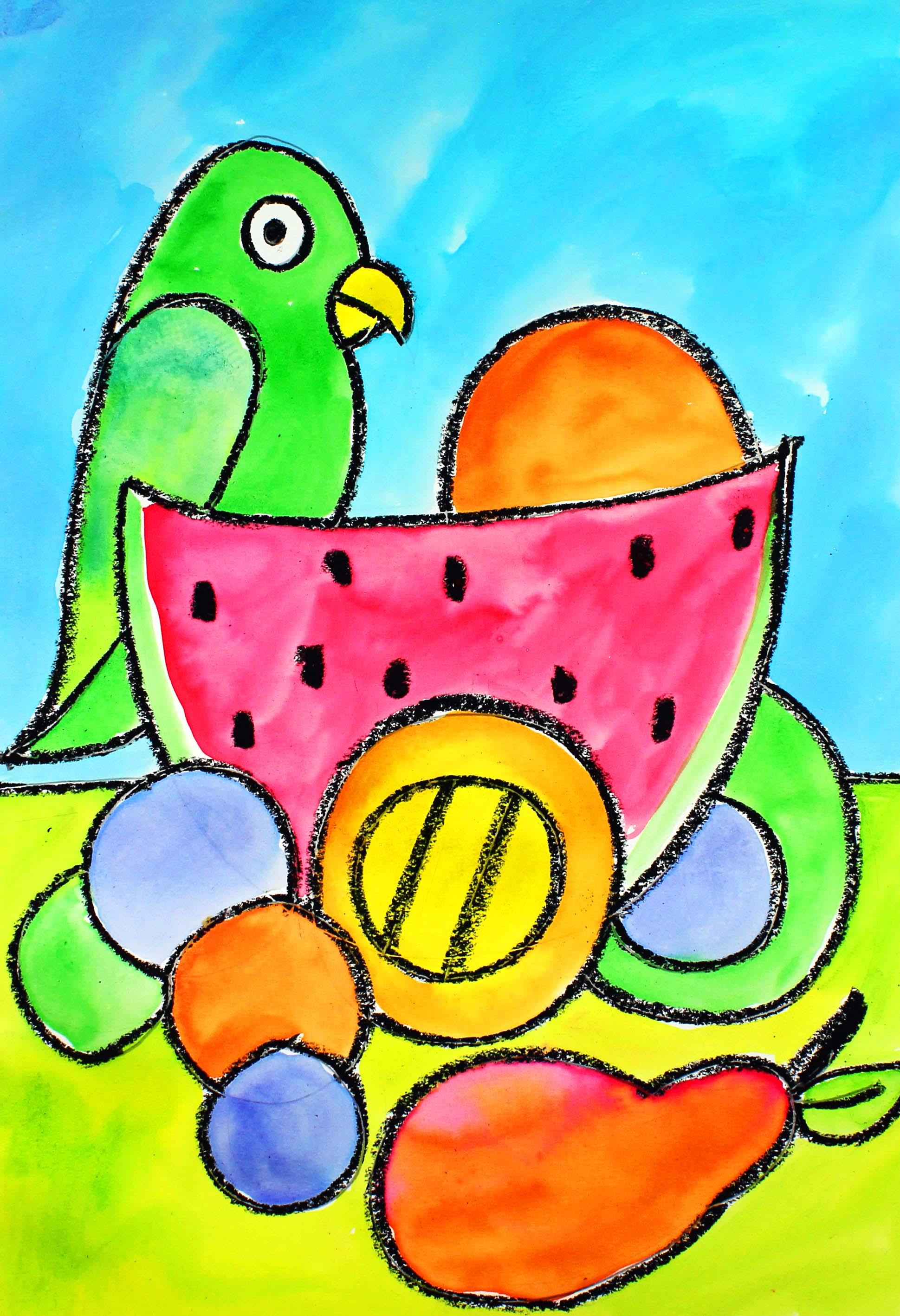
comfortable at all times. Today, we are going to create this artwork that's
inspired by Frida Co. She painted Still Life
with Parrot and fruit in 1951. Let's talk about
the supplies and the materials that you will
need for this project. The first thing
that you'll need is a piece of watercolor paper. You will need a set of watercolor painting
and a paperbush. You will also need
a cup or bowl with clean water and a black
crayon or a black oil pastel, a pencil with an eraser
and a paper towel. So go ahead and gather all of those supplies and materials, and I'll see you back
here in the next video.
2. Step 1: Draw a Parrot & Fruit Design: In this step, we are going to draw our design with our pencil. So let's get started. Go ahead and pick
up your pencil, find the middle of your sheet of paper and go up
just a little bit. And the first line that
we're going to make is going to be a curved line. So we'll start about
right here and make a slightly curved
line just like this. So you'll want to make sure
there's a little bit of space here on this side and a little bit of space
here on this side. Now what we're going
to do is we're going to come down from this line, the end of this line
and go to the end of this line right here
with a letter U. This is going to
be our watermelon. You don't have to
press very hard. With your pencil, I'm
pressing a little bit harder so you can
see my pencil lines. Now we're going to go up here to the top of our watermelon, and we're going to make a
parrot right here in this area. So we're going to go
up to about right here and we're going to
make a curve line going up and then coming down and curve just
slightly at the end. So let me show you that again. Curve up, come around, curve down, and then curve
slightly at the end. If your line doesn't look
exactly like mine, that's okay. Just do the best that you can. Now we're going to make a
slightly curved line like this, and then we're going to
make another curve line going the other way this way. This is going to be the
head of our parrot, and this is going
to be the tummy. Now let's make a beak
right here where it goes in just a little bit with
a curve line coming down, a curve line coming in and another curve
line coming down. Now let's make an eye. You can make any type of eye that you'd like
for your parrot. I'm just going to make a circle with a round circle in the
middle that's filled in. Now let's make a wing. So we're going to start
about right here and make a curve line coming down, jump over the watermelon and
come out down like it is. Now we're going to make
one more line coming down from here and close
up right here. Okay. So that's our parrot. It's going to be a
very simple design. Now what we're going
to do is we are going to create some
fruit down here at the bottom and a little
bit of fruit here at the top. So let's start
here at the top of our watermelon and let's
make a round piece of fruit. We can call this an orange. And then let's make another
piece of fruit right here. So another round circle. It's okay if you go over that initial line
of our watermelon. Let's make another
circle inside of that initial circle
and two lines. Some of these lines
we will be erasing, for example, this
one right here. But we're going to do
that in just a bit. We're not going to worry
about that right now. Now we're going to make another. It's not a full circle, but we're going to start about
right here a few inches or several centimeters down from
the top over a watermelon. And this piece of
fruit is going to be behind the watermelon. And then we'll
make another piece of fruit right here,
another circle. Can't see all of the circle. It goes behind the watermelon. Now let's make another one. Let's say, actually, let's
make a pair right here. So let's make a curve line a and then down underneath the Let's make a curve line
that comes up like this. So this can be a pair. Let's put a little stem on it. You can even put a leaf
on it if you like. Alright, let's move over to
this part of our design, and let's make a
few more circles and shapes so those
can be roots as well. So let's make a
circle right here. Let's make another circle right here behind that initial circle. And let's make another
circle right here. As you can see, a lot of these
circles are overlapping, and as I said before, we will be doing some erasing. And then let's make another
circle about right here. Keep in mind, if your circles
don't look exactly like mine or your shapes don't look exactly like mine, that's okay. You're just going to
make sure that you are happy with your
own design, okay? Yours is going to look
different from mine. Now that we have our
parrot and her fruit, we have our watermelon. We have our different fruits
down here at the bottom. We have our pear. I hope you can see that
pear on the video. Maybe some oranges and plums. We're going to add a table
that they can sit on. So I'm going to go about right here, make a straight line, jump over all of these fruits and make
another line right here. So this down here is
going to be the table. And this up here is going to be the background,
maybe like a wall. One more thing that I
would like to add is, I would like to add some
dots here to remind me to add some seeds
to our watermelon. There we go. In the next step, what we're going to do is we are going to decide which lines we'd like
to erase on our drawing. So when we come back,
that's what we will do. So I'll see you back
here in the next video.
3. Step 2: Erase the Pencil Lines: In this step, we are going to erase some of our pencil lines. So let's get started. Go ahead and pick up your
pencil with your eraser on it. And if you don't
have this type of eraser on the back of
your pencil, that's okay. You can always use this type
of eraser. Use that as well. And what we're going to do is we're going to look
at our artwork and decide which lines
we would like to erase, because as you can see, we have some lines going through
some of our fruits, and we want to do some erasing. Your fruits might look
different from mine. So you get to decide which
lines you'd like to erase. I for one, would like to
erase this line because it's going right through
this piece of fruit. So I'm going to go
ahead and do that. And if I erase a line that
I didn't mean to erase, I'm just going to go ahead
and fill that line back in. So I have a line right here. That I need to erase because
it's going right through that piece of fruit. See that. And then I need to fill in
those lines. There we go. And then this right here, I don't need to erase because this piece of fruit and
this piece of fruit, they're behind my watermelon. So I'm just carefully
looking at all of my fruits and then I'm deciding which lines
need to be erased. So because this
piece of fruit right here is in front of this piece of fruit
and this piece of fruit, I need to erase that
line right there. So then right here, I think I'll erase this line because this piece of fruit is in front of
this piece of fruit. Do you see how that works? Sometimes it takes
a little bit of practice to decide which
lines need to be erased. But the more that you do this, the better that you
will get at it, okay? It just takes practice. All right, so I'm
looking around now, I'm being very careful, and I think that I have all of the lines erased that
I want to have erased. So I think that I'm finished. So go ahead and take a moment, make sure that you have all of your lines erased that
you'd like to erase. And in the next step, we are
going to add some crayon or some oil pastel
to our design. So I will see you back
here in the next video.
4. Step 3: Outline the Design: In this step, we are going
to cover our pencil lines with either our Black crayon
or our black oil pastel. Either one will work great. So what I'm going to
do is I'm going to pick up my black oil pastel, and I'm just going
to start to cover my pencil lines with
my black oil pastel. I'm going to go
slowing carefully, so I do my best work, and I'm going to try
to stay on the line. If I go off of the
line a little bit, I'm not going to worry
too much about it. I'm just going to do my best. Okay? So I'm going to
speed up this video. And you can watch me. And I will be going
slowly and carefully, although it will look like
I'm going fairly quickly. Oh, y friends, I'm
finished covering my pencil lines
with my oil pastel. Keep in mind, black oil
pastels are very soft. So if you touch your oil pastels or you try to wipe them off of
your piece of paper, you could smear your drawing. So you might want to
keep that in mind. And if you have any extra
oil pastel on your fingers, go ahead and wipe that off
with your paper towel. Alrighty friends,
in the next step, what we're going to do
is we are going to apply some watercolor
paints to our design.
5. Step 4: Paint the Design: And in this step, we are going to apply our watercolor painting
to our design. So let's get started. The first thing
that we're going to do is we are going to add a drop or two of water
to each pan of paint. And what this will do is it will soften up the
paint a little bit, and it will make the paint
much easier for us to use. So I do encourage my
students to take that step, take a moment to add just a drop or two of water
to each pan of paint. Now that our paints
are softening up, let's turn our attention
to our design. In this step, we're
going to focus on painting the bird
and the fruits. And then in the next step, we will focus on creating our background
colors for our design. So that would be the table
and the background. Okay? So let's think only about the bird and the
fruit for right now. I'm going to choose to paint my bird green and
my watermelon red. And I'm going to have
some oranges and apples, and I have a pear right
here and maybe even a plum. So maybe I'll paint
my plum purple, my orange is orange, my apples, maybe red or green. And this pear down here, I know they have
different types of pears. Some are green, some are yellow,
some are orange and red. I haven't decided yet. So because this is your artwork, you get to choose the
colors that you would like to choose for
your own design. So the colors that I use are not the colors that
you must use. Okay? Sound good. All right, so let's get started. I'm going to start by
painting my parrot, and I'm going to
choose this green, and I'm going to try to stay inside my lines
for this project. But if I go outside of
the lines a little bit, that's okay. No problem at all. I'm going to also not paint that eye because I
want that to be white. So I'm going to go ahead
and paint, paint, paint, and I'm going to speed up this
video so you can watch me, and I'll be back
in just a minute. Mm hmm. Alrighty friends, I'm finished painting my bird and the fruit. I see some little puddles on my piece of paper
that I'd like to pull up because there's a lot
of paint in some areas like this area and this area. So let me show you a trick. If you hold your paper towel over the area that you'd
like to pull up the paint, soak up the paint, just gently put it over
your piece of paper, gently tap, and then some
of the color will come up. Let me show you that again. So I want to pull up the color
right here on this plum. I hold my paper towel
over that area, gently tap, and it will
bring up some of that paint. So if you have puddles, on your piece of paper that
you'd like to bring up. That's just something
that you can do to bring up some
of that paint. I have a little puddle here. Sometimes I like the puddles, but sometimes I want to
bring them up because they get a little
bit dark. Alright? So that's just an
option for you. That's something that you can do if you'd like to do that. In the next step, we are going
to paint the background. So I will see you back
here in the next video.
6. Step 5: Paint the Background: In this step, we are
going to apply some watercolor painting
to our background. That means the table and the wall behind
this lovely image. Okay? So you get to decide the
colors that you'd like to use. You can use one color
or two colors or three. It's completely up to you. I'm going to use one
color for the background, maybe two, and then I will use either one or two different
colors for the table. I haven't decided yet. Alright, I'm going to
start with the table. I'm going to choose the
colors green and yellow. So I'm just going to get
started with those colors, and then I will move
to my background, and we will see the colors
that I decide to choose. I will see you back
here in just a minute. Alright, friends, I'm finished. I decided to use yellow
and green for the table, and I used two
different shades of blue for the background
right here, the wall. I chose a darker blue
and a lighter blue, and I think it looks fantastic. I hope that you
enjoyed this project. I will see you next time. I
 Em Winn, Teacher, Art Instructor, Artist