Transcripts
1. Introduction and Supplies You Will Need: Hi, friends. How are you? I hope you're having
a great day today. I'm excited about sharing
this project with you. This is a drawing and
watercolor painting project that I designed,
especially for kids. Students do not need to have any drawing or
painting experience at all to be successful
with this project. I will guide students step by step through all the steps
that they need to take. Today, we are going
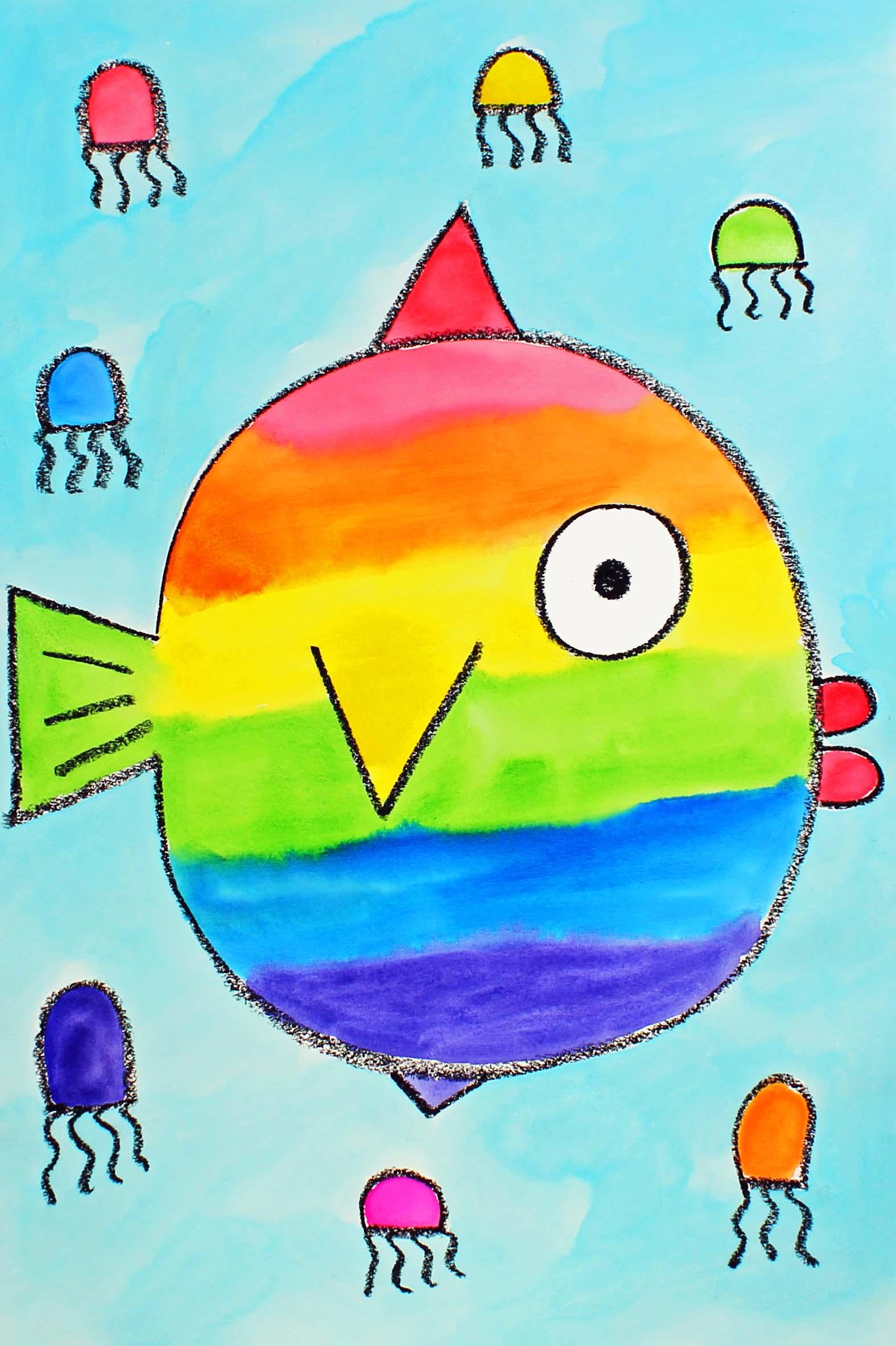
to be creating this Rainbow Fish design. I hope that you have
a lot of fun with this project. Let's get started. Let's talk about
the supplies and the materials that you will
need for this project. The first thing
that you'll need is a sheet of watercolor paper. You will need a set of watercolor paints
and a paintbrush. You will also need a cup or
a bowl with clean water, a black oil pastel or crayon, and a paper towel. So go ahead and gather all of those supplies and materials, and I'll see you back
here in the next video.
2. Step 1: Draw a Rainbow Fish Design: In this step, we are going to draw our rainbow fish design. So let's get started. Before we start drawing,
let's talk about the placement of
our rainbow fish. Our rainbow fish is
going to be here in the center of our
sheet of paper, and it's going to be pretty
large on our sheet, okay? So that's important
to keep in mind. We're not going to go
to the very edge of our piece of paper when
we're drawing our fish, so we're going to leave
a little space here. And a little bit of space here. Okay? So go ahead and pick up your black oil
pastel or crayon. We're going to come in a
little bit from the side. I would say maybe about if you hold your
fingers like this, maybe about four or
even five fingers. And we're going to
start about right here. We're going to go up, come down. We're not going to hit the edge of our sheet of paper, but
we're going to come up, come down, and then
we're going to stop before we close up our circle. Okay? So we're going to
make a circle shape. We're going to come up,
come down. Come across. And then before we close up, we're going to stop because we need to make a little bit
of a tail right here. Now, think about the tail
that you'd like to create. Would you like to create more of a triangular shaped tail, more of a circle tail, more of a rectangle tail? It's completely up to you, okay? So you make a tail right here in this space and connect it to the ends of these lines, okay? So I'm going to make a
tail that looks like this. Straight line, straight line, and then I'm going to
close up like this. I want a smaller
tail for my fish. If you'd like a larger tail, you can go ahead and do that. Then I'm going to create some
details inside of my tail. Like, so that is my tail, and then here is my fish. Now, let's go back to the fish and add some details
for our fish. Let's add an eye. You can add any type
of eye that you like. I think I'm going
to add a circle. I'd like to have a big eye. This is the side of the fish, so we're only going
to make one eye, and then I'm going to
make a dot right here in the center that I'm
going to fill in with my black oil pastel. Got a little bit
of extra on there. And then you can make any type
of a mouth that you like. Would you like to
make a smiling mouth? Would you like to
make some fish lips? You can go ahead and do that. I think I'm going to
make some fish lips, maybe about right here. So the top lip and
the bottom lip. That's kind of funny. Alright, now we're
going to make a fin. So on the side here, make a fin. If you'd like to make a top fin, you can go ahead and do that. I'm just going to
make a triangle. And then if you'd like
to make a bottom fin, you can go ahead and do that. I'm going to make
just a small one. You can make any type of design on your
fish that you like. I'm going to keep my fish simple because it's going
to be a rainbow fish, and so I'd really like those
rainbow colors to stand out. So I think I'm finished
with the details on the inside of my fish. Now let's make some details on the outside on the background
of our sheet of paper. You can make small fish. You can make some Jellyfish. You can make some seaweed. You can make anything
that you like. I think I'm going to make
some small Jellyfish. I don't know if you've ever seen real Jellyfish, but I have. I've seen different sizes. Some are very large and
some are very, very small. And I've even seen
some in the ocean, which I try to stay
away from those. Okay, so I'm going to show you how to make a
small Jellyfish. So I make an upside down
letter C, and then I close up. At the bottom, and then I
make the little tentacles coming out from the
bottom like this, right? So I'm going to
go ahead and make some small Jellyfish to
join my Rainbow Fish. You can make
whatever you'd like. You don't have to
make Jellyfish. If you don't want to. You can
make something different. Alright. After you've finished making your background design, go ahead and look at
your sheet of paper. If there's anything else
that you'd like to add, right now is the time to do that, because in the next step, what we're going to do is we are going to come back
and we are going to start applying some watercolor
paints to our design. So I will see you back
here in the next video.
3. Step 2: Paint the Design: In this step, we
are going to apply some watercolor
paints to our design. So let's get started. The first thing
that we're going to do is we are going to add one or two drops of water into
each of our pans of paint. And what this will do is we'll soften up
our paint a little bit so that our paints
are easier to use. I do suggest to
my students to do this step because it
really does help. Now that our paints
are softening up, let's turn our attention
to our design. So here we have our fish, and we're going to turn
that into a rainbow fish, and then you have some
details in the background. Your details might look different from mine, and
that's a good thing. We want your artwork to look
like your artwork, okay? You can paint the fish, any type of rainbow
colors that you'd like. You can use stripes.
You can use circles. It's completely up to you. I'm going to just use stripes. And then as far as your
details for the background, you can paint those any colors
that you'd like, as well. Keep in mind, we are only
going to be painting the fish and the
background details. We are not going to be painting the background in this step. The background is all of this space that's behind
the fish and the details. Okay? We're not going to
paint that right now. We're going to wait
until the next step to paint that background, right? So I'm going to start
by painting my fish, and I'm going to use
the rainbow color. So I'm going to start
out with the color red. And then I think what
I'm going to do is even add a little bit
of red down here. And remember, you can
do whatever you want, as long as you're using
the rainbow colors. So there's my red. Now I'm
going to move on to orange, and it's okay if the
colors mix a little bit. Watercolor paints love
to mix with each other. So if they touch each other, they will probably mix, and you'll get some
really neat designs. So there's my orange. I'm going to not go into
that eye space right here because I want that to
be I want that to stay white. So now I'm going to
move on to yellow. See how it's mixing with
the orange a little bit. It's exactly what I like. Move over here. I'm touching that orange because I want those colors to
mix a little bit. I decided to bring that yellow
down into my fin because I want that to be yellow as
opposed to yellow plus green. So I have red, orange, yellow. Now I need green. I'm going
to use this shade of green. I think I want my tail
to be green, as well. Now I'm going to move
on and use the blue. Oh, this is such a
beautiful shade of blue. Wow. So I have red, orange, yellow, green, blue, and now I'm going to use violet. Alright, so now we
have our rainbow fish, and we need to make a decision
on the color for the lips. I'm going to use red, the color red for my
lips. There we go. And as I said before, we're going to leave
this area white. If you even have white
around your eye, you can leave that
white if you'd like. That's the choice that
I'm going to make. Now, for my Jellyfish, I am going to paint those
rainbow colors as well, but I'm not going to use all of the colors on my
Jellyfish at once. For example, I'm not going to paint this Jellyfish right here, all of the colors of the rainbow because
it's just too small. Alright? So I think I'm
going to use a color for this one and a different
color for this one and a different
color for this one, but they're all going to be
the colors of the rainbow. I might add pink
in there as well if I have enough Jellyfish. I know that your
background details might be a little bit
different from mine. So just use the colors
that you would like. So I'm going to
start out with red. Maybe I'll paint this
one red right here. Then I will move to orange
and then yellow and so on. All right, friends. So now I have my Rainbow Fish painted, and I have my tiny little
Jellyfish painted, as well. And I painted those
the rainbow colors. I have a pink one down here because I had enough
to paint a pink one. So when we come back
in the next step, we will start painting
the background.
4. Step 3: Paint the Background: In this step, we are going
to paint the background. So let's get started. So we're going to paint all of the space behind
the rainbow fish and behind the Jellyfish or whatever details that you
have on your sheet of paper. Let's make some blue paint for our background because the
ocean is generally blue. So I'm going to add
some water into one of my wells because we're going
to make some blue paint. And the more water that
you add to your paint, the softer and the lighter
the color will be. The more paint that you
add to your design, the stronger the color will be. So I'm going to have this
blue paint right here. Going to make enough of
it for the background. And if I run out, I'm just
going to make some more. Okay. Let's test it out,
see the color. Oh. That's perfect. That's exactly what
I was looking for. So if you do have a little bit of spreading with your paint
colors, that's okay. That's just what
watercolor paints do. They like to spread around. So I'm going to try to stay outside of those
Jellyfish lines. But if I get a little bit in there, that's okay. No problem. Alright, I'm going to speed
up this video a little bit, and I'm just going to
paint my background. Mm. Alright, friends, I'm
finished painting my design. I hope that you had a lot
of fun with this project. I will see you next time.
 Em Winn, Teacher, Art Instructor, Artist