The ability of psychopaths to feel emotions when they are hurt: implications for
Summmary
This study is about the way psychopaths can feel emotions when they are hurt, just like ordinary people and the implications of this analysis – including for the heredity of the pathology.
Introduction
In a large number of cases, psychopaths have suffered physical, verbal and emotional aggression (abuse). They supposedly built a defense, based on their genetic predisposition (Tuvblad, & Beaver, 2013), which left them emotionally “disconnected” in the face of these and other occurrences in general, including lack of empathy, lack of recognition of the rights of others (Bird, & Viding, 2014). And what about themselves? Are these defenses successful? It is known that they do not recognize fear in facial expressions (Association of psychological science, 2011) and that their brains have much less activity when there should be an emotional response. According to a review of the literature (Koenigs, 2012), changes in the orbitofrontal and prefrontal cortex, which perform a series of functions, such as social and affective decision-making that appear to be altered in psychopathic individuals, have been associated with psychopathy – both structural volumetric abnormalities were found (including deficits in gray and White matter density, including in the fibers that connect the amygdala to the ventro-medial prefrontal cortex), as well as functional deficits. Some of the changes are, more specifically, a reduction in cortical thickness in the right lateral prefrontal cortex and, to a lesser extent, in the right ventromedial and anterior cingulate cortex. In these areas, cortical thickness was negatively correlated with the affective facet of psychopathy. But do they feel when they are hurt? Each person feels differently when they are hurt, but do they, like ordinary mortals, have feelings (like adults) towards those who hurt them? Can we date this back to childhood? Feeling sad, scared like anyone tells us that they weren't born that way? Feeling emotion tells us something about this question that we have been trying to answer for years and years in forensic psychology. This will certainly have implications for your conviction in court, in a way that could call into question your responsibility for your actions or lack thereof. However, is abuse also a good excuse and not just a genetic change? All these questions can be answered by science. We can start with a simple percentage study in which the responses of 25 psychopaths to a questionnaire prepared by me are considered. It will be described in the next section – the methods used to carry out this small study that raises and tries to understand in part these questions.
The scientific questions raised here are also relevant to treatment – are they capable of feeling emotion? If so, how can we direct it abroad and not just at home? This study aims to find out in a considerable sample what percentages of psychopaths felt and did not feel some emotion when they were abused and even today in relation to those who mistreated them.
Methods used
My questionnaire consisted of “yes” or “no” answers, to carry out statistics (whether or not you felt any negative emotion towards the aggressor in each situation: as a child and as an adult), as well as some response questions open to a more complete and in-depth analysis of the psychopath’s mind (“what emotions they felt when being abused”). It was a snowball type of data collection via the internet, using the tumblr platform. Data were collected in the 2014/2015 academic year. The sample was 25 psychopaths who responded to my questionnaire via Google form.
Percentage calculations were carried out at the end of data collection and transferred to the final work. In order to be discussed, they will be presented below. A Casio fx-9860-G graphic calculator was used.
Note that I didn’t use a likert scale because the objective of this study was simply to know if the participants felt something, due to the core characteristic of psychopathic individuals, which is flat affect.
Results:
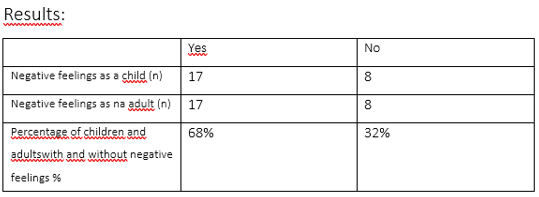
Two of the psychopaths were unable to identify their feelings, but they felt “something”. Among the feelings described as a child there is anger, sadness, fear, dread – a range of emotions as would be expected from any tormented, abused, mistreated child.
Discussion & Conclusion
These results indicate a very predominant emotional expression for a population called emotionally incapable – 68% of negative emotionality in the sample in relation to their aggressor. Both in children and today. In children, the role of emotions described would be expected from a normal child. This is not to dismiss research that tells us that there are genetic influences (Rhee, & Waldman, 2002). Genetic influence exists, as does environmental influence. However, is it right to call it a genetic disease? Or a multifactorial disease? I am against a reductionist view, whether the scales tip one way or the other.
The sample cannot be considered large, but the study cannot be discarded due to the (intermediate) size of the sample. It remains to be seen what will happen in practical terms of law enforcement, as scientists work to answer various questions. To recap, to conclude, are: Are your defenses successful? Apparently it's possible not for some. Do they feel when they are hurt and can we date this back to childhood? This time, based on the results of this study, the answer is positive for 68% of them.
References
Bird, G., Viding (2014). E.The self to another model of empathy: Providing a new framework for understanding empathy impairments in psychopathy, autism, and alexithymia. Neuroscience & Biobehavioral Reviews, 47
Tuvblad, C., & Beaver, K. M. (2013). Genetic and environmental influences on antisocial behavior. Journal of Criminal Justice, 41(5).
Koenigs, M. (2012). The role of prefrontal cortex in psychopathy. Reviews in the Neurosciences, 23(3), 253–262. http://doi.org/10.1515/revneuro-2012-0036
Rhee, S. H., & Waldman, I. D. (2002) Genetic and environmental influences on antisocial behavior: A meta-analysis of twin and adoption studies. Psychological Bulletin, 128(3).