Spain's World Cup 2010 Quest
Abstract
Spanish National Football Team is currently ranked number one in the world according to the official FIFA (Fédération Internationale de Football Association). They earned this spot by winning the EURO Cup in 2008 and 2012 and the World Cup in 2010, making them the only national team so far with three consecutive wins of either the applicable continental championship or the World Cup. When I came across with an interesting dataset for their World Cup quest, I wanted to focus on that particular tournament and try to explain what worked for them on their way to glory.
I believe the Spanish team won the 2010 World Cup because of their line-up strategy and familiarity of each other. They followed a 4-6-0 line up strategy: 4 defense players, 6 midfielders and no strikers. This helped them keep the ball for the majority of the time and run back to defense faster in case of a counter attack. On top of that, out of the 15 players who had significant playing time in the tournament only 2 of them play abroad from the Spanish League (both in England) and those two players know the others already from the Under-21 Spanish National Team.
Planning to use animated information graphics, I prepared a storyboard that includes some live game footage, realistic graphics of the players and animated data that will be delivering my point of view. Below you’re going to see a cover photo for each animation, // comments in italics that tell how does the animation work, and a text that would be the narrative during the animation.
Proposed Project
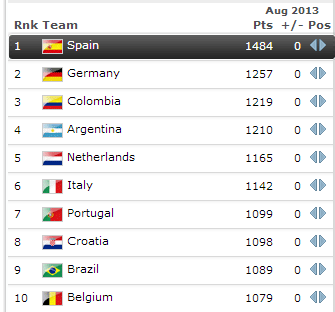
// The animation starts with showing the FIFA World Rankings, on row 20, then scrolls up to number 1 where Spain is at. Afterwards, the World ranking chart transitions into another chart where it shows the recent Euro Cup and World Cup winners. Most recent three rows would be: 2008 – Spain, 2010 – Spain, 2012 – Spain
The Spaniards have never been ranked number one in the world until they won Euro Cup 2008, and haven’t lost that spot ever since. They are the obvious contenders of this because of their success in Euro Cup 2008, World Cup 2010 and Euro Cup 2012. If we had to pick one of the three tournaments to breakdown and analyze the strategy of the Spanish team, it would be the world’s most widely viewed sporting event: the World Cup.
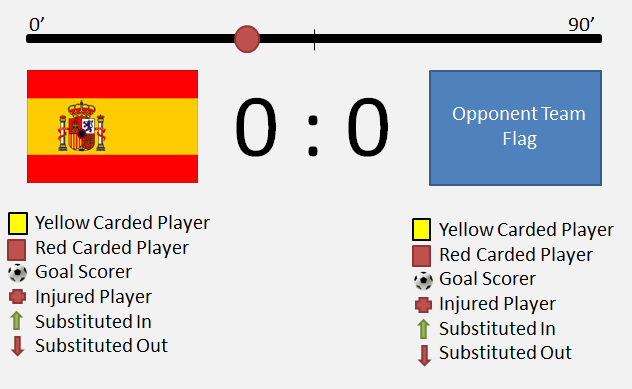
// As the rankings’ animation fades out, the 7 games that Spain played in the World Cup comes on the screen one after the other chronologically. On the top of the flags there’s the time bar. As the red dot (timer) travels from the beginning to the end, the score changes whenever a goal is scored. Also other stats such as yellow/red cards, injuries and substitutions appear on the screen as the timer continues its travel. New stats are added underneath the old ones as the timer goes on. When one game is over, the flag fades out, and the next opponent’s flag fades in. After that, the next game starts. This goes until the final game against Netherlands.
Spain’s World Cup journey started with a surprising loss against Switzerland when the Swiss shocked kings of Euro 2008. “They played very far back and tried to counter-attack. They defended very well.” said Vicente del Bosque, the Spanish coach after the game. The Swiss knew that they couldn’t beat Spain in a fair game, thus they sat back for the whole 90 minutes, giving 63% possession to Spain and scored from one counter-attack.
However the Spanish side bounced back quickly with two wins in the group stage, beating their easy opponents, Honduras 2:0, and Chile 2:1. They made it to Top 16 as the winners of their group, Group H and matched up with Portugal, their neighbors. David Villa ended the Portuguese dreams with a 63rd minute goal and took his team to the next stage. Even though the game ended 1:0, the Spanish Fury dominated the 90 minutes with 19 shots against 9, and a 60% possession.
Matching up with a fairly weaker side, Paraguay, they made it to the semi-finals with another 1:0 win. In the semi-final game, they not only did not let the German side that had a 2.4 goals per game average from scoring, but also crushed their hopes by a late header from Carles Puyol in the 74th minute. This was the only set piece goal for Spain, where as all the other ones were scored in open plays.
The final game of the World Cup was a low scoring game as usual Spain. The 90 minutes ended 0:0 and the two sides went to extra time to determine the winner. Andres Iniesta scored the last goal of the tournament in the 116th minute and put Spain on top of the world.
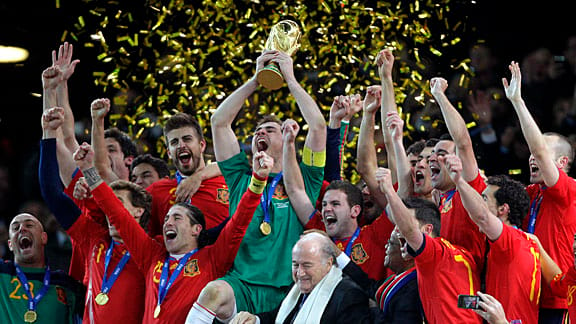
// This would be a slow-motion video footage of Spain raising the trophy.
Even though the low scoring games didn’t satisfy the enthusiastic football fans all around the world, Spain surely deserved the trophy by keeping the ball in majority of every game, and passing extraordinarily well. This 6 game winning streak should be considered as a 12 year investment that goes back to the Spanish Under-21 team in the 2000s.
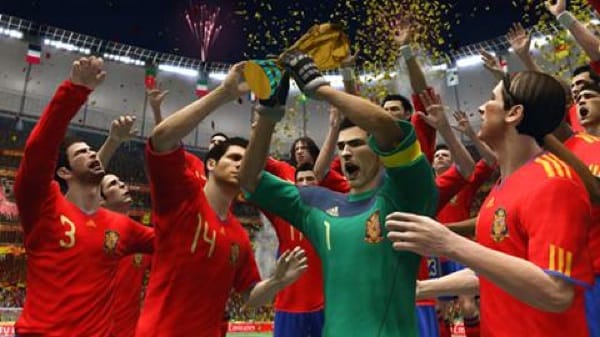
// The final image of the video footage transitions into an animated/graphic picture of the team raising the World Cup trophy. As the narration begins everybody apart from the football players themselves disappear from the shot. Synchronized with the narration, as the narrator mentions a player’s name, that player disappears from the shot.
Among the 23 player squad, 15 of the players had significant playing time from their coach del Bosque. Pepe Reina, Victor Valdes and Raul Albiol didn’t get any playing time. (//Those three players disappear on the shot) Carlos Marchena, Juan Mata, Alvaro Arbeloa, Fernando Llorente and Javier Martinez were the substitute players who got less than 30 minute playing time in the total of 7 games leaving the team with 15 core players. (//Those five players disappear from the shot)
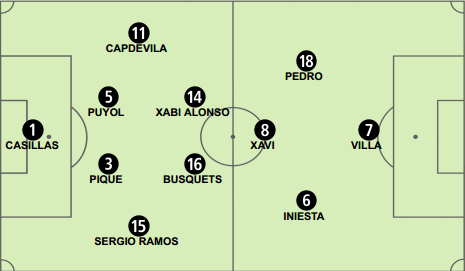
// The camera zooms out from the last image, tilts up to see the Johannesburg stadium from a birds-eye-view. All the 15 players are seen as circles lined up in the middle of the field. As the narrator explains the lineup the players take their places on the field or in the bench.
Among core 15, Cesc Fabregas, Fernando Torres , David Silva and Jesus Navas have been the consistent subs for the 7 games. (// Those players’ circles move to the bench, and the rest 11 circles line up in a 4-3-3 formation) Regardless, they all have contributed significantly for the team. The reason why these guys play so well is because they have been playing with or against each other for the longest time. Compared to other Top 10 countries in the world, Spain has the most players playing in their local league. Spain only has two players in the team who play abroad; Fernando Torres in Liverpool, England and Cesc Fabregas in Arsenal, England. (// Spanish flags pop up next to every player that plays in Spain, the English flag pops up for Torres and Fabregas) Because the players know each other so well, from playing in the same league throughout their major league careers, they’re pass completions are off the charts. Out of the 13 players who were playing in Spain, 6 of them were playing for Barcelona, 2 of them for Real Madrid, 2 for Valencia, 1 for Villareal and 1 for Sevilla. (//The flags move up a little, and the club team logos fade in). So 6 of the 15 important players of the team, more than 30%, has already been playing together every season for the last couple of years! That is why they know each other very well and they dominate the possession every game. Looking at the players’ youth careers, we can see 7 of them were playing for Barcelona, so technically they knew each other since they were kids. (// Youth team logos join in the shot) Overall, every member of the team played for the Under-21 Spanish team in 2000s which is not just another indication of them knowing each other, but also an indication of their youth. Since tournaments like Euro Cup and World Cup are being played once every four years, having a young team helps the team to keep the players for more than one or two tournaments. That’s why this line-up was almost the same in 2008 and 2012 as well.
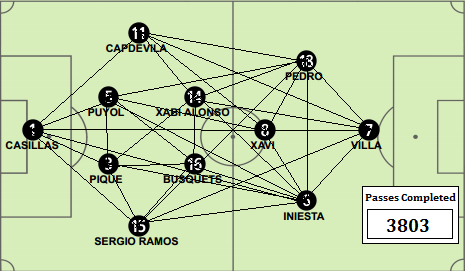
// The flags and club logos disappear. As the narrator talks about the line-up not having any strikers, the animation zooms in to the three players on the top and their original positions appear as a text next to them. Later when the narrator starts talking about the passing stats, the animation zooms out, a ticker appears on the right bottom corner. Every time a line is drawn from one player to another, one pass is completed. The lines start to get drawn slowly, as the ticker goes up slowly. Then it speeds up and stops at 3803, which is the amount of completed passes for Spain in the tournament
Apart from the familiarity within the team, the other thing that made Spain stand out from the other teams was their line-up. Coach Vincent del Bosque did not call any strikers to the squad except for Fernando Torres who only played 3 games. His strategy was tagged as ludicrous, insane and foolish. In his line-up, he put Pedro, Andres Iniesta and David Villa to the top, who all play winger or attacking midfielder positions for their club teams. Villa, who was on the very top, was playing as a defensive forward who ran back every time the possession was lost. By going out to the game with 4 defenders and 6 midfielders, del Bosque aimed to keep the ball throughout the game, complete more passes than the opponent, and strike whenever the opponent is napping. Soon enough the critics realized his tactics were nothing short of pure genius.
Del Bosque efficiently used all of his midfielders in the squad, and the Spanish team ended up dominating the possession stats in every game they played. In 7 games, the team completed 3803 passes by becoming the team with most completed passes in the tournament. In the second place Germany had 2865 passes complete, almost 1000 less than Spain. Also Spain’s passing completion average was the best with 80%, beating Brazil in the second place by 79% (out of 2254 passes).
(//The passing lines and the ticker disappear from the shot. They are replaced by the goals scored. For every goal the build-up passes are indicated with lines. One line leads to another one… This animation is repeated for all the 8 goals Spain scored in the tournament)
Spain’s lack of strikers caused them a little trouble with scoring. They had only 8 goals in 7 games, with a 1.14 goals per game average, they’re 6th best team in the tournament. Germany, ranking number 1, had 2.28 goals per game by doubling Spain’s amount of goals scored. It shouldn’t be a surprise that 7 of the total goals Spain scored were in open play, because of their exhaustive passing routine. Also, 6 of the goals were scored inside the box, which shows that they always went for the extra pass inside the box.
The Spanish team made up their lack of scoring with their excellent defense. They only allowed 2 goals, both out of the penalty area and averaged a 0.28 goals allowed per game. Since they didn’t have any strikers who rarely come back to defense, their massive midfield squad swept away any counter attack threats. On top of that, del Bosque made sure he didn’t disturb the harmony of his defensive line no matter what, by not substituting any of the four defense players or the goalkeeper out of the game throughout the tournament.
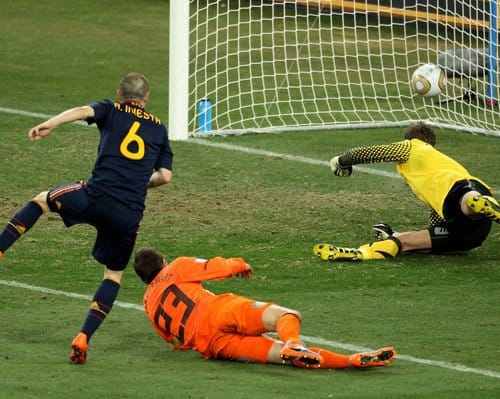
// A slow-motion video footage of Andres Iniesta scoring the last goal of the tournament, the goal that brought Spain the World Cup.
In conclusion, the familiarity that the Spanish players had managed to beat the super talented players of other countries. Del Bosque’s brilliant midfield strategy brought the World Cup to his homeland for the first time in their history.
Discussion
This animation would serve as a great analysis that can be shown on any of the sports networks when the time comes for the World Cup in 2014. Unlike any other major sports in the United States, soccer has the least amount of stats. Especially in Europe and Latin America, soccer stats are pretty simple and most of the times ignored. Player skill that cannot be broken down into stats (so as the fans think) are much more interesting the people. However, putting together animated information graphics like I did in this project, can point out very interesting data about the sport itself.