Judith beheads Holofernes
In my search for a subject to write my analysis on, I came across an astonishing and terrifying painting. The more I looked into it, the more interesting it became.
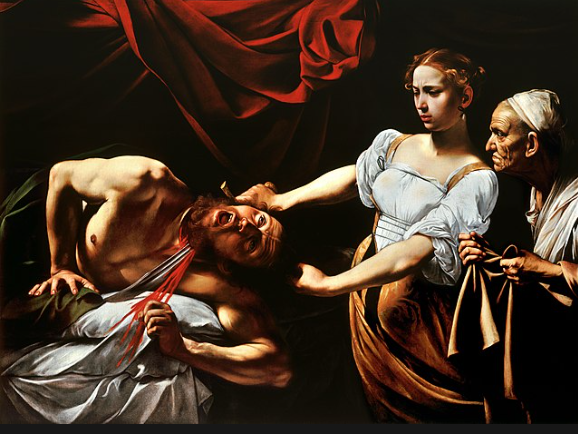
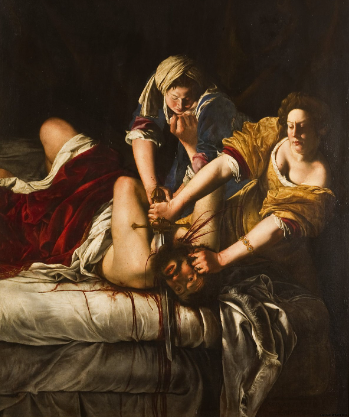
Judith beheading Holofernes is a very well-known biblical theme. The heroine Judith kills Holofernes, a man who wanted to invade her city. And I have to say that many important works of art have been created on this theme, but for me the most important were the painting by Caravaggio, painted in 1598-1599, and by Gentileschi in 1612-1613. They belong to the late Renaissance, and the similarities between them are as clear as the differences. They have the same style. Artistically, we can say that they both use chiaroscuro painting, i.e. the dark background contrasts with the light shining directly on their subjects. In both paintings, the colors are bright and vibrant, the brushwork is polished and clean, not to mention the composition… In both paintings we see two main characters and a maid, Holofernes is lying down while two women stand over him and Judith slays him with a sword in sleep. There are some differences within these compositions which, all in all, have a great effect and are very important in my opinion.
The contrast between the relationships of the individual figures to each other is enormous, and this naturally has an important influence on the tone of the painting. In both paintings we see action, struggle for life. I think we can even say that it is Holofernes' last blow before his death. In Gentileschi's painting, he grabs the maid by the chest and that's why she has to hold him down. Jydith also holds him with one hand, so he is not completely passive as in Caravaggio's painting. “The final blow” with Gentileschi makes the painting even more brutal. But my blood ran cold when I saw Judith's expression. The artist paints a woman who is determined, it was planned, she is not fearful, she is angry and vengeful. The heroine, if we can call her that, is not a victim, she is a perpetrator. Can you imagine a woman who represents a woman in the Renaissance, or at all, as a cold-blooded murderer? And if you look into it, you will find that her work is full of violence, which is spectacular for women in her time. It's also interesting that her focus is on violence, clasped hands and a matter of life and death. Why does she put so much emphasis on physical violence ?
With Caravaggio, I have to say that the focus is on Judith, who looks completely different. The pale white color of her skin and her white dress make her look divine, like a goddess, and her facial expression is even more different from that of Gentileschis Judith. Caravaggios judith looks disgusted and confused and her body language expresses this as well. The maid next to her does not look like an accomplice, but like the devil sitting on her left shoulder, while the maid with Artemisia is the right side of Judith and completely involved in the violence. I find this very interesting, perhaps because it shows two different views of a heroine. In one she is a completely innocent, divine being who would never think of violence, and “the devil made her do it...", and in the other she is a human being, a woman in whose face we can see anger and rage, which is completely understandable given the circumstances.
Overall, both paintings are spectacular, and I am glad I can see at least one in the flesh.