Example: Chat GTP & SEO
1. Generate a list of relevant keywords for a website about company that provides agricultural products
Example:
Specific Products and Technologies
- Hybrid seeds
- Biofertilizers
- Eco-friendly pesticides
- Tractors and farm vehicles
- Drip irrigation kits
Sustainability and Environmental
- Eco-friendly farming products
- Renewable energy in agriculture
- Carbon neutral farming solutions
- Biodiversity in agriculture
- Conservation agriculture products
- Regenerative agricultural practices
- Climate-resilient farming
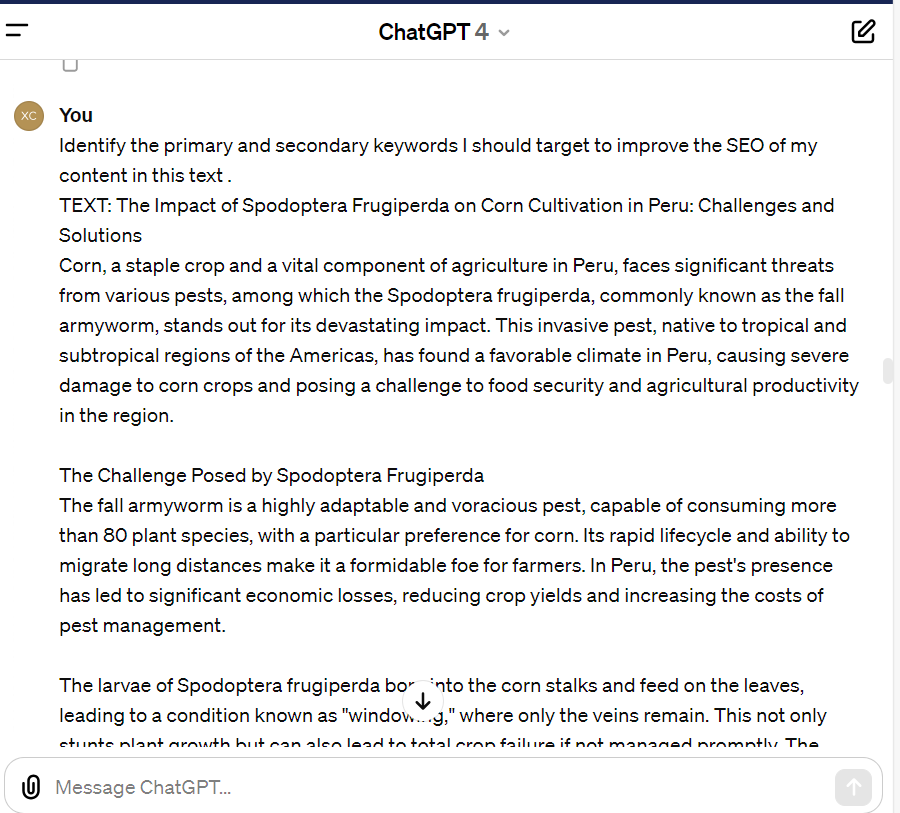
2. Write a blog post about the impact of spodoptera frugiperda in Corn cultivation (Peru)
The Impact of Spodoptera Frugiperda on Corn Cultivation in Peru: Challenges and Solutions
Corn, a staple crop and a vital component of agriculture in Peru, faces significant threats from various pests, among which the Spodoptera frugiperda, commonly known as the fall armyworm, stands out for its devastating impact. This invasive pest, native to tropical and subtropical regions of the Americas, has found a favorable climate in Peru, causing severe damage to corn crops and posing a challenge to food security and agricultural productivity in the region.
The Challenge Posed by Spodoptera Frugiperda
The fall armyworm is a highly adaptable and voracious pest, capable of consuming more than 80 plant species, with a particular preference for corn. Its rapid lifecycle and ability to migrate long distances make it a formidable foe for farmers. In Peru, the pest's presence has led to significant economic losses, reducing crop yields and increasing the costs of pest management.
The larvae of Spodoptera frugiperda bore into the corn stalks and feed on the leaves, leading to a condition known as "windowing," where only the veins remain. This not only stunts plant growth but can also lead to total crop failure if not managed promptly. The pest's rapid reproduction rate and resistance to many conventional pesticides further complicate control efforts, making it a persistent threat to corn cultivation.
The Economic and Social Impact
The economic repercussions of Spodoptera frugiperda infestations in Peru cannot be overstated. Corn is not only a direct food source for the population but also a critical input for the livestock industry, affecting both human and animal food chains. The increased costs of pesticides, coupled with the potential for reduced yields, can significantly impact farmers' livelihoods, especially smallholders who are less equipped to manage such threats.
Moreover, the pest's impact extends beyond individual farms, threatening the overall agricultural output and food security of the region. The loss of corn crops can lead to increased food prices, affecting the most vulnerable populations and potentially leading to social and economic stress.
Strategies for Management and Control
The battle against Spodoptera frugiperda in Peru requires a multifaceted approach, combining traditional agricultural practices with modern scientific research. Key strategies include:
-
Integrated Pest Management (IPM): This approach combines biological, cultural, physical, and chemical tools in a way that minimizes economic, health, and environmental risks. IPM strategies may include the use of natural predators, crop rotation, and the planting of pest-resistant corn varieties.
-
Biological Control: The introduction or encouragement of natural enemies of the fall armyworm, such as parasitoids, predators, and pathogens, can help reduce its population. Research into specific biological control agents suited to the Peruvian ecosystem is ongoing.
-
Genetic Advances: Developing and deploying genetically modified corn that is resistant to Spodoptera frugiperda is a promising avenue. These crops can reduce dependency on chemical pesticides, though they require careful regulation and public acceptance.
-
Community and Governmental Efforts: Awareness campaigns, farmer education, and government support in terms of research funding and emergency response mechanisms are crucial. Collective action can enhance surveillance and quick response to outbreaks.
-
Innovative Technologies: The use of drones and satellite imaging for monitoring crop health and pest infestations can provide early warnings and help in targeted pesticide application, reducing costs and environmental impact.
Conclusion
The impact of Spodoptera frugiperda on corn cultivation in Peru is a pressing issue that requires immediate and coordinated action. By combining traditional knowledge with scientific innovation, it is possible to manage this pest effectively and ensure the sustainability of corn production in Peru. The challenge is formidable, but with continued research, investment, and collaboration among farmers, scientists, and policymakers, it is a challenge that can be met. The future of corn cultivation in Peru depends on our ability to adapt to and overcome threats like the fall armyworm, safeguarding food security and agricultural livelihoods for generations to come.
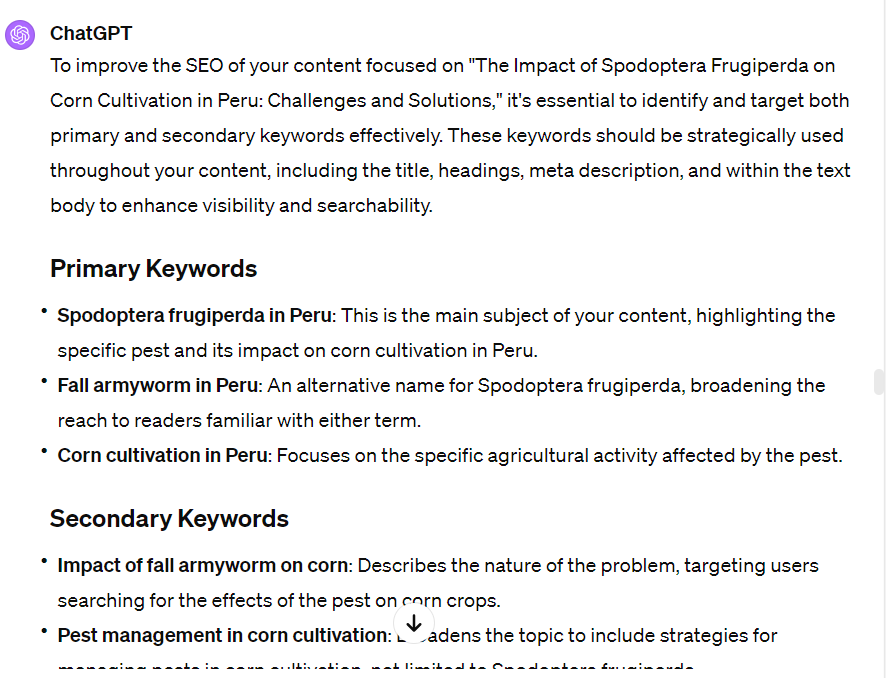
3. Identify the primary and secondary keywords I should target to improve the SEO of my content in this text .....
Primary Keywords
- Spodoptera frugiperda in Peru: This is the main subject of your content, highlighting the specific pest and its impact on corn cultivation in Peru.
- Fall armyworm in Peru: An alternative name for Spodoptera frugiperda, broadening the reach to readers familiar with either term.
- Corn cultivation in Peru: Focuses on the specific agricultural activity affected by the pest.
Secondary Keywords
- Impact of fall armyworm on corn: Describes the nature of the problem, targeting users searching for the effects of the pest on corn crops.
- Pest management in corn cultivation: Broadens the topic to include strategies for managing pests in corn cultivation, not limited to Spodoptera frugiperda.
- Integrated Pest Management (IPM) in Peru: Targets readers interested in IPM strategies specific to the Peruvian context.
- Biological control of Spodoptera frugiperda: Focuses on biological methods to combat the fall armyworm.
- Genetically modified corn for pest resistance: Attracts interest in genetic solutions to pest problems.
- Agricultural technology in Peru: Captures a wider audience interested in technological advancements in agriculture within Peru.
- Economic impact of pests on agriculture in Peru: Addresses the broader implications of agricultural pests on the economy.
- Sustainable farming practices in Peru: Engages readers interested in sustainable agriculture.
Tips for Keyword Optimization
- Title and Meta Description: Include primary keywords in your title and meta description to ensure they are visible in search results.
- Headings and Subheadings: Use both primary and secondary keywords in headings and subheadings to structure your content and signal its relevance to search engines.
- Keyword Integration: Naturally incorporate keywords into your text, avoiding overstuffing, to maintain readability and engagement.
- Long-tail Keywords: Consider long-tail keywords like "how to control Spodoptera frugiperda in corn crops" to capture more specific search queries.
- Related Terms: Include synonyms and related terms, such as "agricultural productivity in Peru" and "crop yield losses due to pests," to cover a broader range of search intents.
By focusing on these keywords and employing SEO best practices, you can enhance the online visibility of your content, reaching a wider audience interested in agricultural challenges and solutions in Peru.