Knowing My Art!
This is just the beginning of my project. I am just going to start answering as much as I can in sessions, as I am able. It is easier for me to answer these by typing directly into the project and including some images to visualize what I am talking about!
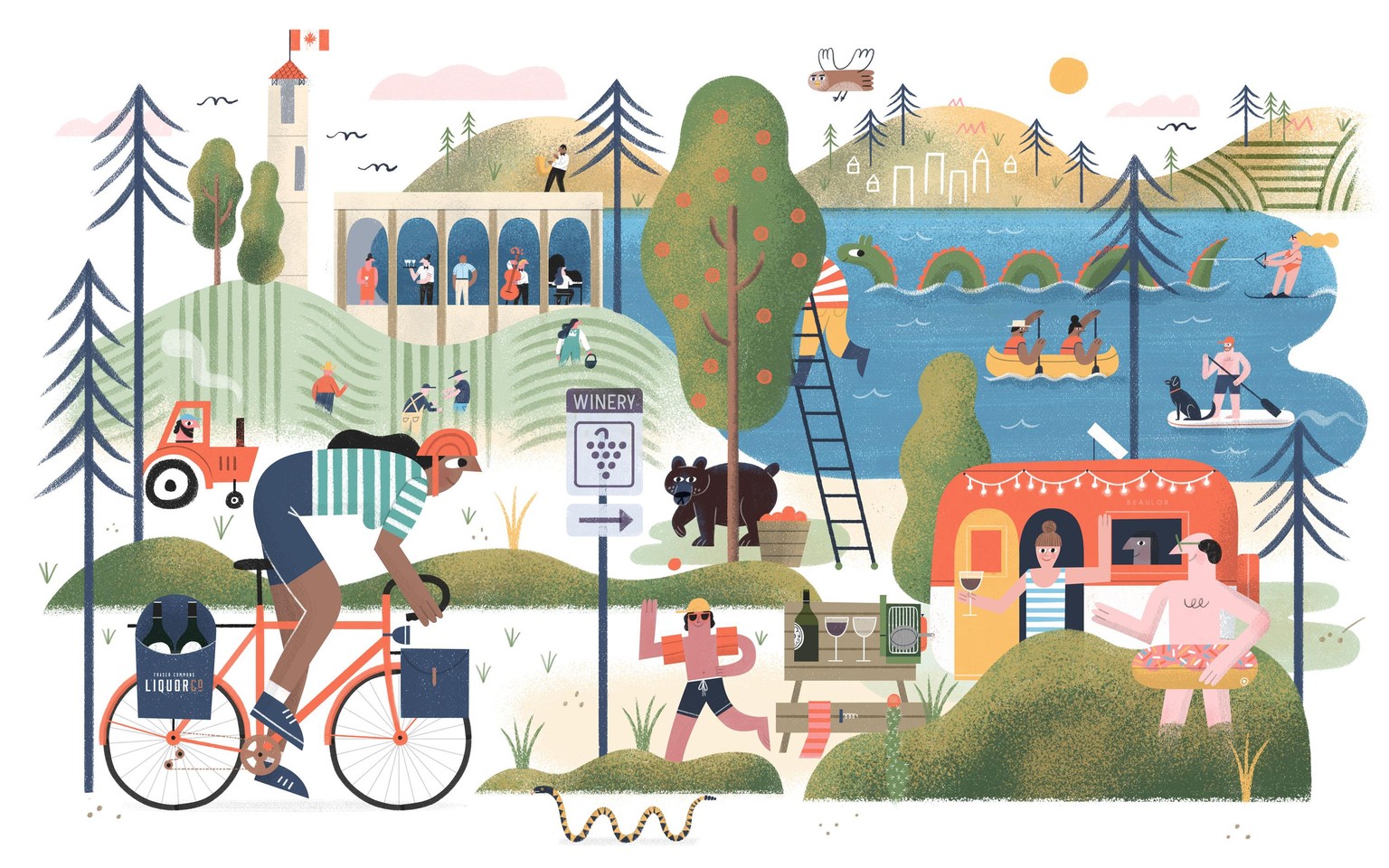
My Virtuosity
- My work has printy textures, bright colours, and is punctuated with darker lines and details. It is shape based, rather than built up using outlines. The line quality is hand/analogue influenced. I often use a custom nib pen brush (in Photoshop) that mimics a physical one I used to use a lot. I often include hand lettering. My maps are characterized by these same qualities.
- My work is fun, quirky, energetic. Sometimes it's sweet and charming. On my website, I describe it as "lively and buoyant". It definitely has a sense of humour and does not take itself too seriously!
- My work these days is often based more around a mood within a specific context, rather than a concrete idea. For instance, it might be about "the art of winemaking in BC". The mood is built up by placing characters, often many of them, in the same scene, in an arrangement that is more fantastical and designed than a literal representation of reality. It is always stylized and never realistic. While occasionally in my commercial work it is conceptual, it is typically more about mood and pictures rather than ideas. Alongside my scenes and characters, I also specialize in illustrated maps, using the same elements and styles, but in a way that blends storytelling and information design.
- My illustration work is most at home in picture books, murals, posters, prints, and for certain editorial applications. I've also done packages and advertisements as well.
- I make my illustrations in Photoshop using a handful of digital brushes that I have put together over the years. They are a mix of brushes that give me a sort of "printy" texture, and various pencil, nib pen and flat brush inspired brushes that remind me of ones I used to use when I worked most in physical media. I also rely heavily on the Pen Tool (vector masks) in PS. Over the years, I have also become totally reliant on using Procreate on my iPad to sketch. I used to have to draw on sheets of paper and use a light table to iterate over them, and then scan them in.
It is important for me to be able to work in Photoshop using the brushes I am used to working with, along with the Pen Tool. If I couldn't use these, I would have a hard time making work that felt the way I want. That's why, for instance, I don't use Illustrator, because there is limited texture/analogue-feeling capability.
My art goes through the stages outlined in this class. I start by knowing what my job/goals are, and then do some research, and that flows into O-mode sketches, then I-mode, where I come up with my ideas. I present those to the client, and they choose one, and I build it out in Photoshop. In my client work it's important to have client sign off before I move onto next steps. I rely on the client's approval to confidently move from sketch to finish, for instance. - A smaller project will take me at least 1 week. I am a slower worker and prefer not to be rushed. I don't do great work if I don't have time to let my full process play out. I need one or two days to make a bunch of bad stuff so I know how to make it better. I need time between these stages to get out of my head and come back to the work with fresh eyes. The ideal time frame gives me enough time to do this, without it dragging on too long and giving me too much time to over-think.
- I definitely prefer to work alone. When I'm working on sketches I typically need word-less music or silence. Then when I get into realization, I can listen to podcasts or music with words, like hip hop, or even a show in the background. This proves I'm using two different modes of my brain for sketches and finals respectively.
My Vision
tk
My Value
tk