CommerceFlowDB Database
CommerceFlowDB: A Comprehensive MongoDB Project for E-commerce Operations1. Introduction
CommerceFlowDB is a MongoDB-based database designed to manage key operations in an e-commerce environment. It is structured to store, organize, and retrieve essential data related to employees, products, and customer orders. This database serves as a foundation for managing the interactions between the business, its workforce, its product inventory, and its customers, enabling seamless data handling across different areas of an e-commerce platform.
2. Purpose of the Database
The primary goal of CommerceFlowDB is to provide a streamlined and efficient way to manage an e-commerce platform's core components:
- Employees: Track staff members and their roles within the company.
- Products: Maintain a catalog of products available for purchase, including pricing, descriptions, and discounts.
- Orders: Handle customer orders, linking products with customer and employee information for a comprehensive overview of the sales process.
This database is designed to support business operations, including:
- Tracking employee performance and roles in sales.
- Monitoring product availability, pricing, and discount structures.
- Managing customer orders, including their status, delivery, and related employee assignments.
3. Database Structure
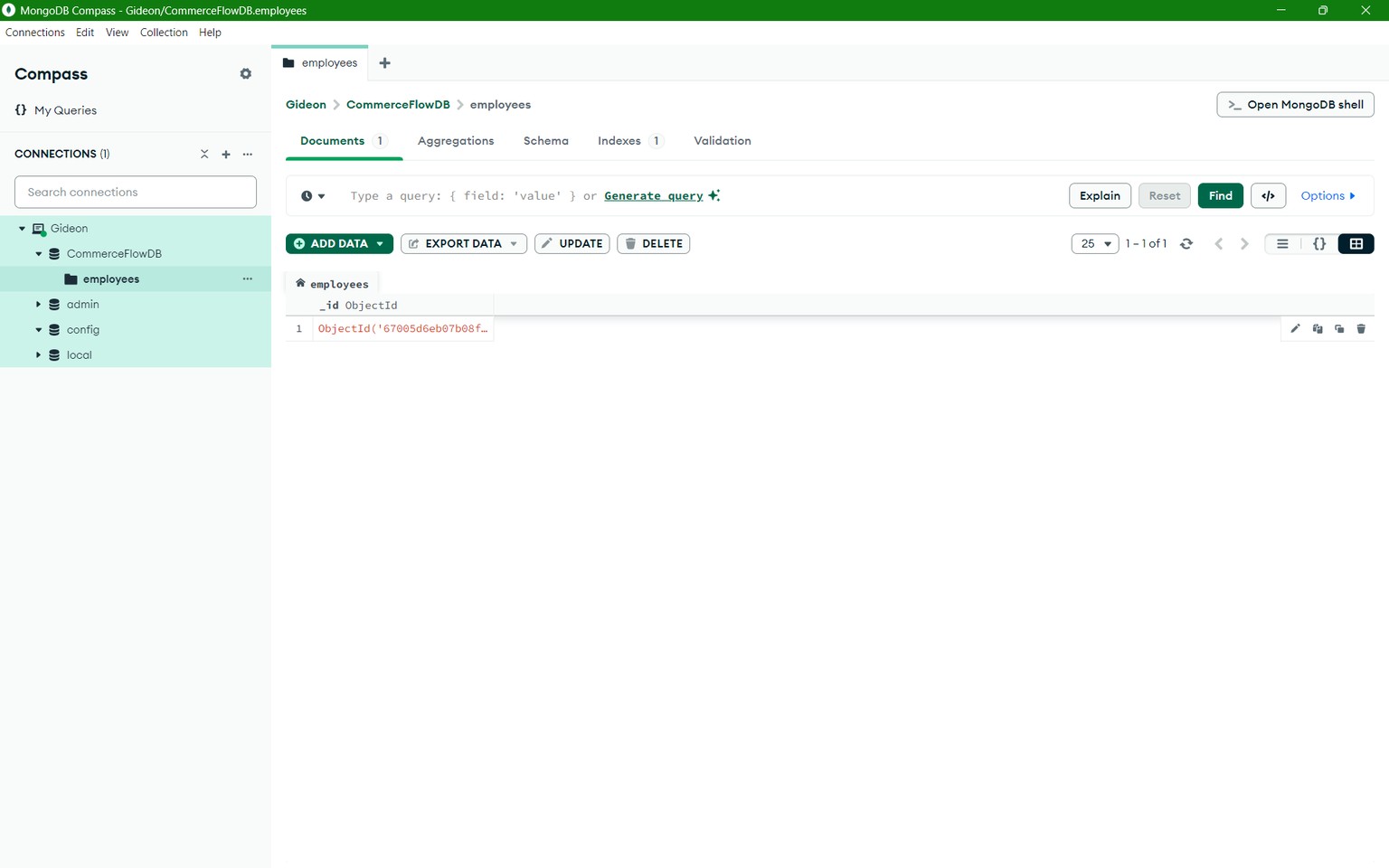
CommerceFlowDB consists of three main collections: employees, products, and orders. Each collection is designed to store specific data relevant to its role in the e-commerce ecosystem.
Employees Collection
The employees collection stores data related to all staff members involved in business operations. Key fields include:
- _id: A unique identifier for each employee.
- name: The full name of the employee.
- department: The department in which the employee works (e.g., Sales, Marketing, Accounting).
- email: The employee’s email address.
- gender: The gender of the employee.
- job_title: The employee’s role or job title.
- salary: The employee’s salary.
Example Document:
{
"_id": 7782,
"name": "Richmound Delnevo",
"department": "Training",
"email": "rdelnevo0@chron.com",
"gender": "Male",
"job_title": "Senior Cost Accountant",
"salary": 4890
}
This collection allows for querying employee details, tracking staff across various departments, and monitoring salaries and job roles.
Products Collection
The products collection manages the inventory of items available for sale. Key fields include:
- _id: A unique identifier for each product.
- category: The category of the product (e.g., Vegetables, Dairy, Grains).
- name: The name of the product.
- brand: The product brand.
- description: A brief description of the product.
- quantity_per_unit: A description of the quantity per unit of sale (e.g., 1 KG, 500 GM).
- unit_price: The price per unit of the product.
- picture: A URL link to the product image.
- discount: Any applicable discount on the product.
Example Document:
{
"_id": 1,
"category": "vegitable",
"name": "Onion",
"brand": "Fresho",
"description": "Onion - Medium",
"quantity_per_unit": "1 KG, approx. 10 to 12 nos",
"unit_price": 45,
"picture": "http://mybasket.vinod.co/images/10000148_13-fresho-onion-medium.jpg",
"discount": 22
}
This collection allows the business to manage its inventory, track product categories, and adjust prices or discounts as needed.
Orders Collection
The orders collection tracks customer purchases, linking products, customers, and the employees handling the orders. Key fields include:
- _id: A unique identifier for each order.
- orderDate: The date the order was placed.
- requiredDate: The date by which the customer requires the order.
- deliveredOn: The date the order was delivered.
- customer: An embedded document that stores customer information, including customerId, customerName, contactPerson, and city.
- employee: An embedded document that stores the employee handling the order, including name and jobTitle.
- products: An array of products included in the order, with each item having its own name, category, price, quantity, and discountPercent.
Example Document:
{
"_id": 10248,
"orderDate": ISODate("1996-07-04T00:00:00Z"),
"requiredDate": ISODate("1996-08-01T00:00:00Z"),
"deliveredOn": ISODate("1996-07-16T00:00:00Z"),
"customer": {
"customerId": "VINET",
"customerName": "Vins et alcools Chevalier",
"contactPerson": "Paul Henriot",
"city": "Reims"
},
"employee": {
"name": "Steven Buchanan",
"jobTitle": "Sales Manager"
},
"products": [
{
"name": "Queso Cabrales",
"category": "Dairy Products",
"price": 14,
"quantity": 12,
"discountPercent": 0
},
{
"name": "Mozzarella di Giovanni",
"category": "Dairy Products",
"price": 34.8,
"quantity": 5,
"discountPercent": 0
}
]
}
This collection allows the business to track each order from the point of sale to delivery, including the products purchased, customer information, and the employee responsible for managing the order.
What CommerceFlowDB Can Do
The CommerceFlowDB database provides the following functionalities:
-
Employee Management:
- Track employees by department, job title, and salary.
- Retrieve information on employees handling specific customer orders.
-
Product Inventory Management:
- Maintain a product catalog with categories, prices, and discounts.
- Easily update prices and monitor stock for various products.
-
Order Processing and Tracking:
- Handle customer orders with details about the customer, products ordered, and delivery timelines.
- Monitor which employees are responsible for specific orders and customer service interactions.
-
Reporting and Queries:
- Generate reports on employee performance (e.g., how many orders an employee managed).
- Track product sales and identify trends in customer purchasing behavior.
- Monitor product discounts and inventory turnover.
Query Capabilities
Here are some of the common queries that can be run on CommerceFlowDB:
Get all employees in the Marketing department:
db.employees.find({ department: "Marketing" }).pretty()
List all products with a discount greater than 10%:
db.products.find({ discount: { $gt: 10 } }).pretty()
Find all orders handled by a specific employee:
db.orders.find({ "employee.name": "Steven Buchanan" }).pretty()
Fetch orders for a specific customer:
db.orders.find({ "customer.customerId": "VINET" }).pretty()
Conclusion
CommerceFlowDB is a well-structured, easy-to-use MongoDB database designed to streamline the operations of a small to medium-sized e-commerce platform. By integrating data on employees, products, and customer orders, the database provides a comprehensive solution for tracking business operations. Its simplicity allows for efficient query performance, while its flexibility ensures that new data can be easily added or modified as business needs evolve.
This database is perfect for anyone looking to manage business processes related to employee management, product inventory, and order tracking, all in one cohesive and scalable environment.