Transcripts
1. Why Writing Matters: I'm in struggled for creatives, can be knowing
what you should be doing to market yourself. Pitching emails,
sending newsletters, blog posts, social
media, and more. Without addressing a key piece
to successful marketing. Good writing. My name
is Shayna cell and I'm a marketing professional by day and illustrator by night. And I want to help you improve your writing
in this class. All those examples I gave are reliant on the written word. So why does writing matter? Strong writing makes you look professional and
shows that you care. It says that you're a
trusted source in your field and you know what you're
talking about because you do, it makes your intentions
clear and tells potential clients and customers who you are and how
you can help them. This class is for anyone
that dreads writing, spots, spelling and grammar
mistakes too late, or you just need to refresh. You don't have to be an
English major to write well, in this class, I'll start
with my writing process. Share what not to
do and what to do. Give you a proofreading
checklist. And as a bonus lesson, share the tools and resources
I use to polish my writing. You'll use this process
for your class project, where you'll rewrite
a past piece of writing that you're
not satisfied with. Ready to up your writing game. Let's get started.
2. Class Project: Before we get started, I want you to pause
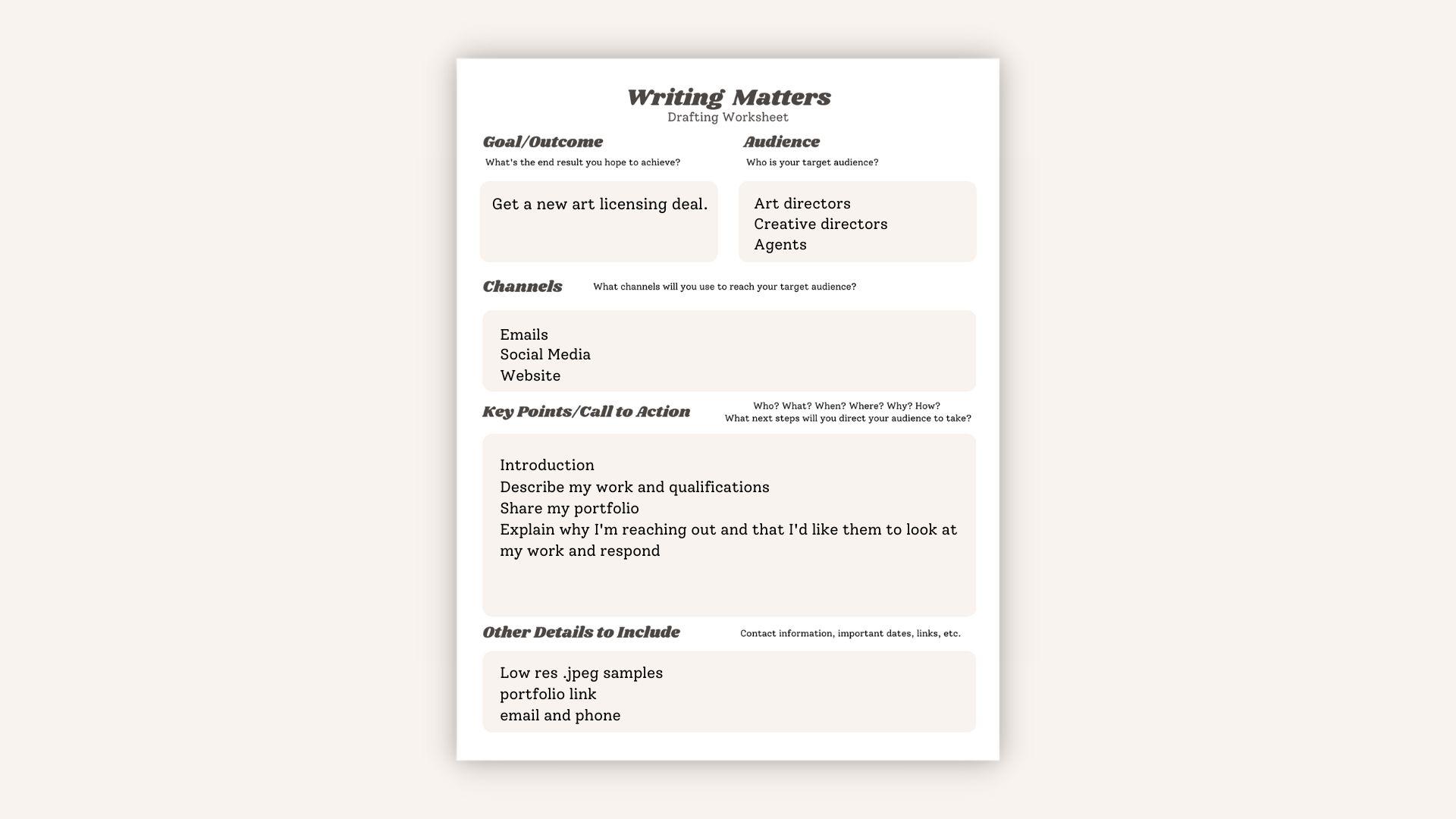
this class and download the worksheet in
the projects and resources tab
underneath the video. You'll fill out the sheets
throughout the class to help guide your writing for
project you're working on. Alternatively, you can dig up a piece of old writing
that you know could be improved and use the process in the class to
revisit your old work. Upload your final work
in the class projects.
3. Goal/Outcome: The first thing that
I like to do before I start any writing project is really narrowing down the goal or outcome
of my writing. Even if it may seem obvious, it can still be really helpful. I've come up with four
different scenarios that we're going to go
through in this class. And you can follow along
with your worksheet. The first example I have is a goal of getting a new
art licensing deal. The next scenario is
figuring out how to tell your story as an artist on
your portfolio or a website. Or maybe you're launching
a new product for your creative business and you need to connect with
your customers. The final scenario we'll
cover is if you're looking to show your work at an
art show or gallery. So whatever your goal is, go ahead and write it
down on your sheet. This will just be our north star to guide us throughout
the process.
4. Audience: Next we're going to
focus on your audience. So really narrowing
down to who you're speaking to and who
you want to reach. So if you're looking to
find a new licensing deal, that could mean art directors, creative directors,
maybe even agents, people along those lines. So when thinking
about your portfolio, Who was that portfolio for? That can be pretty
wide reaching. So maybe it's future customers. It could still be art directors. It could be gallery owners, maybe buyers for
retail or boutique. So when we're talking
about online portfolio, your audience is probably
going to be a lot broader. If your goal is to
launch a new product, you definitely want to
reach the right people. So that could be
existing customers, maybe your most loyal
fans on social media, friends and family, and then anyone else that you would consider your target audience. E.g. if you do surface
pattern design for fabric, maybe your target
audience are filters. So you would want to make
sure to find a way to reach them and connect with
that specific audience. Then finally, we have our
example of the art show and gallery that's gonna
be much more narrow. So we're talking about a gallery owner or
maybe art curators, or maybe a jury. If it's a jury
selection process, whatever your goal is, will determine who
your audience will be. For your project, you'll want to make
sure that you're really targeting the audience that's specific to what you're
trying to accomplish.
5. Channel: One part of making
sure that you're connecting to your audience, making sure you're connecting
to them in the right way. So that's going to lead
us to your channel. So it's our first example that's probably
going to be e-mail. Obviously, you can also go to art shows and present there. Since I want to keep this class focused on the writing aspect, we're just going to talk
about pitching emails to art directors for that
example, for your portfolio, this is probably going
to be an About Me page, specific area on your
website where you're talking about you and who
you are as an artist. Another example could
be a press kit if you're reaching out to
a magazine or a blog, something like that
for some publicity. When it comes to your customers, you really want to connect with those specific people that we talked about in the
previous lesson. So a great way to do that
could be a newsletter. If you have one, if you don't, maybe it's time to
think about adding one. Then obviously, social media
is going to be a great place to share your product with
your fans and followers. And then with the
gallery example, your channel will probably be a written artist's
statement or artist bio. So whatever project
you're working on, this is where you
want to identify how you're going to reach
your target audience. Is that going to
be through e-mail, social media, maybe it's a postcard depending
on the situation. So think about what
will work best for you and what
your end goal is.
6. Key Points: So the first few lessons
were a lot of setup. Now we're going to
narrow down what those key points
are that we want to convey to our audiences. And this will mean really
focusing on the who, what, when, where, why and how. This is also where you'll
identify any calls to action. So basically narrowing down what next steps you want
your audience to take. Let's take a look at
our first example. Obviously, you're going to
want to introduce yourself if you're e-mailing someone
for the first time, they have no idea who you are. So brief intro
will be important. You also will want to give your qualifications or
describe your work so that they know where you're
coming from and why they should be interested in you and working with you. You'll also want to
make sure to include any important contact
information as well as a link to
your portfolio. Or maybe you're attaching
a sample of your work. It's important to share
why you're reaching out. Even if you think it may be obvious why you're reaching out, you're still going to
have to explain yourself. You're not just saying hello and introducing yourself
for no reason. And finally, as we
talked about earlier, you'll need that
call to actions. So provide some clear next steps for what they need to do next. And you may not
hear anything back. That's okay. But we still want to make
sure that we're being really clear in how
we communicate. Our portfolio example
is going to be a little bit different because it's
going to be all about you. You're writing about yourself, which can be a
little bit tricky. So try to focus on
things that people will want to know if they're
reading your about me section. That could include who you
are, where you're from. Why do you do what you do? What inspires your work? What do you make? What are you available for? So if someone wants
to work with you, what are you actually
willing to do? And what are the
services you offer? And then of course, how
should people contact you? You want to make sure
that people know how to get in touch once
they're interested. So now that you've got
this amazing product that you're about to launch. You want to make sure that people know how it
can benefit them. So one of the most
important things is letting them
know exactly that. What problem does
your product solve, or how does it make
their life better? What are some specifics
about your product? If it's a piece of clothing, what's the material size,
everything like that. Bibi, you make art prints. Size is very important
materials used. Sometimes people might
want to hear about your process for
making that art piece. You can also identify how
your product is different, what sets it apart from
other people's work? And then, of course, how can someone purchase it? So we're back to that
call to action again. They love your work. They're so excited about your new products. How would they buy it? And then finally we have
our gallery example again. So this is that
artist's statement. And this is where
you're going to talk about yourself
and your work. So you start with
an introduction. You're going to focus on
what inspires your work. Why should your
work be selected? How was your work as something unique to the gallery or show? And depending on the show or gallery that you're
sending your work too, they may even have
specific questions or prompts that they
want to know about. Those will be very important for the key points in
your messaging. So now I want you to take some time to think about
what the key points are in the message that you're working on for the
class project. And write those down
on your worksheet.
7. Right Tools: Before you write anything, I want to underline this point. It's probably the single
most helpful one I have. And the ease to do write an Apps that are
meant for writing. Do not write as you design. What do I mean? Indesign Photoshop,
Illustrator, Canva, blogs, your website,
social media, etc, etc. These are all tools
and platforms for displaying and
organizing your work. They will not catch
your writing mistakes. And once writing becomes design, errors can become much
more difficult to spot. There's a reason why
graphic designers charge extra for
spelling corrections. So my advice to you is to
write in Google Docs or Word, you can't rely fully on tools, but it will keep things clean and your mind
free from the design. No distracting elements. If you need to write quickly, you can use the notes app on your phone and I
recommend getting it the most perfect you can
in a word processor first, the stakes are less high for captions on social
media or tweets. But if you're sharing
images with text in them, any mistakes will stand
out so much more. So please do all your
writing ahead of time. It can even be on a notepad. Or really I prefer
just a Google Doc, I promise you is so much easier to fix things
in a Google doc, then it will be to go
back as you're finishing a design or when you
spot a mistake, right? As you hit send on that e-mail.
8. Good Writing Essentials: Now that we've gone through a bunch of prewriting and have a basic outline and agenda for
what we're going to write. Let's talk about the
essentials of good writing. Some of these items are just common knowledge for
people who do a lot of writing. Some of these are from books
I've read in the past, and others are just things that I've learned along the way. So first let's talk about the single most important thing. And you may have
heard of this before. Sometimes it's
abbreviated as Smiths. But basically it's all about
saying what you need to say. You're not trying to hide your intentions or what
you're trying to do. We don't want a lot of preamble before we get into our writing. Especially if you're
sending something like a pitching e-mail, it's really important to get
to the point right away. Some other ways are
putting in this as your bottom line upfront, which is a military
phrase or something you may be familiar with from
school, your thesis statement. Even though you're not
writing an academic paper, you still want to have some kind of thesis or a main point. In a similar vein, you also want to
keep things very clear and concise
in your writing. So what does that mean? It can mean a lot of things. One could be overly
flowery language unless you already know poems. But in this case, we're really using this
for business purposes. We don't want to hide or obscure our message with extra words. It's also important not to ramble or use run-on sentences. We want people to
be able to read our work easily and
understand it right away. So we're not aiming for
some academic paper here. We're really trying to keep a lower grade level and keep
things straight forward. I have this quote here
from Bernie Brown, which you may have heard before, but I think about
it all the time. I work in marketing
and communications. Clear is kind of
unclear, is unkind. Now, you can probably apply this to a lot of life situations, but I think it's really
important in communications. Even if you have to
deliver bad news, it's much less kind. If you're not being
clear about it. Your clarity is
actually extremely helpful to the people
you're speaking to. Next, we really want
to think about knowing your audience and writing
for your audience. So this connects back to one of our earlier lessons where we identified who those people are. Your writing is going to
be different if you're pitching yourself
to an art director, then versus texting a friend. You also want to demonstrate that you care about
your audience. And I don't mean
that in a funny way. It just means knowing
who they are. Sometimes it's
just about letting someone know that you've done your research and you know
the basics of who they are, rather than making
blanket statements that don't really apply to them as an individual or so broad that they're
relevant to everyone. So it's really about
finding points of connection to your audience. And as you write to them, It's important to
think about your tone, how formal your
language should be or shouldn't, and word choice. This is especially important if you're writing
from a template. So you really don't want someone to know
that you're using the template is it should be
personalized enough to them. In the past, I've had jobs where I've had to read cover letters. And it's very obvious
when someone says, I'd love to work at
Insert company name here, you want to talk
about the companies specifically and show that
you know who they are. Then you also want
to write like you. So it's a balance of
writing for your audience, but also knowing how
to write as yourself. Once again, with our
template example, maybe you get a
template that you found from another course
here on Skillshare, you're still going to want
to customize it so that it sounds like it's from you
and then it's authentic. So even within the
bounds of good grammar or following writing guidelines should still sound
like yourself. I think the best way to do that is to write how you speak. So sometimes there could be thinking out loud
as you're writing. This will really
personalize things and showcase your personality. You don't want to sound
like 1 million other people that your customers or art directors or gallery owners are hearing from. You want to
sound like you. Then of course you
want to be honest, but not too honest. What I mean here is that
you don't have to tell your entire life story or
bear all for everyone. You just have to be the
right amount of honest. You should be able to
strike the right balance of highlighting your
good qualities. What gives you value or what gives your work value without over exaggerating and also not diminishing
your work either. Sometimes we have the
urge to be humble. I have an urge to be self-deprecating or
overly humble sometimes, and that's not always
helpful if you need to speak with a
voice of confidence. This is all really
about balance, which leads us to my next point. Don't exaggerate. Exaggeration is not helpful
and it's very inauthentic. So e.g. let's say someone you haven't spoken to
since high-school reaches out to you on Facebook with a great business
opportunity, and you barely even know them
and you get this message. Hey girl, Wow, I know we
haven't talked in awhile, but you look amazing. I recently started my
own business and I think you'd be a great fit for
our growing wellness brand. I really hope you're
doing well and would love to reconnect. Does anything sound
authentic about those two? This is what you should avoid. Now if you're actually
really good friends with someone and you have this
level of familiarity. Great. But if you don't, do not pretend because it is a huge turn-off for
people and they will not find you trustworthy or anything that you
say to be trustworthy. This is a really
important point. A lot of style guides
and writing advice, and he has to use strong
verbs instead of adverbs. So I have just a
little example here. She quickly ran home. So there's nothing wrong
with that grammatically. But it's kinda weak sounding. By using the word
quickly in front of RAM, you're adding a qualifier. So it's not as strong
of a sentence. She quickly ran home. Well, if she ran, that's quicker than walking. So I guess that's kind of
helpful but not really. There's probably something
else we can say instead. Said that she quickly ran home. She raced home. They're already changes
things in your mind. You can picture someone
sprinting home. That's another word
you could use. It really is just a stronger
way of saying things. Now this doesn't mean that
you can never use adverbs, but a lot of people
have a tendency to add them unnecessarily. So that's something that you
can spot if you're reading someone's writing
and it can make it look sometimes a
little bit amateurish. If every sentence includes an adverb to describe something, I think this really
ties into some of the other points I've made about confidence and being
really strong with your words. Write with conviction. I think this is a
really important tip and sometimes overlooked, especially if you're
new to writing. It's also something that can
apply to design as well, and that's to be consistent. So being consistent
doesn't mean you have to follow API or APA
style guidelines. But it does mean that
you need to follow some sort of system,
even if it's your own. Some examples could
include capitalizations. So if you have a headline
somewhere on your website, are you capitalizing
every new word? Are you capitalize
the first word and then leaving
the rest lowercase. Whatever you choose, you
just need to be consistent. Other examples could
be oxford commas. You shouldn't be flip-flopping
with your usage of those. Pick one or the other. Even though it may seem a
little bit insignificant, consistently really
lets the meaning of your work shine through. You should be so consistent that it's almost not noticeable. But when you're inconsistent
and we'll actually distract people from the words you
want them to take away. This one kind of relates back to the key points that we
came up with earlier. So it's really important
to be specific. This especially relates
to your call to action. You want to guide your reader along to the next steps
they should take. Don't tip toe around what
you want people to do next. It's also important to
show instead of telling. So this is a common
thing with movies, e.g. how boring would it be if
you are watching a movie and someone narrated
everything they did? I walked to the door, I opened the door, then I walked outside. Then I turned around
and locked the door. That's really unnecessary. We can see all that in a movie. It's a visual medium. Now, even though we're
talking about writing here, I think this is still relevant. Basically your words, we'll
do some of the talking. The focus should be on your artwork or your
product or business. It shouldn't be on all of the great words
that you're writing. E.g. you can describe what makes your work or product
unique or valuable, specific characteristics
about your work, but you have to let people
make judgments on their own. So for my example here, I'm basing it on something that I'll see
you a lot on dating apps. And it'll be a guy
who looks really serious and this guy
with his arms folded. And it says, I'm really funny. Because nothing about
your profile says that you don't have any
other information on there. But if someone was
showing and not telling, maybe their profile
will be really funny and they don't have to
tell me that they're funny. It just is obvious
from their writing. The same goes for
whatever kind of writing you're doing. It's not. I'm such a great artist. I'm really talented. Look at how good my work is. People will be the
judge of that. Not you. Not everyone may like your work, so that's why you can't make these broad value judgments
of your own work. But you can say that I like
to work with oil pastels. And this is the color
palette I stick with, and I'm really inspired
by this artist. Those are all things
that will add a little bit more dimension to your work and ways that you can use
your words to be helpful.
9. Proofreading Checklist: At this point, you
should be able to write a full draft of the piece of writing
that you'll be using for the class project. Once you have your
writing drafted, it's time to proofread and edit your work using the tips for good writing from
the last lesson and some proofreading basics. I'm providing you
with the proofreading checklists that I like to go through with all of my writing. And I'm going to go through
this somewhat quickly, since it really is
just a checklist. There's not a whole
lot to expand on here, but I want to emphasize some of the ones that I find
the most helpful. So our first one, read the texts all
the way through out loud is probably the most
important one for me. There's just certain things
that you're not going to spot until you hear
them set out loud. So there could be just
some clunky language, maybe some odd word choices. You can even spot issues in
the flow of your writing. It's also a way to
spot double words. So if you ever typing and
realize that you put and, and twice or
something like that, that can come out as you're
reading it out loud. Another benefit of
reading things out loud is that it will force you
to slow down a little bit. Sometimes when we're
reading in our head, we're kind of skimming over words even when
we don't mean to. Then the next one will be part of the process of
reading things out loud. That's a way to spot
obvious typos and errors. Next, you'll want
to edit any areas where your message just
isn't coming through. So maybe you can be clear
in your words or you find something that maybe
doesn't make sense if someone is reading
your words cold, sometimes you're so
familiar with a project that those are the things that
you could easily overlook. Then I like to
double-check any dates, pieces of contact
information or data. So making sure all those
things are spelled right if there are numbers confirming
that they're correct, all those little details that can derail something
if they are wrong, then I like to double-check the spelling of names
and proper nouns. Especially if you're addressing
someone in an e-mail, you want to make sure that you're spelling their
name correctly, you're using the
correct capitalization. These can be pretty important to show that you're respecting someone or you're expecting accompany that you're
reaching out to. It could come across as
a little bit sloppy. If you spell someone's name wrong or the name of a company. Then this is the next
one that I'm going to highlight as super
helpful for me. I like to read through all of my text backwards
one word at a time. And this will help me find other misspellings that
maybe I didn't catch before. Punctuation errors. Sometimes you'll find homonyms, words that sound the
same but are spelled differently and you have
different meanings. And then incorrect
capitalisation. And this is another area
where also spot double words, sometimes similar to
reading things out loud. This forces you to slow
down and you have to read every single word individually when you're
reading it backwards. After that, I like to
review any headlines, sub headlines, email, subject
lines, pre header text. Basically any areas
of texts that aren't part of the
main body text. I think it's important to
look at these separately because sometimes
we overlook them. When we're skimming
through things, we almost ignore the headlines. Sometimes. This forces you to stop and take a moment to look at each one
of those headings. And if the writing
we're reviewing is something that's going
to be somewhere online. We would want to test
any links if applicable, or even if it's something
that's gonna be printed where you have
a link written out. You want to make
sure that's correct. But links are very
important to get accurate. Then if possible,
it's always great to have someone else
read your writing. There'll be able to
spot things that maybe you missed or you won't be able to
see because you're too entrenched in
your own writing. I just also want to
add that I'm not doing this process for every
single thing that I write. I might prioritize a little bit or just double-check links. If I'm making something for social media and it's not
like a huge product launch. I may not be reviewing it
as thoroughly as I would, something that's going to
live on my website forever. Now, even if you go through
this entire checklist, you have someone else
look at your work, it's still possible
to have a mistake somewhere and that's
totally okay. It just really depends on how crucial that
mistake might be. We're all human, we
all make mistakes. So don't sweat it. But I think if the
bulk of your work is presented will and make sense, That's really what matters. But taking the time to
go through this process, we're really just
polish things up. We'll present you as the
expert or authority figure.
10. Case Studies: I always find it helpful to see some examples of what to
do and what not to do. So we're going to go over a
few samples with the lens of our good writing essentials and our proofreading checklist. So here we have our
first writing sample. And for all of these, I'm using the case of writing a pitching email to accompany
that you want to work with. I'm just going to read
this first one here. Hello, my name is Shayna cell and I'm writing to
you today to ask about working with your company because I'm looking
for illustration work. I don't have a ton of experience
working with clients, but I think you
would really like my work and should hire me. I studied art in college
and he had no idea what I wanted to do with my
life after I graduated, I worked a couple of dead
end jobs for awhile until I got a job that I liked and I've just been working for awhile. But I've always loved
art, so I started creating again and
building my portfolio. I'm really interested
in illustration, but don't really enjoy
graphic design that much. And it's hard to
find time to work on my art while working full-time. I like painting and drawing pretty things like
flowers and food. If you look at my portfolio, you'll see some examples of
my work like illustrations, paintings, drawings,
and some links to Skillshare classes I teach. Alright, so the first thing
that stands out to me in this sample is that
it's very convoluted. It's a lot about me and myself and not a whole lot about my audience are trying
to connect with them. I'm just talking about myself
basically the whole time. Then as we talked about earlier. I am being honest here, but maybe a little too honest. This is at the point
where I'm oversharing and including
unnecessary details. E.g. if I'm reaching out to someone to pitch my
artwork to them, they don't need to know about the classes that I
teach on Skillshare. It's just not relevant. I also don't need to go into my full-time job and my struggles with
finding time to work. That's also not relevant. If anything, that
might distract from the work that I'm trying
to present to them. And then something
else I want to point out as a common mistake that I see in a lot of writing
is the very first sentence. So I say that my name
is Shayna cell and I'm writing to you today to ask about working
with your company. There's definitely simpler
ways we can say that. I'm getting hung up on here is that I'm writing to you today to while they already know
that you're writing to them. So do we really
have to say that? Probably not. You could say something like, I'm interested in working with your company in the
future and would love to know if
you're submitting artists submissions
at this time. Not only is this a
little bit convoluted, but there's definitely some
run-on sentences here. I wouldn't say that this is the most clear
example of writing. Let's move on to
our second example. Dear Sir or Madam, it is my absolute pleasure
to write to you today to inquire about working with
your brand in the future. Work you produce
is simply stunning and I would be honored
to partner with you. Please review my portfolio at your earliest convenience
to determine if my extensive
collection of artwork can be considered for
a licensing contract. The majority of my work is
inspired by antiquities, the natural environment, and
the nourishment of food. Sincerely Shayna case cell. Alright, so there's
a lot going on here. And this is also
something that I've seen in past work situations, especially with cover letters. And it's this overly
formal style of writing. Even the greeting
Dear Sir or madame is incredibly formal
and outdated. Frankly. It's always best if you can find the name of someone that
you're reaching out to. So I recommend trying
to do that if you can. If you can't, I think a
simple greeting is better. So maybe something like
greetings or hello. Since we're talking
about an email, it's definitely going
to be less formal. If you are writing something
like a cover letter, maybe to whom it may concern. But this is not a
common way to greet each other in the 21st century. Then another issue
I have with this is the overly flowery language. It sounds a bit pretentious. Like someone looked
up every word in a thesaurus to sound fancy. This is not how
someone would talk. Maybe you do, but I find
that hard to believe. It comes across like I'm trying very hard to be
something that I'm not. Another key issue here
is that there are no specifics to my audience. So once again, it's a lot
about me and my work. But I'm not making
the connection to my, my work would be valuable to
this company or business. I'd also say this is a little
bit maybe overconfident. And overall, I just
don't think this is very honest or sincere. It's my absolute
pleasure to write to you today to inquire about
working with your brand. Is it really a pleasure
to write out an e-mail? No. We don't have to say that. That's just unnecessary words. So that's something
I really like to think about in my writing. That's a little
equivalent of receiving something from the
IRS and it says, We hope you enjoy
reading this letter. That's not really the point. Your enjoyment isn't
really relevant to whatever they're sending
you a letter about. One thing I can
say about this is that it's clear what
my intentions are. I specifically say that I'm reaching out for
licensing contract, but that might be a little
bit too forward or direct. I did write this
specifically for this class to be a
little over the top. So this is not something
I would normally write, but I hope this
gives you an idea of the kinds of things that
are going to stick out to people as odd or
disconnected from them. Let's move on to
our third example. Hello, sorry to bother you, but my name is Shayna cell
and I'm an artist reaching out to see if you'd be
interested in working with me. I'm such a huge fan of company. You are the best. If you have a moment, can
you please take a look at my portfolio and see
if you like my work. I'm also happy to
create additional work if there's something
specific you'd like to see, you can call or
email me at anytime. Thank you. Alright, so this is an example of being
maybe a little bit too casual and familiar. There's a ton of
exclamation points and it's not really
professional sounding. So we want to strike
the right balance of sounding like you and being maybe a little bit
conversational while still being professional. And right off the bat, it comes across as unsure
and lacking confidence. So we're starting off with an apology which is not
the right note to strike. You don't have to apologize
for reaching out to someone. It's okay. They get these
emails all the time. There's no reason to apologize. And the same goes for any other
examples of your writing. Something to say,
it's okay to say it, so don't lead with an apology. And then I would also
say that this is pretty maybe phony
and insincere. We're just saying I'm such
a huge fan of companies. So even if you insert the company name there to
try to personalize it, it's still not really
coming across as personal. You're not saying why you love the company or what
resonates with you. Really that sentence
could be said about almost any company. It could just be a lie. So we want to make sure that
it comes across as sincere. Then in this third
sentence here, if you have a moment because
you please take a look at my portfolio and see
if you like my work. That sounds a little
bit maybe desperate. There's a way you could
ask someone this, are direct them to do this
without making it a question. So maybe we could say, please take a look at
my portfolio and see if my work is a good fit for your company,
something like that. And then the next sentence, we totally get away from the
main point of this e-mail. I'm also happy to
create additional work if there's something
specific you'd like to see, while that may be true and you want to provide them
with relevant work. We're also not going to
create brand new work just for pitching yourself
to this one company. That can get tricky into some
kind of weird work for hire situations where you're creating new work that you're not
even being paid for. This is a little bit more about understanding your value and not sounding so desperate that you're basically
offering free work. Then this last sentence here, I can understand the impulse
to add something like this. You want to sound like you're excited and ready to
work with someone. However, we want to have
healthy boundaries, or at least I'm assuming you do. And this is a strange precedent to set with a new company. Someone could really easily
take advantage of that. Then the closing with thank you. Three exclamation points. It's just a lot,
especially if you don t know someone happy to use exclamation points
when my emails with colleagues
that I know well, but you're really introducing yourself to someone
at this time. It just comes across
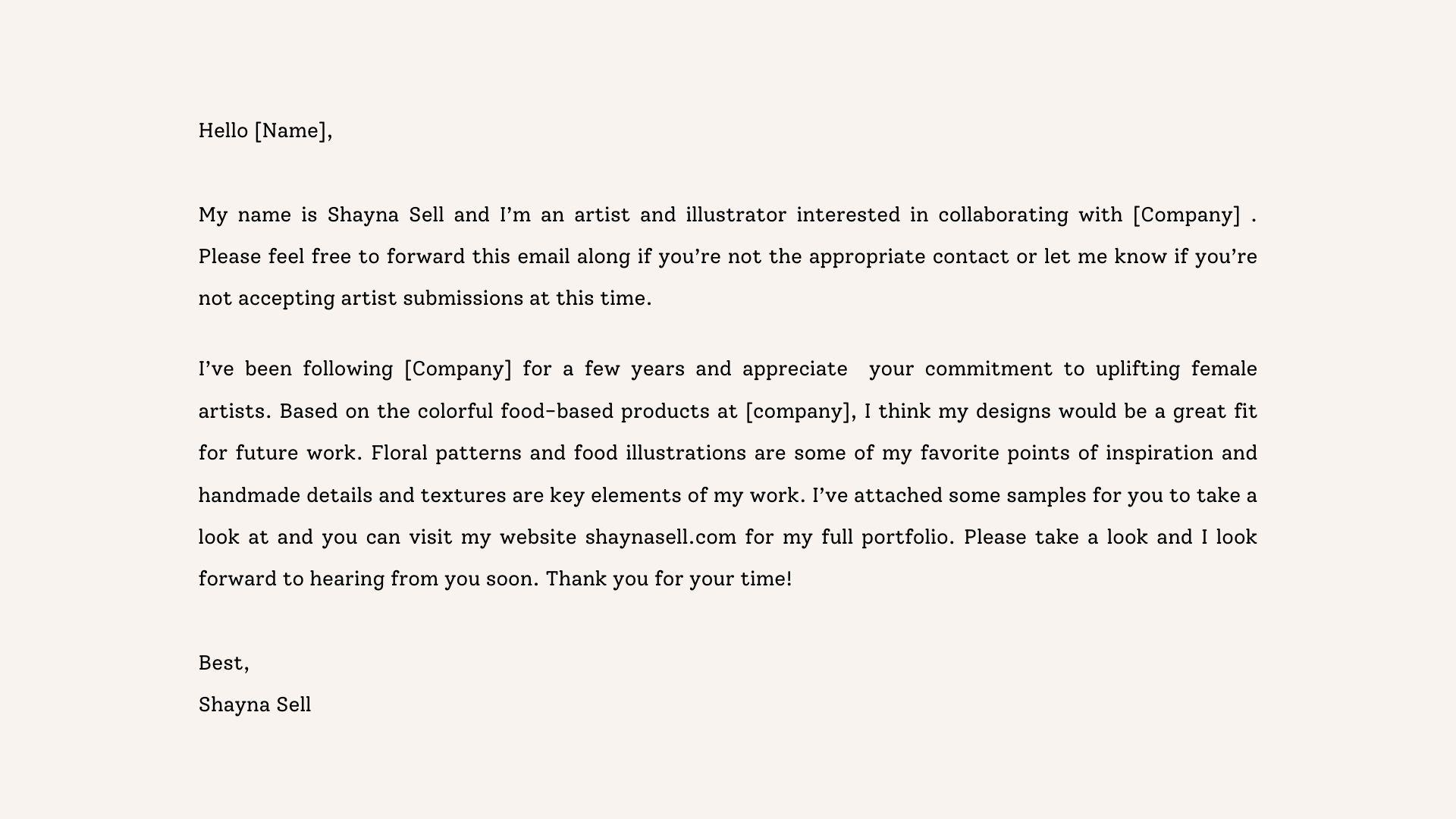
as maybe a little bit immature or overly familiar. Okay, so let's take a look at our fourth and final case study. So hello, insert
their name there. My name is Shayna cell
and I'm an artist and illustrator interested in collaborating with company name. Please feel free to forward this email along if you're not the appropriate contact or
let me know if you're not accepting artists
submissions. At this time. I've been following company for a few years and appreciate
your commitment to uplifting female
artists based on the colorful food-based
products at blank, I think my designs would be
a great fit for future work. Floral patterns and
food illustrations are some of my favorite
points of inspiration. And handmade details
and textures are key elements of my work. I've attached some
samples for you to take a look at and you can visit my website Shayna cell.com
for my full portfolio. Thank you for your time. Best Shayna cell. Alright, so I think this is
definitely the strongest one overall and that
was intentional. But we have a nice
clear introduction here and very clear intentions
in that first paragraph. Something that I really value in my communications with
my colleagues at work is knowing exactly why
someone's emailing me and what the next steps are. And I think I really
clearly outline that here before they even
get into my big pitch. I'm letting them know that, Hey, please forward this on if
you're not the correct person. So sometimes you might
not know who you're emailing or who the
best contact is. And I'm getting those next
steps out of the way here. But if whoever I'm emailing
is anything like me, they don't want to have
their time wasted. So we're getting that out
of the way by saying, Hey, if you're not
the right person, please forward this along. I'm also being clear
here in saying that I understand if you're
not accepting submissions from
artists right now, but I'd love to know if
you are in the future. That's kinda what I'm getting
at in that first paragraph. Moving on to the first sentence
of that second paragraph, I'm trying to make
that connection from my work to the
company I'm writing to demonstrating that I've done some research about
their company and that I know who they are and their
values align with mine. And even though I am
going to have to say things about myself
in this email, I'm really trying to not make it all about me and a little bit more about the company and
how I can connect with them. When I do talk about
myself and my work, I'm describing my work and
how to help categorize it. I'm not making value
judgments on my work or talking about how amazing
I am or my work is. I'm just describing
it and how it would relate to the types of
products that they sell. And then near the
end, I'm directing them to take a look
at the samples that I would have attached
with the e-mail and sending them
to my portfolio. I'm giving them very
clear action steps. The only thing that
I may be missing at the end here is
something that says, please reach out to me
if you're interested in working together or
something like that. I don't really underline
that at the end. I think that's
something else I could do here to improve it. But overall, I think this
is a pretty good email. It's confident, but
it's not over the top. I think I come across as
authentic and like myself. It sounds nice and professional for an introductory e-mail and even emailing with someone back-and-forth that I've
started to work with, me, get more casual, but this is appropriate for reaching out to
a complete stranger. Then there's one more thing
that I kind of glossed over, so bonus points if
you spotted it. But I do have a typo in here. So if you see the top of
that second paragraph, I've been following company
for a few years and appreciate your your commitment. Obviously, that's an error. That's something that
I skipped over when I was reading this the first time. You can see how reading
this out loud would help you spot a typo like that. So that's where that
proofreading checklists from earlier can really
come in handy. Once you've written the
initial draft or your writing, I would go through the process
that we went through with these case studies and look at it with a critical lens to week, you're reading the most
polished that it convenient.
11. Bonus Resources: At this point, you should have a nice writing
sample to work with. And I'm just going to cover
some additional tools and resources as a bonus lesson
that I really find helpful. The first one I'm going
to cover is Grammarly, which is a free online editor. It'll help you
improve your writing. It catches spelling mistakes, grammar, and maybe some
style issues as well. And Grammarly is free. There is a premium version, but I just use the free one. I already have an account. If you just go to grammarly.com, you'll see a page
like this to sign up. I'm just going to go to migrate. And really over here,
since I already have one, I'm using the grammarly editor. So there is an option to add an extension to your browser. I've had some issues in
the past where it didn't catch a couple of spelling errors when I
was using the extension. So I prefer to use the editor right on their
website, which is here. So I'm just going to go
ahead and click New. And then I can copy and
paste my text here. So I have that ready
to go over here. And then it's going to take
a second to assess it. We can also set goals here
it has this little pop-up. So you can actually get
some tailored suggestions. And I think I'm just going
to stick with that for now. There's lot highlighted
in yellow here. Anything highlighted
in yellow is actually part of the
premium feature. So I'm gonna ignore
those just for now. And over on the right, we can actually click on
correctness, clarity engagement. So I'm going to click
on correctness, that's gonna be read. And that's going to show me
all of the things that are just incorrect
English or grammar. Okay, so first it's highlighting dead end
for data and jobs, it should be hyphenated. So I can accept
that by clicking on their suggestion
here, this blue box. Then I can click on the
next one that's underlined. So I'm really interested
in illustration, but don't really enjoy
graphic design that much. Well, I actually think
this is correct. So it's telling me
that I should add an article either the or up. But I'm not really using graphic design the
way it's saying here. The noun phrase, graphic design seems to
be missing a determiner. I'm actually talking
about graphic design as a subject matter or a practice. I think it makes sense. I don't really enjoy
graphic design that much. Maybe one way to
improve it would actually be graphic designing. But that sounds a little
bit weird to me too. So I'm gonna leave it as is. We can also take or
leave these suggestions. So I'm just going to
hit the Trash button to dismiss that. And then we just have
another hyphenation. I'll accept that. Then finally, they have
another suggestion down here. They're saying I should
use of instead of n, But I'm trying to
use the phrase, get a foot in the door. And I'm talking about in
an industry in general, if I was saying like
maybe get a foot in the door of company name, maybe that would make sense. I still think in, makes
more sense here though. So even though this is
a really helpful tool, you still have to use your
own judgment a little bit. I think it's fine as it is.
I'm going to dismiss it. As I mentioned before, everything in yellow
is going to be a premium suggestion hover. You can use the descriptions
on the right hand side here to try to figure out maybe
where your work is lacking. So it can still be helpful even if you don't have
a premium account. I also want to point out the other suggestions
on the right-hand side, the far-right, like clarity. It's saying that
it's a bit unclear. Engaging. It could be maybe
a little bit more engaging. So those are other helpful
tools that kinda tie into what we went over in our good writing portion of the class. So next we have the
Hemingway editor. It really can help
make your work bolder, as it says at the top here, a little bit more clear and help you simplify your
messaging a little bit. So I'm just going to
paste in our other texts. Okay, so right away it's
highlighting a bunch of things. So we have all these
things in blue. And these are all these
little kind of qualifiers. Things that are making
are writing a little bit less clear or
maybe less bold. Here. We're saying, you
would really like my work. It's saying that we can
emit that we really don't need that extra qualifier there. It weakens. What we're saying
so I can get rid of that just is a
really common ones. So you're saying, I've
just been doing this. Well, it's kinda minimizing
what you're doing. And they even say here,
be bold, don't hedge. I can get rid of that. Another example of really
that appears a lot here. And then I'll also point out, so it's highlighted in yellow, things that are hard to read. So maybe they're a
little bit too long. And then in red, these are sentences that are
very hard to read, so we should definitely
address those. Maybe we can split them up
into multiple sentences. So I don't have any passive
voice, so that's good. Let me see if I can find
an example where I do. So let's just replace this. We want to avoid passive voice
as much as possible just because it can come
across as a little bit weaker, it's less active. So e.g. here, the
majority of my work is inspired by how can
we rephrase that? So we're really
trying to get rid of is and make something
else our main verb. So I can change this
to antiquities, the natural environment and
the nourishment of food. Inspire my work. It's just a little bit
stronger and there's an actual action taking place. You can also see it
has not highlighted antiquities or the natural
environment nourishment. These big words that I'm using. So I just want to re-emphasize that you can't rely
fully on these tools. Because really I don't think I should be using these words. There are simpler things
I could say here. Use these tools to
support your work, but you're still
going to have to use a little bit of
your own judgment. Okay, and then I'm
going to move on to a really great resource. It's the Purdue
Online Writing Lab. So you may be
familiar with this. I actually remember
it from high school. I remember having teachers
recommend this website is full of free resources that will help you
improve your writing. So the one I'm
highlighting here is this section on writing
and plain style. I think that's the
most applicable for our class today and for
writing for marketing. We're not writing academic
papers where writing a persuasive text to launch a product or get a
new business deal, things along those lines. So I really recommend you
go through this website, bookmark it, it's very helpful. Finally, we have the
Elements of Style, which is a book by
Strunk and White. And this is an authority
on how to write. Well, it's not very long and
there are multiple editions, so you can find ones that are a little bit more modernized. But I highly recommend this book and it's a
great resource to go back to again and again to revise
your work and refine it. And if you forgot what
any of these are, I've linked all of
these resources and tools over in the class, projects and resources tab.
12. Thank You: Thanks so much for writing
along with me today. If you haven't already, don't forget to download
the class resources and the drafting worksheet under the projects and resources tab. And also don't forget to upload your final writing sample
in the class project. If you have any lingering
questions or comments, I'd love to hear from you
over in the discussions. Tab writing isn't
black and white. So I'm happy to take a look at your work and talk
through any questions. I also wanted to
let you know I have a similar class
here on Skillshare. The dives deeper into
editing and improving your art and design work
with a critical lens. If you enjoyed today's class, make sure to leave a review and I'll join you
in the next one.
 Shayna Sell, Illustrator and Creator