Watercolor Christmas Tree - Easy Watercolor Techniques | Alifya Plumber | Skillshare

Playback Speed


1.0x


  • 0.5x
  • 0.75x
  • 1x (Normal)
  • 1.25x
  • 1.5x
  • 1.75x
  • 2x

Watercolor Christmas Tree - Easy Watercolor Techniques

teacher avatar Alifya Plumber, Artist | Acrylics, Watercolors | Painter

Watch this class and thousands more

Get unlimited access to every class
Taught by industry leaders & working professionals
Topics include illustration, design, photography, and more

Watch this class and thousands more

Get unlimited access to every class
Taught by industry leaders & working professionals
Topics include illustration, design, photography, and more

Lessons in This Class

    • 1.

      Introduction

      0:50

    • 2.

      Materials

      0:41

    • 3.

      Exercise 1 - Techniques

      1:48

    • 4.

      Exercise 2 - Layering

      1:38

    • 5.

      Exercise 3 - Wash

      0:50

    • 6.

      Prep Paper & Sketch

      2:38

    • 7.

      Adding Masking Fluid

      3:14

    • 8.

      Background & First Layer

      6:32

    • 9.

      Second Layer To Tree

      5:18

    • 10.

      Removing Fluid & Ornaments

      7:17

    • 11.

      Final Details & Class Project!

      2:55

  • --
  • Beginner level
  • Intermediate level
  • Advanced level
  • All levels

Community Generated

The level is determined by a majority opinion of students who have reviewed this class. The teacher's recommendation is shown until at least 5 student responses are collected.

480

Students

16

Projects

About This Class

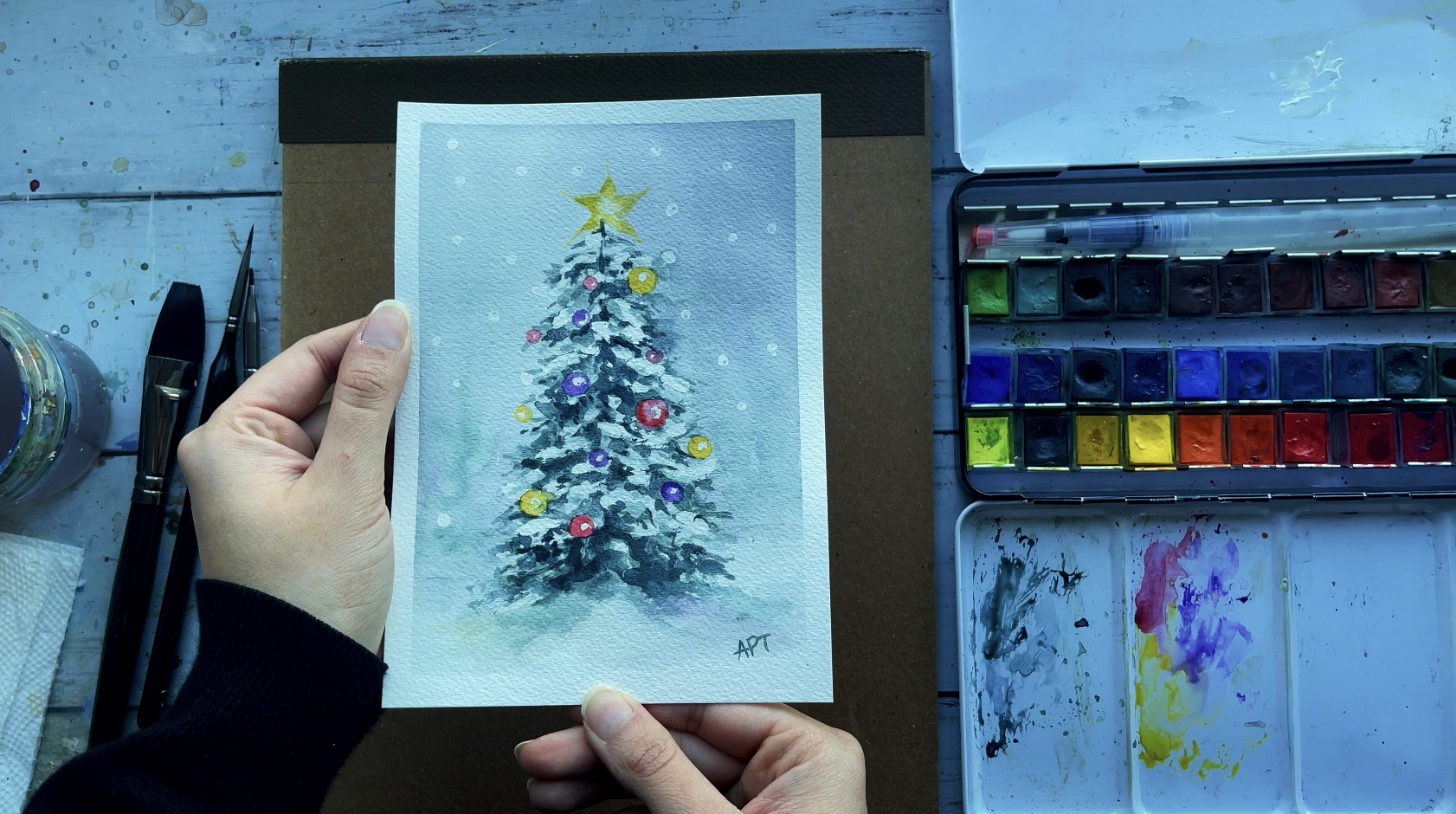
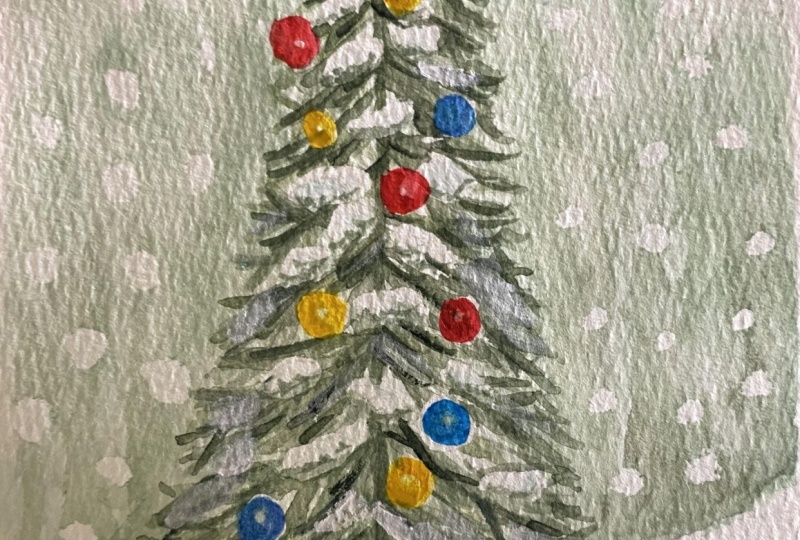
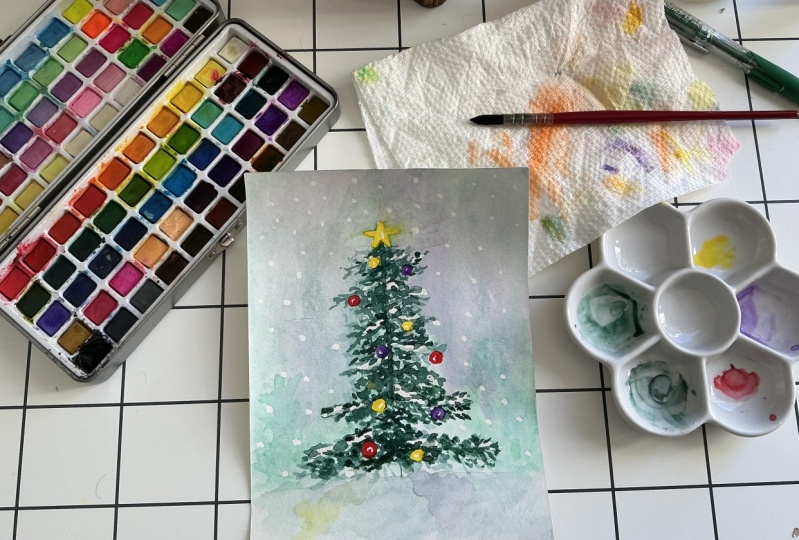
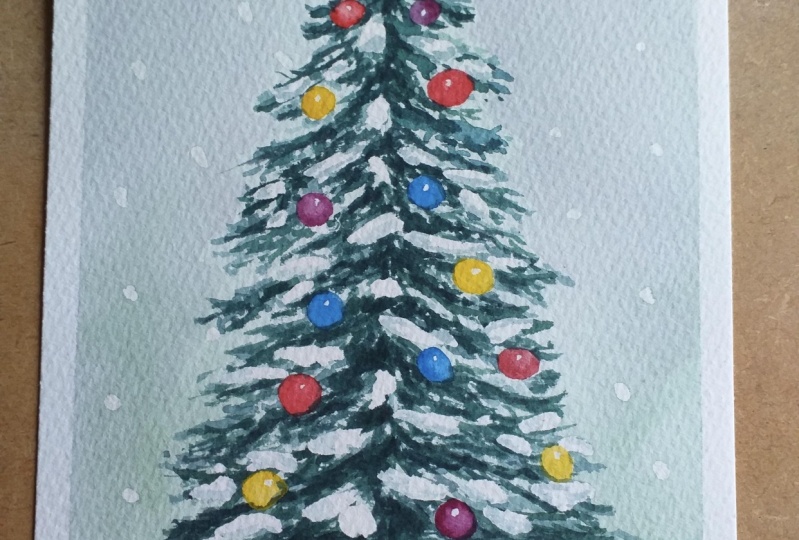
In this class, I will be teaching you how to paint a simple WATERCOLOR CHRISTMAS TREE! I will show you basic watercolor techniques and teach you how to paint this festive and cozy painting. This class is great for all levels!

A former art teacher and now an independent full-time artist, I am so excited to be teaching on Skillshare and I truly hope you find this corner of your space comforting, inspiring, and encouraging! Can't wait to connect with you all!

TOPICS I COVER:

  • Prepping your paper and materials – I will show you how to prep your paper before painting and all the brushes and paints you will need for this project.
  • Warm up exercises – I will go through exercises and cover basic techniques, layering and washes
  • Painting process and details – We will go through a couple of layers, keeping our exercises in mind.
  • Final Touches – This step will teach you how you can be more expressive by mark making with highlights and shadows.


MATERIALS I USED (but use whatever you have available.)

1) Paints:

- Cobalt green, indigo, pink, purple, yellow, red

2) Brushes: #2 round and 0 filbert - https://bit.ly/3mjGcHY, 3/4 flat brush - https://amzn.to/3azl0pM

3) Arches140 lbs 

4) Washi tape

5) Bowl for water

6) Paper towel / rag

*Disclosure: Some of the links above are affiliate links, meaning, at no extra cost to you, I will make a commission, if you click through and make a purchase. I only recommend products that I genuinely use on a regular basis!


SOCIALS

☆ Join my newsletter for 15% off to shop ☆ - http://eepurl.com/hKUHg5

W e b s i t e (Shop Art & Merch) - https://alifyalifestyle.co/

ETSY Shop - Shop Art & Merch - alifyalifestyle.etsy.com

Instagram - get latest updates!

Art Facebook group (Paint With Me) - share your work, connect with art lovers, & monthly giveaways!

Youtube - more art inspo

Meet Your Teacher

Teacher Profile Image

Alifya Plumber

Artist | Acrylics, Watercolors | Painter

Teacher

Hello, I'm Alifya Plumber Tarwala, a Fine Artist from sunny California. A former art teacher and now an independent full-time artist. My classes here will be focused over Loose Landscapes and Florals in Acrylics and Watercolors. I am so excited to be teaching on Skillshare and I truly hope you find this corner of your space comforting, inspiring, and encouraging! Can't wait to connect with you all!

To keep up with snippets of my artist life, follow along on Instagram. I also have a Youtube channel for more art inspo! :)

Instagram - get latest updates!

Youtube - more art inspo

See full profile

Level: All Levels

Class Ratings

Expectations Met?
    Exceeded!
  • 0%
  • Yes
  • 0%
  • Somewhat
  • 0%
  • Not really
  • 0%

Why Join Skillshare?

Take award-winning Skillshare Original Classes

Each class has short lessons, hands-on projects

Your membership supports Skillshare teachers

Learn From Anywhere

Take classes on the go with the Skillshare app. Stream or download to watch on the plane, the subway, or wherever you learn best.

Transcripts

1. Introduction: Hey, everyone. My name is Alifya. I'm an artist here in San Jose, California. In today's class, I will show you how to paint a simple and beautiful watercolor Christmas tree in a snowy landscape. My previous class was about an acrylic Christmas tree, so it only seem fair to show you how to paint one in watercolors. I will show you all the materials that you will need, we'll walk you through basic techniques, layering and luscious and then we'll walk you through painting this watercolor Christmas tree step-by-step. Let's get started and dive right into painting. 2. Materials: Hi. This is everything that I used, a bowl for water, a napkin, and then a washi tape to tape the edges. You'll need a pencil and eraser. This is optional but very helpful. It is a white mask. It's a fluid that you use to mask off white spots. These are the brushes that I used, a flat brush and two small thin brushes. I also use arches paper this time. I went for A5 by seven-inch sheet and then our teaser palette, which comes in 36 colors and everything is listed in the project and resources tab below. Check them out if you're interested. 3. Exercise 1 - Techniques: Before we start, I wanted to go over some basics with you. I'm not going to overwhelm you with a lot of techniques and brushwork, but I'm going to cover the techniques that we will use in today's class, so that you can get a more practical approach for this. The two most common watercolor techniques, wet on wet and wet on dry. For the wet on wet paint is applied to wet paper. You can layer different colors on top of existing wet paint, which will create this blurred out expansion effect, where you will notice the colors bleeding into one another. The second technique is wet on dry, where paint is applied onto dry paper, it is as simple as that. Let's look at the effects that these give us. Now, the wet on wet gives us soft edges, it's more blurred out. This is great when you want more delicate, softer paintings, great use for backgrounds or far-away objects. You can also blend easily while getting an effective gradient and also creates a misty effect. It is also unpredictable and hence not so much in your control. The very opposite of the wet on wet is the wet on dry, which gives us sharper edges, so you can definitely have more control where you can get well-defined shapes. The wet on dry also allows you to lay your paint as much as you want. We will go through layering in the next step. 4. Exercise 2 - Layering: Here I'm going to show you how you can layer your paint in watercolors. I'm going to show you three different kind of washers here, each one with a little more pigment to show you the effects of layering. If you want well-defined shapes when it comes to layering, you will have to work on this wet on dry. I'm drying out my paper with a blow-dryer to speed up the process before I begin to layer my shapes. Once your painting has dried, layer your shapes little by little, getting darker each time, but also wait for your paint to dry in between each layer that you add. [MUSIC] As you can see, the lighter your initial wash is, the easier it is to build up on layering, so keep that in mind when you are painting. With watercolors, you always have to work light to dark, unlike acrylics where you can get away with working from dark to light. I think watercolors as a medium that require you to be more patient. 5. Exercise 3 - Wash: [MUSIC] Let's go over some basic washes here. For the first one, we have a flat wash where your pigment is even all around. Then to get a gradient, I'm starting from a light wash with less pigment and will slowly increase my pigment intake as I move downwards. You can also start dark and then gradually lighten up your wash as well. Two toned is where you combine two colors and merge them together by blending. To blend them, you will lightly brush your colors in between. [MUSIC] 6. Prep Paper & Sketch: First step is taping down the edges. I'm using a washi tape. It does not peel off the paper once you take it out. Before we paint, let's draw a quick sketch of our tree so that we have a basic structure down to make things easier for us. Super simple straight line down for the trunk and then little branches off of each side. Make sure to start small at the top and branch them out in width as you come down. Just like any tree each branch has further little branches, so I'm roughly only drawing a few so you can understand the shape. I'm now going to be trying out the snow and I'll show you why in a little bit. But to get the shape, just draw a little irregular bobs of the shape like I'm doing so right now. Just place them randomly on top of the branches. Doesn't have to be perfect. We are going to be blocking off this snow with masking fluid. But before we do that, I am just going to erase some of these marks and in between each snow just in case I have some of those lines. 7. Adding Masking Fluid: Now comes the masking fluid section, and I will use this to block off the snow. Use any small round brush you have, preferably one that you did not care much for because if you do not wash this out immediately, it will be ruined but as long as you wash it out after you're done, it's fine, but you will need a little bit of soap. Here I'm adding this fluid to each of the shapes I made. Feel free to add some more on parts you didn't draw as well. What this does, it basically masks off this area until you peel it off, which means you can paint over it without caring about getting over the white spaces. Once you take it off, you are left with clean white bits that stand out. Now in case you do not have this, that is okay. You can still carry on with this project, but you may just have to work a little extra and around the white spaces like you would do if you were just to paint it without it. This does make your life a bit easier but if you don't have it, that is okay too. I have painted trees before that do not have the masking fluid on, but of course, if you do have this, it will make it easier for you. Another option would be to add acrylic white paint or whitewash paint in place of the masking fluid in case you do not have that but you would add that at the very end on top of this. You would basically just skip this step and just follow up with the next step. At the very end, you would use some of the acrylic white paint or gouache and lay it on top. But you can also draw these little bits out and say you want to work around it. You can do that and then just work around it and leave that white space open. That also really works. Just do what's best for you and figure out what method just is convenient to you. Here I'm making a little star with the fluid just because I want this to stand out as well. I will also be adding little dots of snow to the background too. Almost forgot about my ornaments. I'm going back in and making small circles where I would want my colorful ornaments to go. After you are done with this step, you will have to wait for this to completely dry before you can paint over it. Grab yourself some hot chocolate in the meanwhile. 8. Background & First Layer : [MUSIC] Let's get this painting started, and give our background a slight wash by wetting your flat brush. Then just covering the top half of the paper, leaving the bottom half just plain right now, because that's just going to be snow. Do not over pull it, only a slight sheen is enough. Since we have our masking fluid down already, we can paint over this area. Using cobalt green or any dark green that you have, apply a flat wash to the entire background. Just an even flat light wash. I was going for a day time, snowy day look, so I am making this really, really light. Using a smaller brush, I'm just roughly getting impressions of background trees. Again, this will not be in-focus, so it doesn't have to be perfected. Just a rough impression of something there, instead of having the background really plain. Wait for the paper to dry completely before going to this next step. Using the same brush and same green, I'm also mixing a bit of indigo as well, to make it darker. Let's begin with our tree. Just following the line across the page, and then I'm going to go over the branches that we drew out. Here, I'm dabbing my brush gently onto the branches to create the leaves. You're just using the tip of the brush at times, sometimes you can use the belly of the brush as well. You're just simply dabbing, dabbing in the direction of the branches that we've already drawn out. Do this throughout the base of the tree. Once you get to the bottom, blend the color out a bit, so that it can reflect on the snow. Here, I'm just adding in some extra bits in the middle to fill up the tree. I wasn't even quite happy with the shape here at the top, since I felt like it came out a bit too much. So I'm just watering that down and blending it in the background. [MUSIC] 9. Second Layer To Tree: Let's darken this up more and add some more details. I'm using a fine thin brush, and the same dark green and blue, and going back in and building on these layers by using the same dabbing method. Your first layer should have been almost 50 to 70 percent dry before adding this new layer. Being careful not to cover up the first layer completely because every layer that you add, it adds more depth and dimension. This is what gives our tree the fullness that you need. So take your time and work your way from the top and keep moving downwards. I'm going back to the sky and adding just the tiniest bit more color to the background so that the snow falling dots that we have created will just stand out a bit more. I wanted to add a tiny touch of purple to add to that dreamy snowy day. After this step, wait for your paper to completely dry before we move on to taking off this masking fluid, which will be our next step. Just work on the sky a little bit more if you choose to and then just wait for it to completely dry. 10. Removing Fluid & Ornaments: Really important. Make sure your paint has fully dried before doing this next step. I find the easiest method of removing this masking fluid is by using an eraser to rub it off. I'm just going to speed this process a bit and I'll catch you in the next step. Now to make this blend a little bit more, you would need to add a slight dimension of color to the snow as well because just leaving it plain stark white, it does not look like it's blending very well with the tree. Going back with my fine brush, I'm adding just a very slight color of the same green and blue mixture that we had already added to some bits of the snow. I'm not covering up all of it but only a part of it like you see me doing so right here. Now to the fun parts, let's add some bright colors of ornaments to make this Christmas tree alive and festive. Using any color of your choice, paint the outside of your ornament leaving the central white. You want a slight gradient effect where the outside of the circle is darker and as you move inward, it gets much more lighter. Have fun with the staff and your tree with whatever colors you like. Using the same method for the star at the top, focusing on making the outside of the star darker and make it lighter as you move towards the center to add that glow and shine effect. Add the tiniest amount of your ornament colors to the snow at the base to get that reflection. 11. Final Details & Class Project!: [MUSIC] Last and final details, we're almost done. But this time I'm just pulling in some of the darks to finish this painting off. Using the same dark blue and green, those are the only two colors that I've used in the entire tree. But I'm adding a bit more of those darker values newly to the center of the tree to add fullness. Again, being mindful of not overdoing it or covering up all our previous layers. [MUSIC] Here I'm just darkening the edges of the star, a tiny bit more for some added shine and we will be done. [MUSIC] Hope this put you in a festive mood and you get to give this painting to your loved ones this season. If you are interested in making an acrylic Christmas tree, follow this class up the part I have linked it below. Do not forget to share your work in the projects and resources tab below. Happy holidays everyone and I will see you in my next one. Happy painting. To shop my arts, do visit my website where I sell my original landscapes and florals, as well as prints in all sizes and much more. To keep up with latest news, do follow me in Instagram where you can stay up to date with my new launches. [MUSIC]