Transcripts
1. Introduction: Welcome to the ultimate
goal setting workshop where you will learn how
to effectively plan and achieve your goals. Do you have desires
that you want to make your reality but you never
know how to get there? Then this class is for you. My name is Georgia,
and in this class, we will create an
action plan for success in order to help
you reach your goals. Including tools such as
reflection visualization, habits, routines, and more. I have qualifications in psychology and health
coaching along with a huge passion for self development,
productivity, and mindset. I aim to help and
inspire people to work on themselves and improve
their lifestyles. I have been on my own
personal growth journey and gone from struggling
with mental health issues, feeling lost and
lacking purpose, to owning my own business, Reaching my goals and
being so clear on who I am and my purpose
in life together. We can create your
very own step by step guide for lasting change
with my proven formula, leaving you feeling
excited, motivated, and ready to start your
self development journey. This class is for
you if you often procrastinate instead
of taking action. If you thrive on planning
an organization, you will gain clarity
on your goals. You will have the tools to make gradual and lasting change
within your lifestyle. And by the end, you
will leave feeling ready and motivated to
start your journey. Once you have this
method, you can use it again and
again year after year to set and achieve new goals and continue
up level in your life. Your project for this class will be to fill out the goal setting workbook that I have provided to create your very
own action plan. So if you're ready and
you're as excited as I am to achieve your
goals, then let's begin.
2. Project Introduction: Your project for this
course is to fill out this 16 page goal
setting workbook which I have provided for you. You can download this PDF from the files and print it
out for you to write on. I have printed mine in a
four and had it bound, but you could print it in
whatever way works for you. Each lesson in this
course directly refers to a different
page in the workbook. I will fully explain to
you the questions and what you need to think about
in order to answer them. I've chosen this project because I think it's the
perfect way for you to understand all of these elements about you and what you
are working towards. And it lays out the formula
very clearly and gives you the opportunity to go back and forth on what
you've written. Filling this out is the minimum that you can do
for this project. There are several opportunities
to get more creative, which I go into detail about throughout the course
and at the end. In the next step section, all you will need
is your printout and something to write with. Feel free to grab
highlighters or colored pens to get
more creative and to be able to differentiate areas and highlight
important bits as well. Once you have completed your
course and your project, you can upload a photo of your chosen section
in the gallery. This could be a section that you directly want feedback on. For example, your action plan or a section that gives inspiration
to myself and others, such as your life buckets or your routines
and affirmations. It is completely up to
you to get started. Simply begin your first
lesson and we will follow along in the work group
together. See you there.
3. Past Reflection: Welcome to your first lesson of the ultimate goal
setting method. In this lesson, we
will be looking at your past reflection. It is so important to reflect on the past in order to learn
from it and move forward. We never want to
look negatively on our past or something we've
done or an experience. We just want to understand
why we do things, how we can learn from
them, and how we can make positive change
for the future. In the workbook, you
have two pages of reflection with six
questions to fill out. I will just note that if
you're on a reflective role, then absolutely grab
yourself some more paper, get stuck into everything
that's coming up for you. So let's walk through these
questions together now. The first question
is, what word would you use to describe
this past year? It may take you a few minutes
to think of an answer. It can be difficult to put so much time into just one word. However, I have included this section because I
think it allows you to get a sense of what stood out to you the most over the past year. Maybe it was a certain
feeling or an event. Perhaps you've had
an overarching theme throughout the year or a specific adjective that
can sum up what you've done. Whatever that word is for you is going to be great
for comparison. It will help you visualize that key shift that you're going to make from the past year
to the next year ahead. The second question
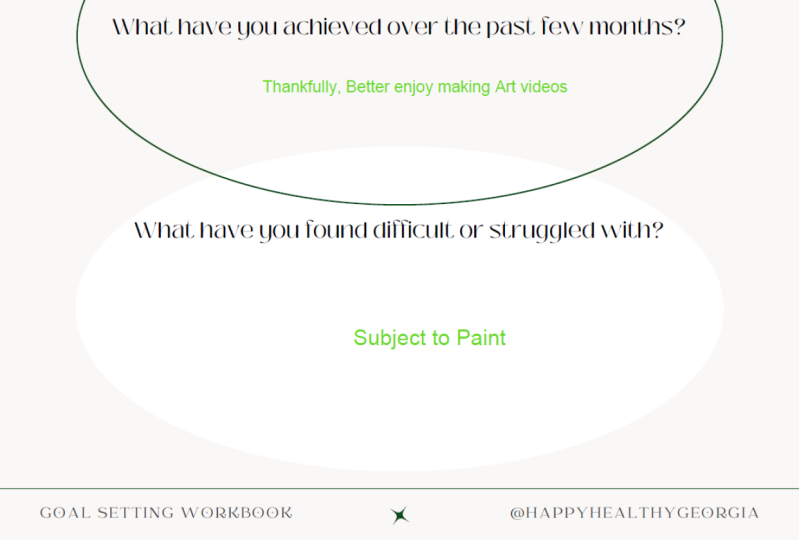
is, what have you achieved over the
past few months? This one is fairly
self explanatory. Look back at any
accomplishments and things that you've done
over the past few months, simply so that you
can recognize them, feel proud of them, and
begin to grow from here. The third question
on this page is what have you found difficult
or struggled with? Looking at these questions are some of the most important. Understanding your weaknesses
and where you struggle is how you can learn and
grow from these experiences. You can use this to choose
any areas that you want to strengthen or work on at a
later point in the course. So anything that you've
found difficult or struggled with over
the past few months, write it down in this section. If you want to add
anything extra about why, then absolutely go for it
over on the next page. Our fourth question
is, have you learned anything important over
the last few months? Any lessons that have
stood out to you, Whether that be
educational lessons, life lessons, a conversation
you had with someone, anything that's stuck
out to you is important. Note it down here. The
fifth question is, are you 100% happy in
your life right now, or are there areas you
would like to grow in? If so, what are they now? If you're 100% happy and
perfect, then that's amazing. But I think most
people will have areas for improvement, as do I. And that's why
we're here, right? See if you can identify these specific areas
that feel like they're lacking or
need any extra work right now and write these down. The sixth and final
question here is, did you set any goals at the
beginning of the year that you have or haven't
achieved and why? So this one is kind of
split into two parts. If you set any goals at the
beginning of this year, whether that was
specifically written down or just in your head that
you wanted to achieve. Take a moment to think
about what these were and whether you have
or haven't achieved them. And write these down and
leave space next to each one. Then for each goal, I want
you to ask yourself, why. Why did you achieve one goal versus not achieving the other? For example, why did you manage to get a
promotion at work? Was it something you really
wanted? Did you find it easy? Was it because someone
was looking over you and so on compared to why did you not stick to
the gym like you said you were going to? Is it
because it was boring? Did you run out of
motivation or did you find another exercise
that you enjoyed more? I hope these
examples make sense. This will help you to
understand the difference here. Perhaps where your priorities lie or where your
weaker areas are, or whether one specific theme keeps popping up throughout, such as lack of consistency. For example, once you've completed these two
reflective pages, you've completed
your first lesson. This first part is
quite heavy going and you might feel tired
or drained afterwards. So well done, It
would be a good idea to allow yourself some chilled self care time after that one. And I look forward to seeing
you again in lesson two.
4. Letting Go: Welcome back to lesson two, where we will be
delving into letting go of things that are no
longer serving us well. To figure out what
these things are, you can refer to your
previous answers of the past reflection on questions
three and question five, and also think about the
following questions. Has anything been holding
you back recently? What habits would
you like to break? What do you do that
drains your energy and doesn't make you feel good? Do you have any
persistent negative thought patterns that
you want to change? I will give you some examples from when I filled out my page. I said that my self
doubts hold me back going on my phone too
much drains my energy, and I would like
to break the habit of scrolling on my
phone before bed. I can have negative thought patterns about the way I look. And I have beliefs around
your personal value coming from the way you look, which I am working to change. I put a lot of pressure
on myself sometimes and sitting inside all day
can make me really grumpy. So this is your page to mind, map all of these
different things or number them in a list, whatever works best for you. This can be a really
hard task to do. And some things might come up quickly and others might
take a bit longer. But once you've written
some of these things down, in the next lesson
we'll begin to look at how we can change these. And this is not
going to be a linear journey, and that's okay. Beginning the process now and putting things in
place for when you're struggling is exactly
how you're going to begin the change
on this journey. For now, I want you to
just close your eyes and have a think about the
questions I'm about to ask. I want you to acknowledge these thoughts and feelings
that you've had. Think about why you may have
been feeling like this. Where these feelings
may have come from. Do you think that thinking this way has helped you towards your goals or has it
moved you away from them? Thank yourself for
trying to protect you or for trying to help
you get through a situation, or for taking on this
belief from someone else. Say that this has
served you well. But it's now time to let go of it because it's holding you back and you're ready to move on and believe
something new. Well done, you have
finished lesson to. Looking at your past,
your weaknesses, your struggles and
things that are holding you back can be super
heavy going again. So amazing work. We have now finished these
more difficult lessons and are moving into more future
goal focused sessions. From now on, we will see
you in less than three.
5. Rewriting Your Story: Welcome back to lesson three of the Ultimate Goal
Setting workshop. This lesson is all about
rewriting your story. Looking back on what
we uncovered from last lesson around things
that are not serving us well, we're now going to
transform this into things that will be
serving us well. Once you've completed this page, it's going to be full of all the things that boost your mood. How to get out of slumps
and bad mindsets and more. It's going to be a
great one to refer to. I will use three of
my examples from the last lesson to show you how you can find these
solutions yourself. Number one is changing
the habit of scrolling on my phone before bed instead
of scrolling on my phone. I recently got a Kindle I'm
planning to read instead, and I'm so excited to read the new books I've
downloaded on there. I will ensure that before
I even get into bed, I've done everything on my
phone that I need to do. There is no need
to even go on it. I will also keep a note pad
and pen next to my bed. So if I randomly
think of anything and if any ideas
pop into my head, which does happen, I usually
drop them down on my phone. I can then write
them down instead. In the long term, I would also like to get an alarm clock, so I don't even
need to sleep with my phone in the
same room at all. Number two is sitting inside
all day makes me grumpy. When I'm planning my
day, I ensure that I add in any breaks, some walk, some exercise to get myself up moving and to have
some time outside. If I have lots of long days
of work planned for the week, then I want to make
sure at least twice during the week that I
change my working location. Whether I go to a
cafe or a restaurant, changing up really
helps my mindset. If I have spent lots of
time inside and I know that I'm not really feeling
great by the end of the day. I know that taking myself out on a short walk around the park
always makes me feel better. I set myself a ten minute
minimum and I usually end up staying out longer because I'm enjoying it so much. Number three is my negative
thoughts around self doubt. The way I look,
relating this to myself worth I will take
this day by day. If I'm having a good day,
then I roll with that. Remind myself of
the things I love, the things I enjoy dressing
in a confident way, all these things
to boost my mood. I'm having more of a
bad body image day. I can still dress in a way
that makes me feel good, but it might look a bit
different to the previous day. I will make sure to write things down or tell myself
things I love about myself and stick them
around my mirror to promote positive thinking rather than automatically slipping
into negative thinking. If I'm feeling
nervous about meeting new people or not feeling
great about myself, I've got a list of affirmations. I say to myself to
hype myself up, for example, you are
strong, you are confident. You are an amazing friend. Your hair looks so good today are just as worthy
as everyone else. You have got this act confident and no one
will question you. Do you see how much detail
I've put into my answers here? Again, if you need more
paper here, go for it. Spend a good amount of time on each thing that you wrote
on the previous page, finding realistic
solutions for these. If you're unsure on
ideas on how to change this look elsewhere, use Google. You can just type
in how to change a certain behavioral
thought pattern and you might get some new ideas to ones that you've
already thought of. Ask friends and family,
other people may see things differently
and give you new ideas. One last thing I
want to address is a super common way of thinking is all or
nothing thinking. For me this could
be once I've set myself my goal of not going
on my phone before bed. As soon as I do that one time, I'll think I've failed
and I'll give up. Or you miss a day of gym
where you have a sofa day. Then you've failed your
goal. This is so not true. If you do think like that, then you need to add it
to your previous letting go page because it's not going to serve you well
going forward at all. You are going to rewrite this and you're going
to say that if you have one bad day or something doesn't go quite as
planned or you go back to your old habit for
a day that is okay and I can't stress this enough
and it's completely normal. I will add. It is
how you come back from this which makes
all of the difference. So you can write
down what you'll do. Maybe you'll remind
yourself of why you started or read through
this workbook again. Maybe you need to make the
habit, you're swapping. More exciting so you get a new book or take
yourself out somewhere different or put
your favorite music on or ask a friend to join you. There is always a solution and
never a reason to give up. You have so got this amazing
work in lesson three, and I will see you
again in lesson four.
6. Life Buckets: Welcome back to lesson four, and today we are looking
at our life buckets. You're probably thinking, what
the hell is a life bucket? And that is what I'm
here to tell you today. I first heard about
this technique on Georgie Stephenson's
podcast, and I loved it. So the idea is that
you give a bucket to each area of your life that
you prioritize and value. For example, mine would
be friends, family, boyfriend, travel,
nutrition, fitness, mental health,
finance, and career. Once you've decided
what they are, you can refer to your buckets and regularly check
in with them. Perhaps something doesn't
feel quite right, you're not feeling fulfilled, you're feeling unhappy and can't work out why you refer
to your buckets, you will assess which ones
you think are full right now and which ones
are empty or lacking. Which have you been putting
all of your energy into recently and which have you
been neglecting from this, You can spend some
time refilling that bucket and refilling
that area of your life. For example, say that
I'm really low on energy this week and I don't know
why I've been exercising. I've been spending time
with others and traveling. Actually, I realize that
I've been eating out loads. I'm traveling and
I'm seeing friends. I haven't been in my
usual nutrition routine, and this might have thrown
me off a little bit. Now I know that I need to
focus on bringing my bucket of nutrition back up for the next
week. Now it's your turn. Write out what your buckets are. Feel free to color them
in and make them pretty. You can stick this page up in your house to make sure
that you regularly check in with them or create
your own poster of your buckets to have up in your room and make it your own. Having it somewhere where
you can see it regularly will keep it fresh in your mind and remind you to check in. Thank you for watching.
I hope you enjoyed this lesson and some more
creative freedom in a task. See you in lesson five.
7. Big Life Goals: Welcome back to lesson five, where we are going to look at understanding your
big life goals. For this lesson, we're going
to do a visualization. I believe these are so powerful and can truly help you feel into your goals
and realistically visualize what you
want for your future. This can work really well if you get comfy, close your eyes. Perhaps dim your
lights to really feel that relaxation and
calm while we do this. But please do whatever you feel comfortable with.
So let's begin. Close your eyes,
breathe in slowly, and let your breath out slowly, again, in and out again, even more slowly, in and out. Try to imagine that your
stresses, your anxieties, your deadlines are
rolling off of your head, down your shoulders, down your arms and falling
away to the floor. Find a calm center
inside yourself. Keep your eyes closed
and breathe in and out. You are in a forest. Walking along a cobbled path amongst the greenery
and tall trees, you come to a clearing
where the path forks into two
different directions. You take the left handed
path and begin walking. This left path is leading you to a version of your future
self in one year's time, where you haven't
reached your goals. You haven't invested time
and effort into yourself. You haven't stuck to your plans. You have done the thing that you always do and set your new, your goals and not done
anything about it. How do you feel about
this version of yourself? What do you wish you had done? What do you look
like? Where are you? I'm going to give
you a few moments to continue thinking about
this version of you. Now you don't like what
you see on this path. You walk back to the
clearing in the forest. This time you take the right
hand path and start walking. This right hand path is leading you to a
different version of the future you
in one year's time. Who has reached the goals
you set out to even more? You put the time into yourself. You understood your priorities. You have transformed.
You have progressed, and you're feeling amazing. What is it that
you have achieved? Where are you now? What do you look like? How do you feel? I'm going to give
you a few seconds to continue thinking about
this version of you, Okay? Now, when you feel ready, slowly open your eyes and
come back to the room. If you want more time
here to visualize, feel free to continue playing some relaxing music or rewind it and listen
to the visualization. Again, I showed you two different versions
of yourself here to help you realize what
it would feel like if you went down both
different paths. This can really help you to feel motivated and capable of what
you're wanting to achieve. I would imagine that your
mind was filled with lots of different images and
feelings during this time. Now I want you to use
the big life goals page in your workbook to mind. Map all of these things down,
what you want to be doing, what you want to achieve,
what you look like, what habits you have,
what your day looks like, what people do you
have around you? Where are you living,
where are you working, what's your financial
situation like, and everything in between. Feel free to dream big here. I hope you feel a lot clearer on your goals and your
future after that. Visualization can be an
incredible tool to motivate you to boost your mind
and positive vibes and remind you of why
you're doing something. You could do this
every night before you go to bed or
as you wake up in the morning or once a week on a Sunday before you
start a new week. Or just whenever you
need to pick me up, use it to benefit you
and your lifestyle. Well done on lesson five, and I will see you
in the next one to understand how we're going
to get you to these goals.
8. Action Plan: Welcome back to lesson six. In this lesson, we're going
to create an action plan for those goals that we wanted
to reach from lesson five. We now know what your
big life goals are. We know where you're
working towards. If you always have that
future visualization in your head and you believe it, then you know where
you're headed. But now we're going to look
at the next year ahead. We're going to split
your goals into three month sections
throughout the year. You can split your goals up by how long you
think they may take, when you want them achieved by, or in order of what you
want to focus on first. So we have a zero to
three month plan, a four to six month plan, a seven to nine month plan, and a ten to 12 month plan. Step one of this
process is to put each goals deadline into
one of the sections. Perhaps you have all year
to complete some things, whereas other things may
have an earlier deadline. For example, say that you
have a financial savings goal of 5,000 pounds for
one year's time. This can go in the ten
to 12 month section. You also have a marathon that you're running in
six months time. The deadline for
this needs to go in the four to six
month section. If you want to split each
section up into three like I've done to represent
each individual month, absolutely, go for it. You can get even more specific with your deadlines this way. Once you've done this
with all of your goals, it's now time for step two. You can't just rock
up at the deadline, unfortunately, and
achieve your goal. You have to put
the work in first. We need to work backwards
from the goal and put a plan in place in the months prior in order to achieve it. Let's go back to
those same examples. If you want to save 5,000 pounds by the end
of the 12 months, this means that you need to save around 416 pounds
every single month. To get to that goal. In each month section,
you need to write, save 416 pounds as part
of your action plan. Then you have a marathon
in six months time. How much training
time do you need? Let's say three months. For the three months
before your deadline, you need to write start your
marathon training plan. That might be three runs a week. And then you have to implement
that into each month, into each week section
to complete those runs as part of your action plan in order to achieve that goal. And you want to
do this for every single one of your goals, the more detail, the more specific you can
get, the better. Here again, if you want to map
it out in a different way, stick a big post
wrap on your wall. By all means, use
this workbook as a plan and create your own version in
whatever way works for you. Now, I just want to say, although we've created a
timeline for your goals, I want to relieve any
of the time pressure. If we put pressure on ourselves, it can generally change
our feelings around the goal and move us into more of a negative
mindset around it. And will affect
the way we achieve it and whether we
achieve it at all. This is a rough no
problem with it taking longer time or shorter
time when life gets in the way or even if you change
your mind on a goal as it's not working for you anymore or your situations changed, you can swap it for
something else. The idea is that you know
what you're working towards, that you're heading in that
forward moving direction. You have the right mindset
for this and that. You now have these
tools that you can apply to any further
goals that you may set. Well done for
completing lesson six. This is a huge
section with lows to think about and
organize great work. I will look forward to
seeing you in lesson seven.
9. Routines: Welcome back to lesson seven, where we're going to look at
your day to day routines. When we are looking
at making changes to our everyday lives and
upleveling ourselves, it is extremely likely that we then need to change the way we live our everyday lives in order to achieve that change. Because if we want a
different outcome, we have to act
differently to get there. Routines are great to give your life structure
and productivity. We want to add routines in that are in alignment to
our future goals. And where we're headed
towards, obviously, everyone's routines are going to look different depending on age, family, work, things that make you happy and
everything like that. We're specifically
going to look at morning and nighttime
routines here. Just have to think about
what you currently do in the morning
and in the evening. Are these routines
serving you well? Do they set you up for the day and then to have a
good sleep at night? Or do you think they're
making this harder for you? Think about what might
be more beneficial for you to do
during these times. It might be something
that you've previously highlighted on a page
in the workbook. Now very few of us will
have hours to spend going through a long list
of morning and night rituals every single day. You do need to make
this realistic to your own situation commitments, lifestyle, and
understanding of yourself. But also incorporating
your future visualization and where you see yourself
in one year's time. Thinking about what this version of you does in their mornings and evenings and finding a
balance between the two. Feel free to research different
ideas of what sets you up well for your day and what things will be
beneficial to you. Perhaps it's about
getting yourself into that positive mindset ready
for the day in the morning. This could be through
mood boosting music or a motivational podcast. Maybe you get some exercise done in your morning
or change up your breakfast or
spend 5 minutes journaling in the evening. Maybe you want to have
a bath a few times a week or read before bed. You could get into a
better evening routine of skin care or making a
plan for your next day. This is completely
individual and up to you. Make sure you gather all
those different ideas. Think about how often you want to do them throughout
the week and how beneficial those different things are going to be to you. An important thing to
remember here is if you stack up loads of different things that
you want to try and do, if you suddenly try and
do them all in one day, it's probably going to
be an unrealistic thing to achieve and keep up, therefore making small changes or telling yourself you're
just going to do one at a time and get used to
that first before starting another one is a really healthy and beneficial way
of looking at it. Well done for lesson seven. I look forward to seeing
you in the next one.
10. Reset Checklist: Welcome back to lesson eight, where we are looking at
our reset checklists. This page of the workbook
is your checklist to refer to when you need to
organize your space and mind, ready for a new month. It is completely up to
you and your lifestyle, whether you want to make
this a Sunday reset, which you repeat every week, or a monthly reset, which you do once a month,
and anything in between. Or maybe you have
two different ones where there's one
smaller one that you repeat every week and a bigger more in depth one that
you repeat every month. If this is the case,
then simply use a highlighter or a symbol
to indicate which steps are for your weekly and
which steps are for your monthly checklist
and which are for both. The purpose of this
is to bring in regular check ins where you
can keep yourself on track and get your body and mind
prepare for a new week in order to keep you on the
path to achieving your goals. I don't know about you, but
by the end of the week, my home can be a bit messy. My mind can be all
over the place. I'm feeling a bit tired and I might be feeling
a bit overwhelmed. This check in allows you to
get all of that stuff in, check and reset your
mind and space so that you feel positive
for a new week rather than stress
and exhausted. So here are some examples
for the reflection section. Feel free to ask similar
questions that were in the past reflection
section of this workbook. Things like what has gone
well this week or this month? What are things that
I want to work on? What's your focus
for the next month and how are you going
to work on that? Your todos could be things
like washing the bedding, doing a face mask, tidying your home, and your week ahead. Prep could be things like writing out a plan for the week. Slotting in things
like your work, your habits, your
exercise, your plans. And then there is
another section for anything else that
you have in mind. Maybe you want to
take yourself out on a solo date once a month
or get your nails done. Anything that resonates with you fits in with your
lifestyle and your goals and is something that
you genuinely want to implement. Put down here, well done on lesson eight. I hope this one's got
you even more clear on your routines
and daily rituals. I can't wait to see
you for lesson nine.
11. Affirmations: Welcome back to lesson nine, where we will be looking at affirmations to help
us reach our goals. If you don't know what
affirmations are, they are a way of positive
thinking and self empowerment. Now, it is proven in countless studies that
your thoughts and attitudes will impact your
life and the way you live it, the way you think
and talk to yourself will be what you see and
how your life ends up. I know it won't be
everyone's thing to sit and say affirmations to
themselves in the mirror. If you're new to this,
it can feel very weird. But they can also be a way of prepping yourself if
you're feeling nervous, as I previously said
in one of the lessons. Or a way of hyping yourself
up if you're feeling down, or a way of building
your confidence if you're lacking
it in the moment. The more you tell
yourself positive things and change your negative
ways of thinking, the more your life
will transform. You can also refer to the rewriting your story
page of the workbook to see what negative
thoughts you want to change and add into
your affirmations. You can also write affirmations
based on your goals. For example, I am in
control of my emotions. I am open to new and
exciting opportunities. I am grateful for
the money I have and I'm worthy of the
money that I desire. I can do hard things. I embrace the
uncomfortable and so on. Also, use the Internet here. Type in affirmations four
and insert your goal here. You'll get loads of
different ones come up. There is also space to write your new word of the year
at the bottom of your page. Refer to the word
you used to describe your previous year on the
past reflections page. And compare this to your
visualization of the next year. To come up with your new word, you can have your affirmations listed on your phone
or next to your bed. You could pick a few to
say every morning or in the moment when you need to
embody a certain feeling. I find that they come in
handy in those moments. Especially, I use them when I need to build my confidence
for meeting new people. Or if I'm doubting myself or I have to talk
in front of people, I need to hype myself up. I can shift my mood by saying the appropriate affirmations and they really are that powerful. And I know that you can
use them to do the same. Well done for completing
less than nine. I will see you in the next one.
12. Next Level Self: Welcome back to lesson Ten, Becoming Your Next Level Self. This next step is about actually becoming this
version of yourself. It is all well and good, just saying and thinking
who you want to be, what goals and routines
you want to have. But if you don't
actually step into this, make the changes,
start this process, then nothing's going to happen. I want you to really
think about who this person is and how you're
going to step into them. What additions and changes are you going to make right now? How are you going to become this person that you visualize? What energy vibe does
this person feel? Who is this next
level version of you? And how can you start
being them now instead of the big life goals
mind map where we were looking at the version of
you for five years time. This next level self in you
need to step into right now. And specifically looking at the next one year like we
focused on in the action plan. Jot down some ideas for this. Here you may be
repeating some of the things that you've
already written on other pages, but that's okay. All of this is helping
you to understand every aspect of what you
have to do right now, how you're going
to get there, and how this energy feels for you, and really cementing
this in your mind. Lots of this section
can be about the feeling and the vibes of
what you're stepping into. Quite often the version of
ourselves that we're at now compared to
where we want to be, can be a huge dump in just the general way we
live our lives. Actually practically
making these changes can be a really long process, but all of these tools we're looking at are going
to help you get there. Having these constant
reminders in your life, whether that's things
on your phone, up on your wall, pictures, words, affirmations, routines,
they're all going to be those general reminders
that are going to help keep that ticking
in your brain. It's when you forget about
these things that it makes it harder to step into
that next level of view. And you have to do
all of that work. Again, constantly
in the forefront of your mind is exactly how
you're going to get there. Stepping into this now, implementing all of
these little things, now preparing all
of these things on your phone in
your everyday life that you're going
to see frequently. Those are the things
you need to do right now in order to start stepping into that and begin that journey onwards
and upwards. Well done on
completing lesson ten. I look forward to seeing
you again in Lesson 11.
13. Habits: Welcome back to Lesson
11, Creating Your Habits. Here we want you to collate
all of the changes throughout your workbook into daily habits that are going to get
you to reach your goals. Flick back through your
workbook and add in the things that you've written
from your previous pages. What habits did you
write that you wanted to change on the rewriting
your story page? Maybe you want to check in on your life buckets once a week. What morning and
night habits do you need to implement and what do you need to do to get to your big life goals that
are on your action plan? Write down the habit
that you need to do and how often
you need to do it. Is it daily, three times
a week, once a week? The key is finding
the balance to make this realistic
for your lifestyle, as well as productive to
help you reach your goals. If you have lots of
new habits on here, I want to be clear
that trying to do all of this at
once is probably not going to work
as it's going to be too much change all in one go. What you need to do here is put them into different priorities, similar to what we did by staggering the goals
in the action plan. Perhaps some of them are
smaller and easier than others. Some you may need to start right away in order to get
you to an earlier goal. For others, you might
have more time. Use highlighters or symbols
to group your habits. For ones that you
need to start now, one that you need to
start in a month's time, so on throughout the year. You then need to have a
tool to track these habits. Are you a pen and paper person or are you an online person? There are so many
different apps you can download to
track your habits. Or you can draw yourself a
tracking table or print off a template or purchase a
habit tracker booklet. You can add your habits
that you're starting first into your first month's
tracker and start from there. Remember to change
them and add in the new ones every month in
order to stick to your plan. Fur back to this page each month when you're writing your
new habit tracker out. Reminders on your phone work great for reminding you
to do things like this. Well, done on completing
lesson 11. Amazing work. You only have one final lesson until you've completed the
course. I'll see you there.
14. Next Steps: Welcome to Lesson 12, the final lesson in this course. We're looking at your next steps you have worked through
and written out so much information
about what you have to do to reach your goals,
which is incredible. And you should be super proud of yourself for making it all
the way to this point. However, now is the hard bit. Now you have to put all of the hard work in to
make this happen, but the good news is you have all of the tools
and information you need within this booklet
to refer to any time. Here are a few things that
I strongly recommend within your everyday life
that are going to help you to implement
these new changes. First is a planner or a journal, whether this is
digital or physical, whatever works best for you. But something that you can
plan your days, weeks, months in that you can
refer to with to do list. You can write your
reflections in cross off your resets and to generally
keep you on track. You can embed your action
plan into this and write out what you need to
be doing every single month. Second is a habit tracker. I mentioned this
before, but again, whether you want to
implement this into your journal or have it on
a whole separate thing, digital or physical,
whatever works best for you. But you will need to be
tracking your habits every single day in order to keep on top of
reaching these goals. An optional tool is
the Vision board. This can be a super fun, creative activity that can serve as a visualization
tool as well. You can look at it every
day to remind you of your goals and keep these
images fresh in your mind. Finally, is an
accountability buddy. If you have any
friends or family that a re on a similar
journey to you, then get them involved,
get them to complete this course and you can keep
each other accountable. No worries. If you don't have anyone to do this with,
as you have enough, check in tools of your own
to keep yourself on track, but it can just
be an extra help. Finally, your project upload. To complete this
course, I want you to upload a photo of one of the
pages from your workbook. This is completely your choice,
but here are some ideas. It could be the colorful and creative life buckets
page that you made or your affirmations
can be really great for others to
see and get inspired. Or your action
plan, if you'd like feedback on the timeline
that you've chosen, whatever it is, I
would love to see what you've got up to for your
project on this course.
15. Conclusion: Congratulations on
completing this course. You have done amazing. I hope you feel motivated and inspired to get going
on your journey. If you're ever in doubt, then refer back
to your workbook. You can redo some
of the activities and it will get you right
back into the zone. We have covered your
past reflection, letting go of the negativity and unhelpful behaviors
and reframing these into positive and
beneficial changes. We have created
your life buckets and understood what
means the most to you. We have visualized
your future and created an action
plan for your goals. Over the next year, you have
designed your own routines, reset checklists,
affirmations and habits, as well as jumped into
your next level self. You have done a huge amount of work and you
should be very proud. I look forward to
seeing your project uploads to complete the course. Finally, I just want to say, thank you so much for
choosing to watch my course. It means the world you've
chosen to support me. And I hope you have gained
the knowledge and tools you need to start your
self improvement journey. My social media and website are linked in my
profile if you're interested in more
of what I do and I hope to see you
on a future course. Thank you. Goodbye.
 Georgia Scott, Becoming Happy Healthy You!