Transcripts
1. Introduction: Imagine you spend hours, days or months designing and launching a product
or building out a whole website or
storefront without knowing whether what you're
making is actually wanted. Then you wait passively for
a response from customers. Guess what happens. You get
very polarized feedback, often in the form of reviews. People either love you or hate you and they
feel so strongly about it that they take to the Internet and tell the
public and their friends. You've left the fate
of your hard work up to the vocal masses, and you're at risk of an
expensive, avoidable flop. My name is Tamara Jensen, and I'm here to help you
make better decisions about your biggest
boldest ideas. I'm an artist, brand builder, and educator, and I've
tried, tested, failed, adapted, and learned
more lessons than I can count through my creative
and entrepreneurial careers. Now I teach others that not
only is it okay to flop, but failing early and often
and being open to learning as we go actually leads to
the best possible outcome. So if you're thinking
about launching a new product, building a brand, or wondering whether
to invest in that expensive studio equipment or embarking on a big, scary, creative project, and
you're doing it all while managing tight resources,
this class is for you. The next few lessons,
we'll design a simple seven day
micro-experiment to move our ideas forward, a tiny test to get valuable feedback on our
barely formed ideas, biggest boldest projects, or just a new thing we want
to put out into the world. We'll dig into why it's important to loosen our
grip on perfection, what makes a useful prototype, how to invite feedback
into the process, and how to use what you learn to make the next best decision. By the end of your tiny test, you'll decide whether
to double down, pivot or head back to
the drawing board. I'll share examples
from my own journey, and I'll give you
prompts to help shape your experiment
and your next. Hope is that this class
won't just give you a system for testing your
biggest boldest ideas, but that it will also help you get more comfortable with trying because the best most
innovative ideas come from putting
our egos aside, inviting and feedback, and iterating toward the
next best version. In the spirit of this process, this class is actually
my tiny test. I'm working on a big, scary,
resource intensive project, and before I jump
in with both feet, I want to know if my
approach is valuable to you. So I'll be welcoming
in your feedback, asking you to share
your thoughts, and integrating your
insights into my next move. I thank you in advance for
being my test subjects, and I'm excited to get started
together. Let's jump in.
2. Class Orientation & The Tiny Test Mindset: Like your discarded
veggie scraps lead to the most
bountiful harvest, failed ideas often make the best compost for
the most vibrant, innovative and
impactful creations humans have put out
into the world. The commercial light
bulb took thousands of experiments to find a
filament that would work. Modern inventor Simone spent three years in over 100
prototypes developing her coat hinger a space saving foldable hanger for tiny spaces that has seen viral success. My artistic and
entrepreneurial careers, my biggest successes have been evolutions of smaller ideas. From a group show of tiny 12 inch paintings
called Small feats to a sold out solo
exhibit called Big in Japan and a pop up,
turn food truck, turn top ten restaurant, I have tested,
iterated, adapted, and evolved my ideas
to minimize risk, refine and improve the
value they deliver, and ultimately make them the
best version they could be. Actually, my first series of classes on Skillshare
evolved from a scrappy process I used with agency and freelance clients
to build their brands. Since then, I've turned those classes into
real world workshops, frameworks for one
on one coaching, cohort based programs
at Business Incubators. And now I'm working
on publishing them as a self guided manual. At each stage, I've listened
and learned from clients, collaborators, and Skillshare
students like you. To refine my process,
strengthen my instructions, improve my examples, and make the framework more
valuable each time. The thing is, I didn't realize
that's what I was doing. I guess the scientific
method from high school biology class was at work deep in my subconscious. But I was asking, hypothesizing, testing, learning, adapting,
and then doing it all again, each time refining
and adding value, all while managing my
resources and minimizing risk. As I started working with other entrepreneurs
and creatives, I drew from effective frameworks like the lean startup model, discipline entrepreneurship
and others to understand the importance
of testing early and often. The goal is to
reduce the risk and manage your resources at
each step of the way, all while collecting
vital information about the value you're
creating with your new idea. Over and above these
tried and tested models, I have identified some
essential practices from frameworks like beloved
economies, emergent strategy, donut economics, and
others that I think make this practice of testing and iterating even more effective, especially for creatives and entrepreneurs who want
to make an impact. So this class is designed
to integrate some of these practices into
the classic models to add even more value. Whether you're
thinking of launching a new line of ceramics or investing in a bricks and mortar space for
your coffee shop, framework in this class will
help you test the waters, build relationships with your
customers and stakeholders, and make informed decisions
about your next best step. The project for this class is a completed seven day tiny test plan that includes
your research question, hypothesis, method,
materials, timeline, success signals, and
next step decision. You can scribble along with
me in a notebook or journal or work through the
digital template linked in the class description. But before we jump into
designing our test, I want to touch on why it's
so important to put our egos aside and embrace
the learning process as we embark on this project, much like we did
when the stakes were much lower in high
school science class. Reality is that assuming our idea is perfect
and then we have nothing left to
learn is not only naive because none
of us are perfect, but it also prevents
us from getting valuable feedback that tells us whether what we're
building is even wanted. Perfectionism also
reinforces systems rooted in exclusion
and inequity. Very few of us have the
privilege, resources, or safety net to take a
big risk on our ideas, no matter how great
they seem to us. So why does it persist? Unlearning perfectionism
takes time and vulnerability, and it's especially
hard in a culture that prioritizes speed and maximizing profit, no matter the cost. Simply put, we assume we
don't have the time to try, fail, learn, and adapt. But when we trust there's
time and step out of perfectionism and into
a mindset of learning, we reawaken a very human and forgotten sense of
self determination. The sense that we can imagine, test and iterate our
way toward a world that is meaningful departure from
the harmful status quo. I think we can all agree that
the status quo is working quite well for a relatively
small minority of people. So it's up to us to bring forward ideas that create
a world where more of us can flourish and live
in right relation with our neighbors and our planet
for generations to come. Failing, learning, and
prototyping again, creates the conditions
for risk taking, collaboration, and
ultimately better solutions. So as we head into designing our tiny tests in
the next lesson, I'm challenging all of
us to practice humility, embrace the spirit of learning, and resist the pull
of perfectionism, so that we can collectively bring our best
ideas to the world. Okay, now that we're in
the Tiny test mindset, we're going to build a test that is small enough to actually run, but powerful enough
to help us make a decision in just one
week. Let's get to work.
3. Exercise: Design Your Tiny Test: Before we build anything to put in front of
people for feedback, we want to get clear
on what we're testing, what we need to learn, the
people we want feedback from, and the kinds of signals that will help us make a decision. Just like in high
school science class, you'll start with asking
a research question. Maybe you're a maker,
artist or designer, and you want to decide
whether to invest in new equipment or software that would take your practice
to the next level, or you're a great home cook and your friends keep telling
you to open a restaurant. Those are big decisions, and
so we'll start by asking the research question
that will help us get the information we
need to move forward. Could be something
like, should I invest in a high quality printer to launch my snail mail print club? Or will a series of paintings of giant origami creatures
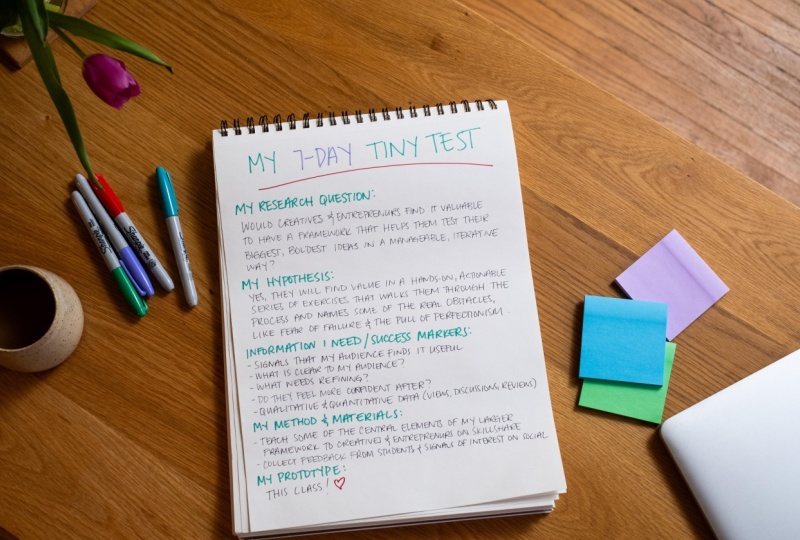
actually sell? Or do people in my area like globally inspired street food enough to sustain a food truck? In my example for this class, my research question is, would creatives
and entrepreneurs find it valuable to
have a framework that helps them test their
biggest boldest ideas in a manageable, iterative way? Next, we want to define our hypothesis or the
assumption we want to test. So in my case, I'm assuming creatives and
entrepreneurs want a framework that helps them move their
ideas forward in a way that minimizes risk and yields
the best possible results. So my hypothesis is that, yes, they would value a framework
that helps them test their innovative ideas in a
manageable iterative way. But more specifically, I'm hypothesizing
that people will find value in a hands on actionable series of exercises
that walks them through the process and name some of the real obstacles like fear of failure and the pull
of perfectionism. The more specific we can
get with our hypothesis, the easier it will be to test. Okay, once we have
our hypothesis, we're going to
define the simplest method we can use to collect the data we need to make a decision about our
research question. So what kind of
information would help you decide whether to invest in
that expensive equipment, sign the lease on a storefront, or spend your evenings and weekends working on your
big, scary creative project? Maybe you want to test the
waters with a wait list or see if people would subscribe to a patrion channel where
you share your process. If you're offering a service, maybe a small group workshop or interviews with
potential clients would give you the
data you need. A simple sketch of
your new idea might be enough to gauge
people's interest and get valuable feedback. So as you're thinking about
the information you need, make a note about the kinds of people who can give you the
most accurate information. In other words, who is
your target audience? Or are there other stakeholders who might provide
valuable insights? And then ask yourself, will your chosen method allow you to get feedback from them? The data I need is
signals that show me whether my audience finds my framework useful
and valuable, which parts are clear or need refining and whether my ideas ultimately contributing
to their confidence and success in
building innovative, sustainable, resilient, impactful
ventures and practices. My audience is emerging in established creatives and
entrepreneurs who are building innovative
practices and ventures and care about the impact they're
making in the world. They're hungry to learn
and apply new skills, and they find value in step by step approaches to help them structure their thoughts
and make decisions. I hope that resonates with you because you're
my target audience. So my method is to teach some
of the central elements of my larger framework
to creatives and entrepreneurs on Skillshare
in a project based class. And then I'm going to collect quantitative and
qualitative feedback through viewership stats, class project submissions,
discussion posts, and reviews. I'll also pay attention to whether my social media audience shows interest in
the class when I post about it on
Instagram and LinkedIn. If you want to go one step
further before moving on, dot down a simple success
marker for your test. Maybe you want to see five
thoughtful replies to your email outreach or ten
sign ups for your workshop, 12 pre orders, two
serious inquiries, or one really clear signal
that tells you people care. Hi. In terms of our
materials, this is the what? What are we putting in front of our target audience to
get their feedback? For our tiny tests, we'll be building a simple but
effective prototype. Now, we'll go much deeper into this process
in the next lesson. But in my case, this
class is my materials. It's a prototype of a larger framework I want
to build to help aspiring entrepreneurs
and creatives develop businesses and brands that
are socially responsible, regenerative, grounded
in care and reciprocity, and ultimately contribute to the well being of
humans and the planet. That is a big, scary
resource heavy goal, and I can't tackle it all
in one Skillshare class, but I can validate my
approach and framework in small manageable
tests and iterate accordingly to ensure I'm providing the most
value to my audience. We'll go through best
practices for simple, effective prototypes
in the next lesson. But for now, jot down your
initial ideas on what format might work best to
collect the data you need from the
people who matter most. Think wet lists, a sample of your writing or creative work on Substack or social media, studies for a series
of paintings, a workshop, a pop up
version of your business, a limited edition
drop of products, or maybe a rendered
or constructed model if you have those skills. Maybe it's a
Skillshare class that introduces your
innovative new approach. Before we move on, feel
free to pause the video and follow these prompts
to design your tiny test. Make sure you write
your answers down in full so that by the
end of this exercise, you have one complete
test concept you can actually run this week. One, your research question. What are you wanting
feedback on? What decision are you hoping to make based on what you want
to learn from the test? Two, your hypothesis. What assumption are you
testing about your question? Be as specific as possible here so that you can
design a prototype in the next lesson
that will help test this hypothesis.
Three, your method. What kind of information, reactions or signals would help you move your idea forward? Who could provide
this information? In other words, who's
your target audience? Are there specific signals or thresholds that would help
you decide? Jot those down. And for your materials, based on the skills, channels, and resources you
already have access to, what's the simplest version
of your idea that you can put out into the world in
the next seven days to get the information you need? We'll spend the next
lesson refining the materials or
prototype, but for now, jot down some ideas
of what might be useful to put in front of your
audience to get feedback. Okay, so now we have
our Tiny test outlined. And the next lesson, we'll build our simplest possible
prototype and get ready to present it for
feedback. Join me there.
4. Exercise: Build a Simple but Powerful Prototype: For our seven day test, we're not looking to
put a polished product or experience in
front of people. In fact, we actually
want to share the simplest version of
our idea in a way that can be presented for
audience's consideration and feedback. This
is our prototype. A prototype is central to the lean startup methodology
developed by Eric Reese and used in business
incubators and accelerators to help bring
innovative ideas to life. In this method,
your prototype or your MVP or minimum viable
product is the simplest, least costly format through which you can test
your idea effectively. Prototype can be
a napkin sketch, a draft, a model, a mock up, or even a verbal description or conversation
about your idea. It could be a pop up
of your food concept or a one night only event, a pre sale order form,
or even just an email. It's less about the format and more about whether it's
presented in a way that solicits useful feedback from your audience and provides the data you need
to make a decision. To start testing some of the approaches and concepts
of my larger framework, I'm using Skillshare
classes as my prototypes. They're perfectly suited to explaining the ideas
to my target audience, testing the activities and exercises that might be
part of my new model. And inviting feedback through
the class discussion, class projects, and
student reviews to help keep refining my ideas. My prototype for my tiny test of this framework is this class, where I'm sharing my
unique perspective on the value of this process, teaching a series
of exercises that I assume will help
people and gathering feedback so that I
can test whether this approach is
useful and ultimately decide how I might
want to refine it to be even more valuable
in the next iteration. Feel a bit sneaky because
my last Skillshare class, financial Consciousness
for creatives, was also a tiny test, where I explore alternative
financial models and concepts like
care, reciprocity, and regenerative finances,
all of which are central to this bigger model of entrepreneurship
that I'm developing. So I invite you to take that
class too and leave feedback in the discussion so I can
keep refining the now, a Skillshare class is an
investment of resources. I've spent time and energy creating the concept,
writing the script, coming up with the exercises, filming, editing, publishing,
and promoting it. But this class came from previous simpler prototypes,
thoughtful conversations, listening to the creatives and entrepreneurs I work
with every day, and using this approach myself. So I still consider
it a tiny test because I'm leveraging
the skills, resources, and channels I already have
access to in order to put my bigger idea into the world in a small way and gather
valuable feedback. From here, I might create a live workshop or integrate
these exercises more intentionally into
my coaching practice so I can keep refining the framework and
building the version that creates the best value
for my audience. Not only is prototyping much easier than building
a polished product, but it's just common sense. It's effective and cost saving. You can build your
product, service or creative project in a way that minimizes risk and ultimately yields better results
than something that goes from an untested idea to fully built and launched
without sharing with potential customers or
users for their feedback. And the earlier we can
do this in the process, the faster we can refine
our ideas to make sure they're actually valued by the people they're meant for. Concept of prototyping early and often is also
central to what researchers and
authors Jess Remington and Joanna Alca call
breakout actors. These are organizations, creatives, entrepreneurs,
movement workers, and others who
reject business as usual practices of our
current loveless economy, which built on extraction and equity in order to
help create what they, alongside their co learners describe as a beloved economy. A beloved economy prioritizes
human flourishing, shared prosperity and environmental harmony
over profit alone. You can't already tell, this is my vibe. I'm all in on it. And so I want to see
if I can apply it in a tactical way to help
people build ventures and creative practices that
become part of and contribute to a beloved
economy. Hence, this class. When you prototype
early and often, your assumptions are tested
and space is allowed to course correct before
investing your valuable time, resources, and energy into a finished version that
might ultimately flop. So really, it's about failing early to win in the long run. The best prototypes
allow you to test your basic assumptions
before diving in deeper. They allow you to include your audience in the process
of deciding next steps, and they replace perfectionism with a culture of learning, which we've collectively decided we're doing in
this class, right? So where does perfectionism creep in during
the testing phase? Well, it shows up as
endless prototyping, going through countless
revisions and iterations to arrive at the perfect
version. Well, guess what? Perfect doesn't exist. So our job as tiny
test scientists, is to resist perfection, find some balance, and
decide what's good enough. Good enough is the version that provides real value
to your audience, your customers. That's it. So how do we know what that
good enough version is? The beautiful thing
about this process is that we don't need
to know in advance. In fact, it's often
best to enter the prototyping process without clinging too tightly to
what the outcome should be. When I first started using the scrappy exercises that would become my Build a
resilient brand framework, I was experimenting
with clients in my own businesses to see what
produced the best results. I didn't set out to create classes or anything beyond that, but it's evolved into
something bigger than I could have
imagined because I've been continually
collecting feedback at each iteration and incorporating it into the next Best version. Now, we're trying to
move quickly here in the spirit of prototyping
early and often. So we want to be
realistic about what we can test in seven days
with our prototype. With my prototype, I'll look at the number of students
and minutes watched, engagement and feedback
in the class discussion, student reviews, and
how my social media and email audiences respond
when I promote the class. So as you're designing your
prototype, ask yourself, what is the simplest version of your idea would allow you to test your hypothesis
in seven days. Could you post something
on social media and get feedback
from your followers? If you have a service
based business or idea, maybe you could offer
a local workshop and invite your target audience
to test out your approach. Maybe it's as simple as a handful of thoughtful
conversations with your target audience or potential collaborators that would provide
valuable feedback. Remember, it's not
about being polished. It's about presenting your idea in a simple format
that will give you useful information and help you make the
next best decision. I know this script
isn't perfect, and I'm sure there are 1 million other ways I could
teach this concept. But if I let myself get
pulled into perfectionism, I'd never test anything, and I'd never move my idea forward. If I waited to share anything
until it was finished, I might have completely
missed the mark and wasted countless hours of hard work
and expensive resources. So before moving on, pause this video and describe
your prototype. It should be the
simplest, lowest effort version of your
offer that will provide useful information
from your audience and help you make a decision
about your next step. Once you've sketched
out your prototype, join me in the next lesson to map out our week of testing. I'll see you there.
5. Exercise: Map Your 7-Day Plan: Putting our ideas in front of people is often
the hardest part. But if you hear yourself saying, I can't share it until
I've updated my website, or the writing is still too loose and drafty
to make sense, you're exactly where
you need to be. When I was writing the
script for this class, I had a hard deadline
for filming. The script wasn't perfect. Maybe I should have
used better examples. I'm sure I could have cleaned up my office space a bit more. Maybe the color of this
shirt makes me look pale. I don't know, but
I'm here filming. At many stages in this process, I had to remind
myself that if I stop to address every little
thing and make it perfect, I would never press publish. The idea would go nowhere, and I would go to bed at
night wondering what if? Life is too short for that. So your seven day plan starts with setting a deadline
for your test. Maybe it's tied to something
already happening in your business or create a
project you've committed to. Nothing gets me
sketching concepts for paintings faster than when a
gallery announces my show. If you don't have
a firm deadline, ask someone to hold
you accountable. Tell them you're running
a test and book time with them now to share the
results after seven days. When I started writing
Skillshare classes, I hired a former
coworker of mine, who was the ultimate
project manager. Her whole role was to keep me accountable to my self
imposed publishing deadlines. Without her, maybe I never
would have published a class, let alone evolve the material
into real world workshops, programs, and products.
Love you, Christina. So, step one, name your deadline and how you'll
be held accountable to it. Step two is preparing to
share your prototype. Depending on the format
and your audience, that might mean publishing
something on social media, lining up a few conversations
with stakeholders, delivering a workshop,
sending an email, or simply putting a sketch
in front of people. Ask yourself how much time you
need not only to share it, but to gather useful data. This is your feedback
collection window. Use most of your week
for this part of the process so you can collect as much information as possible. Now, the seven day restriction on this test is intentional. We want to get data as early
and as quickly as possible, and setting up a timeframe
will help us do that. Now, it doesn't mean
you'll stop getting and integrating feedback
after the seven days, but our goal is to get enough
useful information that we can decide on our next iteration
at the end of the week. So map out the
days you'll use to present your prototype
and collect feedback. In my case, I'll publish
my class on day one, and then use class
discussions, email, and social media to promote it and invite feedback
over the next few days. On day seven, I'll review what I learned and decide
on the next step. At this point, it's
important to release any expectations about
the exact nature of feedback you'll get
and to stay open to other people's thoughts,
experiences, and opinions. After all, if NASA
scientist Lonnie Johnson had led a failed heat pump
experiment to feed him, the super soaker
never would have been invented. True story. So pause this video and map out your week. We'll
keep it simple. Day one, finalize the
smallest useful version of your prototype and share it. Days two to five,
invite feedback, follow up with the people
you most want to hear from, and document what
you're learning. For days six and seven, you want to start looking
at the signals you're receiving and note any patterns, trends, or exciting insights
you hadn't thought about. Before we get to decision time, join me in the next lesson
to chat about how to read the signals and
use discernment to filter out the noise
so we can make a decision about our next
step. I'll see you there.
6. Exercise: Read the Signals: Nothing has driven me more crazy as an
entrepreneur than when someone unfamiliar
with my business says, You know what
you should do? Not every reaction, insight or piece of feedback
deserves equal weight. One enthusiastic comment doesn't necessarily mean
you've struck gold. And one lukewarm
response or thumbs down emoji doesn't automatically
mean your idea is dead. So how do we know which
signals are valuable and will help us make a decision about
our next best step? When I say signals, I mean, the small but
meaningful indicators that tell you something is
landing with your audience. Remember, we want to hear
from the people who matter. Not your neighbor Joan, who knows nothing
about your business idea and not even your mom. Your mom will tell you
you're doing great, sweetie. That's lovely but not
necessarily useful. So we first want to ensure that the data is coming from
our target audience. Then we want to note the signals or indicators
that show interest. Maybe someone signs
up right away. Maybe a person replies to your email with a very
specific question. Maybe a student says, This helped me finally
make a decision. These are not grand
slams, but they matter. And when you add them all up
and filter out the noise, they help you make a decision. You know, noise is
the stuff that sounds loud but doesn't actually
help you decide anything. A vague, cool idea comment from someone who would never
buy isn't actually useful. A random opinion from someone
outside of your audience, like your neighbor
Joan, not useful. Gushing praise from
your mom that tells you nothing about whether
the idea is valuable, wanted, or worth refining. Sorry, Mom, not useful. This is why it
helps to decide in advance what kinds
of signals count. Are you looking for purchases,
replies, watch time, DMs, honest confusion,
strong objections? If you know what
you're listening for and the people you
want to hear from, you're much less likely to get thrown off by
the random noise. So on day six and seven
of your Tiny test, make a note of the signals and the noise and ask where
they're coming from. Depending on the format
of your prototype, this might simply be a list or a spreadsheet of notes
from your conversations, or maybe you have analytics or insights from social media, email subscribers,
maybe you have website preorders,
or actual sales. Collect this information
in one place and note any patterns, trends, outliers, and
exciting insights that you might not
have thought about. All of this data will go into our next step,
making a decision. So join me in the
next lesson where we'll decide whether
to double down, pivot or adjust our idea, or head back to
the drawing board. I'll see you there.
7. Exercise: Decide on Your Next Best Step: That. At the end
of your tiny test, you're not trying
to crown your idea a total success or
a total failure. You're simply trying to make
the next best decision. Remember, we've designed it
to keep the stakes as low as possible while giving us the information that will help
us move our idea forward. At the end of the week, ask whether your data
gives you confidence that what you're building is a real value for the
people is designed for. Or is it telling you that your audience wants
something different? Maybe they're excited
about your new product, but the price is
out of their range, or they want to learn from you, but they would prefer one on one coaching instead of
a group workshop. Maybe the response was a
resounding no or crickets. All of these are valuable and useful results of
our tiny tests, and they don't mean your
idea is a flop or a failure. A resounding yes also
doesn't mean you should empty your savings
account and sign the lease. Whether the signals are
positive, negative, or mixed, they're
telling us what our next iteration should be. If they're
overwhelmingly positive, we can be confident in doubling down on the next
evolution of our idea. Maybe we can turn our small
group workshop into a series or invite collaborators in and offer it as part
of a full day retreat. If you got strong
reinforcing signals, ask yourself, what exactly
got a positive reaction? What was clear?
What felt useful? What seemed to resonate most? This is where you keep
going, invest a little more, and build the next version
with more confidence. Maybe your limited edition
drop sold out immediately. So now you can plan
a seasonal variation with some confidence in sales
for the following quarters. Now, doubling down
doesn't mean making a big leap from a prototype
to a polished product. It means taking
what we learned and making our next version better. More valuable to our audience and closer to our bigger idea. Not only is this a way to manage our resources through small,
meaningful iterations, but it's a way to bring our audience along
for the ride by connecting our decision to their valuable and
appreciated feedback. Like, you guys said
you wanted more, so we're excited to
share our next drop or a workshop series or a product line or
expanded shop hours. Make your audience feel part of your success and they'll
stay for the ride. The reaction you got was mixed, look for what can be adjusted. Maybe the idea is good,
but the format is off. Maybe the audience is wrong. Maybe the pricing, framing or delivery just
needs some work. You do not need to
throw the whole thing away just because it didn't land perfectly the first time. So dig deeper into the data, follow up for one on one
conversations to get more insights and identify exactly where you
missed the mark. By addressing these
gaps or misalignments, your next iteration will
not only add value, but show your audience
that you're listening. I know from the
data from my Build the resilient brand classes that the class around creating engaging values based
marketing content was maybe too long and should have been broken up into
two separate classes. I've taken that feedback and applied it to my
subsequent class planning. Sometimes the test tells you
very kindly that this is not the version to
keep pursuing right now. This is still useful. It frees up your time,
energy, and resources. You can bring what
you learned into a better or stronger approach. During the pandemic, we tried every pivot imaginable
at my restaurant. We did take out cook
at home meal kits, a line of housemade
pantry items, ready to drink cocktails, a retail shop, an online
store, you name it. Some of our pivots
worked well and helped sustain and even
grow the business. Some were flops and
some were just okay. But each idea we tried was done in a careful,
manageable way. It was a pilot test
or a small batch or the DIY version and leverage the unique
skills of our team. Because we framed each
idea as a tiny test, when one thing failed, it
didn't sink the whole business. And when something took off
beyond our expectations, the return was greater
than we planned. So at this stage, you
want to be very open to unexpected feedback or ideas because you might be
surprised at what lands well. And just because something is planned in great
detail on paper, it doesn't mean that
it will shake out exactly that way once it's
out there in the world. My restaurant evolved
into something far beyond my Pinterest mood boards
because I spent years listening to feedback from my pop up and food
truck customers constantly iterating to refine the concept and ensure
I was providing value. Scrappy brand strategy
exercises weren't destined for a series of Skillshare classes when I
started using them, let alone real
world programs for innovative startups at
business incubators. But the responses and feedback that I got from clients and collaborators along the way
allowed me to refine, adapt, and iterate at each step to
grow them into a field tested framework that now I'm confident about turning into a
self guided manual. One of the benefits
of testing early and often is that
it allows you to gather both correcting or negative and reinforcing
positive feedback. It opens up the channels
to all kinds of input that you wouldn't have received if you hadn't tested your idea. So is the data telling
you to double down, adjust, or head back
to the drawing board? Once you've decided
what comes next, let the people who helped you know what you changed and why. This closes the loop,
honors their contribution, and invites them to stay
part of the process. You can share updates
on the results of your test with your
social media audience or send an email of thanks
highlighting some of the standout feedback you received from the
conversations you had. This is not just an opportunity
to express gratitude, but it's relationship building
that keeps your audience engaged and feeling part of
your bigger, bolder idea. Effective test doesn't
just collect data. It also builds
relationships and creates a sense of shared ownership
and accountability. Ultimately, this will
make your idea stronger. At this stage, you've included people in the feedback process. So now you have to present
your next prototype in a way that acknowledges their contributions
and shows how you made decisions in
the latest version. So let's plan our approach. Pause the video here and
answer these prompts. One, what were the clearest
signals from your test? Two, what felt like noise? Three, will you double down, adjust your idea, or head
back to the drawing board? And what are you basing
your decision on? Four, what is the very next version you'll
put out into the world, and when and five,
how will you test it? Join me in the final lesson for some thoughts on
how you can apply this framework to keep building toward your biggest
boldest ideas, and don't forget to
share the results of your seven day test
as a class project. I'll see you there.
8. Closing Thoughts & Where To Go From Here: Putting something
unfinished into the world takes courage. I really want to acknowledge
that before we wrap up. Testing an idea in
its infant state asks us to be visible
before we feel totally ready to listen before we're certain of
what we're going to hear and to keep moving forward before we
have every answer. That can be very scary, but the biggest
innovators out there are living proof that you will
not only survive the process, but it will make your ideas stronger and more
impactful in the end. This is where so much
good work begins. It's not about polish
and perfection, which again, doesn't exist. It's about trying and listening
and noticing what lands, what doesn't what
wants to happen next. From here, you'll
start the process over by mapping out a test
of your next iteration. You have a foundation
to build on, data to back it up, and an idea of what your
audience cares about. So you're now a step ahead. Maybe this time it will take
longer than seven days, but you can follow
the framework from this class to ensure
you have the structure and prompts to think
through the details and arrive at your
next best decision. I hope this class
gave you a practical, manageable way to move
your idea forward without betting everything
on one big leap. In the spirit of being
open to feedback, I encourage you to
share your tiny test, your seven day plan,
what you learned, and what you're
going to do next. I'll update the class discussion with insights and decisions I make about my next iteration based on the feedback
you share with me. So please let me
know what was clear, what was useful, what
could be stronger. I would genuinely
love to hear it because this class
is my tiny test, and you have been
excellent test subjects. Thank you for spending
this time with me, and I can't wait to see
where your ideas go next.
 Tamara Jensen, Entrepreneur & Brand Strategist