Transcripts
1. Getting Found Online : The key to selling anything
online is getting found. The same is true for the
Spoonflower marketplace. Hi everyone. I'm Maria, and I'm here to help you optimize your
designs to increase visibility and reach more
potential customers. On Spoonflower, you designed
a repeating pattern, uploaded your art to Spoonflower,
received your proves. Your colors and
repeat are perfect. But hold on. Your work is still not done. You need to select
keywords for your designs, title, tags, and description. No one which keywords to use to describe your artwork
is your first step. The search engine optimization, also known as SEO. Seo strategies, play
a critical role in customers finding your designs on Spoonflower marketplace. What are keywords
and why are they essential to
Spoonflower designers? Your titles and tags are a select group awards
called keywords. When it comes to
getting noticed online. Keywords or your best friend. The keywords function as labels
for each of your designs. Providing search engines with
the information they need. When someone searches the
Spoonflower marketplace, search engines use
these keywords to determine whether your design matches what someone
is living for. The search engine
uses algorithms to determine the relevance
of web page content. A unique formula that
retrieves the information stored within spoon
flowers data's structure. These algorithms may
change over time to improve the quality
of search results. So why is this important? Optimizing your designs, title, tags and descriptions with
relevant keywords can attract the right customers and increase your chances selling
your creations. And it all starts
with identifying the right keywords
that accurately describe your design and are likely to be searched
by potential customers. Having relevant
titles and tags is crucial in getting found online. In the next lesson,
I'll show you the easiest way to start
your keyword research. So get ready to brainstorm.
2. Brainstorming Keywords: You've heard the phrase, a
picture is worth 1,000 words. When it comes to
selling art online, those thousand words
are up to you. Naming artwork the hang and a physical gallery
is much different than given your
work a title when selling it in your
Spoonflower shop. In a gallery, you would want
the title of your piece to offer a new experience, something
refreshingly different. However, this type of name will not help you in online
search results. It will not get you noticed. Instead, you want the
concisely and descriptively, use relevant keywords for
your titles and tags. Keywords that describe the
Design's theme, color, size, and specific design elements will maximize their
effectiveness. With the right
keywords people can find you and your amazing art. If you wish to convey a creative
name to your online art, you can always add it
to your description or additional details
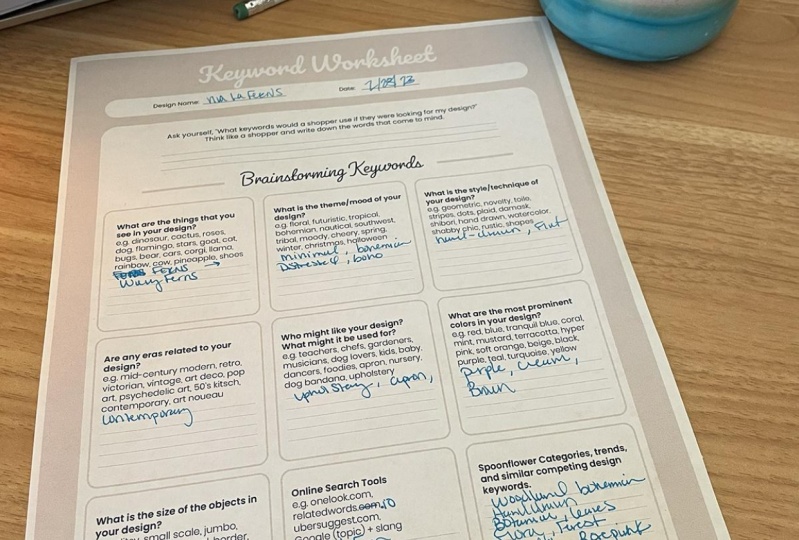
section of the listing. When deciding on keywords and excellent place to start
is by asking yourself, what keywords would a
shopper use or even myself? If they were looking
for my design? Think like a shopper and write down the words
that come to mind. You want your keywords to be distinct enough to stand out, but not so obscure that
customers never used them. Because these keywords help us search algorithm understand
what your design is about. You need to be as
specific as possible. To help you with this, review the following
questions and write down your answers
to these as well. What are the things that
you see in your design? Whether it's dinosaurs, poodles, shoes, roses, or lady bugs. Take the time to identify
the main objects or motifs. Use in your design. What is the theme
of your design? Does your subject
matter tie in with a particular theme,
such as nautical, futuristic plural,
tropical, Bohemian, a season, or holidays
such as Christmas. Also, consider your designs, emotions and vibes, like moody, cheery, playful, and bright. What is the style
of your design? This also includes
art techniques. Here, you'll want to write
down your art style, e.g. watercolor, shabby,
chic, rustic, geometric, and vintage
to name a few. Are any errors related
to your design. Maybe your design was inspired
by a particular time, such as mid-century art deco, pop art, psychedelic
art, and 50s. Kitsch is so write it down. Who might like your design. Note the type of people who might like or use your design, such as teachers, chefs, gardeners, musicians,
dog lovers are kids. What are the prominent
colors in your design? Here you want to
consider selecting two or three dominant colors. Use broad colors like
pink, blue, and red, as well as more trendy color
names such as hyper pink, soft orange in terracotta. And finally, what is the size of the objects
in your design? By size, I'm referring
to the design scales such as ditsy,
large-scale and oversize. You should now have a nice
list of terms that accurately describe your design that you came up with rather quickly. In the next video, we will take the keyword
you just assembled and use online tools
to find even more.
3. Keyword Research Tools: Okay, you're off
to a great start. You've assembled
an ample list of great keywords that accurately
describe your design. But that's just the beginning. Let's take your keyword
research as step further by using the words you've gathered
from the previous video. You want to ensure you
have enough keywords for your title and all 13 tax plus, you might've missed
an obvious word that may not have
occurred to you. I have two online tools
to help me with this. And by the way, both of
these tools are free to use. One, looked.com is an
excellent site with many uses. Today, we're going to look at its reverse dictionary tool. In the search bar, you want to enter the most prominent motif, let's say the design
features of frog. Here in the definition, I
see the word amphibian. Wow, okay, That's the word I
would not have considered. But then again, I'm
not in the frogs. Now let's take the
word amphibian over the Spoonflower and see how
many design results we get. The goal is to get our design on the first page of
search results. And of course, the more
pages of results returned, the more challenging it will
be to get shown on page one with the word amphibian eyes E7 gene
pages of results, which is pretty good
considering most capex top out at 119 pages, 17 pages for amphibian is much better than if I
were to search for frog, which returns 58
pages of results. That's almost 5,000
frog designs. Let's look at the frog
results a little deeper. Even with 58 pages of results, I have three broad designs on the first page to
be transparent. One of the designs I entered in a weekly challenge
nine years ago, and one-third place with it. All the love I received from this challenge is
likes, comments, and sales throughout the years is now helping this
design gets seen. It's worth noting that
any likes, comments, or sales of design receives will help boost its position in Spoonflower search algorithm by interacting with other
spoon flower artist. It in turn can help you
rise in the search results. If you see designs you like, stop for a moment and
comments on them. Many times those artists
will return the favor. This one gets a boost
from all its sales, even though it plays
low and the quirky and Vivienne's weekly
design challenge. Another side note, you
don't need the land in a Winner Circle of a spoon
flower design challenge, or design to generate sales. Goods, subject matter and killer keywords will
give you the upper hand. And wouldn't you rather
have more sales than wins? Okay, back to the words
and Vivian and frog. I would consider both
pretty good keywords, but I'd love to do better. Let's return the
one look and see what other words
they have listed. Here's one bull frog. Wow, only one page
results on Spoonflower. That is a great keyword. So if the design
included a bull frog, I would certainly add keyword. But let's say your frog
wasn't a bull frog. Let's say it was a tree frog. Awesome. Tree frog is another
grade search term with 376 design results. If we combine the
two words into one, there are only 14 results. Perfect. I would
consider both versions, tree frog as two words and
tree frog as one word. Excellent keywords, and
add them to my list. Let's move on to the other
tool I want to show you. This one shows related words. Let's type in the
word frog again. The first part here is towed. Another good keyword
that returned 1003 designs and about 12 pages of results on Spoonflower. And further down the page I
see tropical rain forest. That's what I'd like
to look further into. Upon taken it over
the Spoonflower, a returned over 2,500
design results. Well, that's a little
more than I'd like. But if I were to add frogs
after tropical rain forest, there are now only 60 design
results, but greater still. If a customer were to type
in tropical rain forests, tree frogs, that's
only 26th. Results. You never know what or how a customer will
search for things. And the great thing
about tropical rain forests is that a works really well as a keyword
for the frog subject. Frogs are the most abundant
amphibian in the rain forest. These tropical frogs are also
the most abundant in trees. How do I know that? I Googled it? A note on using keyword
search phrases as tags. All tags must be 20
characters or less, including spaces and hyphens. For this long string
of search words, say tropical rain forest, blue, green tree frogs utilize the following multiple
tags and stand for the best results that get
discovered by more searches. Tropical rain forest,
tropical rain forest, blue green, blue
green with a hyphen. Frog. Tree frogs as two words, and tree frogs as one word. In the next lesson,
I'm excited to share my secret weapon for uncovering the best keywords
and topics that truly resonate with
Spoonflower shoppers. I'll show you how to have access to data-driven insights to create designs that meet the needs of
potential customers.
4. Next Level Research: Get ready to take your research
skills to the next level. Who were suggest is the perfect tool for
helpful keyword insights. The free Chrome extension
will provide you with monthly search volumes for
queries made on Google. And it also integrates
with YouTube, Amazon, and other sites developed
by SEO expert Neil Patel. This handy tool can be
accessed in nine languages, making it convenient for
users across the globe. Once installed, all
that's needed to retrieve relevant keyword data is to search using
compatible web sites. The Uber suggest free
Chrome extension is great for gauging the topics popularity or
finding related keywords. However, the real power
lies in its paid version, which unlocks a feature that has become my ultimate
secret weapon. I needed to know what topics
the Spoonflower audience was looking for and what keywords
they use to get there. With Uber suggest you can actually see the top
pages by traffic. Customers visit the
most on Spoonflower. Talk about a game changer. The tool helps me identify the optimal words to include
in my product titles, tags, and descriptions so that they appear in Spoonflower
search queries. And not only that, it
gives me a roadmap to what design topics
are in demand. The strategy here is to
take these in-demand topics over the spoon flower to see
how much competition it has. When you find one with low
competition, you've struggled. I keep a list of in-demand
low competition topics for when I create new designs. It's especially handy
when creating designs for Spoonflower Weekly
design challenges. I will select the topic from my list and adapt it
to a challenge theme. Nearly every one of my design entries cells before or during the
challenges voting. How I place in a design
challenge is not a factor. Winning is never my goal. Making sales is the data
is constantly changing. So I liked the check-in every few months to see
how the topics move. E.g. I've been watching cow
print move up the list. So I decided I needed
to get some cow print designs onto the
Spoonflower platform. I immediately added 24 designs in varying colors and sizes. Going down the list,
the words mushroom and frog are getting
a lot of hits. Mushrooms are generating
almost 15,000 estimated visits per month while frog
is getting over 10,000. As we scroll down, we see more variations of
these subjects, like cows for AGI, blue cow and cute mushrooms. But better still, you can look deeper into which
keywords are used. Let's look deeper into mushroom. You can take these
search terms to Spoonflower to see what
kind of competition it has. E.g. let's take a look
at neon mushrooms. There are only 150
designs for this. I would certainly add that to my list of potential
topics to design. Or if I already had
a mushroom design, I would consider re-coloring
it with neon colors, or as seen here, adapt a mushroom design for the fall or Halloween keywords. It's super fun when you find a search term with little
to no competition. Like when we look further
into acute mushrooms. Let's check out cute
mushroom doodles. Only 45 search results are here. Uber suggest is an
incredible resource that helps me develop
designs that are likely to resonate with Spoonflower shoppers and
boost my chance for success. And this is just the first page. There are so many more
opportunities to explore. Overall, Uber suggest has
been an invaluable asset and increasing visibility in sales for me on the
Spoonflower platform. And it remains a key part of my strategy when
creating new designs. Don't just take my word for it. Try it out with their seven
day free trial and see how quickly it will
revolutionize your SEO efforts. I should add here that I am
not an affiliate or sponsor. I am not receiving any
compensation from Uber. Suggest for this
endorsement is just what I use to make the most of
your keyword research. Let's uncover even more places, the fine great keywords specific to the
Spoonflower marketplace. So if you're on a tight budget, you will definitely want to
be me in the next video.
5. Digging A Little Deeper: Never assume you can
dig a little deeper. Hey everyone, In this video, I'll give you more
great places to find keywords for your
Spoonflower designers. Reviewing best-selling
designs on Spoonflower is a great way
to boost your tag game. Not only do they have the
audience's attention, but their success also means they must be
doing something right. Scrolling down any design page, I can easily find out which keywords those top
designs have used. E.g. if I had a
llama theme design, I would search Lama
on the platform. Then click on a few designs
with the same style and feel to mine and see which
keywords they're using. Instead of copying and pasting exact keywords from
any given design, researcher options and ensure your selected keywords
are unique to your work. Every design is different, even if the topics
may be similar. So every cluster of keywords
should be different too. Not only does this help customers find what
they're looking for, it boosts your
listing in searches compared to other
similar designs. Spoon flowers category
filters provide an invaluable resource for
finding perfect keywords. You can explore their top
and trendy colors, style, and topics by hovering over the fabric tab in the
navigation bar and drilling down further
into the categories defined specific terms
related to your designs. Here's how it works when a customer uses the
search by categories feature on Spoonflower and drills down and
clicks on lama, e.g. animals to farm to llama. It takes them to
the results page of designs that contain
Lama as a keyword. These filters are intuitive. Meaning if you tag
your design as llama, a customer who selects the animals filter will
also senior design. They're using these filters
to determine tags is a good practice to help maximize the visibility
of your designs. The Curated Themes
on Spoonflower is based on Spoonflower is
best-selling designs, popular online searches
and up and coming trends. Use the theme titles as
keywords for fabrics you may have already uploaded
that also fit the theme. Or for future designs. Define the Curated Themes, go to fabric in the
pages navigation and select curated themes
from the drop-down menu. From there, you will see an
array of theme names like neutral nursery or rustic
launch. Here's a tip. The curated themes
are a great way to generate ideas and
inspiration fast. Use secure rated themes as prompts and consider what
design you can create. The bid in each collection
is the perfect way to keep up with what's popular
and get fresh design ideas. It's also a good idea to stay on top of the latest trends. This brings me to my last
place to find great keywords. Spoonflower releases, trend
reports periodically. These reports include
expert opinions, advice tips, and
trending search terms. They give insight into what keywords are most often used by customers looking for
particular types of designs, making it easier for you
to take your designs fittingly so they appear
in customer searches. When visiting the Spoonflower
blog type trend report into the search bar to
find these reports. Here's something else
you want to consider. Take insight from spoon
flowers blog is a great way to stay one step ahead of the curve when
creating new artwork. By keeping up with
the trends and themes popular within the
Spoonflower marketplace. You're more likely to have
designed selected by them for their marketing efforts
and distribution channels. And being on Spoonflower is
radar is a very good thing. In the next lesson, let's explore the process of creating design titles
in more detail.
6. Creating Effective Titles: Because many customers
shop or designs on Spoonflower by typing
something into the search bar, you want to ensure
that your designs appear in those searches. Now that you have identified
a mix of keyword options, using them in the
most efficient way possible across your title, tags and descriptions
is essential. And I'm going to cover each one separately over the
next three lessons. When creating the title, we must consider the design. What words accurately
describe your design? What would someone type into
the search bar to find it? The long-term success of
your listing depends on how well you can describe your design to the
search algorithm. Once you've determined the keywords you would like to use, you'll need to start organizing it to appeal to customers. And the search algorithm. As a general rule of thumb, use the primary keyword at
the beginning of the title. This will help search engines
understand your design and may boost the likelihood of your design ranking
for that keyword. When creating the title for
your spoon flower design, you want your title to be
concise yet descriptive. I recommend that you use more than three words or
more than 20 characters. However, going
overboard and including too many keywords in the title is known
as keyword stuffing, which can harm your SEO
efforts in the long run. Yes, there are titles like
this, and surprisingly, I am seeing this practice of keyword stuffing occurring
more and more on Spoonflower. Even among popular designers, please don't follow their lead. The search algorithms know when you are cramming
in a long list of keywords and your rank will
eventually be lowered for it. Make sure the title makes
sense and is easy to read. It's best to focus on
creating relevant, descriptive, and
easy to read titles, ones that makes sense. Otherwise potential customers
may quickly lose interest. Descriptive keywords
should be ones that an average person
might search for. Don't get hung up on abstract
names or obscure terms. They also need to be relevant, so keep out any words
unrelated to the design. If your designs appear
in irrelevant searches, this can lead to customer dissatisfaction and your listing being d prioritize by the
algorithm in future searches. Once you have a
great title crafted, you don't want to use it for more than one of your designs, nor do you want to copy
another designers title. Each title needs to
be uniquely its own. Ultimately, taken
the time to craft an appealing and
formative design title is key for helping
make sure your design stands out and grabs
people's attention. If done correctly, it can help maximize your
chances of success. In the next video, I'll cover the best practices and
guidelines for your tags.
7. Selecting Effective Tags: Whether you're a beginner
or seasoned designer, choosing the right tags, it's essential for customers
to find your designs. Selecting the right tags might mean the
difference between a design being discovered and
a design being overlooked. Unfortunately, it's
not always easy to determine the best and
most effective tags. But don't worry in this lesson, I will give you even
more tips for selecting those perfect tags so that your designs get all the
attention they deserve. So let's get started
learning how you can maximize the potential
of your tags. You can get more
eyes on your work. For effective keyword tags, you want to balance
broad and specific ones. Broad keywords are
highly searched but tend to be very competitive. Whilst specific keywords
are much less competitive, but their search volumes
tend to be lower. So here's what you
need to remember. Variety is key. A combination of broad
and specific keywords is vital for ranking in search. Do not neglect the tag section. Skipping on tags is like not giving yourself the
recognition you deserve. So makes sure all 13 slots
are filled with keywords. If you don't take
advantage of all 13 tags, seriously reducing the
chances of showing up in searches and being
seen by customers. Be mindful of copyright and
intellectual property laws. Refrained from using the names of other contemporary artists. Artworks are copyrighted
property in your tags. It's important to
remember that while another artist's
work may inspire us, we cannot use their name or any copyrights in our
tags without permission. Make sure you double-check
your tags to avoid any misspellings
or other mistakes. However, if you have a word
that's commonly misspelled, such as Ginko, consider
including both spellings. This can expand your reach
by ensuring your tags are optimized for all possible
search inquiries. Let's now talk about the use of singular and plural keywords. Generally on
Spoonflower searches, a keyword singular
and plural versions, have the same search results. So I lean towards optimizing
for the plural form. Since the singular form will be included in it by default. Unless we're talking
about words with irregular plural forms
like baby versus babies, then I may consider
both variations, especially if I wanted to reach out to parents looking for baby designs with spelling variations such
as gray and gray, include both versions if it
was essential to my design. I wanted to mention that
Spoonflower says their system notes these spelling variations and we'll see your design, whichever version you use. In my experience, however, gray and gray have always given me two
different searches. So I will continue to use bold
for this word and others. Similar occasions regarding SEO, things aren't always
black and white. Therefore, you must test
things and use your judgment. In the next lesson,
I'll show you how to create captivating
descriptions that engage visitors while providing search
engine visibility.
8. Writing Descriptions: Let customers know
the story behind your art and what makes
each design special. It gives you an advantage
over other sellers. If you're like most creators, writing descriptions for your
designs may seem daunting, but it's worth the effort. Crafty and engaging stories
is an effective way to connect with customers and make them more
likely to purchase. Your designs, description,
and additional details sections need to be informative,
clear, and compelling. Tell the story
behind your design, why it was created,
what inspired it? Elaborate on the
colors and techniques. Consider including how someone
might use your design. This will help
customers visualize ways your design could
fit into their lives, making them feel more
connected before buying. Here's a tip. Matching the
customer's language is especially helpful in
your design descriptions. I don't mean you need to
know a foreign language. I am referring to the
unique terminology, jargon, or slang for
any particular subject. Google is a great
place for this. In the search bar,
type your topic with either the word
lingo or slang. E.g. I. Would search surfing slang
if I had a surfing design. Here you'll see sides with a
glossary of surfing slang, surfer terms, and even one that will have him
speak in like a surfer. So yo dude start finding
new radical list of search terms for design topics and ride the wave to success. Using lingual specific to
a particular topic gives customers and
indication that you understand them and know
what they care about. Giving you an edge when
connecting with them. That sense of connection is invaluable when
establishing trust, making potential customers more likely to engage
with your designs. Note that these descriptions
are not only for customers. Search engines
also crawl through this information
when determining ranking in search query results. For this reason,
you should avoid repeating the same
description across multiple designs by
taking the time to write thoughtful and
meaningful descriptions for your designs
listed on Spoonflower. You'll be giving yourself as
significant advantage over other artists who don't put as much effort into this
step of the process. Customers will
appreciate reading the details behind each
one-of-a-kind design. Is that not only informed, but also connect them to your
art on a personal level. Given them more insight
on why they should choose your design
over anyone else's. So go ahead, get creative, have fun, and hanged lives. In the next lesson, I'll demonstrate how
customers can still find a newly listed design
for a popular search.
9. Real World Example: It always seems impossible
until it's done. Countless hours of thought and effort go into creating designs. But how much time and
energy do you spend? Discovery and the keywords
most often used by customers? In this video, I'll
show you that even with a saturated niche
or a new design, there's still a chance
of breaking into it. And you don't need a
massive social media following the take
advantage of this, I only have a little over
500 Instagram followers. Instead, you need to invest more time in
keyword research, which many designers overlooked. So let's look at a very
trendy but saturated subject. Mushrooms. I just entered a mushroom
design and the poisonous plants Spoonflower design
challenge that is open for voting
during this recording. So this is a new design
in a popular niche. I chose this design because I wanted to demonstrate
that a new design can be seen on the first page of search results for
popular niche. Let's get started. When I typed the word mushroom
into the search bar, as you can see, there are over 10,000
search results. However, IZ one
of my designs for this highly
competitive search on the first page being footnotes
and mushroom hunter. I entered this design and then gnomes Spoonflower design
challenge in 2021. And like my Japanese
frog Cloud design we discussed in lesson three, it did not place well
in the competition. But because of its
keywords in sales, the design has worked his way to the first page or this
trendy search term. Sometimes it just takes a
little time to get there. For your new designs. The strategy is to target multiple low
competition keywords. These lower competitive keywords increase the chances
of customers scene, and buying your design
in a search without directly competing with a
more established keywords. This is very important
to understand. Your designs will first be discovered through these
low competition keywords. Then gradually
build traction and visibility through sales
likes and comments, which is how their
rankings improve. So that eventually
your designs will show up higher in the rankings
under the board. Competitive keyword searches, Like mushroom in this example, there are few more tactics to give you design an edge over competitors vying for attention with these
well-established keywords, which I will explore more
deeply in an upcoming course. For now, let's continue
with the mushroom design I recently entered in the poisonous plant
Spoonflower design challenge. I needed to find less
competitive keywords that customers might use so that my design would show up on the first
page of search results. Mushroom fans might search
for the scientific name of these red top mushrooms of
polka dots called fly agaric. So let's type in fly agaric. Not bad. I'll add it to my list, but I'm still trying
to get the page one. Generally, most
customers probably wouldn't know its
scientific name anyway. So when thinking
like a customer, I would probably describe
the type of mushroom I want. If I wanted a red
polka dot mushroom, more than likely, that's what I typed into
the search bar. So let's do that. Red polka dot mushroom. And look, there is
my design entry. And it's interesting how, except for the word
read, my title, read toad stool, rooms, doesn't have any of the
words I just searched for. Which demonstrates how
important your tags truly are. So don't neglect them. The word toad stool on its own, we turned 45 pages. The results, while red towed
store returned 11 pages, showrooms Gardner,
13 pages of results. I also recall polka
dot mushrooms in many children's
fairy tale books. As you can see, even with a new design in a
saturated niche, it can still be found in the
Spoonflower marketplace. You just have to
be persistent in finding low
competition keywords. This strategy can
be your foot in the door to becoming
more discoverable. Each like comment
or sale will boost your designs rank and
increase its chances of appearing on the first page
of search results attracted more attention to
your designs and ultimately increasing
your sales. That's why optimizing
your listings on Spoonflower is so essential. It will make all the difference.
10. Course Project: What's your skills to the
test and show off your work. For your project. You're going to do
one of two things. Either share a picture of
your printed worksheet filled in with the
keyword research for one of your designs, or share a screen capture
of the actual designs, marketing and selling section on Spoonflower showing the
title, description, and tags. This is an excellent
opportunity to try out what you learned in the
course and give feedback. Once you have completed
your project work and uploaded it to
the projects gallery, checkout, all your fellow
students projects. Hi, I'm always inspired
when I see the diversity and creativity coming
out of everyone's work. Moreover, receiving
feedback from your peers is always beneficial, both in giving and receiving. Not only does this help
ensure that everyone understands the content discussed
throughout this course, but it also allows us to use our newly acquired knowledge
and skills in contexts. So don't forget, once you've
finished your project work, uploaded to the project gallery and check out everyone
else's project.
11. Final Thoughts: Congratulations on
completing the course. You now have the tools and
techniques for your designs. This stand out from
the crowd and create more opportunities for
customers to find you. A good keyword strategy is an essential tool
that could lead to exciting new opportunities and not let your hard
work go unnoticed. Taking the time for
keyword research may seem like a chore, but it's an integral part
of marketing and promotion. Remember, people can't buy
something, they never see. You will also want
to take the time to update your keywords on existing Spoonflower designs and reevaluate
them periodically. This takes patience, but
it's essential as it increases the range of potential customers that
could find your designs. Who searches. Having accurate,
up-to-date keywords for your designs is critical for attracting potential
customers and helping them find what they're looking
for quickly and easily. By following me on Skillshare, you'll be the first to know
when I read these part two of the secrets to getting
found on Spoonflower, two goes on SEO searches
where you'll learn even more tips and
tricks to maximize your shots visibility,
and performance. If you liked the course, please take a moment
and leave a review. Not only does it help me, but it will help and encourage other students find
intake the course. To do this, navigate to the Reviews tab beneath
the video player, then click Leave review on the right-hand
side of the page. It would be a lot if you can take a few moments to write one. They encouraged me to continue creating more
courses like these. Thank you in advance, and never forget, create
courageously.
 Maria Faith Garcia, Create Courageously