Transcripts
1. Introduction: To me there's nothing
more joyful and fulfilling than to have
the ability to walk up to anybody everywhere
in the world and put them in a state of wonder where everything is possible. And the best part
is everyone can do. Hi everybody. My
name is Tim and I invite you to join the
magical experience. I'm so excited to welcome you
to my first Scotia class. You will learn basic slight of hand techniques to perform
impossible magic feats, such as making things disappear, appear, and even transform. I have prepared five
effects that are simple, easy to learn, and most of all, fun to perform and practice. I've been performing magic
for almost ten years now. Performing everywhere
at restaurants, cafes, even nightclubs for my family, friends, and complete strangers. In my class project,
you recreate a performance of one of the five effects that
I will teach you. You can make up your own
presentation and your own moves. The only requirement is that you will show it to at
least one person. You can also perform
it in front of the camera and then
upload it to skill share. I will give you tips and
guidelines along the way so you can master the effect
and amaze everyone with it. Now take note that there's
no prior knowledge required. Everyone can do these things. You just need a couple
of things that you mostly have laying
around in your house. So let's grab a deck
of cards, some coins, and let's get started brain.
2. Necessary Tools: Now, before you can practice
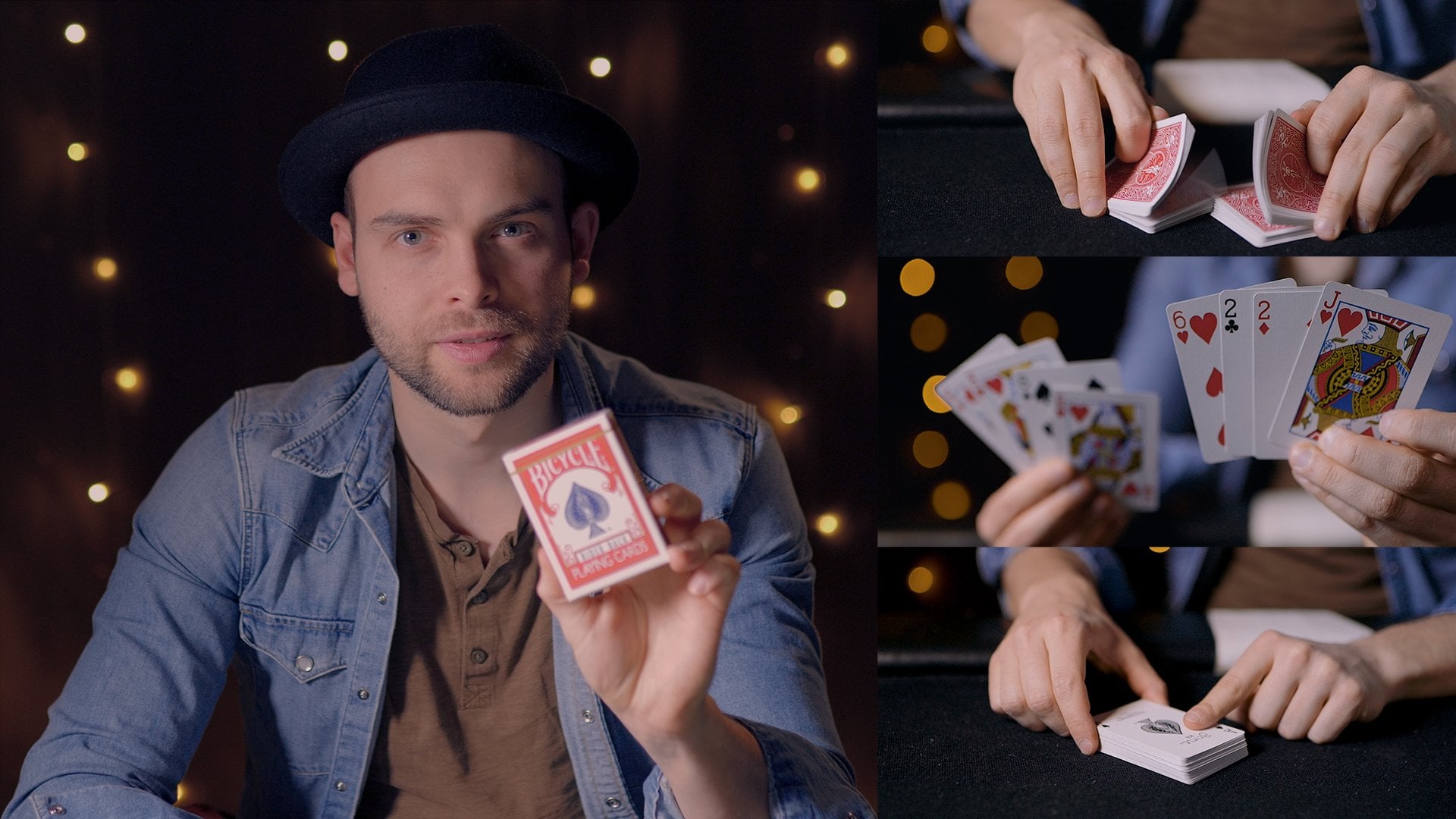
and perform these effects, you need a couple of things. I have a deck of cards with
me here that's bicycle brand. You don't need to
use bicycle brands, but those cards are
the best ones for performing magic tricks
and just very cheap. $2 or $3 I think. But if you don't have them, just use any cards that you
have in your drawer. You need a couple of coins. Three coins is fine
or two coins is fine. I have American Half Dollar. The general rule is when you get the coins, the
bigger the better. But just use any
currency for practice. If you want to
practice at first, the bigger coins are always
better then a lighter. I just have a lighter with
a warning sign because I need the warning sign for a specific effect that
I will teach you. Get one of those. That
some white thread, we need it for the
gypsy thread effect. Then I have goodies,
that's just a pin. You don't really need that, but that's also required
for one effect. But you don't have to
use a pin. You can also use a coin from a different country or
a different currency. It just has to look
different from the coins that
you're using first. Then just, yeah, that's it.
3. Basic Card Handling: Now let's begin with
basic card handling. I will show you a few ways,
how to hold the cards, how to cut the cards, and how to shuffle the cards. So you have a basic
understanding of how to handle a deck
of playing cards. I have 52 cards here. I hold the cards in what's
called the dealers script. That's the most natural
and most often used script that we use all the time. You have the first
finger at the top side, the thumb on the right side, on the right length side,
and the other fingers resting on the left side. I'm left handed. That's why I hold the
cards in my right hand. If you're right
handed, you probably hold the cards in
your left hand. So just mirror my
actions and think left, When I say right, you hold
the cards not too firmly. Now I'll show you a
simple tabled cut. If you cut the cards, that's what's called a
single tabled cut like this. You take those two fingers, the middle finger and the
thumb break off about half of the cards and just lay them next to you and take the
rest, put them on top. You need that for
the first effect because there's a lot
of cutting action. The action is this, cut and
complete, just like that. Now the first shuffle you will learn is the
overhand shuffle. And you have the cards
in the dealer's grip. You come with the left hand, take it, turn it 45
degrees clockwise. Then you have it
between those fingers, Between the middle finger, the thumb and the first finger. And then this thumb
takes ten or 15 cards off and shuffles off the
rest with every take, the thumb pushes off ten
or 15 cards like this.
4. Basic Card Principle: The Key Card: The first card
principle that you will learn is called
the key card. The key card is the card that you will peek
at the bottom of the deck that the
spectator isn't aware of. When he shovels the cards, you give him the
cards at first and shovel the cards
when he's finished, he gives you the cards
back in a messy condition. You need to square the deck up. That's your motivation
for doing the motion. And in that motion,
you peek the card. The deck is messy.
You take it in mechanic's grip
or dealer's grip. Then you come with those two fingers with the
middle finger and thumb and square the short side. Then you take the cards
at the short side, turn it, and then
square the length side. And in that you look at
the car, I'm peeking. The seven of clubs. Right now, I know the seven of clubs. I need to remember
the seven of clubs. Just repeat it in your
mind. The seven of clubs. The seven of clubs,
because that's the key card that the
spectator will put his card, select the card next to, so you know the selection
of the spectator. That's the key card principle.
5. Explanation The Pulse Trick: We'll come back,
we'll come back. Now. Let's take a look at the explanation of how I did it. You learned the key
card principle, and I've used the key card
principle in this effect. And shuffle the deck of cards. And she can shuffle,
shuffle, shuffle. And I don't have to do anything, I just have to wait
until she's finished. And then we will do the
square up action like this. The cards are messy.
I will square the deck up and peak the card. I'm peaking the two of spades. So I think two of spades. Two of spades. Two of spades. Then I spread the cards. But you can just let
her take any card. She takes it out,
holds it against her heart. I'm looking away. I still think two
spades. Two spades. I don't know what card she picked, but
that's not important. I just know that to
spades at the bottom. Then I say to her, if you put the card on top,
I know where the card is. She puts the card on top and
I know where the card is. But if she cut now, your key
card that you remembered, the two spades, is the card
that is below her selection. Even if she cuts one more time
or if she cuts like this, that doesn't change anything. You still know
where the card is, where your key card is
if you spread the deck. Now like this, now I'm looking
for the two of spades. I see the two of spades
is there in the spread. And the card right next to it, on the right is her card, in this case, the
Seven Arts, right? Was it the 77 art? Then the rest is
just presentation. I just take her car,
take her pulse. I'm just looking for the two
of spades and I say, oh, I'm reading body
language, let me see. Then I just eliminate a
few cards and say, oh, you pulled me in this direction, you pulled me in this direction. And that's the presentation. You can make up your
own presentation, but that's I chose to use. And then at the end, I just dramatically revealed
the card that she picked, the seventh arts,
by using her pulse. And that's all there is to it.
6. Coin Handling: Finger Palm: Basic coin handling. Now I will teach
you three moves, or three concealments and one fake put that you will learn and use in the
next two coin effects. Now the first move is what's
called the finger palm. That's a method to conceal a
coin between your fingers. So it looks like you don't have a coin hidden in your hand. You have it here between the second finger
and third finger. You have it in the lower third of the finger of the finger. The only thing you do is
curl those two fingers in. The coin will stay
put and you can move freely and it looks
like you don't have anything in your hands. You can also make a
gesture like this, that's to show the spectator
that there's nothing here. He's not going to think that you have something
concealed there. Just like that mirror. The two fingers,
they look natural. Again, that's the position of the fingers and you just
slightly curl it in. Then you have the
coin concealed. That's what's called
the finger palm.
7. Coin Handling: Retention Vanish: Now I will teach you
the retention vanish, or retention of vision vanish. It's a fake put technique where you supposedly
take a coin, put it in your hand, but
it's not there, it's empty. I will teach you a basic way to do the retention
of vision vanish. There are hundreds
of ways to do it. And that's just a
simpler method. You take the coin between
the second finger and thumb, you put it in your hand, or supposedly put
it in your hand. That action, you start closing the fingers of the right hand like
this finger by finger. When you come to
the third finger, when the coin is not
visible anymore, that's when you do this action. This hand does this action, just pulls away like this. When you do it like that, it looks like you put the coin in. But it's not there because you also try to let the
coin catch some light. So it looks better like this
if you move it and then it looks like you put
it in and then blow or do anything and
make a vanish.
8. Coin Handling: Tenkai Pinch: Now the next
concealment that you will learn is called
the tanki pinch, or the Gosman pinch
looks like this. The hand looks empty yet
I have a coin hidden. It's a Ackie move, but you will get used to it. You
just have to practice. The hardest part is getting
it into the position between the pinky and
the third finger. You hold the coin
like this between the second finger and
third finger and thumb. Then move the coin back. And you have to make this
gesture with your hand. When the coin is
in this position, you just take the Pk and the
pinky curls in the coin or takes a part of the
coin and now it is clipped between the third
finger and the pinky like this. Again, the movement is this. Then you just open the hand
and now it looks empty. You have to keep the hand to a little bit angle
towards the spectator. Can't see like a little
flash of the coin there. But then you have the coin in
this position and the move to make it appear is like a
reversal of every action. You just close your
fist like that and then open your hand
and then the coin appears. You have to practice this. It's a little bit
more difficult, but you have the coin in
tank hi, pinch like this. Then you turn and close
the fist like this. You have the coin there.
Then the next move is relied on by gravity. You have to move the
hand up like this. You have to let go of the coin
so it lands in your palm. You have to try it.
You don't have to use it for the
first magic effect. You can also make it
appear in any other way, but just try it and learn it. And it's a very visual move because you have an empty head. And then you go like this, and then just the coin
just suddenly appears. Yeah. And that's the
tank I pinch by. Pray. Pray it.
9. Coin Effect Nr 1: Appear & Travel: Okay. The next effect
is called appear and to travel. And
I have a coin here. Can you take it in
your left hand? But the thing is
we need two coins, so I'm just going to make one appear and we'll take it
and change places with it. The coins will change places. Okay. Okay. So like that I did it and now they
will change back. Did it again, you're
not impressed, right? Not really. The hard part is making disappear
in appear in your hand.
10. Explanation: Appear & Travel: Now I'm going to explain the
appear and travel effect. You start with one coin and
ten kai pinch like this and the other coin rests in your hand there or
there. It doesn't matter. The hand looks like you have a coin in your
hand, nothing more. But did you secretly have
the coin and tank pinch you? Go to your spectator and say, I'm going to perform a
magic trick for you. I have a coin here, can you
put the coin in your hand? But then you say, oh,
I need two coins. And then you do the
action of making the coin from tank
pinch appear like this. But you don't have to use it. If you're practicing it and you find that you
can't get it to work, just start off with
two coins and just say I'm going to give
one coin to you, I'm going to keep one
coin and then just do the fake put and vanish. But that's the way, if you know the tanky pinch
or if you mastered it, do it like this,
give her the coin. And then you make
the coin appear with the tank pinch like this. And now you do the fake put. You tell her, I'm going
to take this coin and I'm going to
make the two coins change places with each other. Now I have the coin and finger
point right now because I did the retention vanish
that you just learned. And I put my hand
on top of her hand. But if I would do it like this, it would fall or it
would make a sound. So I put the thumb on
top of the coin so I can straighten out my
fingers and go like this. And then I would say the
coins will change places, just like that, but
nothing happened. But then you say, okay, I'm going to make
them change back again. She's not oppressed,
and then you reveal that the
coin has vanished. But in that moment,
exactly in that moment, you put your thumb off so the coin can drop and it
makes a sound like this. Then she knows the
effect happened. And in that moment, you reveal that the fist is
empty, so again, you have it like this and magic, the coin appeared and that's the appear and travel effect.
11. Coin Effect Nr. 2: Transformation: Now, this next effect is
called transformation. And do you like my button? Yeah, yeah, Yeah. You want to take a look at it? Of course. Take it. Wow, it's
a smiley face. Mm hmm. Now, and if you could change that button into anything
that you want to, what would be your choice? Money. Money? Yes. Let's do it. Blow just like
that. Now we have.
12. Explanation: Transformation: Okay, now let's take a
look at transformation. I'm going to explain it to you. The preparation is you have
a coin and finger palm, you have a button or
something that looks that in similar shape of a coin but
has different attributes. I also have another coin,
like a Chinese coin. You can use that or use
a smaller coin because when it changes the difference
it's very appealing. Anything you can use
SD card, I don't know. But the preparation is this. The finger coin,
the finger palm, I'm taking the button and giving it to her so she can examine it,
take a look at it. Then she gives the coin back to me and I ask
her if you could change this coin into
anything, what would it be? This is the action that's like the conditioning, the spectator. That you do this movement, taking this button and
throwing it in your hand. Because after that,
after a few times, after just talking
to her and saying, what would you change it into, then you do the move. The move is called
the Bobo switch. And take the button,
when you're throwing it, straighten the fingers of the left hand that
has the coin in it, you basically push
the button in with your first finger
and the thumb push it in and let the coin
fall into the hand. And immediately
closing the fist. She doesn't see the change, but the action is you do
this two or three times. Then in that action
of throwing it again, that push the button in with
your first finger and thumb. And straighten out the second
finger and third finger so the coin can fall
into the fist, close it. And then this hand takes the
button into finger palm. And then she, she says nothing. Hopefully she says money. But if she says something else, I don't know what other people
would change that into. But if she says something else, then you say, you know what? I would want to change it into, I would want to
change it into money. So you can always use your
kind of presentation for that. Or your wish. I would wish for money, let's
wish for money. The coin, the button changes into the con yea, and that's it. That's the effect
called transformation. And then you can leave
and take the money.
13. Effect: Gypsy Thread: Now this is one of my
personal favorite effects. It's called the Gypsy Thread. You need nothing more
than a piece of thread. Just like that.
Going to break it off. I hope you can hear that. Let me see. And I'm
going to break it into a few individual pieces
like this there. And now I'm going
to take them just like that and roll them
into a little ball. Can you see that? Now? I'm going to take it just like that with the ball attached
and now just blow, and now it's restored again.
14. Explanation: Gypsy Thread: Now this is the explanation
for the gypsy thread. You need a white thread, or red thread rolled onto
the tube. Onto your tube. Because the tube will
hide your secret. The preparation you have to do before performing the effect is taking about the same
length that you will cut off. In the effect, you will
take it at the end, at the tube, you
will roll it up. You will roll it into
the small little ball just like this. This small little ball is
concealed behind the tube. You have this
little ball that is concealed here behind the tube. Nobody sees that. You
can leave that in your pocket and just take
it out and then perform. You can come out like
this and show it or just leave it
somewhere there where the tube hides the
small little ball. When you're performing,
you take the thread there like this and then cut off about the same length that you
roll it up like this. Say break it off. Then you will cut them
with your fingers, or you can use lighter, or if someone has a
scissor, you can use that. You will cut it
into small pieces, just like I did in
the performance. When you have those pieces, you take them this with the ball you will keep in your hand. In your left hand. Then you roll up those
pieces into a little ball. Now this is the situation
that you're in. You have the thread
with the ball concealed between the thumb
and the first finger. And the cut pieces that are also rolled up into a
ball on the other hand. Now you will transfer
this ball into the hand where the thread
is. Show it like this. And now you change hands. You change from the left
hand to the right hand. In this moment, you will conceal the ball with
the cut pieces and bring the other ball into view that's
already on the thread. They see a ball
every single time. Then with the left hand, you will take the one
end of the thread. With the other hand you
will take the other end. The ball is still concealed, but it's now concealed
on the right hand. And then everything's finished. You just need to pull them
apart and that's the effect. And now it's restored. Again, you can give it to the spectator and just get rid of a piece.
Just throw it away.
15. Effect: Changing Lighter: Now let's get into
the next effect called the changing lighter. I have a lighter here
with a warning sign, Keep away from children. The funny thing is if you
take the sign right there, you can make it disappear. Just like that. Now it's
gone from both sides, but you can also
just take it again. It appears again, it's just a fun little effect.
16. Explanation: The Changing Lighter: This is the explanation, you will learn what's
called the paddle move. The pedal move is basically
just this turning, the lighter 90 degrees, but you will do it in the
motion of showing both sides. That's what covers
this small action. This small action is covered by the large action of
the wrist turning. That's a basic
principle in magic, that the larger motion
covers the smaller motion. It's invisible because if you look at the
lighter like this, I do this, it looks like I'm just showing both
sides to you, right? But I'm showing
you the same side. You start off with
the lighter and explaining that
there's a warning sign on it, keep away from children. And you just show it casually on this side and then on the other side with
the paddle move. Now, the timing is crucial here. You have to start here again. This is the movement. While you're turning,
you start moving. That's the slow down action. While you start to
turn your wrist, the thumb will roll the
lighter forward like that. It looks like you're showing two sides because the
wrist is turning, but you're showing the same side when you're doing it fast. It looks like this. That's the warning sign.
The action to make it disappear is to take the other hand in this fast motion of turning
it like a clock clockwise. You turn it with your thumb, like this. With this thumb. In that case, you have it here. If you want to
make it disappear, you can also use this
thumb. Doesn't matter. You can use this thumb to do the turning or the
thumb or both. They help each other and then
you just make it disappear. That was fast and
slow motion again, like this and fast. Now you show the sides again. You do the paddle move again. It's gone there from there
and it's gone from there. And then you can make
it appear again. You can do this as many
times as you want. Yeah, that's it. That's the changing layer by.
17. Book Recommendations: Now what I've shown you is just the beginning
of the art of magic. There's a lot more to discover. If you have any questions or
want to learn more things, I will be uploading
other classes concerning other effects or other
topics such as coins, cards, and other everyday
objects that will go deeper into the subject of card
defects or coin effects. I have two books that I would recommend if you're a beginner. The first one is The
Royal Road to Card Magic. That's a very good
beginner's book. If you want to dive deeper into the subject of card magic, literally everything is in here, from transformations
to transpositions, and every single effect
you can think of and the necessary moves that
will make it happen, you will learn many shuffles. The double lift that will
also cover in my next class. And there's just a really
good card magic book to start if you want
to focus on one topic. If you want a more
general knowledge of performing with cards, coins, everyday objects,
paper or number magic, then I would recommend
the magic book by Harry Lorraine, one
of my first books. I really enjoy that
there are very, very good effects I
used to this day. I still use, and there's
also magic with everything, with balls, with cards, with coins, even mental magic that I will also be
covering in my next class. Like mind reading effects, predicting the
future, and so on. So if you have any
questions regarding a specific topic that you want to dive deeper
into, just ask me. Just send me a message and I will recommend something
for you that you can buy. And by the way, those two books can be bought really
cheap on Amazon. I think I will just leave the affiliate links from Amazon below so you can find
them very easily. And they just, I
mean, Royal road to card magic is I think nine bucks or ten bucks and
the same with this one. That's an older version, but it's been reprinted
like a couple of times, so you shouldn't
have any problems. But yeah, that's my
that would be my book, recommendations for you if
you're starting out in magic.
18. Conclusion: So that's it. Five effects that are easy to perform
and fun to practice. Now for my class project, please create a performance of one of the five effects
that you learned. You can make up your
own presentation and change it however you want. Make it your own. That's
the most important thing. You can film
yourself in front of the webcam or show
to a real person, show to a friend of yours, to your family, and film
yourself while doing it. It would be amazing if you could share your performance with us. I could take a look at it and give you tips so you can master the effect and everyone else gets to enjoy the
performance you created. Be sure to check out
my upcoming skirt. Check classes that will dive
deeper into the topics of card handling and coin handling
with advanced effects. See you next time you
guys are for stress.
 Tim Domsky, Close Up Magician / Filmographer