Transcripts
1. Introduction - Human Skull: Hi there. My name is Bobby and I'm currently working as a Senior District sculptor at wetter workshop into Zealand. So nice to meet you. I have more than 10 years of experience. They this. So hopefully I'll have a thing or two that are useful to share. If you are a beginner digital sculptor, or a 3D modeler, or are considering these artistic path. This class is for you in 30 minutes or so. I will share the basics of what it, what to pay attention to when a sculpting anything digitally. The tool I'll be using in this case is ZBrush made pixel logic. But you can use any other sculpting application where we use the human skull as the base of our knowledge for another. So you can feel comfortable to tackle them or a divest subjects I'll cover in the next courses, such as sculpting human portraits and sculpting the human body. Hopefully, by the end of this class, you will have a great district sculpture of the ones called end and new mindsets regarding art making general. So enjoy.
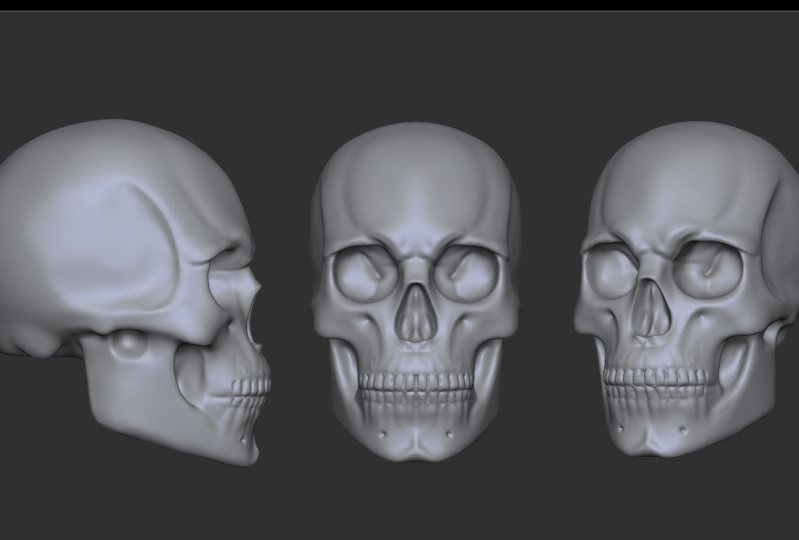
2. Term 2 - Sculpting the Human Skull: Welcome to the call sculpting course of my digital sculpting workshop series. I hope that you learn something new by the end of this and that together we can become better rapists. So let me start by saying how unique the human skull is as a practice subject. It has features of the human face itself, which holds the most recognizable pattern in nature for us. The eyes, right? It, it has a dark side, if you will. Much explored in our history or religion, scolds sculpture, entertainment, which will inspire us in different ways when sculpting. So it changes the flavor a little bit when compared to the actual skin surface level. And it's full of clear defined lanes that are much easier to detect than on the face, which is good. It's always a good study. So when we put it all together, we then have the easier task at hand and exciting subject in a familiar pattern of shapes. Edit to the understanding of those artistic concepts from the previous class. We can now be in a new mode of being wild sculpting, which is great. We are no longer copying the reference or copying other techniques blindly. Hopefully with this series, if you notice the shift in your mind, you'll be looking for shapes and ways of simplifying and stylizing nature. These works both as a experimentation tool and a corrective device that will put you back and track in real time all by herself. So while you watch me sculpting, Let's try to see through a different lens. The starting point doesn't really matter as it rarely represents the final forms. All it can do is speed the process a bit. But we're not really concerned with time. Time scale that's gained for free. So no need to focus on that. As I push and pull things, What's happening is that I'm trying to find shapes that resemble something already known in me. Almost like Bella seen yourself on a rope. So balance is not a thing in itself. Balance, the result of small, small corrections done in real time. The same here with the sculpting process, where you're finding in correcting things, always looking for information. So the more information I add. At this stage, the first stage, you could say, the easier it is, the easier, the easier it gets for me to actually start representing parts of the model. And when I use the word representing, I'm going back to the previous video. Once I have enough information, there is a smooth transitions in my actions here. So it isn't a well-defined line, right? Where I begin one inside the other is just everything is really flowing here. Your mindset may shift a little bit. So that's why I call it a smooth transition. But this is when I am actually trying to find a simplified ways of representing each part of the model. Like you can see the eyes and I'm just calling the same names here of the face, eyes, cheekbones. The actual anatomical names. They will matter for now. They're just a tool for us. So lacking the previous class where it showed different drawings, there are all where they were all representing the same thing in different ways. Different ways of drawing the same subject, the same here with us. So through the video, you'll see how it's a constant battle of removing a certain amount of information. Let's say from the reference that you have in being able to still be true to the objects essence and the level of realism you're aiming for. Because we have a goal here, sculptor and realistic scope. Well, with implied shapes and ways of representing the actual scope, you're not just copying it all. So this approach is what we will be exploring through this, these courses, three series. It's what gives appeal to the model in the first place. Everything else depends on this. And that's why that's my focus on this video and all the other ones. I would never jump straight to the detailing layer, high frequency details. Before mastery this part a bit more. So this approach will also give you more control over cartoony and highly stylized shapes in the future. Because this is what we've been doing the whole time. We've just been doing with more complicated combination of forms. But it's the same thing. Everything that I'm saying here, then it's just a way of breaking down the actual act of sculpting. Like I'm trying to find ways of describing what's going on in real time here. Instead of. Giving you a step-by-step approach. Let's see. So we are developing our sculpting through language first. That's the point here. So your understanding has to change. And then everything else will follow. Anatomy knowledge, references, construction methods, and the list just goes on and on. There are all these tools, tools to let this understanding takeover. Okay. So let me make it clear what the goal is. In case it's not too clear. My intention is to have something realistic. In the end. With, with purposes of expressing emotions through the anatomy and human anatomy as an art form. And to help us achieve this goal, we have to find unique ways of representing parts or aspects of this anatomy. In this, uniqueness can only be achieved by you. Whereas many can have similar perfect copies of the same subject if we were copying. And this is what we do to up through these courses. Back to the model. Now, what do you see me doing here with the help of the clay brushes and flattened brushes is exploring planar surfaces of the coal. And if you look up references of the planar faces, that planar surfaces of the face are planar surfaces of a skull on the Internet who may find different versions. And it's fine to copy them or reference them for awhile or as you progress. But the point is to know that those planes are not the only ones. Let's say you only study someone else's planes or simplifications. Your work will end up looking really similar to what you've been copying. Even if you're copying a simplified shapes. Probably even more so. Because more experienced artists, they already developed their way of simplifying things, even if they are not aware of explaining this way or they don't explain this way. But they do have their own tendencies on how to simplify everything. Even if it's not 3D, 2D, right? It's more obvious in 2D drawings, paintings. So you can use the planes that I'm doing here as inspiration. You can copy for awhile. You can copy other depictions of. Planes of the face as well. But keeping mind that this is an exploration that you have to do. So even, let's say the shape of the nose there. The whole of the nose where mine is triangular in shape with a flat top. Where if you try to do it, like I really just a square shape, perfect square. You could explore this. This would have an effect on all the rest. But maybe you find a way to make it appealing with the rest. So MOE form by itself is either good or bad. It's always a relationship. And if you focus on the names of the parts and, or if you focus on copying the reference, the reference, perfectly realistic reference, but not real photo, photo of the real object. You'll be missing that part, that understanding of your own exploration. Right now, I may make it big some parts, more extreme, relays extreme of the model. But doesn't mean that's the only way I would do it. One way to force you to explore additional ways is by using a different base mesh. So right now I use today sphere, but you can use some other shapes of base meshes as a starting point. Maybe we start from a different place. Instead of always blocking the shape of the head and then the eyes. So try to achieve the same exploration from different directions. So the path will change a little bit, which will force you to explore, actually explore different shapes. Once you master one way of achieving the final result, Let's say, Why don't you try a different way? Or else you will always be doing this for speed. And then once you have a good result, people will look at your work and realizes well sculpted scope. But that's not the endpoint. You can explore the possibilities forever. But that's where I, I would have to show actually, exploration never ends. And the more you explore, the more unique your work will be. It's pretty easy to see how was an artist gets to a professional level and maybe start, starts making money through, let's say, a style of sculpting. That person will hardly have the chance or opportunity to explore different shapes. It's not because it's good or bad to being in that position. I'm just pointing to the fact that you're not exploring. If all you sculpt is, let's say, strong dude's with a certain body type in a certain pose. The theme itself doesn't matter. I don't care about the theme itself. Since we are talking about shapes here. What is actually happening? You're just not exploring more shapes. You're not exploring more poses. You're not exploring different body types. And you may think or maybe not even realizing that way that I'm putting here. But this is the way to describe a strong person with lots of muscle mass. But it never ends. Just keeping mind that each market that it's settled as a style has its own language. And then language was not defined by you. You can read that language. You know how it looks like as you're applying that language to your model. So you're missing the opportunity to explore your own ways of seeing things. It will take a while for you to master that one style or another style, which is great as a learning tool. But I, I noticed that people, sometimes they don't stop exploring. And I think that's a lost opportunity to see how far you can go. But it's fine if that's your goal, it's fine. I just think that exploration is it's where most of the fine lines. If we go back to the model now, you can see how I'm being mindful. Let's say about defining the planes that I have in mind. There's a pre, most of it, let's say the, the bigger shapes here. Most of it is well established shape on how to define some parts. I'm not going full exploration here. Or else it would be hard to follow along and explain the process and the idea behind all this exploration that I'm talking about. But let's say the forehead is one area that you can explore a lot more because it's a bit more open to interpretation. Whereas the other shapes or are so simple that you, you probably find it harder to explore even more and change. But every little bit of space in that model can be explored in a different way. So once, once I have a well-defined planar definition. Of all the parts, I can make it more realistic. Let's say. And it's not only about smoothing out the borders, even though that's part of what I'm doing here. You remove all the hard edges. But there's also a play or how much remove and how much you break up. All the other forms. The more you break up polity that you build. Until now, the more you lose that sense of simple the things are. And you may find it harder to move away from that simple way of describing things because now you have a lot more inflammation going on. So it's a lot more to control and judge if things are flowing into one another. A good way to know if things are flowing. If the model is appealing in a way. This shape wise, we're not even talking about meeting behind anything. There's no meaning behind the the shape of the jaw at this point. So one way is to keep rotating your model, looking from all angles and keep trying to find flowy lines or curves, not only on the silhouette, but in-between shapes. So in ZBrush you may have to change the light position because it will change the relationship between forms. So rotating the model was part of the process, of course. So you can look from different angles. Material that gave me, give you a different impression. And I agree that it's easier to find the silhouette. And you will be able to explore a lot more when we scoped the actual body. Because there's a lot more going on and we are used to shit just seeing muscle shapes and the fat tissues. And they usually have a more their natures based on curves, whereas the nature of school is more. It's based moral lines and straight lines. When the same way you can stop at any moment and try to find relationships between shapes and lightened shadow. So it's not really a recipe on how to make things look good. I cannot say that to make a specific part of any model look good. That's how you do it. Because BED part by itself doesn't mean anything. It has no weight on anything. It's always the relationship between forms. And forms could be. Or the bigger shapes. You could split. This call here in, let's say, five big shapes. Or you could be more detailed in split into 10, whatever. But the point is, there's always a relationship between forms and that's happening from every angle. The beginning might be easier to change that relationship through this silhouette. So just rotate. Watch the silhouette for awhile. Stop moving. Then with the move tool, you put things into place again. And slowly you move to the inside of the model. Always tried to find that. You're trying to find it curves and pathways that will make the forms flow into one another. The last stage would be breaking up even more. And I'm implying some of those lines here. I'm not going to fully detail that model because it's not a point here. But I'm doing some of it. And that breakup, then it can be a lot more random. And I'm just I'm not just throw in lines all over the place, right? Drawing some lines like I did right now. Nice smooth them out. But then they can be lot more random in nature. If you make them too well-defined, your beauty and new shape and you'll bigger shape. If that's the goal. If you can make it look good, then it's fine, but it's probably better senior as a preparation for the detailing part. I just like how it looks, gives a nice breakup. The highlights and the surface itself. If you add some sharp corners, sharp lines like I'm doing right now. We're implying quality of the material. So we need some type of contrasts between smoother parts and sharper parts. But if you make something too sharp, not only you will build another bigger form, like I said before, but the contrast will be too much. So you also measuring the contrast between the lines that you're drawing. Almost like drawing really. So paying attention to the flow of forms from every angle. Pay attention to the contrast between the lines that you're drawing. If you can slowly realize the control of these two specs will look more appealing over time. You just do it without even thinking too much. Actually. It may require a bit more concentrated concentration in the beginning, but I'm sure it will become second nature if you're booting up that skill with that understanding. Okay, So we we did most of the work. Actually the hard part of sculpting, which is having a well-defined surface to work on. And all the shapes are working well. In relation to one another. I can randomly, without any thought behind, I can start breaking up the surface a bit more. So it gives it another level of interest. I could have. I could stop right now and just remove all the other sharp corners and just work on this surface. I hope you'll get a point. The most important part of the process will always be, up to this point. The beauty of the forms in relationship between them. The same will apply even if you are working on par, details and wrinkles. But then it has to be built on top of what we did so far. And this is not going to be part of their foundations that these courses are here. So I'll leave you with a video for the last 10 minutes. Video only. O n here my comments. Feel free to ask me anything. One last thing about the, this practice here of these sculpting of the human skull. It's a great way to, let's say getting inspired. Whenever you don't know what to do. Just try to sculpt Humans school as quick as possible. See where your intuitions land. It's a good way to getting the flow because you've probably end up doing this type of model a lot. And if you end up working with faces portraits, you'll be working with the same shapes. In here is slowly begin to imply of the landmarks from the bones into the skin level surface. So it's a good, good, sturdy, a good way of investing some time in sculpting. Don't know what else to do. So enjoy the rest of the video. See you next time.
 Fabio Paiva, We are just imagination of ourselves