Transcripts
1. Intro: My name is Camille Hussein, and about a year ago, I started posting on social media about my journey into medical school. I opened up about how I wasn't the best student or test taker, but I was able to teach myself on how to study, how to manage my time, which led me into being accepted into my dream medical school. I worked hard because I did not want to give up. And I've learned a lot over the years, and I hope to show you all of that in this course, we'll go over how to take notes, how to memorize, how to create a steady schedule, space repetition, practice questions and more. Plus, this course should now include bonus sections and I will be adding to this course frequently. So what are you waiting for it? Let me show you how to study smarter, not harder, so that you can get your time back and improve your life.
2. Background And Layout of Course: Our brain can retain more than we realize their short-term memory and long-term memory. Obviously, if I just give you my phone number, you probably wouldn't be able to remember it for a very long time. But we remember childhood memories vividly. And you don't have to think twice about riding a bike, checking your emails or surfing the web at all comes naturally. And there are reasons as to why these skills and memories just don't fade away by understanding how the brain works in researching some evidence-based methods, I've created this course to really help you succeed in your academic and self-development goals. This course really might be suited for students, but it's really for anyone trying to learn a new subject, skill or trade. Learning is a science in the principles learned in this course can really be applied to anything.
3. The Study Mindset: It isn't really our fault that we never learned how to learn as a student, you're tasked with balancing extra curriculars, a social life, and your classes, Learning How to Learn was not at the top of your priority list. And weirdly enough, a very few professors even tackled the subject. I think it really relates to that professors are experts in gurus in their field. They learn the material a certain way and all they really know is how to teach that material. Professors are so focused on teaching the content that they never teach students how to effectively retain the information. And focus is shifted towards grade percentages and passing the course, which creates a lot of anxiety for students, especially students learning for the first time. I call this a lack of education within education, now I truly believe every student is teachable and there's no such thing as bad teachers, but there is such a thing as teaching the wrong things. For example, we've frequently engage in passive learning techniques and we actually swear by these techniques and was crazy enough, a survey came all asking what students believe are the best study methods which happened to be the wrong ones. But yet they still agree that these are the best study methods. And some of those common ones include re-reading textbooks, hoping that you're probably gonna memorize it by reading it over and over again. Another one is just highlighting your notes, highlighting everything you're trying to hurt. The most important part is you highlight every single thing in your textbook and your notes, your lecture slides. Another thing would be re-watching lectures. So let's just say you watched lecture and you watch it again the next day or the following week, and you don't learn anything new because of it. And another thing is just rewriting your notes. And it's good to rewrite your notes. But if you don't summarize your notes, that's where the problem lies. And these are some of the most common ones that students do, right? And if you're given like a list to memorize and if you think you're seeing it over and over again, rewriting it will help you learn. It's not efficient. There is a big misconception of effective learning techniques and I'll be going over a better methods to maximize your learning. But first, let's develop a plan.
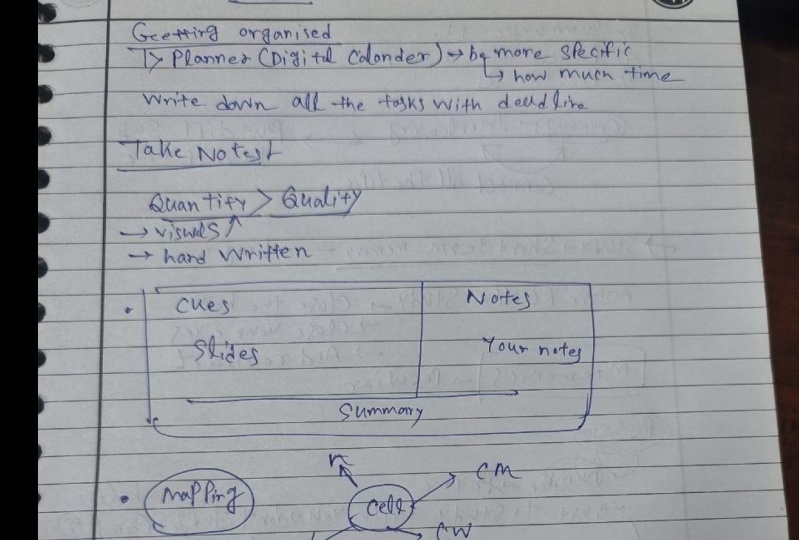
4. Getting Organized: So this topic kind of seems more appropriate to talk about in my next course on and productivity. But it's really important to tackle. You're studying with a rough plan or sketch of things. You could also call this sharpening the saw, right? You wouldn't want to saw a piece of wood with a dull saw. You'd want sharpen it first. And by planning and organizing your essentially sharpening the saw, some of the best methods to planet out is to create a schedule. If you're a fan of writing it out, you can do so on a planner or a piece of paper. But the big thing is you want to make sure it looks neat and you can take it wherever you go. I really do recommend any digital calendar, Apple, Google notion, or any Cloud-based platform. That way, you can modify your schedule on the goal from any device. So whatever system you develop, make sure you make it your own, and make sure you make it accessible for each hour of the day. You want to get very specific of what you will do. Don't just say you're going to review Matt from 2 to 4 PM. Get detailed and say something like you review Chapter 2 for 30 minutes, review a quiz for 30 minutes, and then you'll do practice sets for an hour. Do this for all your courses. Trust me, it takes a lot more time, but you will end up feeling a lot less overwhelmed because you don't have to decide what exactly to do for each course. It's already planned out for the week. Here's an example of what a good Google Calendar looks like, color-coded to make it look nice and make sure you make time from the meaningful things like eating, sleeping, socializing, and exercising. On top of this, make sure you review the syllabi. Yes, I think that's the plural form of syllabus. Write down all the important dates and deadlines into your counters so they don't catch you off guard when you start to be proactive with what you'll learn in how you study, you tend to be less reactive to all your deadlines and everything going on around you. This frees up way more time and mental space to actually learn. This small investment of time will set you up perfectly. And what we discussed in the next steps.
5. How To Take Notes: Note-taking is a great form of active learning if used correctly. Note-taking forces us to dig really deeper and this allows us to encode what we learn. And whenever you exert this kinda effort, you learn. But like I said, it all comes down to how effective your note-taking actually is. Here are some general principles all students should be aware of when it comes to note-taking. So something that might surprise you all is that when you're taking notes, the quantity of your notes is actually a little more important than the quality, right? So don't focus on make your notes look super fancy. That more unknowns you take, the more you summarize, the better your notes will be. The next thing is really trying to incorporate visuals. So if you have the draw diagrams, if you can insert images or pictures, it really adds value to your notes and it allows you to really interpreted better and helps you to learn better. And a big thing is try your best to make handwritten notes. Please trust me on that. Now let's review some common and useful note-taking methods. It can vary depending on the class you're taking and how you like to learn. So the first one is called the Cornell method. And for the Cornell Method, imagine that your professor didn't give you slides or any kind of lecture notes. So you have the goal from scratch. So on one column, accused, on one column make notes on the bottom. Summary. Now, and this is pretty self-explanatory, but with queues, the big points that you got. So the first thing you'd probably writing in is on the note side, everything you learned in lecture, everything they talk about. And on the left side is for q. So when you add the reference, your notes back, they quickly reminds you what the slide is all about. What was discussed in class, what was discussed about a certain topic. And of course, on the bottom is summary. Summary is a summary of your notes and the big points. The next one is concept mapping. And this is really good when you kinda look at the material, you kind of understand it, but you need to organize it in your mind. So for example, let's just say you're learning about cells. The main idea, the main thing is a cell. And within a cell, there's a cell membrane, there's a nucleus, There's a cell wall. And then there's this thing called mitochondria. You might have heard of it, the powerhouse of the cell, yada, yada. So I'm taking components of this main idea of a cell and I am branching it out into the smaller ideas in each small idea that I'm circling here. Might have even smaller ideas of smaller examples and stuff that you need to know about this thing. So for example, to really understand what the mitochondria does, you might write something like a produces ATP for the cell as the powerhouse of the cell. And the next method that you want to do is just, let's just say that gave you slides, they give you notes. Now, what you're gonna do is highlight all the important terms. So notice that this professor, it kind of already put in red some of the most important terms, right? And I am highlighting those again. So when I come back, my mind kinda knows that these are the key words and key terms that I should know when I reference this slide. And then I should know as I'm listening to lecture and I'm doing that even in the subnets underneath the lecture slides, some professors are nice enough to give you notes. So when I look back at my notes, I'm referencing only the highlighted parts. And for these key terms and there's still don't kinda make sense to me. I might write my own definition in there, right? Some additional notes on top of what was written in lecture. So if you ever heard of the word tunica, Virginia, I never heard of it. So I wrote some additional notes in the margins to make sure I know it and to make sure I can summarize it Emma on words and I wrote down with an ovarian follicle. There's a cortex and medulla cortex I know is on the outside would utilize that. I know is on the inside. And now who has a question I'm going to make from my notes. A question I'm writing is, where are the ovarian follicles located in the ovary? And I can take a quick look at my notes, but I tried to answer this question without looking at my notes. And because I know this, I know the answer is cortex. So those are a few ways to write some notes.
6. Tech For Optimal Studying: By now you've realized that we were living in a digital world. Now this isn't a bad thing because technology information is available at our fingertips. But there's definitely a technology gap when it comes for students at schools. This technology gap could be explained for many reasons. They can't afford it. They don't want to buy it. They don't know what to buy. And this is why I'm going to recommend my personal recommendations for tech, apps and websites when it comes to your studying. And this is why I'm going to recommend tech apps and websites to really optimize your studying. And much of this tech that we talk about will actually help you in your future no matter what you're going into. So the first thing we're gonna talk about our laptops, I'd recommend the MacBook because it is built to last and it's a great investment and it is very compatible. And most tech and websites out there. Now, of course, a laptop is obvious, but the bare minimum, you need a good functioning laptop that you can take with you wherever you go. Obviously, you want to make sure it has a webcam built-in and also antivirus. You don't wanna spend time fighting a virus or having your computer crash on. You don't get a warranty because your laptop is going to be your baby. Apple products have a great deal on warranties, and I rather spend a little bit of extra money. So I have that peace of mind. So in case something does happen to my technology, I can replace it and get right back to it. Now we're going to talk about note-taking devices or tablets. And I'd recommend the iPad in the Apple pencil. It's honestly a brilliant system that take notes on you can easily import documents and right on his documents with your Apple pencil. This is honestly a clean in simple, lightweight solution to carrying on your important documents and taking notes. And I guarantee you your life will become a lot simpler by switching to the iPad and Apple Pencil. So my recommendation for note-taking apps, OneNote is what I use. Notability is specifically designed for Apple products. There's a good note, there's Evernote, There's notion, some are free, some costs, money, and definitely choose the app that you prefer and causes you the least amount of stress, the less friction you have to note-taking process, the more likely you are to abide by it. So don't be afraid to invest a little money if you do like that app. Some websites I recommend is Quizlet and Chegg. Now these are great for finding practice questions and finding answers and explanations to these questions. For no cards or flashcards, I would recommend Anki, Quizlet or landscape. Flashcards can be really helpful with classes. I would recommend checking out these websites, see what you like, and either create your own decks or create your own flashcards. But typically on these websites and applications, there's pre-made decks already out there. And you can usually find these decks by simply Googling them. Other helpful websites with students that's worth a mention is promo focus at IO, Wolfram, Alpha, Google Drive, open study if you want to study with some partners or in a group and rate my professor.com. So you can take courses that are really suited to your needs.
7. Spaced Repetition: Memory is a lei, wild thing. We can master a skill or concept by practicing it for hours. But if we don't review it later on, we tend to forget it. And there's something called the forgetting curve. You can remember almost a 100 percent of what you just learned. But as the days go on, there is a steep decline and your retention. By understanding the forgetting curve and applying spaced repetition, we can retain large amounts of information and not lead ourselves to believe that we've learned something when in reality we have not. Here's my personal space repetition model. And I've developed this and I've been using this for the past few years. It's worked wonders. So the first step is that you want to watch lecture and take the notes as we discussed in the previous videos, right? And I recommend Washington recordings at two-speed if you can handle it if you had to watch it live as okay. Just take the notes as you would as a present, but just take good notes as we talked about so far, right? So there's your first step. Your next step, write your second step is to review your notes within 24 to 48 hours. The reason why is, as we talked about the forgetting curve, that's information starts to drop off. So you want to solidify all the information really consolidated gives it some time to marinate. You want to try to interleave different classes, right? Don't just do one topic at a time. Should I do different topics, different chapters, different classes? It takes longer, but it's going to help. It's going to create engagement in your learning is going to create effort that's going to help with encoding all of the stuff that you learn. Summarize a difficult concepts in complicated slides. Really tried to put that into your own words as you're reviewing it for the second time. You can take pictures or mark slides that you will need to review or memorize later because you're looking at it and you just know there's no way you're gonna understand it or maybe we remember the small details right away and that's okay. Just focus on what you need to learn, the concepts of big ideas and then you can always memorize things as you review them over and over again. The third step is to review the material again within one week, if possible. After a week. Again, we're talking about the forgetting curve. We're trying to flatten that forgetting curve. We've looked at it twice so far. You want to look at a third time within a week, week time. So you've looked at other stuff and other things. We've tried to interrupt your memory, we're gonna come back. You're really going to try to consolidate that into the deep parts of your brain. You're not looking to reteach yourself. Everything is just to review the main points and the concepts. Really try to explain it to yourself without looking. That's how you know, if you really know it and it's going to help you with retaining, that's a form of active recall. If you're struggling to do that, that means you have not learned it with the third time. You have not learned it correctly. If you can't tell it without looking at it, if you need to look at anything through, review it, go back and relearn it, and try it yourself again. Use outside resources if you need to, to really consolidate it before then the last step as the exam day approaches, we want to start practice questions with everything you've learned. I'd recommend a week before. That's really the best time to start doing practice questions. Do the questions that offer explanations are tackled answers where your classmates, this is really effective, this is really helpful. Any ones that you're struggling with market, maybe you can do with them the day before the exam or a couple days before the exam because maybe you haven't learned that concept. Go back and reteach yourself after you've done questions and you've seen what it is you need to work on, right? These are your gaps in knowledge that you identify through an objective measure of practice questions. Make a note of that. Review oldest topics you are struggling with a little later, just focus on doing the practice questions and then come back and logos topics that you've been missing. This is a great way to really get extra points and perform the best that you can in your exams.
8. Interleaving: To understand what interleaving is, let's first talk about something that you might be used to, which is mass practice. Mass practice is something that you've likely done. You just know by a different name, otherwise known as cramming. There's usually entails trying to review a subject over and over again until it makes sense, you start to feel a sense of mastery over what you've learned. And this leads you to not revisit the material later on. And honestly, this might have worked for your previous exams depending on the exam that you took. However, at the expensive cramming, you might burn yourself out, lose sleep, force yourself to chug caffeine and now adequately revisit topics that you haven't reviewed. Interleaving will include studying topics for a short time, but spaced out in time. And the big thing is to alternate and the topics that you review. And this might seem counterproductive because it takes a little longer and requires more effort. However, studies show that this leads to long-term retention and you will most likely to remember it after your exam and take it out into your career because you've probably been in a class where you were studying and you've got to yourself, I'll never uses outside of class. So what's the point? But typically, the principles that you learn in any class will show up in other courses. And those principles that you remember and you master will help you out in the future. Because it's always easier to learn something when you can relate it to something that you know from the past. So how might you interleave with your busy schedule when you're planning out your schedule to review, tried to put different subjects back to back, and then be honest with how long you can really focus for it. Let's just say you do two hours of biochemistry and in 20 hours of calculus. And this is why I talk about organizing and scheduling in the previous videos. Interleaving really works with a good steady schedule. And when you're first putting a schedule together, you might be tempted to put similar classes together, but I'm going to challenge you to not do that because this forces the brain to context switch and really compare and contrast that subjects you were learning. It feels weird at first, but the results will speak for itself, even in specialized programs such as medical school, which is what I've been doing. I tried to include interleaving and all my studies if I'm in a blog, so just cardiology. I tried to focus on pharmacology for an hour, pathology for an hour and in physiology for another hour. Practice questions are a great way to interleave, especially when you're preparing for a cumulative type of exam, it's best to mix up the questions by content and we're gonna discuss this more in an upcoming video. It just forces the brain to think more critically and this leads to retention. And the best thing is which relates to studying smarter. It's the more effort that you exert, the less time you actually had to study.
9. How to Memorize: And med school, we learned about how the memory circuit actually works. The hippocampus is a major player for creating memories, but usually that refers to short-term memories. Long-term memories are stored in deeper parts of the brain and are still much debate as to where these memories are actually stored. And there's a specific process as to how we store memories. We input memory through the use of any of our five senses and a more senses you use, the better you encode it. This is why it's beneficial to actually see. And here, the information that you're trying to learn when you first hear some information, it's stored in your short-term memory, but short-term memory is temporary and there's actually a limit to it if you just review something as likely been stored in your short-term memory. But if you don't rehearse it or if you replace with something else, a won't be effectively stored in your long-term memory. We tell ourselves that we remember as a concept or a term after reviewing and a few times, but when we are actually tested on it, we cannot recall it. So memory is really tricky, and it's best that you rely on evidence-based techniques to really improve your memory. These techniques take the stress out I'm memorizing and let's go over them right now. So the first one is active retrieval. So it's more like a concept is that whenever you review something, whenever you look at your nodes, whenever you watch a lecture, close your eyes, look away from the information and try to retrieve it and try to recall it from your mind without referencing anything. This is hard, this is engages you with the material, but it allows you to memorize things that you wouldn't be able to memorize beforehand. And another thing, and I'm sure you've heard of this, but this one is called pneumonics. So for example, a very classic mnemonic is Roy G Biv. It's a mnemonic for the spectrum of light, which we learned in physics. Well, if you're a science major, you would definitely know what I'm talking about. Another one you might have heard of if you're a math junkies, might be SOHCAHTOA, right? And that's where the angles of a right triangle to determine their links. And for all you biology Nerds, remember snowdrop, that's for memorizing what kind of things are in the blotting procedures. So the next thing we're going to talk about here is phonetic associations. Phonetics just means how things actually sound. So you'll learn a lot of weird words, fancy terminology, and these sound different, right? They don't sound typical. And you can use that to your advantage. So here's an example. If you've heard of virus or bacteria have one virus is a picornavirus. I had no idea what a coronavirus was, right. But all I need to know was that the coronavirus has a virus underneath it's family called a rhino virus. So how do I memorize that a rhinovirus is a picornavirus. So I think of a rhino eating a corn, hit coronavirus pickle corn. So now all I do is imagine a rhino eating pickled corn. Sounds salient, sounds crazy, it sounds abnormal. So now I'm going to remember it. Another thing you want to consider is a memory palace. The palace utilizes familiar settings, familiar objects around you, right? So a classic example you might want to use as your own house. So pretend this is a house. Pretend you have forums in your house, and each room in your house represents an important concept or a topic. For example, let's use the example of a planet's right? So in the order of what you walk through your house, each room, each area represents a planet. So you can easily remember mercury, Venus, very educated earth, and so on, right? And this is how you would utilize it. And now there's great websites like right here, you see pics arise. This picture represents vitamin B1, Right? It's an important vitamin and his lot of characteristics and each kind of part of the picture represents that. So sketchy check out picks arise, check out other memory palaces, websites out there. Now another thing we're going to talk about, and I'm not gonna go too in depth, is called the peg system. It's a very advanced way to memorize, but the best way to illustrate this is by using an example. So take numbers, we all know what numbers are 1, 2, 3, 4, 5, 6. So here you're memorizing a list of numbers 112 and so on. So let's take the first number 112. Let's say for our peg system we say 1 equals gun to shoot. So if I'm trying to memorize a number 112, I just say that Tommy is wearing one shoe was just too and he has to guns. So if you look at him from top down, he has to guns, which is two 1s and one shoe, which is 12. And I can memorize 112 that way. And you could pretty much create a story to memorize complex numbers. There's other ways to memorize big lists of information, but there's develop peg systems that you can find on the Internet and use for your classes.
10. Bonus: Using Letters and Sounds To Memorize: The next way of memorization is something that I've kinda devote myself. There's not a real name for it, but I figured I tell you this so you can pay more attention to it because you might find it very useful and your studies. So a big trick I've used in my school is paying attention to letters in specific terms or the words that I'm learning in school. And sometimes I'll even use alliteration, the first letters of the words and memorizing to kind of associate two words that are related to each other, especially if they share the first letter of each word. If they had the first same letter, it really is helpful to parents together and learn from it. One example I'll tell you about is, this is way to memorize. Gray. Gray is spelled a different way versus American vs. England. Memorize how we say Great America is greatest build GR AY, because the a represents America and England. You can say gray, which is GR EY in the E stands for England, manages a very small way to look at it. Now, I use this and I developed my own ways. And one class in medical school called Neurology, I had to learn these specific tracks. Tracks are just long pathways in your spinal cord in this case, and tracks are present everywhere in the body. Two trucks I hadn't memorized was the cuneate tract and the Priscilla's trek. Now, I'm going to put the words up here because obviously you've probably never heard these words before. But for each track, this is how they're actually spelled. So in all seen that in my notes, I looked at cuneate tract and realize that the second letter is a U in the cuneate tract corresponds to the upper body. So I kinda memorize it like that. And the Priscilla's track. And if you look at the third to last letter, It's an L. And an L stands for lower body because that track controls the lower body. So I memorize two very complicated tracks in neurology. And I didn't not spend any more mental space trying to memorize that. And even if you're learning words and school, and these are just weird words, are the words sounding words, maybe the word sound like something you've seen before, you've heard before, the more you associate the words with something else, if you add a bit of saliency are important to it, it really does help with memorizing those words. So I'm one term in Chemistry was called Dying. Now dying sounds like Dine, right? And Dynasty means there's two double bonds, two covalent double bonds. So I always thought like Okay, how can you memorize that? Well, to dine out in a restaurant, you need at least two people. So two people can dine. So you need two covalent bonds for a dying, the more lean or inappropriate it is that better at you'll encode it into your memory. So I hope you enjoyed that extra little trick to really increase your memory.
11. Bonus: Memory Device: Peg System: This section we'll be talking about the peg system, which is a great way to memorize large lists or things in a specific order. The peg system was created by Henry Hudson. The pegs are a list of words that you create on your own and you take these pegs and you do a one-to-one association with the list they are trying to memorize. So in this example, we'll be using this peg system that is widely used. I found it on the internet and for the sake of illustration and for the sake of demonstrating what the PEC system is, there'll be easy to follow. So we're going to use a system of one will equal been, two will equal shoe. And then three, we can say equals 3 and 4 equals door. And as you can kinda tell, these words rhyme with the numbers. So it makes it really easy to remember. We're going to try to use this to memorize a list of groceries and enlisted Groceries might look like the first one being milk, second one being eggs, that third one being butter, and a fourth one being bred. So you're going to associate the words that you just develop from your PEC system based on the order of the grocery list. So for the first part of the Lewis was milk. So you can say just imagine milk being poured over a hamburger bun. And for the second one, which is eggs, imagine you're cracking apparent eggs into a pair of shoes. And for the third one, you can imagine a stick of butter being spread over a tree trunk. And the fourth one, which is bread. You get imagined the door and his door handle is actually made out of a loaf of bread. And obviously not using this class to memorize your grocery list. So let me kind of put it in terms of something you might understand. Maybe you're trying to memorize a list of elements on the periodic table. And the first one is hydrogen, second one is oxygen, and the third one is carbon. So for the first one, you can say, you can imagine a bun being tied to a balloon that's filled with hydrogen. Everyone knows that balloons are filled with hydrogen gas. And the second one, which is oxygen, you can imagine oxygen taking, falling on someone's shoe. It was a very heavy. And a third one being carbon. And you can imagine a tree, so the carbon trees actually soak up carbon. So you can use this kind of Peg system to memorize a list of elements on the periodic table. I'll very simple way to memorize, a little more complex, but I hope that was helpful.
12. Should You Study In Groups?: You might convince yourself that you could study alone and you might need others to keep you accountable. During your studies, I've seen groups studied together and I've seen that it has not been effective to really understand this, you need to be honest with yourself and figure out what study environment you actually thrive in. Personally, I think a good mixture is both. And it really does depend on the kind of study techniques you'd utilize for each different setting when you are creating a study group, do not gravitate towards your friends because it's becomes harder to stay focused and sometimes becomes a unhealthy competition amongst friends. Find someone you can trust a study with and who won't judge you. I'd recommend that you put into a study group would be three. If you've ever heard of the metaphor, too many cooks in the kitchen, it really does hold true in the steady setting, the best things that kinda review as a group are practice questions, concepts are list and require strict memorization. When someone asks you a question, you are forced to retrieve it from your brain and then you have to explain it in your own words to that person. And this is a great form of active recall. And during explanation, if someone has a clear gap in their knowledge, You all should work together to teach that person before you refer to any resource. And this is really the optimal way to do it. And I would limit group practice to only a couple hours at a time because it does become quite mentally draining after that. And pro tip because of the age that we live in, you can always study with people through Zoom or FaceTime. Individual studying in practice is something you should be accustomed to because it will take up most of your studying process. You must really learn to value, to study on your own. Effective study habits to do when you're on your own is reading, watching lectures, doing practice questions to really build a good foundation of your knowledge. That way when you have a good foundation and you can talk about it much easier in a group setting, it is best to switch the context, switch of the environments because it increases engagement, increases effort at this leads to better learning. Find the right people, find the best place to study on your own, schedule, a healthy balance of both, and you will learn to equally enjoy both.
13. How To Use Anki and Quizlet: Okay, so let's talk about digital note taking apps that then we've talked a little bit about it in a previous sections. And in this bonus section, I will show you how Anki and Quizlet looks like and you can really decide what you want to use. And of course, as science majors, as a med student, we really do like Anki because there's a lot of information and it incorporates that space repetition. A Quizlet now does the same and still both of these platforms are free. So let me show you how Anki looks like. Number, assuming that you've downloaded Anki, you made an account on Anki web.net. And after you've done so, let's get into how the home screen of Anki might look like. The icon looks like this and you log into your app on your computer. So this is where your layout in your home screen for Anki. Now I already have a bunch of decks pre-loaded that I download from the Internet. That mean my classmates made and even shared among all of us. That's really, really good thing about Anki is that you can download a DAG for you, make it and distributed to whoever you want to. So each deck, you can actually make some decks, right? But you're starting off simple. Don't worry about making a bunch of subjects, just keep it really simple. So we're actually gonna look at this deck right here. This is called a 100 and concepts is two hundred and eight hundred note cards and these are actually due. This means that based on the algorithm, based on the spatial partition model of Anki, this is the mana cards that you should do first because it's been proven that you haven't reviewed them enough and you might have been struggling with them. So it looks like these cars are due. We will click this and I'll show you how it looks like. So of course, when I click Study Now, in this case we're talking, we're using like a diagram to demonstrate which fascial planes we cut through. And you should know that in the neck and it goes to cervical fascia, pretracheal fascia. And you would kind of guess what the answer is. And honestly, I have no, I don't remember this at all. So cricothyroid membrane, so it shows you the answer in a different color and it's really nice. And I had a black background with this one, you can include a further explanation as to why the answer was correct. You could include an image which is really helpful for my students. And this might show where exactly you're cutting for the, for the crack of every membrane. So that is how a card might look like, but you may create now you don't have it creative as intricate. It really basic. It can literally have said like how many tissues are considering a cryotherapy. And if you had to memorize three and you put three for your answer, and it gives me a simple notecards that and how to space repetition comes into play is that you're going to have buttons here. In this case there's four buns, but usually my S3 buttons. And I might say again, hard, easy, and you pretty much rank it as to what was the difficulty of that card. If you want to say again, that means it was very difficult card and you wanna see you in the near future. It was very easy. You might not see it for a while. So there's sort of means one year, one year, 4.7 months, less than 10 minutes. And you won't see these kind of numbers is because this is a very old decks or done a few times. That's why the numbers are like that, but it'll be way more like simple numbers will be like less than 15 seconds to minutes, ten minutes, that kind of stuff. Especially when you just create a deck and how you will click these and then you click with your mouse, or you can call it two numbers. So in this case, if I click two, it'll end up those end up being selecting as a hard difficulty. So to go back to your decks, so I just showed you how a carbon look like in the deck. But you should know a little bit about how to add a card. In this case, I made a test deck and I will show you how to add a card. You can just click, Add red up here. So after you click that, this will pop up and you're asked in, and you can have something as simple as how many planets are in the solar system? And you can write down the answer in a Pluto as a planet, Barcelona says not. So this is how you make a card, right? And it gets added to your deck. And you go and now you have a knight who had this card right here. And having planets in our solar system, you click a if this was easy for number three, very, very, very simple, right? And you get into a groove. And of course with the browse feature, you can browse all the cars index that you had. Silver Quizlet. This is how I look like when you go quizlet.com. And we'll type in if we want to find a biology deck, for example, right? And see in front of our algebraic. And then you can click the deck whether you make it and you upload it to Quizlet, or you find that the second line, it doesn't matter, but you can click. There's already a bunch of flashcards and this sets you click flashcards. And then there you go. You can do the question and you see the answer, and he move on. And there's a little less space repetition in this that they usually have space repetition model. But unfortunately, unless you've got a plus version, you can't get a space repetition model, but Quizlet is a free online Cloud-based platform which you could upload your decks sharing with your classmates. And you can collaborate on decks, which is really nice. So of course, this is very simple and more aesthetically pleasing way to do digital note cards, and I recommend this as well. That's a little bit about digital note card taking. Use that to your advantage, but don't be overwhelmed with it. Start off small and work your way up. I hope this bonus section was a little helpful. Now took on the next one.
14. Practice Questions: We talked about active recall earlier and how it helps you to increase memory and retention and practice questions are one of the most objective ways to gauge your knowledge. When you do practice questions, you don't get to really decide what to review. It integrates different aspects of the material into a difficult, yet more engaging format. And that is what really builds learning because you really don't have any other choice besides to recall the information and retrieve it from your memory to answer these questions. And as you do this, this enhances the synaptic connections in your brain. Research and books and studies all agree that practice questions are one of the best ways to learn. The hardest part is figuring out when to start practice questions and to figure out if they're even our practice questions for your course. Best practice questions incorporates everything you've learned and have answers with explanations. You can find practice questions by asking you, professor if they have any, use all quizzes or exams, go to websites such as Quizlet, chegg and find practice questions. Or you can write your own with classmates. Okay, So this is how you're gonna do a practice question. You gotta do practice questions the right way. And this is from the MK, very difficult Xander old pre-master to the take and the more practice questions To do the better. But let's go over how to do practice questions. Here's a question. Basic question asking about was the following processes is glucose-6 phosphate end product is simple first-order question asking you this product, glucose-6 phosphate to glucose-1 phosphate attached. Which of these processes is it the end product, right? And I rethought from the top my mind on my glucose-6-phosphate to use glucose-6-phosphate. Any sleepiness active form after being broken down from glycogen. So the process must be glycogenolysis. And I'm doing that without looking at the answers, right? And it looked down on my boom glycogenolysis and I just thought about that in my mind. Okay. And I was like and I got the answer, but sometimes you can do that if you're really good at it. If not, try to answer the question without looking at the answers first, then go to the answers because you can easily get confuse, right? So as glycogenolysis, is that the correct answer? Yes, it is. The answer is B. And here's an explanation, right? So I'm not going to read the explanation because you might not understand what the heck this is talking about. But whether you're in science or math, this is how you're going to look at a practice question. You're gonna like not look at the answer, guessed the answer, and then go back and check your work and the chick Amelie or you can check at the end, however you kinda prefer. And the best ones are the ones that are heavy explanation for the right answer. Here's a good answer. An explanation for the wrong answer is a big thing is understand why they are the correct answers, correct, even if you had a right and understand what the other answers are wrong to really solidify. And if you've got this wrong, that you're going to go back and you're gonna review glycogenolysis, you might review the other pathway, so make sure you don't make that kind of mistake. And that is what you wanna do with practice questions. And you could find these, as I talked about in the video. You can find it in many different places.
15. Bonus: When You Get A Bad Grade: So when I first created this course, I did not include this section. And after thinking about it more and talking to my own friends and seeing other students kinda goes with this. I kinda figured I should talk a little bit about it. And just to let you know, I didn't plan on script, the ball goes on to talk about here as we want to talk from the heart. Because I have been there when you get a bad grade and the world just seems to be over. You've studied so hard, and then you get your grade back, and then you are just devastated because you put in all that work and it does not translate into your grades. And it seems like everyone else doing way better than you. Everyone else is a sinner classes and you're getting left behind. But you know what? As when you get a bad grade, it's a learning experience. It's a chance for you to make mistakes. People who have always done really well in school have never really understood failure. You have the opportunity here to take this failure, learn from it and apply it going forward. Most of the time, it's not because you don't know how to study, like by you watch in this course, you're gonna get better at studying. Studying is a science that you can figure out in practice and incrementally you will get better at studying. That's not the issue. The issue is your mindset. You probably think because you failed an exam, that you must be stupid and you start to think about all the negative thoughts in your head and they become the only thing in your mind. So when you go back to studying, you can't focus. Or a worse, when you get a bad grade, you take away every positive thing in your life. You don't do anything that makes you happy anymore because you want to punish yourself, because you tell yourself, I got to study more. I gotta push myself more in order to get the grades that I want is just something going on at home. Is there something going on with your mental health? Is there's something going on with your physical health that might be preventing you from studying the way you want to. Improving your studying is just treating the symptoms of what you're feeling. You gotta get to the underlying diagnosis of what it is and how do you really understand what's going on with you is that you might seek help, whether it's a professional, whether it's your family, whether it's a trusted friend or you just have an honest conversation with yourself, right? Whatever you do to get in touch with your inner self to figure out what is actually father you, you've got to figure that out before you jump right back into your studies. And of course you've heard this, but I genuinely mean this. You're not defined by a bad test score. Even if you do really bad on your center nice tests, you do bad on your final exam. Maybe you've got a retake the course. Maybe you've gotta repeat a year. Maybe you're going to take the exam again, but guess what? You're okay. The people that you love are still okay. So it doesn't matter if you mess up, if you fail to great learning experience. So this was a very interesting section to include, and I wish you the best of luck with your studies.
16. Have fun!: At this point in the course, you're probably thinking there's no possible way that this can be fun. See, when you tell yourself if something isn't fun and you start to dread it, That's where burnout and procrastination really kicks in. This is why you should seek out fun while you study. I think it's a great time to perform on exams and demonstrate what you've learned. And as you're watching this course, you realize how good it feels to have control over your studying. Because you can dictate how much time you want to spend. You can really get excited about showing others how to study and how you've learned concepts and teaching people is a really fulfilling activity to try teaching the concepts and material back to people. If you can teach a concept well, it really shows that you have mastery over it. And good tip is to make studying fun and incorporate humor wherever you can. There's some studies that show when you associate positive emotion with studying, you're more likely to retain the information. So even if you've got to fake it, the more positive you are, the better you will learn. So don't blame me, blame the science. Take pride in what you get to study at every moment in your life. Remember, studying is the same thing as learning, and we are all destined to be lifelong learners. The quicker you develop a healthier mindset towards studying, the better your balance of life will be. Because when you work hard and you perform and when you reward yourself, that becomes much more meaningful. And of course, take pride in their relationships and networking you do during your studies.
17. Conclusion: I just showed you how to study smarter. Feel free to come back and check out these videos again, when you're feeling confused or you need some sense of direction. The project I have for this course is for you all to go into Google Calendar or your planner and create your own study schedule. Feel free to include a screenshot of higher schedule looks like. So other people can check it out in the comments and in the reviews so they can get a general sense of how to structure their schedule. And hopefully by you posting your schedule, you can inspire other people to do so as well by watching my course, I hope to give you time back as you study more effectively, think about what you're gonna do with all that extra time. Please follow my socials to see more content like this. I recommend this course to your study pals and colleagues. Remember to study smarter, not harder. Cheers.
 Kumail H, Content Creator