Transcripts
1. Introduction: What did you the name
of your class was? Self cares through art. Three exercises for stress
relief and mental clarity. Art? But what if I
don't know how to draw? Well, do you know how
to draw a statement? Yeah. Then you are good. You can take. Cut. Hi. My name is Antonia, and I am a softball artist and an art therapist
from Romania. But believe it or not, art was never in
the books for me. Up until a while ago, I was running my own thriving weight-loss
coaching business and I had exhibited new artistic
inclinations whatsoever. Yet two years ago
art saved my life. It helped me cope
with child loss and the difficult
emotion that ensued. Nowadays, art is how
I make a living. I made clay objects, I weave, I paint, and I help other people manage their own emotions through
art therapy workshops. Whether you're having
a hard time at work or difficulties in
your personal life. Maybe you're just looking for a creative way to de-stress, decompress, and achieve
some mental clarity. This class is
definitely for you. You don't need any kind of skill or previous
experience with art, you just need some
paper and some paint. By the end of the class,
you will know how to use my three-step method to
tackle any difficult emotion. How to set up a workspace
that supports your workflow, how to use introspection as
a key to self-awareness, and how to use art as a communication medium for
your emotions and your needs. Extra bonus, you will have by the end of this class
three works of art, which you most likely
want to showcase. Keep in mind, these
exercises are based on work I do and art
therapy workshops. I just know that it
will help you gain confidence and achieve
mental clarity. I really do hope you will take this creative
journey with me. I cannot wait to see you bloom.
2. Class orientation : [MUSIC] I'm so happy you've decided to take this
creative journey with me. In this class, I
will teach you how to manage difficult emotions and how to practice
mindful self-care through my easy
three-step method. Now, I developed this method
in my healing process. I just know it is
fit for anybody. Whether you can only
draw a stick man or you draw beautiful,
intricate landscapes, you can use this method to
get a clear sense of self, a new perspective
on your feelings and situations and just relax. In this class' is project, we will go through three
creative exercises, each one building on
top of the other. The first exercise will help us gain some mental
clarity as stress, anger or anxiety can feel disorientating and confusing
once the mind is clear. The second exercise will help us get a clear perception
of ourselves, our strengths, and boost
our self confidence. With a clear mind and a
clearer sense of self, we can move on to the third exercise which is envisioning what
makes us happy. Where do we want to be, how do we want our
life to look like, and where we should
channel our energies. Aka how to detach from
the current situation and from the current
feelings and come up with creative solutions. Now, once we have our
three works of art, we can start finding the
meaning behind them by filling in the worksheets,
dictionary, and introspection. You can find them below this video in the projects
and resources tab. Dictionary is a compilation of symbols and the
meanings we give them. Whether it's a color, a shape or a stroke we're
using in our painting, it means something
specific to us. For instance, in my country black is associated with death. Not a happy color. But for me, it's actually the friendliest color
I could think of. Whenever I use it, it's always shines a light
on the other colors. To be frank it is fit
for any occasion, a little black dress. The introspection worksheet
works a bit different. It poses questions we should
ask ourselves to better understand what lays behind the creative process and
our creative choices. Now, this class is not about the aesthetic
of our creations. Don't worry if your
work is pretty or not, although I would
love to we are not exhibiting them and turn
over or at least not yet. Anyway, you will love them. In my past experience, everybody ended up in
love with their works. This class again, is mostly focused on the creative process. Expressing your feelings,
finding your needs, tapping into your subconscious and just relaxing, distressing. Good. I'll see you in the
next video where we will go over the tools and the resources we need to
complete our project.
3. Tools and Resources: Before we jump in into
the artistic process, we need to gather tools
and set the stage. In this lesson, I will
go through the tools and the resources we need
before we get started. We will need a black marker, some acrylic paint, or some watercolor if you're
more comfortable using that. You can only get a
couple of colors, the ones you want, you
don't need the full set, one or two basic medium brushes, and you can get synthetic
ones because they are cheaper and they are more friendlier with any kind of paint
you're going to use. Three or more sheets
of watercolor paper. You will find it marked
as 200 GSM or above. That represents the thickness of the paper and how much
water it will hold. The bigger the number,
the more water. A small ceramic
plate or a saucer that you can use because
ceramic is easier to clean. If you have a palette
for mixing color, you can use that as well. Two glasses of water, so we can clean our brushes
when we're changing colors. A hairdryer to speed up the drying process
and our worksheets, whether you print them out or fill them in
on your computer, just have them on hand. When I use artistic expression
to manage emotions, whether I'm on my own
or in a live workshop, the first thing I do is
to gather my materials. I don't want to
break the process and run around and
get this or that. Make sure you have everything
you need right next to you. The second thing
I do is to set up my workplace so it
supports my workflow. I don't want to hear
that phone ringing, make sure you turn
that baby on silent. Now find a place where you
can sit comfortably for a longer period of time and a place which
has good lighting. You don't want to end up
at the end of the process with a back pain and a headache
from squinting too much. Get yourself a blanket if you usually go
cold at one point, get a glass of water to drink, to stay hydrated, or your beverage of choice. I have my cup of coffee with me. Now, the second thing I want in this sensorial input
category is the smell. Smell is deeply connected to our feelings
and our memories. I want the workplace to smell nicely to give me a good vibe. Go ahead and light your
favorite scented candle, maybe melt some scented wax, or like me, light up your Palo Santa or
an incense stick. Now for the audio input, pick a mantra, a song, or a poem, which you can sing
continuously and repetitively in a loop
throughout the process. It can be, I like big
butts and I cannot lie, whichever you can
sing repetitively. This will help you numb or keep your conscious mind
busy while the subconscious will be
expressed for your painting. If you have problems
finding something, I will leave a couple of suggestions in the Projects
and Resources tab. Good. Now, we're all set and we have
everything in place, let's dig into the
first exercise where we will find
some order and chaos.
4. Exercise 1: Finding order in chaos : [MUSIC] Welcome back
to the first exercise. In this lesson, we will
complete a two-part exercise. We will firstly express
the chaos within and then we will try to see some meaning behind it
and draw it on top. Just so everything is clear, I will walk you through my creative process and explain the decisions I'm
taking as I go. Just keep in mind that during
the process of expression, you need to keep that
conscious mind busy. Make sure you repeat
that mantra or the song you've picked in a
loop continuously. Now, more often than not when we are faced with
difficult emotions, with depression, with sadness, with anxiety or anger, we can always trace
that back all of them to one feeling
and that is chaos. For me it's like a
mush at everything, I can't really pinpoint. It's just a lot at the same time and I cannot make
ends from tails. Let's start expressing that and transferring those
emotions on the paper. Now for me, the feeling of chaos is translated into color just flowing
into each other. [NOISE] I'm just going to dilute some acrylic paint to
make it more fluid. Also, you can just put layer on top of the layer so you don't
need to dilute anything. If you feel [MUSIC]
like your chaos can be expressed through
overlapping layers. Now that I have my color set, I'm going to use the paper as a traveling medium and
I'm going to moisten it. I don't want to give
it a certain shape. I just want it to
be, well, chaotic. That's what I'm trying express. By doing this, we are using the technique wet on wet from actually
water color painting. [NOISE] What happens
is that your water will act basically like
a traveling medium. When you come with a droplet of color, it will just spread. We can help it fall out. This is perfect. I'm not giving it any shape. I'm just tapping on the brush so it releases droplets
of color everywhere. I just want some more. You can even touch it,
it will still travel. You can even bring some
more color on the paper. Don't worry if you
get paint everywhere, you will just re-decorate it's no problem. I do
it all the time. [LAUGHTER] Now that I have all the chaos
expressed and it is chaotic and the color is set in, I'm going to use my
trusty hairdryer. Not thirsty, though
it is thirsty. Trusty hairdryer to speed up the drying process.
I think it's dry. [NOISE] Now I'm going
to use my marker to draw some order
in this chaos. Now, there was this
game I used to play with my brother
when we were kids. We would lie on our backs in the grass and stare
at the clouds and try to find shapes in the clouds. The one who found more, won. Whether it was an animal or an object or a
mountain or something. If you could make
the other person see it in the clouds
then you won. This exercise is
pretty much the same. Look at what we made and
then with the black marker, we can draw the shape on top. Now, if you don't see
anything just back away a little and try
to squint your eyes. Now look like this. Look at it. Because I know you will
end up seeing something. You don't have to find
any meaning for it. If you saw it just
draw it on top, we'll get them to
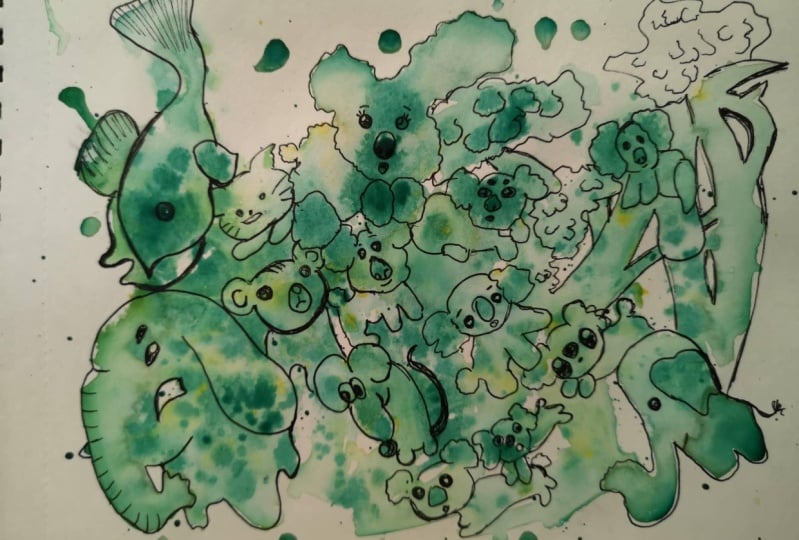
the meaning later. The moment I started
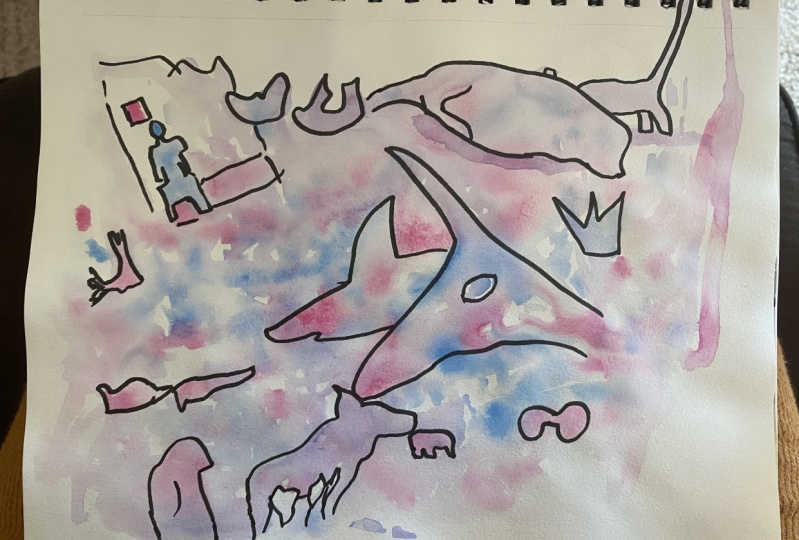
splashing droplets of color, I just could see a buffalo. Don't ask me what that means
because I have no clue. But that's what I'm
seeing right here. So I'm just going to
go ahead and draw it. [MUSIC] Good. Now that we have our chaos expressed and
we give it some meaning, we can move on to
the next exercise. Let's clean up the place a bit because mine is a
mess right now. Then we'll move on to the
second exercise where we will project ourselves as trees
and make conscious choices.
5. Exercise 2: Reclaiming your power : Welcome to our second exercise. This lesson is all about
reclaiming your power. Now that we have a
nice neutral mind, that we have released
some of the chaos, we can work on building
our self confidence and on tapping into the
resources we already have. I know it doesn't seem like confidence has a lot to do with anger or stress or
anxiety but the truth is, a lot of these hard emotions, they trick us into believing
there is no way out. That we have no power over
them. That's where we come in. Realizing we already
have the power we need and that we already have the resources we
need to overcome a situation will actually
help us overcome it. Let's start off the
second exercise by drawing ourselves this tree. We don't want to go
into too much detail just yet, so no decoration. This is the basic
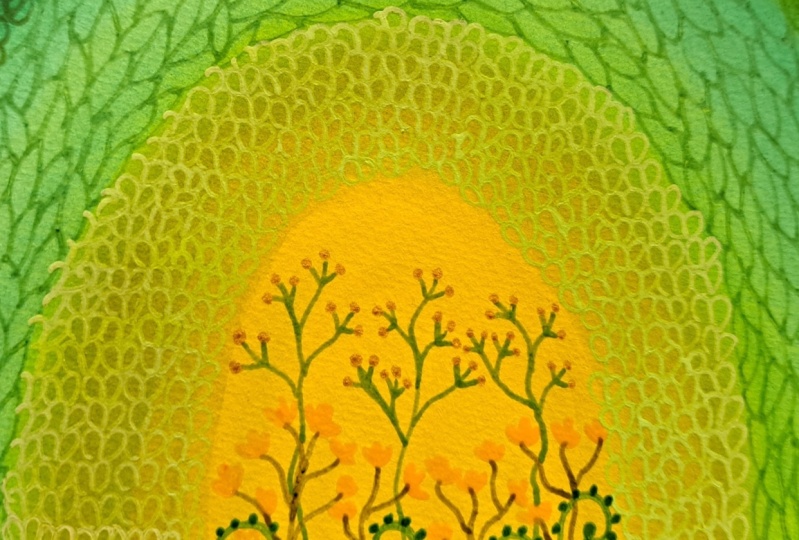
of it and again, we can use any color we want. I will be using my indigo blue, which I absolutely love. So drawing the tree, put in a crown, maybe some roots, maybe
the shape of the tree. You can make it as thin as you want or
as thick as you want, as straight or curvy. You can make a big crown
or a very small crown. You can put in branches. You can make it
round or like me, currently it's going very well. Let's get into some more water. You can make strong roots. One big root or maybe a
lot of them like vines, maybe you want them very
thick or very thin, very branched out or again, just maybe just one. You think of it.
You think how you want to draw this tree
which represents well, you. Okay, so once we have our tree, we can make a conscious tree. This is when we can
stop saying the mantra all over and over again. Stop saying, "I like this
but let's make it out lie." all over and over again. We're going to start making a conscious choice.
So this is us. Now we're going to bring in some elements that we
might want like a bird. I know I want a bird in
this canopy because it is beautiful and I love it and
I want to bring birds in it, and I want them to sing and play around the
tree, for instance. They will give me a
sense of calmness and well, easy-going and happy. So I'm going to put that in. I don't know if I'm going
to draw maybe some grass or maybe a sun behind it. Just think of the elements
you want around the tree. Maybe you want to
bring people in. Whatever feels right,
go with your gut. Once again, if the
piece is not dry or you feel like the colors will
just blend into each other, we can use a hairdryer
to speed it up. It's also okay if you want
the colors to blend in. It's okay not to
try it but I don't. I want my birds to be
perfectly visible. I want to use white to bring
in some light into the tree. I feel like it's a bit too dark and I think it needs a little
bit of white in it's life. Remember in this stage, we're making conscious
choices to add things in. I feel like I could add
some flowers at the end of the roots and I know
that doesn't make any sense but that's
what I feel like doing. I think this will
be a perfect fit. At this point I feel
like I can just stop right here and I don't feel
the need to add anything. If you do feel the need to keep adding things
add them away. Do whatever goes with
your gut and whatever you feel like you need to put
in the drawing, go for it. Just a reminder to not look too much into
your illustration, we will circle back to it. Now that we have ourselves
this beautiful, strong tree, we can move on to the
third exercise where we will envision a happy place.
6. Exercise 3: The Happy Place : [MUSIC] Welcome back to our last exercise,
The Happy Place. Now with a clear mind
and a strong spirit, we can focus on envisioning
what we want for ourselves. We don't need a mantra anymore, we need our conscious mind to be with us because this is when we choose what resources we bring into our lives
and into our paintings. Now, self-care is famous for the little things,
the little rituals. While I believe that
self-care is primarily acknowledging your needs and your wounds and healing them, I'm not the one to kick the sensorial input and you
might have noticed this. Let's focus on what we want
to bring in our painting. Anything that brings you joy, whether it's Palo Santo or maybe a particular
brand of scented wax, whether it's coffee,
whether it's an activity like
painting or creating. Maybe you like weaving, maybe you like taking
long walks in the park. Focus on what you want in life. Where do you want to be? What do you want to do? What resources do
you need to do that? This is all about choices
and conscious choices. Whichever you feel
like it brings joy in your life and can give you an extra
boost of energy, you can put in the painting. I know, for instance, that in my perfect moment
I would be here at my desk in my studio
where I'm actually filming the class because
this is my happy place. I'm going to draw in my desk. I know I want it from the front. You can put in some more
water if your acrylic is too thick and doesn't
want to spread out. This is my desk. You don't
have to make it complicated. You don't need to make a
realistic desk or something, or any element in your
painting unless you want to. You can do it if you
want to. You can do it. I'm going to be at
my desk. I think I should paint myself then. I can even draw in a stickman, it's pretty much what
I'm going to do. I would be painting. This is me. I'm done. I think I look lovely.
I don't know about you. I'm just going to go
like this. We're good. I'm going to come in
with a lighter blue and I'm going to give it a bit more shading
and a bit more shape. For the next step I'm going
to add here my coffee mug, which you can see right here. [LAUGHTER] It's my favorite. I love coffee. I need
my cup of coffee. It's not that I
need the caffeine, for me having coffee it's a very tender, self-care,
loving gesture. If I'm going to meet
up with a friend, for instance, I know I'm
going to have coffee. I want to have my cup of coffee. Put in some streaks here. What else do I want?
[NOISE] I want those pretty birds that I drew because I
want them singing. Can you tell I like birds? I'm going to put
in some branches. The studio would be in a forest. Now I'm going to add in
some leaves because I feel the branches
are a bit empty. Once we feel the
picture is complete we can move on to the
second part of the class, finding the meaning
behind the work. In the next lesson, we will begin to fill
out our worksheets. This will be largely
based around the works completed in
these three exercises.
7. Filling in the worksheets : [MUSIC] Now that we have
completed the three exercises, so round of applause, everybody, [APPLAUSE] we have
all the groundwork we need to fill in
the worksheets. Get the printed version ready or open them up
on your computer. Let's fill them in with
symbols and their meanings. Let's use them to translate
our works of art. I have my worksheets here, the dictionary one and
the introspection, I'm going to start
with the dictionary. The dictionary worksheet
will be a compilation of symbols where we look at our
creations and find colors, strokes, elements,
like for instance, I think you can already
tell I have a couple of common elements, like the birds. I have birds in two drawings, so that must be something that means a certain thing to me, and I have the blue
color everywhere. Even here, the blue mixed with the red
and it became purple, but it still has a blue base. I have red, which is very
interesting because I usually do not go
for the red color, but it so happens
[inaudible] went through it. What else? I have
flowers and trees, so I have nature over here, and I have this buffalo. I'm going to dig in and
see what it means to me. These are the symbols
that I'm going to go through and see
what they mean. For instance, birds, I know that for me
birds mean family, friends, pretty much people I love and people who
look out for me. I have the blue, which for me is the
color of serenity. I used a wavy stroke
in the self perception and is relevant to me
because I am trying to be a lot more
gentle with myself, a lot more understanding, and a lot more flexible in
the way I think about myself, and the way I see myself. So wavy I'm going to
go with gentleness, and here in my happy place, I draw the straight lines and I think I did that because I do need some form of structure. I used straight
lines in the trees, in the desk, in myself. I do need structure and I do need order in my
life in general, whether it's personal life
or professional life. Again, all of these symbols, whether it's a
color or a stroke, it can mean something
very different for you, and what you draw is very
relevant to yourself. The introspection worksheet
consists of a couple of questions related to your
creation and to your process. So this is something to help us both take a moment
for introspection. Answering these
questions will give us valuable information in
regards to our needs, our desires, our emotions. Now, keep in mind these
questions are not exhaustive. If you feel like
you need to answer a question which is not in
this worksheet, go ahead. Let's start off with
the first word. How did you express the
chaos in the first exercise? Is it all a puddle, as it is in my case, or did you use
overlapping layers? Everything is a puddle
in my case, so puddle. The thing is, when I
am feeling confused, I don't see as the
problems overlapping. I see all the problems
interconnected and just mingling and I can't
really tell heads from tails, so this is how I view any issue or difficulty
I see in my life. What do the shapes you drew in the first exercise mean to you? How can you relate to them? Well, it is a buffalo. We've already established that, and it is a connection
to my ancestors and a symbol of resilience. The second exercise,
how does the tree look? Happy. It looks happy. It's also like it's
dancing actually. Did you choose to add
something to the tree? Yes, that was my friends. I chose to add friends
and flowers to my roots. I chose to bring in people in my little universe,
and not just people, but bringing people who love me and who I love
and who care for me. Now take the time to fill in, and once you're done, let's move on to
the translation.
8. Translating our art : In this lesson, we will get some valuable
insight from our works. We will use the worksheets to see how we perceive
ourselves right now. What needs we have and what inner and
outer resources we can use to prop ourselves up. Based on the
information I filled in the worksheets and
the creations I made, I can see some really
valuable takeaways. I have expressed a need
for my loved ones, for having their company with the birds I
drew everywhere. Also, I think I'm going through a moment but I need to
connect with my ancestry. I need to send some love to the people I've never met like
my grandpa and my grandma. I think I need to find
out some more about them and show them some respect. Maybe find their wisdom and
tap into their resources. But I can see that
I've learned how to be gentle with myself and I
think I need to do that. As well at the same time, I think I need a lot of clarity when it comes to
my work and my daily life, which I haven't
really felt lately. I think that's why it's
in my perfect moment. It's a need that I need
to satisfy right now. That is, well, mental clarity. I think one of the
inner resources that can actually help
me a lot is compassion. Compassion, and
gentleness towards myself and towards
the people I love. Also the need to have nature
really close, which again, where I'm from right
now it's winter and nature is not
really blooming, as you might know. It's actually quite
fury outside and I haven't been on nature
walks in quite some time and I think I need to
bring them back in my life to relieve the stress
I've been feeling lately. What is clear for me, especially is that I need to create and I need to surround myself with nature
and the people I love, and the people who care for me and watch over me to be able to decompress and handle
any difficult emotions, which for me is quite new, because generally, and I've
done this exercise before. The perfect moment was of me
is that indeed at my desk, indeed in my studio with
nature, but I was alone. This is quite a
revelation that I'm having right now
as I'm speaking, that I'm creating
the people I love. I'm craving company. I have done these exercises so many times and
in so many ways. Every time I get such valuable insights
on what I need right now and how I feel, and what
resources I can tap into. I really hope it made
you feel more calm, more assertive, and
definitely more confident. Join me for the next lesson
where I will recap the class.
9. Final thoughts & bloopers: If you're seeing this, it probably means you
have completed the class. No, I'm joking, you definitely
completed the class and by now I really hope you have achieved a calmer state of mind and a new found strength
and confidence. Now you have a new tool and a new skill to manage difficult emotions
and express them. Recap time. [MUSIC] Artistic
expression is potentiated by silencing your
conscious mind. Reciting repeating phrases helps you tap into the subconscious. When facing a tough time, we calm the seas, build the ship, and
set to sail, aka, sooth the chaos of
thoughts and emotions, find inner resources, and then envision
the perfect moment. We all give different
meanings to different things, and that is our key to translating our
artistic expression. Introspection and
asking ourselves questions about our
motives and reasoning, our symbols, and our process help us become more self-aware. Self-awareness helps us tend to our own needs and desires, which in turn helps us navigate through tough times and
difficult emotions. That being said,
artistic expression is a very personal process and I understand that you might
feel exposed when sharing it, but have you ever felt that instant connection while
looking at a piece of art? Maybe you felt like you belonged
or you felt understood. Art has that magical ability of finding the common
ground between us. That is why I strongly encourage you to share
your works of art. You have no idea who will
find them soothing or who'll feel connected through
what you have created. I would also love to hear what was the most
valuable insight you got from this class. If you like this class, please give me a
thumbs up and leave a review that will help the class reach
like-minded people, and it will definitely encourage me to find more creative
methods to manage our emotions. If you have any questions, leave them in the
discussion tab and I will be more than glad
to answer them for you. I thank you from the bottom of my heart for choosing my class and spending
this time with me. I really hope I'll see
you in the next one. What is the name of your class? [inaudible] [LAUGHTER] I think we got it. [LAUGHTER] Action. Self-care through art, three exercises for stress
relief and mental clarity. Art? But what if I
don't know how to draw? You can draw a stickman, right? You're going
off-script. [LAUGHTER] Yeah. Yeah. [LAUGHTER] Yeah. There's an intro. It's quiet. What's the name
of your class? [LAUGHTER] Hey, buddy. [LAUGHTER] My makeup. What is the name of
your class, buddy? What did you say the
name of the class was? Again. [LAUGHTER] What did you say the
name of the class was? Again. What did you say the
name of the class was? [LAUGHTER] What the class name is. [LAUGHTER]
Name, class, what? My husband everybody. You're ruining my
makeup. [LAUGHTER] What class name do, what? [LAUGHTER] [MUSIC]
 Antonia Teaha, Art & Connection