Transcripts
1. Intro: Today we're going to
talk about how to write your own feature
length screenplay. If you've ever written
a short before, you're in a good place as feature-length screenplays
simply build on that format. Throughout this course, I'll
be giving you all you need to know to get started
writing your own screenplay, including how to format it, which software to use, and how to structure
your scripts so that you can make
the biggest impact. Hi, my name is Zoe. I'm a cinematographer
and a Professor of Film. I've been shooting films
for many years now. And the projects I've worked
on have gone on to be shown at festivals like Sundance
and Caribbean tastes. As you may know,
one of the courses I love to teach his
script writing. I've written scripts
for everything from class projects to award-winning short films to Skillshare courses
like this one. By the end of this course, you should be able to
write the first draft of your own feature
length screenplay in no time. Let's get started.
2. Class Project: Class project. Our project for this
class will be to write the first act of your own
feature length screenplay. Throughout the lessons,
we're going to cover how to format your
texts correctly, which software you
can use to help you do that and how to
structure your story. For this class, it will
be really helpful to have access to a
phone or computer with a notes or a Docs app
for you to start jotting down your ideas and writing
the beginnings of your screenplay in our
brainstorming session. Additionally, if you'd like to follow along
with the textbook, see if you can get your hands on a copy of sub-fields book, screenplay, the foundations
of screenwriting. Also, it's a good idea
to approach writing with patients as a first draft of your screenplay
might not be perfect. Writing is rewriting. So be kind to yourself as you
write and review your work. Let's jump into formatting.
3. Formatting: Formatting. Let's start by talking
about screenplay format. If you're already
familiar with format or you're comfortable with the
program like Final Draft, feel free to skip ahead. But we'll be using subfields
book screenplay as a guide. There are several
technical rules that all screenplays must fall in order to be
considered properly format. Here's a list of them all. The reason that
screenplays follow this specific format is not just to all look the
same for the sake of it. It actually has a lot
to do with producing. It's commonly understood in the film industry
that a single-page of a screenplay equals
about one minute of on-screen time in the
final cut of the film. So if a producer gets
handed a 120 page script, they can quickly figure
out that the film will probably be
about two hours long. This will allow them to
start making their plans and creating the film's budget
based on that number. If a script isn't
properly formatted, that timing will be much
harder for them to estimate. Okay? Once you have your pages
properly formatted, it's time to begin
reading, right? Almost. Another part of formatting
is ensuring that the text itself follows
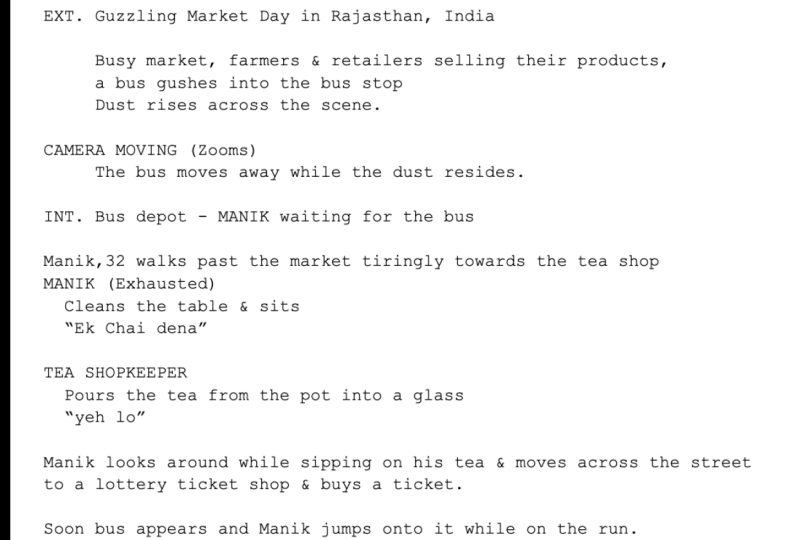
a certain structure. Let's go through an example so I can show you what I mean. In this example, you'll notice
that each line has enough. Line. One is called the slug
line or the Scene Heading. This line will specify either the general
or specific locale, and it's always capitalised. In this case, the
scene is set outside, which is specified
by EXT for external. The opposite of this would
be INT for internal. The general location of
the scene is somewhere in the Arizona desert
and the scene is set during the day as
opposed to at night. This line tells everyone who's reading the
script a lot of important information that will help them visualize the scene. It's also extremely useful for cinematographers and
gaffers as knowing that it's an external
day seen will help us plan for the type of
lighting setup will need. And if we're shooting on film, the type of film stock we
should have ready for use. Line two is called
the action lines. This is a single-space description
of the people, places, and action taking
place as you're seeing begins with the action line. It's important to write
only the essential details. Descriptions of
characters are placed. There should only be
a few lines long. And when you start
describing the action, you should try to
contain those thoughts to four lines or less. Line three is an optional
element with the word moving, the writer suggesting a
shift in camera focus. When writing, you can choose
to include these elements for more details, or
you can admit them. Just know that the ultimate
choice as to how the scene is shot will fall on the director
and the cinematographer. Line for another solid line. It's important to
note that whenever we change location in a film, we need to include a solid line. And this is a perfect example. Even though we were just outside the vehicle
in lines before, we've now switched
our perspective and have gone
inside the vehicle. A totally different setup. Sometimes seems like these are actually shot inside
the studio with a green screen rather than
out in the elements were things like audio and
lighting are hard to control. This is something a
producer would make note of and schedule
into the shoot. Additionally, this line gives us instruction as to who the
shot should be focusing on. This potentially suggest
to the director to reveal the character so the
audience in a certain order. In line five, we see that
the name Andy is capitalize. When new characters introduced, their names are
always capitalize. This is to help the
reader know that this person is entering the
script for the first time. And for producers, this
helps a lot with scheduling. If they know that
they can shoot up to line five without
the actor who plays. And then they can save money by only calling that actor
to set when necessary. Depending on how long it takes the production to
get to this point, they may even save a
day's worth of pay. A producer's job is
to always think about the bottom line
and the financial impact of their choices. A well-formatted script can
make their jobs much easier. Blind six, the beginning of
our first line of dialogue. When you're formatting dialog, the name of the characters that speaking is always capitalize, and it's always in the
center of the page. In line seven, we have a stage direction
written in parentheses. These are stage directions
for the actor that give them a bit of direction
with their dialogue. Now it's best practice to
only use these in the script when absolutely necessary
for the tone of the scene. As actor should usually be left to interpret
their characters for themselves and also to
follow the director's vision. Line eight is where the
dialogue actually begins. You'll notice that the dialog stays in the middle of the page with a very specific 1.5 inch
gap from the left margin. This is again to ensure that the length of the
film is easy to estimate because
it's also easy to get carried away with
something like dialogue. As a general rule
in script writing, you should show not tell. Line nine is another
example of stage direction. In this case, this is a
physical direction that takes the place of a
potential line of dialogue. Using a physical rather
than a verbal response is encouraged to avoid
the entire film just being a bunch
of talking heads. In line ten, we see that the
word sputters is capitalize. This is true for all
sound or music effects, as it helps us sound
designers quickly identify where they may need to source a song or record a sound, like stage directions,
It's important to note that these
are only suggestions. Sometimes an exact
sound or song might not be possible to get due to
budgetary constraints, but a good sound designer will do their best to get
a comparable option. Finally, in line 11, you can optionally choose to indicate the end of the scene. This is not a necessary step, but if it makes you
feel that the writing flows better, feel
free to add it. You can use phrases
like cut to dissolve two or fade out as suggestions for the
director and the editor. And that's it. Now you're ready
to start typing. So let's go ahead and talk about what software we can use
to make our jobs easier.
4. Software: Software. When you're writing a
feature length screenplay, you'll be typing anywhere
from 40 to 120 pages or more. Considering the amount of
writing you'll have to do, the software that you choose
to type in is even more important and impactful to
your productivity as a writer. Keeping this in mind, I'd strongly recommend using a software specifically
designed for writing screenplays such as
Celtics or final draft pro. Celtics is an online
screenplay formatting program with a free tier. If you have a solid
internet connection while you're writing
and a small budget, I definitely recommend
checking it out. Many of my students swear by it. However, if you have
a reliable computer and around a $100 to
invest in software, I'd highly recommend purchasing
a copy of final draft. Final draft is the industry
standard screenplay formatting software that will do all of the
formatting for you. Currently, it's not
subscription-based. So once you pay for
it the first time, you'll have it for life. Additionally, if
you're a student, you typically get it
at a discounted price and with a longer free trial. If you ask nicely. In my opinion, final draft
is the best option to use. If you're serious about getting started with screenplay writing.
5. Conflict & Character: Conflict and character. When writing a screenplay, if you forget everything else, there's one really important
rules to try and remember. Conflict. To make something dramatically interesting
to an audience, there needs to be some level of conflict within every scene. Conflict, no matter
how small is what keeps the audience engaged and watching to the next scene. If as you're writing, you find that your
script isn't as motivating as you'd expect. Try introducing more conflict. It's also important to remember that our
stories are driven by our characters or subjects and their deep wants or desires. If your character desire
something strongly enough, it will carry through
in the writing. Films are generally
about a character who wants something
but can't have it, and their journey to get it, as well as the obstacles that they encounter
along the way. It's the journey that we as the audience become invested in.
6. Story Structure: Story structure. Now it's time to start writing. But how do we actually make
our stories interesting? What elements are
necessary to make a screenplay engaging for
readers and ultimately viewers? Let's talk about
narrative structure. Narrative structure
is typically how most screenplays are written and how most movies
are structured. And this structure is based on something called
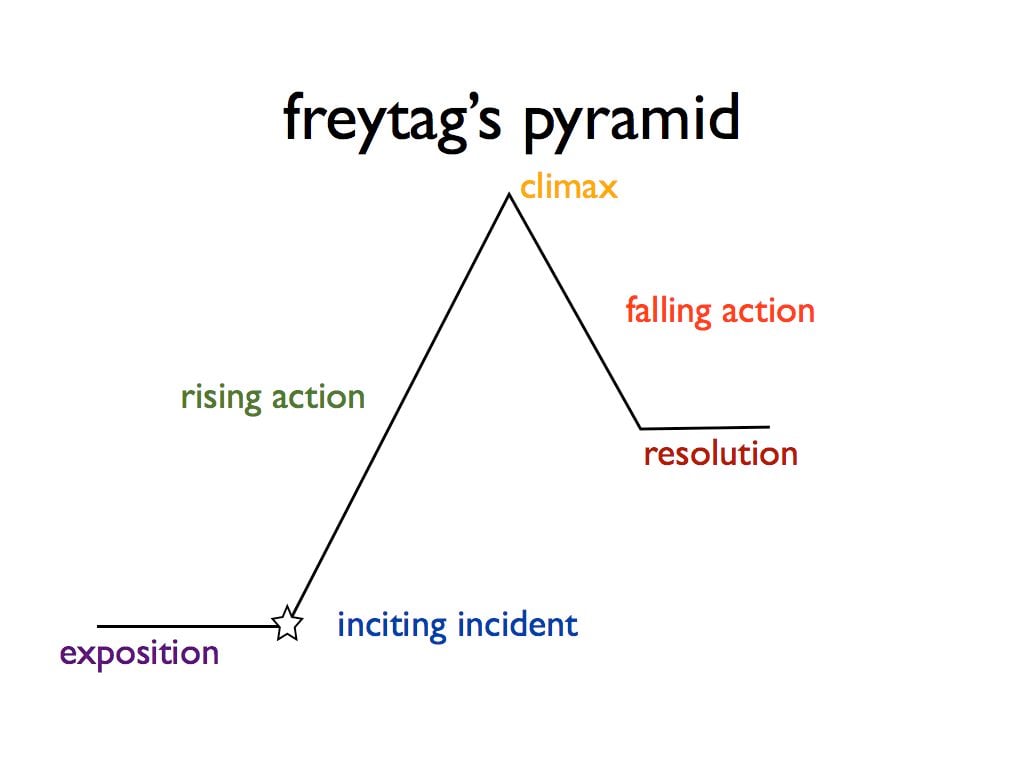
Freytag's Pyramid. Freytag's Pyramid is a
structure laid out by 19th century writer Gustaf
for a tag in this pyramid, there are five main parts. The exposition, the rise, the climax, the fall,
and the resolution. We're going to explore
this pyramid within the context of the
three-act structure, which is built around.
7. Three Act Structure: Three-act structure. The three-act structure is a
way of dividing up a story into three parts based
off afraid to experiment. This structure was
first popularized by sub-field in 1979, the writer of the text we
referenced in the lesson on formatting before and
certainly since then, the vast majority of
Hollywood films have been written following the structure
or some derivative of it. One of our goals today is to become experts of the
three-act structure. So let's dive in.
8. Act I: Act one. Act one, we start off with our character in
their normal state. We watched them in their regular day-to-day life
and gain knowledge about who they are and how they interact with the
world that they live in. This is the exposition and the first part of
Freytag's Pyramid. Nothing particularly
remarkable happens in the beginning of act one. Its main goal is to just
let us become familiar with the elements that make
up the journey were going on. In a feature length
film of two hours after one usually takes up
about 20 minutes or so. It's just at the end of act one that the story
really begins to start. Justice Act One is about to end. The character is faced with what we call the inciting incident. This is a moment that completely changes
the trajectory of the journey that
the main character has been on up until this point. Think about the moment
in Black Panther went to Charlie's father dies and he
is forced to become king. That is the inciting
incident of the film as up until that point
to trolleys journey was going on one path and then was instantaneously shifted
down another path. Within minutes, he is forced to defend his claim
to the throne, and once he wins, he becomes
the King of Wakanda. Usually when a film
is being advertised, the details of Act One
are in the log lines. In the case of Black Panther, it's logline on
IMDB is to Allah, air to the hidden but
advanced kingdom of Wakanda must step
forward to lead his people into a
new future and must confront a challenger
from his country's past.
9. Act II: Act to the inciting incident
of act one shouldn't be compelling enough
to catapult us into the longest act of your
screenplay, act two. Act two is typically
around 60 pages long, and it's where the meat
of the story lives. This is the act in which your main character is
faced with a challenge. After challenge, this build is what Freytag called the rise. Typically enact to
the main character is faced with at least three
challenges or crises, with the final one
of them being the largest of them all the climax. Each of these
points of crises or challenges for your
main character either overcome or get around in
order to reach the climax. How your character response
to these challenges allows us as the audience to get to know them
much more deeply. It's usually enact to where the audience
becomes invested in a story and really begins to root for the main
characters to succeed. Again, using black
panther as an example, there are many points at which the main character two trolley, is challenged with
an ACK tube and being at a runtime of
more than two hours, it definitely needs them to
keep the pace of the film. Let's talk about a few of them. One is when two cello discovers
that cloud is trading by brain him on the black market in an effort to stop him, he travels to South
Korea where cloud is intending to make his trade
in order to stop the trade. However, at the last minute, Cloud manages to
evade the child has grasp while simultaneously
injury and agent That's the child who was
working with in the moment to Tala is
faced with a choice of continuing to pursue Cloud or to take the dyeing
agent back to a condo. So that is life maybe saved. Ultimately, he makes it difficult but morally sound
choice of returning home. There are many
things the audience learns about to
China in this scene. Not only is he of
sound moral character, choosing the life
of a friend over the potential admiration from his subjects and respect from his friends back
home and Wakanda. But he's also not
afraid of failure, which is how his
morally sound act as seen when he returns
home without Cloud. This example just talks
about the first of many crises that take
place, enact two, each one arguably rising
in conflict and important as the act continues until
the story reaches its climax. The tip of freight tags pyramid. The climax is arguably the most important
part of the story. This is where the audience
finally gets an answer to the question of whether or not all the
buildup was worth it. In action film, this
usually involves some sort of major battle
scene in a romantic comedy. This could be the moment that the main character professors their love for their
crush in Black Panther. This moment is an epic battle in which the audience
watches to find out whether or not
the child remains king or if his antagonists, Eric Stevens, overthrows him.
10. Act III: At three, the result
of the climax is what is known as the fall or the fourth part of
Freytag's Pyramid. These are the moments after the climax in which the
story begins to wrap up. In the case of the
result of a battle, each side would begin to come to terms with their
newfound faith. At three can be the shortest
act in a screenplay, depending on how it's written. And it usually runs at
a similar length to act one at around 20 or 30 pages. In the final part of
Freytag's Pyramid, the dentin wall, the story comes to a conclusion
of some sort. This doesn't necessarily mean the story is over
for our character. Rather, it's a natural
stopping point for this part of the story. Oftentimes in a series or a story that's
looking to become one, there won't be a clean ending S entice viewers into
watching the next film. It's important to remember
that in Act three, it's considered bad form to introduce completely new topics. As this act is really
meant to tie up any loose ends that
the story already has.
11. Connecting the Dots: Connecting the dots. So we have everything
we need to go in and write excellent
award winning screenplays. Now, it's just about doing it. As I've said before, the most important thing
with anything is to just get started and to
go easy on yourself. Try to set a small
achievable goals like writing a single scene
a day and going from there. If you set out like this, you'll have your first draft finished sooner than you think. Just remember that
writing is rewriting and don't be too hard on
yourself if you're not in love with every sentence, the most important thing is
to put something on the page. Even if it's terrible, at least you can
make that better. But it's hard to make something better if there's
nothing on the page. As a final exercise
for this course, let's take a couple
of minutes and brainstorm a few ideas
for your screenplay. Pick an idea you
want to write about. Set a timer for one
minute and write down everything you want
to happen in that story. It doesn't matter if they
all don't make sense. We'll sort them later,
write down characters, their desires,
locations, plot points, anything you can think of. There are no strict
rules or restrictions except to write and keep writing
until that minute is up. Feel free to pause the video. Next, let's sort through
what we have to choose at least one character
with at least one desire and at least one location and a few plot points to focus on. Set the timer again. And with those in mind, flesh out what your AKS 123
could possibly look like. Write down what
you come up with. Finally, set the
timer one last time. This time for two minutes and start writing
the first scene. It doesn't have to be
perfect, just get started. You can always change it later. Aim for it to be at
least a page long, if not two or three. Hopefully that Brainstorm
was helpful for you. Feel free to do it again with a different combination
of characters, locations, and plot points until you find something
that inspires you.
12. Conclusion: We've talked about a
lot in this video, from screenplay formatting
to the three-act structure, to the different
software to use. I hope that some,
if not all of it, will be useful to
you as you start writing your feature
length screenplays. I have a few other
videos on how to work with camera
equipment and lighting. So be sure to check those out. As always, let me know if you have any
questions, comments, or concerns about
anything I shared today and I'd be more than
happy to address them.
 Zoë Davidson, Software Engineer & Cinematographer