Transcripts
1. Introduction: Hi, and welcome to my course on planning a stress-free work. You're probably here because you don't feel like your time is your own. You get to the end of your work week and realize you haven't accomplished anything that you set out to do. And what's worse, you probably feel really stressed about it. Now imagine you have time on your calendar to tackle your highest priority items. And you also have time set aside for mental health and fish. Hi, I'm Rich, a UX designer and manager at Google. Throughout my career, I've learned and picked up on a lot of productivity tips that I've compiled into a system. At the core of this system is planning your ideal work. And this one I'll teach you today. Along the way, you'll learn how to block off time for your most important tasks in your calendar. You'll also learn how to bind times for mental health and fitness. I also share with you some tools that I use for goal-setting and prioritization. At the end of this class, you'll have your ideal work week and a way to make improvements every week so that each week that you use this system and get better and better. So what are you waiting for? Go ahead and continue to the next video so we can dive in.
2. Ground Rules & Mindset: All right. Before we get into the nitty-gritty of blocking out time in your calendar and go into my entire system. I want to set up a few ground rules. The first is to believe in yourself, this is a new process and you've never seen it before. But as long as you have the confidence that you can do it, I think you'll do just fine. Also, give yourself permission to make mistakes. Sometimes we learn our greatest lessons through a mistake. And I just wanted to make sure that this is a space where mistakes are allowed. It's okay. And the last thing is Kaizen. And Kaizen is Japanese for continuous improvement through allowing yourself to be new and open to this and make mistakes and learning from them you will continuously improve. If you stick to this system or any system, as long as you go back and look at what your mistakes were and how you could fix it, you will improve. So those three things I just wanted to make sure we all level set there before we continue into the meat. So let's continue to the next lesson.
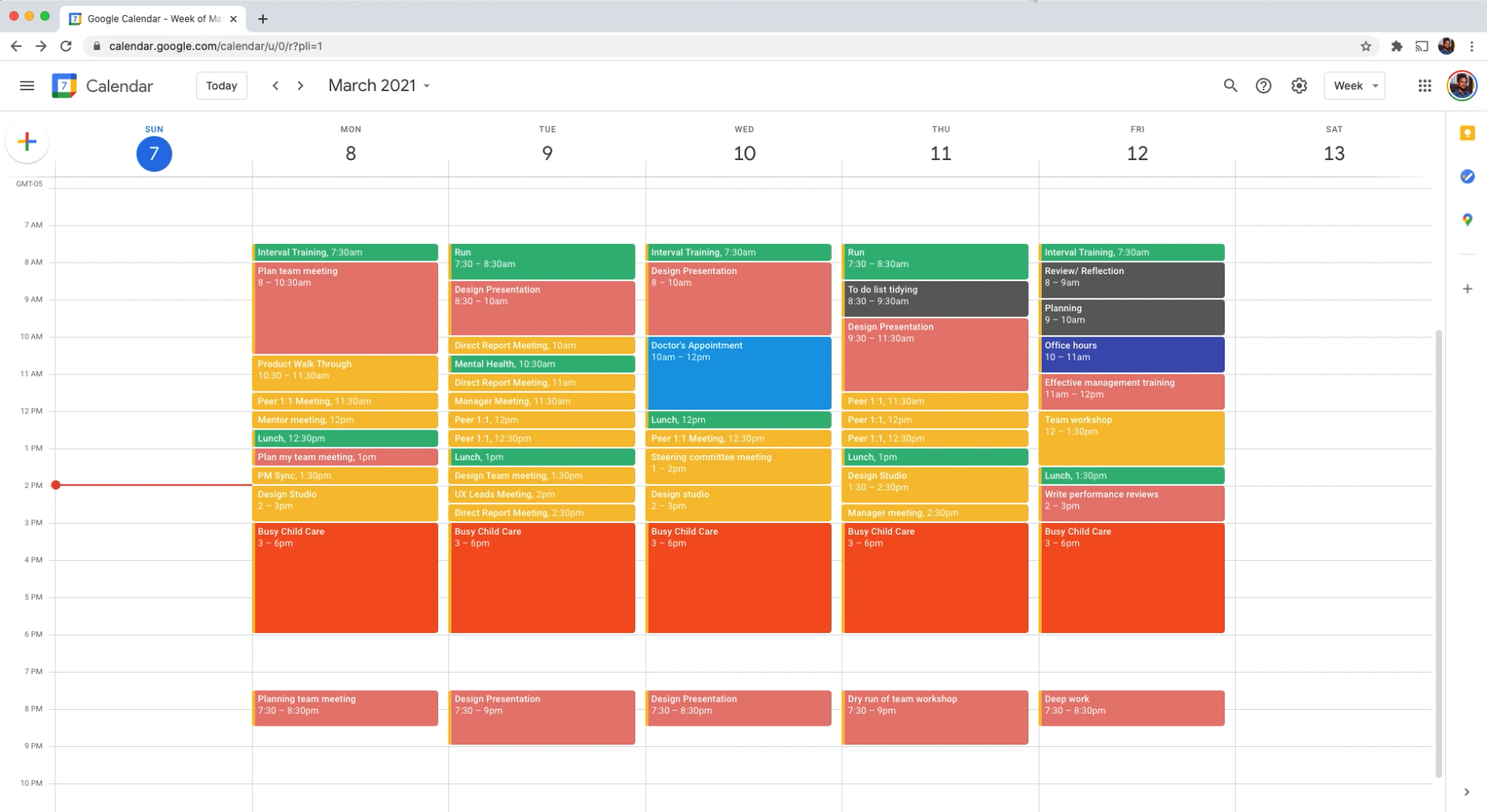
3. Creating Recurring Blocks of Time: Welcome back. In this lesson, we're going to dive into calendar and go ahead and start blocking off time so that you can focus on their highest priority task each week. Now these blocks of time will be recurring so that there is consensus from week to week, so that you're able to do that. Things that are most important to you will also block off time for health and also fitness activities that you may want to do each day. So let's just dive in and I'll show you exactly how to do it. Hope in Google Calendar. And what we're looking at here are all the commitments that have already made for the, for this upcoming week. The first thing we want to do when we're blocking off time is think about when is the best time for you to do deep work. Time when you'll be able to focus. And you want to pick about one to four hours every day because there's research that shows that we could only concentrate for about that time. For me, the best times are in the morning. So I'm going to go ahead and schedule a Deep Work Session for me. Between eight AM and ten AM. I'll also color code this so that at a glance, I know that this is my deep work session. Now I'm also going to make this repeat so that I know that on Mondays and Wednesdays, wednesdays from eight AM to ten AM, I can't schedule some deep work time. We'll fill in what exactly I I'll do during those times and what you'll do during those times. But for now, let's just put them as placeholders. So I have Monday was they said Now I'm going to do Tuesday. And on Tuesday I'm going to go and I'll start at 830. I'll call it deep work again. And I'm going to end it at 10 as well. And remember to choose a color. Good. Now I'm going to do another session on Thursday at around 930 is called Deep Work. And I'll go to 11, changing the color. And on Friday I'll do one more session here. Work. And I'll change it to the flamingo color again. Pen, I'll save. One thing I just recall I forgot to make these recurring, but we'll skip that for now. I also have opportunities at night to review today or just do some expertises that I need to finish up. So I typically go at 730 and continue to deep work. In this will recur as well. Custom Mondays, Wednesdays and Fridays. And then on Tuesdays and Thursdays, I'll go until nine o'clock. There's this theta. So now I have my deep work time saved. The next time I'm going to add on my mental health and fitness times. Now. I have a goal of exercising every day. I like to do interval training and I also like to run and I'll go ahead and put those into my calendar as well so that I know when I'm going to do those things. And I'll change the color. I like to have my mental health times as green. Actually, I need to repeat these and this will repeat on Mondays, Wednesdays, and Fridays. But now they're saved. On Tuesdays and Thursdays. I'll go for a run. And again green. And this repeats on Tuesdays and Thursdays. And faith. Now we have our deep work time or a fold is time for our highest priority items. We also have some times for some exercise. The next time I want to block out is time where I can review my to-do list and that I will schedule for Thursdays between eight thirty and nine thirty am. Let me just go ahead. And IDE I like to do this because drew out the Weka add things to my to-do lists and it may get unruly. So I'll go ahead and schedule some time to do some tidied. Okay. Now the next time, next time I'm going to save is time to plan out my week. I like to plan for the following week on Fridays. Now, this is a time where you would actually go ahead and fill in all the details of your deep work sessions. And we'll get to that in enough in a future video. We'll just go ahead and let this repeat weekly on Friday. All right. And then the last time I want to save is a time for review or reflection. This is when you will go back and look at your week and think about how it went and what you did well, what you could do better, things like that. I'll talk more about this in another future session as well. So for now, let's just go ahead and make this recur Save. And that's it. So listlessness, I showed you how to find times on your calendar for deep work and also find handling encounter floor exercises. And then the last category is running time for the maintenance, things like planning for next week, reviewing your to-do list and tidying it. And also just reviewing a week in general and reflecting on what you did, what you did well, but he could do better.
4. Goal Setting & Prioritization: Welcome back. In this lesson, we're going to go over goal-setting and prioritization. In the last lesson, we blocked out time in our calendar so that we could focus on our most important things. Now, we want to make sure that those things aligned to a higher level goal that we want to achieve. And to do that, we have to have goals to begin with. What I like to do is at the beginning of the quarter, I list three to five goals that I want to achieve by the end of the quarter. And with that, I have something to time my task to each week. I make sure that each task aligns with one of my main goals for the quarter. Now you may not have already listed out what your goals are for this quarter. So if you haven't, there's one method I'd like to introduce to you to help you decide on what your goals should be. And that's called the two list method by Warren Buffett. Now, this lesson, this method is pretty simple. There's two steps. The first step is to list about 25 of your top career goals. Are your goals for the quarter. Go ahead and list them out. Now, the next step is to look at your list of 25 items and circle the ones that are your top priority, the ones that you care the most deeply about achieving. You want a circle about five of those, only five. And once you're done with that, you'll have your two lists. The first list of 25 and then your second list of the five items within that first list. So your priorities for the quarter would be the five the top five things that you've listed. All right, Now that you have your list of up to five bowls, put that aside for a second. Let's talk about the tasks that you need to accomplish for the next week. You may already have a list of tasks that you need to do on the to-do list or some other way to capture them. Let's take a look at that list and prioritize them from most important to least important. And if you need help figuring out what's most important and what's the least important. Let's bring back our goals. First. Look at your list and look at the things that align with your top five goals that you've already laid out. If there's anything that doesn't align to those goals and put them at the bottom of the list. And the things that do align to those goals put them at the top of the list. So another way of prioritizing is called the Eisenhower Matrix or Eisenhower Box. It's a two-by-two matrix that splits your task up into urgent and important items. Now, on the top, you'll see you have things that are urgent and not urgent. And then along the y-axis you'll have things that are important and not on-boarded. And what you wanna do is that in each of the quadrants of this block lists down all the things on your task. List in side one of these box. If it's urgent and important, right in the urgent and important box. If it's not urgent and important, put it in the not urgent and important box. And so on. Until you have everything on your list mapped out into this Eisenhower Matrix, there are some key things that you could do with each of the items in this box. For example, the important and urgent things. You want to prioritize those high because you need to do those things first, the not urgent and important things, they may not be as high, but you do want to get to them. So scheduled dose. And then the two urgent, not important things and not urgent and not important things. You either want to delegate those or just avoid them altogether. This box is a cool tool that you could use to quickly prioritize your list. That peered with the goals that you set at the beginning of the quarter are two ways to make sure that you get the things that are most important to you.
5. Scheduling Deep Work: Now that you know what your highest priority items are, we're going to take those and fill it in to the time you've already blocked out for your highest priority items. This lesson is all about putting in the details interior week's calendar. So let's go ahead and do that now. So my top priorities for this week are planning a team meeting during a desired presentation, writing some performance reviews, and doing some effective management trainings. This list is in priority order, so the first item on the list is my most important thing. So I'm going to block off time on Monday to do that. I like to block off the most important things first and given enough time so that I know that I couldn't complete it. But we'll go into this schedule and put in plan meeting and then Save. And this will just be for this advent because this is something that I need to do this week. And since I have an extra half hour, I'm going to go ahead and extend this time that it takes up the entire block. So now I have 2.5 hours on Monday to go ahead and start planning my team meeting. I don't know if I will actually finish during this time. So I'm gonna go ahead and add another time in the evening for planning. And save. And again, is just going to be for this event. So now I'll repeat this for every Deep Work Session on my calendar. So I know exactly what I need to do when those times come up. Now the whole point of this filling in the details is to be specific about what you intend to do during your deep work times you've blocked off. I think my design presentation is probably going to be a long time. So I'm going to schedule several sessions of me doing this. Okay, I think that'll do. Now. The next thing on my list is my effective management training. This is a course that I'm taking. I want to make sure I make time for that. And last thing is my right. I just added time for that because I noticed I didn't have a deep work schedule for it, but I do want to make time for it. And I'll just do that from two to three on Friday. Is also this time here. I'm going to do a dry run of t workshop just so that I can prepare myself worth better, make sure it is ready. Because that's happening on Friday. Now you notice that I have some empty spaces in my calendar, which is fine. And I also have one deep work session that I haven't allocated for, which is also fine during the week. I might want to change that and add something here and I can do that then. And during the week, I might want to add some more the some time available for meetings and whatnot. But this week I'm looking at it. It's already pretty packed with meetings and I haven't scheduled any lunchtime or any additional additional mental health time. So after I have all my detailed work times blocked off, I like to make sure I add in those lunchtimes and those mental health times. So on Monday, looks like this meeting is right during lunchtime. And I think I'm going to schedule over it and make sure I do lunch. And I'll just do that. This is a type of meeting where I don't necessarily have to do anything or I don't have a large talking role in this meeting. So it might be okay for me to do lunch. Now that I'm thinking about it, it might make sense for me not to go to this meeting. I'm just not going to go. And just so that I could have at lunchtime where I'm not interrupted. And since I have extra time, I think I'm going to just use this to plan my team meeting theme. Meaning I just noticed that I've been saying team meeting, but it's actually a team workshop that's happening on Friday. So team meeting, team workshop, but it's a meeting with the team, but it's a workshop. So that's one thing that I make sure to do. If I fill it, be overwhelmed and there's some time that I need for myself for lunch or anything else. Um, make sure that I just book it for myself and don't go to the meetings that are less important. So I have time here. So I'll go ahead and take that time to do mental health. And for mental health, what I like to do is either walk around my my house. Since we are all working from home now. I used to take the time to walk around the office, but now just walk around the house and perhaps get some water or I'll take a 10 minute nap. Now there are some studies that show that a 10 minute nap can rejuvenate your mind for up to three hours. So I take advantage of that whenever I can. And I also noticed that on Tuesday I don't have any lunch scheduled, so I think I'm going to schedule lunch this time. This is another team meeting where I can either be late to or not show up, but I'm going to take the first half hour of that meeting, that lunch, and then I'll just move this over so that I know that I'm only going to attend, but the first half hour for the last half hour. And then I have lunch in between then on Wednesday and looks like a good time is already set for me to have lunch. I'll go ahead and put that there on. There is a doesn't look like a good time. But again, this is a, another medium where I can be late two, I'll just go ahead and to lunch there. And then on Friday, this looks like a good time for lunch as well. And that's it. We have our calendar set for the week or at least this is my calendar is set for the week. We just filled in the times that we've already reserved for ourselves to do a highest priority task because we had our task list, it was easy for us to jot down exactly what we wanted to do and when. And additionally, we also put time in for for lunch and mental health breaks. In those times are just as important as the time that you're focusing to do and doing in your deep work. The last thing I want to mention is that when these times come during the week, you want to make sure that you prioritize them. You could think of these as meetings with yourselves. Now, if you've scheduled a meeting with someone else and didn't show up, that would be really rude and bad. Now, why would you think of someone else's more important than yourself? You could think of. You can think of it as the same thing. Now, you just scheduled time for yourself throughout the week. And if you don't show up, that doesn't bode well for how you feel about yourself. They're asleep. You are important too. So make sure that you stick to your schedule. And when the time that you book.
6. Weekly Reviews : Now, at this stage, Let's imagine that you've gone through out your week and you've hit some year goals. You've completed some of your tasks, you've hit the meeting that you wanted to do with others and yourself, or maybe you have it. Maybe things had to get moved around, whatever the cases, it's the end of the week. And what I like to do at the end of the week is review and reflect upon the week that I just had. And that's what this time it's war. On Fridays between 08:00 AM and I now am. I take the time to ask myself some questions about the week. For this, I use a weekly review template where I asked myself five questions that I'd give me a good sense of how I feel, what I accomplished, what went well, what didn't work so well. And what I would like to try next week. This isn't a spirit of Kaizen continuous improvement. Every week, if I continue with this system, I wouldn't, I know that I will improve little by little because I'm reflecting upon the things are accomplished and the mistakes that I've made. You know, they say that a mistake isn't a mistake. If you learn from it, it's a less than and that's what I tried to hold two. Another thing is listing out my accomplishments. At the end of the week, I feel good that I've accomplished a task that I set out. Sometimes you don't remember what those are, but if you write them down here, you give yourself an opportunity to pay cellphone it back. And that's what I do during this time as well. But there's not much to say about review except for the fact that it's the time we review what you did to out the week. And that's about it.
7. Final Thoughts: Well, that wraps up my system for how you could plan your week. We learned a lot. So let's quickly review. He learned how to take control of your week by blocking out times for both productivity and mental health because both are important. Then we figured out what our goals were. We picked three to five of our top goals. And then we use those goals to prioritize all the tasks that we needed to accomplish. The goals and the task didn't line up exactly. We also use the Eisenhower Matrix or box to make sure that we scheduled the things that were important, not urgent. And did the things that were urgent and important. After that, we went ahead and took all of our top priorities and filled it in the time blocks that we've saved for our deep work. That way, we knew exactly what we're gonna do when those times came up. And then lastly, which I showed you how to review your week at the end, when you've gone through and had a full week, we ask ourselves some questions just so that we can reflect upon. He did whether we did well or not. So the last thing I really want to leave you with is the idea of Kaizen doing a little bit every time, just so that you can continuously improve. If this system works for you, great. If it doesn't find something else that works. If some things work and some things don't, just make sure you take on the things that do work for you and leave off the things that don't. Lastly, if you've been following along and setting up your camp, your calendar along with me, make sure that you share work so that the rest of the people taking this class can also see it. Right? Thanks.
8. Recommended Books : So the last thing I want to leave you with some recommendations that has helped me along the way in my journey of productivity, right? The things that I've shared with you today came from the various books that I've read on the topic of productivity. So really quickly, let's go through them. The first book is Atomic Habits by James Clear. It's a great book for learning how to adopt life changing habits. The next book is Deep Work by Cal Newport. This one talks a lot about how to focus during those times, focused time that you've already mapped out for yourself. The next book is when by Daniel Pink. And this book talks about when are the most optimal time to do specific things. This book also has a great chapter on y taking that is important. Definitely recommend you checking that out. The next book is Make Time by Jake Knapp. And this book talks about all the tips on how you can do your most important things in life. In general. It's really great and it has a ton of tips. The last book I will recommend is measure what matters by John Doerr. This book is all about goal setting on institutional level. Well, if you part of a large company and you want to make sure that you set goals for everyone in your org. This is a great book for you to pick up.
 Rey B., UX Design & Productivity