Transcripts
1. Intro: Hello and welcome
to this course. Today you want to
speak about can we fix? My name is Stephanie boom. I'm a character designer
and illustrator and I'm specialized in characters for my journey
started ten years ago. Since then I've worked for
a wide variety of radio, role-play and board games. At the beginning, all my
focus bands into techniques like learning perspective,
anatomy, rendering. But this time I realize
it's about more than flawless trunk muscles and pretty faces greater
than something. Prove it. We want to relate. We want to feel to have
a personal connection. We started in this course. I wanted to take you
with me on my part. I will show you
techniques and tools like silhouette, shape,
language, proportions. You will channel
your inner actor and create a legal maneuver. Those techniques are
universal and can be used with all
techniques and styles. In Humana if you
have just started out or if you've been
turned into wine. At the end of the course, you will be able to create characters that
interesting, engaging. Let's go to work.
2. How to design a Character: Okay, We will start
with classical task, designing around arrow keep
all this year very simple. It's just for demonstration. Propose to make a point. So I will just put all the
possible cliches into this. A lot of armor, everything in different shapes, spikes to make them
look more dangerous. Maybe you are also
scaled so we can also add some batches. Like today, I was capable
to make a fire by myself. I'm a ridiculous
amount of weapons. And of course you need spells, a lot of them because
somehow he has to carry all those stuff
around with them. So like, what is it,
What is it like? The weapons, of course, and potions and magic
books and tomorrow, daggers and Ninja
start a helmet. But you know what
makes a helmet and a hat and feathers because
we are in a generous mood. And of course he
also needs a cave. And some of those
unnecessary pieces of clothes where nobody really
knows what they're good for. I guess just decoration. Okay. Well, I have to convince it looks less
she didn't eyeball. If we give them some
open glass and it could be an overambitious
cost player. Actually, it's nice. Okay, well, the, honestly, it does not work as a
serious Raja design, right? So what does it even
more dignified design? Well, does not
really work either. But how are we making a
character design that is neither too confusing or borrowing? As always, there is no simple
answer to this question, but there are a few
points where we can start working
with silhouette. Shapes, potions. Study language, well selling. These are more will be
topics in this course that will help you to improve
your character design. So it's going to, it.
3. Silhouette: So a cigarette. This the first thing
that we receive when looking at a person
or an object or whatever. So let's make a little test. Go on. I'm in no squint
your eyes at it. And then look
outside for people. Because it's just people
who are far away. We often see not more than
vague shapes and silhouettes. And yet they already
say a lot like age, fitness level, emotional state. We understand a lot even
with less information. By the way, the woman on the
far right really does exist. She goes a walk
close to everyday. Before goose in the stroller. She also has a dog. He's only allowed to
sit on the wreck. Okay. In character design,
we use silhouette as a tool for two things. Variation and clarity. For yourself or for
a client doing where variation is always Good idea. I, I have a book
recommendation for you. It's the skillful hands man from Scott Robertson and
three of his students. It's a concept art book. So it's exactly what
you could expect. It's a lot of it will break
my waist and disposition. It's okay. It's a book full of exploring ideas for characters, creatures,
wrappings, landscapes. And of course they're
using. It's really nice. I guess you can't even see it very well,
but yeah, it's cool. So silhouettes as
a nice way to let your creativity flow and find some awesome
original ideas. And this is what
you want to do now. It's always good to use
really ****** paper. So there's less pressure involved than when you use
the good, expensive material. So yeah, yeah, just
absolutely paper. It is mainly about quantity
rather than quality. It's more about thinking in as many different
directions as possible. So just put all your
brain and just do it. Okay, here's a story from
the book, art and fear. It's about Arabic
teacher that divides his class into two groups. One will be rated on quantity, the other in quality, while wrong group shopper to use as much work as possible, moment and equality, the
other would only need to deliver one piece that
therefore is perfect. In yen, the group
graded for quantity, not only delivering
a huge body of work, but also the pieces of
the highest quality. Why are they experiment and
learn from their mistakes? The quantity crew was moved busy theorizing
about perfection. Rather than doing anything. We often start with the
things that we already know. That's the moment where
perfectionism Hansen, he tries so hard to do something nice that you're too afraid
to try something new. But in order to be creative, it is necessary that
you relax and let go. Okay, so allow yourself
to experiment. I mean, that's the message here. And of course, it will
also create a lot of junk that maybe also some really
cool and original ideas. And don't worry too much if you don't know what this
or that marks should be, just trust in your brain and it will come
up with something. Because our brains
are really great and making sense of
things were in fact, that is not what is already
difficult than other life. But here, it's
coming really handy. After you've made
several sketches, you can show us the
most interesting one, and we'll get out from here. So I will now scan my page and continue
drawing on my iPad. Clarity is especially
important for animation. Because here, movement happens
in friction of seconds. And in order for us to
understand what is happening, it is very important that each key position is
as clear and readable as as long as we
see the drawing, we understand what's going on. But it's no longer
the case as soon as we see only the silhouette. The clarity of his position
is therefore not so good. Here. On the other hand, it's much better and we understand
that immediately. Here's another example
from spawn top. Again, the scene as
understandable as drawing, but not as a silhouette would add to this is the
question of intention. The left image, he
is holding a gift, but we don't know what he
intends to do with it, whether it is for himself
or for someone else. On the right image. And only the pose and
silhouette become clearer, but also intention behind. As long as we don't
do animation, we don't have to be quite
as strict as they are here. So it's good to keep
an eye on how to push a pulse to get more clarity. So next time, check if your character stands
the silhouette. And if not, then see
how you could improve the resign or the position in order to gain more
clarity and readability. Make a rarity of silhouettes
for one character. That can be a while We're
or any other profession, like a party this year, a garden or whatever. Really. If this is too complex, you can choose option
to what is making variations of an object
that this person might use. Because of course
the same that is counting for our character. We can also use for objects and objects and
disregard can have a personality to do
as much as possible. I mean, six should
be the minimum. But I would highly suggest you move something between 1020. This is done. Ask yourself, what are the most interesting
sketches you came up with? And why do you think so? Another question would be, how would you describe
their personality? Or in case of the object, what does this object tell us about the personality
of their own? Okay, Then go to work.
4. Shape Language: I'm sure you already
done this at some point, but let's say not and
this is your first time. Okay? So which associations
do you have? When you look at those
three basic shapes? Let's start the
so-called bad. I bought. It's playful, happy, and
lighthearted, sweet. But if you try to lean on it, it rolls right. Not
exactly reliable. Now the square, solid, Scrum, resilience, trustful and you can lean and rely on
it whenever you need. But mostly of triangles,
you will get two times. One stable and one is
when we think of it mostly in a dangerous way,
fast, explosive temper. Seriously, you don't
want to mess of it, but there's also a
superpower to it. Intelligence, confidence,
energetic, a true leader. It shows us react to. Each shape has both positive
and negative properties. There will be a PDF that I provide to get out of this
course where you will find a list of more
possible properties that we associate
with each basic form. Of course, these are
just a few suggestions and you can add
more if you want. Those are characteristic curves. There are universal and
deeply rooted in us. This is why we can just use them wonderfully for our
character design, namely in the form
of shape language. This is a great example from
when the bishop on how to apply different shape
languages to one character. And notice how the same
character can fears so different based on the
form that we are using. I remember his beak
shape language. We mean not only solid forms
but also line quality. For around it would be
curved and organic lines. Trade and power layer
for a rectangle. Diagonal and sharp angles
for triangle shape. We can find this
different line qualities. When we go back to
the chef again, look at the shoes or the ears. It's really great
to see how Randy applies a different
shapes and every detail. So just take a second
and observe it a bit. But be careful to
not be too literal. Just because the
left chef insist on a rectangle doesn't mean they can't be curves
or diagonals too. It's not about
representing a form, Absolutely, but about using
and adapting its quantities. Okay, but how do I know which
shape language to choose? I mean, we already learned that certain shapes are associated with certain
characteristics. Some are physical,
some psychological. So I guess it's just a good
idea to have a look at well-known characters and how their characteristics are
reflected in their shape. Language. Can we design is very simple. He only comes up circle. What makes it especially
soft and cute, looking perfect to speak
to a very young audience. Superman type of group
is only a notch older. H02 is based on so-called, But he has design,
has more complexity. He looks friendly and kind. But things to the
now edit rectangle, also a bit more skillful
and strong, reliable. Someone who wants your plan while you're on
holiday is or can be asked for help when
you kitchen pipe breaks. Principle miles mainly for kids. So next target, young teenagers, thanks to his proposal later more about this and
circular design, he is still simple
and kids friendly, but idea was to give
them a more cool. What is mainly due to the
use of spikes and pointed shapes instead of circle
and rectangle like this. Now you'll see a combo
of circle and triangle. What makes him fast and HE, but also with a good heart, again, where you
Team Mario or sonic. For me, it's definitely sonic. Even though I never
made an elastic. I would like to try
this again today. Everyone's at least my song cuckoo shows a combination of all three shapes
and spoiler alert. You will see this
a lot, especially with Japanese based heroes. He has all attributes
of a circle, is funny, friendly, optimistic. The triangle shapes of his hair gets the extra energy boost, like we already saw ultrasonic. And he is a classical leader
with a clear goal in mind. Someone who knows the direction and don't allow others
to step in his way. The rectangle shows
that strength, physically and mentally. He has a strong
sense of justice, can easily take it and is
there when you need them. So reflect what are your characters traits and how you can express
them visually. And now it's already time
for your next homework. Find three characters and
analyze their shape language. And what does those shapes
say about their personality? And if it's helpful, get
inspiration from the list.
5. Proportions: The, you know, the feeling that all your characters
look more or less the same just with different
clothes, hairstyles. This is because you stick to the same shapes and proportions. For a line of characters, we want a significant
different types, shapes and proportions. And the more you don t
have to stick to reality, the more you can
go crazy and wild. Everyone who watched or read one piece knows what
I'm talking about. But let's go back to
the fundamentals. What's our proportions? To give you a definition, let me read a text from
Ashley Hearst about it. Proportion is largely
about the relationship of the size of one element
when compared to another. When drawing or
painting realistically, propulsion is important. If the proportions
are incorrect, then the resulting
image will look less realistic or abstract. There are amazing
books existing on how to draw anatomy
like this one here. And then you'll also learn
how to construct proportions so they fall into
idle dimensions. And as little tip,
if you don't want to get a copy of yourself as a website where you can read
all the classics for free. But back to proportions. A classical tool for that is
the height to hedge ratio. During the phase of growth, the body size changed
significantly, but by comparison,
the size of the head has not changed too much. Therefore, it is well suited
as a unit of measurement. Thanks to this method,
we can not only create believable proportions
which age, but also gain helpful
orientation points, like the position of the
chest or belly button, the crotch area, et cetera. Let's see how this
could work in practice. I already made a rough sketch of this character concept okay, for what I want, but I'm not
sure about the proportions. To check this, I
low-carb many times his head fits into his body. What would make 6.5? Be quiet okay. For a woman, but it's
a bit short for a man. So I want to extend the whole
thing by at least one head. As reference, I use
7.5 model from Loomis. That will help me later on
to find the right distance. Now let's get my drawing to
match the new dimensions. But that alone, for sure. I still have to check
the proportions within my figure and to know
where what should be. I orientate myself on my reference entranceway
all important box. Now I know the correct
distance for the knees, the belly button, etc. Since my figure is not frontal, I adjust these lines
in perspective. It's quite easy with their
perspective transform tool. And when that's done, I can start drawing the basic
framework of my character. Apart from genetic
predisposition, our body says a lot of what interests and
activities we pursue. Even though all those
women are Atlas and therefore beautiful fits
and powerful bodies, the differences are great
and say a lot about a required strengths and qualities that go along
with every discipline. Of course, also aspects
of our personality, our showed in our bodies. Therefore, again, we
can use proportions and body shapes for
our storytelling. Let's take a look how
this can be realized using Big Hero six
as an example. Okay, let's start on
the left with fossa. Remember again the
second chapter and psychological
meaning of shapes. In the case of a sub E, the use of S career, solid, immovable, both
physically and mentally, a very lawful by the
book kind of person. If you look down on proportions, we see that the biggest
empathizes on his upper body. They present a strings and
his material art skills, but combined with soft lines, they represent his kind nature. Anyway, he's a bit like a
tree, realistic and crowded. Google is a more, HE carried out with a strong focus on
sportive activities. So therefore, it's
not a surprise that her main weight as on the legs to show this
strengths that she has there. In general, if you look at
kids or young teenagers, like with those two
characters here, you find a more narrow rectangle
for their torso shape. And if we look at
hurt and we see a more defined and
female body shape showing that in a way she is the more independent and
matured character and this group and you live in is
extremely slim and tall, giving you an expression
of lightness. What is also found
in her character. Her lines are in
general, less HE, but more fluid and soft and her total shape is closer
to the one over teenager, what underlines her
childlike nature. The same could count for Fred, classical teenage body shape, even though through
his hand backpack, he gets a few triangles that are underlying
his enthusiasm. But otherwise he is
a very HLS body. Once again amplifiers
his friendliness, but also that he is less
skillful than the others. Hero, the youngest wrong. So that's not a
surprise that we found is boyish torso
shape also on him. His main focal point
is actually his head, or is not only showing his age, but also his status
as the young genius. Perhaps you have noticed that just by using a
different torso shape, our perception of a
character can change a lot. So just playing with debt can
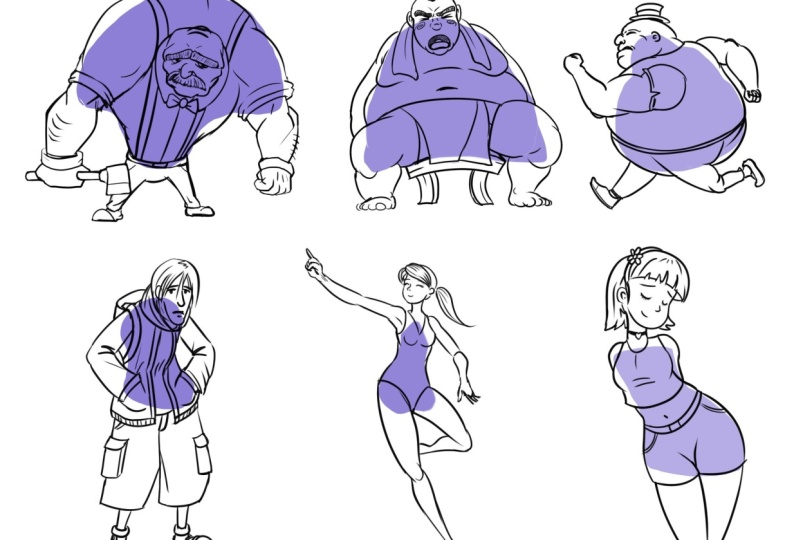
create interesting results. In general, we can distinguish
between for ground types, the shoulders are
wider than the hips. They are more narrow
than the hips, or both have the same width, which is the case with a
rectangle or an hourglass shape. Again, we found is that
a character concept only with a shape of the torso and see how you could turn them further
into characters. So this is what I will do now. So far you learned a lot
in a short amount of time. So this is the moment
to just lean back, relax, and just
watch me drop it. Good. And now it's on you because this will be your next exercise. Draw a bunch of different shapes and develop
characters out of them.
6. Body Language: Okay, we are emotional beings. That means we want to make
a story out of everything. If a, C, a character is said, we're excited, we
feel with them. A character shows emotions
is not reliable to us. We can engage the connection. When do we want to know
what is the story? So we want authentic characters. In order to draw them, you have to find them
with in yourself. Think by eons, being an
illustrator but being an actor. So what I want to do now as a
little experiment with you, I will guide you through
different scenarios. And you have to protect
yourself as good as you can into these situations. While you're doing this, pay attention how your body and how your
posture is changing. What is the position
of your shoulders? What are you doing
with your bag? Are you rounding up,
crunching in yourself? If you trade up your position, what are you doing
with your hands? How is the position of
your neck to your p.sit? Stiff, do feel relaxed. Things like this. Okay, so because I've come
for table, has two eyes. Now imagine you are in school. You really don't
like the subject and the teacher called
students to come forward. Security. Of course you don't
know anything about it and you are afraid
that he will pick you. How does that make you feel? And how does your body behave? You pull your head
a little closer to your shoulders, like your total. Do you round your back and
curl up to avoid being seen? Take a moment to observe
your body reactants. Now get up from your chair
and walk a bit around. Imagine the lesson is over. He did not pick you, but now you feel drained from
all the stress and fear. You walk down the hall, protect yourself
into the situation. How does it feel? How would you want? Suddenly you see the person
you have secretly a crush on. Your heartbeat goes up, your nervous at funnily
that's running in your reins. How does this change
your position? And why you're still
thinking about what to do? The person turns around, looks directly at you and smile. It's such a ****** day. And now it's the best day ever. How are you fear? What are all the
little changes that express the joy in
your face and body? What has changed compared to your first walking so-called. Welcome back. I hope you enjoyed this lecture. So you see like an actor has two amplifiers with a character and what are to play them? We have to do the same
in order to try them. I kill wherever I please
and nothing can stop me. What is really essential
is that you have a story to protect yourself on. If there is none, then I could just happen at a client is
just coming to you and say, Draw me characters in
scenario x epsilon, so you have no story, no personality, no nothing
in these situations. I found it very helpful to still come up with a story by myself, even though it is not relevant for the game and decided you, nobody will ever get
to know about this. There's so much more helpful for the design process and also
for your own motivation. Giving each character
personality and background star
helps me a lot to come up with ideas
for individuality, signs and expressions. I believe that history
gives a character richness and believability that is
visible to the viewer, even though they don't
know the story behind it. In order to come up with ideas, I asked myself a few questions. What is their role in the story? How is their
relationship to others? What is their motivation? What is that special strength
and what is their weakness? And often enough, in
trying to fight answers, your brain will
automatically crank out the story to make
sense of it all. Now where we have more
insight about our character, it's time to move them. And therefore, I would like to present to you another tool. It is useful to
give you a figure, a basic structure, something that sets the flow of the
poles and holds it together. The line of action is an imaginary line that
describes the direction and motion of a character's body and is a leading force
of his action. Mostly it is a single line
and form of an S or C cough, often along the spine, but that is not mandatory. This one is especially
important for animation where warm poles is flowing
seamless in one another, but also single illustration and less cartoons diodes
will benefit from it. A character based on
a straight line looks mostly stiff and a bit boring. But compared to the same
pose with a curved line, looks much more dynamic
and interesting. You probably know the Christmas Carol adoption from dismay, there's a blockage sustain called the flowing of the block. I hope I pronounced that right. What does in any way
and excellent name. So and the artists behind
ME, diverse studies. So he took screenshots
from the movie and paint the line of action on top of
them to see that dynamic. It's just wonderfully to see how the line of action
comes into work. And it's really helping to just tell the
story in the scene. So I would highly recommend
to check this out. So the line of action is
actually a great foundation. It's normally the first
thing that I tried to build everything else
then on top of it. So I make my line and then I mark the most important points, like shoulders, had
hips, feet like this. And then I add the volume and finally the complete trolley. And again, imagine this
line not only as a line, but as a force of energy
that flows through the body. And not only the
character itself, but everything that is
also on the character, like the hair, cloth bags, as well as to everything. The first character shows
a lot of enthusiasm. This energy is outgoing and
flows in all directions. This is clear not only from the poles and the
facial expression, but also other
details like hair and begs follow this
driving movement. The second pose shows
the exact opposite. Exhaustion, push everything
down in this pose. The same downward energy can also be shown in details
like the dropping head, eyelids, and lower jaw. The last poll shows a scared and intimidated
energy ran the first pose, everything is directed outward. Here, everything goes inward. The body becomes stiff and tricep press everything
against its. Think about an action and draw the same situation but with different moods of
your character. The quality of the
drawing is not important, but I want you to focus
on the use of line of action and that your character really
transport affiliate. Okay, then good luck.
7. Worldbuilding and Costum Design: Let's say you want to
make a character that is based in 18th century England. Of course you have no
clue what it work then. Of course also another good
choice or history books. I have this long history
of costumes and nice one. I have one about uniforms
and another one from my man. Also about history of questions. So that's nice. You can find that books
just in your local library. But what are you doing
if your character is not based in real-world
but in a fictional. Here is a little
star retirement. Ten years ago, I went to
against convention with my portfolio and I tried to learn my first job
as an illustrator. I was super nervous
and shy and afraid. It nobody would like to hire. I target, especially
the companies that were so small
and so ******. I mean, not the company is, but the artwork that I saw they were associated with next to them. My work is looking like
a sparkling unicorn. This is a sorry, Hawaii
indeed lend my first job. I mean, the payment
was horrible. But by the way, this is me, just after a stroke. I was supposed to make character illustrations
for a role-playing game. And I panicked a little bit because I did not
know the world. I had no clue which kind of costumes I
could put those characters. Luckily, the brother of my former boyfriend at this time was a passionate
leader, RBG player. So he could give me
some advice that triggered some great
experience and r0, and this is what I wanted
to share with you. Briefly summarize the topics
you should look out for our geography with
different ecosystems, whether clima, wildlife, and everything else that
is related to the planet. The next big topic is society. Considering of culture,
politics, history, science. Especially in cultural, we find many subcategories that
can be very interesting. Then there is economy. We have infrastructure and
manufacturing and resources. Although the first to use
and create by society, they are highly dependent on the environment in
which they live. We could also add mythology
and cosmology and magic if those are relevant
for your world and story. And yet again, the list is not complete and not every aspect
will be important for you. But it just gives
a good overview. The more we think
through those aspects, the more believable
our world will become, and therefore also the
characters that live in it. Now I want to show you how all those considerations
can come together. I guess the setting is
familiar for most of you. Otherwise, just imagine post nuclear war world
where the environment transformed into a
desert and close to no natural
resources are left. And a few people that survived
fight about what we minds. Okay, That's a setting. And now let's have a look at the main antagonist
and his costume. He owns most of the
remaining resources and has built a phonetic
code around them. Like most, he suffers from
tumours and other disease. And to ease the pain, he covers
himself and white powder. What is creating a very
specific look that can be easily mimicked
by his followers. So we see a consequence
of the environment, disease because of nuclear war. And the consequence
of this illness. The white powder that
is now originally trademark and connection
for him and his group. Now about his clothes, he really is
transparent or more, which is decorated
with service metals so that even without knowing
his past and story, we understand that he is a
man of war and military. The AMA hold and
protect a certain body, but it also makes them look more stronger than he actually is. We have a rope that is underlining his role
as a cult leader. And a gas mask is another reminder after
problematic environment, plus also his privileged
position in it because he has access to resources
that others don't have. Costumes don't always
have to be extracted. I guess it's the way we
German way to pronounce this. Nor do you have to add details. Often it is enough to just add a few items to create
a recognizable. For example, how we put
on with his combination of classes and scar or his house representing scarf that can
be even mimic from a baby and we would recognize
it, or layers hairstyle. But let's look again at Mad Max. All antagonists are crazy. Designs are meant to
be strange and scary. But if you compare
now the heroes, there are quite simple
basis of what they were. You could also find
in your own closet just dust and less
shredder and the heart, the blood, but you
get what I mean. They appear more real
to us, more reliable. We can easily identify with them if we look at
them as a collection. The first we notice
that they all seem to come from
the same world, the same environmental
and social circumstances. After that, we are collecting information to find
similarities and differences from which we can form groups like clan leaders, followers, The five wives. But there are other
connections between groups. If we look at for
your SAS makeup, which disappears over time, it is not unlike that
of the War Boys, shows a connection to
immortal Joe in her clothing, she has several pallets to Max and the fabric
of the top is not unlike the one Use
Benefit wife's clover, not only functional. They give us hints about
the life and history of a person and his
relationship to others. For an interatrial reward
that there are unique enough to stand out from all
the others in the group. We want to see how they
relate to each other. And as a whole, despite all their differences, we want to have the
impression that they are all coming from the
same environment. It's like in school, you have a big group of people within. They have different interests like sports, music, science. And based on their interests, they could find new groups, like a basketball
team or a punk band. These groups are
highly homogeneous. They dress alike,
they speak alike. Even though those groups
seem to be very different. Indian, they're all coming
from the same environment, the same city, the same country, the same moment in time. So now we know what matters. Personality and function must be reflected in a character, as well as the world and the circumstances
in which they live. For this, it is
important that you know as much as possible
about the world and can extract
consequences for life in it and how its residents
make use of it. This will be your task. Build a world, brainstorm about a possible setting and a
civilization that lives in it. Start by choosing the
environmental circumstances like desert island underwater, the world about gravity, what ever basically, what are the challenges that are coming with this kind of environment? And how could this
society that listen it, deal with those problems? What resources are available? And what can you conclude
from this for clothing, architecture, and transport in a PDF is attached
to this course. You will also find the map that I showed you at the
beginning of the lesson. Use it as guidance and inspiration for your
brainstorm process. And if you really
want to impress me, then design a character
that lesson as well.
8. Tell a Story: In the end, it is
as simple as this. If you tell a story, then your picture will
be immediately better. Mostly simple things are
enough to tell a story which tie you tell us
basically not important. I mean, not that important, as long as there is one. So if there's only one thing
that you can take away from this course and
instincts tell a story. With this, we are at
the end of this course. I hope you enjoyed it. I hope you learned a lot
or at least a few things, or at least you felt
well entertained. I would be amazed like arrays, if you would share your work in progress
and your final results, rivers in the project gallery. And if you have any
questions or suggestions, then let me know
here on Skillshare or right medium on Instagram. Today, of course, we can follow me if you want to be at today. What's happening? Me and so on. So uh, yeah. I thank you very
much for joining this time with me and
see you next time.
 Stephanie Böhm, i'm a Illustrator in the Games industry