Transcripts
1. Welcome!: You want to make art,
but there's just never enough time between work, family, and endless to dos. Creativity often feels like
the first thing to go. I hear you. But what if I told you it's not
about finding time. It's about making it. It just takes the right
strategies. Hi, I'm Mel. I'm an artist, educator, plus business owner, freelancer, and busy m. And I know
how challenging it can be to juggle creativity
with a packed schedule. That's why I designed
this class to help you make the most
of the time you have. In this mini course, I'll
show you how to reclaim your creative time with
three simple steps. You will start by
defining your goal so you can focus on
what really matters. You'll then make the time by uncovering hidden
opportunities in your day. And finally, we'll optimize your time with strategies
to make every minute count. This course is short, straightforward, and designed to fit into even the
busiest schedule. And by the end, you'll
have the tools you need to make consistent
progress on your art, no matter how little
time you feel you have. So let's dive straight in.
2. Step 1: Define Your Goal: One of the most important
steps in making time for your art is being clear on why you're creating
it in the first place. Knowing your purpose
gives your art making direction and
ensures that you're spending your time on what
really matters to you. Are you trying to improve a specific skill or
explore a new medium? Do you want to design
a picture book, or perhaps you're creating just for the joy and
mindfulness it brings. Make your goal specific
and actionable. The clearer you are
on your purpose, the easier it will be to
stay on track and avoid wasting time on things that don't move you
closer to your goal. For example, if your goal is, I want to find my style, that's too broad to
work with effectively. So try breaking it down. You might say, I want to get
clearer on my approach to using line in my art to better understand that
aspect of my style. This is specific and actionable, much easier to focus on. Your goal should be
something that you can realistically achieve in
the short to medium term. After which you'll then
adjust your goal to tackle something else or the next
stage of a larger goal. Taking the previous example of, I want to get clearer on my
approach to using line in my art to better understand
that aspect of my style, you may then decide to explore your approach to
color, for example. So take a moment to think
about your purpose. What do you want to
achieve with your art? Write it down in a clear, actionable way so that you know exactly what
you're working towards. Once you've defined your goal, it's time to break it down
into small manageable steps. This is key to
avoiding overwhelm and making sure that when
you do find time to create, you know exactly what to do. Start by brainstorming
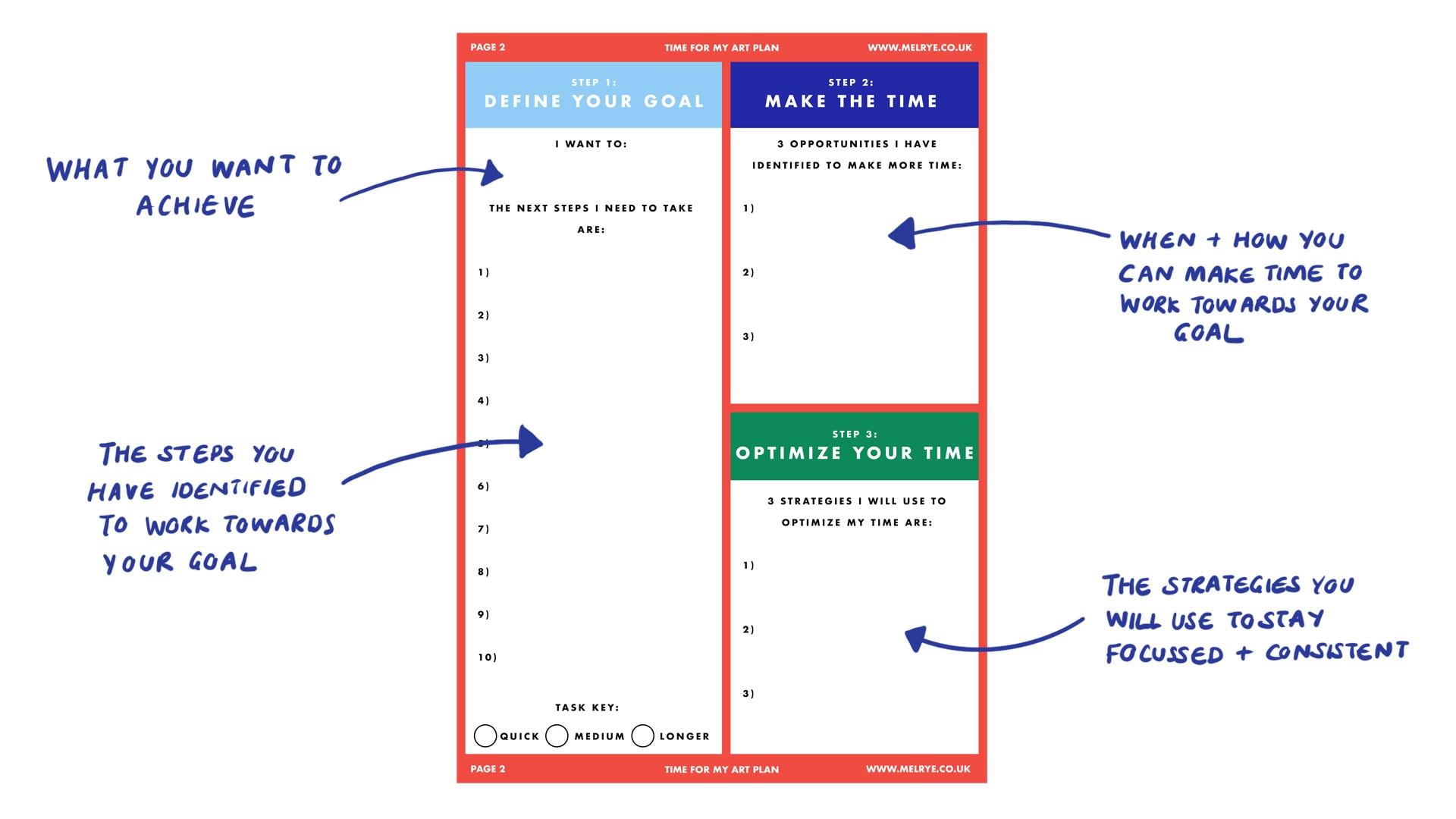
all the different steps involved in reaching your goal. There's a page of the class resource PDF to
help you do this. You might find that some
steps can be broken down even further
into smaller tasks. The more you can break it down, the easier it will
be to take action. Once you've brainstormed all
the tasks you need to do, you can list them on your
time for my art plan. There's a couple of ways
to organize your tasks. If some tasks need to be
done in a certain sequence, list them in that order. For example, if your
goal is to learn how to paint botanicals
with watercolor, you'll first need to
gather your materials, then find references
to work from before practicing brush
and water control, then color mixing, et cetera. If the tasks can be
done in any order, group them by their complexity
and time requirements. You could create categories
such as quick tasks, for example, brainstorming
ideas or gathering references, medium tasks like practicing
a new technique for 15 minutes and longer
more complex tasks, for example, completing
a full artwork or deepening your understanding
of a specific technique. You may find it helpful, even if your tasks
need to be done in a specific order to
consider the time and complexity of each task and
add some color coding to your list so that you can easily see at a quick glance
which are your quick, medium and longer tasks. This will help you match tasks to the amount of time
and energy you have. Maybe you have 5
minutes on a busy day. So tackle a quick task. If you have an hour, maybe you'll dive into
something more complex. Take a few minutes to
break down your goal into manageable steps and see if you can group them in a
way that makes sense. Use the class resource
PDF to help you.
3. Step 2: Make The Time: That you have a clear goal and know what steps
you need to take, it's time to make sure you have the time to
actually do the work. Let's start by reflecting on how you're currently
spending your time. This is where you need to be
really honest with yourself. Take a moment to
look at your day and your week and think
about where you could carve out even
just 10 minutes or more to work on
your creative goals. Consider these common
time opportunities. Do you have a commute to work or school that
you could use? Maybe your lunch break at work, waiting in the car to pick up your child from an activity, perhaps whilst you're standing in line at the grocery store, during TV commercials
or while listening to podcasts or before bed
or early in the morning. These small pockets of
time can really add up and you may find that there are more opportunities
than you think. Take a moment to
reflect and write down where you could find time in your schedule
over the week, no matter how small, there's a worksheet in the class resource
PDF to help you. Next, let's think about how
you can bring in some help. We all have more on our
plates than we'd like, but sometimes we can create
more time by eliminating, delegating or automating tasks. Are there tasks that you
can cut out or say no to? Maybe there's something
you're doing that isn't serving your goals
or draining your energy. Here are a few examples. Could you say no to that extra meeting or social commitment
that isn't essential? Could you cut down on time spent scrolling
through social media? Could you say no
to projects that aren't aligned to
your current goals? Are there tasks you could
ask someone else to take on? Delegating can free
up a lot of time. For example, could you ask a family member to take over a household chore or an errand? Could you hire a
cleaning service to help free up your
time for creativity? Could you have a
colleague handle a work task that you're
overwhelmed with? Are there tasks that could be
automated to save you time? Think about repetitive tasks that don't need your
constant attention. Could you set up automatic bill payments or subscriptions? Could you use scheduling tools for social media or emails? Could you automate your grocery
order or online shopping? Take some time to
brainstorm and jot down where you might
be able to eliminate, delegate or automate
tasks in your week. You may not be able to tackle everything on your
list right away, but finding even three
small opportunities in your week to free up your time can help you
get closer to your goal. Write them down in your
time for my art plan so that you can start putting
these strategies into action.
4. Step 3: Optimize Your Time: Now that you know
the steps to achieve your creative goal and have identified some pockets
of time in your schedule, it's time to make the
most of those moments. The goal is to ensure you're not just finding time to work, but using it effectively so that you're as productive and
focused as possible. First, planning ahead is key. You've already broken
down your tasks and identified when you have
time to work on your art. So now it's time
to match them up. Add your tasks to your
calendar or planner so you know exactly what
you're doing and when. Preparation is
just as important. If you can, do some prep
work ahead of time to ensure you can dive straight into your task when
the time comes. For example, set up your art table with the
supplies you'll need. Choose a reference image or gather inspiration
beforehand, pre cut paper or materials or
supplies if you need that. This way, when you
have your art time, you won't waste a second
getting ready to start. You'll be able to hit
the ground running. Now let's talk about how to make the most of
that precious time. When you're working,
it's crucial to stay focused and protect
your creative space. Distractions are everywhere, but we need to make
our art time sacred. Here are some ways to
reduce distractions. Find a quiet space, free from noise
and interruptions, turn off notifications on
your phone or computer. Let your family know when you need uninterrupted
time for your art. Close unnecessary tabs or
apps on your computer. Put headphones on, even if
you're not listening to music, just to signal that
you're in the zone. Make your task as
fast and efficient as possible by making sure you aren't doing more
than you need to. Some examples of
this in action would be if you're working
on a research task, identify exactly how many
examples you're looking for, and don't continue to
research beyond that. If you're working on a drawing, you could reduce the
scale or simplify the materials to make it
quicker and easier to complete. It's easy to think that multitasking will help
you get more done, but in reality, it
can slow you down. Our brains need time to
switch gears between tasks. Focus on one thing at a time, whether that's sketching,
painting or refining details. Once that task is complete, only then move on
to the next one. Focusing on one task at a
time allows you to give your full attention and
energy to what you're doing, which will not only
help you get more done, but also help you enjoy
the process more. Decide before you start
each task how much time you think it should realistically take
and set a timer. This isn't a hard limit. If the timer goes off and you
haven't completed the task, you can still finish it. But when you know you have a set amount of time
to complete something, you would be amazed at how much more efficient this can
make us with our time. By planning ahead,
preparing your space, eliminating distractions,
simplifying your task, focusing on one task at a time, and using a timer to
keep you on track, you can optimize the time
you've set aside for your art. Reflect on which of
these strategies will work for you
and pick three to try and put them onto your time for my art plan
in the class resource. This will help you
stay on track, make more progress, and help keep the
creative flow going. Remember, it's not just
about finding time. It's about using it wisely.
5. Final Thoughts: Congratulations. You've made
it to the end of the course. Let's quickly recap
what you've learned. You've identified
your purpose for making art and broken it down into small manageable steps to stay focused and motivated. You've reflected
on how you spend your time and found pockets where you can
work on your art. Plus, you've identified
ways to free up more time. You've learned how to plan
ahead, prepare your space, eliminate distractions, and stay focused to make the most
of the time you have. By following these three steps, you'll be well on your
way to making time for your art and progressing
towards your creative goals. Now it's time to
share your progress. Upload a project to
the class gallery showing how you've applied
what you've learned. I can't wait to hear how
you got on. Bye for now.