Transcripts
1. Introduction: Why Your Topic Isn't Your Brand: Taken any of my classes before, you should already
know how to film a video and how to
edit your video down. If you haven't yet, you should definitely
go watch those videos. Now, it's a matter of what
do you talk about on camera. And maybe you have,
like, a topic. I feel like a lot of creators
have a topic in mind, but a topic is not a brand. Want you as a creator
to be a brand. There's more to you
than just the thing that you talk about. Let's
talk about the difference. If you make videos about coffee, then coffee is your topic. But you as a person, and what I want to know
as an audience member is why do you care
about the coffee? What do you notice about coffee that other
people don't notice about it? What do you believe? What do you enjoy? How do you look at it, and how does it fit into your world? Does it fit into your brand? Because in the world that
we live in right now, AI, information is at
our fingertips, and if somebody just wants to know the basics of anything, they can get the
basics of anything. What makes it special
coming from you is that you are putting
your context on it, your lived experience,
which is always going to be more than a how
to or a listicle. And when you approach
it this way, then everything that
you talk about, all of your content is
going to feel connected. And I want you. I want your audience to
know what you're about. I want them to know why they follow you and why
they keep coming back. But when you're not clear
in explaining what you feel about the thing and
sharing your actual world view, then you're asking strangers on the Internet to figure
out who you are for you, and that's not fun
for anybody to watch. It's not. It's not.
I'm sorry, it's not. If people aren't
sticking around, then maybe this is the issue.
This is the situation. And the FX is not going
to be posting more necessarily because you can post more and it's still be
disjointed and not make sense. The thing we're going to figure
out is what you stand for across more than one video. So we're going to do a four
by four framework that I came up with for you,
for me, as well. I've been using this myself. We've got four content areas and four types of videos inside
each of those content areas. So that's going to be
16 ideas on one page. If I just say, Hey, write down
16 ideas for me right now, you might come up
with something, but it might be a little
bit all over the place. This is going to
ensure that we have 16 videos that live in a world, your world and know that this is just a
starting point, okay? This is not a rule book. It's a way to get clear
about who you are and what your viewpoint is in this world in the thing
that you talk about. But it's not the
only way to do this. Okay? It's just helpful. It's a helpful way for us
to see where you stand. And by the time you fill out
your four by four worksheet, you're going to
have a picture of where your brand is strongest and where it's weakest and
maybe where you can work on it and where you should
definitely start. We're going to look at it
from the viewpoint of a mom, creator, a photography
creator, and coffee creator. And bonus, I'll show you
what I'm doing, as well. And I do want to let
you know that none of these creators are teaching classes about the
thing that they do. They are not coaches in
the thing that they do. This is a topic that they enjoy and they make content around it, and we're going to build brands around it. Okay, let's do it.
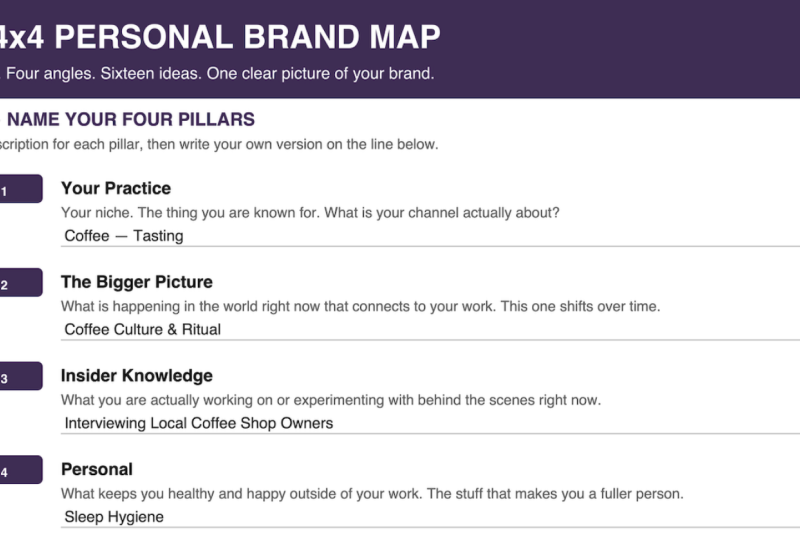
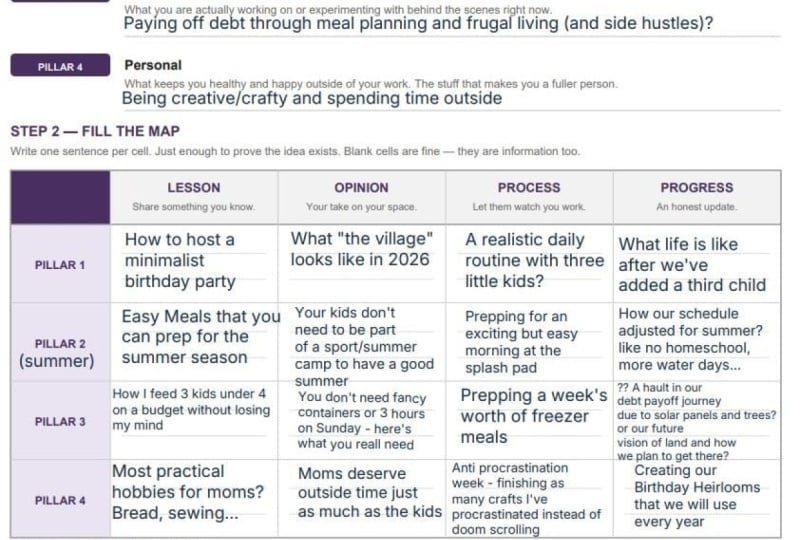
2. Your Class Project: The 4x4 Personal Brand Map: For your class project, this
is what I'd like you to do. You're going to download the worksheet and
either print it out or draw the chart for yourself on another piece
of paper. Either is fine. Answer the questions
for your four pillars. And then you're going
to fill in the chart, one sentence per cell, and it doesn't need to
be the full idea, and it doesn't need
to be the script, but you will find a
lot of the times, it might be your hook, but
it doesn't have to be. Just enough to show yourself
that the idea is there. And if you get to a cell and you don't
know what to put there, you're running a blank, just let it be blank. That's okay. Because that is information
that we need, as well. And when you're done, upload
it to the project gallery. So we can all take a look. We can all talk through it. And what I want to
know from you is, did anything stay blank, no matter how hard you
thought about the idea? Or were there any of
the cells that had so many ideas that you didn't even know
which one to pick? All of this very
good information. And, of course, if you have any questions or you're
stuck anywhere, let me know in the comments, I am here to help you out.
3. How to Find Your Four Pillars: Okay, your brand needs
four content areas, and we are going to
call them pillars. You might have heard this
before. You can do three. You can do five,
but I always think, like, a roof can be
held by four pillars. It makes it a clean structure. I want you to think
of these pillars like they're different rooms
within the same house. Each one is different, but they all belong
in the same house. They all belong to
the same person. Now, to start, let's build
your four pillars this way. And before I explain
this, I want you to just know this is
a starting point. Your pillars might
look different, and they might shift over
time, and that's okay. That's the point because
it is your brand. But this is a starting point. Pillar one is your practice. Your practice is the thing
you want to be known for. Some people will say
it's your niche. You might not be the
expert in something yet, but this is the thing you
want to be known for. This is what we're going
to call your practice. Like, the photographer, their practice is
photography. The mom. Their practice is motherhood. For the coffee creator, their practice is the
enjoyment of coffee. For me, my practice
is being a creator. And I want to know
what is your practice? What is the thing you want to be known for with this content? If somebody asks you what
your channel is about, this is going to be the one
sentence, one word answer. But I don't want you
to worry this is not like everything, everything. This is just the main thing. Cool. And if you don't
know what this is yet, pick something that you're
really excited about, and then we will run through
the rest of the exercise. So you can understand
what we're doing, and then you can make
your decisions later. But you'll understand
how the framework works. Pillar two is the
bigger picture. This is how you
connect what you do, what your topic is,
what your practice is. How does that connect
to the larger world? This is going to change
from time to time, but this is also where
you can get onto current topics or trends
or anything that has, like, has to happen right now. This is not permanent. This
is what currently relevant. For example, right now, for me, it's AI and what that
means for creators. But six months ago, it might
have been something else. A year from now, it'll
be something different. For our mom creator, this can be what
modern motherhood actually looks like versus
what is sold to us online. For our photographer, it
could be the fact that we live in a world that moves
too fast to notice anything. Or for my coffee creator, it could be the relevance of the rise of Macha
versus coffee. Where does it fit
in the world of your thing right now?
Don't overthink it, okay? There's probably something in your world that you
have an opinion on, and the stronger the better because that's going to
give us more to work with. Pillar three is
insider knowledge. For this one, I want you to think about what you're actually doing behind the scenes.
Not theories or advice. I want to know what you are
literally working on right now that your audience might find interesting to
see the inside of. For me, right now, it is building my
personal brand. So in this pillar, I would share content about
building my personal brand, not how you build
a personal brand, how I'm building my personal
brand, for our photographer. It might be preparing
for an art show. Not how to prepare
for an art show. This is just behind the scenes of her preparing
for her art show. For our mom creator, it might be figuring out a new
school routine. Not how to do a school routine, just here's how I'm doing my
school routine right now. And for a coffee creator, this could be how I decide if a coffee shop is good
or not. How do you decide? This is how do I decide? How do I know if
it's good or not? What is the current project? What is the current experiment? What is the thing that's
actually happening? And naturally, this one is
going to shift, and it's fine, and it should, because
hopefully you're progressing past the thing
that you're doing right now. And pillar four is personal. This is where I want
you to share what keeps you healthy and happy
outside of your work, because there should be
stuff outside of your work. And this is where, if you
wanted to do morning routines, if you wanted to do get ready
with me or day in the life, where we get to see
a little bit more of you I want to see
the actual stuff, other things that
you're interested in. Other things in your life, your relationships,
your hobbies. Other things that have nothing
to do with your content, but it still lives in
the world where you are, so it still works
with your content. I just want you to
be a fuller person, which is going to make
you a better creator. People connect to these
things. They connect. And I know this
one's easy to skip, but I always find that this is the most interesting
one whenever I get to learn a little bit more about the creator and what
they're actually into because then I can see,
like, Oh, she likes this. I also like. Now,
before we move on, you might hear
these four pillars and think one of them
doesn't fit you. And that is okay. That is natural, that is
normal. We can swap it out. You can make it yours.
This is your plan. This is your four by four. This is for you to
make it your own. The framework is just
a starting point. What matters to me is
that your four pillars together make a complete
picture of who you are, not just the topic
that you cover. It's you who makes
the content about the topic is what I want
to see. Cool? Cool.
4. The Four Angles: Lesson, Opinion, Process, Progress: Now you have your four pillars, and inside each of those, we are going to make
four types of videos. For this framework, we're
going to call them angles, which is just different
ways of looking at each of these pillars in
a repeatable way. So you're not having
to just pluck 16 ideas out of the ether using
the framework to help us. And again, these
are a suggestion. It's a starting point.
If something really, really, really doesn't fit, switch it out for
something else. It's fine. What matters to me the most is that across your four angles, you are showing up
in different ways, and you're just not
making the same type of video on repeat. Which is fine. There's
a place for that, but what I want for
you is to be a fuller, more complete picture for
people to follow along with. The first angle is a lesson. If you've picked your
topic, you know something. If you exist at all, you know something. Share it. It doesn't need
to be a tutorial, but it can be a
tutorial. Super simple. The goal for this one is that when someone
watches this video, they leave knowing something that they didn't know before. Our next angle is opinion, and you should have
opinions about things. There is something
in your world that you absolutely have
a point of view on, and I want you to share
it. Don't hide it. And it doesn't necessarily
need to be a hot take. It doesn't need to be
spicy or controversial, but that is also a
tool that you can use. What's important to me
is that it's honest. It's an honest opinion
based on you and your lived experience and how you feel about it. How
you feel about things? Because you're a human and you have feelings and you
feel things about things. When somebody
watches your video, whether they agree
with you or they don't also can feel
something about it. Process. You've got to let
your audience watch you work. I don't want this to be
the polished version. I want this to be the real
version of what you are doing, making something,
figuring something out, something where you are
in the middle of it. What I want is that when
somebody watches this video, they feel like they're
actually in the room with you. Here's how I do this thing.
Watch me do this thing. And our last angle is progress. I want you to think of this
more like a progress report, not that you need
to be progressing. You don't necessarily need to be further along than you were
the last time you checked in, even though that is ideal. All I want you to do is be able to regularly
check in and say, where I am right now with
this thing that I'm doing. What is working? What isn't
are you still figuring out? All I want here is an
honest update from you. It could be good. It could be
bad. Just something human. So when somebody
watches this video, they feel less alone with their own process
because they see Wow. Other people do this, too?
I thought I was alone. But they're not
alone. Because you're sharing, 'cause you're honest, and you're being a creator
that's being vulnerable on the Internet and
sharing your story. So we've got our four angles. We've got the
lesson, the opinion, the process, and the progress. And these all cover
different reasons for someone to follow you, because you're not only useful, you're also
interesting, and you're honest and you're human. And you're more than
just a resource. And content that does
all of these things, I feel is content
worth following.
5. Let's Fill It Out Together: What do you say we actually
fill one of these out? And I'm gonna do it
live with my brand, but if you want to follow along with
yours, then let's go. Yes. I love that for us. And just so you know, sometimes these ideas are gonna come fast, and sometimes you might take
a second to think about it, and sometimes you might
not have an answer. All okay. All of it's useful. Don't overthink it,
and let it be fun. Alright, pillar one
is your practice. So a lot of people were gonna say, like,
this is your niche. This is what I'm saying is the thing you want
to be known for. So if you're like,
not in the room, people are like,
Oh, what do they do? This is what
you want them to. I am a creator. Now,
let's look at what's the bigger picture in
relation to our practice. This is something
that's happening in the world right now that connects to what it is that you do and you
want to be known for. So if you happen to be
like the mom creator, you could be in the season
where it is back to school. That is what is happening
in the larger world. And that can shift over time because something else might
be relevant next month. For me, right now, it
is AI for creators. For the coffee creator, maybe it's Pumpkin
Spice Latte season. And this whole pillar
is going to be about Pumpkin Spice
Latte for the month. For the photographer,
maybe it's going to be a whole pillar about a
specific camera that just came out or a specific style that is currently popular
in the photography world, something that is in the larger world of the
thing that you talk about. Pillar three is our
insider knowledge. Like to think
there's also maybe, like, a behind the scenes. What I want to happen here is for you to talk
about what is it that you're actually working
on right now and experimenting with and taking
us along on the journey. For my insider knowledge, it is right now a series called Behind The Build Personal Brand. Now, this will change. Once
I'm done telling this story, I will switch it
to something else. It'll be behind the build
bookkeeping for my business. I don't know, whatever it is. The new studio build
behind the build. This is always
going to be behind the scenes series for the mom. It could be insider knowledge of things I wish I knew
before I was a mother. And that's insider knowledge
because I'm not a mother, and maybe there's things that they know
that I don't know. For the photographer,
this might be where we talk about
different lenses, right? Things that only
they're going to know. Like, what are the tools
that you need to be a photographer that a lot of
people don't think about? That could be stuff that
you do in this area. For my coffee creator, it could be a series interviewing
the coffee shop owners, the local coffee shop owners. And then that creator is getting some insider knowledge for
the audience, for all of us. And then personal think about things that
keep you healthy and happy within this work that you do things that make
you a fuller person. Like, this could be a
series on your cats, which I talk about
my cats a lot. For me right now, I want to talk about
sleep hygiene. How do you spell hygiene? I think that's
wrong. It is wrong. Hygiene. Maybe another one
I need to do is spelling. In this exercise, I'm
doing sleep hygiene. And that is personal to me, but it's also in relation
to being a creator. Like, that's important,
but it's not necessarily something
you would think about when you're thinking
about creator content or content about being
a content creator. The photographer could also
talk about sleep hygiene. The mom could also talk
about sleep hygiene. The coffee person can talk about sleep hygiene in
relation to coffee. And how maybe they're
not sleeping because they're doing content
about a lot of coffee, so they're drinking
a lot of coffee. This one is really just
going to depend on you because you are the
center of your content. Your practice, your niche, your topic, that's
just your topic. You are still the content. And if you're not
yet, then I want to make sure that's
where we're going. Let's get into our angles. So we have our lessons so that sharing something you know, it doesn't necessarily
mean it's a tutorial. Something you've
learned with the goal of when somebody
leaves this video, they know something they
didn't know before. Your opinion, your
take on the space, can be hot take,
can be a cold take. Just what do you feel
about it? You got to have an opinion.
Please have opinions. Your process, let people see
you work and your progress, which is an honest update of where you are with something,
whether it's good or bad. And if you think about each
of these pillars as a series, right, and it's not forever, that tends to help me because it's a limited run
because then we can switch these out from month
to month with the hope that you keep most of it, and then you can rotate
like little bits at a time. So if you are trying to switch your brand into being
something else, you could do it incrementally. So, if we're talking
about being a creator, a lesson that I can
share, tons of those. I can talk about how
I organize my ideas, which is really just brain
dumping a lot of stuff. We continue going
down this way because the lessons can be a
series across the pillars. If we do AI for creators
as my second pillar. I could say the
lesson here is how I use AI to organize my ideas. Putting the screenshots
and my Notes app into AI and saying, What
is she thinking? Pillar three, right? We've
got our behind the build. I could continue
and share how I use AI and my ideas to clarify
my personal brand. And then pillar four,
personal sleep hygiene, how I like we're staying with ideas,
if we want to, right? Like, it doesn't have
to be. But if this is we're connecting these, this could be how I capture ideas so they don't
haunt me in my sleep. They don't keep me out. Now,
these are all connected. They didn't need
to be connected, but this happened to be connected in
writing this one out. And this is what's fun
about doing it this way is like this can be a
series going this way, and it also you could have something being a
series going that way. Basically, we're playing
content idea Bingo. We want to fill out
all the squares. Now, we're going to opinion as a creator,
what's a hot take? A hot take I have right now
on the topic of yapping. Opinions on it. There's plenty of things that I could
talk about there, so I'm just going to
leave it at yapping. Hot take on AI for creators
is fear is not the answer. But learning how to spell
could be the answer. Behind to build. An opinion. This could be like, why I won't take a corporate jobs personal to me.
That's my opinion. It's like that I'm not cut
out for corporate job. And opinion personal
if we're staying within sleep is that I think
sleep is very important. Yeah, that's like,
Well, maybe, maybe not. You know, maybe that's a
blank one. I'm not sure. Okay, so creator process. So let's let them
watch you work. This could be filling
out this chart. A process AI for creators
is walking through, like, actual prompting process for my personal brand could go back to reference
this other one here, and then process for personal
for sleep hygiene can be my sleep routine I
should do, but I don't. Alright, creator progress. I like about progress is that this section can be your seven
days of doing this thing, 30 days of doing this thing. Like, I think there's a lot of potential in progress
across the board, but it doesn't necessarily
need to be that. So creator progress. There's a lot of things
there. I'm not quite sure. I don't quite have an
answer for that one. Progress of AI for creators. Could be I tried ten AI tools. This is What's Good or not. Progress of the personal brand, like, literally could
be I'm confused. Progress for sleep
hygiene can say, you know, I've been trying to sleep, but it's not going well. So you can see that even for me, it doesn't all come so easy. But you can take some time
to sit with it, right? I know that if I
sit with this, yes, I'll come up with some ideas. But at least I have a good framework, and
I can look at this. Overall, it's pretty much filled out, so I think I'm good. But if say all of
this was empty, then I would maybe need to
change that to something else. If all of this one was empty, then maybe I need to change
that to a different angle. There's a different way
of looking at things. Then when I feel like I've said everything I need
to say about, say, the AI for creators, then I will fill this out again and I will just put
something else in there, whatever is currently relevant. When I'm done talking
about sleep hygiene, because it doesn't need to
always be sleep hygiene. And then the personal one, I really would rotate
month to month, then maybe next month is cats, and then maybe the month
after that is travel. Maybe the month after that
is shoes. I don't know. But something to give a little
personal flavor, you know? These can be series. This can be series. This can be a series. It's a good way for you to ideate and maybe get
some ideas organized. And remember, this is
just a starting point. This is for you to customize in a way that works for
you and your brand and your brain with the hope in the end that your
content that you have for the next batch that you're making
tells a cohesive story. And once you finish these and you come back and
you look at it, things are going
to look different, and that's on purpose. It should look different
because then you're gonna have this information and
you're going to be able to make some
choices with it. And that is how it's supposed to work. Let me
know how it goes.
6. How to Read Your Results and What Comes Next: Now that you've filled
out your chart, let's take a closer look. If you happen to get
all of the cells filled and they're
all ideas that you're excited about, amazing. You got a month's worth of
content right there or longer, depending on what
your cadence is. But what I think is
more interesting is when it isn't
completely filled out because then it
becomes a mirror to where we stand with
our brand as a whole, what's really strong and
what's really weak and how we can use all of
that to our advantage. The first thing I want
you to do is think about what cells were
easy to fill out. Which ones were the ones where
the ideas just showed up. You actually had multiple ideas. You didn't have to
think about it. You didn't second guess
it. You were like, Oh, I don't know
which one to pick. You just pick one, and maybe you put a couple
of things in there. That's the most alive
territory, okay? That's the one where you
can really take it and run. And that is a beautiful place to start obviously,
you're excited about it. The next thing I want
you to think about is which pillar had all of
the four cells filled in, had all of the angles. If you have anywhere
on your chart where a whole row is full, then that means you have
real energy behind it. You have real
excitement behind it, and that's going
to be your anchor. This is going to be the place where you're always going
to have something to say. Which is delicious.
We want this. Next which pillar has
three or more blank cells? I don't want you to force it. If you don't have the answer, if it's not there, that's okay. Maybe you need to sit on it. Maybe you need to
think about it. Maybe it's something that requires a little
bit of research and a little bit more
experience in the topic. Maybe it's just not ready yet.
So you can just leave it. And after a month of making
the videos that were easy, you might find the thing that
could replace it because maybe there's too much in one of the other pillars that
you can split off, and then that can
become its own pillar. Now let's look at which
angle stayed mostly blank. If there's one type
of video that just didn't come naturally to
you, that's worth noting. And it doesn't mean that
you're doing it wrong, but if it's something
that you want then we need to develop it, and if it's something that
you don't care about, then we need to replace
it with something else. After you start to make the videos that
are in your chart, here's a couple of things that I want you to pay attention to. And really, really, really, it's not the views or the likes. Okay? What I want you to pay attention to is what
are people saving? What are people sharing?
And what are people continuing to have
a conversation with you about in your comments? Then we're getting into
something where you are connecting with the
audience for real for real. These are the things that
will tell you which parts of your content actually means
something to your audience. And then you can go harder
there if you like it. And if it's not working, then you can switch
something out. With this information,
you're going to be able to what you need to go deeper on and what you
need to get rid of. And remember, this chart
is a starting point. So you can take the chart. You can highlight the
ones that were working. You can X out the ones
that aren't working. And then if that means
a whole pillar or a whole angle doesn't work,
you can change them out. You'll clearly be able to
see these things don't work. Like, I just love information. The more you do these
things, the more that you iterate and you
try different stuff, the more you're
going to know and then you'll have a clear
direction on where to go. But if you started
your content with just 16 ideas out of the ether, then we're not
actually going at it strategically to know what works or what doesn't because
everything is a one off, as opposed to the
way we're building it in the four by
four framework, which is having a couple of
different through lines. And the more you do this,
it's just going to compound. You're going to get
more information because you're not
starting over each time. We're just looking at
things in different ways. You're going to
get more precise. You're going to get deeper with your audience and your topic. Yourself. And one last thing. Now that you have your chart and you know what
you're going to make, you can head over to take my effortless talking videos class, and I'll show you
how to film and edit your talking videos fast
using AI in premiere. It's like, my
favorite way to edit. Take the framework,
run it a couple of times if you need to to find the things that
really work for you. Then go make the videos. Then come back with
the information, cross out what doesn't work,
highlight what does work. And as always,
remember, you got this. And make more videos.
 Marielou Mandl, Video Creator, Content Creator