Transcripts
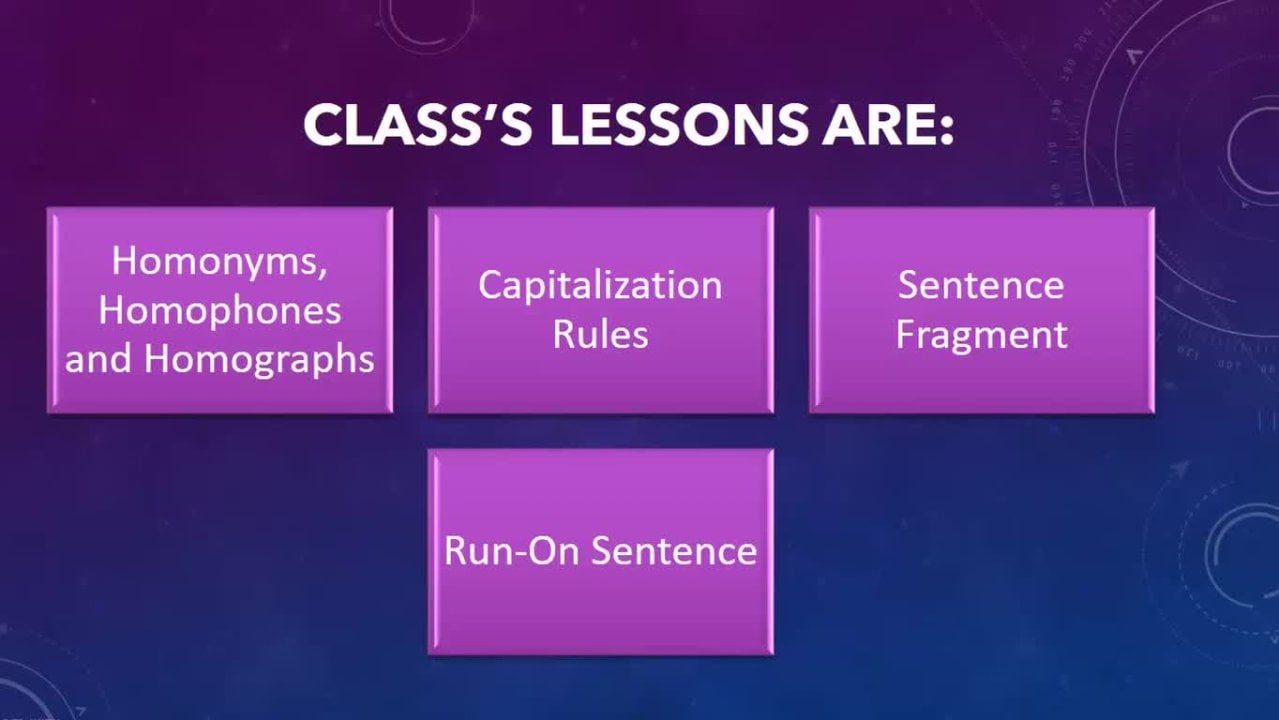
1. Introduction : Hello everyone. My name is Theta. Am here today to talk to you about the lessons that will be mentioned in this class. And this class you will, they're writing process. Punctuation or writing. Verb tenses, grammar skills, and using conventions. This is why I urge you to begin learning English from this class. Also, I want you to know that I am a teacher. And did you get my experience? I've found a lot of students are facing problems. My learning English and how this language is very important. So excited to help others to improve their English language. I hope you benefit from this class.
2. Adjectives And Adverbs : This lesson is about comparison between adjectives and adverbs. Adjective is a word that describes or modifies a noun or pronoun. Adverb is a word that describes or modifies adjective or another adverb. What is an adjective? To know the adjective in a sentence, we ask which one, what kind, or how many are. In other words, adjectives are classified in three groups. Which one? What kind? How many? The first group or the first the question is, which one? We use, which one for demonstrative adjectives. Adjectives, to identify particular nouns or pronouns. Example that car is mine. The demonstrative adjectives are this or that for the singular pronouns or nouns. These or those for the plural nouns. What? This book is read huge, scary. Hillary or import. As we see in this sentence, read huge, scary, hilarious and important. All adjectives, they are categorized under the question was, are the, are the adjectives that show color, shape, size, opinion, and others. Justice started an exciting, challenging job. Exciting and challenging are the adjectives. How many? I have two cats, too, is the adjective that shows how many or that shows the quantity. I have. Some cakes also some, it's an adjective that show quantity. Adverbs. The odd VR words that when, where, why, how, To what extent? I carefully carried the books. In this sentence, the adverb is carefully how I carried the books. I read the book carefully. So carefully describes the verb which carried. So carefully is an advocate. She completely destroyed herring new car completely. It answers the question to what extent she arrived for the meeting? Early in the advert. When did she arrived for the meeting? She arrived early for the meeting. So early he describes, which is the last example. The public library often holds its meetings. The adverb is here. Where does public library often hall meetings? So he answers the question. So it is the adverb that describes the verb halts. Here are the rules for adjectives and adverbs. Rule number 1, many adverbs and with alloy, but many others do not. Examples, quick is an adjective. When we change it for adverb and become quickly. She thinks quickly. She is a quick. Here are two examples. The first sentence, quickly is an adverb, y. In the second sentence, quick is an adjective. They show it was the same meaning, but they are used in different positions. Rule number 2, the word good is an adjective. Adverb equivalent is Well, you did a good job. You did that job. Well. In the first sentence, job is an adjective. It shows or describe the noun job. In the second sentence, you did the job. Well, how did you do that job? You did that job? Well, when is an answer for that question? It is an adverb that describes the verb did. The rule number three, the word well, could be an adjective to. When referring to health, we often use well rather than good. Here, when we want to describe our hands. We use well rather than good. In this case, well become an adjective. You don't look well today. I don't feel well either. Rule number four, adjectives come in three forms called degrees. Positive or normal, such as bad, sweet, efficient, competitive, sweeter, more efficient, superlative, sweetest, worst, most efficient. Now what are the comparative adjectives? They are the adjectives that used to compare between two people, animals, or even groups. How to use comparative adjectives. And E at the end of the world. Such as big or bigger, small, smaller. In the example, big ends with consonant, vowel, consonant. So we doubled the last letter G, and we put ER. And more in front of the word. More beautiful or more interesting. We use more for the adjectives that have three carbons. Some words don't take neither ER, more and more. For example, a good. And the comparative form become better and become worse. Now the superlative adjectives, they are the objectives that are used to generalize the comparison Among all. When we use to generalize that comparison, we use a lot of adjectives. Have to use the third negative adjectives. Add EST at the end of the word for exempting big, biggest. And here also with other veggie because big consist of consonant, vowel, consonant becomes smallest. The second rule add most in front of the word. Also, we use mostly for the adjectives of three syllables. And there are some words that change that do not take neither ESD, northernmost, for example, Good, become best and become worse. Rule number five, when this, that these, those are followed by a noun. They are adjectives. When they are appear without amount following. Then the pronouns. This house is foresee. This is for sale. The first sentence followed by noun, which is house. So this is an adjective. And the second sentence, this is alone without a noun. So this is a pronoun. He is an exercise about adjectives and adverbs. My classmate is, we have two choices. As we see here, the word that we will choose. Well, describe the noun, which is that sum. So we will choose the adjective lice. My classmate is a nice person. I can speak Spanish very good or well. Here it is evident to choose when Katrina took up painting the class, so she can paint pictures. We have to choose a beautiful or beautifully. The web that we will choose will describe the word pictures. Pictures is a noun. So the word, whether it be an adjective. So the adjective is a beautiful. We will choose beautiful. So she campaigned and beautiful pictures. Mr. Smith looked when I got an a plus on the exam, we have to choose angry or angry. The word that we will choose. Well-described, the world, looked, and looked is a verb. So we will choose an adverb describes a verb. And adverb here is angrily. Mr. Smith looked angrily when I got an a plus on the exam. Them use it is to please them down. We will choose loud or loudly. Here. We will choose loved. My friends all. Tell me that I sing. But, or badly. Here, the word will describe seeing. Is it a verb? So we will choose the adverb, which is badly, that he took his Armani and walked out the door. Quiet or quietly. Here we choose quietly. They see fit quietly, talk the money, and walked out the door. Which was the output that got weighted silently for the mouse to come out to the whole width, choose silently the advert. My cousin, Always walk very quickly. Or chronically our choices. We use the adverb quickly because we will describe the verb walks that my boss gave me was easy or easily. Here we choose easy the adjective, because we want the scribe, the word which is now somos is very kind old kindly. Here we chose, coined to describe former switch. Now, the little boy kept that cookies for himself, selfish or selfishly. Here we choose selfishly. Another exercise about adjectives and adverbs, but here we will focus on the comparative and superlative adjectives only.
3. Articles : Our lesson today is about articles. What is an article? The articles are the words. They define whether something is a specific or non-specific. There are two types of becomes the different articles at defines. It's known as something specific to illustrate something we previously mentioned or known, something unique or something being identified by the Speaker. Example. This isn't any. This is a previously specified leak. In other words, one already known to the reader. The indefinite article a or N. They define known as something specific to illustrate something good genetic or something we mentioned for the first stone example, this is this is a previously unspecified lake. Articles are determiners. The articles are reclassified as determiners. And the terminal system before a noun to indicate the quantity position. This is the city or definiteness. Examples of definite and indefinite articles that share specific audience. Another example. Can you pass me at specific? In this example, the reader knows which Apple is being praised. Example The one, last night's dinner. Last example. I love. I'm not built by. Here we notice that the speaker likes to eat apple pie after linear. Any oppose boy will do knock specific form. Articles go before adjectives. An article also modifies amount that is already being modified. Boy, an adjective. When this happens, the article and goes before the adjective example, He's authored less mole and books curves. Here the noun books is being modified by the adjective, the definite article, the city before the adjective. Another example, you will get an excellent beads on, don't use. Here. The indefinite article goes before the adjective excellent. The indefinite article a or an is only for singular nouns. It is not used for plural nouns. It does not used with uncountable nouns, example in the water. Now, when do we use a? Mdr1 is used before a vowel sound, and a is used before a consonant sound, not a vowel or consonant letter. Example, a house. And our. Both words start with letter. Starts with a consonant sound, and hours thoughts with volatile. Some articles are used with possessive determiners. My, your, his head hour then, or possessive pronouns, mine, Your his head hours. The example, take me to your leader. This sentence is incorrect. You cannot use the with the pronoun your order with the possessive determiner, your. The second sentence, take me to your leader, is, our lesson is finished. Don't forget to take care about the articles. See you soon.
4. Noun : The lesson is about its definition, types and examples. Noun is a lot of speech. The part of speech is thoughts or words. Nouns identify people, places, things, and ideas. Common nouns, meaning the general people, places, things and ideas. Example. Doug. Proper nouns, names, Pacific people, places, things and ideas. Example, Alex, Mrs. Sandra, will be not proper noun. Always thought this with a capital letter. Some examples of both common and proper nouns. Boy, for example, we can say David as a proper man. Or CT or MRI can save the name of the city, boston dollar. As a proper noun. We can say that E from cat. How to spot a common known and the proper noun, common known? That question, what is it? Why not proper noun? And citizens, that question wants me. What is it? Example, it is bread. What's its name? London Bridge. Nouns can be categorized according to their structure or abstract looms came to be seen or touched. Example, determination and democracy. Concrete can be seen or touched. Example, lawyer, three, Cloud. Collective nouns represent Group example, comma t. Team. Compound now consists of two or more works. Example, water button, gender-specific know, it does make me exempted. Man, woman, actress from a verb and ends with I-N-G. Example, getting that become from the verb, get standing from the verb stem. From the verb to draw nine character winner. Again to be Lord allies. The salt. Soy. This nouns we cannot make them known, formed from the book has no verb like traits. Exempting a good building. The function of the noun may be a subject. Or atoms contain vitamin C. Hear the word or the noun, oranges. Became as a subject. The noun could be also an object. He likes. Oranges is an object, or it could be accompaniment. They are orange. Some known example, I love dogs, but I hate acts. In this sentence. Dogs and cats are the nouns. And now that exam on Save today. The word AdWords is honor. My mom is a nice woman. And woman are nouns. You must see adductor because of this sleep disorder. And this centers the word Dakota is. So as we see in this lesson, we learned how to identify them in centers and all of the forms of the node.
5. Tenses: Simple Present: Our lesson today is about simple present tense. Simple present tense is used to describe habits, unchanging situations, general truths and fixed arrangements. Simply present tense with Ishi to the singular subjects. We add as ES or the IES. For example, he eats a my screen. He is as singular subject. So we add, asks for the Berg. Also, she was at movie, The birds fly in the sky. For the verbs that end with a consonant plus y, we cross the y and add IES. Maddie, Mary's studies, studies, and carry, carries on for the verbs that end with vowel plus y, we add on Lee as play, plays, enjoys, enjoys. Say save. For the verbs that end with double S or S or C edge, we add ES. For example, go, it ends with 0. So we add ES for the verb where we use it in the simple present tense with singular subjects, watch, become watches. We add ES since it ends with C. Actual Schwartz's case, kisses, fixed fixes, buzz, buzzes. Simple present tense with we will lay the plural subjects and the pronoun I. We don't change the examples. They catch. Fish. The subject is. So we use catch and its main form. We write a story less students to study English. Action verb examples. Sammy drinks or Thracian Jews. In this example, Sammy is singular subject. So we use drinks. We add us for the verb. The students studied for the exam. The subject is the students who, which is singular. So we add IES studies. Is our boy plays football, the subject is the boy, Singular, so we add us whatever plays. The girlfriend watches a movie, they eat. In this example, the subject, which is plural subject. So we use the verb and its main for some special cases. We have in the English language work to be the verb to be. We use it in the form of is, singular subjects, he, she, it, or singular pronouns. And we use instead of the verb be and with the pronoun I. Also use are with plural pronouns which are new and they instead of the verb be. For example, she is beautiful. The verb to have. We use in the singer for the singular subjects. Instead. And we use have for that plural subjects and the pronoun I. Example, he has a new project. We have an exam that too do. We use does with a singular subjects? He, she it, and we use do with the plural subjects. We, you, they ended the pronoun. For example, I do my homework. Negative 4. For the singular subjects. He, she, it, we use thus, since much cannot be hold alone and the actual work cannot hold it. So we use those to hold lock. She does not study. And don't forget in this case, to keep the verb or the term, the verb to x. Four. For the plural subjects, we with a and for the pronoun I, we use due to hold. The word not. You don't like Cucumber. The question form. Singular subjects. He, she, it we use does that, play tennis? And also in this form, we do not forget to keep the verb in its main four. And for the plural subject to you, we, they end for the pronoun I, we use Do, do you go to school? Some keywords? Always, usually, often every day, every week, every month, every year, every Saturday. And exit.
6. Action: Linking and Auxiliary Verbs: Our lesson today is about action linking and auxiliary verbs. First of all, what is a verb is a word that expresses an action or occurrence. There are a few different types of verbs and a few things to keep in mind about each type. And in this lesson, we will discuss three types of verbs and how we use them. First type of verbs is action verb. It is the verb that expresses an action that the subject of a sentence does, did in the past or will do in the future. Not number one, the subject is the noun or pronoun that the sentence is stoking of a number to the complete sentence should have both a subject and verb. If one of them is not founded or eliminated. So we did not go. It's sentence recall it fragments. So the group of words are fragment and not sentences. They are sentence in one case, if both subject and verb founded. Some examples about action verbs. Eat, sleep, do, speak by smell. Sync. Side. Note, action verbs include also actions that are actually invisible, not only the actions that are truly action pocket. Some action verbs are not visible or they are not touched by the person. They are more mental actions, more than body or physical actions, such as seeing and decide. Both of these verbs, they are action verbs, but truly the mentally action verbs and not physical action. From here we will see an example. Eats pancakes. The subject here is Maria. She's the person who did the verb or did the action verb. Here is yet. Another example. Medea thinks about her friends, sit upright. In both sentences. You see that the subject is the same, which is muddy. Yeah. But the thing that is the verb in the first sentence, the action verb is. And in this sentence the verb is. In the first one, it is anonymous action verb. But he thinks is an action verb that shows a mental decision on mental action. The second type of verbs is linking verb, is a verb that connects a subject to the other word in a sentence that describe it or that provide additional information. In other words, linking verb acts only as a bridge. It only can the subject with the other words to make a complete meaning, to give the reader an additional information about the subject, or to describe the subject. Here, some examples about linking verbs appear to be in all forms. Our was where become, get, look, smell, sound, taste. Some linking verb examples. That kids appear excited about the holiday. The subject is the kids, and the verb is appeared here, appear is a linking verb. It only shows to us or give us information that the kids are excited about the holiday. Another example, my sister is NAD plus is only convex money sister with nervous to show us that my sister is madness. I feel sick. Here only shows us that I am sick. Seems delicious. This means that the cake is delicious. The third type of verbs is auxiliary verb. It is also called helping verb, is used with the main verb to help express their main verb, tense, mood, or voice. The main auxiliary verbs are to be, to have to do. They appear in the following forms? To be as is was. Where being B? Well B to have as has, have, had, having, well have to do as does do, then, done, doing. When do. Auxiliary verb tense. He had eaten the whole pie. Had is the auxiliary verb. It shows the tense of the verb, had eaten, which is past perfect tense. He was snorting all night, was as the auxiliary verb. It shows the tense of the verb, which is was snorting. Faster progress systems. Auxiliary verbs for mode. Did it go well? Did auxiliary verb shows the mood of the verb, which is imperative mood. Do try our thoughts. Do the auxiliary verb shows the mode, which is imperative mood. Auxiliary verbs for voice. The pie was eaten by the dog. Was here is the auxiliary verb. It shows the passive voice of the verb of the sentence, not number one, the main verb is the important verb in the sentence. The verb that shows the action or state of being of the subject. Not number two, the main verb can stand alone, or it can be used with a helping verb, also with an auxiliary verb. That is another kind of model called modal auxiliary verb or modal verb. The modal auxiliary verbs are can, could, shall, should, may, might, must. And wood. Here we do not forget that the modal verbs do not to change the verb. We keep the verb and its main. For some modal auxiliary verb examples. We must focus on what should the teacher is saying. He must for necessity. Another example, you can win in that competition. Here shows possibility. I ran be anosmia. Not one. Don't write, could shoot off. Would we cannot write off. Next two could or should, or would. Not, to use scan for ability and May for permission. Note three, expand count two came out not too can, not too separated words, but a one word.
7. Subject of the sentence : This lesson is about subject. What is subject? What is the subject of a sentence? The subject of a sentence is the person or thing doing the action or being described. Here is an example. A dot py. The answer is li. Li is the subject. In the second example, n0 is happy. Who is happy? The answer is D. So also is the subject. As we see in both examples, the subject is the same. But the thing that differs is in the first sentence, we show the action that knee is doing. While in the second sentence we are describing be. Every sentence must have a verb and every verb must have a subject. Here is an example. The nurse takes care of her patient. The subject in this sentence is Venter's and the verb is takes. The subject of the sentence couldn't be unknown. Pronoun as sentence has one main subjects, which is the subject of the domain. Example, venus is the hottest planet in our solar system. The subject here is Venice. Venice is now the second example. It is the second brightest object in the night sky. In this example, the subject is a and it is grown. Now. There are three types of subjects. Simple subject, completes subject, and compound subjects. Simple subject is the single word that is the subject of a verb. It means the main word that describes the best subject. In this example, Perry puts a lot of garlic in his foot. The subject here is petty. 30 is the simple subject. Complete subject. Example, that boy is a clever, the phrase that boy is a subject, it is complete subject. While boy is as a simple subject, compound subject, a subject with two or more simple subjects. In other words, when the subject is made up of two or more elements, it's a compound subject. Example, petty and the Claudette, when to the park. The phrase Barry and the Claudette shows a compound subject. Since Harry alone is unknown and that unknown, they are two elements, so they form a compound subject. There are four main ways which a subject appears in a sentence. The subject performs an action. An example, my dog bit the postman. The subject is this clot example. Sonny is a clever again. Here we're given information about tagging. The subject is identified. Example is the one who we are, blue t-shirt. And the fourth way, the subject has an action done to it. Example minded was taken to the vet. Here we use the passive voice. That is an excellent reason to care about a subject, which is subject verb agreement. Subject verb agreement means using the right version of the verb to agree with the subject. Example. The dog is happy. Here. We use, for the dog, we don't use the dog. B, which is wrong. Here are some examples. Alex has occurred. Has. We use it for singular nouns or subjects, and Alex is the subject singular. So we use another example that children are playing. The Children plural subject. So use, we don't use it. Here is an example also. Several monkeys and gorillas were seen climbing. Three. As we see the phrase in red, similar monkeys and gorillas show a compound subject. The last example, the purple jelly beans tasted great. The phrase and red the purple jelly beans show a complete subject. Why beans is the simple subject of the sentence.
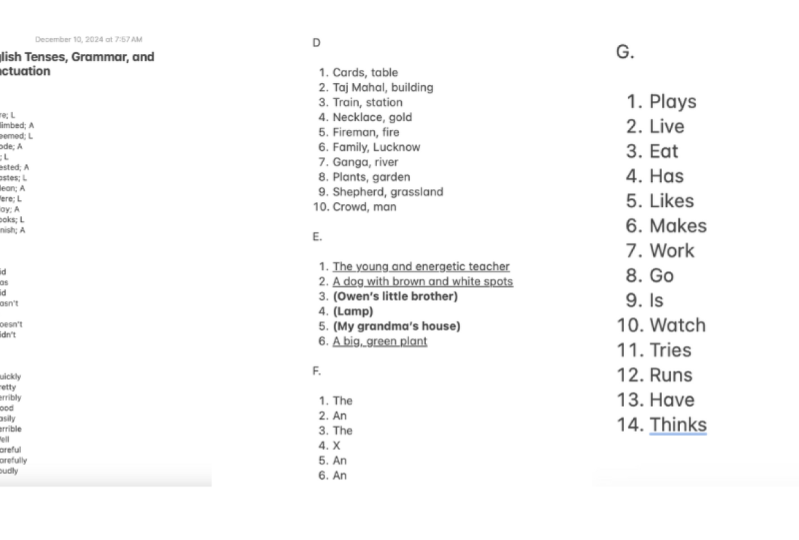
8. Project : Worksheet about the previous listens. Exercise warm under Lundberg, It's centers that are a fourt, an action verb, and L for linking the number one, your boots are there to you from your wall here to the verb is odd, we underline it and cause ADH is linking for. We'd like if the verb is action and the verb is linking. Oh, so we continue the synthesis. And the same way exercise to fill in the blank with the correct auxiliary verb from the choices are presented. We shouldn't choose the correct auxiliary verb. And the first sentence, what the kids doing when you last saw them? We have the choices was where did be the correct choice is where? Continue with the other sentences in the same way. Exercise actually use the word in brackets as an adjective or adverb. We use it as an adjective if it should modify the noun, and we use it as an adverb, it should modify the sentence number 1. Here reads a book. We have the word quick. Quick here we'll modify the verb reads, so we should use it as an adverb. We, he quickly reads a book and we continue in the same way. Exercise for right, the nouns in the following sentences of cards on the table. The nouns are cards and table. In the same way. Circle the simple subject underlying the concrete subject. We studied or relearned the types of subjects. We have three types, simple, compete and compound. Here in this exercise, we should circle the simple subject or the main subject, and we should underline the complete subject. The young and energetic teacher did a good job. Here as a simple subject is teacher, while the complete subject isn't the young and energetic teacher. We circled teacher and on the line the young gun and there's a thick teacher and continue in the same way. In this exercise, put the appropriate article. Put x. If we don't need an octagon. In some cases we don't need to put an article. So we put the articles are a new t-shirt over there. Better than red door. I like the blue t-shirt over there better than the red one. And this sentence, the speaker knows the t-shirts very well, so we use the undo continue indices. Fill in the blanks with the correct phone, use simple present terms. We learned about the simple present tense. It takes us with the singular subjects, and we keep the verb and its main form for the plural subjects. Based on Saturday. We put. Because she singular, she plays baseball and soccer game. I hope you benefits from these exercises.
 Leila Tar