Transcripts
1. Introduction: When I was a teenager, I remember being at my
weekly guitar lesson and I asked my instructor, how do you know what notes to play over a
chord progression? My instructor could
have answered me a bunch of different ways, but instead, he just looked
back at me and said, that is the big
question, isn't it? I look at this moment as
important because it's when I decided that I was
going to try to get close to an
answer for myself. I'm Lancelot Houston and I'm
a musician and producer. Since asking that question, I studied guitar in college, played in several bands, and became a music
teacher myself. But I came to realize that my instructor was
right all along. There is no right
answer in this class. I want to help you get
started to find that answer for yourself by learning
the basics of modes. Modes are a series of scales that have different son
of characteristics, but utilize all the same notes. We'll embark on a journey through the world
of guitar modes. Unveiling the secrets of
these musical flavors. Join me as we demystify modes. Explore their unique
characteristics and learn how to incorporate
them into your play. So grab your guitar
and let's get started.
2. Class Orientation: Today you're going to learn how to play
through the modes. By the end of this class,
you'll have learned some patterns that will serve as the foundation
to your playing. In my project, I'll
be demonstrating how to play through these
modes and how to put them together to create
an exercise that will help you with developing
your skills on the guitar. All you'll need is a
guitar to get started. Here's what I'll be looking
for in your class project. Playing through the
mode seamlessly, using a metronome to keep time, and subdividing these patterns
with different rhythms. You can submit your
project by recording yourself on your phone or
another recording device. Next we'll take a look at the basics of modes
and the theory behind.
3. Foundation: What are Modes?: Before we get into play modes, let's make sure we
build a foundation of understanding by covering some basics of music
theory. What are modes? Modes are a series
of scales that have different sonic
characteristics but utilize the same notes. I've heard modes
described in many ways, including scales that start on different degrees
of the major scale, or scales within a scale. In order to best
understand this concept, let's move over to the keyboard. First, some basics. There
are 12 different notes. This is known as the
chromatic scale. Here we're looking at all
the notes from C to C, going from a low
sea to a high sea, this is called an octave. The notes in between consist both of black and white keys. The white keys of
the piano are A, B, C, D, E, F, and G. The black keys
are the notes in between, or you may know them
as sharps or flats. When a note is sharp, the pitch moves up or to
the right by one key. The black key to the right
of C becomes C sharp. When a note is flat, the pitch
moves down or to the left. C sharp could also be
looked at as D flat. One way to refer
from moving from note to note is in
terms of steps. When moving through
the chromatic scale, we're moving in half steps. C to C sharp is a half step. Now let's say we
moved from C to D. This would be called
a whole step. It's also important to
note that there are no sharps or flats between
the notes E and F, and B, and C. Now I want to
look at the C major scale. We can look at how these
nodes are grouped in different ways depending on the scale type for major scales. Let's see how it's built
in terms of steps. Major scales follow
this pattern. Whole, half, whole,
whole half starting at. Let's take a whole step to D, another whole step
to a half step to a whole step to
another whole step to A, a whole step to, and finally, a half step to reach
an octave above. Now let's take a look at modes. By learning the major scale, you already have
learned the first mode, which is called Ionian. Let's move to the next, which is the Dorian mode. Dorian starts on the second
note of the major scale, in the key of C. The
Dorian mode starts on D. We could also look at this in terms of steps. Essentially, what's happened is we're taking the first note of the Ionian mode
and putting it at the end of the scale to
get the dorian mode. The pattern then becomes half. We can follow this pattern
for all the remaining modes. If we start on the third
note of the major scale, this is the phrygian mode. Phrygian, in the case of C, starts on the step pattern, then becomes half. Let's move on to the fourth
mode, which is Lydian. Here, in the case
of the key of C, Lydian will start on the, the step pattern becomes half, half. Moving on to the fifth
mode, mix Adian. Here we'll be starting on a G with the pattern of hole half. The sixth mode is Eolian. Here at the sixth mode, we've reached the relative
minor of C, which is A minor. The Aeolian mode and the minor
scale are the same thing, the pattern becomes
whole, half pull, and finally, the seventh mode. In the case of the key of C, the Lochan mode will start on B, the pattern then becomes half pull. Now that you have a handle
on the theory behind modes, let's go over some basics
of navigating the guitar and you'll be one step closer to playing through the modes.
4. Foundation: Guitar Navigation Basics: In order to play through
the mode seamlessly, we'll need to go over some basic navigation of the guitar neck. It's important to know the
note names of the strings. We'll start with
the first string, or the string playing the highest indicated by the
small E on the diagram. The second string is the third string is
the fourth is D, the fifth is A, and
the sixth string, or the lowest string is another E. You'll most likely have fretboard indicators
on your guitar as well. In this diagram, you'll see
single diamonds on the frets, 357.9 and a double
diamond on the 12th fret. The 12th fret is
important because it indicates an octave
above the open strings. The notes played open are the same notes at the 12th fret. Next let's go over how I'll be referring to your fingers
and your fretting hand. Your pointer or
index finger is one, the middle finger is two, your ring finger is three, and your pinky finger is four. Now that we've
covered the basics of guitar navigation
and terminology, let's dive into the
first mode, Ionian.
5. Ionian: In this lesson, you'll
learn how to play through two octaves of the
C Ionian mode. Ionian is first in
the modal series, and it's just another name for the major scale in
terms of steps. Ionian follows this pattern, half to play this mode. And you'll want to
get your hand in the seventh position
starting on the low string. You'll begin by using your two finger to
play the eighth fret, followed by your four finger
to play the tenth fret. Moving on to the string,
play through frets, 78.10 with your 12.4 fingers. Next on the D string, play through Fort 79.10
with your 13.4 fingers. At this point, you've
played through the first octave
on the G string. Follow the same pattern
by playing through frets 79.10 with your 13.4 fingers. Next, move to the
string and play frets 8.10 with your 2.4 fingers. Finally, on the high play frets 7.8 using your 1.2 fingers. Now you've played through
the second octave. If you want to finish
out the pattern with the remaining notes
accessible in this position, you could play the tenth
fret with your finger. Here's how ionian sounds played, both ascending and descending. Here's how it sounds played over some chords
in the key of C. Great work on getting through. Next up, we'll tackle the.
6. Dorian: In this lesson, you'll
learn how to play through two octaves of the
D Dorian mode. Dorian is second in
the modal series and is essentially the
same as the minor scale, but with a raised six. This gives it a slightly mysterious quality
in terms of steps. Dorian follows this pattern. Half, whole hole,
hole, half hole. To play this mode
in the key of C, you want to position your
hand in the tenth position. Starting on the low E string, you begin with your one
finger on the tenth threat, followed by your 3.4 fingers
on the 12th and 13th. Threats. Moving to the
string, play through frets, 10.12 With your 1.3
fingers on the D string, you'll need to move your hand to the ninth position and
play through frets 910.12 with your 12.4 fingers. At this point you've
played through the first octave
on the G string. We'll follow the same pattern and stay in the same position. Again, playing through
frets 910.12 With your 12.4 fingers on the string, you'll move your hand back to the tenth position
and play frets 1,012.13 with your 13.4 fingers. Finally, on the high E string, we'll finish up the
pattern by playing the Tenth Threat using
your one finger. Now you've played through
the second octave. If you want to finish
out the pattern with the remaining notes
accessible in this position, you could play the
12th and 13th threats with your 3.4 fingers. Here's how Dorian sounds,
forward and backwards. Here's the story. And played over some chords
in the key of C. Great work on getting
through Dorian. Next up we'll take a look
at the Phrygian mode.
7. Phrygian: In this lesson, I'm going to
show you how to play through two octaves of the Phrygian. Phrygian is third in the mortal series and is characterized by its
minor scale qualities, but with a flat and second. In terms of steps, Phrygian
follows this pattern, half whole. To play through this
mode in the key of C, you want to place your
hand in the 12th position, or you could utilize
the open strings and play through this mode
in the first position. Starting on the low E string, You'll begin with your one
finger on the 12th fret. Follow this by using your 2.4 fingers and play through
the 13th and 15th. Threats. Next on the A string, play through frets
1,214.15 With your 13.4 fingers on the D string, you'll play through frets
12.14 with your 1.3 fingers. At this point, you've played
through the first octave. Finish out this string by using your finger to play
the 15th Threat. Next on the string, play through frets 12.14, with your 1.3 fingers. Follow this on the
B string by playing frets 1,213.15 with your 12.4 fingers on
the high E string. We'll finish up the pattern by playing through the 12th
fret with your one. Now you've played through
the second octave. If you want to finish
out the pattern with the remaining notes
accessible in this position, you could play the
13th and 15th frets with your 2.4 fingers. Here's how phrygian sounds,
ascending and descending. And here I'm going to use the phrygian mode and play over some chords
in the key of C. Nice job on getting through. Next up, we'll take
on the Lydian.
8. Lydian: In this lesson, I'll show
you how to play through two octaves of the
F. Lydian mode. Lydian is fourth in
the modal series, and it's known for
its raised fourth, which provides a
floating or other worldly sound in terms of steps. Lydian follows this pattern. Hole, half hole one half. To play through this
mode in the key OfC, you'll want to place your
hand in the 12th position. If you want to utilize
the open strings, you could play this in
the first position. Starting on the low E string. You'll begin with your two
finger on the 13th Threat, followed by your four
finger on the 15th Threat. Moving on to the string, play through frets
1,214.15 With your 13.4 fingers on the D string, you'll play through frets 1,214.15 with your 13.4 fingers. At this point, you've played
through the first octave. Moving on to the string, play through frets
12.14 with your 1.3 fingers on the string. Play Threats. 1,213.15
with your 12.4 fingers. Finally on the high play the 12th and 13th threats
using your 1.2 fingers. Now you've played through
the second octave, but if you want to finish
out the pattern with the remaining notes
accessible in this position, you could play the 15th
Threat with your four finger. Here's how Lydian will sound. Ascending and descending. Here's Lydian played over
some chords in the key of C. Nice job. I'm getting through,
Lidian. Next we'll take a look at the
mix of Lydian.
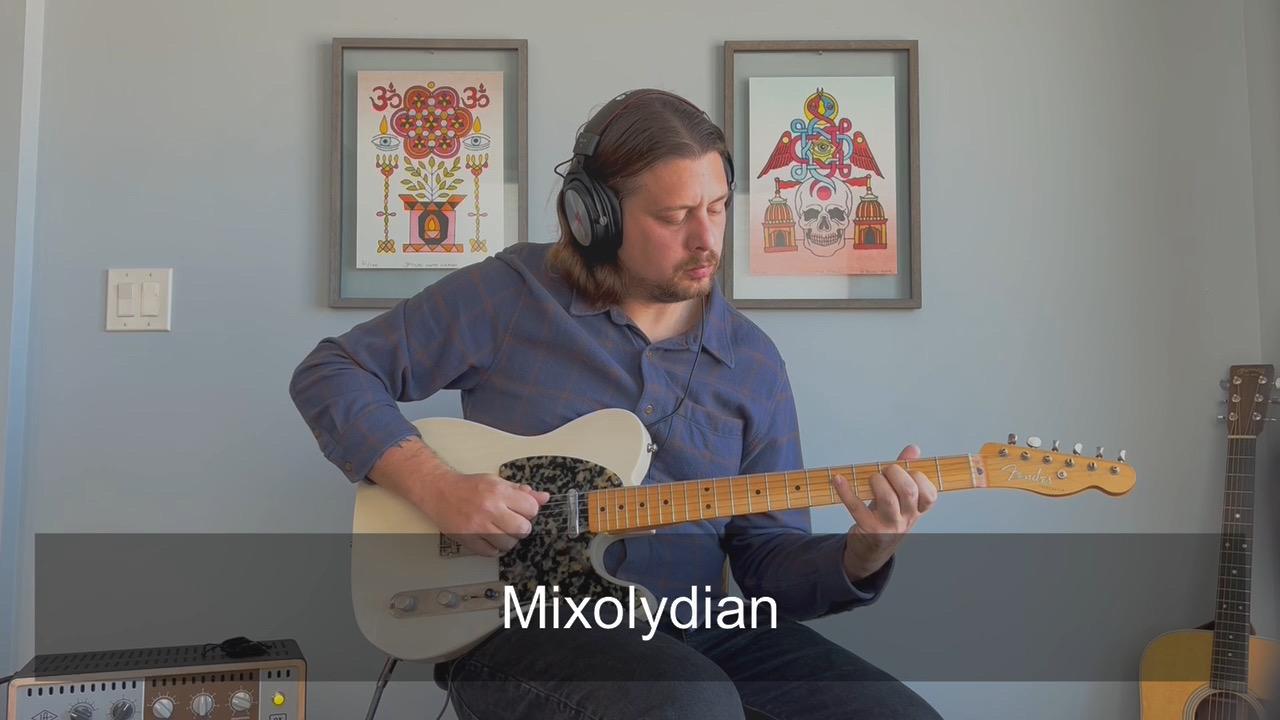
9. Mixolydian: In this lesson, I'll show
you how to play through two octaves of the
G Mixolydian mode. Mixolydian is fifth
in the modal series. Mixolydian is
energetic and bluesky, with a dominant
seventh that creates a strong resolved feeling
in terms of steps. Mixolydian follows this
pattern half hole. To play this mode
in the key of C, you'll want to place your
hand in the second position, starting with the low E string. You'll begin with your two
finger on the third fret, followed by your four
finger on the fifth fret. Next on the string, play through frets 23.5
with your 12.4 fingers. Moving on to the D string, you'll play through frets
23.5 with your 12.4 fingers. At this point, you've
played through the first octave
on the G string. Play through frets
24.5 With your 13.4 fingers on the string, shift your hand to the
third position and play frets 35.6 With your 13.4 fingers on the high, remain in the third position, and play the third fret
with your one finger. Now you've played through
the second octave. If you want to finish
out the pattern with the remaining notes
accessible in this position, you could play the fifth
fret with your three finger. Here's how mixolydian sounds. Ascending and descending. B, B. Here's how mixed Lidian will sound over some chords
in the key of C. Excellent work getting
through Lidian. Next up on the list is the Ali.
10. Aeolian: In this lesson, you'll
learn how to play through two octaves with the alien. Alion is sixth in the
mode of series with minor scale intervals conveying a sense of depth and emotion. In terms of steps, Alon follows this pattern to play this mode in the key of start by placing your hand in
the fifth position, starting on the low E string. You'll begin with
your one finger on the fifth fret followed by your 3.4 fingers on the
seventh and eighth. Threats on the A string, you'll follow the same pattern
to play through frets. 57.8 with your 13.4 fingers. Next on the D string, you'll play through frets. 5.7 with your 1.3 fingers. At this point you've played
through the first octave. Next on the string, switch to the fourth
position and play through frets 45.7 With your 12.4 fingers on the string, shift your hand back to the
fifth position and play frets 56.8 on your 12.4 fingers. Finally, on the high string, play the fifth fret
using your one finger. Now you've played through
the second octave. If you want to finish
out the pattern with the remaining accessible
in this position, you could play the seventh
and eighth threats with your 3.4 fingers. Here's how Olian sounds,
ascending and descending. Here's how Olen sounds over
some chords in the key of C. Good work on getting
through Alien. Next up is our final mode, Lori.
11. Locrian: In this lesson, you'll
learn how to play through two octaves of the Lochreion. Lochreion is seventh
in the modal Sr. The Locrean mode is unstable and dissonant due to its
diminished fifth interval. In terms of steps, locrion
follows this pattern hole. To play through this
mode in the key of C, you'll want to place your
hand in the seventh position, starting on the low E string. You'll begin with your one
finger on the seventh threat, followed by your 2.4 fingers on the eighth and tenth
threats on the string, you'll follow the same pattern
and play through frets 78.10 with your 12.4 fingers. Next on the D string, you'll play through frets
79 with your 1.3 fingers. At this point, you've played
through the first octave. Finish up this string by
using your four finger on the tenth fret on the G string, follow the same pattern and
play through frets 79.10 with your 13.4 fingers on the string. Play frets 8.10 with
your 2.4 fingers. Finally, on the high, play the Seventh Threat
using your one finger. Now you've played through
the second octave. If you want to finish
out the pattern with the remaining notes
accessible in this position, you could play the
eighth and tenth threats with your 2.4 fingers. Here's how lo can sounds,
ascending and descending. Here's how Locrian sounds over some chords
in the key of C. Excellent job on getting through the Lo Korean mode and
the entire modal series. Next up we're going
to take a look at how we can make
the most out of these patterns by using different rhythms and
alternate picking.
12. Alternate Picking + Rhythm: Now that you have a good handle on how to play
through the modes, I want to show you how you
can get the most out of these patterns by incorporating different rhythms and
alternate picking. Once you've gotten comfortable
with the scale patterns, start trying to subdivide your picking to
incorporate quarter notes, eighth notes, triplets,
and 16th notes. Using a metronome will
help you keep time and increase the accuracy and
subdivision of your notes. I want you to try this exercise
using alternate picking. Alternate picking is simply just the practice of switching between up and down strokes. When playing through
the exercise, you most likely played each note once and then
moved on to the next. Let's refer to this as
using quarter notes. When you have that down,
play through it again, but this time subdivide
using eighth notes. So in other words, we're
going to keep the same tempo, but play each note twice. Next, move on to
subdividing by three, also known as triplets. Finally, try keeping
the same tempo, but subdivided by four, known as 16th notes. Now let's put it all together, and I'll demonstrate
these techniques in my class project.
13. Class Project: Now we've reached the point
where I will show you my class project and demonstrate how to play through the
entire modal series. In my project, I'll play through two octaves of each
mode in the key of C, both ascending and descending, at 90 beats per minute.
14. Conclusion: Congrats on making it to
the end of this class. I hope you're coming away
with a deeper knowledge and understanding of how to
play modes on the guitar. Post your final project
in the project gallery, and post any questions you may have in the
discussion section. Remember, practice
makes perfect, so keep honing in those skills, and I hope to see you in some of my classes in the future.
I'll see you next time.
 Lancelot Hueston, Musician - Producer