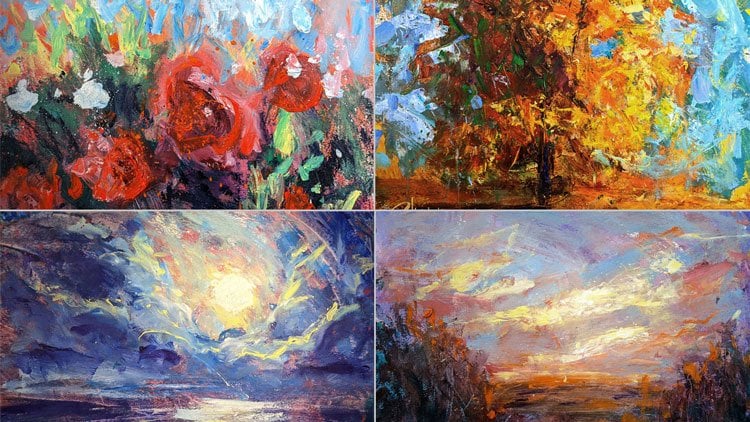
Transcripts
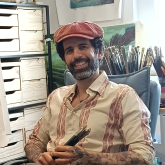
1. Welcome to Free Expressionism!: Hi there, I'm Christopher
Clark and welcome to my painting course,
free expressionism. Painting like you
just don't care. The autumn, autumn is
my favorite season. I love all the color changes. I love that you can
smell the changes in the air when you open
the door and you step outside and you can smell
that summer is ending and autumn is about to
comment then winter like I love that change in the air, that crispiness of the air. Super fun and really fun theme to explore as a theme
for this class, we're gonna be doing for
paintings together for little studies that each
one is less than 20 min. If you did a small one later, even smaller when you
can do them real quick. So I'll run through the
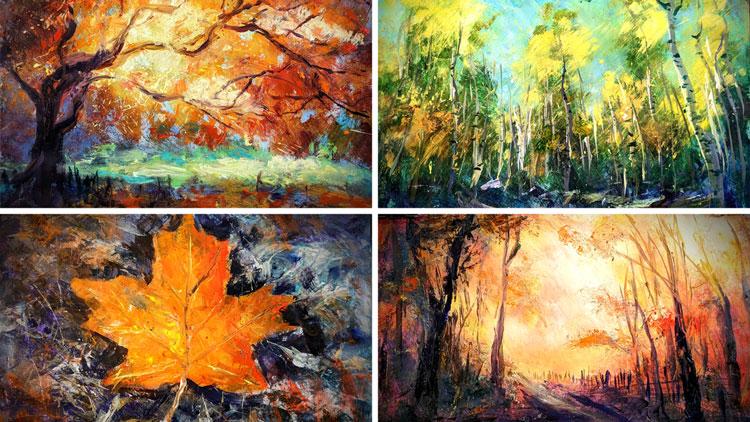
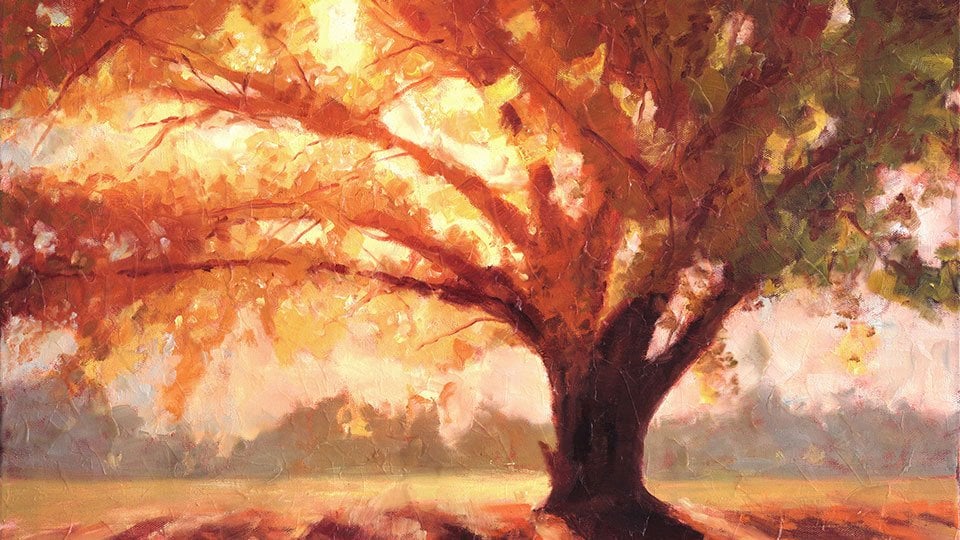
pieces that we're gonna do. The first one we're gonna do is this lovely autumn
tree landscape with the sunset
gray color palette. Really spontaneous,
really cheap materials, cheap paper or cheap brushes, cheap paint, so that you
can do a lot and not be worried about you're
using up expensive. Or you bought that really
nice expensive canvas that you're afraid to touch because you
don't want to ruin it. Well, these materials that
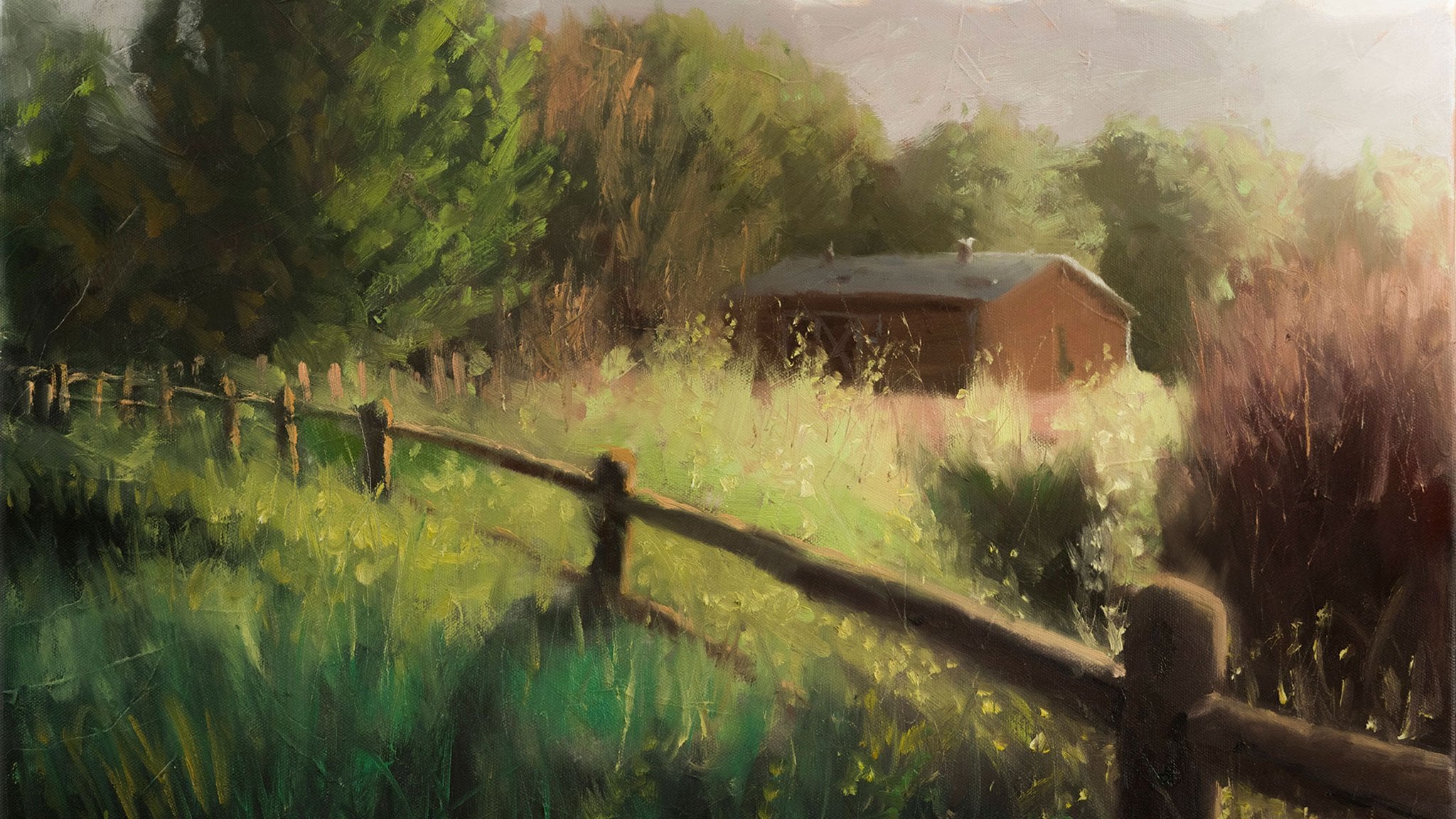
you're welcome to ruin, That's what this class is for. Number two painting we're
doing is this winter, autumn Aspen scene and very
cool palette, blue skies. But like I love those
yellows and greens of the Austin Aspen's when
they're starting to change. So this is number two. The third one we're doing
is a little different. It's just going to be
a simple autumn leaf on a darker background of
other dried leaves and stuff. Fun experiment to see
what we can do with not a landscape more of like
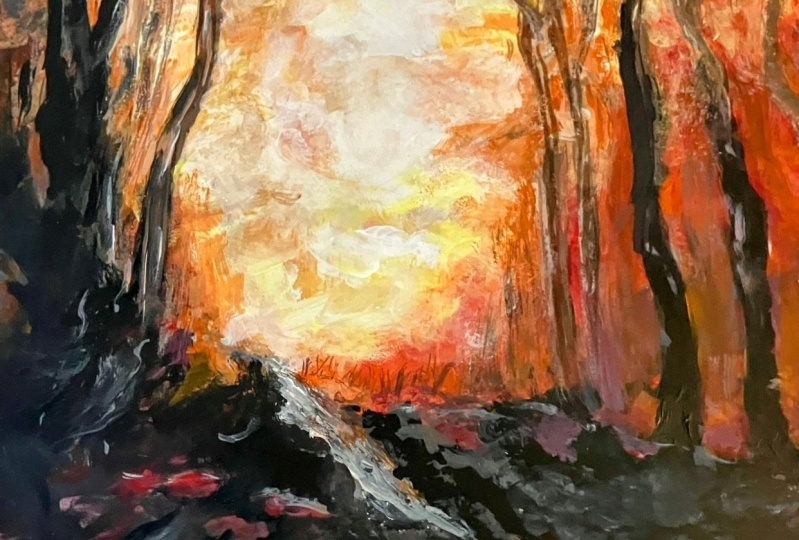
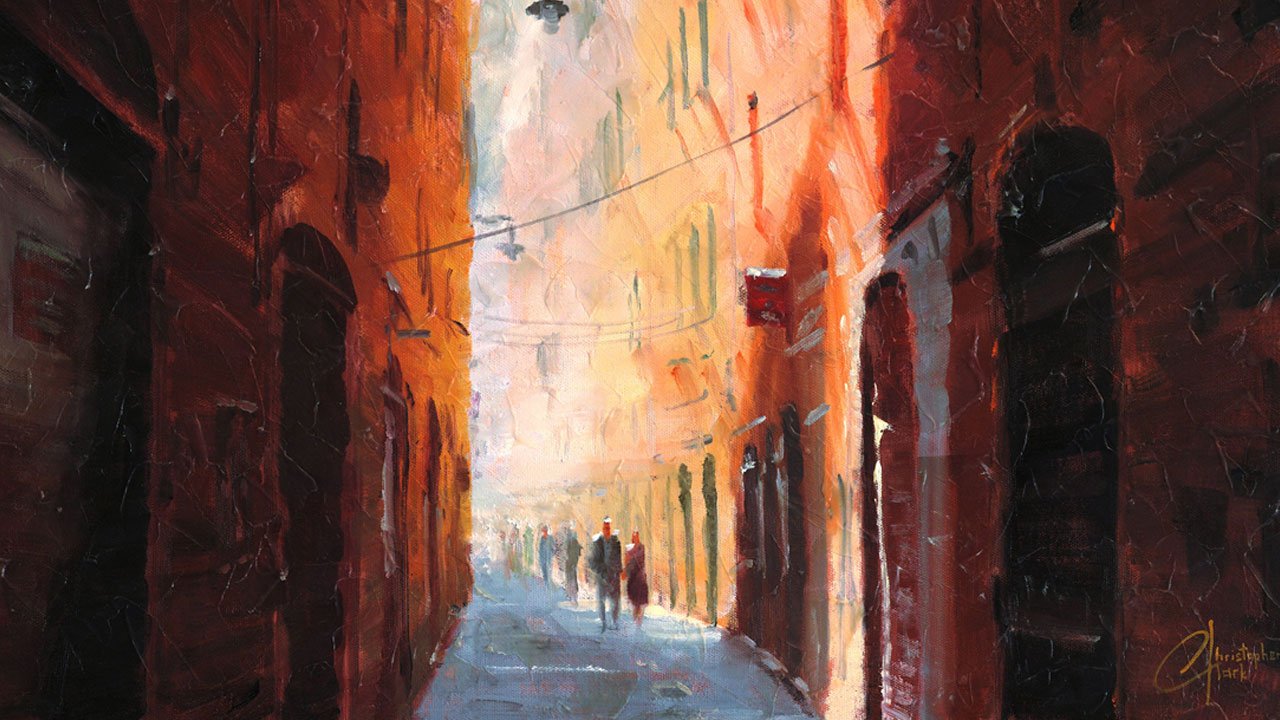
a little life, I guess. Then the last one we're doing is this great autumn
sunset. I can center it. There we go. Sort of path. Maybe it could be metaphoric for your journey in
life or something. Or this could be your journey through
your art or whatever. You walk into the scene. So that the point of
these is to, you know, a lot of people feel
very inhibited, inhibited with their painting and they're afraid
to make a mistake. They're afraid to ruin
the nice materials and they're afraid that other
people are going to think. And is it going to sell?
And all that stuff really just sucks all the
creativity right out of you. So if you're looking
to be more creative and be more spontaneous
and have more, get the creative juices
flowing and all that, whatever metaphor
you want to use, you need to get rid
of all those fears. And that's what this
class is about, is not carrying about
any of those things were using inexpensive
materials and paints. We're spending just
a few minutes on each piece and no one
ever has to see these. That's a key thing. If you really want to
do this in this way, is no one is going to see these. They're not for sale. You
don't post them online. You don't need any
judgment or approval or likes or comments or
anything like that from people. That really is very
freeing and lets you open up and really say
what you want to say. It lets you make mistakes
and lets you experiment and try things that you'd never
would have tried before because you just don't care, you're just having fun. You're allowed to just play
without anybody watching you. The whole like dance, like nobody's watching, well,
that's what we're doing. We're painting like
nobody's watching. Which is a very, very
different mindset. If you haven't
done it in awhile, it changes everything I do might loosen you up when you
wanna do a serious piece. If you have that
practice and you can let loose and be more free. Even when you're doing
a serious piece that's gonna be for sale or
view or whatever. So, yeah, just really cathartic and just the act of painting
and splattering and using your hands and
using random hunks of tools that you can
find to do whatever it's fun, have fun. That's what this class is about. So enough talking with that, we'll get up at a setup to
our easel and get started. So see you back
here in a second.
2. 1, Golden tree: Okay, I've got a very
simple setup here. Just got some regular
old drawing paper. This is 14 by 17. I don't know why that's
a standard size for a lot of cheap notepads, wouldn't paper pads, but it's, you know, it's weird
number but it's standard. It's not very nice paper at all. It's a little thicker. It's not like typing
paper, that's it. Maybe a little too thin, it
might buckle under the water and paint but nothing fancy. You can even use all pieces
of cardboard and whatever. It doesn't matter. I've got I do I use a glass palette
because what I liked, It's cleans up really easy. I just got all the
colors of acrylic. I'm not even gonna
go through them all. You can see it's like white. There's yellows, oranges,
browns, reds, blues, greens. That's it. Whatever
you got works. This is not about
nice materials. I got cheap chip brushes
from the hardware store. These are some cheap like
synthetic hair brushes, just different sizes,
whatever you got. It doesn't matter
for this scene. I'm feeling like, yeah,
it's an autumn scene, but I'm kinda thinking like some cool colors to
start with in the sky. So I'm literally just
going to, I just got a couple of little
tubs of water here. I'm just going to
start filling in some where this is all about
flanging and having FUN. I, there is this like
sun in the middle. So I'm going to maybe
make that lighter. I'm reaching for some
of my other darker blues and I'm not really being that discriminant at all. I disliked this glow equality. And this paper's
warping a little bit, but I'm not that worried. I might even go even
darker on the edges. Maybe next time I'll tape that down with some masking
tape or something. For now I can deal with it. Yeah, this is a red painting. It's very oranges and stuff, but I'm just kinda making this, this sort of glossiness. Hey, we'll keep going.
We'll make it some dark. We'll put some greens in here. I love the glowy quality. Maybe we'll hit some up here, it's a little, little more
purpley, so I'll grab some. You can use whatever
colors you like. It doesn't matter.
The acrylic dries so fast that you can just
add layers and layers. And there's a quick
little thing, I really not very discriminant. I'm just washing my brush
and some water here, filling it off, like
Bob Ross style. Beat the devil out of it. Then I like all these phon, oranges. I'm going to paint these
beautiful, beautiful oranges. Will just grab some orange. Maybe dip a little water. I'm just going to
start the haben. I love, I love autumn. It's my favorite
season. Makes me happy. Oranges, my favorite color. You know, you're an artist when someone asks you what's
your favorite color? And I say my favorite color
is the Autumn color palette. That's when you know, you're
a dork and you're an artist. So again, I'm kinda keeping, this is gonna be my son area. I'll come back and
brightness up later. Maybe I want to start
working my way around. I love. I'm not
measuring anything. I'm, I'm on my more
involved painting videos. I would have a brief
little grid we do, we'll do a charcoal
drawing first to study. This isn't really
about studying, this is about having FUN and
maybe just getting some, some angst out of your system. Can change hands. My hand gets
tired to do this all day. And I need to conserve
it to do the rest of the rest of the course. So I'm just going darker and darker as I go around the edge. This is what is this
in the middle of it? I can't think of the
names of colors. The words don't work, right? I don't want a little
more orange there. And maybe you don't
even wash the brush. As I work my way out. And I guess there is, I'm using this this
reference as a guide. I'm not really following
it that closely. I'm just having FUN. There is a little bit
of a grassy thing here. I'll try to include
that because it's pretty this gets
real dark over here. This is just, just this
big massive leaves, and this is just a
cheap 1 " chip brush. You can find it at the
hardware store for cheap. Maybe at the bottom
there's all this like this is like dirt and
leaves and stuff. I'm gonna I'm keeping
the brush dry carefully. Don't like yank the
paper up, but whatever, do like 20 of these, each of these videos is
gonna be 20 min or less. For one, that's
the nice size for an upload for like
a painting course. That's the size that works well, 20 min or less. Even in my more involved
painting courses, I break them up into
little chunks like that so it's easier to digest. But also If you're doing this as a FUN little experiment
or a little study, or maybe you are studying for a painting that you're
going to do later. Just do a little, little
quick 15, 20-minute things. It's, it's quite
freeing actually. Here's some grasses. And no one ever
asked to see these. I think that's what helps
make them effective, is that nobody ever
has to see these. This is for you just for
your own study purposes. I like this a little bit of beam of sunlight coming through here. I'm going to add that. I'm not really washing the
brush off. That's okay. Maybe I well now I want to get into that to be careful
I do these too fast. And suddenly I'm done with
the painting and it's only been like five-minutes or these quick little
ones might Oh, it's only been like 8
min. I should slow down. Let's let's do this
sort of sun area. You can smush and roll and
you know, hey, watch this. I got a palette
knife here just so don't get my hands
completely filthy, but I'm gonna get a bunch
of water on this brush. And I'm going to like
flicks some color on there. I'm gonna place where
I can make a mess. That's helpful. Look at that, That's Fun. Like this is the sort of expression equality of
this, of this course. Like really have a good time. And maybe you wear some clothes, you don't mind getting
paint all over. This is a white shirt. I probably shouldn't warn
this. But it's alright. This is just like enjoyment. I was reading an
article this morning that like doing Art and creative things is actually good for your mental health. Um, it's not just about, I don't know, hippy
woo-woo create a, you know, like it's legitimate. It's not like some made-up. Like ooh, arts and crafts. Yay. It's happy. It's fine. I'm like No, I'd actually,
it's good for your health. These are really, really, really, really good to do. This kind of activity. I want even more
bright right here. We're really going to go for it. Whatever you got left
in the brush and house, I can do that. Maybe it will poke a little. There are some has some little
bits come in through here. Little parts that are
poking through the trees, like the sky or something. Maybe I'll put a couple there. And we don't care about this. This is just for Fun. We'll put some more grasses
zinging through here. And I used a decent amount
of paint on the palette. You don't need a ton, but enough to to have some don't be
miserly with your paint, then you just run out real quick. What
does that look like? I looked check over and
see what it looks like sometimes when I'm missing is
some leaves on the ground. Let's add some of those in. I haven't changed
brushes at all. I'm just using the
same old crummy brush. I try not to get any paint on
my on my monitor over here. It's alright. There's leaves here. I've got a palette knife. Without chewing up the paper. I can smash it around. You know. You don't want to put some juicy pieces around here. Just grab some with
a palette knife. You can use cheap
paint for this too. It doesn't have to be
nice quality paint. Go to your Art Supply store
and get those cheap like two-dollar tubes of paint that has got a paper
towel over here. Them can briefly clean
off some things. I'm letting it drip and
whatever, and it's PFK-1. This is really, I don't
care how this comes out, so I'm just playing with it. You are allowed whether you're doing this
for Fun or for Art. If it's just like your job or you're trying to do
this as a career, you are allowed to
play and have FUN. That is actually
really important. As a creative person, you don't just like, let me
paint, what's going to sell? What am I painting today? What's going to sell today? Yeah. You have to do that.
You panes bills. Sure. You do have to consider that. Now. Then if you're
painting stuff that your clients
want or a commission or something. Sure. Great. But you are allowed to
just play sometimes that's okay too. That's
really important. If you're an amateur, like just doing it for FUN, then the reason you're
doing it is to play. So yes, play, have a good time. Don't take yourself
too seriously. Maybe this is like, Hey, there's a big pile
of color like I was just disregarding the trunk
and the branches and stuff. Lets you know, I was just loving these colors and
where the center with a light is coming
through and stuff. And there's some dark shadows
and some funds stuff here. Let's maybe try
to add some tree. I got some I like the flat
brushes because I can make little like thin lines
are big, fat thick ones. Let's let's grab some
just some color here. I'm going to, I like when
it goes through the light. And then picture
is my reference, but I don't have to stick to it. I can invent my own tree. This is my tree. And it's
going to appear before me and say hello, get a little water. I'm not using any medium. You can, you can use
whatever you want. I kinda liked the fact
that it's sort of this bent over shape. This is running, grabbed
some of my dark purples and you can use
black if you want. I don't have black
on this palette, but you can use it if you want. So you look, you
can get big chunky like shapes with this, with this flat brush and see like I've got like
all these cool shapes happening and I'm just pushing down with whatever color
I happened to have. I can push a little lighter and I've got some
little tiny branches. They're like all these
twisted branches coming out. It's great. And then as all kinds of stuff, if I wanted to really
get some thin, I might choose a thinner brush. I'm just kinda playing with it. Now. Here's where
you can really spend some FUN time adding all the little tiny
branches that you wanted. Maybe they come off like that. I want to make my tree
a little thicker. This is my tree is gonna be, I'm departing so far from
the reference because it's not your rule book or
it's not just a guide. You're not trying to
duplicate this photo. Whatever photo you
took in the park today when you were
walking like, well, I want to paint that
or if you're outside in nature or Painting plain air, maybe we'll put one eye,
goes off like that. That's fine. Let's grab a smaller brush.
What does this do? This is a, this was
a brush like this, like around one that
I actually cut with a pair of scissors
to make super tiny. So let's do something with that. I just stuck some water on it. And I can do some
really FUN little branching things with that. I'm just playing. Letting the branches
is going to dance around. Like Bob Ross. Let him play the dance and the trees are about the
freeze thing in nature. You let them play and dance and have a good time
and just have FUN. He's covered in paint. Sits
over here by my, by my table. I need just like
watches me paint. And he gives him the
encouraging thoughts. You can spend all day on this, on the trees and the little branches coming out everywhere. Maybe there's some,
some sticks and twigs for all the creators
to run and hide and play. Maybe this could be a
little darker in here. You could spend all
the time you want refining this and
playing with it. The Acrylic is still
pretty wet right now, so it actually is
blending pretty nicely. It's Fun. He looks
wanted really. I'm looking at the I just glanced over like,
Oh, that looks nice. I haven't looked
at it in awhile. Maybe I want a little
more orange over here. I'm or bread maybe. And I can see all that blue
is still poking through, almost looks like some sky
that's still sits still there. That's cool. Little more. Oranges here. Yeah. So it's only been
it's been about 15 min. You can if you're just
playing and having FUN, you can get really far. And this could be a study. You could try a different
version where you paint the background red instead. Or green. Triad could try color the sun
even in your picture. Paint the whole thing purple. Pay attention where your
light is and make that a lighter version of
purple or whatever. And you know, you'd be surprised at all the fund little extra colors that poke through the unexpected
unexpected little notes that come out that you, you didn't plan on. Maybe there's some grass
down here by the tree. I love these. I love you
letting the brush do the work. I'm like, I'm letting the
bristles smush and do organic things that that maybe I would never
have thought of. You know, I'm taking advantage of the texture of
the paint, of the surface. This case it's just
paper, but, um, it's building up with
textures and the texture, the brush and all those are like part of your
little painting team. It's not just you, it's you and the paint and the
surface and the brushes, and it's all these things. So you have FUN. Let's see here.
What else can I do? I don't know, this is
looking pretty FUN. I'm almost out of
some of my colors. I want some of these leaves to overlap the branches
a little bit. I mean, this one's this
one is just about done. Could call it finished
at any point. But I'm enjoying it. It's a
good cathartic experience. Hey, you can double
fist it, right? I got up paint brush with a
different color in each hand. Rendering anything complicated. You don't have to be
intimidated by it. Some people see me do that. Wow, you're
ambidextrous. I'm like, Well, you are to you
just don't practice. Everyone's ambidextrous. You just never give your
other hand to chance. So put the Brushing other hand in and it might paint something. My right hand paints
differently than my left hand. So it does It does things
that I wasn't planning on. So I just let it anyway. Yeah, there's a Superfund, really wild expressionist
autumn tree scene. I was stand up and
look in a mirror or look at it with your phone to see at different and
you'll notice things like, Oh, there's no red
on the ground. I want it to distribute
some of these colors, reds, all these juicy colors. And there's nothing
on the ground. Not to say like, oh, their leaves would be falling
there and they'd be read. Yeah, that's true. But I
liked the colors to be distributed all over
the whole painting no matter what the subject is. So that helps.
Yeah, there we go. Superfund. Little Autumn scene.
Just a few minutes. You look in the mirror and you can see some shapes
you didn't like. This little tree shape was
odd and they fix that. There we go, that's better.
So that kinda stuff. So here this one's done. So don't show it to anybody. That'll make you more liberated
to do whatever you want. You don't have to worry
about anybody seeing this. So cool, this one's done, tear it off and do another one. So I'm clean this up a little bit and we'll come back in a few minutes with
our next piece.
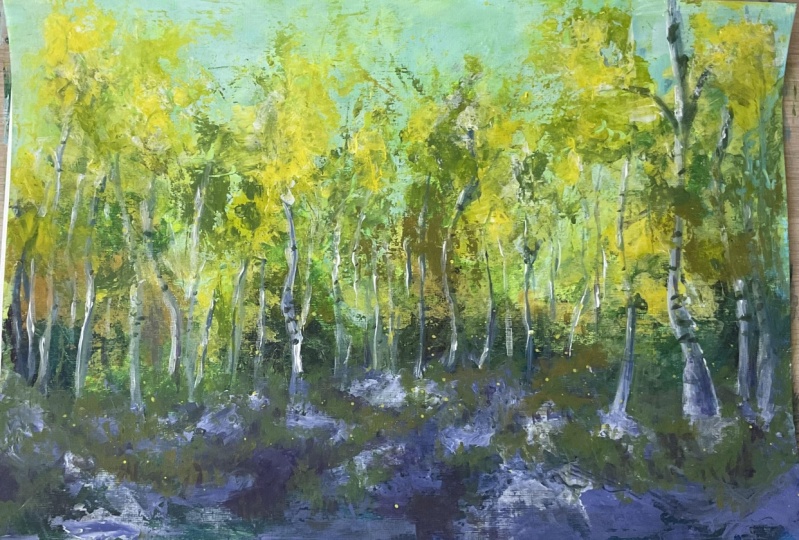
3. 2, Aspen trees: And we've cleaned up a bit, and we're back with
our next piece. This is a fun Aspen seen. Aspen's in the
autumn or beautiful, and I live in Colorado
currently, and that's wonderful. That comment last time
about how I said I'm going to do the whole thing
green underneath. I'm going to take
myself up on that. I'm going to do. The whole
thing is going to be green. I'm going to start with
maybe more yellow green on this side because I think the light is
coming from the left. And I'm going to move over. And I'm a graduate
just going to make it more just green on this side. And I'm just it's just water
and a little bit of paint. I'm not I don't have
any medium out. You can use whatever you'd like. And there's some stuff that's
still showing that's great. Like paper. I like on the bottom, how it's like this
really dark strip. This is your chance
to see the painting as well as this large shapes. The bottom is this. You can, I teach this in
my more intensive classes. You can squint at the
piece, just gently. Relax your eyes and close them. And you'll see this sort of
dark strip on the bottom. Maybe it's even
purple over here. I don't know. It's kinda fun. Maybe they get some more blue. I like to have colors
fade across the painting. I think it's, it's pretty high. It gets them dip the
brush in a little bit of water and hey,
fleeing a little bit. Whatever you got left on it. Kinda fun. You can smack to paint on there
wherever you want. And look at these swirly
things. Don't cover that up. That's pretty, I didn't
do it on purpose, but hey, maybe I
want more of them. That's pretty little swirly, is that that was an accidental happy little
accident, right, Bob? Happy little
accidents. He agrees. Now, I'm going to maybe pick
a slightly smaller brush. There's some darker
greens and stuff. Maybe I'll just
smoosh in some of these loosely going
off of this picture. I guess I probably
could have painted some sky in first,
But I don't know. These these dark, interesting juicy green was just
going to hit me. I know it's autumn, But there are there is a lot of green, especially Aspen's. They are green in
the summer and they turn yellow in the fall,
probably just fall off. There are a lot of greens and yellows that mix together,
which is really fun. There's some kind
of pine or IRA, I don't know for some over here. Not thinking terribly
hard about it. I was going to bring
this out to you. This is a piece of plastic. I've clearly used it before, but this was a
rapper or something. I can use it to help me. I'm going to scoop up
whatever paints here and helped me sort of dab some, some color on here just
to get some texture. You can use it to
drag it through the paint. Look what that does. That's fun, right?
I'm just having fun. Making big circles.
I can go down, I can go this way. Yeah, that's cool. Maybe I'll want to pull out some
more of this purple. And I'll do that down here. I'm going to, I can put
it on with the brush. I can paint it on
this plastic thing. I don't know. I'm
just kinda wing it. I think our masking tape
is going to come off here. I tried to run it
in a little bit. I'm not sure if it worked. We'll see. Just really pretty dabbing it on there. Yeah, that's fine. We'll
put some more up here. This is less about like I'm just seeing big piles of
color and shapes and stuff. It's less about this is a tree. It's like this is,
this is purple, blue, this is green. Yay. It's more about
that kind of stuff. I can dip it in the water. I don't know what that happens. Then it will really start
to pull off some of the some of the
paint a little bit. I don't want to
tear the paper up. It's kind of cheap paper. I think that's
alright. And you know, you get a little messy,
whatever big deal. That's all part of the fun of
painting. I wear an apron. I shouldn't have worn
this shirt, but, uh, well, let's do want to
put in some of that sky. Maybe we'll use this
brush. I don't know. I don't know why I painted
this guy. Perhaps I'll die. It's kinda, this light is
kind of greenish over here. Usually. I always say in
my landscape classes, you paint the sky first
and you move forward. Well, clearly we're
abandoning that rule today because making our
own rules, right? And I can do several
layers of this. I think. Some white plus some green makes
a wonderful bright, hot sky blue color. And as I move over, I can maybe use the blue instead system. Yeah, these are quick studies that should only
take you 15, 20 min. You can do them smaller
to it. Really dislike. Work it for a few minutes
and throw it away and work it for a few
minutes, tear it off. I didn't mean to throw it away, like moving out of the
way. Do another one. Do 20 of them, do 50 of them. You'll get your method
down and you'll get your confidence up that, you know, you'll you'll
get past that fear of, I don't know where to start. What you've started
and you finished and you've started and you
finished and you're like, Yeah, I remember
this, This was fun. And your confidence will go up and you'll be able to look
at a painting and say, Yeah, I can paint this and
it will turn out, okay. My painting will turn out okay. Just like my life. And
it will make you happy. Because that's what life is, is just taking the chance
and you see what happens. Don't worry too much. And when
you try and try too hard, it gets stiff and you stop trying so hard
and just have fun. That's when you really,
something really creative happens. Alright, That's a fun. Maybe I'll add some, I
will finish this off. I like this brush. I'm going to keep
it going. Let's add some of these sort of orange. There's a little
bit of orangey ness behind this yellow. And there's some on top of here. Now I'm really just
grabbing piles. Watercolor paint.
This a big blob. Maybe I'll, this is covered
in purple is turn it over. I'm gonna double fist it again. I'm gonna put the paint on with this thing, with this brush. And I'm going to sort of move it around a little
more with this one. I might I might be a piece of an old piece of
paint flaked off. Hey, it might, it might stay on my painting and add
something that I didn't think to add a couple
more right up here. There's chunks of paint that are coming off of this old thing. And they're going to
remain on my painting. And hey, they might, they
might add something good that I wouldn't be done on purpose. This is a very
complicated scene. You could spend years
painting all these leaves. But maybe even for now,
you just want to figure out where all the
shapes and colors go. So maybe you do this
first, you know, you can spend years
painting the leaves later, or maybe you like this
version better. I don't know. Yeah, That's great.
I'm going to come back and hit the sky. That's a little
more lighter value. So it really stands out. It's kinda a little too dark. It looks pretty. It looks pretty because
it came out of me. I'm not I'm not trying
to impress anybody. I'm not trying to make it
look like the picture. I'm trying to just whatever
my mind grabs onto, I do it and it's kinda
look great because that's where your mind is
coming out on this page. That's really the exercise. Is, you're not painting. You're not painting an
autumn Aspen landscape, you're painting yourself. So let that happen. And it totally Well. I've heard someone say, when you stand back and
look at a painting, you can see the subject. And when you get real close, you can see the artist. I've always liked
that because that's, that's kinda what I feel
like is happening here. The subject is an autumn
aspirin, wintery scene. But this is all me coming out. This has nothing to do with
autumn or Aspen or anything. I mean, I, I love this
kind of subject matter, so that's helping you
paint what you love. Then it will, it
will look better than anything else you
can think of the paint. Because that's when
you paint your best and your painting for you. Rarely nice hot ones, right? Bright hop and I'm just
dipping into the yellow here. I'm just sort of motion and around and making
it look interesting. A little more of this
darker one here. A couple of little
oranges. And why not? Again, I'm just, I'm seeing blobs of color and I might go, there's a, there's a blob. That looks fun. There's a, there's some color over there. Why not run with it? Maybe it's time to
put in some branches or trunks, whatever, you know. Should I use this
guy again? Why not? You know, grayish
something or other? I don't know, a little bit of white and
have you just pick all my colors up being a purple. That's okay. Maybe they need to
be a little wider because I can't really see them. They are I liked how
they're kinda like leaning in from the side. This one goes all the way
to the top off the page. You only need to see it. And we can add some other
stuff coming out of it. I love these flat
brushes because you can do thick and thin. These are sort of shade ones
that are like in shadow. I can add can add some lighter paint and we
can make some ones that are coming out of the light
being shined on from the sun. I think I just want
a lot of them. Maybe, maybe some of them or
you don't see all the way through. Alright, let's add. I just dip the same brush. Maybe I'll, maybe
I'll do even a couple the edges of some of these. This is probably the
most defined sort of detail work of this
whole piece so far. Although you can really
see how much I'm defining it and painstakingly, I'm just having at it. It's kinda fun. I'm keeping this sort of
like they're angled in, like It's dislike there so tall that they reach
inward like this. This is the vanishing point would be up here if you're going to get technical about it, which were not in, not in this class. We're just having fun. I want maybe some darker ones again. Maybe this is kinda rough here. And then what if we
did some splashes? Let's get rid of that. What if we did just get some some water? I've got a little spray brush spray bottle here, if you can. Once in awhile, spray
down your paints. I love this technique
because it just adds so much chaos and
unpredictability. I can smush them that this is a, this is a regular
old palette knife. I'm using this to keep my fingers necessarily getting completely covered in paint. I can smush like this. I smushed down. You know. There's so much
you can do with this. There's a whole lot of
rocks on the ground. I don't know if I can mix. Let's do palette knife work. People love palette
knife paintings, right? Not that I care because
this is my own painting. But, you know, you want some
rocky, organic textures. I just grabbed this gray, whatever this was and I
can spray my palette. Let's pick up all this crap. Make a little salad bar, and just go for it. Couples that are brighter. Couple that goes this way. There's a, there's
some rocky action taught rocky action
in the Rockies. Maybe I'll do a couple more
trees with the palette knife. You know, maybe there's
some little tiny guys that are poking through
in the very back. Maybe I'll throw a little more. Sometimes I try to see if I can use all the paint I've
got on my palette. I'm just pushing paint. And sometimes you can just
stop looking at the reference. Like, Oh, I'm done with
that. That was an idea. And now I'm just going to
continue with my own thing. So that's looking pretty fun. There are little tiny. If you want to get
some more details. Some of these branches
have those little black. This is a smaller brush. Maybe those little
black shapes like that, we're branches that
had broken off. Maybe this is a closer branch. Like the way the
skin of the bark of the tree kinda blisters and lake leaves, little tiny scars. Not a tree, just botanist, whatever you might
want to call it, arborist, I don't know. But yeah, that's kind of a typical
characteristic of Aspen. So maybe I'll throw a
couple of those on there. The close one is the one
that we'll see the most. And I'm using the
side of the brush, I'm just sort of
smashing them on there. If you hold the brush like this, you can only get so many
angles off the brush. But if you hold it, like here's how you write or
do it the underhand grip. So if you hold it like
on top and you can do all kinds of
extra fun things. Your wrist and your arm
flow so much better. You can smush the side of
the brush down onto it. And all I needed was
a couple of those. And look how that's implying all this detail
about these Aspen's, this close one is the one
that's our biggest clue. You do one, close one and then you start to see those
same ones further away. And you can tell
it's the same tree. So you don't need
as many details. Anyway, this one is almost done. Again, I could spend
a whole bunch of time on this and
they'll grab some dark. And I'll do some
of the shadows a little more on some
of these rocks. Just for fun, just to
eat up another seconds. Before my 20 min is up, you can put a timer on yourself. When you do these. 20 min
is up, boom, I'm done. That'll keep you honest
and keep you moving and not getting stagnant. Like my timer, I'm trying to keep the
videos 20 min, okay. That makes you edit and think
and just do and react and not agonize over so
many things that can, that can just stop
you in your tracks. You just go, go,
go, get it all out, practice and express. And it's cathartic. And it's actually, you're getting a lot of
your inhibitions out of the way and it's so useful
for this kind of exercise. So yeah, 20 min, so just let it all pour
out and you can stop and look at it and enjoy your work. It's really fun. You
can see your mind and yourself and all this peaceful, chaotic sort of thing. It's a great juxtaposition of everything going on in
your life, all in one place. You get it out and
you can look at it and you can process it. So we'll call this one is done. We'll clean up again and we'll
move on to the next one.
4. 3, Autumn leaf still life: Okay, this is an
interesting scene. This is sort of some old, crispy dead Autumn Leaves with one juicy beautiful
orange one in the middle. I'm gonna, I'm gonna
kinda start with that concept of this big, beautiful orange
leaf in the middle. Not doing it, not
doing a leaf shape. I'm just like that's
where it is in general. Right there. And then
the rest of this, I think I'm just
going to do dark. Like slather in some
purples and greens. I'm not being too particular. Maybe there's red
over here, blue. I've kinda like
how the colors are moving around the
whole Painting. There's some like maybe
some reds over here. Fine. We'll hit some more darks. I like having the corners be
dark, like this vignette. That brings this
glow into the piece. I just grab all the dark colors and add a little
more in the corners. Then I like to just flying
whatever I got left on the brush and
just let it happen. Maybe I want a little darker. I think I definitely want this. We've got this great
sense of light already. Dark, dark, dark. And then boom, there's my leaf. Let's see. Now we're actually doing
a shape of something. This is probably the
most specific sort of drawing that we've ever done. Like, I need this to
look like an object. That's okay. I'll do that. I'll do the leaf later. I'll
leave that till the end. I'm just going to
play with the sort of dirt, crispy, leakiness. I'm letting that
Where's my plastic? I really liked this stuff. I can maybe put it on
here and pull it off. It's still wet. This is
from the last Painting. It's still wet
while we'll use it. There's wet paint on there. I can do this and peel
it off and you get this great crispy texture.
Plus this is wet. The Acrylic paint hasn't
completely dried yet, so it's going to affect what if I sprayed it
with a little bit of water and then did this? Just having FUN. Or I
could motions smear. I want, I like
layers of texture. The plastic is a great
tool for just abstraction. And you can use
whatever you want. Maybe. Now I want some
color of some kind. Obviously, I haven't
really mixed anything yet. I kinda want a grayish, a little bit of white,
and then a little bit, a little bit of
everything else. I want. I'm using a nice big fat
palette knife right now. This is actually a Bob
Ross palette knife. If you want to know. Because I'm big fan and the tools are
actually really good. And I'm going to sort
of like there's these, maybe it's a little more brown. I'm getting a little more. This is probably
the most specific like that I've done for
any of these pieces yet. I'm just adding some FUN. I'm swooping with a flat part. I'm can scrape with
the razor sharp heart. I can smush it flat and then
I can go back through it. It's wet for several minutes. You can do all kinds
of stuff with it. I want this sort of chaotic
leakiness going on. What if I do some just brown? I was hoping that the crispy
dried. The dead leaves. We more brown, purple and
then that would leave my bright orange living leaf to be really, really exciting. Maybe I'll do a little
more white and just mixed. You can smush it, grab it, smush it, grab it, smush it. And that's an easy
way to mix paint. Will do a couple of those. See, I'm even holding the
palette knife with my overhand. Like I'm not holding it. I actually, I've never
this kinda palette knife, this is one of those
flat ones like, I don't know what
shape you call it. But it's really
great for holding flat and pushing
flat on the surface, you can get all kinds of
PFK-1 shapes and stuff. And this paint is,
it's still wet, but it's drawing a little bit. This stuff dries really fast. And so I'm already getting
layers and layers of Transparent things
happening but I'm cut COVID covering over
and covering over. And I might scrape a
little bit about off. And you can, if it's still wet, you'll see the layer underneath the leaf is still
here somewhere. I haven't really
worried about the end. I'm just kinda enjoying
this this texture process. I love this stuff. I
could do this all day. I love adding texture. And I'm putting this
on decently thick. Maybe I'll take my
horse, my plastic. Maybe I'll do this
once or twice. Watch it on there. And you can, I save rappers from stuff,
reuse, reduce, recycle. While this is a recycled
piece of plastic from some old wrapper or something,
I can follow it up. Remember this trick?
This is a FUN one. You can dab it. You scrape it all the little, the little pointy things, grab some paint and
move them around. And you've got so much going on. Alright, maybe I actually
want to do my leaf now just because I'm at 6 min so I can
always play around with it. More. Leaf has got
all these red colors. It's like one shape there. This is, again, this is probably the first
time I've actually tried to make a shape in
any of these classes. Like I'm actually
drawing some things, so, but it can be simple. There's like three parts. There's this part,
There's this part, and there's this
part sort of like, you know, these three things. That's okay. There we go. I'm just grabbing some orange and then I can
fill it out later. We don't care, we're
just playing around. And then I'll add
a little bit of a drop shadow behind it. I was kinda what I was
thinking this leaf is casting a shadow. That's what's helping
us see it better. I want it to stand out a
little more so I can add some, some brighter colors, like
lighter value colors. I'm not going to throw too
much technique at you in these classes is really
just about having FUN. But value contrast is
definitely something, a light value versus
a dark value. You'll see the light one against the dark
one and vice versa. I'm just using my flat. Whatever this brush is made
of synthetic, whatever. Maybe I want some juicy
Red's right here. That's fine. Because I
like things that are Fun. Again, I haven't
practiced this painting. This is my first
time doing this. I'm doing this with you guys. I'm exploring this with you. As my first time. I'm talking my way through
it so you can hear my thought process about how
I might tackle something. This is probably the most I've
concentrated at of any one of these paintings
because it might go, this has to
look like a leaf. But again, it doesn't have to. I could just, I just
love this color. I mean, this is looking
pretty cool right now. Don't really look like a
leaf, but it's pretty. I'm enjoying. So you
can smush and twist. Abandon what you
think you know about a paintbrush because you can
do so much more with it, then you are aware of literally look at it like I've never seen this
instrument before. Does this the end to paint with, Ooh, look what that does. What does this do if
I smush it like this? Like, you know, look
at it like with foreign eyes and see what you can do with it that you've
never thought of before. There's some cool textures
actually, I liked it. I'm gonna draw some veins. I'm gonna draw
those in the leaf. The paint is still decently wet. I'm sort of carving into it. That's pretty and it's way
more organic looking than me, taking a different color
brush and actually doing it. And I might do that too. But it is another
variation of that. I'm kinda liking how one side of the leaf has some
brighter colors in it. It's like yellows and then
it's like a dark red. Like I can see, I'm always thinking
about light and where did the light come from? This even avian has
some, some white in it. Some white in there.
Just a little. I'm going further than I wanted. I can come back later
with a darker color. Oh, here's the stem. Here's
the stem. Look at that. So I love these brushes. I can do so much, so many different sizes,
shapes with them. Let's do some of those, maybe some of those veins. I can do big thick things
and little delicate, dainty things with
these nice razor sharp, flat or bright or
whatever you want to use. I like long flats So yeah, I'm whatever,
whatever strikes you. This is, again, a quick
study, so don't overthink it. I'm going to just grab
a brush is clean. I'm gonna do some
super darks now, greens and purples and whatever. And maybe I'll come in
and add some of this. There's some. Now I'm going to actually
carve in a little, more specifically the
edges of this leaf. Now I'm painting, and
the other direction, I'm painting the negative
space around the leaf. And hey, maybe
there has actually some darker stuff here
too that I could add in. Because some of those
colors have dried. I'll do one right there.
See you a couple of nice little crisp chisels. And suddenly you have the shape of this leaf
will just appear. It's been hiding, waiting
for you and it says, Hello, I'm a leaf. Where have you been all my leaf. Now that wasn't funny
at all. Sorry. Let's do some more dark
around this edges. This is looking fine. Maybe
we want That's pretty dry. Let's add a little bit more. I want maybe some sticks
and twigs and things. Lets do the palette
knife for that. Grab some and get it wet. Right up to the leaf. Maybe one of them goes over just a little bit because there's sit
sitting on the forest floor. And if I wanted to, I
could spend hours painting this just like the reference. And it would look very pretty. But that's not really
what I'm going for. I could also let this whole
thing dry and then glaze over it with some more browns
and like water and stuff. If I wanted to. Lets
see, it's looking good. I'm just playing at this point. Yeah. You have to let yourself
you have to grant yourself the right to play.
Little kids do it. That's, you know,
they're good at it. It's so natural, they don't
have any inhibitions. And it's very healthy. And we lose that. They don't lose the
ability to play. We just think it's dumb. We get older and think we're
too old, for instance, immature and we
think it's childish. But actually it's very important
for your mental health. As a happy human being,
even as an adult. It is not childish at all. That's very important. You play in different ways
when you're an adult. Sure, but it is actually
still very, very important. Maybe I'll do I got a
smaller bristle brush. I want to do some more. I liked the splatter ease. I'm going to mix some
bright oranges here with some water splatter, some a little bit
here and there. Maybe I'll do some red. This is Autumn. All my favorite colors. Oranges, yellows, reds would
like accents of purple. Cinema. My dork. When someone's like, what's
your favorite color? My favorite color is the Autumn
color palette like that. So you know, I'm a dork
and I'm an artist. That's exactly what
an artist would say. Gets. Redistribute
some of these colors. Maybe there's a little
orange, they're a little bit there. Me, this continues like this. So I can the orange belongs
around the whole painting, not just in this one
section it fits. You can tell this is orange. Orange leaves world because
there's a little bit of him all over her, them. However you like.
Maybe this leaf has a little bit of this stem. Why are they getting any
paint on there? I don't know. Do this once in awhile. Keep your painting side. This is just a spray bottle
with water in it. Keep them alive on the palette and you can
scrape up what's down there. This is a regular like the
trowel shaped pallet knife. This is my favorite, you
can tell it's wrapped in like duck tape and I've
abused this thing to death. There's you all come up here and I can just
play around with it. Maybe there's some more yellow And they do this one and then you tear it
off and do another one. Remember, this will train you to just relax and let
go and have FUN, and just admit to yourself and acknowledge it to
painting will turn out okay. Just like your life, I encourage you to not necessarily
show these to anybody. Do 100 of them and keep
them in a little stash. Don't show them to people. It will take away all
your inhibitions when you don't have to make an
Instagram post out of this. When you just paint what you're feeling and you don't care. We're painting like we just
don't care because we don't, because you care too much when you're really
trying to learn how to paint and voyage just like kills all your
creativity, right? So when you don't care as
much, you just like, Oh, this is PFK-1 and then you do this a couple of
hundred times and like, Oh, I get it now. And then when you do care, this will be such a
more natural process. Your start to finish
painting will just happen. It'll flow so much better. You'll be confident about
your color choices. You can dislike.
Yeah, I know what? I could see that in my mind. And you just grab some
paint and go for it. And it looks like magic. You've just done it a
couple hundred times. Because that's, that's when you like just barely
started to grab it. You start to grasp
that the thing after a few hundred that
has to flow out of you. So that's what these
paintings are far. Just let it all flow out all over your
hands and everything. This is this one
is looking done. I stop and look over
at my monitor, Mike. I want some more oranges and I could let this dry
and then glaze over. I just want some whispers
of other oranges around. Like this orange light is bouncing around
the whole Painting. Acrylic paint dries so fast, I can glaze over it
and it won't disturb my all these fund brushstrokes
and textures that I have. It won't, it won't
smush them in, smear them because
it's dry already. It's it's dried since
we started 19 min ago. So that is one way that Acrylic
is very cool. It dries. It can be a bane,
how fast it dries if you're trying to do some
really subtle rendering. But for exercises like this and building up
layers of texture, It's very, very cool. So I think this one's done. Yeah, beautiful Autumn leaf. For a lovely autumn
day. That's your thing. I love autumn crisp weather, oranges, purples,
all that stuff. So that was FUN, chaos, and beauty
on the same place. So well Cool. Well
that was phon. Let's clean up and
we'll do one more. So see you back
here in a second.
5. 4, Sunset path: Alright, we said a
couple of paintings ago. You could just do a whole
surface read to start with. And then I'm gonna,
I'm gonna try that. I'm going to maybe do an orangey red right
in the center here. And then work my way because I do like to think about
that there's still some purple and
just rush my light. So we'll keep going with the red and a little bit of water. You know, it's just a splash,
it inflamed and everywhere. I definitely recommend doing somewhere you can make a mess. This is red, but it's red. If I cast a light on it. It's darker in the corners. I'm just grabbing this
is alizarin crimson. Or you can use whatever pink or purple or whatever you want. So here's my, and then
for good measure, maybe dip a little water in it. You get some fun, unexpected
things happening. Smush, smoosh, smush, them. Get water all over your
computer. That's great. Alright, well let's, there's some super juicy dark
purples in here. Let's go with that. I'm just going to
slather it on there. Maybe it's got sort of a maybe
this ground is like this. It's like very flat. And then over here is although the tree three ***** happening, I'm just going to make
this all one dark shape. Will carve something
out of it later. I'm smudging and turning and
moving the brush around. Maybe this darkness is a
little less dark here. I'm really just thinking
about like to sort of clumps of dark hair, dark. And we've got this light sky. So right now it's this purple. I'm seeing purples and reds and all kinds of
stuff happening there. That's fine. I'm just pile and n. And then maybe for the ****
of it will just throw in a little bit of green. Because green doesn't
want to be left out. So there we go,
There's a good start. And it can be unexpected
greenness happening here. That's pretty, um, I'm gonna go the opposite way and I'm going to add
a different brush. And I'm going to start doing
some of these lighter goals. And there's a sky here that's
going to reach into there. It's the brightest there. I can, I can add that in. I'll keep gradually
making it lighter. Then. This is always just
fun to do now. And then it adds some unexpected little color
adventures everywhere. We'll just keep doing
that. I'm going to be, I can actually add
some white. Now. This guy is pretty white. I might have to do this
a few times because this paint is still pretty wet. I want it to be really like to cover up all
these other colors. I might have to let
it dry for a few and then come back to it a few
I mean, like a few minutes. Like, I'm not going to walk away and take a
break or anything. You could do that if
you had more time. But this is for this exercise. I'm not that worried about it. And then you can
just take it and do some swirly is like that. Like hey, there's
kinda like that, like directional quality
to it. Let's do it again. I'm gradually, I think
I'm just hitting it with white now because there's so much color on the brush on the paper that
it's mixing still. This is acrylic and it does dry quickly, but not that quickly. You got you got some time.
You've got a few minutes. There's this distant yellow
glow back there somewhere. You can use a paper
towel if you want. You can dab and smush
with a paper towel. Different different
tools and techniques. You know, your tools
don't only have to be brushes and
palette knives, that can be anything you've
got around the house. Go to the 99-cent
store and hunt around. I think that'd be fun to
like smush onto a paper or a pallet or a canvas or
whatever and see what it does. Be surprised at what interesting
or the thrift store. What interesting objects like a plastic spatula or whatever,
you know, you never know. You'd be surprised at
what random things can make some beautiful marks. I'm going to take
this whole thing and maybe start doing
some more of these. Like there's some
leaves that come out I like this combo. I want to do that like I was doing with
the plastic before. Only I'm using a paper towel
now. It's a little softer. Maybe. This kinda
continues over here. I'm gonna just going
where I see shapes. Whenever I'm doing this
kind of thing that the tree trunks get
an added in the last. I'm not really seeing trees. Don't think about it as trees. I'm just seeing
shapes and colors and oranges and yellows
and bright fun things. This isn't about painting trees. You're painting,
color, your painting. Fun. Whatever, like woo, I love that, orange.
Let's grab some of that. This isn't about painting of a forest with a path
and all that stuff. It's like it is, and it's not at the same
time at this stage. It, let's say if I was gonna
do a very intricate painting of this, that'd be fun. It could be a really
beautiful piece. This could be my warm-up. This might give me some
ideas that I could do. For the more intricate version. That could be a
combination of type, intricate details and loose, crazy abstract splashed color. You know, speaking of splashes, can't leave out those guys. Just dip it in the water, gets some watery paint. And then it ends up some stuff on the palette knife. I'll
just throw that on there too. Okay. There's some,
some down here. Maybe this is more
like a shadow is, we'll do some dark here. I mean, this can be some of the greens hanging out
in the shadows here. Just shove it in the water, grabs some going sideways, getting pain all
my arms, you know, I can grab it, some of it. I like the green
and the corners. It's kinda fun and it
adds a little bit of cool quality and all this
warmth as all this crazy, just super hot mega oranges and yellows and the
green is a break from that. Yeah, look at those like super
strong horizontal things I'm looking over at
now at my monitor like, Wow, that's cool. I didn't even intend
that, but it looks great. There are some paint leftover on the knife. I'm going to use it. No paint left behind. Okay. Maybe I'm going to come back and do a
little more sky now. Because that really should
be super nice and light. I do want maybe a
clean paper towel to dab this time because my other ones covered
like greens and purples. I don't want to introduce that. I like where this is going. Maybe I'll switch
hands and I'll make the lines go this way this time. Screener grab some
yellow. Sorry, white. Yeah, if the color is
escaped my brain when I'm in full flow mode here. I was loved going to
the hardware store or whatever and go into their paint section and
going through their paints. And I love the colors
that they named them, the names of the
colors they give them. It's a fun, It's a fun game. Go there with a friend and have them turn their back
and not look and you pick a random color chip and
read them the name of the color and see if they
can guess what color it is. If I gave you a color called carousel flu or colors
that is is it a green, isn't a purples that are bred? You know, if I gave
you a color called Summer wind or
colors that I like, the names are very clever. That would be a fun job. Strangely, I think I'm going
to add some super cool gold. This color called nickel azo, yellow was like one
of my secret weapons. It's the greatest gold color. Transparent. It could
be more yellow, it could be more green. It's got a mind of its own, but man, it's gorgeous. I use it in the oil and acrylic. There's a little
poking through there. That's fun. Yeah, I'm just
going to list my sky color. I don't want to actually yeah, I want to keep that kind of
whites. I don't want to use. I might have to come
back and hit it again. I'll click that clean Let's add some trees. Let's do it palette knife style. Let's add some
further away trees. I'm just going to mix up some
colors and grab a bunch. Maybe this isn't the
right tool for this. It's not quite doing what I want. That's okay. We'll do it. We'll go back to our trusty
flat brush. Working good. Working, well, majors out there. You can see these
brushes are great. I can push hard and then I can drag it and
it gets softer. And maybe it doesn't
maybe it breaks up. You don't see the whole trunk because there's leaves and
stuff that block it out. Well, that's a giant
pile right there. Didn't mean to put that much
paint on it, but it's great. Maybe the trunks overlap, they cross over some of
the leaves and sometimes they're broken and you
don't see behind there. There's this one. Instead of coming in. Again, I can, I can abandon the reference and
I can make my own, my own trees that are
telling my own story. They of vanished down here. Let's scoop up some
of this dark fill in. I'll grab some orange. Yeah, this paper towel
can be as much of a brush. Anything else? Move some things around a little bit to a little
more orange over here, do a little yellow. A little bit of the ochres. Maybe I got a little something
coming through here. Maybe some of these are
crossing over this part. But I can put as many as I want it to
come out and come over. Maybe there's some
leaves on them. I kinda lost some of those. I'm using my paper towel like a weird little paint
brush right now and it's working pretty good, right? What do you think? Not bad, huh? Um, all that red is still poking through a lot of these areas
and it's really working. I didn't have to paint a lot of the red leaves because
they're already there. Hey, there's a path. I guess. I'm gonna go here. And then I think I want, I want this path to be
darker in the foreground. And I can use this same tool
to paint some of these, these cool, what
do you call them? Sticks. And maybe they get lighter and smaller
as they get further away. That's linear and
aerial perspective. So now it looks like they're
going off into the distance. Really need some shadows. Sort of break it
up a little bit. Just sort of floating there. There we go. Anyway, there's
a couple of big ones. They're attached to
the ground like that. I like the paper towel idea or something else
because then it just doesn't look like a
paintbrush stroke. It looks like you can't quite tell how
the pain got there. You know, it's like
this organic quality. The pain is like scattered
and this really cool way. Like how did they how did you do that? What tool was that? I don't necessarily always
just do a brushstroke. I want it to be a mystery. How did the paint get like that? What tool is that? You can use? Anything like where's my palette
knives and water. Can do that with a palette knife to just
smash it on there. How did the paint
get there? It's not just a brushstroke.
What is that? A mystery? I can grab some of this
wet paint and pull it. I mean, I can take some of
these now and I can dig through some of this wet paint. I don't want to cut through
the paper and tear the paper. If I was canvas or wood panel, I could go at it and
it would be fine. But this paper is a little, you know, little more delicate than what
I'm doing with that. And maybe now for
us super thick bed, I can grab some just
purple and some greens and come in here
for a big thick tree. Let's say this. There is a nice super sick tree here that I haven't done yet. Compliant instance tree Just add palette knife. It has a couple of branches
that come off there. Wo, watch out. Oh,
that's lovely. Maybe want a few more of these dark leaves
and the foreground. Some of this green. Maybe I'm just grabbing
whatever colors are here. Like I'm keeping it dark because this is
like my dark area. I'm working loose
and quick and I'm really enjoying this and it's
coming out really pretty. I love it. Um, for a quick
study, this is great. So if I was going to do a more
detailed version of this, I think I would have a
little more of an arsenal about how what I like
and what I don't like. I might try this again with a different base layer
first to see what happens. Maybe I might do it green
or purple or whatever. I don't usually, I never start
with just a white surface. I I I cover it with something first
and then go from there. Adds a lot of interests. This one is just about
wrapped up. I think. So many fun things happening, an accident and on purpose, I can keep poke around
at it, but yeah. It's just like the speed at which you're going to
just let it flow out and it's just like it gets rid of
your day and it gets rid of all your all your concerns and inhibitions and it
really lets you let go. That's why this is
such a great exercise. Fill in some of this up
here, I would say I'm done. But, you know, you can
spend as long as you want or time it and then
be done with it. When it's done, you're done. So that's fine. You
can leave it at that. So yeah, get it all out, leave it all on the paper. Don't think too hard
and just paint, just let it happen and grab
a color. It looks fun. Do it. I'm giving you some
ideas and some techniques, and I am deploying some technical things
just because I've been doing this for
such a long time, but you do it a
couple of hundred times by a couple of sketchbooks
and blow through them. You'd be surprised at
how much deferring your different your
painting will be after doing this like literally 100
times and see what happens. It's very free, your flow will happen and it will just
be so much more natural. After awhile, you'll
grab a color, it'll be intuitive and
you'll lose your fear of it. And it's really
cathartic and you get all this stuff out and you can sit there just like stare at it. And, you know, all
these fun little, little accidents
and little moments. And just like, Well, I want to be inside
this painting. And maybe existentially,
maybe you are already inside the painting because the painting is you
and all that stuff. Anyway, we'll recap
here in a second. So cool, thanks for painting and we'll see you
back here in a minute.
6. Summary: Okay, that was a really
FUN little session. Fun little painting studies. I hope you had a good time. It was very spontaneous and
not very calculated at all. We'll run through the
pieces that we did. This was first we started
with this great Autumn scene. Just a weird tree
sort of bent over. I liked the light
coming through. And of course, Autumn
is my favorite seasons. I love the colors. People asked me all the time,
what's your favorite color? You know that random
question that everyone asks. And of course I'm
an artist, so I say my favorite color is the
Autumn color palette. Oranges, reds, Brown's
little purple. Because I'm an artist and
that's what artists say. My favorite color palette is definitely the autumn palette. I love all these colors. There were some light
zinging through there when the green. So this could be a study for a more complicated painting for the future if I wanted to
spend some time on it. Or it was just a really FUN, spontaneous way to
enjoy an autumn scene. Which I hope this what
you can use it for, just to fling some paint and get some some stuff off your chest and have a good time without the pressure of making a beautiful finished piece. Of course it will be beautiful
because it's a reflection of you on the canvas
without any inhibitions. So that's what's funny
about this exercise. The next one we did was
this Autumn Aspen scenes. If you'd like more of
the yellow quality of Autumn, this one's for you. More yellows and greens
because it's kinda the Aspen sort of idea,
which I think is really FUN. So again, just not a whole lot of
thought behind this one. Just the less you think the
better just you see a color, you like it, you grab
it and you run with it. And you can use any
tools you want. Crummy old brushes, not
very expensive oil paint. Just because you wanna
do like you wanted to. Hundreds of these if you
can't do a couple every day, you'd be surprised at how, how well your
method will improve even when you decide to do
a nicer longer painting. This one was FUN. A little more of a cool
palette on that one. And then here, just to mix things up instead
of a Landscape, we just did a simple
little Autumn leaf, just chilling by itself on a little bit of other old,
crispy Autumn Leaves. I liked the color
contrast and this one, I love orange, like Hey, oranges phon, throw
some orange on there. All those grays and stuff in all the leaves
and the background, I made them purples
and greens and reds and any color you like. This is really your chance
to experiment and have FUN. What's funny about
this as you don't have to show these to anybody. Of course I'm doing that here
because I'm instructing, but you don't just
show them to anyone, don't post them online. They're not for
sale. It really is freeing when no one will
see this except for you. It's like you're
a little journal. It's like your artistic diary.
And it's very liberating. And then finish it off this
great sunset Autumn scene. This was a whole lot of
all my favorite colors, the oranges and reds and stuff. And I love the contrast
and the atmosphere, equality in this one Superfund. I could spend all day making
all those little trees. Or I could just scratch in some, some random whatever with whatever are different tool
I've never tried before. This is your chance to experiment and use tools
you'd never used before, or Techniques you'd never used. Because, hey, this took
me less than 20 min. I could do a smaller one. This is a bigger one
just for demonstration. You can see it, but you
could do one half this size, maybe a little piece
of paper like this. It could only take you
like five-minutes. You do a bunch of those. Then you can really play and you'd be surprised
what kind of stuff you can discover by just not really
carrying the whole point. This class is called the free Expressionism Painting
like you just don't care because that changes your
whole mindset when you care less and you're just
letting your sort of, your subconscious and
your soul paint for you. Turned your brain off
for awhile is kinda what as an artist you
need to do sometimes because we inhibit that part too often or the world
does or whatever. So anyway, really
FUN experiment. I encourage you to like, use your own photos
or anything you find, whatever inspires you. Lets keep it simple. These are all very, very simple pieces. You can take a
picture of your park. You can go sit in the
park, do it. In real life. It's can be funny the way. I hope this has a Fine
exercise and I hope you can learn more about your Art
and more about yourself, more about your materials and just have a
good time with it. And it just helps process so many things and leave
it out all on the paper. Because whatever happens on
the surface of the painting, the painting will turn out just fine, just like your life. Alright. Keep saying
that it happened in the middle about
painting one day and that's totally true. Revelation moments. Anyway. Thank you so much for
joining me for my course. Free Expressionism Painting
like you just don't care. The Autumn addition,
Autumn, my favorite season. Christopher Clark
and happy painting. And I'll see you next time.
 Christopher Clark, Professional fine artist and instructor