Transcripts
1. Felt Intro Video 1: uh, my name's Joe McIntosh. I'm a textile artist. He was lucky enough to live and work in cental ish Cornwall, England I've lived in for the last 21 years, during which time I've run workshops and courses on a variety of craft and textile elected subjects. On today I want to introduce you to how to make fat. So we're going to be using some of this lovely shapes place to create a piece of textile art like this, using some very simple materials and equipment. So you might be wondering why you want to learn how to make felt well. For first of all, you'll be quite a new skill. New skills are always very useful, and hopefully, while acquiring your new skill, you also have some fun on. At the end of this, you will be able to correct a fabric that is one of the most ancient. It's been around for thousands of years, even longer than spinning and weaving on. At some time, you'll be able to create your beautiful piece of text are not so come along, follow my instructions and we'll have some fun together.
2. Felt Equip Video 1: So what would your open equipment are you going to need for the short calls? Well, I should just like to mention that all of the things I teach, I got people being able to do them whether they have a studio or whether they set up the kitchen table dry on now on without having to buy lots of expensive materials and equipment . So full making felt festival you will need, please. So this is merino fleece, which is from Australian shape. But any fleece will produce felt. It may just be a slightly different texture and politics. So in order to make sure that we keep where you're working, not soaking, we have towels to cover the surface on also to contain the water, which will be used like when I use the trade. You will also need some very playing net. This is just a piece of old net curtain, or you could buy the fabric of your local fabric shop. Uh, you will need something like this, which is a bamboo marked, which has a very rough surface necessary. You could also use a bumpy blind or a beach mat. The protective Russia on mug might seem a little unusual, but they're quite useful. And I'll explain why, when we come to how to make felt, Andi, you will also need some form of soap for the process. Now I use washing up liquid. It doesn't matter what brand. You can also use some flex if you wish, but I find washing up liquid it much easier to use so that also the basic materials and equipment that you need to produce felt.
3. Felt Layout Video 1: so open to show you the process required to turn this lovely fleece into a lovely piece of textile art. So first of all, we're gonna look at how we lay out the fleas. Now, this place is very interesting, is very soft and fluffy. And if you hold it gently on politician clear, you'll find it will come off court easily. If you grip it tightly on, pull hard. You suddenly find you can't. Now you can see I've covered the table with the towel. I've got my plastic tray on my net curtain. Now, these are all to make sure that when you when we apply the water later, we don't completely flooded the kitchen. So let's make a start laying out our place now. To start with, I'm gonna lay out some of the sea. I'm just starting with the sort of turquoise and then in a few minutes, are due in a couple of other colors because the sea is very really one color. And now I'm just trying to know how gaps but you'll see in a little while we will be doing a few more or less so let's audio little bit of this believe so. A few wispy bits. I'm not doing anything, technically perfect. It's an idea on the representation off the sea. So now let's do a little bit of the beach with this. Lovely. So the yellow. So again, I'm just pulling off. I'm trying to keep, uh, the whole thing rather than pulling off individual bits. So have a nice little bitch of the beach on. We'll have some sky. So for the sky, I want to Nice, bright blue. Let's have a look. So again, it's just a nine idea. It's not gonna bay a technically perfect picture. So that's my first love. Complete it Now the second lair. The fibers need to go in the opposite direction to the first layer. So in order to get your felt nice and strong so that's my second lad off the sky. So now I'm gonna take my second laugh off the beach. No, because it's see on the sky on the beach. I'm not too worried. If things slightly overlap, where will I should let you know little while so a little more of the sea. So this is the second level now, the next Lor, which is the third leg will be in the same direction us the first lap. If I was doing this as a bag or a hat, I would probably do about five last to make it nice and firm. So that's my basic C Now then a little bit more off the beach, just pulling it off So it just less nicely another little bit of sky. So then you do have to watch that the police doesn't touch to your sleeves because it can tend to. So I've got my basic see beach and sky I'm just gonna pop in some little detail bits on the sea because sometimes the sea here around some ties just a little bit so purple It has little different shades of blue just to give you and idea that c is not necessarily wrong color So there we are from turning the boat around. Now you can see we got to see the page of the sky Just ready frond express
4. Felt Add Soap Water Video 1: So now I'm gonna show you what you need to turn this fluffy fleece into felt. So the first thing we're gonna need is just a pop art piece of net curtain on the top. Now, this is only so that if there's Augusta waned off somebody sneezes, coughs. It doesn't blow the flicks everywhere. So the next thing we need is so now for this purpose, as I mentioned previously were using washing up liquid doesn't matter what brand you use. The only thing I would say if you're using a cheaper brand, you might find you need to apply a little more. I can't give you an exact amount. It's just a question of goal. Over. Give it a nice so to obstruct image. Now, what we need next is some hot water. Now I'm using the water's boiling from the kettle. However, if you are a little nervous of that or you want to do felt making with Children, you can use lukewarm water. It may just take a little bit too fat. So this is where the trade of the tunnel come in because we don't want to spread the water everywhere. So I'm just going over to give the fleece a nice soak. No, when I first love to make felt at this stage, I had to wait ages for it to be cool enough to handle that. I loved using a potato masher for this process. Or you can use a book because what we're going to do now it's just by pressing the potato mush up, up and down all the mug all over. We're starting the filtering process until it's cool enough to handle. Now you're not sliding it. Yeah, because you don't want to spoil the picture. You're just simply going all over, up and down until your piece is cool enough for you 200.
5. Felt Rolling Video 1: So now my piece is killed enough for me to handle. The first thing I'm gonna do is get rid of the excess water. So I'm just gonna take the pace to places of net. Fold them in half, fold them again. I'm horrified. People buy down doing this where everybody goes. Oh, no. You ruined it. No, I haven't. It will be following. I should also say this stakes, that this is not about getting rid of herself from water. This is about continuing the melting process. So first of all, I'm just going to take this into the bowl. I don't need to train now, but what I mean next, it's the bamboo much. Now this has a rough surface. Is the rough surface which gives the friction plus this up with the water that continue the melting process. So just unfolding this now. So if I'm very careful, just peel off the top to show you that I still have my picture. Now you called. Just stop the Felton at this stage and it would be fine. It would just be very soft and fluffy still. So let's just peel this off very gently, because it has started felt ing but obviously it's not felt it completely yet. You can see I'm going to stop now You can see I've still got I've still got my sky My beach of my safe So I'm gonna put the net back Call now, just like it Nice and slow But despite that, so now I've put it onto the rough side on now I'm just gonna run it up a bit like a sausage roll. So it doesn't have to be really, really tight. Just reasonably tight. What? My hands a little. Now all I'm doing is this. I'm not squashing it. I'm not moving it around the table, simply rolling. So this is continuing the melting process? No, like pastry felt shrinks the way you roll it. So every so often to keep it in and I share your gonna unroll eqt, turn the whole thing around. Now, when you do like this, you might find that some of the edges are not contained on the mat. That's fine, because when you turn it back again, they will bay. So we're now doing the rolling, which turns it into a nice firm piece of felt. Remember to turn it every so often, so it shrinks the way you roll it. So hopefully, by turning in you ender, place a nice square case rather than a long thing. Rectangle or a short foot pit Fat pigs. Now, after a while of rolling it, you should be able to remove at least one piece of the net. I'm just rolling still in the mouth. Now this can take a little while. So in a moment I'll show you have to tell when your fleece is ready for your felt is ready for the next stage, just a little longer now. Occasionally you'll find it. Sometimes what's to flip over onto the other side of the mat? If it does that, that's fine. Just clearly off. Don't put it back. Come to the right side. So now I'm gonna vote. Now you can see we've already got the piece of felt. However, it's still very soft and fluffy, so I'm going to continue rolling it without the neck now. But because it looks a bit tedious to watch, I'll show you how to tell when it's done. So if I some of the farm output pin shit and I could still pull up the fivers. That means it's no ready on, still needs more rolling, so just well, it a little bit longer. Then I'll talk to you about how what the next stage is on. Then how you can Abella shit what? It's completely drawn.
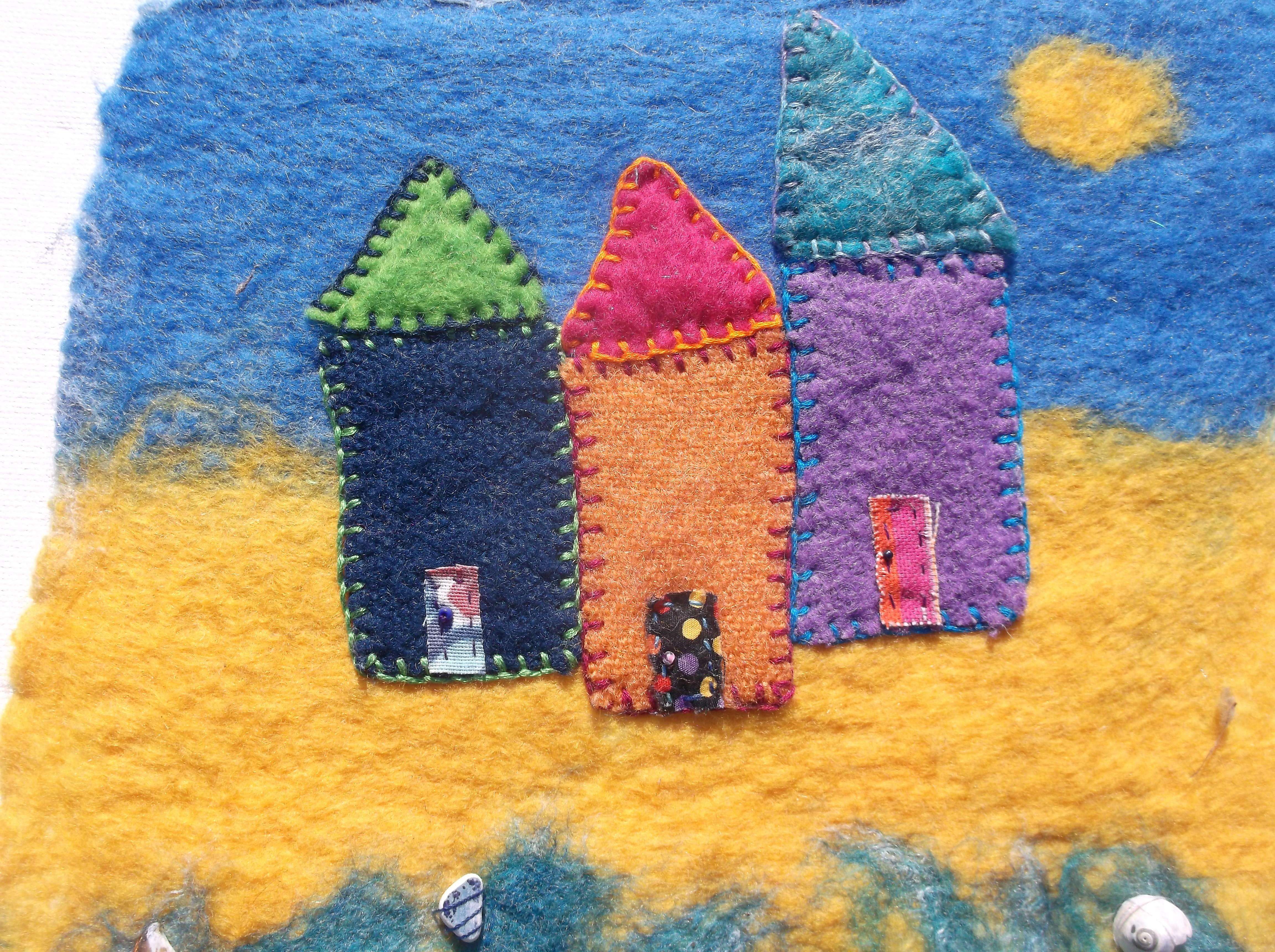
6. Felt Finishing Video 1: So now I got my foot piece ready for the final spirit. Just pelting process, but not necessarily the final stage of creating a piece of textile after I'll talk to you about that in a moment. Right now, you still have soap in it, Which, if we leave, it can rock the felt all the time. Don't mean immediately, you know, quite a long time. So in order to avoid that, I've got a bow here with some cold wolf, and I'm just gonna add a little bit of ordinary vinegar. Doesn't have to be What special it could be round it could be What? Just a few drops vinegar being enough. Sage is what will we move? So now you can also just give it to Vincent cold water first. But I'm just giving it a drunk in the subprime vinegar, so I'm gonna leave it in there now. While I talked about how you can embellish your pigs now, you could Doesn't matter. You can leave it for a few minutes a few hours, and then what I tend to do afterwards is just give it another instant cold water to get rid of the smell of the soap. So let's put that to one side. It's in the hands of one, so you can see on this pace, which is one I made earlier. I've added a few details, so I added some beach shots. Which of you some died, will Blackett pieces to a plea K on with nice blanket stitch, some little bits of fabric for the doors on little beats for the handles and then some of my beach cummings from the big Chairman's and ties. But if shall see us in China and then I just stitch the whole thing on to a stretch canvas . But you could have caused putting onto into a frame, if you wish. So I hope you enjoyed my video on Have fun with your felt making.
 Jo McIntosh, Textile Artist - St Ives Cornwall UK