Transcripts
1. Intro: Hi, my name is Niche
Snow, designer, productivity advocate
and lifelong learner. Over the years, I've taught
myself a wide range of skills from calligraphy and
hand lettering to notion, podcasting and
even punch needle, all without formal instruction. How? By creating my own
personal curriculum. Lately, TikTok has
rediscovered this idea. People are designing their own
self study like semesters, choosing topics they're
curious about and tracking their growth like students
in their own school of life. I love this because I've
always worked this way, and I want to show
you how to do it too. In this class, you'll design a self study
plan that feels doable, fun, and aligned with
who you are right now. You'll finish with a
personal curriculum you can use month after month, complete with a
syllabus schedule, and ways to stay accountable. If you're ready to create
your own learning path, download the resources,
and let's get started.
2. 1.1 Brainstorm Your Interests : So brainstorming
your interest is lesson one under creating
your own self study plan. Every curriculum
starts with curiosity. Take a minute to list everything you're drawn
to specific topics, skills, hobbies or ideas
that make you think, I'd love to learn this. Don't filter just
stream of conscious. What are the things
that pop into your head and just
write them all down? Don't think about
if it's useful or not, just write it down. And once you've done that, I also want you to
look at maybe some of your social media
accounts that might give you other ideas about
what your interests are. For example, if
you're on Pinters, take a look at your boards. What are you saving the most? If you are someone
who has, like, very structured Pintrs boards, like, what are the
name of those boards? Like, does that give
you any insight into things that you
are interested in? If you are on, for example, Instagram or Tik Tok. If you tend to save those posts, what types of posts
are you saving? If you go into the
saved post area of any of those
social media sites, do you see a pattern or a trend of things that
interest you the most? Think of this as
your curiosity list. The goal here isn't to
commit to anything yet. It's to see your interests
laid out in one place. For example, I created my own list of interests by
reviewing my reading list, the classes that I'm drawn to, the social media posts
that I bookmarked. I looked at my Pintresbard. I looked at my saved bookmarks. I looked at the substack topics that I tend to be interested in the YouTube videos I tend to watch when I
go into my watch list, I began to notice
patterns that helped me quickly generate a
list of recurring things. I also reflected on areas
I haven't yet explored, but might want to
add to my list. So your exercise
for this session, jot down all those
ideas either in your self study
plan template that I've provided or
in your journal. Whatever makes sense for you. Once you have that list created, take a few minutes
to rank your list. Start by highlighting
the topics that feel most exciting or
meaningful right now. This quick ranking will help you identify which ideas require
your attention first. Look at it like you're choosing your college electives
for your creative life. Once you've done that, next
is choosing your topic.
3. 1.2 Choose One Topic: Next step, choose one. Now that you have
your curiosity list, I want you to look through it and we're about
to simplify it. For this first round, I
want you just to choose one topic to focus on
for one month, 30 days. Keeping it to one will
help you build momentum, stay consistent and actually
finish what you start. You might be tempted
to do two or three, but I highly suggest for
this first go around, you just choose one
to see how it goes. Once you've gone through a whole month of
focused learning, you'll see how easy it
is to scale this system. You can then, repeat
this process for another month or even
run multiple topics at once in future months or quarters depending on your
energy and your goals. So the idea is to start small, learn deeply, and create a
rhythm that fits your life. So for this session, look through your list, rank the list, and choose the one that you
want to start with. Once you've chosen
that one topic, we'll move on to creating
some learning goals.
4. 1.3 Define How You Learn (Learning Goals): All right, the last
lesson in Module one, define how you learn. One of the biggest
mistakes we make is trying to learn the same
way as everyone else. The truth is each of us processes information
differently, and that's what makes
self study powerful. You can design a method that actually works
for your brain. I noticed that many
of the people who started the personal
curriculum trend came from what's
called BokTok which is a community of TikTokers
that discuss books, and they tended to build
their self study around stacks of books that
they were going to read for their specific topic. That's great for them, but it doesn't
work for everyone. Personally, I need a mix of formats to fully absorb a topic. So we're talking podcasts, videos, articles, and
hands on projects. But you may have a totally
different learning style. But if you have downloaded the PDF that I provided
in the resource section, one of the worksheets I have is a learning style
self assessment. This self assessment has five different
learning sections that ask you some questions
to help you get an idea of what kind
of learner you are. I also have a bonus reflection
and environment box, so you can start
thinking about what type of environment works
best for you too. I'm hoping that this
self assessment allows you to really think
through your learning style. For example, if reading
isn't your thing, lean in on audio books or
video lessons. Sign me up. If you learn by doing, include many projects or
experiments in your syllabus. If you love structure, making sure that you add your study session
to your calendar. The key is to make the syllabus, your learning plan easy to begin and enjoyable to continue. So your exercise for this session in your template or wherever you're taking notes, make a short list of how
you prefer to learn. It is your personal
learning formula. This will guide your
material choice and help you stay consistent. Once you've done that,
let's begin Module two.
5. 2.1 Learning Materials : Alright, on to Module two, which is building your
personal syllabus, the first lesson is curating
your learning material. So let's build your
learning program. Every class, even a self study
one, needs good material. So I want you to keep your
preferred learning style in mind as you begin to
gather your content. So think of this as your
shopping list for your brain. Here are a few
categories to explore as you're curating your content. The first is books. Most people are going to have
books in their curriculum. Regardless of what type
of learner you are. And so if you choose to do that, remember, you can go with
free options, paid options. You can go with physical options or digital options when
it comes to books. When it comes to physical books, you can go to places like Thrift Books to get
discount books. You can get digital
books that you can pay for on Kindle and Apple Books. You can go to your local
bookstore to get physical books. You can go to the library. And with the library,
you can go to your local branch to
get physical books, or you can connect your
library card to apps like Libby and get digital
versions of the books, either versions that you
can read in apps like Kindle because it'll provide it through Libby for you
to read it in Kindle, or you can do audio books. I do audio books all
the time in Libby. So know that as you're
building your list, there are multiple ways
of obtaining books, and they can be free or paid in a style that works
best for your brain. Also think about podcasts
and YouTube videos. These are excellent
free resources for auditory and
visual learners. Other things to consider
are documentaries, Ted Talks, newsletters and blog. So, for example, I keep all the AI newsletters that I receive in a folder that
I plan to read later, and I want to put that into an AI curriculum that I plan to do later for my
personal study. Last but not least, but
not this is totally, you know, not the end of the types of content
that you can use, but another type of content for consideration are
like field trips, and these field trips
could be to museums. You could go to free
or paid workshops. You can go to just physically
go to a coffee shop for a personal
journaling session that you can bring where you can
bring your learning to life. The point is, if you want to get outside the house and do something to help
with your learning, that can be done
in multiple ways, and it really just depends on the topic that you choose
and kind of what you find or define as a field trip for your particular syllabus,
your particular topic. So to guide your research, let's use a real example. Say, for example, you always wanted to write fiction, okay? But the idea of a full length
novel feels overwhelming. So you might start by exploring different
types of fictions, and maybe you land on the
idea of writing a novela. And a novela is something in between a short
story and a novel. So think of it as
it's like typically around 20 to 49,000 words. So I'm using this
specific example to help you think through the process of
building a syllabus. So you decide on
this novella, right? So from there, you could
use targeted searches, like how to write a novella. Nove structure, Novella pacing, Novell word count 15 to
30,000 or 15 to 49,000. Or you can search things
like NovelalaOline. And as the search
results come up, you can click on the various links to see
what appeals to you. You can also, let's say, if you were researching
this topic, you can also mix in
broader searches, like even just how to write fictions to round
out your study. And as you're doing
all of these searches, you should save
articles, videos, or book recommendations that
pop up and interest you. And you can always mix them later if they don't
make the cut. So there's a lot
of different ways to gather the information that you need as far as the
materials that you need. And I suggest not just
using a search engine like Google to find content, go onto YouTube and do searches. Go to some of your
favorite bookstores and do searches of
the content there. Go on to Red it or Substack. And I would say, as
you're searching and you're gathering
all of this content Pay attention to the ratings or the repeated
recommendations because maybe you'll see on Google, YouTube, and Red it, everybody brings up the
same book or everybody brings up the same
workshop or same whatever. More than likely, it's
something that you should probably add to your curriculum because people truly
value that content. So as you do this research, gather your resources
in one place, the syllabus template
that I provided, or you could use your
browser bookmarks. You can create a pinchers board. You can create a list
in your Notes app. You can create a notion page. The point is, you need to have a structured way of gathering
all of this content. Yes, you could write it down, but I highly suggest
for this part, being able to have a digital way to capture it because a lot
of things will be links, and you want to be able to easily get back to those links. So you can make it as
complex, you know, or as easy as you
want, as far as, like, how you gather
this information. But just make sure that you have one central location where you're organizing all
of your material. And then remember, you can make your curriculum as budget friendly or as
deluxe as you like. It's your school,
it's your rules. So I hope that example
that I provided, like, on even like how to
write a novella kind of helps you think through how you want to gather information for your particular topic,
because guess what? That is the exercise
for this session. Add the materials you find,
as I mentioned before, to either the
template I provided or however you have decided
to organize your content. And remember, as you explore, the important thing
is to collect everything just in one place. As I mentioned before, the browser bookmarks
or the Pintrsbard, your Noeapp or the notion page, just keep the
resources organized, ensure you can easily reference them when
you start your study. And if this feels overwhelming, you can always see if
someone else has already created a personal curriculum that they're sharing for free, because a lot of people online are sharing their curriculums. So you can do a search for personal curriculum syllabus
for how to write a novella, how to start
knitting on physics, you know, whatever
you want, you know, you can search and see if maybe someone has already
done the groundwork, and then from there, you
can use it as it is, or you can then customize
it a little bit more. I just want to
make sure that for someone who doesn't feel comfortable doing deep
searches on specific topics, I just want to make sure I can meet everyone
where they are, and no one feels overwhelmed
in this journey. And remember, there is no
right or wrong way to do this. The point is that you
just get through it. So after you have gathered all the material
that you think you need for your syllabus, go on to the next section.
6. 2.2 Create Your Syllubus: Lesson two under Module two is creating the actual syllabus. We're almost there people.
We are almost there, right? So remember, you are accomplishing this over
a four week period. So we want to make sure
that this is achievable. In this section, you are
going to choose a title, write a course description, write learning outcomes,
and decide on a goal, and you're going to organize this content over four weeks. I'm going to stick with the
writing example used in the last session to walk
you through how to do this. The course description
and learning outcome sections are
optional in your syllabus, but I highly recommend them. Begin to work on this syllabus. If you go into the Resource
tab for this class, you'll see three PDFs. You'll see a printable PDF
where you can print this form. Or you can use that PDF to open it in good notes and take
notes and good notes. You'll see another
PDF labeled forms, and it allows you to use
Acrobat in order to, like, type into the
different areas. And then a third PDF is the PDF that I'm showing
you here where it's already filled out so you
can get a sense of how you can use it
for your project. If you go to page eight
for course materials, you'll see this is
where you can cut and paste in or write in depending
if you printed this. The content that we talked
about in the last lesson is just a good way of throwing in everything
that you found, adding the URLs, maybe
start to chunk out the information either
by type or topic, just so you can
see what you have. Start to organize it. For me, I kind of chunked everything by things
that I want to watch, things I want to listen, things I want to
read, and events. But you can do it
however you want. The point is that you have all the content for
consideration in one place, and you can start to organize it so you can then use it
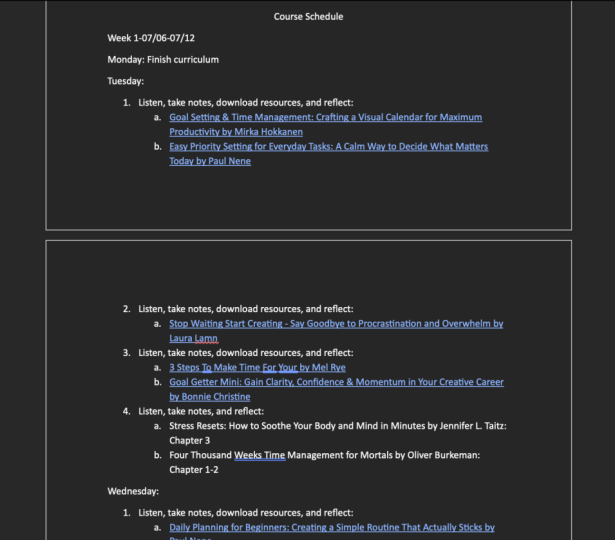
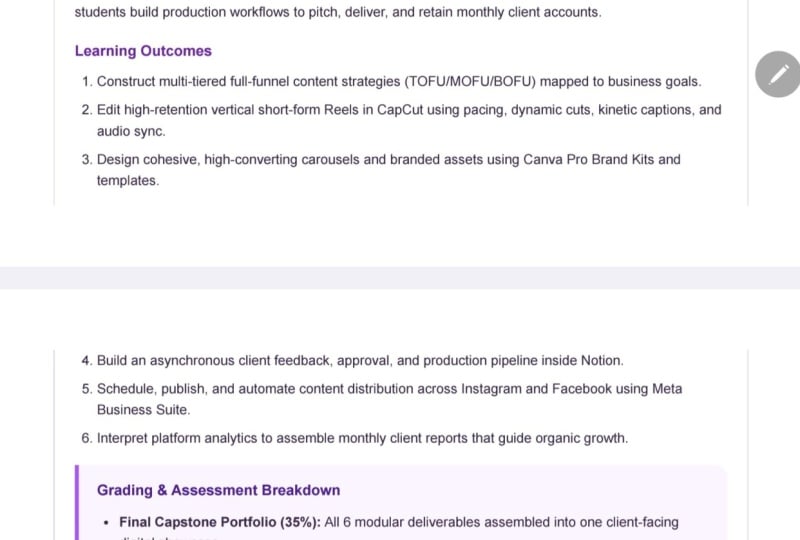
to create your syllabus. Next, you have the syllabus. The syllabus is three pages. The first page has the title, the duration,
course description, learning outcomes
and assessment. And the next two pages are
week one through week four, and this is where
you would start to organize your information. For the first page
of the syllabus, I recommend giving your course a fun title that is relevant to what you're
trying to learn. You put in the duration
for this class. We're focusing on one
month, but in the future, you might do a fall semester
or summer semester. For the course description,
keep it brief. Two sentences about what
this course is about. The learning outcome,
I suggest adding a few ticks on the
things that you want to get out of the
course that you're creating. And these just gives
you a good base for what you're
trying to accomplish, and it will help you when you begin to structure your content. Then last but not least on
this page is the assessment. That's how you're going to grade yourself and hold
yourself accountable. You can make this as easy
or as complex as you like. I added a grading scale here, and I gave percentages, like a weight of percentages to everything that I want to
do from a midpoint check on how many words I've written to the goal is to complete a polished draft or three strong chapters by
the end of week four. So that's like 35% of my
grade for this course. I have quizzes and
self checks and also weekly exercises that
I've created for myself. I have the reflection for 10%. And it says, Here, all work should be completed on schedule. If I fall behind,
I'll document why, adjust my plan and make up
the work within two days, like a commitment to myself. Now, for the fun part, this is where you begin to
take all the materials from that other sheet and start to put them in their
respective weeks. Sometimes when you're
putting together a class, you'll see themes
start to pop up for me when I was looking
for Novella content, I saw several themes
story foundations, building the world
and characters, drafting and pacing and
editing and sharing. And so I decided to
split those topics up, subtopics up into different
weeks and then bundle the content that made sense with the particular subheader. So, for example, for
story Foundation, I had a lot of content that concentrated
on story and just, like, learning how
to write a novella. I didn't use all of it, but I used enough to feel the time that I have
decided to commit to this, which is 4 hours a week. So this Skillshare
course is 36 minutes. I believe YouTube video
is under an hour. I have, like, a podcast
I'm listening to and probably the most
time commitment here is the book
for Stephen King, which is what I'm going
to listen to on audio. But I can kind of
listen to that every day during the week in
the car and so forth. And so I don't think that
it should be a problem. And for the things that I
need to concentrate on, I'm going to block off 2 hours, two days a week in order to
sit down and do these things. So I'm fully committed to
doing all of this content. Then also, I have
an assignment here, which is to write one sentence, and then I have a
quiz for myself, and you can use Claude or
Chat GBT to do a quiz. I want to do a quiz when I
finished a Stephen King book, so I can go and ask hatGBT
like please give me a five question quiz on based on Stephen
King's book on writing. And then it can give
me the questions. I can answer the questions. I could put my answers
back in there, and it can kind of let
me know how I did, and I can have it grade myself. So I'll talk a little
bit more about AI later, but I just wanted to give you an idea on how you
can create a quiz. You can have someone else
create a quiz for you. Maybe some quizzes are available online that you can use for whatever you're
learning to do. There's just so
many creative ways to figure out how
to test yourself. And then I have, this
little prompt here. And so you'll see, as
I mentioned before, I have this example in
the resources section. And you'll see if you open up this example that I kind
of follow the same kind of theme throughout the
sheet of thinking through what content I can truly
get through in a week because I wanted
to make sure that it wasn't too overwhelming. But I wanted enough
content there where I could really start to
understand the content, and I wanted to make it
like a real college course. And so what I would
love for you to do it's begin to
fill out this sheet. There is no right or wrong. Even if you Google, like, personal curriculum
videos on social media, you'll see some
people might just have a book a week
that they're reading, or some people might have
watching YouTube video, and they might have one project that they're
completing a week. There is truly no right
or wrong way to do this. The point is to not make it so complicated that you
don't even get started. Make it as simple as possible. Put in as much work
as you want to that you're excited about putting
into creating this syllabus, and then just start. You can always
modify it as you go. But you just want to put
some information down on paper or down digitally in
order to begin your journey. So please fill out this template or
whatever template you may have created for yourself in Notion or Excel or whatever else
you've decided to do. And once you've
done that, please move on to the next lesson. And again, be creative. There is no right or wrong. Just get started.
7. 3.1 Scheduling & Consistency: So on to Module three, tracking and celebrating
your progress, the first lesson is about
scheduling and consistency. So it's easy to start learning, but staying consistent
could be a real challenge. I want you to treat your
personal curriculum like a real class because it is. The difference is you're
the one who sets the pace. Just like if you are enrolled
in a college course, you need to determine
your schedule or the type of class you
want to enroll in. We all work differently. Some people prefer
in person classes while others thrive
with online learning. Some require a set time in place while others enjoy the
freedom of flexibility. When you consider how to set
up your curriculum schedule, I want you to think about these two options and determine which one
works best for you. The first type of schedule
that you can set up for yourself is what I
call a fixed schedule. So just like at any major
university or college, your classes are set up for
specific days and times. And so if that works for you, having a specific
day and time setup, this is an example of how your
calendar could be set up. You can pick days
that work for you. So you can say Tuesdays
and Thursdays are your main days and maybe you have Saturdays for
your homework. In your calendar, you would then schedule the specific
time that works for you. For this example, I
have given 7:00 P.M. To 9:00 P.M. As allocated
time for the course. And then you'll
see I also put in there actually what is expected
for me to do in week one. And if I wanted to, of course, I could just maybe, let's say, I just wanted to watch one video on this day
and read on this day. Maybe I just put the
two items for that day onto that calendar entry. So you can set it up, however,
it makes sense for you. But the point of this is, it's important to put
it on your calendar, dedicate days and times if that helps you hold
yourself accountable and set up reminders
that will pop up 30 minutes before a
class is going to start, so you could start getting
your area ready and making sure you are kind of in go mode when it's time
to do your course. And of course, this is just
one example of a schedule. Whatever days and times
work best for you, that's what you should go with, whatever you think
you could stick with. Okay, on the second type of schedule I love talking about is a more
flexible schedule. For two different
ways, you can set up your calendar for a
flexible schedule. Going with the same Tuesday, Thursday premise
and Saturdays maybe for homework or just for
a third day of class, instead of setting
up a specific time, you can set your calendar
as an all day event, and that's just like
a reminder to you. At some point, you
need to make time to do some of the items
in your week one list. And just like before,
you could copy some of those items from week one
into your calendar entry, but at least it is a
visual reminder for you to do these things every time you open up your
calendar, and of course, you can set up reminders
for these two, it'll just pop up, of course, in the morning since
it's an all day event and then you just have
to be really mindful about making time to fit some of the
exercises into that day. A second way to reflect
a flexible schedule on your calendar is to
have the calendar, just having specific days
just doesn't work for you, but you're really good at maybe making time in your fringe
hours in order to do things, you can set up your
weekly events. So for week one, I have it where I have, the week one items in there, and I have a set from Sunday to Saturday that first
week in January. And then the second week, I have the second week
of content that's due. That's just like
another way for you to set up your flexible
schedule in order for you to have some visible reminder of the things that you're
supposed to do. And, of course,
you can get super creative with these calendars. You can add a final
assignment entry here. You can have a
combination of what I've shown you four fixed
and flexible schedules. The important thing
is that you find a way to hold yourself
accountable and that you deem this
important enough that when your calendar
reminder dings on your phone or your tablet or your computer that you
actually take action. Like, you treat it
like you treat work, and you're going to commit
to it no matter what. So please take a second
to think through this. And of course, in your workbook, I also have a calendar schedule. That you can use in order to just help
you think through it. So you see, I've just
messed around here with, like, some times and you can use this for
planning purposes. And I have a little note section on the bottom, and it says, Saturday and Sundays are assignment days Monday
and Wednesdays, I will read, watch and
listen to the material. And then I also have
a statement in here I am committed to writing at
least 15 minutes a day. I misspelled that. I'll
aim for the mornings. But you see where I'm
getting here is like, plan out, how you want
to carve out your time. And once you do that, let's
move on to the next module. Homework grades, and
self certification.
8. 3.2 Homework, Grades, and Self-Certification: Now let's talk about
homework grades and self certification. Every meaningful
curriculum should end with something tangible, something that
captures your growth. That could be a final project,
a reflection journal, or even a short video sharing what you learned and
how you applied it. Then celebrate yourself. Print a certificate,
post your results, or even invite a friend to, like, grade your work. Not for perfection, but
for effort and creativity. When I taught
myself punch Nedle, I shared my pieces online and
gave a few away as gifts. Most recently, I
finalized 12 classes for my personal curriculum after I went through my
brainstorming session, and I took the time to design
a Snow University seal. I know. That's super extra. But once I complete all of the 12 courses that I've set up, I am going to get that
seal made into an iron on badge that I can
add to my jacket. It may sound silly, but these small
rewards and rituals make learning feel real. They give you, like, something
to look forward to and remind you that progress
deserves to be celebrated. Your learning journey is
worthy of recognition. So find a way to honor your hard work and keep
your momentum going.
9. 4.1 Learning Space and Exploration: First lesson under Module four, let's talk about learning
spaces and exploration. Your environment
shapes your mindset. Whether it's a corner
desk, a coffee shop, or your couch, you need to make your space feel like
your creative studio. You can add little cues
that tell you your brain, like it's time to learn. Some people like music
or ambient noise. Some people might want to light their favorite candle or use their favorite
pen to take notes, or somebody might have, like, a little board or
a visible tracker so they can see their progress, the progress that they've
made on their curriculum. So you're creating an experience not just checking off lessons. For example, I prefer to
work in complete silence. It forces me to
focus and lets me, lock in without distractions.
But that's just me, right? Other people need something
in the background. So please take time
to think about where you're going to learn and how you
want that to look. So let's get into exploration. Remember your curriculum should energize you, not exhaust you. So schedule explorations. And that could mean
visiting a museum, going to a craft market or watching a film
related to your topic. Don't just sit at
your desk or on your couch only during
your class time. Get out and do things,
even if maybe, you know, you're not
one to go out much. Try to, like, add
a little bit of exploration to your curriculum. And remember, at the
end of each week, make sure you are taking
that time to reflect. I just want to double
down on that, like I did. In a previous lesson, but I want to add some additional questions that you can ask yourself at
the end of each week, which are what inspired
you, what challenged you? And what do you want
to explore next? Learning is more meaningful when you connected to your life. And so just by constantly
reflecting on what you've done will help you appreciate even more the hard work that
you're putting in.
10. 4.2 Using AI to Shape Your Curriculum: In this lesson, I want
to talk about using AI to help shape
your curriculum. One of the best ways to supercharge your personal
curriculum is by using AI as your research
and organization assistant. Think of it as your study
partner available 247. Before using AI, do your own initial research
and develop your own list. I purposely added this to
the end of this class, so you wouldn't use
AI as a crutch. But I do think that using
AI is very effective, but it is important to balance
it with your own research, your own critical thinking. Here's how I suggest
using AI effectively. The first way is brainstorming. And there's brainstorming,
there's resource discovery, syllabus structuring and
accountability prompts. But I want to start
with brainstorming. My first prompt might be, I want to create a one
month personal curriculum for writing a novel. I've never written
a book before. What do I need to learn? Ask me some key
questions so you can determine what resources
might work for me. Give me three potential
projects I can realistically
complete in a month after finishing my curriculum. So it writes back like, why do you want
to write a novel? Do you already have a story idea or are you starting
from scratch? What kind of stories
do you love to write? And then it has questions about writing
experience and comfort, time and structure and
some questions that I can answer about
my learning style. And then it says, once
I've answered the question that it can help design a four
week personal curriculum, recommend specific
authors videos and books, and outline three realistic
one month projects. Of course, I'm not about to answer all of these
questions that would take me definitely
down a rabbit hole. But you can see by asking
these questions and having a conversation with whatever
chat box you decide to use, it can help you think
through what you want to do. So, for example, we have
decided to create a novela. And so how may how
did I get there? I was doing some research on the types of fiction
novels there are. And so, just to give you an example as part of
your brainstorming, like if you didn't want to
answer all these questions, but ask more questions, you could ask something like, What are the different
types of fiction? And now it is giving me
by length and structure, different types of fiction
from flash fiction, from short story to novelette to Novella to novel to series and saga and
so on and so forth. And it also is giving me all of the genres
that I can write in. And so you can see how you
could go down a rabbit hole. Like, if I run into we
young adult or mystery, I can ask you some
questions about that. And then, based on the
answers to those questions, I can then determine what
direction I want to grow. Oh, do I want to
write a novella? Do I want to maybe do something simple
like a short story? That's 1,000 to 750 words? Do I want to write a romance
novel or a fantasy novel? But just by going back and
forth with the chat box, it will help me break down
exactly what I want to do. So you can see how this could be an excellent brainstorming
tool so you can figure out what you want to focus on if you don't yet have
clarity on that. Well, another way you can
use AI in order to help you with your personal curriculum
is resource discovery. So, for example, you
can ask your chat box. I've decided to write a novela. Can you provide a list of reading and video
materials I should consider for my one
month curriculum? Also, I like to include some DC events related
to writing novelas. Now, of course, keeping your
self assessment in mind, you can ask for, you know, more or less of the type
of content you want. Do you want more blog articles? Do you want more books. Do you want more videos? Do you want it to find classes? You should get pretty
specific in your prompt. But for this example, I just
kept it pretty general. And so it has provided me with some
videos that I can consider. It also has provided me
with some books and guides, one of which I've
already included, which is the Stephen King. Okay. W. And then it has also given me writing events in the DC area where I'm based, and I could consider some of these events in my curriculum. And it also provided unprovoked a section how to
use these in your curriculum. Here's how you can incorporate the above into your
one month plan. And it has foundations, plot and structure,
voice dialogue, and scene workk and the
revisions and next steps, which is interesting
because I went through the four ways I broke
down my content. So there are some
similarities here, but they're slightly different. So I could take this
into consideration and modify my current
curriculum if I so choose. Um, but you can see here how Cha chiPT was able to
give me some resources, at least to start with. And then, let's say, if I didn't really
like any of these, I can say, like, Hey, these YouTube videos are too
long or too short or I'm looking for more
mystery Novella writers or fantasy or whatever. And so I could have
this chat with ChatGBT to get even more examples of what I might want
to potentially use. And so, depending on
the type of content, you could really, really dive
deep with Chat GBT Cloud, whatever your AI tool of
choice is, in order to, like, help you discover
resources you haven't already found through
your own searches. The third way that I
mentioned about using AI effectively is potentially
for syllabus structuring. So I'm going to open up my class PDF and
in the class PDF, of course, I have already broken my content
down into four weeks. But let's say I hadn't. I could create a prompt
that says Below, I've added the
course materials and an event I want to include
in my personal curriculum. Organize them into a
four week syllabus that begins the week
of November 16. I can only dedicate 6 hours per week to learning,
make it achievable. What I did is I copied and pasted all
of the course material, even though there are a few that I didn't actually
include in my final. I could tell it to
kick some of it, but I'll just leave it as
it is for this example. But I've pasted it all below. It's okay if it's not pretty. And then I just picked one of the events from the link that I had in the PDF that
starts on November 20, which is why I decided to ask ChaGBT to start my class in the middle of November
just for the heck of it. Alright, so as always, ChaGBT is praising me. Perfect. You've already
assembled an outstanding list of materials that balance story,
character, and editing. And so it now lists the
personal curriculum below, start date, November 16, time commitment 6 hours, go build core fiction skills
in structure character, and editing to outline and
draft your own novella. And so it has, like, what week one will be
the theme, the goal, it has like 2 hours
of watch time, 1.5 hours of read time, one hours of listening time
and reflect and write. And then it has, like, an optional event
which I put in there, which happens to fall
on the first week. And then it does the
same two for week two, week three, and Week four. So this is, like, a great start. You definitely have to use some critical thinking
and look through it, make sure that whatever tool you use has bucketed it
into the right week. You also need to make
sure that it read the time stamps on all the
different videos accurately. So it's saying, like,
watch these for 2 hours, but how long are they really, am I only watching
half of it? All of it? Will I have 30 minutes left
after watching these videos. So you still have to
go in and do kind of, like, some critical
thinking on your own about, is this really achievable? Like, where it says, read, 2 hours, are these
articles? Are these books? So am I just reading
until I stop? You know, so you have to you
do need to check the work. And then it says,
by December 13, you'll have a Novella
concept and full outline, opening scene draft, a working editing checklist and a foundation for continued
drafting through winter. And you might not
be able to see it, but in each of the weeks, it did have, like,
a writing prompt. And so the writing prompt in
practice is supposed to help me with achieving my goal of having something written
at the end of four weeks. Um, at the end of it, it says, Would you like me
to format this as a printable syllabus PDF? And so I could say, yes, I could have it exported as a
spreadsheet if I wanted to, or I could start
asking you questions, maybe to move around things, telling it, I don't
like something. So I can really go
back and forth here and massage the content. So I encourage you to
play around with it. The second way is like,
you've already created. If you've done your syllabus already because you've been
following all of the prompts, you could attach your PDF. So I'm going to attach my PDF. And I also wrote a prompt, just a simple one
that just says, thanks because, you know, they always say, thank the
machine, please and thank you. We'll know when it's
going to take over the world. Okay, so thanks. I've attached a PDF
of the syllabus I put together along with some
additional thoughts. Let me know if I'm
missing something. Also, create the content for
the quizzes I've outlined. Alright, let's see what it does. It says it's reviewed my PDF, and it says, I've done an
excellent job at structuring. Here's some feedback.
So overall assessment, it likes my themes. It says I've balanced
the modalities, thoughtful evaluations,
some minor suggestions. It says I need to maybe add a
daily writing habit metric. Um, clarify quiz format. Do I want multiple choice, short answer or reflection, and post course reflection. It says, after Week four, add one What's next unquote page to plan revision or
publication steps. So so those are some suggestions for me to
take into consideration. And then it also for the week
one quiz I have outlined, it has given me a
quiz with the answer, but I could always modify that
prompt and say, you know, please create a quiz, but don't give me the
answers yet because yeah, this is, like, cheating. Week three, it also
gave me a quiz. And that kind of
goes into actually, the quiz goes into the
accountability prompts. So, you know, I've already
talked about brainstorming, resource discovery,
syllabus structuring. And the last thing was
accountability prompts. And so, since I already had
something in my syllabus, I asked it to go ahead
and create some quizzes. But I could also ask it for
some reflection prompt ideas, ideas on what my final
project should be, what I realistically
can write in a month with only being able
to dedicate 6 hours a week, you can have a chat box
help you with, like, your final project
and or quizzes, tests, journal
prompts, you name it. It can help you with those
accountability resources that you want to put together. Last fois, I'll mention it can also help with
tracking progress. So you can ask AI to, like, summarize your weekly
notes or progress logs, turning kind of like
your messy thoughts into usable insights or have it help you build a
calendar or tracker to, like, visualize your progress. So there's just so
many different ways that you can use AI. I'm just dabbling
with it a little bit here just to make sure that you know that there is another
tool that you can use in order to help you come up
with a curriculum in no time. Let's go to the next section, reflect, refine, and share.
11. 4.3 Reflect, Refine, and Share: Hi. The last lesson
in Module four, reflect, refine, and share. You've been shaping
your personal curriculum throughout
this class, adding ideas,
refining your goals, and creating a structure
that fits your life. Now it's time to pause and
reflect on what you've built and give it
one, last polish. Revisit your template or notes and ask yourself
these questions. Does this plan still reflect what excites me most right now? Are there any lessons, resources, or goals
I want to adjust? What worked well during this
process and what would I change the next time I
created a curriculum? This reflection isn't about
rewriting everything. It's about aligning
your curriculum with where you are today. Once you refined your plan, document your key takeaways, what you learned about yourself, your creative process,
or how you learn best. You can capture
this in a journal, a short reflection
video, or a post. When you're ready, share
your completed curriculum and reflections in the
Skillshare project gallery. This is a learning community, and your syllabus can help others learn a new
topic, please share it. I'll be checking in to see what you've created
and also to see if you have any questions and to celebrate how
far you've come. Remember, reflection
is part of mastery. It's what turns
learning into growth. Thank you for taking my class, and I hope you enjoyed
it. Take care.
 Nache Snow, Educator // Speaker // Author