Transcripts
1. Introduction: You could think that building a creative life
requires discipline, that you need to push harder, be more consistent,
overcome your limitations. That if you just
had more willpower, you'd finally make it work. Or you can believe something
entirely different. You could believe that
the way you're designed, your rhythms, your limitations, even the things you've
been told are holding you back are actually
pointing the way forward. This is what I call the
Coexistence Philosophy, and it changes everything.
Here's what I know about you. You've tried to be consistent. You've downloaded the apps, you've started the
bullet journals. You've blocked the time. And for a few days, maybe even a few weeks, it worked until it didn't. And then you found
yourself right back where you started wondering
what's wrong with you? Let me tell you that
nothing is wrong with you. Productivity industry
has sold us a lie. They told us that scattered
equals undisciplined. But if we just tried
harder, pushed more, forced ourselves
to be consistent, we'd finally break through. But here's the truth
they won't tell you. Consistency isn't
about discipline. It's about safety.
Your nervous system doesn't care about your bulls, I cares about your survival. And every time you force yourself into a system
that doesn't honor, tu you're actually wired, your nervous system receives
a threat, so it shuts down. You're not broken.
The systems are. I know this because
I've lived it. I was born three
months premature, doctors told my parents to have low expectations
about my future. I grew up with learning differences,
chronic health issues, and eventually was diagnosed with obsessive
compulsive disorder, the kind that used to
run my entire life, and, frankly, was a
deep form of suffering. For years, I tried to overcome
all of it, push through, be normal, be disciplined, mask myself, change my reality. And it almost broke me. And then during a particularly difficult season of treatment, something really
shifted in my life. I stopped asking, How do I overcome this and
started asking, What if I learned
to coexist with it? What if my limitations
weren't walls but waypoints? Most importantly, who
I was meant to become? That question
changed everything. I became an art director by 20, not by overcoming
my differences, but by designing around them. I built a six figure
creative practice while navigating OCD and
other health problems. I've helped alongside
multimillion dollar campaigns, and my work has been featured on Good Morning America more than
once displayed in Disney, New York City Holiday Windows and with an upcoming and really, really exciting
partnership with Walmart. Now I teach other creatives
how to do the same. I've taught over 8,000
of you guys and worked one on one with dozens of
entrepreneurs worldwide, helping them stop fighting their wiring and start
building with it. Your nervous system
does not distinguish between business stress
and life stress. It's all in the same energy pool with how your body
processes information. And any system that pretends otherwise honestly is
setting you up to fail. So we're going to be building something very different today, something that works with
your whole holistic life, not just the parts that
look good on Instagram, good on social media, or strictly even part of
your creative practice. This class, I'm going to share the philosophy and practices that made all of this possible
for me and for others. And you're going to learn
why your nervous system, not your discipline, determines your consistency as a creative
and a business owner. You'll discover how to map your limitations
and design systems, actually work with your
life, not against it. By the end of this class, you're going to have
a complete 90-Day Creative Life
Blueprint in Notion, a personalized roadmap
that honors your energy, your seasons, and
your nervous system while actually moving your
creative goals forward. Promise, you're not broken,
you're not undisciplined, you're not too scattered, too inconsistent or too
much of anything. You're just trying to fit into systems that weren't
built for you. Let me show you a different way, a way where scattered
becomes sustainable, where your limitations
become your blueprint, or you stop overcoming
and start coexisting.
2. The Coexistence Philosophy: Let me start with
something that might sound a little controversial. Discipline is overrated. What is the problem is that we're trying to fit a creative, maybe neurodivergent
Limitation navigating human, which is all of us into
systems designed for machines. Think about it. The entire
productivity industry is built on an
assumption that if you can put X into your system and you get Y output results
that you're a machine, and it really just
needs optimization. But if you just follow the
right morning routine, download the right app, block the right amount
of time properly, you're going to
finally be consistent. You're not a machine. You're an amazing human being who's complex with a body
and a nervous system. Limitations real, ever green shifting life
that constantly is changing. Here is another truth that the productivity industry
doesn't want you to know. There is no quick fist. There's no magical pill. Real sustainable
creative businesses, growth stems from
consistent, long, hard W. Not sexy, not viral, not what gets
clicks on social media, but honestly, it's the truth. It's the things
that happen behind the scenes and the
flexibility with it. The apps aren't
going to save you. The templates will not save you. The morning routine
that's perfect on YouTube will not
save you. So what will? To me, it's systems that honor
how you're actually wired that work and compound over time with flexible consistency, consistency that comes
from safety at force. It is a shift from
habits to hacks, from optimization
to coexistence. So why do traditional productivity systems
keep failing you? Well, typically, it's
for three reasons. First, they ignore
your nervous system. There's a nervoscientist
named Stephen Proges who developed something
called polyvagel theory. It's essentially a map of how
your nervous system works. And what he discovered is this. Your nervous system has actually
three different states. One is called the
ventral vagal state. This is where you feel safe. Connected, created. This is where you can
access your best work. You might even call
it your flow stake. The second is fight or flight. This is your sympathetic
nervous system really kicks in
when it proceeds, there's a potential threat. And then the third is
complete shutdown. It's total system collapse. We've probably all been there. Creative work literally requires you to be in that first state, the safe state for
most of the time. When your nervous system
detects threat if it's a threat that's just
this system is too rigid. This to do list
is too stressful, or I can't keep up
with this piece. Naturally, your
body's going to say, No and shuts down. Not because you're lazy, not because you lack discipline or you don't care
about the goal, because your nervous system's whole primary job is
to keep you alive, not productive, but alive. And there's actually
a difference. I know it doesn't feel like. Second is that they treat
you like a machine, right? Machines don't have greek. They don't have chronic illness. They don't have ADHD or OCD or anxiety or days where
the world feels really, really loud or
overstimulating or heavy. Machines don't have seasons
like winter or exhaustion or summer or distraction or autumn
or momentum, but you do. And any system that doesn't account for that will
eventually break down or slow down or need to
be constantly recalibrated. Third, the industry sells
discipline when you actually need safety as more
of a band aid treatment. Consistency isn't about
discipline alone. It's about how safe you feel as you move through your goals and move through your decisions. Your nervous system
will let you be consistent when it feels
safe to be consistent. I know it sounds a little
redundant, but stick with me. It is not when you
shame yourself into it. It's not when you white
knuckle through something. Those are usually
temporary fixes. Safety is something
I really want us to understand in a whole new way that we may have never
been taught before. And this is where Coexistence
Philosophy comes into play. There is another psychologist named Stephen Hayes who spent decades researching
something called the acceptance and
commitment therapy. And what he found is actually
really, really fascinating. Trying to suppress
uncomfortable feelings and discipline actually
makes them more persistent. In fact, there was
a famous study also by another psychologist
named Daniel Wegner, who asked people not to think of a white bear, and
guess what happened. And you're probably
picturing it right now. They thought about
white bears constantly. More than 1/minute, actually. This applies directly
to your creative work. When you try to suppress self
doubt, imposture syndrome, fear of failure,
you actually end up making these thoughts
much, much louder. But here's the
twist. ****** shows that when people accept uncomfortable
feelings and focus on pursuing meaningful
work anyways, they actually
experience more joy and less distress over
a period of time. Acceptance literally costs less energy than
resistance itself. I learned this through my own
recovery process with OCD. Intrusive thoughts and anxiety were honestly
unbearable at times, and the more I was
able to sit with a discomfort, through the sweat, through the literal tears, the more I was able
to actually take my power back and my
cues from my condition. And once I realized this,
I was like, Wait a second. I've been doing this since
I actually was a kid. Now, I'm not here to
glorify discomfort or reduce what maybe you're
experiencing in your life. This is about
acceptance of actually how imperfect our
day to day often is. In a world that has
mistakes and burdens and twists and turns and
worry and inconsistency, mastering this art is like mastering the communication
within yourself. It's not just limited to a form of physical
or mental suffering, but it's actually how
you receive information, how you filter it, how you project it back into the world. And this internal dialogue then allows you to create with
clarity instead of chaos. So instead of trying to
overcome your limitations, what if you learned to
coexist with them instead? What if you stopped
seeing scattered as a failure and started
seeing it about data, about what you need and how you operate and how you take
in all that information? What if you design
systems that breed with your nervous system
instead of fighting against it? Here's what that looks
like in practice. You don't force yourself
to wake up at 5:00 A.M. I your body naturally
wakes up at seven because you actually
need 9 hours of sleep, unlike your friends or maybe
your significant other. Despite the fact that
you've planned to work on a painting
or an illustration, if you wake up
with a migraine or an unexpected phone call from someone in distress
in your family, you have systems in place to strategically shift
the task around and still be productive within the unexpected
limitations of your day. You don't plan your biggest
creative push in December if December is historically your lowest energy
month as a person, and maybe you even have less resources due to the weather. You don't commit to a
90 day sketching sprint at the same time that
maybe you're navigating some other big physical or
mental exploration with doctors appointments or a
workplace schedule commitment, like, even a seasonal
sport that you're trying to take care of for
yourself or for your family. Instead, you ask, What
does my nervous system need to feel safe right now
in the season that I'm in, and that is where
you build from? This is actually how scattered
becomes sustainable. Not by becoming
someone different, but by building systems that work with who you actually are. This is so, so exciting because we start to
communicate with the internal monologue of our creative self and
who we want to become. I want to teach you
how to do this in real time every single day
for any part of your life. It's really, really exciting
to stick with me. S.
3. Evidence Microdosing: Let me ask you
something. Why does your comfort zone
feel so comfortable? I promise it's not random. It's not a character flaw, and it's not something that
you need to overcome with a heroic leap and all
this, again, discipline. Your comfort zone actually feels comfortable because you've gathered evidence that you are going to be
safe in that space. Every time you've done
something in that comfort zone, whether it's posting a
certain type of content, working in a familiar
creative medium, or talking to people
that you know, your nervous system has
collected that data. This is safe. We survived
this. We can do it again. But here's what happens when you step outside of
that comfort zone, you have less evidence. So your nervous
system does not have proof that you're safe
doing this new thing, the thing that you're
trying to work through. So it really, really freaks out. Yeah, all of us are trying
to find the perfect planner, and this is actually the deep work that needs to happen first. It's not because
you're incapable and it's not because
you're not ready. It's because your system
is doing its job. It's protecting you from
a perceived threat. You've probably seen these
comfort zone diagrams. The comfort zone is
obviously the center. Then the fear zone,
the learning zone, and the growth zone
expands throughout the ridges of these
circular spaces. And traditional
advice is you jump from the center straight
into the growth zone. Just do it, right? You feel
the fear and do it anyways. You take the leap. And, sure. Sometimes we can do that. But what actually
tends to happen when you try is that you panic, you shut down, you
run back to safety. You don't stay consistent. You don't stay motivated. You don't follow
through, because you tried to go from
zero evidence to 100 pieces of evidence
from I've never done this to I'm doing the
scariest version of this. Your nervous system obviously
does not work that way. It needs proof, small repeated proof that you can survive the thing
you're trying to do. Now, maybe the word
survival sounds a bit heavy for those
of you listening, but we're wanting
to apply that to anything that takes
energy and effort. You're expending energy
and you're spending time, that is a form of survival
to your nervous system. So whether it is calling
somebody on the phone, paying a bill you've
never paid before, posting consistently
on Instagram traumas, it all applies. So obviously, I'm
here to tell you what actually works,
in my opinion. Back in the 1950s, another psychologist
named Joseph Wallop discovered something called
systematic desensization. He was treating
people with phobias, extreme fears that were completely shutting
down their lives. Instead of telling them to just base their biggest
fear all at once, he actually created
a ladder structure. If someone was
terrified of spiders, he didn't start by putting
a spider on their hand. He started by having them look at cartoon drawing of a spider, then a photograph that
was more realistic. And then a spider
in another room, and then in a jar
closer to them, and every single time taking it to the next level
of experience. Each small exposure
built evidence of, I survived this level,
and I'm actually safe. Naturally expanding the
comfort zone by doing this. You reported a 90% success rate. Not by forcing
people to be brave, by letting their nervous systems learn safely one
small step at a time. This applies directly to your creative
practice in business. You're not scared of spiders, you're scared of launching
or of posting or of charging what you're worth or being
visible or even failing. The most reliable way to build confidence is not through motivation alone
or affirmations. It's through mastery of experiences, small
repeated successes. Each time you complete
something, even something super, super tiny, you deposit evidence into your nervous
system bank account. The I did it once. I can
do it again velocipy. This is the kind of
person who does this. This is the kind of
person who I am. And this is why the
work we've done in other master classes here is actually really impactful of breaking things down into
small bite sized pieces. This is the psychological
magic behind seeing something through and microdosing this in practice. So what I like to call it
is Evidence Microdosing. Instead of trying to
make a giant leap, you microdose tiny
amounts of evidence that you're actually doing
something safely, even though it
might be something a little bit scary or stretchy. So here's what that looks
like. You're terrified to share your work on Instagram? Don't post a reel
to 10,000 people. Instead, post a story
that disappears in 24 hours to your 50 close
followers. Evidence collected. I shared something.
The world didn't end. I'm okay. You're scared
to raise your prices. Don't double them
overnight for everybody. Raise a few things, 10% or even just for new clients or customers.
Evidence collected. People still said
yes to my work. I'm worth more than I thought. You're overwhelmed by
launching a course. Don't build a 12 module
multi hour long course. Host one free lesson
for a few people. Evidence collected, I can teach people that found this helpful,
and I'm able to do this. This is why the system
I'm going to teach you in this class works so, so well. It is not just a to do list. It's an evidence
gathering system that we fuel on a daily basis. Every single task you complete, no matter how small is a
deposit of, I can do this. I did it. I'm the kind of
person who follows through. And the other beautiful
thing is that each piece of evidence doesn't just make
that one thing easier. It actually expands
your entire zone of safety because your nervous
system starts to learn, Oh, new things aren't
automatically dangerous. Growth is possible for me, and we can do hard things. So here's your action
step four right now. Think of one thing
you've been avoiding in your creative practice
or in your business, something that
makes your stomach just drop a little
bit when you think about it and just feels like something you've never
been able to overcome. Now, I want you to take that, and I want you to actually
make it 75% smaller, not easier, but smaller. Instead of launch my website, it becomes w the About page. Instead of start a newsletter, it becomes write an outline
for my very first email. Instead of pitch a
collaboration to Store, it might become a list of three people I would want
to talk to or work with. Then this is your first
piece of evidence. In the next lesson,
we're going to talk about who you're becoming, your identity based outcome. But for now, just hold on to that smaller version
in your mind. I want you guys to take action on it because that small thing, it is not settling. It is actually
something where you are building the creative
life that actually lasts.
4. Identity-Based Outcomes: Most of us do when we think
about our creative business. We've set goals, right? I'd want to make
$50,000 this year, or I want to get 10,000
Instagram followers, or I want to launch
my brand website, or I want to sell out
of my first collection. And those goals,
they're not bad. They're actually really,
really important. They matter. We want to celebrate that
realization and clarity. Here's the problem.
Metrics alone won't keep you going when
things get really hard. And I don't just mean difficult but complete and under setbacks. Think about it. You
hit a rough week. The launch didn't go as planned, or you posted something and
you get absolutely crickets. The sales numbers you hoped
for didn't show up at all. So if you only measure success
based off of that number, you're going to start
to spiral. I'm failing. This isn't working. Maybe
I'm not cut out for this. Maybe I'm not a good
enough creative. But what if you had something
deeper anchoring you? Something that said, the
number doesn't define who I am and who I know I'm
becoming through my actions. This is the magic and an
identity based outcome. Something I need to
say, and I say this to every single
client I work with. Motivation is not
something we can rely on. It is flimsy, it's
unpredictable, and you cannot build
a creative life or business on top of it. I know that's not what
you want to hear. We've all been taught
to worship motivation, to chase it, to wait
for it before we act. But motivation, it gives
you, like, a sugar rush. It gives you, like,
that burst of energy, and then it crashes really, really hard. I want
you to think about it. Have you ever noticed how
some days you wake up, super motivated to
work on your business, while other days
you feel you can literally barely open your sketchbook or
your laptop, right? And that's because
you're building on motivation alone as
the only objective. And if you're building
only on that thing, you're actually
setting yourself up for a literal roller coaster of productivity and
procrastination constantly in duality fighting each other. So here's what actually happens when you feel unmotivated. It's actually a form of
self preservation, right? Your brain is
subconsciously saying, Hey, long term, this
isn't adding up. We don't really
have a plan here. We're not really going
to have a way of getting to $50,000
in income this year. So we're going to just not
give our energy into this, and it reduces that motivation. When I have a client who says, Sarah, I haven't
created muttons. I'm freaking out. I'm
scared. I'm not good enough. I'm not a real
artist, it tells me right away they don't have a clear identity based outcome. They don't have goals
tailored to that outcome, and they have no idea,
typically where they should actually be putting their
energy for results. Whether this is in your
creative practice or something more holistic like a full
entrepreneurial pathway. This is something I also like
to call the Creative creep. It might have something you've heard before with
lifestyle creep, and that's when your spending
rises with your income. So you're always living
paycheck to paycheck, right, despite earning
more, potentially. Creative creep is a
little bit similar, but actually with goals, right? You're constantly
chasing bigger numbers, more followers,
more productivity, more sales, more visibility, whatever that is, without a grounded sense of
purpose or identity. The goal post just keeps moving. You hit 1,000 followers, then you suddenly need 10,000. You make your first
1,000 or $100, and suddenly it's
not enough unless it's 10,000 or $100,000, and you end up creatively
completely burnt out, disconnected from
your original vision, chasing arbitrary
metrics that don't even align with who
you want to become. This is exactly why
identity based outcomes matter so much. When you have a clear
identity based outcome, something magical happens. You build a
foundation that isn't vulnerable to the
endless chase of more. Instead of asking, Do I feel motivated to
work on this today, you actually start
asking, what will the person I'm
becoming do today? This subtle and quiet
shift changes everything. There is another psychologist named Wendy Wood
who studies habits, and she discovered something, honestly, super fascinating. About 43% of what you do every day is actually
considered automatic. So nearly half of
your actions aren't driven by conscious
motivation or willpower. They're actually triggered by cues within your environment, by who you believe that you
are and the environment you're building around that
belief. And here's the twist. Another psychologist Darryl who discovered that we don't just act based on who
we think we are. We figure it out by who we
are by watching what we do. Sounds a little bit like a
tonguetwister. Hang with me. When you create
something, your brain observes that behavior
and concludes, I must be this type of person, a creative person, a
painter, an artist. When you show up
and the happens, even when you don't
feel like it, your brain concludes,
I must be somebody who actually follows through
and does these tasks. You don't need to
feel like that person first in terms of
your emotional state. You become that person
by acting like them. This is the difference
between, I want to make art, and I am an artist, or I am a creative
business owner. I'm going to launch a business versus I already am
a business owner. Trying to be consistent to I'm someone who shows
up when I'm able to. Verbs are actions,
nouns are identity, and your brain treats them
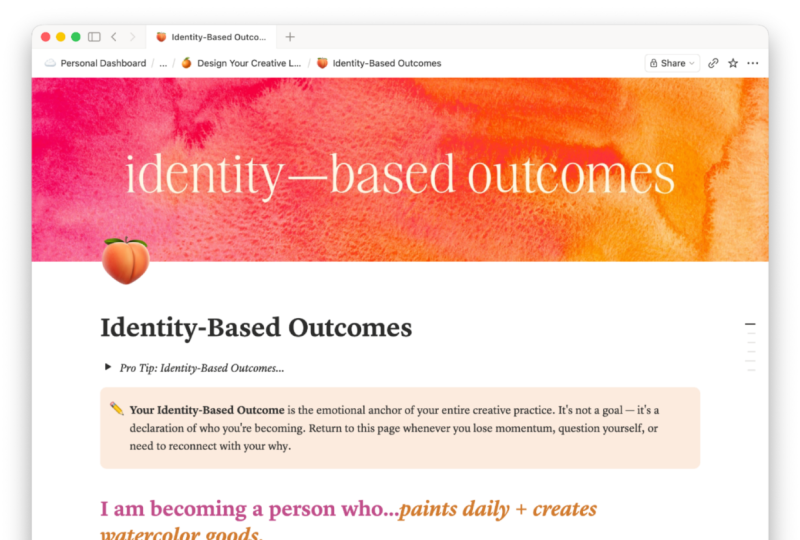
very, very differently. So now it is time to create
your identity based outcome. It is a statement that
really answers one question. Who am I becoming? Not what do I want to achieve? What numbers am I trying to
chase or what idea do I have, but who am I becoming as
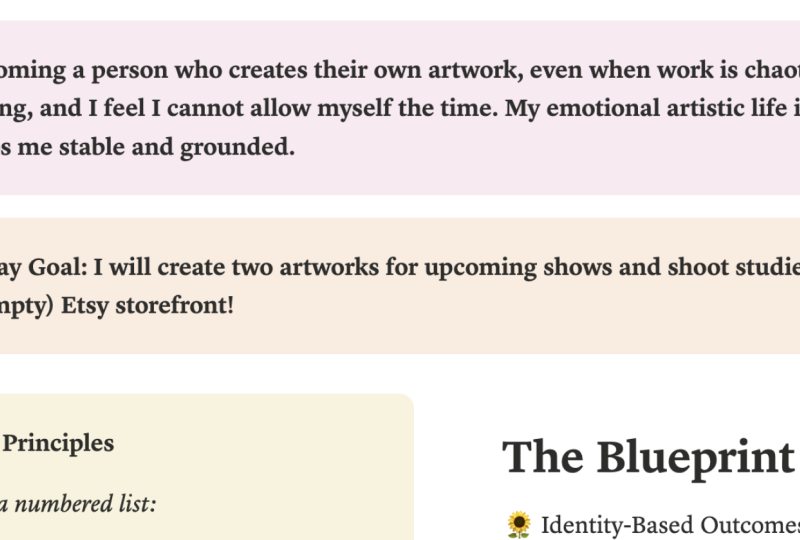
a person holistically, within my creative sphere. So I am becoming a person
who fill in the blank. If you're already
sensing it, I'm giving you a little
bit of homework. I am becoming a person
who creates consistently, even when inspiration
is not present. I am becoming a working artist whose work supports my
family and my dreams. I am becoming someone who truly values rest just as much
as work and hustle. I am becoming a business
owner who makes decisions with
clarity and not fear. I am somebody who works through
my anxious doubt anyways. Notice, these aren't
about numbers. They're about more
than just metrics. They're about who
you are at your core and the type of season that
you're working towards. This is why having a
flexible workflow that knows your limitations
is even more important. Alright, so this is where you actually get to do the work. I would love for you guys
to pause at this lesson, go to your class
resources and download the Notion template
provided to you or grab a PDF if you prefer. If you've never used
Notion, no worries, you just hit Duplicate and you fill it out like
any other thing, like a word or Google document. Navigate over to the identity
based outcome section and complete the sentence. I am becoming a person who
blank. Don't overthink it. Your first instinct
is usually right. You can always refine it later, make it as long or as
short as you want to. This isn't permanent. It is really just your starting point. Ideally, don't move forward until you've written
this down clearly. I know this might feel small, but this is the first deposit into your evidence bank account. The moment you write,
I am becoming, you've already started becoming, and you're building
up that evidence of how you're going to move
through the roadwoks. Your brain is
watching what you do, and right now you
are doing the work. I'm so so excited for you. Meet me in the next
lesson when you're ready. We're going to talk about the 12 most common roadblocks
that creatives often face and how to
design your life to coexist through these
roadblocks and decide them. But first, please, please, please write your
identity based outcome and meet me in the next
lesson when you're ready.
5. The 12 Common Roadblocks: Over half my clients tell me
that I am a procrastinator. Maybe you've said this
about yourself as well, and it is probably one of the top words I hear from
other entrepreneurs. But the truth is
procrastination is actually not a personality trait
or a personality flaw. Saying I am lazy or I'm just a procrastinator is
actually a blank tactic. It's a way of avoiding
looking at deeper realities. Procrastination means deeper
problems such as doubt and different thoughts at
play when it comes in relation to our life practice
and our nervous system. Sometimes we have a
fear of succeeding or living up to that
success failing, and maybe you're not crystal clear on what your
next step should be. So you end up doing
nothing at all, or you end up self sabotaging by jumping between
one project to the next. It's kind of like eating an elephant with a
teaspoon when we look at your goals
as a whole and how your nervous
system responds to it. So the question isn't why
am I procrastinating. The question is, what is my procrastination
trying to protect me from going back to that nervous system work and
back to the safety work. Something I learned vulnerably
in my own journey with my mental wellness is completely changing how I
look at procrastination. And this is a concept
called pleading the Fifth. It's based on the Fifth
Amendment, actually, and is the right to protect yourself from self
incrimination, which sounds a little
bit intense when we're thinking about
a creative practice. But ultimately, we're saying
that we have the right to not self incriminate when it comes to our fears and doubts, basically saying, either
way I'm taking action, I don't actually care if the outcome or my fears
are true or not true. It's an act of taking your power back by releasing that
you don't actually care or need the
certainty in order to move forward because
the truth is that one of the most complex part
of working through doubt and anxiety and procrastination is actually releasing the
idea of uncertainty. It is knowing what
will happen or what could happen and trying to
plan every single detail, ruminating about the
potential consequences or trying to plant every single thing
down to the minutes, it doesn't actually help. It doesn't change reality
that we all face, which is ultimately the reality of uncertainty, fogginess, energy, that's just part
of the human experience, and you're not going to
eliminate them just by planning better or
having a great planner. It's learning to
coexist with them. I've identified 12 roadblocks that come up again and again. This is not from Chachi ft.
This is not from theory. This is from real conversations, real coaching sessions, real
data, and real patterns. And I'm going to
weave through these, and as I do, I want you to
notice which ones make you go. That feels a little bit like it's okay if
you only have one. It's okay if you have all 12. We're trying to get more
to your root causes. Number one, I procrastinate often or have a fear of failure. Number two, I get distracted easily or
struggle to stay focused. Number three, I tend
to not complete projects and slash or
miss my deadlines. Number four, I always
feel burnt out or get burnt out while doing
complex work or projects. Number five, I lack confidence
in my potential success, skills, and my self worth. Number six, I don't have an outstanding work
life balance and overwhelms and sense
of control in my life. Number seven, I don't know
how to get from A to B, which is idea to
finished product. Number eight, I don't
create enough space for regular mental and
physical wellness or my own life practice in
relation to my creative goals. Number nine, I'm lacking a workflow for
productivity and success, which is ultimately
a productive and clear routine or
broken down goal. Number ten, I'm usually feeling overwhelmed,
doubtful and stress. Number 11, I don't know my value as a creative or
I don't think I have any. Number 12, I don't think
I'm actually setting healthy or achievable
goals or goals that will get me to my dreams.
Know it's a long list. It's a lot to digest. But I want to ask, did any
of those resonate with you? If you're like most
people, probably three to five jumped
off the page. And here's what I
want you to know. Again, you're not broken.
There's nothing wrong with you. These are just the
obstacles that your nervous system has
learned to navigate and use as different tactics to bring you back into a sense of safety over a perceived threat or something being too big or too
scary or too unclear. Roadblock is not a wall. It is actually a waypoint. The road block is actually
giving you instructions. You just need to
learn how to listen to pause and to reflect
on what actually is working instead
of labeling it as a way of a blanket tactic
of procrastination. Even the most
successful creatives deal with these feelings
on a daily basis. You're not going to have a
milestone arrive when suddenly overwhelmed with
doubt or fear or procrastination just
completely disappears. Is basically saying
you're a robot? Actually, something that I see all the time is that people recastinate often
because they're waiting for the
procrastination to go away. So it's actually the cycle that just continues over
and over again. They think, Once I
feel less overwhelmed, once I'm in this new
season, then I'll start. Once I feel more confident,
then I'll launch. Once I have it all figured
out, then I'll take action. But the difference
between you and someone who doesn't
procrastinate in your eyes, actually isn't
someone who doesn't feel procrastination tendencies. They don't necessarily
not have road blocks. It's that they've learned how to handle it, who exist with it, recognize it for what they
actually are tackling those root causes and moving through them as
thoughts, not facts. So obviously, I have some homework for
you in this lesson. I want you guys to
open up your notion, template again, go to
the roadblock section, and I want you to look again at those 12 roadblocks
and pick the top one, maybe two if they're
really, really connected. Try not to pick all of them, you're not going to try to
fix everything at once, but I want you guys to pick
the one that feels really, really loudly right now in terms of that identity based
outcome we've already set, the thing holding you and I want you to answer
these questions. What is this roadblock
protecting me from? Is it protecting
you from failure, from judgment, from being
seen, from disappointment? Really, really get honest with yourself and write it down. The second question is, what
does your nervous system actually need to do to feel
safe pursuing this thing, working alongside or
through this roadblock? Do you need a quieter workspace? Do you need smaller tasks? Do you need accountability? Do you need permission or to work rest more into
your schedule? What would make this thing ultimately feel
less threatening? Now, if you want
to go even deeper, there's a technique
called the five whys, and I want you to take
that roadblock and ask yourself why five
different times. So, for example, why am I
procrastinating on launching? Because I'm afraid it
won't be good enough, that I'm not going to
get any evidence of my success because
there'll be no responses. And then why am I afraid
it won't be good enough? Because I don't have
much experience yet. I've never watched
something before. And then ask yourself, why does a lack of
experience worry me? Because I'm afraid people
will ultimately judge me. Well, why am I
afraid of judgment? Because I don't want
to disappoint people. And then, of course, why don't I want to
disappoint people? Because growing up, disappointing people meant
losing approval and respect. This is our way of
actually peeling back the different layers
of your roadblock. In the next lesson,
we're going to talk about focus and how to choose your 90 day big goal without getting
overwhelmed or scattered. Hopefully, teaching
you more about this microdosing and coexistence
evidence is going to help you move through this in a completely new way and write
your coexistence strategy.
6. 90 Day Focus: Choosing Your Big Goal: It's Monday morning,
you've done your coffee, you've opened your laptop.
You're ready to work. And then you breathe because you have a
productivity system. You have a Notion template, maybe just like the
one we're working on. You even have a roadmap. You've done the work, but you don't know what
to actually work on. I probably hear this
every single week from the people
that I work with, and I like to call this the
Monday morning problem, which is just my silly way of reminding us that we
might have the tools, but we don't have the clarity. Should you work on your website? Should you work on
your email list, your social media content, the new product line
that you just came up with at three in the
morning last night, the course you've been
planning, the portfolio update. Everything just feels
super, super important. Everything feels urgent. So you end up doing kind of a little bit of
everything or nothing, and you're not really making real progress towards
significant milestones. That's the lesson
where we try to make those adjustments we talked
about in the previous lesson. And by the end,
you're going to know exactly what you're building
in the next 90 days. Not five things, but actually one single thing that we're going
to go all in on. Before we choose your goal, I'm going to talk
about why 90 days. Not 30 days, not a year, but actually 90 days. Research has shown us that significant
transformations tend to happen around the
three month mark. It's like our brains need 90 days to really
cement new patterns, new ways of thinking, to really create lasting habits
and lasting change. So 30 days, that's just long enough to kind of get
started and get us primed. Still kind of in on
honeymoon phase. A year that's really, really far away for
our brain to kind of latch onto a bowl
and stay focused, and it kind of
feels unmotivating. But 90 days, it's
like this sweet spot. It's just close enough to
stay urgent but just long enough to create that real transformational
pattern building. And what I also love
about 90 Day cycles is that your creative business, in my opinion, and your
practice has seasons. You can't operate in
the same intensity in December as you do in March. 90 days gives you
permission to align your goals with your
life's natural rhythms, wherever you're located
and whatever they are. But this is also
really, really crucial. We're not trying to do all
of the things in 90 days. We're actually focusing
on one big thing instead. Because, honestly, what I see
happening all of the time, the scattered approach
kind of looks like this. Someone launches a print shop, but then around the same time, they also start a
YouTube channel, and then they create a course, and then they offer new things, and they build a website at the same time so they can
launch the print shop, and then they feel pressured to post on social media daily. Result is obviously
exhaustion, burnout, and minimal progress on
really any of the fronts. Now, they might have
felt inspired because their favorite YouTuber
has all of these things. But the reality is that person probably built these
things up over time. And this is why we want to focus on one thing and then build a support system around it
to get these real results. And that result is
actual progress, real data and real confidence to expand that comfort
zone that we talked about. It doesn't mean you
ignore everything else. It means you have
one primary goal that gets your best energy. And then everything
else either supports that goal or it's put
on pause and weights. This is what I mean when
I say needle movers. The tasks that actually move the needle forward on
your main objective, milestone and who
you're becoming, not the tasks that
make you feel busy, the tasks that make you feel and see evidence building progress. So if you work with me for more than 5 minutes or
taken any of my classes, you're going to recognize a
little bit of this structure. And this is all about finding your 90 day goal
with the brain dump. So I'd love for you guys to
open your Notion template, go to our 90 day focus section, and for the next 10 minutes, actually, please set a timer. I would love for you to
write down everything you want to do in your creative
business and practice. Don't filter. Don't
organize, don't judge. Don't think what's
possible or not possible. What do I have the
resources for? Whether it's launching a course, updating your portfolio,
raising your prices, getting started with wholesaling,
pitching your product, building an email list, redesigning your
website. All of it. Every tab that is open
in your brain right now, close it by writing
these things down. This progress is actually
really therapeutic because you're overwhelmed isn't coming from not
knowing what to do. It's coming from actually
trying to hold all of these ideas typically in
your head at one given time. When you externalize it, when you get it out on paper, your nervous system can finally
take a breath and relax. We're starting to
build evidence. You're going to
move with more rest and strategy and safety. So pause this lesson, set your timer for 10 minutes. I'd love for you to brains on. Don't worry. I'll wait for you. Now I would love for us to
narrow down your brains up, and I'm going to do
that by giving you four different filters
through these four questions. Filter one is, does this align with my identity
based outcome. So remember that
person you're becoming a statement you wrote
down a few lessons ago. If this fold doesn't
really move you towards that identity or
move you away from it, I'd love for you
to cross it off. Not saying no, we're
just saying not yet. Builder two is, can I
complete this in 90 days? Not start it, not
make progress on it, but actually complete it. If the answer is no, it's either too big or it's not
specific enough, and we need to narrow it down. Bilter three is, does this work with my current roadblock? So remember, we talked about the coexistence work in
the previous lesson, and if this goal requires you to suddenly overcome your
limitation overnight, if it demands you to
be someone you're not, it's not the right
goal right now. And then the last filter is, is this going to
create honest momentum or is it going to be draining? This is a gut check. Does
the goal excite you? Does it feel like the next step? Is it something you feel
like you're willing to walk through all of the hardships
with the logistics, the things you have
to learn, the things that are going to be out
of your comfort zone? If it doesn't light you up and feel like
something you really want to tackle and get to
understand, it's not your goal. So run your brain dump through these four filters until you
have a few options left. And now we're going to proceed
towards the final step, and that is looking at your
remaining options, obviously, choosing one that feels in the best alignment
with you today, not because the
others aren't good, not because you're
never going to do them, but because this one is first. And deciding when
we're doing something first and committing
to it in fullness, it really gives us a new
sense of safety when it comes to our 90 day
focus transformation. Make it clear, make
it something you can actually measure
if you're able, not, build my creative business, but maybe launch my
first online course and aim to have my
first 20 students. Not just get more clients. Let's get more specific. Book five new clients on the projects based on my
portfolio over the next 90 days. This is ultimately
your 90 day goal, and this is what
you're building. This is what you're
working towards. This is your answer to that
Monday morning problem, meaning that every
task that falls into your to do list should be in alignment with this 90 day plan. Next lesson, we're
going to talk about the Daily Top five that
I've been hinting at and how to break
this big goal into Daily actions and
actions of the needle. But for now, I would love for you to write
your goal down, commit to it because that
Monday dread that you're used to actually just became the thing that's gonna
make you really, really excited to get to work.
7. The Daily Top 5 System: So now you have
your 90 day goal. You're clear on what
you're building, but this is where most
people get super stuck. Traditional to do lists are honestly where your
dreams go to die, and you guys know what I mean? You know, all of
those endless lists that just keep growing and
growing and growing and growing until you just
feel paralyzed looking at it and you just don't even
what you should be working on. You add ten things,
you complete three, but then you add seven more, and you're constantly
feeling behind. You're constantly overwhelmed. You're constantly feeling
like you're not doing enough. And so we need to find a radical solution
to this problem. We're actually only going
to pick five things that day that align with your 90
day goal, but with a twist. I'm gonna get such
twists in a minute. Not 20 things, not
50, but five things. And before you panic and think, Sarah, I have hundreds of
things on my to do list. How am I going to
just move the needle in my goals with
five things per day? You were never meant to do all of those hundreds
of things today. Your to do list is actually
similar to a brain dump. It is a way for you to
take it out of your brain, but the top five is your way
to actually get strategic. So we don't need to gauge all of the things
you have to do every day. We need to be hyper
focused on the things that matter the most in
that exact few hours. Give your brain
permission to focus. Actually complete
things in fullness, in a sense of
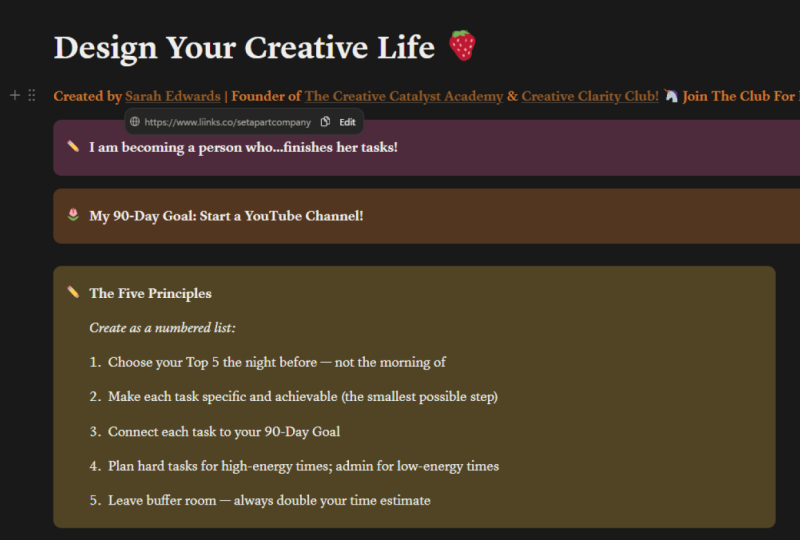
quality and energy. Now, these five tasks are
not just business tasks. And this is the choice
I was hinting at. Your five actually
includes your entire life, your business, your creative
practice, and your life. So remember, your
nervous system doesn't distinguish between
business and life stress. It's all the same bucket. So your top five might include send a
proposal to a client, write a blog post,
order new supplies, call the doctor's office back
and clean the kitchen sink. The mix is normal.
The mix is healthy because you are a complicated
human, and we love that. You're so much more than
just your business. You're so much more than the
creative acts that you do. And your top five should
honestly reflect the amount of energy you have in your
day to expand into something. So how do we actually get
the top five system to work? The first one this
is big, is choose them ideally the day
or night before. This is very, very crucial. You do not want to be organizing these decisions right in the morning because
in the morning, your brain is foggy, your inbox is screaming for attention. Analysis paralysis
kicks in, but at night, dinner or after the
house has settled down or after you've
completed your day, you have a little bit
more slowness with a strategy of how you're
filtering through your ideas. Ultimately, you're moving with a little bit more intention. You're going to be
able to sit down, look at your 90
day goal and ask, What are the five
things tomorrow that are going to
move me closer, and how is that going
to operate within the limitations that might
already be on my schedule? This also helps you
sleep better as a bonus, by the way, because
you've emptied your mind. You have an actionable plan, and your nervous
system can actually take a breath and relax and go, I know what I'm doing tomorrow. The second principle
is you want to make them obviously specific
and achievable. Don't write work on website
as one of your top five. You would ideally write
something more like design about page layout or write
homepage copy for website. Don't write launch course. Obviously, you're not
going to do that in a day. Principle three is connecting them of course to
your 90 day goal. Each task should ideally move you towards
your bigger goal or support your holistic
life to help you move towards that
goal more safely. If it doesn't need
to ask yourself, does this really need
to be in my top five? This is something I can
defer or delegate to later. This is what I mean when we
talk about needle movers, tasks that actually move
the needle forward, not tasks that make
you feel busy, tasks that make you
feel progress and move you closer to results because results build evidence. Principal four is considering your energy levels.
This is a big one. So you want to plan
on challenging creative tasks when you're
typically most focused. Saving admin or rudimentary work for maybe some
lower energy times. For me, mornings are
really high energy. That's when I write,
I create a film. And then the afternoons, that's
when I try to respond to emails or schedule posts
or organize files, things that are a
little bit less of my intentional brain space. You really want to
know your rhythms and work with them,
not against them. And lastly, Principal five
is heaving a buffer room, which creatives are really,
really bad at traditionally. So don't unpack
your top five into, like, a tight,
unexpected schedule. You want to have some wiggle
room because life happens. You know, kids get sick.
You miss a phone call, a coor ask you for help. You weren't planning on
it, and success is having clarity and making your tasks
as manageable as possible, not by actually checking off 50 low quality
things in one day. And this is where
I actually want to introduce something that
I have my clients do. And at first, they tell
me, This is really silly. Why the heck are you
have me do this? But it always always helps. What I want you to
know about creative entrepreneurs in
particular is that we chronically underestimate
how long things take. I am definitely
someone who does this. We think, Oh, I can write
that email in 5 minutes or I can film that
entire class in 3 hours. And then 30 minutes later, we're still coming up
with a subject line or this other email popped
up and we're distracted. We think, Oh, yeah, I'll
clean the closet in 2 hours, but then 4 hours later,
we're still, like, trying to decide what shoes
to drop off at Goodwill. Right. So my rule is actually
the rule of doubles. You want to double
your time estimate. Always, always, always. If you think a task is going to take 30 minutes,
block off an hour. If you think it's
going to take 2 hours, block off 4 hours. This isn't pessimism
or being cynical. It's actually being
more realistic. And the bonus is that
if you finish early, you actually get a nice dopamine hit that you beat
your own estimate. And again, this
goes back to how do we build safety if
you're success. Instead of
disappointing yourself, you're actually surprising
yourself and you're trusting the strategy of how you move through
your decisions. My personal definition of success is I would
have done great today, if I actually did one
thing to achieve my goal, one thing on my top
five list, most likely. Not five, not ten, not 20, but one thing. Now, usually, I'll do
more than one thing, but I don't attach my sense of accomplishment and my
identity to getting through a massive
list because I'm still moving the needle
towards who I'm becoming. I'm still moving the needle
towards my 90 day goal. And it's really always
reminding me of who I am, not what I want to
be all the time. Every week, I would love for you to try and review a little bit. Even just subconsciously, you don't have to make
it a whole thing. Celebrate your wins,
even the smallest ones. What challenged you? What did you learn that was new that you didn't
know the week before? And what do you want to
adjust to moving into your next week that
really surprised you? This system works because it combines focus with flexibility. You're not trying to
do everything at once. You're not blocking off
these really rudimentary, three hour time blocks. You're choosing the right things with intentional strategy. Ideally, tonight, if you're
able not tomorrow morning, I would love for you to
open your Notion template, go to your Daily
Top five section. Look at your 90 day
task and ask yourself, what are five things tomorrow that's going to
move me closer to this goal or support
my life progress. Make them specific,
make them achievable. Use the rule doubles when you're writing down your time
metrics with them. Include both business
and life tasks. Maybe you can only do one thing for your 90 day goal tomorrow. Maybe it's all five.
But regardless, write them down, close your
laptop, exactly what to do. No decision fatigue, no analysis
paralysis, just clarity. In the next lesson,
we're going to talk about seasons and how to design your creative life around your body's natural rhythms instead of fighting
against them.
8. A Seasonal Creative Life: Trusty, when I tell you that you cannot operate in the
same intensity in maybe one time of your life or one time of the year
versus another. And yet, so many productivity
systems ask you to have the same kind
of baseline of expectation energy as you
move through your goals. Same output, same
focus, same everything. But as we've talked
about already in this class, you're
not a machine. You're a human with a body, and bodies have
different seasons and needs and levels
of complexity. Not just about the seasons of winter, spring, summer, fall. I'm also talking about
philosophical cycles. I'm talking about
months when the world feels loud or there's better
business maneuvers for whatever you have
planned if you're more of a summer
facing business or geographically where
you're located or how your family dynamics change in different
times of year. Creativity is something
that ebbs and flows as a response usually to what's going on in our immediate
environment and surroundings. And a system that doesn't
account for that will honestly eventually break down or at the very least not
be consistent. So this lesson is
about designing your creative life around
your natural rhythms instead of fighting
against them or trying to override them just
out of expectation. So we're obviously going to
start with the most obvious, which is the calendar
seasons, literally, right? So think about December for Western culture typically
is heavy with holiday, family obligations, financial
stress and dynamics. If you're here in
the United States or other parts of
this hemisphere, you know that there's
the winter season. Maybe you are someone who
kind of feels depleted in the colder months
or maybe you're the opposite and you
feel really excited. Maybe when the New
Year comes around, you feel that pressure
of the whole new year, new launch energy, and other people might feel crushed by it instead of motivated. March or moving into spring might feel like a season
of burnout for you if your holidays were exceptionally stressful in business
or obligations or life. Whereas for some
people, spring might be the opening door chapter of a season we've been
looking forward to. Regardless of what fits for you, I would love for you to start
tracking these patterns. Consider reflecting back on
the past year in particular. What were some milestones or big memories or things
that really stood out? Feel free to go back through journal entries or
emails or photos in your camera roll or text or have conversations with people that you tend to be with
throughout the year. When you know your own patterns, you can intentionally
design goals, milestones, and 90 day
action steps around them. Don't plan your
biggest launch or your biggest task in
something that typically is a high stress life month or when things are really demanding of your energy externally. Work within your seasons
instead of against them. These are really
good limitations to be aware of and to celebrate. And then moving from
our calendar seasons, we actually have our
internal seasons I love talking about this
because this is about body cycling and about
patterns you've noticed in your own life due to
different responses. Maybe it's related to your
health or way of thinking. Maybe it's related to your immediate environment
with your family. Things that you're navigating
as a group or a unit, people that impact your
immediate space of productivity and really understanding where those energy connection
points come from, whether in a given week, a month or a particular
calendar set of months, such as the 90 days that
we talk about often. You really want to
question everything, and you really want to pull apart where do I
actually feel like I'm most unlocked in different parts of my
entrepreneurship journey? Ultimately, the permission slip I want to give you is
that you're allowed to let the season be the
season and not the standard. So obviously the question is, how do we actually
design for seasons? You've already heard me talk about tracking your patterns. In Notion, there's
actually a space for this. I would love for you to really
start to reflect and pay attention to which months you feel like is
more high energy, what weeks you feel like
are more low energy? Anything coming to
mind you already have on your life roadmap
that's coming up, exciting things,
stressful things. Again, feel free to go
back through your camera, go back through journal notes, talk to friends and family, reflect on times where you felt really creatively inspired. Are you noticing a pattern? Think about other commitments
you have going on, whether it is
business commitments or family vacations
or family planning. And then the next thing
you want to do is you want to naturally plan
around those seasons. So you want to schedule
your projects, your launches, your
milestones, big, creative, high energy tasks in a space
around those elements, and you also want to have
the gentle maintenance and recovery built in
as well if you're able. So perhaps Monday is
your most meeting light day because you know
it's the best way to set intention for yourself
and your family that week. And then maybe you also
don't have meetings on Fridays because
you want to enter into the weekend
with reflection. Whatever elements
you can control, whether it's when
you run your errands or when you have your
morning pages on your sketchbook is going
to make a difference after you take reflection of
recognizing your own patterns. Both versions of
yourself are okay. And remember, going back to
that definition of success, if I did great today, it was because I was
able to do one thing, even on my low energy days, something as simple as
putting the laundry in the laundry machine
or something as big as finishing a
large oil painting. This is where creative and life practice coexist together. Then lastly here, we
want to give yourself a couple pieces of
non negotiable rest. Not to rest when I have time or rest when everything's done
or rest when I've earned it, but scheduled, protected,
non negotiable rest. Ideally, I think, one
full day off per week, one week off per quarter, whatever that looks
like for you, but having it built into your schedule also starts
to treat ourselves holistically with
respect also allows us to creatively recharge
our batteries without guilt or shame. I think something that's
interesting is that when I pursued making another
productivity class, a lot of people were asking me, Hey, how do I get over procrastination? How
do I get over doubt? How do I be more
productive? How do I be more motivated? How
do I follow through? I think a lot of
people are expecting, here's the break all magic pill template or here's the fully built Notion template for you. To build out your day. But usually, where we have these breakthroughs
is recognizing patterns and inflicting
breakthroughs based off of our own realities, based off of our nervous system, based off of learning more about ourselves and how we actually can move
through completion. I want to make this
really simple for you. The more you're able to follow through and
complete things, whether you're ADHD or you're a caregiver
or you're someone with minimal resources or you're somebody that has
unpredictability in your life, the more we can protect
and support that, whether it's through
understanding seasons, having a top five to do list, having a 90 day action plan, more evidence and confidence
you're going to build the safely move your experience
and your reality, and nobody else can mimic that. Nobody else should be able
to step into your workbook, step into your system and mimic it because it
should be built for you. When you're ready, we're
going to jump into another lesson that's
going to equip you forward towards these goals.
9. The Return Protocol : So hopefully, I've
made it pretty clear that life
is unpredictable. And if you're a
human being, well, things happen in our world. So I want to give you guys a return protocol because, look, we all fall off
the wagon and have unexpected things come up in our creative and life realities. At some point, this is probably going to
be likely for you. Within your 90 days,
life's gonna happen. Someone will get sick or
you'll feel under the weather. Deadline will explode or change. Energy might crash
out. You might have another deadline or priority swoop in and kind of derail your
thought process. Maybe that week or that
deadline will turn into two, and you're going to look at your Notion Templin and
you're going to be like, Oh, my goodness, this
is so untouched. My 90 day goal has
been abandoned. Your top five is nowhere
to be seen or found, and you're going to be like, Oh my goodness, I'm a failure. You're not a failure. This is
what it means to be human. And this lesson is about
what to do when that happens because it
probably will happen. It's not an if it's
a win. I'm just being a realist in
your corner here, and I want to
support you through all different parts of
your 90 day journey. First, let's obviously
talk about what not to do if or when you
fall off the wagon. We don't want you starting
over from scratch. And I see this all the time. Someone misses a week or they miss a day in their routine of sketching or drawing or
building their website and they decide they
need a whole new system, a whole new plan or a whole
new goal, a whole new idea. They redesign their plan. They pick a new outcome, they pick a new milestone, they pick a new project. And this is usually a form of self sabotage disguised
as a fresh start. And we don't want to punish you in an aggressive
catch up plan. We don't want to look
at everything you missed and try to do
it all in one weekend. You're going to burn
out immediately, and then you're going to
fall off the wagon again. Now, remember what we talked
about Evidence building. We don't want to deposit negative evidence into our
comfort zone bank account. You're someone who can do this, and the falling off just means
that you're living a full, complex, wonderfully
made human life, and we just need to have
flexibility, too, breathability. Your plan, your goals, your creative practice
is living and breathing. It's like an actual thing
we need to care for. And so we needed to kind
of have this flow to it. This is what I would
rather have you do instead of coming out
with a crash out plan. So step one is obviously
acknowledging what happened, not with judgment,
but with awareness. Remember how we filter in
and project information. So you're going to
open up your notion. When's the last
time you check in? When's the last time you did your Daily Top five? That's it. No story. Just facts. Maybe it was two weeks ago. And this is not about
confessional thought process. This is just observational
thought process. We're giving ourselves
permission to unpack our creative
breathing right now. And then next, obviously, is what's the one
small thing that you can do today to
reconnect with that goal? Not five things,
not play catch up, not everything that you
missed all in one weekend. It is one single thing. Maybe it is updating
your Daily Top five. Maybe it's responding to some
emails you left in draft. Maybe it is choosing
a new task from that 90 day goal and writing
it down, breaking it down. And then the next
step is we want to enter kind of like a
maintenance mode for one week. Is actually really crystal. You're not going to be jumping
back at full speed, okay? So for the next seven days, your only goal is to show up in the most gentlest way possible. So that top five list, maybe it's just top three. Maybe it's just one
thing that 90 day goal. You're not abandoning it. You're just not
pushing aggressively. You're rebuilding evidence
that you can show up. You're reestablishing safety
with your nervous system. Maintenance boe
is not giving up. It's not taking your
foot off the gas. It's actually just
a form of strategy in business and in your
creative practice in your life. After a week, you're going
to reassess how it feels. Do you need another
week of maintenance, or are you ready to ramp
back up based off of the season you're
in and the energy levels that you're navigating? Really trust your
rhythm and listen to your creative intuition about what actually is going to help you reach the
end of a single task. Don't need to layer
it on it and make it complicated to compensate, okay? You are going to fall off, but you're also going to return, and fall off and return is the actual pattern of what it means to be
an entrepreneur, what it means to be a creative. I've been building
business for years, and I still have full weeks where things really
fall and break down, weeks where I don't
follow protocol, weeks where I feel really,
really disconnected. And sometimes where
I question things, and I'm like, Am
I meant for this? Then I return, I use
this exact protocol. I enter back in gently. I do a little bit
of an assessment, and this is the difference
between someone who builds a sustainable creative practice and someone who
doesn't my opinion. It's not that they
never fall off, it's that they know how
to return when they do. It's all about how we respond
and react to realities. They don't spiral into shame. They don't start from
scratch every single time. They just come back very gently
one small step at a time. So something really
interesting is that sometimes when we
fall off our plan, it is a slight indicator that something may
need to change. Maybe your 90 day goal
needs to be adjusted. Maybe your top five is a little too heavy and underestimated. Maybe you're entering into a low energy season, and
we want to honor that. Listening to what that
fall off is telling you, your systems serve you through data and information about yourself, not the
other way around. And in the next
lesson, we're going to bring everything together into that blueprint I
was talking about for your sustainable
creative life. Remember, falling off does not
mean you've lost progress. It just means
returning to progress.
10. Your Complete Blueprint (Closing Thoughts): You guys, I'm so excited. We did a lot of work. You now have a blueprint for your sustainable life in
terms of how to move through, respond, and react to
your 90 day action plan. So let's do a quick review of everything that we've
moved through today. Number one is we have the
Coexistence Philosophy. You're working with your
limitations, not against them. Number two is Evidence
Microdosing now. You're going to be
building safely within your nervous
system through small, consistent actions and steps. Number three is you have
your identity based outcome. You know who you're becoming, and that is your waypoint. Through your
limitations, you're not just acting and doing
and following trends. Number four, is
you've identified your personal roadblocks that might be
holding you back and applying your
coexistence strategy. Number five, you have
your 90 day goal. You know exactly what
you should be building in the next 90 days,
that one thing. Number six, is you have
your Daily Top 5 System. You have a practical
tool to break your big goal into daily
needle moving actions. And, of course, you know
how to move through cycles, the starting over thanks
to a seasonal design, understanding your building
with flexibility into your system for high
and low energy times in your life and practice, and then you have
your Return Protocol. You know how to show
back up without shame or guilt when
something doesn't align. This is your complete bloodprint and this isn't just theory. This is your actual system. So now I want to
obviously tell you how we can have this
working all together. Night before bed, again, I would love for you to open up your Notion Template or whatever you were choosing to do the work to look at your 90 day goal. You check where you are
in your seasonal cycle. You look at your week ahead, understanding your life,
obligations and commitments, and really starting to identify
from a time perspective, is this high or low energy. You're going to pick your
top five to tackle tomorrow, maybe just three
or maybe just one. Whatever you need to do is okay. But the key is
writing them down, closing the laptop
or the journal, and relaxing because
you can feel safe knowing you're moving
strategically into your tomorrow. Tomorrow morning,
you're going to wake up knowing exactly
what you should be. Big or small, no
decision fatigue, no analysis pross, no
comparison or trend following. You top five, your top one, whatever you need to gather evidence that you
are able to do this. Every single week, I
would love for you to check back in with that
identity based outcome, and really just doing a gentle audit through
accountability. Every month, you should
be reviewing kind of some of your roadblocks
and asking yourself, am I coexisting through these roadblocks to the
best of my ability? Or do I need to adjust anything? Of course, if you fall off, you're going to know the
return protocol coming back gently one small step at a time into that
maintenance phase. Obviously, in a closing thought, I'm going to share
your next steps and resources to help you completely take this
to the next level. Obviously, guys,
congratulations. That was a lot of inner
work to move through today. And I know it really, really breaks away from
maybe what you were expecting for a blueprint or a creative practice and
life building plan. No it's not fancy steps. It's not a fancy planner, but I'm telling you this
is where it happens. After working with
so many people and other people coming to me
and emails and DMs asking, How do you stay productive
and be so creative? It's not because I'm able to
find this magic pill system, or I'm not somebody without a lot of roadblocks
and limitations. I face them every single week. It's because I understand
the hyper flexibility that my goals need and
how I'm going to build evidence up
for my success. The next thing I'd love
for you to check out is that I actually
have two awesome packed resources for you. The first one is unscrambled, and this is a creative guide to clarity,
confidence, and cash. I literally step
by step teach you through the implementation
of the nervous system, how to build your
business models towards income
goals that you want to tack on next
to really expand, step into wealth, step
into productivity, and step into the most confident voiced
version of yourself. Other book that we
have is at the table. This is our newer book, and
this really digs deeper, so much deeper into what
we covered in this class. You can also
download that eBook, or you can listen
to the audiobook to have a coach in
your back pocket. And then, lastly, we have an extremely exciting new
launch with our community, where we actually
have a free community where I would invite you
to work on your clarity, your confidence,
and your business foundations completely for free. The Creative Party Club,
you can check it out. In our ink flow, you can get to know me and my work
and really expand with all these topics we've
talked about today from breaking things down to
accountability to partnership, to storytelling to
expertise, to confidence. So please go check that out. We're so excited to build
our creative ball together, get to know each other and support each other
in that space. Obviously, you guys know me
by now. I'm Sarah Edwards. Thank you so much for
entrusting me with your time, spending this beautiful summer
day with me outside. We so so happy that you're here. I'm so happy that you're here.
My door is open for you. Please feel free to
follow me on Instagram at Settle Part underscore
Company. My dam door is open. Seriously, I respond
to all my emails and all my dams personally. So please reach out
to me questions, if you want to
connect, get to know each other. I would
love to work with you. I'd love to meet with you.
And if you're interested in building out your business,
your workflow plan, your offer, your
limitation strategy, all of the things from branding
authenticity together, do that with my one on
one coaching program at the Creative
Catalyst Academy. You can also message
me about that. I would love to work with you and get to know you one on one. Just like so many other
women around the world, we're building something
great together. Thank you so much.
I hope you have a beautiful sunny
rest of your day, and I will see you
in the next bus.
 Sarah Edwards, Artist, Author & Creative Success Coach