Transcripts
1. Introduction: You're planning on opening a digital product store
on any platform, or maybe you already have one, then customer service might not be the first thing
that you thought about, but I'm sure that
you have considered how to deal with
unhappy customers. Like any kind of
product based business, a digital product
store can come with a number of challenges,
including technical ones. In this course,
we're going to be going over information and strategies to help
you prepare for future customer
service challenges. Help you build your
personal rule book for dealing with these problems. I've personally been
selling digital products online for about ten years now, and I've dealt with so
many different problems with a bunch of different
strategies to help get through them and to resolve them peacefully or
happily for both parties. My name is Rebecca, and I will be your instructor
for this class. If you're ready to get
started and prepare your digital product
business for future sales, then let's head into
the class together.
2. The Basics for Happier Customers: When it comes to managing
customer experiences, the best strategy is to get ahead of issues
before they arise. We can do that by being
really intentional and methodical with our
products and our methods, with the way that our products
are presented online, and also with the materials that customers receive after
they make purchases. There's generally
just two reasons that customers a digital
products aren't happy. Either they didn't get what
they expected to get with the product after
they purchase it or they can't figure
out how to use it. No matter how hard
we double check everything and make sure
our products are great, there's always going to
be a small percentage of customers who just
misunderstand what's going on. For example, customers who think they're buying a T shirt, but it's actually
just the graphic for the shirt and
circumstances like that. Even with the clerest
messaging in the world, there's still going
to be some people who misunderstand what
the product is about. Want this number to be as
small as possible, however, making sure our
messaging is super clear is the first step in
avoiding future issues. We have to make sure that
our product listing images, titles, keywords, descriptions are all being
very specific and very clear on what it is that we are offering and the customer
is going to be receiving. If you haven't
done this already, you can check out what other sellers in
your niche are doing to make sure that these kind
of confusions don't arise. So again, for example, if you are selling a
graphic to go on a T shirt, your photos might be
that graphic mocked up on shirts so the customer
can understand the use case. But again, some of them might misunderstand what it
is they're purchasing. The price should tip them
off, but it doesn't always. So including text over those mock up images,
something that says, like, graphic only example
use would be another step to help clarify what it is people are buying. Another step we can take to ensure there are
no problems along the purchasing pathway is to test all their products
before they go to launch. Let's just say we're further along the customer
journey now and someone who has actually
bought your product. They've paid for it. They've received their
instructions on what to do next, but there's a problem and something in the
file doesn't work. I've had this happen myself. One of the things I sell
is mainly Canva templates, and for some reason, I cannot figure why, but occasionally a
Canva link expires. That's in spite of me
not changing anything, and other customers have bought this thing
with no problem, but occasionally it
just stops working. But sometimes this can
also be just because of a typing error when you are
formatting your deliverable. Avoid these kind of situations, I would recommend
that you sit down, open up each PDF or deliverable or whatever
the product is that you're creating and testing all the links to make sure they go where you want them to. This is especially important
if you are selling things or creating
them in batches. So, for example, I was creating many different
Canvas templates and using the same deliverable
template for each of them, but changing the
link and the title of the product in each one. It is very important to go
through and double check, even though it's boring to
go into each PVF and check all the links to make
sure they are going to the right template and that
they work in the first place. If you're concerned that
the method that you're delivering your digital product might be a little bit confusing, then you might want
to ask a friend or a colleague if they want to test out your product for you. This could be especially useful if you are creating something in a kit or a bigger project that involves
multiple components. You want to make sure that
the product is easy to understand and
that anybody using it can get the promised result. Finally, the third thing that I would recommend that
you do when you are setting up your shop and doing these initial
kind of work, in order to avoid customer
misunderstandings, is to make sure that
your licensing terms are very, very clear. So what I mean by this is, can the person who buys this product use it
for personal use only, or can they make products
to sell with it? Do they have reselling rights, and they can go and resell this digital product if they change certain things about it? This will really depend on
what it is you're selling, but you should know your own
usage rights ahead of time. Now, if you're selling on a platform like creative market, this is already a feature built into the whole marketplace. When you go to buy a
digital product there, you pick the tier that you want, either personal commercial
or extended commercial, and the price will
change depending on the bigger the license. This is really straightforward just because of the interface. But if you're running
your own store, be it on Etsy, or your website, then you're going
to have to be a little bit more
intentional about clarifying those usage and licensing rights
to your customer. Usually, this is all included
in the product description, and that's where you can
find more details about it. But it may also be worthwhile making one of the
listing images, the photos that people through to look at your purchase to be a sort of info graphic with information about the
licensing terms available. In general, this is going to either be that people can use the product for
personal use only or if they can use it
for commercial use. I do sell a lot of commercial
use digital products. But because these are digital, I have to make it very clear that what they are purchasing is the right to sell
the end product and not the template itself. So for example, if the
product I'm selling is a template to create a
children's picture book, the customer can then
sell the finished book as like a physical
copy or an e book, but they can't sell the template or the camera file that
the book is designed. Can adjust these rules
to fit whatever product it is you're selling and however it is intended to be used. But I do think it is
really important to be very clear on this
point from the beginning. So as you can see,
clarity of messaging, and the way that we communicate with our customers is really key in making sure that we can avoid issues down the road. A lot of the problems
that can arise from not following through on
the steps I just talked about are going to be
really repetitive questions about ways they can use things, ways items can be accessed. And that can all be
achieved by being really clear on your messaging
about what you are selling. Make sure you don't
under deliver. Over delivering is fine, but don't under deliver on
what you promise to offer. The next lesson,
we're going to talk about how to make sure
that customers who have made the decision to purchase
from you already stay happy with their decision to
have purchased this item.
3. High Ticket vs Low Ticket Expectations: There's a really interesting
difference between high ticket and low ticket
customer expectations. And by ticket, I mean, an item that costs a lot versus an item that costs not so much. When we look at this from the point of view
of the customer, because, of course, we
have been there ourselves, then for a $2 item, I'm not expecting a huge
amount of customer service or a ton of time from the person selling the product
because it's $2. I know I'm just buying something small and probably
straightforward. On the other hand, if I spent $300 on something and then
had a problem with it, I would definitely expect
whoever sold it to me to take the time
to make things right. This is definitely true
for digital products. I've seen this in my own stores. I have a store that
I sell, you know, two to $3 graphic items, and I receive virtually no
messages on that store, whereas the store where I sell bundles or higher ticket items, I receive lots of customer
service questions. This is partly just because the product
we're talking about, the higher ticket
one is more complex. It has more to it. There's
more in it, and of course, there's more
variables for things to go wrong or be confusing. A more complex offering comes
with more risk as a seller, and therefore, it costs more. So I will say that
if dealing with customer service
issues like what we've talked about or what we're
covering in this class, if that intimidates you, then I would definitely recommend focusing
on a store that has lower ticket items
in the sort of $5 and under range because you are generally going
to be receiving less customer service tickets,
just issues to deal with. Than in a more expensive
product store. Just keep in mind what kind of investment you're asking
your customers to make when they buy something from
you and make sure that your customer service abilities align with that expectation.
4. Providing Support Materials: Now, no matter how complicated or simple your product might be, I really think it is a good
idea to always include support materials or
tutorials with that product. This could mean a
little text file with instructions or a PDF that
walks them through it. It could be a little
booklet or a guide that helps with the process or can
even be a video tutorial. The exact type of
support material really depends on what
it is you're selling. However, I think you're going
to find that the time that it takes to make these
support materials really does pay off as it
lowers the amount of customer service inquiries
that you have over time. Because I sell templates, I try and make my
tutorial videos, which I usually provide a
little bit more generic so that they can apply
to as many products that I sell as possible, and I don't have to keep making an individual tutorial
for every single item. This works for variations. So for example, I
sell book templates, so I will have a tutorial on
how to edit a book template, but the exact
template itself might be a little bit varied
depending on what they buy. Now, this reference
material that you're making is actually
really valuable, and it is a selling point. You can use it to
market your product. So, for example, you are selling a wedding invitation template. Itself, that's fine, but a wedding invitation template with a tutorial on how to edit it is a more well
grounded offer. And I promise you, if you
haven't in cats already, you would be shocked
at having people buy templates for software they have never heard
of and never used. It's not the majority
of people, of course, but it's definitely
not a small number. And having those video tutorials or other reference materials is going to save you a lot of time helping that
small demographic.
5. Offering Customer Service Channels: Now, even if you
take all that time to make those
reference materials, there are still going
to be some customers who just want to talk to you. Some people really
prioritize being able to talk to a human
being with their problems, and this is especially true
for more expensive items. But keep in mind that
expensive is really relative. So what might seem like an affordable product
to somebody might be really a big investment
for somebody else. So it is good to think
about what channels you want to offer for
in person support. You're selling on a
platform like Etsy, then it's fairly straightforward because they have
a messaging system in place where customers can
message the seller directly. So that is an easy method, but they do have a
lot of metrics and sort of rankings that are based around your speed of replying, so that can be another
kind of challenge to managing the customer
service side things. But if you're selling
on another platform, your own store or
another platform where they don't have
a messaging system, then you may want to
think this one ro that I handle it
personally is I set up a low cost e mail address for
each of my online stores is like a customer support
line that I include on all my deliverables so that they can just click and
send me an e mail, and I sent that e
mail up on my phone, so I receive them directly. I will say with, like, thousands
of sales under my bells, I don't receive a
lot of e mails. So that's again, testimony
to having done the work ahead of time to make sure that the marketing materials
are really clear. The tutorials and deliverable are really helpful
and straightforward. And then if people get through all those filters
and still need help, it's just a small number who
end up e mailing. But it is And when people
reach out to you, there's generally only three
results they're looking for. They either have a question,
they need an answer for. They need help using the product itself, or they want to refund. Hopefully, the questions aren't
difficult ones to answer. Usually, you are going
to know the answer because you design the product. And if you can refer
them to resource materials or fix the exact issue they're having
with their sort of technical side of things,
then that solves that. But the refunds can be a
little bit more tricky. We're going to talk
about that more a little bit later as we head into our next section on
handling challenging situations.
6. Dealing with Negative Reviews: If reviews are really tricky. Some people leave
them without ever contacting you or looking
for help with the product. Some people have I don't give five star personal policy
for whatever reason. And sometimes you get
a negative review for misunderstandings
that really just aren't fair and that's
not your fault, but it still happens. In some cases, a negative
review can be instructive. It can point out
something that you missed or a little flaw
with your product, and that can be
helpful for fixing it. However, that doesn't
make it feel any better. When I think about
one star reviews, I have one story that really sticks out to me from selling, and the product was
a canva template. The customer purchased it,
and within a a day or so, they reached out
to me saying they can't figure how to open it. I spent about three days
going back and forth via messaging on Etsy with this
customer very politely, very patiently, trying
to help them figure out what the problem was and
what they weren't getting. This customer had never used Canva, hadn't heard
of it before, and they didn't want
to make an account, but you have to make an account
to use a Canva template, and they didn't know
this before purchasing. So I walked them
through the steps, but after a couple of days of trying to work
on this problem, they said, Listen, I'm sure
this product is great, but I'm just going to give
up. I can't figure it out. I sent them a follow up message
to that with, you know, another offer or just
trying to discuss it more, and they never replied to me. But the next day, I got a
one star review saying, this product is probably great, but I can't figure
out how to use it. I'm not tech savvy enough. So after all those hours
of helping I put in, that one star review
really stung. It felt like they didn't
really need to leave a review. They didn't get to
use the product, even though we tried
to make it happen. Was frustrating
about that in this particular was that the customer really wanted to make it work. We tried really
hard. In the end, it probably just wasn't
the best product for them, and I don't think they
probably should have purchased a template for a software they
weren't familiar with. But this was a unique situation. This exact same template I had sold a couple hundred
times before, and I'd never had anyone
not be able to use it. So given that context, the messaging here wasn't
really the problem. It was just one of those
situations you can't really fix. That, and sometimes
you do just have to swallow a bad
review and move on. But in certain cases, there are some
things you can try to maybe turn that
review around. I would rarely
recommend replying to reviews publicly
unless there is something significantly
misleading or untrue about that
particular review. For example, I didn't respond to that one star review
because there was dozens of other reviews for the exact
same product that were five star and had lots of
good things to say about it. So I wasn't worried
about that sort of overshadowing
the good reviews. Times replying directly
to the customer, though, can be a good idea, especially if you're on a
platform like Etsy. Sometimes customers
don't realize that their reviews actually impact
the success of your shop. I would only recommend reaching
out in situations where a little bit of customer service might seem to actually
make a difference, and this is kind of the script
that I would use for it. I would say, H i,
the person's name. Thank you very much for your
purchase of product name. I saw your review, and then
you only gave it three stars. Is there something I
can do to help improve your experience with
name of the product? So it's pretty short and sweet, but that's kind of how
I would lay it out. I wouldn't express my
disappointment in that review. I wouldn't put any sort of
negative messaging in there. Just say, I saw
you gave a three. What was it missing? And maybe frame it as constructive criticism or or just like looking
for your feedback, what could be better about it? You can decide how you
want to frame that. Now, you might not get
a response at all, or you might get a no
or something else. Maybe they do have
something useful to actually tell you
about the product. But in some cases, you
actually can fix whatever it was that was holding it back
from a five star review. And in which case, the customer may not realize that they
can edit their review. Once the matter is resolved, I would recommend you
send a follow up message, something along the lines of I'm so glad we were
able to figure this out. Thanks again for supporting
my small business. If you decide to take the time to modify your review at all, and then just tell
them the steps for the platform how to
modify your review, and just have a great day
and leave it at that. I would just make
sure you emphasize adding that you're a
small business in there, and I think that's
a really key point, because I think some
people think if they're buying from
Etsy, for example, they kind of get overwhelmed
by that big brand name, and they think it's sort
of like, I don't know. They forget that there's people behind the
stores and they're individuals rather than it
being from a big corporation.
7. Responding to Unusual Requests: Other challenging kind
of message that you can receive from customers
is a weird request. I know this seems kind of vague, but sometimes you do get requests you don't really
know what to do with, and I'm not even just
talking about spam messages, which can be a lot to
wade through at times. I one time, got a very polite
and well written message from someone asking
if it was okay with me if they purchased
all the items in my digital product shop to then sell on their
digital product shop. Was really shocked
by this because as a digital product seller, you sort of get used to the idea that there's going
to be some sort of piracy. People are going
to, you know, steal your digital products and resell them without
your permission, they shouldn't, but
they do sometimes. But I thought it was a very
polite, weird request, and obviously, none of my
items were listed as resale. They were all personal use or commercial use with the
specific parameters. So I wrote back and just
said, please don't do that. And the issue wrote back or they wrote back
whoever it was, and said, Okay, and that was it. But that message
really made me panic. And I'm glad that I was able to handle it sort of
calmly and politely, rather than jumping to
being really defensive. Now, I never did receive a purchase order for every
single item in my store. So presumably this
never happened, and this person
was just a little unusual and moved on with
their business idea. But if something like this
ever did happen to you and someone was selling your items
on a platform like Etsy, there are specific methods
of recourse you can take to request that these
things are taken down. But maybe you'll get
a polite pirate who asks permission
first and you can just say, please,
please don't do that. In any case, is it
just one example? Sometimes there are just
weird messages you'll get and people asking
you unusual things? My policy is always just be
polite and calm and brief as much as possible to deal with weird requests and try and move on and not take
them personally. It can be hard, but that is
really the right thing to do.
8. When to Refund or Refuse: Besides dealing with
negative reviews or unusual requests from people. One of the more challenging
aspects of selling digital products is figuring out how to handle
refund requests. The challenge here
is that there's no way to return a
digital product. As soon as the customer has it, they can't just send you back the file and you believe that it's deleted off their computer.
You can't get it back. That's why most
digital product stores have a no refunds policy. If you were to issue the refund, the customer still
has that file, so you're sort of
just out your money, and they still have
what you offered. However, in my years of
selling digital products, I have given refunds
for certain things. And some of this will
be platform dependent. So on a platform like Etsy, because they sell
physical objects too, there is a refund mechanism. You can refund a portion
or the whole transaction. On other platforms, specifically ones that are a
digital product focus, there may not even be a
method to do refunds. But for those platforms that
do let you issue refunds, it's up to you to figure
out where the line is and how you decide to issue
refunds if you do at all, and you may choose
to never do that, and that's your right. First of all, I would
never recommend offering a refund if the customer
doesn't ask for it. So I would never suggest it
as a solution to a problem. Have only one situation where I suggested it as a
solution to a problem, and I'm not super proud
of it, but basically, it was Christmas Eve and
I was at a family dinner, and I got a little notification on my phone that I made a sale, just like a $10 sale. And then a few minutes later, I got a very angry, irate message from
the customer saying that they they
hated this product. It was nothing what
they expected. There was features that
they were expecting that I never promised
were in this template, but they thought it
should have been. They were very unhappy
and blowing up my phone, mid dinner, looking
for solutions. And I was so stressed out
for Christmas reasons, probably, but I just said, You know what I'm going
to go to refund this. And it's Christmas, and
we'll get rid of this. And I was very lucky
that that customer also didn't leave a
review after the fact, because in most cases, they usually still can leave reviews, even if you refund them. But I still really
feel bad after that experience because I did
go against my own policies. It did fix the
problem, but sometimes a refund won't actually
fix the problem. It just takes away the money that you earn for
dealing with it. However, I have had situations where on more
compassionate grounds, I have given a refund. An example of this is someone bought a single
template from me, and then same day they purchased my big store bundle that
included that template. And when they reached
out, they said, Hey, like, just wondering, I
happened to buy the big bundle. Could I get a refund on the
thing that's already in it? You don't have to say yes
to that. It's your policy. But I guess I just decided
it would be nice to do that. And I had already made
the bigger sales. So had they just known
better, maybe, again, that was maybe on me for not
cross listing the bundle, then they would have made that mistake
in the first place. I've also had customers buy two of the same digital product, often in the same transaction. And it just made sense to me to refund one of them
after they asked because obviously they just clicked two rather than
one in terms of quantity. Given my store policies that the digital products
have no refunds, I would have been
within my rights to just say no to these requests. But again, I try and use my judgment in some
compassion when it comes to just little errors
of transaction like that. It's never an easy
decision to decide to give money back in
these situations. Obviously, like I
said, you don't get a return of the product. Generally, I would say
that offering refunds for fixing mistakes like buying
to the same thing is okay. Whereas, I don't use refunds
to make angry people go away because they typically are still angry after
you refund them. There's no guarantee they won't leave you a
negative review, and at the end of the day,
they still have your product. I would say that if you
are receiving more than just the odd request here
and there for refunds, it's really worth investigating
why people are having issues with your products or not getting what they expected. If this keeps happening, then
odds e there's something about the product that is
misleading or disappointing, and it's probably a better idea to take down that listing for a little while and rework it to try and fix whatever
the issue is. Probably a lot like me,
you don't want to have one questionable product
drag your whole store down.
9. Proactive Customer Service Techniques: With all of these situations and solutions that
we've talked about, how can we sellers make
sure that we kind of get ahead of them before
these issues arise? So we already
talked about making sure that the product works, that the messaging
is clear and that the resources are in place to help customers use your product. But you also want
to stay ahead and anticipate issues that might
come up in the future. As you continue to
run your store, the challenges that pop up are going to be experiences
that can help you to develop your
personal protocols on how you handle situations
with your customers? You're selling a digital product that is more comprehensive. So think like a program or a class or something
like online experience, then you may have customers that are engaging with
that product for a long period of
time versus like a template or a graphic
they may use once. So there may also be an open
line of communication with those customers as they stay
engaged with your offering. In these cases, I would
say it's really good to stay proactive in
case problems arise. So if you have videos and
your video hosting goes down, or the platform
that you use to do your offering is experiencing
technical difficulties. Sending a sort of group
e mail to whoever it is that's part of
your program would be a good way to get ahead of those complaints
that are going to come in as people realize that they can't access
their material. Just tell people that you're
working on a solution, and then you'll update
them when it's fixed and then update them
when it's fixed. This is obviously applicable for a very specific kind of niche, but it is good to get ahead of technical
difficulties if you can. Other strategy that you can develop over time is to develop your own personal library of protocols and approaches that you can use to help customers. When you are receiving
the same kind of messages over and over again, it can be helpful to have
sort of a copy and paste collection that
you can just send them when it is applicable. So an example of this is that I often have people
message me on EtS who can't figure
out how to get their digital download
after they've purchased it. That's an ESI issue, really. This is generally
because they are purchasing off of the ESI app, and you need to use
the web browser to access the downloads, and there's instructions
in your e mail, but it is messy. So to solve this, I
have a screenshot saved on my phone of the
instructions Etsy provides, and their help pages that I can just past that
picture right into the chat and also past the URL link to the
help page about it. And that way, the customer
can see very specifically, not even in my words, just what Etsy says to fix this problem. Another issue that I've encountered a lot is
people saying they can't open their Canva template if I sell them a Canva template. To common reasons for that in my experience
are because either they aren't logged
into an account or they're using
a private rouser. Either way, it won't
open smoothly. So for this, I do have a
pre written explanation. I can just paste in
to solve the problem. And yes, this explanation is also in the deliverable
that they get, but not everybody reads that. Fact is that people who are
buying digital products are coming at it with a very
wide range of tech savvy. I would even say that, depending on the
product, of course, people who are buying
templates are not necessarily the experts in those
specific pieces of software. To this end, I
think that kindness and patience goes
a really long way, and I think it's actually
quite brave of people to reach out when they admit that they don't know how to do something. So I like to have a lot of
time for people who just need a little extra help
to get to the end result. I think going above and beyond for that very small
percentage who need a little extra help goes a really long way into
running a good store, and I think it does
account for why I have so many good five star
reviews on my shops. Now, if you really
want to go the extra mile with your
customer service, you can follow up with your
customers after purchase. For most digital products, I only do this with customers who have previously
reached out with a question or had some sort of concern about the
product pre purchase. I think these people already
have expressed that they appreciate a little
extra help or attention, and just a quick message saying, like, How did you like it? Especially if it's a new
product you're offering, and you're not 100%
sure if it's great yet. It's a good opportunity to impress them with
your customer service, but also get some
valuable feedback. If you are selling
something bigger like a course or a membership
program or something, especially off a platform like
Etsy and on your own site, then setting up an
automated e mail sequence with these sort of
follow up questions can be a really good idea. This is really great for high
ticket items, especially. And that automatic
e mail sequence for customers who
don't need help, they could just be impressed
by your follow up. And for the customers
who do need some help, that can make all
the difference into their satisfaction
with your offering. At the end of the day, as
a digital product seller, you are not going to hear from the majority of your
customers ever. A very small percentage
will leave you a review, and a even smaller percentage will have an issue that
you can help them with. It's really just like any
other product business, except with the benefit of
not having to deal with shipping and handling and
moving products around. And in my opinion, that
makes it really worth it.
10. Course Wrap Up: We've discussed in the
lessons of this course. Good customer surface for digital product
sellers is mostly about preparing
ahead of time and anticipating issues
before they arise. By doing the kind of upfront
work that we've discussed, you can more easily
handle the challenges that customers are
going to throw at you. Running this kind of business definitely has a lower number of customer interactions
overall compared to other product business types, and that is the appeal
for a lot of people. However, that doesn't mean
there aren't challenges, but they are ones you
can definitely overcome. Hope that you're feeling
more confident to deal with the challenges that come with running a digital product shop. If you have any questions, please leave them
in the discussion, and I would be happy to
chat with you there. I also have lots
of other courses on subjects related to this, digital product stores, product
development, et cetera. You can check those out if
you enjoy learning with me. And to wrap up, I'm
going to give you a little assignment to help you practice your customer
service skills, so we'll check that out
before finishing the class.
11. Class Project: Our class project,
I'm going to have you respond to some staged
customer questions. Use this as an opportunity to figure out your tone and how you would handle these
particular types of situations if
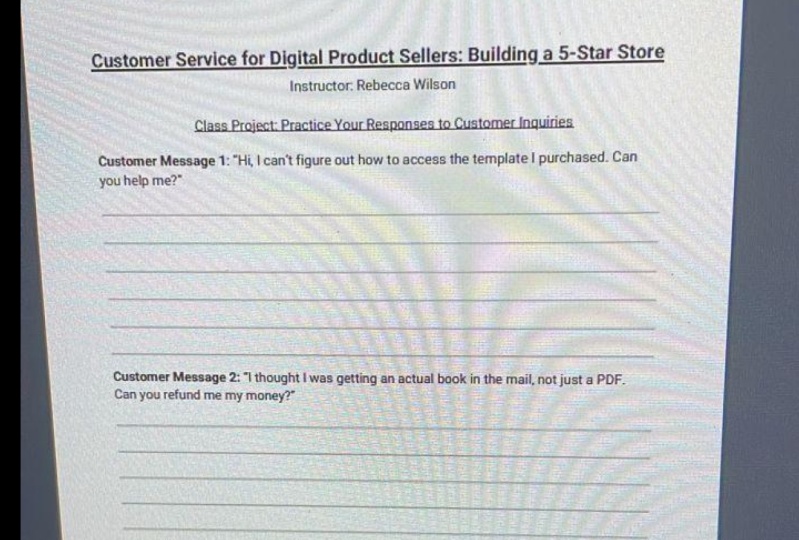
they ever came up. You'll find a PDF attached to this class in the
downloadable materials. There are three exercises in
there, three little proms. So experiment with answering those and feel free to either, type up your answers
and then take a screenshot of that to
upload it to the class, or you could choose to have the questions and paste
them in the discussion, where you could
get some comments from your classmates as well. Really looking forward
to seeing how you handle these questions
and what kind of approaches you take to
dealing with these situations. So looking forward to seeing
what you have to share. And final thing, if you
enjoy learning with me, please do consider rating
my class. It means a lot. It helps other
learners like you find my content and know that it's good. I hope you thought it was. Good luck with your
digital product store. I know you've got this and have a great day.
I'll see you later.
 Rebecca Wilson, Artist