Transcripts
1. Introduction: Hey, how you doing?
It's Clayton here. And in this lesson,
what we're going to be learning about is how to crop the panels of your
comic book sequences. In other words, how do we
frame up the scene inside your comic book as it unfolds
from one panel to the next? Now, depending on the
way you go about this, you're either going
to end up with a sequence that's hugely immersive or one that's just kind of like
it feels a little flat, a little repetitive, doesn't quite hit that
cinematic immersion that we're looking for. I'm going to show you with
this simple trick because I use it all the time
within my sequences, how much you can bring to your comic book
sequences as they play out simply by
pulling in that camera, and placing the main subject within the window of your story exactly where they need to
be in order for them to make the most visual impact possible and to keep
your readers hooked. Without further
ado, I say that we jump straight into
this and get started. If you have any
questions along the way, be sure to drop them
in the comments, and I'll be happy to
answer them for you. Alright, let's do this.
2. Setting up the Panels: Alright, so here we are
in Clip Studio Paint, my favorite drawing
application of choice. As you well know, I'm using the legendary line art brush by Mark Brent, can
download it for free. Off of her website, it is absolutely wonderful this brush because if you've ever seen any of
my lessons before, you'll notice that it draws beautifully just like a
pencil, except digitally. All right, what we're going to do first up is we're just
going to draw up some panels. Can be any sorts of panels. We're going to try out a few different dimensions
here. Where's my ruler tool? I'm going to grab the ruler tool here and clip Studio Paint. It's right there on the left. We've got figure ruler selected. We're making sure that
we are on rectangle. We're going to zoom in
first. There we go. We're going to be laying out
a sequence here. All right? We're going to keep it
fairly rough to begin with, because in these initial stages of the comic book
page drawing process, we're thinking in very simple
terms, broad terms, okay? Macro. What I mean by macro is we're thinking
of the overall image. We're not getting caught
up in the details. And you'll notice that I've got one long skinny panel
over to the left, another long skinny panel running horizontally
across the top, I'm going to have one that's got a little bit more height
to it underneath, and then we're going to have a relatively squared off
panel at the end there. Okay. And you'll notice that I'm creating
some gutters here. That's the gaps
between the pens. I want to try to keep
those consistent. You know, a lot of the time,
what I see in beginner work is that they won't pay enough attention to getting
these gutters correct. We need to make sure
they're ship shape lined up as accurately and consistently as we can possibly get them. So you can see that trying to keep that gutter
spacing nice. It's a little side note, little extra bonus for
you to keep in mind. Then we're going
to do a final one here to the bottom right, we're just going to stretch
that out. There we go. Now, this ruler tool serves as a guide that the pencil
is going to conform to. As we run it around the frame of the panel that we want to draw
down onto the page. Pretty nifty stuff. It's one of my favorite tools
here in Clip Studio Paint. So you can see I'm very precise with my panels because I know that it leaves us with
a professional look, a professional level of quality that we
really do want to try to capture within anything that we're drawing onto the page. I feel like this one could do it a little bit more
space. There we go. And that is just our basic
comic book page layout that we've done in
landscape mode. All we've got to do now is run our pencil around
these ruler guides, and, you know, select
your desired thickness. I'm going to go with a thickness around about this, you know, something reasonably
uh, you know, defined. I'll leave us with a nice
decently thick edge. Nothing too thick, though. I don't like frames
that are too thick. That's a personal preference, but we just run our pencil
around the outside. You can see how easy that is, by the way. Super duper easy. Now, why have I selected to do these panels at
varying dimensions, okay? Some are long vertically,
some long horizontally. Others are a little
bit more square. Well, it's because on
a comic book page, you never know what
you're going to get. You are going to
be working within panels of all different
shapes and sizes sometimes. And so you've got to know how to work within those ranges across a spectrum of
potential dimension that these panels are
going to be presented in. And so here we go. We've got our panels drawn up. We are ready to rock and roll. Now, I'll bring this to a certain level of
completion, but as I said, what I'll be showing
you here is a part of the comic book page
drawing process that I really tackle at the very beginning before
I add in any refinement, any details, any design, and certainly any rendering. This is all layout stuff. So we're working
with Menkan models, very roughly drawn figures and extremely basic backgrounds. So here we go. What I'm going to do next is
I'm going to zoom out here. Now you know why
I'm doing that it's because I like to
work from a distance. In the final edit of
this lesson, though, you will actually see a
zoomed in representation, so you're not going to miss
much at all, I promise you, you're going to get a close up, detailed view of exactly
what's going on. But the thing is, for me, I
can't actually work close up, especially in these
initial stages. So I can't impress on you enough how important it is
to work from a distance. It gives you an overall look at how the composition
is coming together, so keep that in mind. All right, we're on
our pencil tool. Let's go ahead and do this.
3. Drafting, Cropping, Composing the Sequence: Now for this sequence, I'm
going to I don't know, let's do a basic action
hero type sequence. Maybe we'll have a
female character, a male character mix
things up a little bit. And we're going to keep it pretty loose and mundane.
Here's the thing. You don't actually have
to necessarily think about how you're going
to frame it up just yet. We're working digitally,
so anything kind of goes. I'm going to draw
in a head here. Alright. And we're going to be placing the camera
below this character. We had a little bit
of perspective them. Now, some framing is going
on here, absolutely. Is it the final framing,
though, not necessarily? Now, the other thing
to keep in mind is that usually these panels
can be split up into thirds. Okay? In fact, every one of these panels can be
split up into thirds. And on each of these thirds, where the line intersects. So at these points, usually
it's a good idea to put a prominent focal subject on
those intersecting points. Now, you can also have it so that maybe you've got
a character here, this might be a close
up shot of their eyes, and they could be taking
up two third columns, okay, one and two. Now, that can happen along the
rows on top of that, okay? And if you work
with these thirds, usually what you're going
to find is that you're able to capture relatively
decent compositions. Now, I'm going to fly kind
of blind here as far as my thirds are concerned as I'm
sketching up these panels. I'm just kind of going with
my feel at the moment, but I do think about this. I'm conscious of those
thirds as I work. So just something
to keep in mind, a little insight into
what my brain is doing as I lay down these well, these different elements
within the panels. Okay? So I'm going to
have this character here, and we might have his
arm coming out there, and then maybe a fist All right, so arms coming forward,
Fs is coming up. And then I'm thinking we'll have another character down here. This character is going to be placed just underneath the
initial one that we drew up. This will maybe be
the lady character, so you can see that she's
set a little further back. All right. Now, here's where the
framing comes into play, and it might still be
the final framing, but I want to show you
something real quick. All right? We're going
to have her arms going back in space there. Okay. Now, I want to give
her a little bit more room. As you can see, things
aren't exactly lining up on these thirds
like we might want. So we need to fix this because
it's not looking right. Things look awkward.
They look squashed. So I'm going to make a selection
around this character. Now obviously, if you're
working traditionally, this is going to be a
little bit more difficult. But any drawing application is going to allow you to
do this quite easily. Now, I've made a
massive boo boo here, and I've actually drawn. There's a a very
unfortunate mistake to make because it makes this process much
more complicated. But what I'm going to do here
is I'm going to copy and paste what I've just drawn into this panel onto another
layer so that I can work on it independently of the
panel frames themselves. Okay. Control C, Control V
onto another layer. Alright, so you can see that there are on separate
layers there. Now, the reason for this is because we're
going to be doing a lot of moving around,
a lot of shuffling. So I want this character to
be placed a little higher. Okay, up here a bit more. And to the left is
what I'm thinking. Remember, we're
considering those thirds, these become quite important, and we want to give
enough room below this figure to allow a decent amount of exposure
for the figure below. Okay, we want to give them
some more room to shine, and we may even want to increase
their size a little bit. So you can see here this is the framing process
that I'm talking about. We're just getting everything
placed in position where we feel it's
going to work best. And if I place this character higher on where I think that
third is going to intersect. So around about here, I bet that placement is going to
look fine and dandy. Okay, cool. So
that's working well. But then this
character up the top, I don't feel is going to
fit in with what we've got going on with
these two characters. Here's what I'm going to do. I'm going to take this
one down here and I'm going to shuffle them
across to this side. There's going to
be a point where the thirds come down and intersect on this
character's head. Just let me draw that in
there for you real quick so you can see what I'm thinking about
in a visual manner. Might be a third here
and a third here. You can see that we
want the focus of the character to
be on their head. Alright. That's what I'm thinking
about, which means that as we redraw in the
character that we wanted coming in from the front, we're going to bring them
closer to the camera. But I'm thinking, and, hey, let's mix things
up a little bit here. Give this character's head
an alternate angle to the one below just to keep
things nice and varied. So I'm going to have it so that this character is going
to be coming toward us, but they're kind of
bent over, right? So that means that
we're going to have a little bit more room
down the bottom there. All right? They're
flying toward us, just like Superman. See that? Beautiful. Now, we
have gone through a process of framing of
just taking you through it. That's what I'm
talking about, okay? We have readjusted the placement and the poses of
these characters. We've made it so that Look, let's bring her
fist forward here. That might look a little weird. Let's have another
crack at that. So this would be her
shoulder upper arm for arm fist. There we go. Beautiful.
It's a nice strong fist that we've got going
on there. Okay. And then we got the
character above, which is a little larger. Now, further cropping
is required. I want to bring him closer. I want to make him take
up more of that space. Why? Because it's gonna
help to produce more depth. Within this shot. Now,
what that's going to mean is I need to bring his
leg up here, okay? It's sitting way too close
to the character below. So cropping, framing,
call this what you like. It basically all means the same thing when
I'm referring to. I get my eraser out there, get rid of those off
cuts. There we go. So that's it. As you can see, you don't need a
whole lot, right? You can basically go in there, make the adjustments
you need to make, and then you're set for the
next phase of your drawing. You know exactly where
everything's going to go, how big it's going to be, and where in relation one
character is going to reside with another character in the panel in the same space. Okay, cool, so
let's move on here. Now, don't worry. We will go over the top of
these characters. We'll find them a little
bit so that we can have a little bit fun with
a little bit of fun with drawing these characters and the subject matter
within the panels. But I do want to just
hit the point home here that we are using this cropping technique
specifically in the earlier stages of the layout thumbnailing process
for our comic book pages. Okay, moving on here, we're going to well,
we'll have one character. Let's say, I know what we'll do. We'll do it like a sideshot of the characters as they're
flying toward the camera. So this will be
the lady in front. We'll have her leg
coming back there. That might be a bit
of an awkward pose. We'll see how that goes. But you'll notice that she's
a certain size right now. I'm actually going
to make her much bigger as we
continue forth here. All right. So she's going to have her back kind
of twisted up. We're going to bring
that arm over here. You can see how gestural I am with my figure drawing
in these early stages, gives me room to make mistakes, to rework the drawing if I need. And you will indeed, see me rework my drawings
again and again. Look at this. I'm completely
repositioning the head here. And I got no worries
about doing that because the initial head I laid
down, it was very simple. It was super, super basic. Didn't take me a lot
of time to draw, didn't have a lot of invested
time and energy into it. So I can make those changes with absolute freedom and not
waste a whole lot of time in putting in all this work into a flawed foundation that just wasn't going to
turn out in the end. So this is why it's
important to start simple because it means that you are going to be able to make the changes you need
to make if required. All right. So there
we got her pelvis and her legs drawn in
at the back there. Now, I'm feeling like we
could adjust her body, so let's go ahead and do that. I'm simply going to
make a selection around the upper half and just
rotate the body up slightly. Now, I'm liking her
for the most part, but I do feel like
there could be a little bit more
movement within her. So I'm going to
adjust once more, dispose Okay, I'm going to bring the head
up to about this point. So we've adjusted
the head twice here, and it hasn't taken us
a whole lot of time at all on each iteration. So this really is a
phase of exploration. Now I want a little
bit of a bend happening within her arm
here as we bring it forward. Now it is going to be
foreshortened away from us. So that's important
to keep in mind. Alright, there we go. Done. So she's positioned
to a certain point. And next up, we're going
to add in the other guy. So he's flying off
into the distance. Now, most of his head really should be covered
by his upper body there. Now, here's the thing. I'm going to be creating
some overlap between these characters later as
we adjust their cropping. We have his leg coming up here. Yeah, it wasn't just
the bee hind of the lady that we were drawing. It's also his behind,
so, you know, we have equal opportunity
here. All right. And what we're gonna do
is we're going to have his arm coming out
here toward us. But let's lift. All right, increase the size of the
forearm there so you can see that some nice dynamism and foreshortening
happening. It's pretty cool. All right. Great. Now, again, things aren't placed exactly
how I want them here, so it's time to do
some shuffling. This is definitely
a technique that I utilize every single time I draw anything
down onto the page. I'm going to have him
sitting on this third, okay? That's about the cropping
that I want for him. I'm going to lift him
up so that his head, his noggin there is sitting on where
those intersecting thirds would roughly occur. Okay. Now, it doesn't
have to be exact, but it should be really in
the ballpark, if possible. Look, I'm going to
make him even bigger. Maybe we'll make him take up the first or the last rather, two third rows. There we go. Done. Now, here's where
the magic's gonna happen. I actually want her
overlapping him, and what I can do if I want is I can just paste
her onto another layer. You really do need the layers
working for you if you are utilizing this te technique
to a significant degree. All right, let's go ahead and we'll increase
the size of her. Now look at that. Look how
much span we get on her. All right. Now we'll move
her around about to there. I'll probably end up
increasing her fist size. But you can see there
that his leg is creating a nice frame for
her over the top. Unfortunately, her body
is creating a little bit of a tangent in
that lower region. So I'm going to bring
her down a bit more. I might even increase
her size somewhat, and that'll just about do it. Okay. I'm liking that
framing a lot better, at least at this point. So I'm going to go ahead, get my eraser out and
get rid of the off cuts. Wonderful. Next up, we need
to reposition him. I'm not liking where his leg is on this side at the moment, so I'm going to go
ahead and just lift it up so that it's coming
out more that way. What that does is it creates
a little bit more of an extra overlap between
the characters there. That's good. All right now I've got to go ahead and actually adjust
his pelvis there. We'll bring that leg once
again up around her head. Now that is intersecting
with the top of it, so we either have to keep it clear or we have to create
some significant overlap. I'm going to opt for
keeping it clear and we may be to lower we may be
able to lower this leg. Let's go ahead and do that. We'll lower it to around
about this point. Let's just see. Let's
shuffle this guy around a little bit and potentially adjust his
position entirely. All right. Maybe down here is going
to be better for him. You know what? I'm
going to redo his pose. Here's the thing.
It's a process, as you're drawing in
these characters, you're going to discover
different things that you like, things that you don't
like, and hopefully wind out with a better
outcome by the end. Now, for this guy, I'm going to change
him up a little bit. I'm going to have him turning
around and looking at her. He'll be creating
a little bit more of a body twist as well. So now we're looking
more at the side of his pelvis. All right. And I don't want to I
don't want to represent his booty too much here just because I don't want to Like, I don't have a
problem doing that, but I don't want it to look like he's posing
too much, you know? So maybe we'll make it so that his leg is actually
coming down here, because, you know, in
that initial shot, it kind of is going in
a downward direction. So we'll have his leg
coming down there, and then this one over
here will sort of be coming up around
top of her face. Now, I do feel like we're missing something
in this region. So this is also about thinking in terms of how you're going to
fill up the space. Within the image, like, how are you going to utilize
that negative space? Where does it need
to be utilized? You know, here I'm thinking
that I'm going to go ahead. I'm going to create a forearm
and a fist. There we go. And then here, I'm going
to bring out his arm, bring out his forearm, and then boom, there
we have it done. And then he's going to be
looking over his shoulder, like I said, except we can't
really see his face now. So maybe we'll just have
him looking forward. Well, then again, let me mess around with
this for a moment. You know, it's such a it's such a creative portion
of the process, you know, actually going
through and figuring out where everything is going to
sit plotting out the scene. I'm liking that a
little bit better. So we'll go with it, and I'm going to create some shape there in his
torso, in his pelvis. You can see these edges
that I've incorporated. Okay, and I think
that's looking good. What I'm going to do next is
I'm just going to lift her a little bit higher to about here. Just because I think that
that'll work better. And then I feel like her arm is a little too close to the top
edge of that panel, so I'm going to
bring it down lower. Okay, look at that. Look at these small tweaks that we're making to frame up the scene. Not just that, but also to
ensure that the artwork itself is fit in the most optimal way
inside the panel, okay? That is the most important thing is just to make sure
that it actually fits You might have a cape or something that's
going to flow up over here. Okay, great. Beautiful.
Let me take a sip of coffee here. Yum. Coffee is an important
requirement as well. Make sure you put that
on your checklist of necessary steps to take within the drawing process.
Take a sip of coffee. Good for re hydration. Some will say that
it dehydrates you, but I say it rehydrates
because mostly water, I have a watery. I don't like to
drink proper coffee. It's all instant coffee
for me, but I digress. Let's talk about these
next few panels. We have one and two. These are a little
bit easier because they have dimensions
that aren't so severe. All right. And what we're going to do
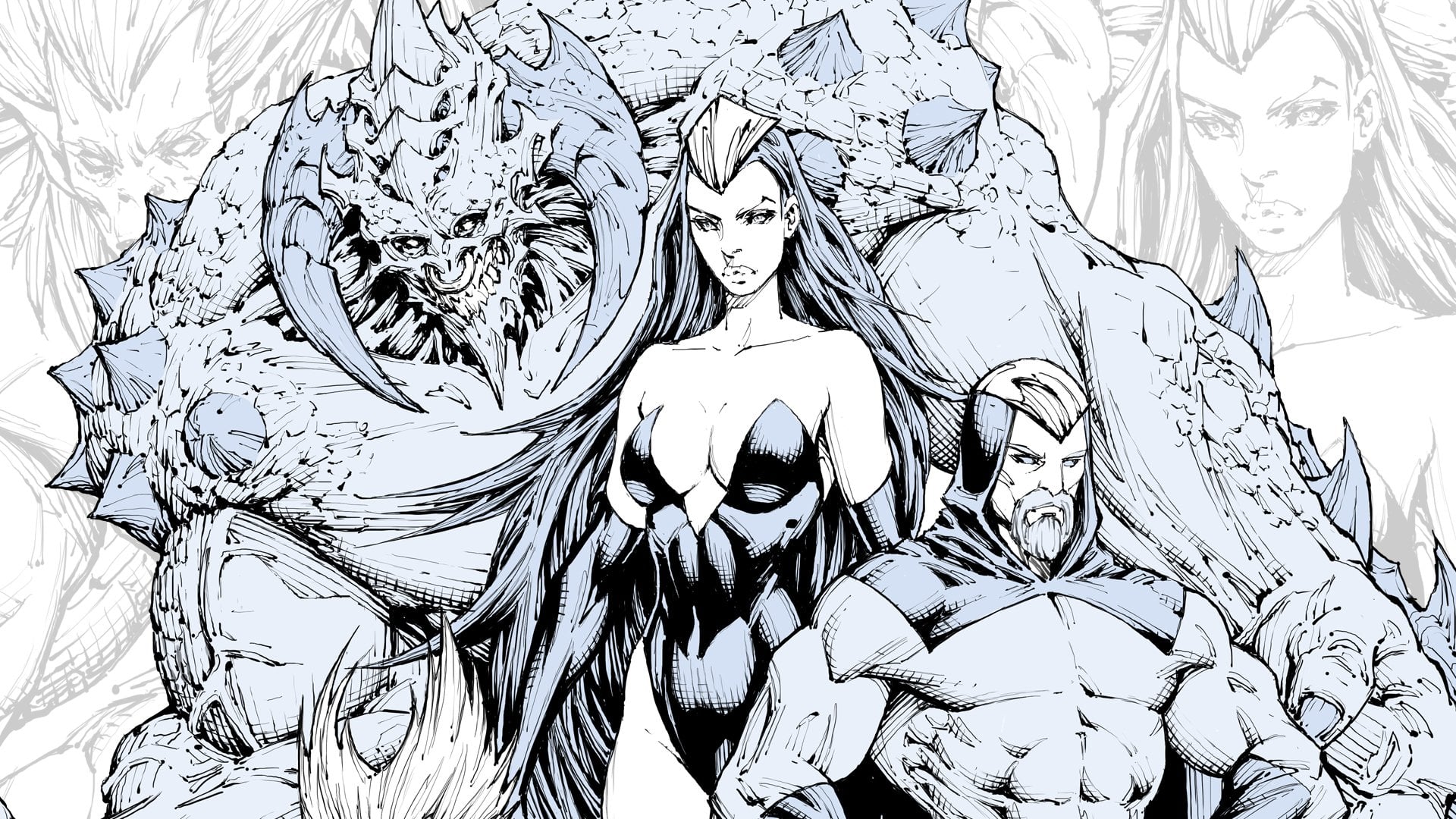
here is we are going to show the mega Boss. All right. He's going to be a giant. And I don't like
boring camera angles. So instead of just showing him from the front
at an eye level, I'm going to pull the camera down and show an upward
representation of him. Now, we need to pull this
sequence together, okay? So I'm giving you
so many bonuses here in this lesson,
because guess what? When it comes to
sequential storytelling, this boss here with this baddy that we're laying down on the
page, he could be anywhere. If we don't show
these characters in the same scene as him, they could be in completely
different locations and we wouldn't know any better. So think of this not only as an introduction
to the villain, but also as a establishing shot. This is something
that once again, a lot of new wonderful people to the comic art craft miss in their sequential
storytelling. Alright, so this is going
to be his legs there. Give him nice big tanky
legs. Look at that. Beautiful. Just
sketch it in there. Have fun, get the
energy flowing. Alright. Now, I know it's
easier said than done. Really. You know what
the funny thing is? The longer you've been drawing for the more
competent you become, the rougher your work starts
to look. Isn't that weird? Well, it's true. It's
definitely true. Okay, so I'm going
to have you know, this isn't going to
be a fancy pose. It's gonna be a
power pose, though. So we're going to have his
fists coming down here, done. And then we're going to maybe
have this arm coming up, and he's going to be, you know, reveling in his power. That's that's what
this arm is all about. That's going down and then
back up away from us. Cool. Now, we don't want to necessarily have to cut
and chop up this dude. So we're going to create a brand new layer above him for the characters that
are flying toward him. Alright? And so we're going to draw
our first character here. So this is the dude character. He's on the right in this scene. So looking back, that means he's going to be
placed on the left. Now, don't be afraid to
overlap a few things, okay? Let's have him
overlap the leg of this monster of this bad guy. I know that I'm drawing
some pretty crazy, foreshortened angles here, Bashots as well,
of the characters. You know, I like to make things difficult on
myself. That's for sure. This is going to be his legs. You can see that they look like Michelin man legs because
they're so foreshortened. Look, we'll have this arm coming out here and it's going to
sort of be coming toward us. Alright. Sam with this arm
It's coming toward us. So if you've ever, like, the arms are going
out the back, right? They're sort of
coming out the sides and then they're
being pulled back. That's what I'm trying
to show there, anyway. Now, these legs are looking
a little too stumpy, so I'm going to go and edit
them, at least this one. You know, here's a
secret to my art. I usually just look
at how bad it is initially and fix the
mistakes within it. And I think that's
really the trick to becoming a decent artist, at least in my technique, the Clayton technique
is that, hey, just know what mistakes to
spot and then how to fix them, you'll be as good
as gold, alright? Now, I don't want to be spreading
his legs too much here. I, uh, maybe we'll bring that leg out just
a little tiny bit more down to about
there. We'll see. I want it to be nice
and dynamic, though, this is going to definitely be certainly a shot to
behold for this guy. So, let's actually bring his leg down to
about this point. Cool. That'll work. And this
one's coming out there, so we'll have his foot
be placed on that angle. Cool. That's looking
really good. You can just imagine
a nice lens blur on this guy in the back
as they fly toward him. And then we're going to
have the lady on this side, so she's coming up there. I'm going to place her head
right underneath his armpit. Again, creating
that nice overlap because here's the thing. Sometimes we have a tendency to avoid overlapping
elements on the page, but we should not avoid this
so much because it creates a beautiful amount
of depth when we can actually utilize
it effectively. All right? So let's just hold down the undo
button on that one. We're going to have
another crack at it. I'll create a little bit of
a twist within our body. Now, here's the thing.
She's closer to us. So let's take advantage
of that, right, because we can create
multiple levels of depth within this scene if
we're smart about it. We can have her in the
foreground, the other character, the other hero in
the middle ground, and the bad guy in
the background. I'm going to put her pelvis on a little bit
of an angle here. I like to create a bit of a twist in the bodies
of my characters simply because what it allows me to do is just make
their pose more dynamic. It allows me to add more
movement to it by default. Okay, so here's
the thing, though. I'm going to need to make
it so that her legs are for shortened appropriately.
All right. Now, this one's going
to be coming down, I think, a little
further forward. Do I like that? No, I don't think that's
working very well. Let me just maneuver her
toward the left some more. Okay, that could work. I feel like this leg
needs to come down on more this angle. That's what I'm thinking.
That's what I'm feeling. And this leg is going
to come forward. And I'm thinking,
then we'll have the lower leg come back again. Look at that. A beautiful amount of depth is now happening
within her pose. I'm really digging that. And then what we can do is, of course, you know, we can have this arm
coming back toward us. So now we're going
to have her body. Oh, this is great. I'm really feeling her movement. You know, that's always a good
thing when you can really start feeling the movement
of your character. That's when you're able to
bring some life to the pose. Alright? So we're going to
look at the difference in the tilt of the shoulders
and the pelvis. That's what we're
looking for there. That's what we need. And if we're smart about this, what we'll do is we'll bring
her arm up here, okay? So she'll have her fist there, and then she'll have her
forearm and then her upper arm, and Brum it comes back
into the upper body there. Now, that is a
good looking pose. I'm thinking we could still give it a little
bit more length, though, on her arm. So let's move it
out here some more. We could probably even
give it more bend, too. So I just bend the pose of
my characters to my will, and that is the
wonderful, you know, gift, the privilege
that you get as an artist is you get to kind
of draw your characters, however you like, and nobody
can say anything about it. Well, they can say
something about it, but, you know, what are they gonna do,
draw something better? It's everybody's choice
as to what they draw. I think if you have put in
the years of effort to become an amazing artist and you want to draw things
in a certain way, then you have earned that
right, in my opinion. And if anybody wants
to complain about it, they should learn
how to draw and draw things in their own way. Now, I'm not happy with that arm pose, so
I'm gonna redo it. I know what I want to go for, but I just haven't executed
it exactly in the right way. So, you know, that's something
that you're gonna find. Sometimes you got a
really great idea. You just didn't
execute it right. So don't give up
on it. Just have another crack at it like I am. You'll notice I never settle. Well, I rarely settle on the initial thing
that I come up with. So, you know, I would suggest leaving it
a little bit open, trying out a few different
options and just see, you know, see what
you can come up with. Now, her other arm
is going forward. So well, you know, maybe we'll have it
repositioned out here. That could be cool. But that wouldn't make sense
for where her you know, it wouldn't make sense for
the angle of her upper torso. So we'll just leave it as if
it's going forward there. I mean, that'll work. Great. I think we're done. I'm gonna make her a
little bit bigger. That's what I'm
gonna do. I'm gonna make a selection around her. Once again, here we
go with the cropping. I mean, it's kind of
cropping, scaling, framing. It's all the same stuff. But the thing is that if we make her a little
bit bigger here, we are going to be able to create that beautiful
beautiful depth that we are always
striving to capture within our work. Okay? Look at all the overlap
that's going on here. That's good. It's
something we want. I go to move her fist back. Arm is looking a little bit
too long for my liking. All we need to know is where the positioning of the
fist is going to be, and then we can sort of rejig the foreshortening
of her arm accordingly. Okay. Look, I'm even thinking that we bring the fist back to a roundabout here. I think that'll
work even better. There we go. Done. Ah, actually, I liked it better the other way. But hey, you got
to try things out, you know, you never know
what you're gonna get. But look at that. We've got some nice anatomy going
on, some for shortening. It's all looking
absolutely fantastic. And now we're onto
the final panel here. Alright. And for this one, look, Hey, you know what
we're gonna do? We know that these characters are in the same scene
together, okay? We know that. That's
information that's important to us as the reader. So now what can we
do? Well, we have the luxury of doing
a nice, close up, zoomed in shot of the
villain's face, okay? And we know that he's
looking right at them. So zoom in here. And we'll get a nice
detailed shot of his head. So we're pulling the
camera in tight. Notice that I've cropped
his face just by default. Now, will I crop it more? Maybe. Maybe I will do that. You know what it'd be
good? It'd be good to maybe put his head on a
bit of a different angle. Okay, so let's just
capture his head from this side. There we go. So all I need to do is just get the basic
structure of the head down first. We're
scribbling it in there. Try to resist the temptation of getting too
ahead of yourself. When it comes to your art, you don't want to start refining too early on is what
I'm saying there, because, you know, you need
to get this stuff down first. You need to know what
the blueprint is. That's what you're defining
here, the roadmap. If you don't know
what the roadmap is, you're going to get lost
and you're going to go down bad roads that
lead to nowhere. So make sure that you've
figured out the territory, you know, that you know
where it is you're headed. I'm going to here's the cropping process
right before your eyes. Now, let's actually place him on a completely
different layer just so that we're not mucking
anything else up. Alright, and here we
go. Look at this. Look how fun this is. We can just go in there, sort of figure out where
we want his head to be, and then we're done.
That's working well. Nice, easy one for us. Fun one, too, especially when it comes to the
drawing portion. But as far as the subject
of this class is concerned, okay, cropping your panels. We've gone through that, okay? That's done. For this
part of the process, it is done. It's solid. It is ready to rock and roll. So I couldn't be
happy with this. This is a good layout. Again, we know what's happening. We know where
everything's going to go. And I'm so excited to jump into the I guess you could call it the refined sketch
where we start to figure out what kind
of anatomy is going on. You know, we could
leave it here, but I want to give
you a little bit more than just basic
mannequin models. So we'll quickly
grow through this and refine it a tiny, tiny bit. But as I said, that is the cropping mechanism that's at play of just taking
you through it. You can see that on each
one of these panels, we carefully framed up exactly
where these characters were going to go and how
large they were going to be, what sort of overlap we
were going to see, okay? And what you'll notice first
and foremost is that every single one of these
character shots have variations incorporated
into them. Let me draw and talk
here. As we work. I'm going to place all of these layers into
a single folder. Okay. There we go. And well, you know what? I think that we could probably draw straight over the top
of what we've got here, but I'll make a
backup just in case.
4. Refining the Sequence: Okay. So as I was saying, what you're going to notice
is that we have a whole bunch of variation that we've incorporated into each one of these shots that we picked
for the characters. We have some close up shots. We have some pulled
back, medium shots. No shot is the same, though. Look at how dynamic the
characters are, okay? You can see the amount of for shortening that we've
incorporated into them. You can see that it really does feel like they're coming out of the panel, out of the page. This is what creates
an immersive story, an immersive
sequential experience for your reader,
for your audience. And that's really our goal at the end of the day
as comic book artist, is to create an
experience which is as immersive as possible. You can see here that once we've got the
basic sketch down, it becomes so easy to just
draw right over the top. And what's more important than that is it's less stressful
than just winging it. Like, we know where we're headed now. We've
got the game plan. Now we just got to work over the top and have fun with it. Are we still going
to make mistakes? Sure, but that's okay
because guess what? This isn't the final line art, either. Wouldn't you know it? There's multiple phases of the development process for a drawing that a drawing
should go through. It's not a one end done
sitting at the drawing board. You're gonna want
to come back to it? You go to want to
mess around with it? You know, try out a few different
things, see what works, see what doesn't you know, hopefully, by the end, you're able to come
up with something that is gonna knock the socks
off your readers, okay? So this is his head done. Let's give him a little
bit of a hairstyle. You know, I like
the 80s and 90s, so I'm going to give
him a little bit of a crazy hairstyle, you know, something like this, maybe, make it a
little bit longer. There you go. Sketch in some hair there. You'll notice that
I'm not getting too crazy with it, except
for the style. But as far as the amount of time I'm
putting into it, you know, usually I would fall into the trap of rendering the
heck out of everything, but not so much here. No, we're going to, you know, remain chill and just draw a little something
in there like that. Enough here to, you know, go over the top with some refined pencils once we're done, once
we're happy with it. Alright, now, once
we've gotten this far, it's time to well,
do the hard part, which is a foreshortened body, not as easy as you would think, but we're going to
have a crack at it. Look, probably what we're
going to be seeing here, first and foremost, more
than anything else, is just his pecks. That's mostly what's
going to be visible. We might see a little
bit of the sternum, but that's about it, okay? We're not going to
see much else there. We got his leg, of course. We'll give that a little bit
more of a refined shape, but it's pretty much
what it's going to be. All right? We don't need to
add too much more to it. From there, we can draw
in the trapezius muscles. Alright, there we go. I like to really bring the tendons through on the
neck of my characters, especially in a shot like this. You might even see
some shoulder muscles behind those trapezius muscles. You can see that I've
just sort of fudged them. I haven't really double checked that that is anatomically accurate,
but it looks right. And sometimes just having
it look right is enough. So that's the dude done. Let's tackle the lady character. Okay. She's at a little
bit of a distance here, so I'm going to be fairly
vague on her facial features. You know, if you're
ever wondering, how do I draw characters
from a distance? This is sort of how
it's done, right? You just take the
details out and you focus on just the
primary elements alone. Not really much else. Alright, so that's
her face drawn in. I'll give her a little
bit of a hairdo, too. Now, that hairdo
is going to run up behind the character
that is in front. Okay, I'll give her a funky
looking 80s hairstyle, too. Something like that,
get the eraser out, get rid of the hair line. There we go, and maybe just
this little line here. Maybe this one as
well. Okay, done. So you can see, it's
really that easy. That's kind of the level that
we're taking it to here. Next up, we're going
to do the same thing. We're going to draw in a
little bit of anatomy for her. Now, what does anatomy
really allow you to do? It just helps you to
construct the body. All right. It's a tool, just
like perspective, just like foreshortening,
like anything. And I find that knowing anatomy really helps you to shape
the body accurately. It gives you the ability
to kind of go in there and just ensure that the structure and the
functionality, okay? The mechanics of your
pose checks out. A lot of artists, they end up
with broken looking poses. And it's not necessarily that they're bad
at figure drawing. It's just that they don't
have a solid understanding of anatomy and the restraints that are placed on
the human body. Okay. We can only bend
our arms and legs so far. Now, can you push it? Yes. Can you push it to the limit and do some
really intense poses? Heck, yeah, you can, 100%. But that comes with time,
experience, practice, and understanding the process of stylization and how all
that good stuff works, which is, well, outside
the scope of this lesson, but we'll certainly do something on it because
it's important. It's important for sure. Now, I'm going to go ahead
here and I'm going to make a selection around Henogon. And then what we're gonna do is we're actually going
to increase its size, and we're going to
reposition it, too. I've gone ahead and just accidentally rotated my
canvas there. Whoops. Alright, there we go
reposition around about there. Now, this is similar to the cropping techniques that we were talking about earlier, you know, where we
just go through and reposition things
how we want them. You know, I love working
digitally for this reason. A lot of people will say, That's cheating, but guess what? They made an eraser for a
reason in traditional art. You can see that
that's cheating. Having another star at your
artwork to make it better to bring your vision to life in the exact way that
you want it to be, I don't think
that's cheating. I think that that's just
being smart, really. And uh and critical of
your work, you know? You've got to be critical and you've got to know how to fix it in order to create something that really
does stand out from anything else that's
been created out there. You know, there's
a lot of there's a lot of rubbish artwork. There's a lot of stuff out there that just isn't it's
not cutting it. And unfortunately, it's
actually published work. You know, I hate to put
anyone else's stuff down, but some people got to
up their game, okay? It's important to see
where the flaws in your work are so that you
can draw effectively. Remember that drawing in any art form is a
communication process, okay? You're actually trying to
give the reader a message. You're trying to
tell them something. And if they're getting lost
in translation all the time, then you haven't done
your job effectively. You know, that's just
the truth of the matter. And you can say, Oh, well,
that's just my style. Well, you want until
the cows come home. But ultimately, if the audience is looking at what you're
laying down onto the page, and they just have no idea what it is you're trying
to say with your art, if they can't follow the story, especially in a comic
book illustration sense, you know, you're really kind
of drawing into the wind. Nobody's going to get what it is you're trying to
get across to them. Okay, so we've sort of sketched up her
pose there. It's fine. It's not my best pose. I'm not super happy with it. Probably her arm could be lifted here a little
bit more, I think. Let's go ahead and do that. You know, talking and
drawing is definitely a challenge for any art
teacher, I would say. But one thing that I
really like about it is it enables you to sort of disconnect just enough to not overthink things. Alright, done. Now, we were gonna
give this guy a cape. So I'm going to make sure
that that's incorporated into this first panel for
the sake of consistency. And that'll hide all of that back fudgery that I
went through before. Isn't that dandy?
Alright, don't have to worry about backing that to
me if a cape is covering it. There we go. So that is panel number
one, done and dusted. Let's be through the
rest. All right. We'll start with the back
of this lady's pelvis. Now, here it's really just
going to be a process of incorporating the anatomy, refining a few things here and there, the shape specifically. The shape of female
anatomy is especially important just because you've got a minimum amount
of lines to use. You don't have as much to define their anatomy,
unfortunately. If you start to use
more lines than you need to for the female body, what ends up happening is it starts to make them look
either more masculine or it ages them. Okay. And look, I don't
make the rules on that. That just tends to
be the visual effect that comes about when you start to add in a little bit more detail to the ladies. So I would say, try to avoid that
if and where you can focus on shape more
than anything else. Feeling like that leg needs
to come up even higher. Yeah, I'm very particular
about how I draw my female characters and the way that their anatomy
ultimately ends up looking. You know, it can be overdone, of course, just like anything. But, I mean, you can
overdo male anatomy, too. You know, look at Rob
Lifeld's work, which I love. I love Lob I love Rob
Lifeld as an artist, 100%, but you know, what made him
stand out from the rest was the way in which he just went full on
with the anatomy, you know, he went overboard. He went over the top with it.
And that was really cool. That requires skill. The thing is, he got a
reaction from the audience, and back in the 90s,
they frigging loved it. They loved it in the early
2000s, too, you know, I always say that the 2000s, the naughties as they call
it, they were great, too. They were just as
good as the 90s. And I think the 80s as well. Some people would probably argue with that,
but that's fine. I like that era a lot. I think you've seen
a lot of innovation. A few remakes started coming
about during that time, but it really was a lot of new stuff was still being
created and styles, and, you know, people
weren't afraid to explore and to see the different options that
they had at their disposal. And I think that is something that's
missing a little bit. You know, we're so afraid
sometimes to travel outside the box and of
what's already been done. So worried about, you know, over emphasizing certain
aspects of our characters, whether they be male or female. But in the end, this really is what helps people to to connect with your
work in a unique way. It gives your art a
specific identity. And having an identity to your
art that is recognizable, whether you might
say or see it as good as bad as good or bad, I think that it's a
wonderful thing to have. It sets you apart
from the crowd. And that's always something that you're going to want
to have as an artist. Now, ultimately, at
the end of the day, you're going to learn
a lot of rules, a lot of the fundamentals
of what makes Artwork work. You learn about anatomy,
about perspective, and all that other
wonderful stuff that is, you know, it's not exactly the most riveting thing to practice to become
a good artist, but it is necessary, I believe. But once you get
there, once you've figured it all out and you
know what you're doing, hey, don't be afraid
to break the rules. I mean, I think that that's
an important thing to do. Definitely break the rules. I would encourage you to break the rules because in the end, you have the
opportunity to do that, and you sort of take
these techniques and you make them your own. You make your own
stuff with them. They become aids when
you get into trouble, a helping hand for you to work out your problems,
problem solving techniques, really, you know,
something's looking off with the perspective
and you know perspective, then you can troubleshoot your way out of those issues,
those perspective problems. If you don't know perspective and you see something off
with the environment, it looks distorted or
slopy in weird ways, then that's well, you're
stuck in the mud, then you're not going
to be able to figure it out without the
helping hand of a mentor, somebody who's more experienced. So yeah, as much of a pain as it is to
learn the fundamentals, I would certainly tell
you that it almost certainly is going to pay
off most of the time. It's not a confining
thing either. It really is going to help
you out in a big way. Now I have to figure out how this part of the body is
going to fit together and I've made the center
point of her body a little ambiguous there and incorrect. I'm
going to fix that. Okay, so the center of
her back is going to come down into this area. Once I know where the center is, I can kind of construct the rest of her anatomy
around that point. Okay. Then we have this
bit coming up, down. Okay, we have this
bit in the center. All right, that'll do. That'll work. It doesn't
have to be perfect just yet. You know, I could probably
spend hours just on this lady. I am a slow artist.
I'll tell you that. That's one of my
weaknesses as an artist. I wish I could be faster. I wish I could speed
up a little bit. But unfortunately, I'm
just I've accepted the reality that I'm
always going to be a perfectionist and I'm
getting better at it. It's very hard for me
to be satisfied with anything that's not exactly
how I think it should be. Okay, now, we have
got that you know, I find that shaping the glutes of a female character
is especially important. So I'm going to
take a little bit of time just to perfect that. It is important. People judge that kind
of thing visually. All right. Next up, let's add in her hair. For her face, it's pretty simple because she's
facing away from us, so we just have to do a little
bit of an outline there, maybe draw in her
ears at the back, bring them down a little lower. Okay. And then the
rest is just her hair. Okay, so we'd have a jaw
line coming down like so, back of her ear. And the hairs gonna be
flowing out like that. Alright. We can get
our racer out now, get rid of the
back of her skull. And that's looking great. You as for this stuff, we can get rid of
it because we sort of we got the anatomy
figured out in there. You know, that's still gonna
lead up into her neck area, of course, but, you
know, it's done. It's done and dusted, okay? So once that's done, you can draw in the
rest of her hair around the top of her head, around the back, and beautiful. That's good to go. Great. Let's move on to
the guy at the front. We'll move a little
faster through this. He's going to have
his hair there. Remember, because he's
a little further away, we can get away with less detail being incorporated into him. Let's go to have his ear
there foreshortened arm. Alright, let's put some
time into this fist. Remember that when it comes to your comic book
illustrations, the hands of your characters
and the faces are always going to be two areas that you really
want to hone in on. Why? Because people
pay attention to them. Why? Because they're trying to connect with and relate
with your character. All right. There we go. We can even add in a little bit of muscle structure
there for the arm. Look, I'm getting carried away. I do love anatomy.
Anatomy is fun. It's like a jigsaw puzzle
when you think about it. It's just figuring out where the right pieces go really
at the end of the day. Can see how fast I'm going through this just
for the sake of time. I'm rushing it a little bit. There's going to
be mistakes that I'm making probably,
you'll have to forgive me. But for the most part, I think it's working
pretty well. Notice that I'm
drawing in his body, one muscle at a time, like I'm literally
constructing over the top of that initial drawing
using the muscle structure. And that's what I mean. It's
just the best aid ever. It really does help you out. Now, as for his behind, we're going to how did
I draw that in there? Yeah, it looks like his body actually twists up a little bit, so we're going to place in
the hip structure there, draw out his leg.
That's all good to go. And then, you know, we might have a
little indication of his booty on that side, but not too much. You know, it's partially
obscured because we're looking at a side
view of his body there. And I'm going to keep it rough. I'm going to keep it scribbly, just 'cause, you know, that's the aesthetic that
we're going for evident. Once that's done, we can work our way up the
rest of the body. Now, here we're going
to see the lats come around and down
going to come up again. Okay. Now, once you have really gotten a handle
on your anatomy, you'll notice that it loosens up in much the same way that
mine is loosening up here. Obviously, I was much, much tighter once upon
a time with my anatomy. And I think that a little
bit of creativity, caricaturing comes in
later on down the track. As you become a more
experienced artist, you sort of you want to have
fun, you know, I think. It can be hard to have fun again with your art after
you've been spending years of study at
the drawing board. I can actually be
very difficult. Now, something to keep in
mind is that men, you know, they call this centerpiece of the back view of the pelvis. I think they call
that cleftalHizon. Now, it's important to note that that is actually shorter on
men than it is on women, a little something to
keep in mind there. I'm going to make his hair
run off out the panel. Just because otherwise, we're going to end up with a tangent. And then we have his cape there. So let's draw in the
rest of the cape. Let's go to partially obscure that hand on the opposite side. That's fine. We want
that obscuration. It's going to give
us some depth. And now he's done. Now, just think if you
were to go over the top of this once again with a pencil, you'd have a decent amount
to work with there. Now, I have forgotten to
actually draw in her breast, so we'll just place that down, like, so that's done. Next, we've got these
characters down here. So this is probably going to
be the most complex penel. We're going to spend a little
bit of time on this one, but we're still going to
be fairly quick with it. So we'll start with the ladies since she's
in the foreground. All right. And this is just about defining the lines that we really
want to keep here. All right. Once we know that, then
we can clarify it. That's what we're doing.
We're just bringing clarity to what we want to
have there in the final image. Okay. There we go. So we got this leg
coming forward. You'll notice the rhythm
here that we see in the glutes as one leg moves
forward and one pushes back. That is something that's
important to know. Okay, there we go. And then
we have that leg coming back. So that's fine. That's
actually working really well. I don't want to get too more detailed there because
otherwise I'll have to bring everything else
up to that same standard. Right now, we're going to
have some overlap there, of course, between the character in front and this
lovely lady character. I'm going to reshape
this area a little bit. There we go. And then we're
going to have her lats. Bring those up. We'll have shoulder muscles. Okay. And then we'll also maybe get a peek at the breasts there. It's a little hard to tell. I do think that
the ribs won't be as prominent as we've
drawn them there. So we'll be able to see
the breast pass them. Okay, especially because just
of the angle of her torso, then we can go in,
draw out her arm. Now, I know that this
is a little bit messy. What I would encourage you to do if you're following along, because it can be hard to
follow scribbly, messy artwork. I would suggest use this as an exercise to
practice loosening up. Practice loosening up. Really try to understand that in the beginning of
anything that you set out to create as
a pencil artist, you're going to need to have a certain amount of
energy behind it, and that energy can't come
from being too careful. You really got to be able to
get the gesture ing, okay? Even in the anatomy, not
just the pose itself, but the actual anatomy, the way that you shape
your character's body, that gestural stylization
almost needs to be present. It's what brings
your work to life. And if you don't have
it, it's going to feel dead on the page, and
that's just the truth. That is just the cold, hard truth of the matter. Okay, so this is going to
be her fist on this side. We're gonna give it a
little bit of shape. Okay. There we go,
done and dusted. And once we figured that out, it's time to yest it. We're going to draw in her hair. It's going to be
coming out toward us. As you can see, got a nice amount of foreshortening and perspective applied to it. Which is what we
want. We'll have a little ear here, for sure. Little ear here. It rhymes. Now, maybe that hairs
in fact coming down a little too far on the
front of the face. I'm going to actually get rid of the front of the face
and just redraw it out. There we go. And then we add in
the other details. These gestural direction
lines that sort of show the movement of the
hair, how it's combed. That's what I think about as
I'm laying in these lines. So you might consider
the same thing. Like, if you're
combing out this hair in the direction you wanted it to flow in, how
would you do that? Never have hair that's just straight that's not
being affected at all by the elements or the momentum of your
character's movement. Otherwise, it comes across
as fake, unfortunately. Sure. And fakery is the last thing we want to be producing
within our art. Why? Because Well,
it's going to break the suspense of
disbelief that we are trying to cultivate
within our artwork. Suspense of disbelief is an important thing to
maintain at all times. Why? Because it makes for more immersive and engaging
experience for your audience. Makes them feel like this
could really happen. Maybe it could be really
happening to them. You know, I mean, in a sense, they gather character in the
story as they're reading it. I'm feeling like this breast
is probably a little bit too visible for the angle that we're looking
at the character on, so I'm going to bring it in. Okay. That's a little better. And now we're going
to tackle the guy. So he's in front here. All right, we'll get rid of some of these overlapping forms. Alright. There we go. You can see how that all of a sudden reads way more clearly. And now we go through
the same process, right? Now, as I said, this
is going to either be difficult or it's
going to be fun. I'm not going to say
it's going to be easy, but it will be a fun puzzle to solve if you know your anatomy. If you don't know your anatomy, there's probably going to be a little bit of
a headache for you. It about at this point
because we are drawing characters from the
bottom up the back view. I mean, you know, that's one heck of a view
to draw a character on. It's pretty darn
difficult, in fact. And so if you're not well
acquainted with the human body, if you don't know how
to maneuver it around inside your mind and picture
it from different angles, then yeah, is this
going to be easy? Hell? No, it is.
It's not at all. So you've got to really just be patient with yourself if that is the situation
that you're in, and it probably is if you're
not an advanced artist. You know, this is in some sense, what we're going through here is an advanced process
where we're sort of just being really loose with the anatomy and we're
sketching it in there. But the actual cropping, which is what this lesson
really was the focus of, that's something that should be considered even
as a beginner, you know, how you
frame your panels. It's not talked about enough. I don't ever see it
really being taught. I mean, to be honest with you, there's not a whole
lot of lessons out there on comic
book illustration, specifically in regards to
sequential storytelling. You know, there's a
lot of nuance to this that just it's
difficult to learn about because there's not a
whole lot of information on the specifics that are out
there that is out there. And so you find yourself kind of guessing your way through it, trying to figure it out,
wondering why, you know, you're not getting those jobs that you expect to get from
the comic book studios, wondering why you're not getting the likes that you want to see
on Facebook and Instagram. And it's a lot of these
little tiny issues that, you know, unless you
watch a lesson like this, you just would be
completely unaware of. Like, that cropping process just makes your work look way more
dynamic almost immediately. And I'm not joking. It really does. That's
why I do it every single time I draw because I
know that it works. And I mean, you saw
it for yourself. I don't really need
to sell it to you, but I guess my point is that if you can
learn as an artist, just starting out about these
little nuances that aren't common knowledge that
are really only learned through going through this stuff on your own and
stumbling through. Like, I just learned
this along the way. I tried it out one day, and I was like, Damn,
this actually works. This is making my
artwork look better. I'm going to stick with it. And so that's how
some of this stuff is actually discovered. And, you know, the thing is, is a lot of the artists
who are discovering it, they're working in the industry. They're not teaching this stuff. They're sort of, you know, working on comic books. That's their day job.
That's what they do. They don't have time to
actually sit down and do a class that's in
depth like this. Now, his legs are a
little bit funky. I'm going to get the eraser out and reshape them a
little bit here and there. But anything is going
to look funky when it's this foreshortened.
Let me just tell you that. Have you ever, you know, really looked up at someone
from a lower angle, like, really looked up at them, like a dramatic low angle. It's kind of weird. Like the whole the whole body, the whole face,
especially if you're looking at someone's
face, it shifts, it morphs into
something that's, well, kind of strange to look
at just because we don't often see people's
faces from that angle. Now, I learned about
this back when I was kind of dabbling in
the video game industry. Well, you know, I
actually worked in it funly enough for a long time. Well, for a few years. You know, I felt
like a long time. Yeah. But I remember the guy who taught
me three D modeling. He told me early on that you've got to basically keep in mind the same things that you would keep in mind
if you were drawing. You got to keep in
mind that shape. You go to make sure
everything looks good from every single angle. Whether you're working
with polygons or contours. Now, I'm going to add
a cape to this guy. It's going to come
out behind him there. So we'll draw that out. And you can see that the lines
that I've just added in, there's another
little bonus for you, along with the lady's hair. These are directional
lines, okay? So they're all sort of bringing our line of
sight into the middle. And that's where the
big villain guy is. Notice how we sort of blended
the scenes, didn't we? We got him in there,
but we made sure that the heroes that are coming
to basically attack him, they are present
within the scene, too. Then finally, we're going to go ahead here and we're
going to do the bad guy. And I don't know. I don't have a design for him, so I'm just going to make it up. As we go, I'm going
to give him, like, a skeletal face, maybe. Yeah, something like that. Make him look really horrifying. Yeah, I'm still working
from a distance here. So it's going to be a little bit vague as to probably what I'm laying
down onto the page. I can really go gung ho
here on his design, though, because, you know, the next shot is just a
close up of his head. This is probably
going to be the only time I ever draw him. So I can make it as complex
as I want this design. And hopefully I won't ever need to use him for anything else
if I decide to do that. I do love just making up
characters on the fly, though. You never know what
you're gonna get. Okay, there we go. Got some kind of crazy
headdress thing going on there. Then we'll get the pecks
drawn in. Those are done. All right. We are going
well on time here. Beautiful. We've done
quite well, in fact. Now we draw in the abs. You know, this guy, he
hits the gym, okay? He doesn't miss He doesn't
miss a day at the gym. He's got to, like, take
out the good guys. Can't be slacking off.
Alright. There you go. So he's going to have, you know, partially some of his glutes showing probably
at the back there. You know, don't
be afraid to draw glutes either on men or women. They are a significant
part of the human body, a huge muscle, in fact, and they're also fun to draw. So there's that don't
be shy about it. I think as an
artist, you can't be shy about drawing anatomy. Go to a few life
drawing lessons, try to desensitize yourself
a little bit to it, and you'll find that
you grow a new found. Well, you just start looking
at the human body, I guess, from a different perspective, which is not a bad
thing, trust me. And I've just drawn his
hand around the wrong way. So I'm going to go back there. There we go. That's better. That is better,
believe it or not. I know it doesn't
look it, but it is. We'll draw some
knuckles on his fist. I'm going to increase the thickness on that line
of the guy's cape in front. Then what we're going to
do is we're going to go in there and draw in his knees and we'll make it so that
they're covered with some armor so that we don't have to get into the nitty
gritty of all of that. All that knee anatomy,
which I don't mind. I mean, knees are pretty easy
to draw, believe it or not. I just draw them like a
skull, you know, like this. Hey, that'll actually add to the design, so
I'll leave it there. So we got some big quads
happening within his legs there. So here's a little tidbit
of trivia, I guess. I always had trouble
drawing legs. Couldn't work them out
for the longest time. I remember them. I literally remember
them giving me so much grief back in the day. They were a thorn in
my side as an artist. But I worked hard at them. I practiced them more
than anything else. And then after a while, I was less comfortable drawing
arms than I was legs. So that just goes
to show that you get better at that which
you practice most. That would you practice most. And it goes for anything. So think about what is
it that you want to what is it that you're having
trouble with right now? Is it legs? Is it
something else? Figure that out, and then
once you've figured it out, practice it practice it
more than anything else, because that's what's
going to allow you to get extremely good at
it and actually master. Okay, if you want to
know how to defeat the challenges or overcome the challenges that you're
facing within your art, you simply need to just
face them head on. Kind of like playing a Mio game. You're going to get
these difficult levels, and you're definitely
going to die. You're going to fall
into the larva, you're going to get
hit by fireballs, and you're going to have
to restart the level. And it's going to go that way until you finally figure
out what the technique is, what the secret is to
overcoming those obstacles. Now, I don't feel like
this guy actually has enough shape to his legs. I feel like they could
definitely be better. So I'm going to bring this quad forward. I think
that's what I'll do. Sometimes you got to really
exaggerate the anatomy in these more foreshortened
views to kind of hit the point across. All right. We'll do the
same thing on that side. There we go. That's
feeling better. Look, those legs look
like they're coming right at us now. Done. He might have some
belt on as well. We could give him that
up here somewhere. Fantastic. Maybe we could even give him a leg
band of some kind. I got a little bit of a tangent there with the guy's
arm, but that's fine. It's not too much of a big deal. In this instance, anyway. Then over here,
what's happening? We've got I guess
that's his arm. I think that might be his
arm coming in behind her, so we'll draw that in. But I'm going to increase the thickness of
the line around her behind because we don't want
to lose that in the detail. If you ever find
that something's not standing out as
much as you want it to, just give it a thicker outline, and that'll solve
that situation. Okay, that'll just about do. We could even create
some speed lines here. Okay, sometimes they
make all the difference. Increase the thickness on the legs as they come toward us. And that panel is
pretty much good to go. Next up, it is time to lay
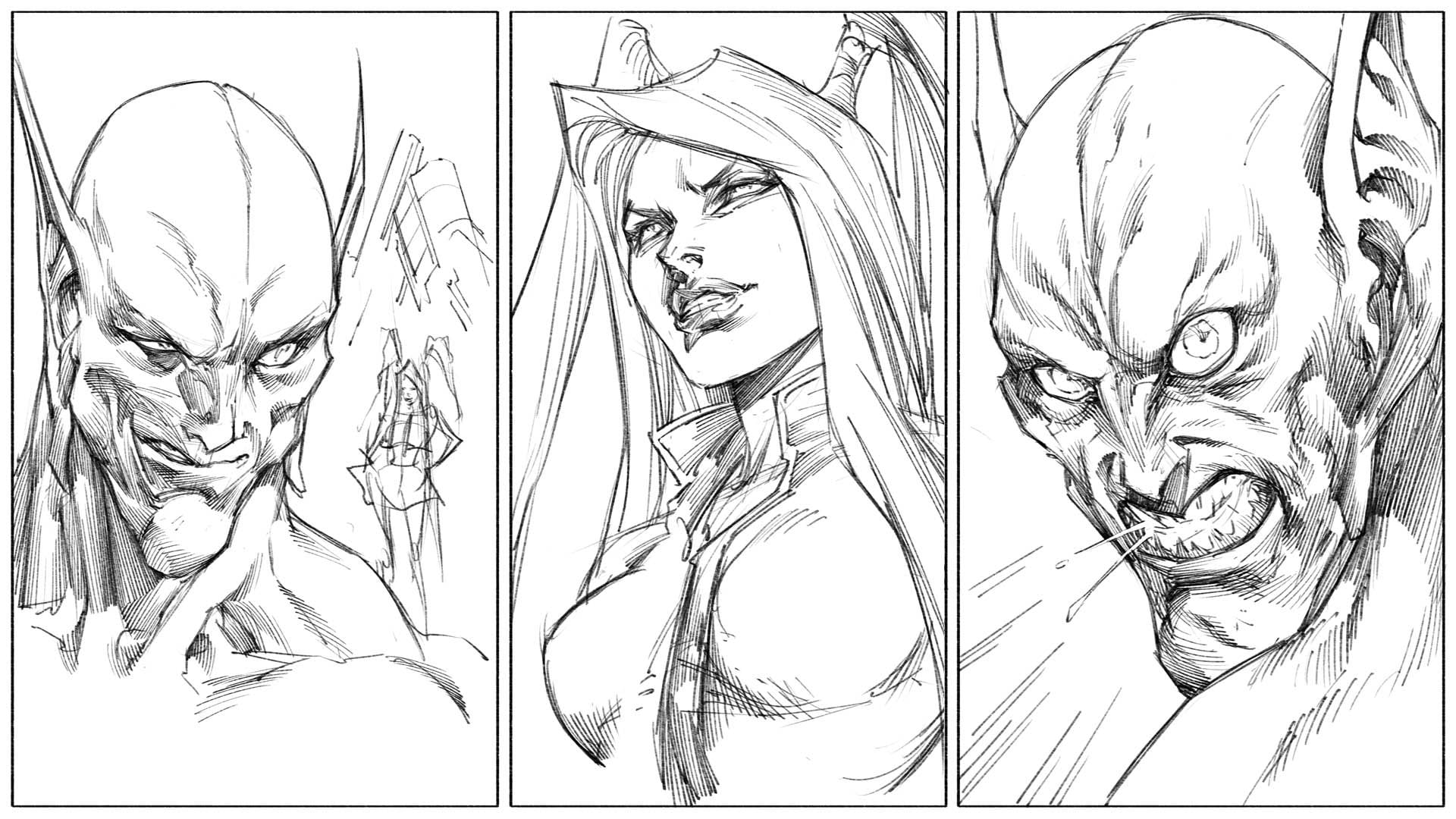
in the face of our villain. Okay? And this is
gonna be a fun one. I love drawing faces. I mean, there's so many aspects of comic book illustration, character art in
general that I love. Now, we're looking up at him, so we have to consider
that because it's going to determine what shape we pick for the eyes
of our character, for the other facial features. I'm going to place
down his nose now. Now, his nose is sort
of missing, right? Like, he's a skeleton dude. So that means that the
opening of his nose is going to come right up
probably above the eyes. Probably about to
there, I would say. Okay, cool. There we go. Let me sort of figure out
how I'm going to shade that. I'll do a few different holes, actually, in his face. It's important to understand
the skull structure, too, especially when you're drawing these upward views
of your characters. Okay, we're going to
have his brow up here. It's going to connect onto
the nose, by the way. We're gonna get a
decent amount of detail and shading in this area. Now, with a close up shot like the one we're
dealing with here, of course, more detail is
going to be necessary. You know, that's just
what's going to end up happening. All right, there we go. And then as for his mouth, I'm gonna draw in some teeth. Like so. There we go. Get the eraser out again and lay in the bottom
set of teeth now. Okay. I'm going to make them kind of sharp but kind of
regular teeth, too. Once that's done, we'll start kind of getting
them in there. Alright, now, they're rough.
They're scary looking. Just what we want
for this character, this villain, we want
him to look scary. Of course, we can go in
there with the eraser. Erase weigh some of the
divisions within the teeth. So we'll be left with
something like that. And then we're going to lay in the details for the
rest of his face. This is where we
get to really start incorporating some of
those gooey details that are really going
to bring him together. You know, I don't know where
I pulled this dude from. He was floating around in my subconscious brain somewhere. I suggest that you fill up your mental
library as much as you can and do so with the kind of subject matter that you would like to ultimately
end up drawing. If you really love
drawing superheroes, then I suggest you start going through all the Marvel
movies that are out there, all the DC movies. You know, really try to fill your mind with
not just inspiration, but an understanding of
how different things look, different creative choices that other people have
come up with before you and try to figure out how you can implement that within your own work. I'm not happy with his nose, so I'm going to undo that. Okay, I'm picturing, like, how far would t
5. Outro: That wraps up this lesson. I hope that you
get a ton of value out of it and that
you put some of the techniques and the methods
that I showed you here to good use whether you're in the really early stages of just laying out your
comic book sequence, figuring out what you want to show in terms of the subject, the key focus that you want
to present within that panel, how to crop it frame
it, position it, give it that depth
that is going to pull the audience
right into the story. And then, of course,
taking it further, right? Maybe you're at that stage. Maybe you're ready to move on to the more refined step within the drawing process
that really allows you to start bringing that
initial foundation together and visualize
it as something that could be polished
and turned into a finished piece of art
later on down the track. We went the whole mile we
really didn't cut any corners. We left no stone unturned. At least on this subject, I hope that moving forward,
you will consider it, that you'll be conscious
of it and that you realize what it can
bring to your art. Like I said, I've seen plenty of artists out there who will
present a comic book sequence, and almost every single panel is the exact same sized head and positioning cropping
for their characters. And it just results in a flat, boring looking
visual sequence that really doesn't have the
impact that it needs. To hold an audience's
engagement. And that's always what
we're looking for. That's like gold to
us, the attention of the audience. Well,
that's it for me. Until next time,
keep on drawing, keep on creating, and I'll see you next time.
Bye bye for now.
 Clayton Barton, Harness the Power of Dynamic Drawing