Transcripts
1. Introduction: Hi, I'm Kara from Cara Corey designs and I have a class for you today on how to make a chunky crochet reef with wool roving and a wireframe. So I'm going to show you how to make a wreath on a twelv inch frame, which is kind of a standard size that you can get at craft stores. But she wanted to make it a different size. You could also buy a larger ring and a little more wool and make it bigger. So I'll show you how to do the single crochet stitches, which are really easy around the outside. And then if you want, you can embellish this however you want. You can add ribbon or flowers, kinda holiday decoration. Or you can just look up plane and have like a minimalists look and hang it in your house. It's like a holiday decor item or on your front door wherever you want to put it. So let's go to the next part where we'll talk about the materials that you need to make this reef.
2. Materials: So today we're going to learn how to make a knit wreath out of wool roving. And these are the materials that you need to do this project. I am using a twelv inch wire ring, and this is what you would use to make any kind of floral wreath. And you can get them at craft stores for like three or $4. And they also come in other sizes. So if you're going to do a bigger one, you certainly could do that. You would just need a little bit more fabric and a little bit more length of wool to get finished. This one is 12 inches and the finished wreath is around 14 inches. A few count for all the fluff. Then you also need some fabric to wrap around the ring so you don't see that enzyme. I am using felt. And I cut it into long skinny strip that's like three or four inches wide and I'd say it's about four feet long, so like 48 inches. And that should give me enough to get all the way around the ring. Again, if you're using a bigger ring, you might need a little bit more fabric. Most important part is the wall. This is Merino wool roving. And it's basically wall before it gets turned into yarn before it's spun. So it's very thick, very fluffy and fuzzy. I order this from a website called World of wool. And as in the UK, so you can Google that if you want. And at sees a great place to find wool. And there's a great shop called sheep's wool, but I order a lot from Basically you need about ten yards, which is not very much. And if it comes by the pound, half a pound, eight ounces would be plenty. I think if you're gonna go to a bigger reef, you might need a little bit more than that. But this is a sort of middle of the road softness. It's not super expensive and this is the guide. But if you'd like to get a color, there's tons of colors available. And you could do red, green, gold, whatever you want. I'm just sticking with white right now. And then if you were going to crochet this with a hook, you would need a huge hook. This is a size 35 millimeter, size 70, Thirty-five millimeters. And that's how you'd make the big stitches. I'm actually going to just use my hands. So not necessary to have a hook, but if you didn't need one or you didn't want to use one, that's what you would use. And then I like to use some thick ribbon to hang the wreath when I'm done. So that's an option. But really could use any kind of string or hook to hang it when you get finished. So those are the materials you need. And we'll go on to the first part.
3. Wrapping the ring: So we're gonna start by wrapping this with fabric so that you don't see underneath the wall. I'm just gonna pick any spot on the ring to get started. And I'm just going to sort of overlap this enough that it's fully covering the wire part of the ring. And I'm going to tighten it a little bit so that it's not loose and it's not going to come unraveled. And I'm just going to work around the ring. Septa, pull this whole length of fabric in and out of the center every time and just overlap and RAB and see a little tagline overlap and wrap all the way around until I get back to where I started. Because there's probably more fabric than I need. So if I have a little extra at the end, it could just cut it off. Or I can continue wrapping until I use all of it. And you could use a different fabric, woven felt, you don't have to use fell. I just like it because it's kind of thick. So it really does hide that wire underneath very well. So I'm just going to wrap until I run out. And then I'm going to tuck this in and return it to the back. And I'm just going to find a little place where I contact the fabricated and because I'm covering it up with some tight crochet stitches, I'm not too worried about that coming undone, but you could put a little glue in there if you are worried about it coming and done. So then we have a ring that's already to be covered.
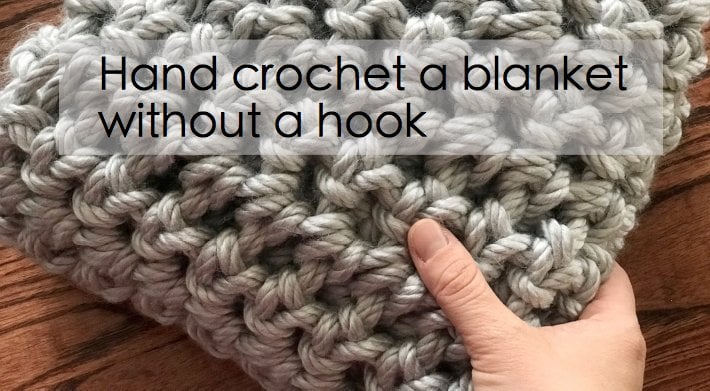
4. Crocheting the wreath: So now for the crochet part, if you've crochet before, this is probably somewhat familiar, but it's a little bit different when you use your hands. And I also wanted to mention that if you are allergic to wool or if you don't want to buy wool for some reason, you can look for an acrylic substitute and there are lots of those out there. And you can look at craft stores to because sometimes especially in the winter or they'll have seasonal acrylic versions for sale. So when you're getting started, basically what we need to do is make two loops on your finger. And then you'll pull the working yarn, which is the yarn attached to your gain or the big pile of yarn. Pull that through the two loops that are on your finger, and that makes us single crochet. So we'll make a series of those all the way around the ring. So to get started, I'm going to leave a little tail like six inches long. And I'm going to hang it over my finger like that. So it's just kind of hanging there. And going behind the ring. I'm going to just pick any spot on here. And I have that tail hanging down behind and one loop over my finger. Now I need to get a second loop on my finger in order to make a single crochet. So I've gotta reach through the middle here with my other hand and, and pull up a loop of yarn. And I'm going to place that loop of yarn on my index finger so that I have two loops. Okay? And now I'm going to reach behind and pull the working yarn through the two loops. And if you want, you could kinda wedge your thumb and there, I'm just going to push it with my left hand through these two loops to complete the stitch. And what I'll do is I'll pull on new loop through like that and place that on my finger. So that is a single crochet, that's what it should look like, and that's one. And that basically allows you to get started without having a big old not on here. And when we get all the way around, well, join up with this original stitch. So that's getting started. And now we have to do a second loop. So you have one on your finger and you need to. So again, coming from behind, pulling up a loop and putting it on your finger so that you have to. And then behind pushing the working yarn through both of those loops, pulling up a new loop and putting that on your finger. So that's kinda the process. You're always reaching through the middle. Put a loop on your finger. Reaching from behind. Pull the working here in through. So as you can see, if you turn it up, you're getting these little v's on the top. And that's making that kinda signature pattern. If you find that you get like one side kinda puffing up like that. When you get your wreath finish, you can go over and kind of tuck that in a little more, even it out a little more and make it look more perfect. But I'm just going to continue doing those stitches around the ring. I'll do one more. So you can see reached through the middle. Put our loop on your finger. Reach from behind, pull a new loop through. Just gonna keep doing that all the way around. And then I'll show you how to finish.
5. Finishing: So I've made it all the way around my ring and I'm just about ready to close up the two ends. And before I do that, I just wanted to show you one thing that happens a lot is your the tops of your stitches that are supposed to kinda show through the front. They get kinda pushed to the back. And so before I finish, I'll just kinda go around the ring and pull them forward a little bit. Because I want to be able to see that outline. That's what makes us rings so pretty. Okay. So now I can see those stitches a lot better. So now I have this gap here and I wanted to close. So I have a loop that was on my finger. I have the tail I started with in the tail that I'm finishing with. If this tail that you're finishing with is too long, you can either cut or tear it. So you don't have more than like six or eight inches left. So what I'm gonna do is in order to keep this from unraveling, I'm gonna take this tail and thread it through the final loop on my finger. Just kinda tighten that. And then what I wanna do is connect this to this side. So what I'm gonna do is take this tail, kind of pull it over so it gets close to my very first stitch I want I'm gonna do is I'm going to turn it to the side too, where you can see this is the very first stage, the little v It makes. I'm going to thread this through the backside of that V. And basically what that does is it joins up the two sides. If I pull on the tail, they kind of come together. So there is a small loop and connection there, but not a big giant lump That's gonna show. And if I was going to hang a piece a ribbon around it, I would put it right here where that connection is. But it's fairly flat. So basically what I can do now is turn it to the back side and I have these two tails to deal with. This is a bit of a long one, so I'm gonna tear it. And I'll show you that the best way to tell her wall roving is not to have your fingers too close together from very far apart, you Paul. And then it should tear into nice little feathery peace. Okay, so now you have two ends and you just want to tie them in a not a double knot or a single not whatever it takes to kinda secure that without it sticking out too much. Because you kinda want this last stitch to come forward a little bit and cover up that transition point. And then back here you just have these extra pieces that you don't know what to do with. So what I would do is kind of fold them up and tuck them underneath a stitch because they're just going to hide back here in the back. No one will ever see them. So lift up some wall, took them under. The backside is not as pretty as the front and it has some kinda holes in it. So make that the back like this, the front. And you read this all finished. And basically what you can do now is you feel like there's some uneven kind of puffy part. You can kinda work on tucking them in a little better so they don't stick out. So it's nice and even. And once you're really happy with the way it looks, then you can attach some ribbon. So I like this big fat ribbon, basically you can just cut off a piece. Maybe you like 20 inches long or so. Find that spot where you started, which is right here. And then you can just kinda make little hanger for it. Like that. You could tie a really pretty Bo, you could use any kinds of ribbon, then you can start decorating this if you want putting flowers on it. Whatever you wanna do to make it personalized to your house. Or you can just leave it plain and have it be minimalist. It's up to you. So there is your net reef.
 Cara Corey, Knitter and overall do-it-yourselfer