Transcripts
1. Introduction to Sketchbook Panels: Join me again for another
fun art project where we use a limited palette
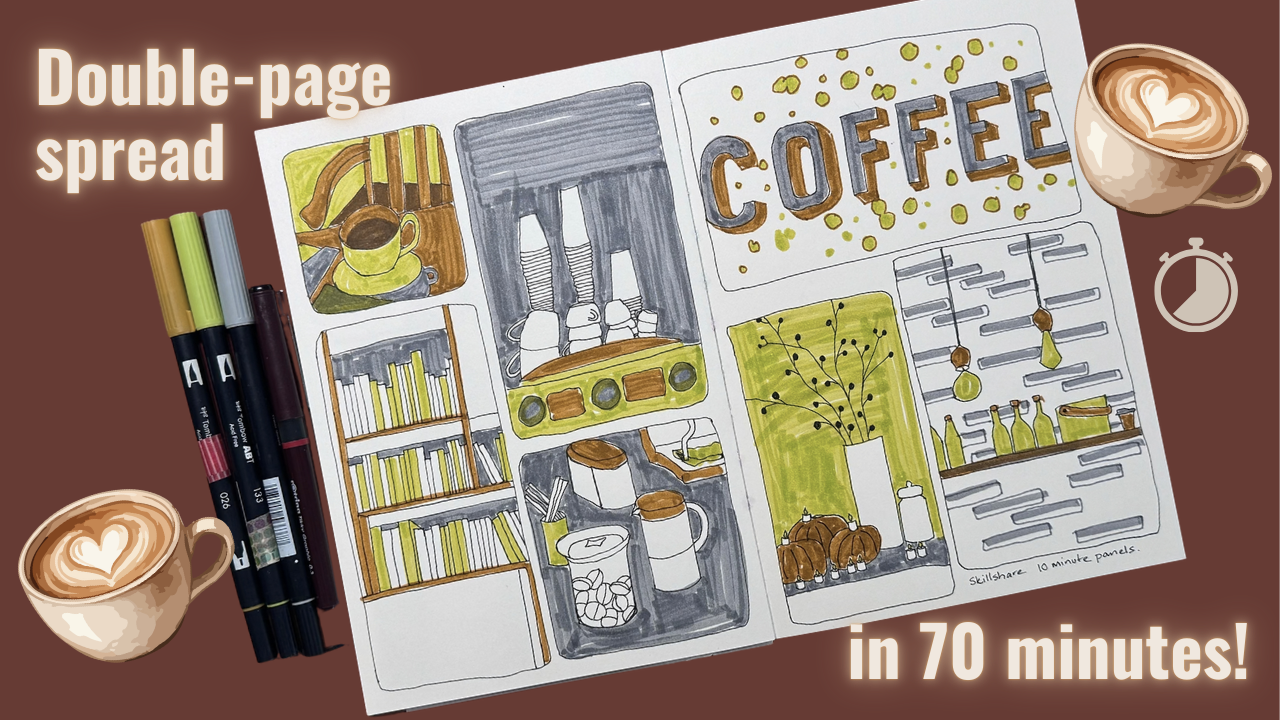
of marker pens and create a double-page spread
in our sketchbooks by drawing up panels and taking complicated cafe images and creating easy
cropped in drawings. And if I haven't met you
before, my name is Jane. I live on the Gold
Coast with my husband, two remaining chat Olts. If you don't know what
they are, they are the ones that are now around 20. Still living at home,
along with a dog, two cats, an aviy
and three chickens. I also teach local art
classes on the Gold Coast. Grab your pens and
your sketchbook and let's get into the art room.
2. Class Project: To begin this project, you need to go to the
Project and Resources tab and view the
seven cafe images. They've all been
chosen from Unsplash, a website that has royalty
free images for us to use. We'll credit the photographer's
name on each slide. You don't necessarily
have to download these images because each image will be on the screen
whilst we draw them. But if you want to
use them to crop in, then you can find
them under this tab. You will have a double-page
spread just like this one, completed within 70 minutes. How wonderful is that? I would also love for you to upload your work
in the same tab, which is the project and
resources tab so that I can see your work progressing and give
you constructive feedback. Only way for me to know that
you have done my class is by uploading your work into
this tab, so don't be shy. It's also an awesome way to be able to see how someone else has sketched up their
double-page spread using the same images
and instructions. Let's now head to
the materials video so you know what
materials you need.
3. Material List: Okay, let's get on
to the materials. As you can see, there's not
very many materials here. We start with a sketchbook. Now, you want to
do a sketchbook so that you do have a
double-page spread. It's all about filling up
your sketchbook and doing a double-page spread on the same subject really
makes it come together. So this sketchbook is not a
four and it is not a five. It is right in between. It's a 200 GSM paper. So it means that the copy will not go over
to the other side. It is better to have a
heavier weight paper. It can be cartridge. It can be a mixed
media sketchbook, but you want to have
that thicker paper so that you don't see what's behind this image and then
ruin the page for here. So the other things that
we've got is a drawing pen. Now, this is a waterproof
drawing pen. It is a 0.2. This is the one that I have
used for this project. And as you can see, it is a really good size weight for
doing a sketch like this. Tombow markers. Have
you heard about them? They are jewel tip, so they have a brush
end like this. And then this end is a fine end. The great thing about
tombo markers is they are watercolor markers, and they blend two
colors together, and then they self clean. So this nib got quite dirty, and now it's lovely
and green again. So what I mean by that is, if we look at this brown
that happened here, I've used this pen. It is this brown here, which is this pen,
followed by the gray. So I've gone over that area of brown with two color markers, and it's created a third
color. Done in there again. Also did it in here with
the gray and the green pen. That's what I love about
the Tombow markers. They blend beautifully,
they self clean, and they last forever. These two here are over
10-years-old because I used to have a shop and I would
sell the Tombow markers. I would let people use mind
to test out the colors. And so they are 10-years-old, and look, you would
not know it at all. So that is it for art supplies. Very, very simple for
a very fun project. So let's get ready to start drawing and
do our first panel.
4. First Panel - easy cafe scene: Okay, so we have
our first image, which is it's quite
a simple one. It's the sunglasses sitting on the notepad with the
empty coffee cup and a nice chair with
a nice back in it. Also a nice pop plant
on the window sill. So I'm naturally going to go here because that's
just natural for me. I'm going to go a square panel. You can do all of this up
before we set the timer. It's fairly small when you
look at the page here, the dynamics of it, but maybe I'll do a long one there and make a
bigger square there. Let's start on this one. Our very first one.
Let's start the timer. Now, there we go. All right. Now the reason, which
I've probably already explained that I am using pen is so because you don't
have time to do the sketch up in pencil rub
out here and there. You just don't have
the time for that. It is what it is. And helps keep it a lot
more organic as well. To start off with an ellipse
straight up is a bit cruel. I haven't really done my table in perspective there either, but it doesn't matter. We've got 8.5 minutes
left on this first one. And I'm allowing a lot of time. I probably gone too small with this square for a
ten minute drawing. Okay, you've got just
under 7 minutes left, and I have done a fair amount got the edge
of the wall in here as well. I've done a fair amount
already in my line drawing. Just the 5 minutes to go. Mmm. I kind of want to leave
some blank space as well. I might make the wall green. And I've got 3 minutes to go, and I myself have
finished this one. But the camera is going to keep rolling because
I'm going to make sure that you've got the
image up for 10 minutes. And I'm really debating what
I do about these last bits. I'm thinking I'm going
to make that floor. I wonder if I could
make it gray brown. So by going with gray, I've got time, so I
may as well use it. It's quite a dark gray. And using limited colors, too, which helps just remove any um big decisions and
making it too colourful. Limited palette does work well, and these Tombow markers do like to blend together
to create new colors. So that worked quite
well for that. Made that a lot darker. I could do the same in
coffee cup and then make the top. We got minute 30. Still plenty time. So I've made this a full cup of coffee. It's not going through, no. And now I've been left with that little bit of white
space down the bottom, so I'll definitely
have to fill that in. With? What color? What color? What color? I might go gray
and then green over the top. Would you. I'll do that. 30 seconds left. You may be like me
with this first one done something where you don't really
need the 10 minutes. Okay. And that timer is up. Even though it started again, don't worry about that.
I will change that. So I'm going to cut this video and we'll move on
to the next video and we'll have a new image.
5. Second Panel - coffee machine with chalkboard : Alright, so onto our
next image, this one, I am going to go a bit
further down, I think. Then that will leave
this one being could be quite large
or could go to there. So I might go to here. Oh, I fell a bit short
from where I wanted to go. These panels don't need
to be perfect, remember? Okay, so I guess I'm
doing four on this side, three on that side,
I would imagine. Ready to go for our
next ten minute. Don't know what
I'm doing. Okay, I think I might focus on
the coffee machine. With the cups on the
top, that's quite a lot. I might do from the knobs
of the coffee machine. Now, of course, you
may not be doing the coffee machine
with the cups on top. It is quite detailed. Who's doing the lettering? That's a bit of a challenging
one, but also quite. Yeah, it's a challenge, I'd say. But there's also the glass coffee makers
up the top there, the little individual ones
that they probably sell, they don't use in
that coffee shop. And then, obviously to
the is at the right, you've got the coffee
grinder and a few more cups. So there's a lot going on in this image of the coffee shop. I have more time. I'm putting a lot more
detail in this time. We have 8 minutes left. Okay. That are in the middle are not the same size
cups on the outside. That's the beauty
of actually drawing something rather than just
taking a photo and moving on. I you actually see
a lot more detail. You would never know that the
cups are a different shape and size on this coffee
machine if you were just taking a photo in a
coffee shop because you liked the aesthetic of it and not for any
other real reason. But drawing what you see means you just
observe a lot more Okay, so we have 6 minutes left on this panel.
How are you going? 'Cause if you're looking
at what I'm doing, I can't believe that's taken me 4 minutes to do
that much so far. So at this stage, I feel like I am not going to
be adding any color at all, given the fact that I've got all those cups on
top to draw yet. And it also doesn't look so
much like a coffee machine. It looks more. I feel like it looks like a bit
of an oven at the moment. But anyway, how is yours going? Are you sticking to three
colors along with a black pen. Of course, if you don't
have the Tombow markers, then you're using
something else. And I've mentioned before
in regards to the color. So this works well with
watercolor, as well. As long as you have got a
waterproof drawing pen, like the one that I'm
using, that's the really. Hang on. I've just it is a
UIPNFne line that I'm using. I just blanked on the
actual name of that one. So that is a waterproof
and fade proof pen, which you can buy
in many places. So they're quite well
known this range of pens. But I don't know if
I actually told you what pen weight
I'm drawing with, but from the image, it looks like it's a 0.2, which is a good all
round size thickness. Alright, what we
got? We have just got over 4 minutes
left. And look at me. I am still drawing this image and the cups are getting thinner as I went down, and they look like they're
going to topple over. But that's okay. I
think when I add color, it's not gonna be so obvious. I just am leaving adding color
to the very last minute. Okay, we have just got
over 2 minutes left. So hopefully you are adding
color as well as I am. I look like I have never
colored in so fast. The other thing with
these tombo markers is you can see those lines
look quite harsh now, but as the ink dries, that will not look as
harsh as it does now. So yeah, I'm just trying to get
color down as fast as I can without going outside or inside other areas that
want to be certain colors. And you have 30
seconds remaining. Time to draw or color
in very quickly. We are down to the
last 20 seconds. And that is 10 minutes up again. Alright, so I'll
again end this video and come back for
the third panel.
6. Third Panel - bookshelf beside counter: Okay, we are on to number three. So this is the one where the bookshelves are
the main focus. So I am going to do
a long thin panel. And just get all those books in. Alright. So have you
chosen your panel? Are you ready to start? Sum. Let's get started now. So hopefully you can see
my time you're in there, but I will call it out as well. This is really hard to know
where you're going to crop. So I'm just gonna go in with bookshel Hi, everyone. I'm just stepping in here just to let you
know that this was a really long photo
horizontally, so you won't see my
drawing for this one, and I will move the timer
up so you can see it again. The negative space is
really good to use as well. Okay, so I'm going
to demonstrate the negative space
here, actually. Before I do that, there
is the shelf behind. So with negative space, I am drawing the white of the
wall and not the books yet. So, it will just be uneven. And I will do all
those books in well, I guess I can do them in now. If I want to go seven months totach with through this here. It's the first book. We have 6 minutes,
15 seconds left. Now, these books
started going on slant, and I didn't really know that, so I don't know what
I'm gonna do here. I might have to make it up. Alright, so we have
got 5 minutes, 30 seconds left, which is pretty much halfway for
this panel. How are you going? Have you started
color yet? I do not. I risk it this time, and I leave it to less
than a minute to go, which is a bit too short. So I hope you are closer
to color than I am. U How long are we going for time? Just under 5 minutes,
4 minutes 49. I've just realized that that's
the bookshelf I've done, and then I was about
to do it again. So that's not kind of good, but I'm going to I might
just I might do it again. Just different. I'll go
for different shapes. Just under 4 minutes left now. I don't get a hurry on. I'm not going to
get any color down. Just under 3 minutes. I'm not sure how you are
going with this third panel, but I am finding myself getting into too much
detail too quickly. I don't want to be messy
with the lines and have them hanging over other
lines, like a cross line. So I just think I bit off a little bit
too much for this one, with all the books
all being individual. I should have honed in more maybe on the pop
plants up a top. Hopefully you are
smarter than I am and have done something
like that and haven't found yourself all
of a sudden getting down to less than a minute to go
to actually apply color. Minute 30 left. Okay, I need to get color down. So I'm just going to get some background in because
we have got 35 seconds. And that is time up. That's another 10 minutes done. Wow. That panel is
looking a little blank. Alright, so again, I
will stop this video, and we'll get ready
for the next one.
7. Fourth Panel - halloween counter: Alright, so we are on
to our fourth panel. The image with the Halloween and there's some pumpkins
off to the left. Alright, so we are ready to go. Let's start clock. You've got your image ready
and your panel drawn up. We are on. So I'm
going to go straight for the bench and where those pumpkins are and all the little cute tea
candles as fake as they are. I have taken a break in
between the first three, and this one, had to
drop my daughter to work and get some
dinner for tonight. So it's been a good hours. So I've kind of I warmed up
and now have to start again, but that's what happens. We don't all get to don't
get to do this all at once. If we can. Awesome. But
you can break it up. But I'm looking
forward to seeing your results of how
you go with these. Please make sure that
you post them in a resources area so that we can all have a look
at each other's panel. It's really interesting
when I do this in a class locally that we're all
drawing the same thing, or at least I'm instructing
them to draw the same thing, and how different everyone
hanss that drawing. That's a weird looking pumpkin. Okay tips for me. Might make it slightly
bigger so that I can use the space that
I've given for this panel. Or Ooh. And what's beside it? It's a glass jar, I think. I'll just make it a glass jar. There we go. I've made that
one up and looks a bit like a cookie jar more
than coffee beans, which I think is in it. Bunch. I How long have we got? We've got 5 minutes
left on this one. Shouldn't have probably
colour these black, but anyway, too late now. Just over 4 minutes, less. The idea behind the
panels is to create a double-page spread of
a scene for a theme, as in this case, so it's all
cafes, cafe style scene. But if you're traveling, you could be taking
some photos of your day and then
from those photos, do a panel a double-page
spread panels in your sketchbook and break it up into more of like a little story of what's
happened that day. Doesn't have to be when
you're on holidays somewhere, can just be even just your
normal old day to day. Okay, I'm spending way
too long on those, so I need to move on, start
putting in a bit of color. This is easy for the pumpkin. Could put a bit of black outline a bit more shape to
them, as well. Wokend. We've got 2 minutes, 25 left. Go so quickly. It's also very good to time yourself because if you
don't time yourself, you get caught up in detail, and you can always go back, like I could go back to the bookshelf and add
more color to it, which I may do because it
looks a little bit unfinished. But timing gives you that ability to be able to work out what it is you're
actually doing. We've got green flames
on our little t lights. And let's do Oh, I think the gray background
is gonna be too dark. I might do a green background. I'm using a
waterproof black pen, so I can run over the
top minute 20 today. I can run over the
top of the black pen. Did topled a little bit there's
'cause I was coloring in. Yeah, did it again. Just on those little dots
that I colored in. They're probably still
a little bit wack. 39 seconds. Well, I'm gonna run out of time. All 16 seconds.
I'm gonna make it. Oh, no, sir. That
will look funny. Let's go to the black pen. Oh. Time's up. I wretch all rules. Just pouring a bit of wine in on those pumpkions. There you go. You're allowed to cheat.
No one's got a night. Alright, so I will
end this video again, and we'll go on to the next one.
8. Fifth Panel - semi difficult: Okay, so as I started this, a concrete truck has
turned up fixed up. Um, anyway, we just have
to continue with it. Do people are allowed to build? And that is definitely what
they're doing next door. Adding another
bedroom or something. Okay, so I'm going
to go down here. I don't really know what
I'm gonna do to those ones. I might even do a shape that
goes a bit like the step. But, this one I'm
going to go for, let's start the
timer. Now we go. We're on. I'm gonna
go for the jug of water and the jar of cookies
down the bottom there. Try and do a bit of a sincle one again like I did up here. But pairs of lipses
that I don't like. It's a bit of a weird
lid that I've done. I thought I was doing
the right thing there, but it doesn't look it. And the base is
very off as well. Ellipses are hard. Maybe I need to do an art
class on Elixes. I do an art pass locally. We do a lesson on Elixs. They are circles in perspective. And it's what I do ellip is They are so wrong
that I like them. I actually like them. I they just so out there
and weird and wrong. Oh goodness. Okay. What
is the in this jar? They look like fortune cookies. But very round. Looks We have got 6.5 minutes left. Saving the best one until last. If you do it in the order
that we're doing it in, I'm saving the best
one until last. But you might have seen
the images already, which it is the coffee sign. So, um, it's a lot to do in 10 minutes when
you're doing writing, but I don't mind
a bit of writing. So signs just in case no
one knew what on earth. These look like
enormous coffee beans. Um, yeah, in case no one
knows what spread I'm doing, the coffee sign
should give it away. I think I'm gonna
give up doing these. They look diculous. 5 minutes to go on this panel. The one thing I'm planning for my Japan trip because
we're going for two weeks. It's my husband and my daughter
who are going with me, but I'm not going to
have a chance to be able to sit in a cafe and draw a scene or even sit outside because I'm traveling
with two people who do not enjoy drawing
when you are traveling. So with that being said, I will be taking
a lot of photos, collecting a lot of bits and pieces and creating a sketchbook that I draw on when we were when we are in the
rooms of the apartment, or if we're traveling
on the bullet train, there are the times that I'm going to be actually drawing, and it will be all from photos, which makes it very easy and still very fun to do a
traveling sketchbook. Okay, you got 3 minutes
30 left on this panel. One correction I must make is
that my daughter does draw. She will be taking
her sketchbook. She's very good at
Japanese anime. So we'll be really
enjoying being over there, being out to go into
shops anime shops, which I don't know how
excited I'm about that, but yeah, she will
be drawing, as well. Probably on the train, maybe the airplane, as well. Uh, but it will be anime figures rather than what I'm doing, which is creating a sketchbook about Japan and the
places that we go to. Alright, time for color. We've got 2 minutes, 20 left. I do hope that you are getting down a bit more color than I am. And I'm also I did say that that gray Tombow
markers would Um, the lines would not be as
obvious once it had dried, but I am to be
corrected on that. The marks have not dried
on that drawing above. So I'm not sure if that's
'cause of the paper I'm using, but I don't know if I've
ever had that happen before. It definitely won't go through
to the other side, though. That's the one beauty about Tombow markers is that they do not go through
to the other side. They're not alcohol based, and they are watercolor
pens, as well. 1 minute left. It's deep inside
my thoughts then. Not a drawing of passports and have all our passports being
updated, which they have. Okay, so we've got 40 oh, well, we're actually 35 seconds
left of this one. Get coloring. I'm madly trying
to get some color down, and it's looking very much
like the panel beside it now. And that is time up. Okay, let's stop this video
and get on with the next.
9. Sixth Panel - a lot going on in this cafe: Alright, onto our
second last panel. Now, I'm going to go. I definitely want the
coffee one to be there, so I should have
brought this one up a bit higher 'cause I
don't need all that room, but I will go here, and I think I might just
come up a little bit. Finish a bit early there. And then that way the next one can be there. There's
a little gap there. There's a little gap
there. That's all good. That can happen. Oops, I don't know why I'm
putting that down. All right, are we
ready? Let's set go? Okay, what are you
doing in this scene? This is a very
complicated scene. I am going to focus on the bottles on the
wall and the lights. So I might put the
light in first. Alright, so I have a
little confession to make. As I was doing this panel, I was more so mumbling
to myself than I was talking to you about
the drawing, et cetera. So I've decided to
do a voiceover. You will also hear a voice over in the next panel for a
completely different reason. You have to get to that
panel to understand why. So I'm just going to
break this video by talking about the power of
having a regular hobby, such as drawing and
painting does for you. I will let you know
what time it is. Now we have got just
under 9 minutes. So 8 minutes 45 you've
got left on this panel. I am reading this from
my screen, as well. So if I stumble a bit,
that's the reason why. So the power of regular sorry, the power of regular
creative hobby. As an art teacher, one of the most common
things I hear from adults is that I wish that I had a hobby or I used to draw, but I'm not good anymore, or I wouldn't even
know where to start. And I think this says a lot about the world we
live in because somewhere between
childhood and sorry, adulthood, many of us stopped doing things simply
because we enjoyed them. And it's so true. So many of my retirees
that I teach locally, they say that they haven't actually done anything
since they were at school. And these women are usually
over the age of at least 60. So that's a long time to be going without doing
something that you enjoy. We replace hobbies
with responsibilities. We replace curiosity
with productivity, and we started to believe that if we weren't
good at something, it wasn't worth doing. Alright, you have
7.5 minutes to go. I will continue this
on in a little minute. Okay, continuing on. Having a regular hobby, especially something
creative like drawing or painting
is not a luxury. It's something our
brain actually needs. When you sit down
to draw or paint, something quite remarkable
happens in your brain. You're not just making art, you're activating
multiple areas at once. The part of the brain that
processes what you see, the part that controls
movement in your hands, and the part responsible for
focus and decision making. One of the few activities that engages the brain in
such a complete way. And yet it feels calming. That's because creative
activities help reduce cortisol, the hormone responsible
for stress. Even a short session, 30 to 40 minutes can
noticeably oh, goodness, I can't speak noticeably lower
stress levels in the body. We're just under the
six minute mark now. So while it might look
like you're just doodling, your brain is actually shifting into a more balanced,
regulated state. And then there's
something called flow. And that's not my cat, my
cat's name is Florence, and I always call her Flo. You may have experienced it
before without realizing. It's the feeling where
time disappears. You're completely absorbed
in what you're doing, and you're not
thinking about emails, your to do list or
what's for dinner. You're just present. Drawing and painting are some of the easiest ways to
access that state. And flow is incredibly powerful. It improves
concentration, strength, strengthens neural
pathways, and it gives the mind a break from
constant overthinking. Now, here's something important. You don't need to be good at art to experience any
of these benefits. The brain does not care if
your drawing is realistic. That's a very good
point, actually. It doesn't care if your
painting is frameworthy. The benefit comes from the act of creating,
not the outcome. But many people stop themselves before they
even begin because they believe creativity
is something you either have or you don't
it's simply not true. Creativity is not a talent. It's a skill, and
more importantly, it's natural human instinct. Children don't question whether they're good at drawing.
They just draw. They experiment, they play. They enjoy the process. And that's exactly
where the benefit lies. Just to quickly step in there. I say that regularly to my
retirees who I teach locally. I tell them to leave their
adult brain at the door. And let the child
come in to play. And you should be doing that as well while you're actually doing any form of creativity. Leave your adult
brain at the door. If you are over 12-years-old, leave your adult brain
at the door and let your child your inner
child play because it's amazing what happens when you take that restriction
away from yourself. Okay, how are we
going for time now? We have got just over 3 minutes. So 3 minutes 15. I will take a quick break and I'll come back
with a little wrap up of what I'm talking about. Drawing teaches you to slow down and really look
to notice detail, to observe light and shadow, and to see things you
would normally rush past. In a world that constantly pulls our attention in 100
different directions, that ability to focus, even for a short period
is incredibly valuable. Then there's the emotional side. Art gives us a way
to process thoughts and feelings that we don't
always have words for. You might sit down
feeling overwhelmed, distracted or unsettled, and by the time you've finished,
something has shifted. You feel calmer and clearer, not because you've
solved everything, but because you've given your mind space to
move through it. And that's why doing a
hobby regularly matters. No once every few months, not when you have time, but regularly, because the real benefit comes
from consistency. 10 minutes here,
half an hour there, a quiet moment at the end of the day doesn't
have to be perfect. It just has to happen. Because each time you
sit down to create, you're doing more
than filling time. You're lowering your stress. You're strengthening your
brain, you're improving focus, and you're reconnecting with something that is
inherently human. You have just under a
minute and a half to go. Perhaps most importantly,
you're giving yourself permission to do something purely for the
sake of enjoyment, not for productivity
or performance, not for anyone
else, just for you. And in today's world, that is incredibly powerful. So have you ever thought,
I wish I had a hobby or I used to enjoy drawing or
I'm just not creative, I would gently challenge
that start small, pick up the pencil
which you've done, put some color on a page,
which you're doing, and let it be simple,
which, again, we are breaking down difficult images and
making them simple. It's not about what you create. It's about what
happens when you do, and that is where
the real value lies. You have just over 30
seconds remaining. Hopefully, you are
coloring in by now because we don't want to
leave it too late, do we? I will end this and come back
with the normal recording. I can't anymore. Okay, that
is time up for that one. We do what we do. Take a break and come back.
10. Seventh Panel - coffee sign & wrap up: Okay, so we are on
to panel seven. And as you can see, my panel
has been already done. And what happened is it wasn't a case that I forgot
to hit record. It was a case of,
I didn't save it. And when I went to
quit the program, I said, Yeah, yeah, I
don't need that one. And as soon as I quit it, I realized I just
deleted a video, and I tried so hard
to get it back, and I couldn't so
what I'm going to do, I'm going to set the timer. The images come up now. I want to talk to you
in regards to actually, let's just get into the timer, and I will tell you what
I'm going to talk about. So time starting. Oh, so sorry. You do need to do your
final panel drawing. If you're doing it in the
same lamp that I'm doing, you will have a landscape box. But if not, you might
want to focus on just one of the parts
of the image as well, not the whole coffee letters. Alright, let's start. I think my time needs to be replaced. It's starting to struggle. So what I want to talk to you
about while you are drawing is the benefits to the brain when it comes
to doing a hobby, such as drawing or painting. It might be a side geek. You might actually be selling
some of your art somewhere. So I have asked my friend
Chat GPT for a little script. I do pay for chat GBT, so it does know me. It knows me. I knows
that I'm an art teacher. And that I not only do art, but I also teach others art. So I'm going to go
into this script. I've only read half of it, so I might stumble
a bit as we go on. But you're getting into
your drawing and let's go. So there is something
quite powerful about sitting down with a
pencil or a paintbrush, no notifications, no pressure, just you and the page. Drawing and painting might
look like simple hobbies. But what they do to your
brain what they do, sorry. But what they do to
your brain and your well being is
anything but simple. When we draw or paint, we activate multiple areas of
the brain at the same time. The visual cortex
processes what we see. The motor cortex
controls hand movement, and the pre frontal cortex helps with decision making
and problem solving. Even the emotional centers
of the brain lights up. It's like a full brain workout, but one that feels calming
instead of exhausting. Sorry, I'm just going to have
to change my glasses over. Research shows that
creative activity reduces cortisol,
the stress hormone. Even 30 to 45 minutes of making art can significantly
lower stress levels. That means your body
physically relaxes, your breathing slows,
your shoulders drop, and your mind stops racing. And here's the beautiful part. You don't even need to be good
at art for this to happen. The benefit isn't in
creating a masterpiece, it's in the process. When you draw, your
brain shifts into what psychologists call
the flow state, that feeling where time
disappears, you're fully present, not thinking about yesterday, not worrying about tomorrow, just noticing shapes,
colors, and shadows. Flow is one of the healthiest
states the brain can be in. It improves focus, sorry, it strengthens neural pathways
and builds resilience. And over time, regular
creative practice actually helps rewire the
brain in positive ways. Creativity increases
neuroplasticity, which is one, sorry, which is the brain's
ability to adapt and grow. The more we challenge
ourselves creatively, the more flexible our
thinking becomes. That flexibility doesn't just help in art, it helps in life. I'm going to have to
remind my students that I teach here on the gold coast that one because
they sometimes tell me that I set them tasks
that are too hard. Back to it. So you become
better at problem solving, more adaptable, more
open to new ideas. In a world that constantly demands productivity
and performance, drawing and painting give
us permission to slow down. There is something deeply grounding about putting
color onto paper, watching pigment
spread in water, feeling the scratch of
a pencil on texture. I love the sound of
a pencil on paper. It pulls us back
into our senses. It reconnects us to ourselves. And for many adults, that reconnection is
something we're quietly lost. As children, we drew
without hesitation. Without judgment,
without comparing ourselves to anyone else. Somewhere along the way,
many of us stopped, not because we didn't enjoy it, but because we decided
we weren't artistic, but creativity is not a
talent reserved for a few. It is a human instinct. And when we ignore
that instinct, we often feel a
little disconnected, a little restless,
a little suck. Regular drawing and painting
can also improve memory. Studies show that sketching
information helps us retain it more effectively
than simply writing it down. The act of observing and translating what we see strengthens
cognitive connections. It sharpens attention,
I trains patients, encourages us to look more closely at the world around us. You have 4 minutes
and 44 seconds left. Sometimes we don't
even realize we needed that to realize
until we started. Oh, gosh, I forget. Art gives us a safe space to express feelings that are hard
to put into words, stress, grief, joy,
excitement, uncertainty. All of it can be
processed visually. Now, sometimes we
don't even realize we need that release
until we start. That's where I went
wrong there. Looking at the screen to the timer. Now, let's talk about
something people are curious about turning
creativity into a side gig. For some, drawing and painting
begin purely as self care. But over time, confidence
grows, skills develop. People start asking,
Did you make that? And slowly, the idea
of selling artwork or teaching others doesn't
feel so far fetched. Having a creative side gig
can be incredibly empowering. It builds confidence in a way, in a different way than
a traditional job. It's personal, it's
expressive, and it's yours. And interestingly, when we monetize creativity
gently without pressure, it can actually increase motivation and
skill development. But the key is this the
joy must come first. If creativity becomes
only about income, it can lose the very benefit that made it powerful
in the first place. You got 3 minutes
and 10 seconds left. So whether you draw once a
week at the kitchen table, attend a local art class, join an online
creative community or slowly build a small side
income from your artwork. What matters most
is consistency. The brain thrives on repetition. Small, regular
creative sessions are more powerful than waiting
for the perfect time. 15 minutes, 30 minutes, an hour, it doesn't
need to be elaborate. It just needs to be regular because each time you sit down, you're not just making art. You're luring your stress, you're strengthening your brain. You're improving focus,
you're building resilience, you're reconnecting with joy, 2 minutes 20 left. And perhaps, most importantly, you're proving to yourself that creativity still
belongs in your life. In a fast paced world of
scrolling and consuming, choosing to create
is a radical act. It says, I am more
than my to do list. I am more than my
responsibilities. I am allowed to make something just because it feels good. Drawing and painting
are not childish. They are not indulgent. I was always guilty
of thinking that. They are not a waste of time. They are mental fitness, they are emotional regulation. They are personal growth, and they are available
to all of us. You've got a minute 36 left. So whether it is a
hobby that fills your cup or grows into something that
adds to your income, the real value is in
what it does to you, the calm, the clarity,
the confidence. Pick up the pencil, dip the brush, make a mark. Your brain will
thank you for it. Alright, so that is the little script that
Chat GPT came up for. With for me, and I actually
found that quite interesting because I do tell my
you got 1 minute left. I do tell my students that the fact that they are
coming together in the community each week
and sharing a love that they all adore is really good for their
brain, and they know it. I teach a lot of retirees. So they're the ones
that have been there, done that and have some
great stories to tell. You've got 30 seconds left. So I'm going to actually read
a bit of that out to them next week when I see
them and just remind them how much they're
doing for their brains. Alright, you have
15 seconds to go, and then we are all done. I'll keep, um, the film
rolling after this. And it is over. Oh. I'll put it back
to my page there, take that image away. And regardless of the size
of your double-page spread, you have just completed a
sketchbook page in 70 minutes. And it's interesting, as well. It's not just one drawing where you've gone
deep in detail. It's seven little
ten minute drawings, and using a limited
palette is also fantastic. Those pens have disappeared from the desk at
the moment because I've actually been away, and I would have
taken them with me. And then not put them
back for the pretty sure. No, they're not here. But you can see how
effective it can be when you've only got a few
marker pens to use. The other thing you could do
is actually use watercolor. So go in with a black marker and get all your outlines in and then go in with
watercolor because that's a very quick
paint to use as well. Okay, so in wrap up, please remember to go
back to the project and resources tab on this project, upload your image of your double-page spread so that I can see it and other
students can also see it. I will give you some
constructive feedback into it if I need to, but I'm pretty sure
you guys are going to smash it and you're going to
do great double-page spread. I've really enjoyed this class. I might do a different subject and do another seven panels, maybe in this sketchbook, maybe in a different
layout sketchbook. So, that's it for me
for this project. Keep on drawing and
painting and thank you. Oh, I'm trying to get
the love heart right. Thank you for being in
the art room with me. Mm.
 Jane Whittred, Art Teacher and Illustrator at Mrs Red's