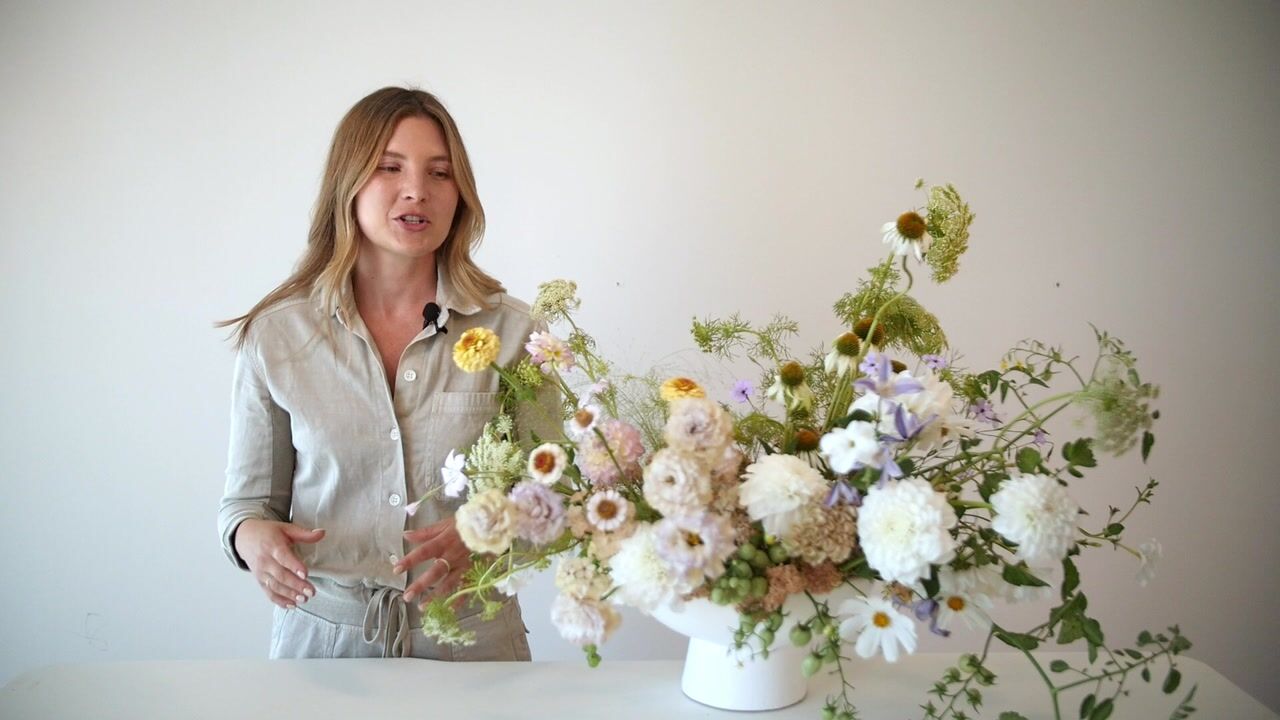
Transcripts
1. Welcome + Let's Get Started!: Grand centerpiece making. Now that you've taken some
time to really understand the different shapes that centerpiece arrangements
can take on. We're actually going to create
an arrangement together. So for this project
you're going to need the vase chicken wire tape that we just prepared together. You're going to need
your Lazy Susan. So it makes it
really easy to see all sides and dimensions
of your arrangement. You're going to need a pair
of floral cutting shears, as well as your row strippers.
2. Welcome + Let's Get Started!: Grand centerpiece making. Now that you've taken some
time to really understand the different shapes that centerpiece arrangements
can take on. We're actually going to create
an arrangement together. So for this project
you're going to need the vase chicken wire tape that we just prepared together. You're going to need
your Lazy Susan. So it makes it
really easy to see all sides and dimensions
of your arrangement. You're going to need a pair
of floral cutting shears, as well as your row strippers.
3. Get Prepared: Understanding Arrangement Shapes: Okay, So now that you've
taken some time to go through the
answers on your own. We're going to work
through this together. So I'm going to use this
great book in full flower. And I'm going to show you
some real life examples of the shapes that
you just identified. So the first one
that we're going to talk through is going to be our round arrangement. So this is what it
would look like. It was drawn out. But basically the flowers
like you can see in this real life
example are taking on a really round shape
around the vase. So as there as long as they are tall and they're really
maintaining that round shape. So that would be an example
of around arrangement. The next one that we're
going to talk through is going to be our
crescent curve. So this is a crescent
downward facing curve. So you can see this
drawn out like this. And then you can also
see a real life example. So the crescent is facing downward with the
focal points down. The third shape is going to
be our whole gars curves. So you can see that
the focal points are high left, and lower right. This could also be
high right, low left. But this is a real life example. You can kinda see that in action here for the Hogarth's curve. This next one is going to be an example of an
oval arrangement. So you can see that our
focal points are long and on the sides are flowers are longer on the sides and
shorter in the front and back, also maintaining a shorter
height through the middle to kind of create almost like a football shape if you were
to look at it from the top. This is going to
be an example of our upward facing crescent. So this one you can see obviously our focal
points are on one side. That could also of course
be facing the other way. But you have sort of a
C-shaped that's upward curved. And our last and final shape is going to be our asymmetrical. This is where you would
have one focal point high on the left or right, and then you'd have
a longer focal point on the right or left, depending, obviously we could
go the other way here and then you're
going to have shorter stem links on this side. So it's basically
kind of creating like an L-shape one way or the other. And you can see that in the
real life example here. So remember, these are all examples of some
traditional shapes, but obviously a lot
of floral designers are now mixing the
two so somebody could create more of a oval-shaped
asymmetrical arrangement and things of that nature. So just be aware of the information so you
have it and that you can fully understand what
you're looking at when you're doing design
creation and research.
4. Get Prepared: Placing Your Chicken Wire: So before we start our
centerpiece arrangement, we're going to have
to prepare our chicken wire so that we can make sure to get it
into our base properly. So for this project,
you're going to need, again one inch green PVC
coated chicken wire. You can buy this in
bulk and there is a link in there
for you on Amazon. And you'll most
likely wanna pair of wire cutters to
cut through that. If you use your shears on the wire over time,
it can dull them. So essentially, what we're
going to be doing is cutting. I already pre-cut this, but you're going to be cutting
a piece of chicken wire. And how you're
going to determine the size is you're
actually going to take your vase and you're going to set the role, that
chicken wire role. So it will be like this. I will just set that
chicken wire roll across my vase, my
chicken wire stuff. So I'm going to use the
one that's already cut. So you are going to place this over your vase and
you essentially want there to be about an
inch and a half of chicken wire over each side
when you lay that over. And then again on this side we have like an inch and a half. You can kinda see that. And so I would cut over here with my wire cutters to give myself an inch and a
half on each side. Now, this is the part that
isn't super graceful. So what we're gonna do
is we have to actually fit this chicken
wire into our vase. So the best way to do that
is to really just kinda start working on one of the
sides and pushing it in. And again, there's no
pretty way to do this. I usually try to get one side going and then I'll move my base back over to my
workspace so that I can kinda get that side in. And then I'll push
my other side in. And the goal is really to get the chicken wire on the top, on the sides, but also
on the bottom right? Because when we put
our stems in here, we want them to stick through
the chicken wire and get caught on the bottom
that the whole idea so that our stems won't
fly out or flop around. So this is kinda what
you're going for. Again, it doesn't
have to look pretty. No one's gonna see
this in the end. But this is sort of the
coverage that you're going for. And you can see it's
like a little bit domed. So it's not flat, but it's
also not super domed. And then once I get that in, I always use my
waterproof floral tape to just kind of tape down an
x across the middle here. That just gives me a little
bit of protection if I M pulling leaves or sorry, fine. And pulling stems in and
out of the arrangement. I don't want this chicken wire to fly out for some reason. You don't mess up my design
and you're just cutting, taking, taping all
the way across. You just want a little bit of that tape showing on the sides. And then I'm gonna
go this way with it. The tape also helps us understand our grid system as we're working through this
arrangement together. So I'm going to refer to some of these quadrants as
we go through class. So that'll be good for
you to have that as well. And then you want to just go ahead and fill your base up with water pretty full and
you'll be good to go.
5. Step 1: Placing Your Greenery: Project, we're actually going
to start with our greenery. Starting with greenery
is a great way to really identify the
shape of your arrangement. And it's also a great way to
kinda create a grid system for all your other
flowers to lay into, especially if you're not
working with chicken wire. But it is normally
good to work with about two or three
different types of greenery for your project. That way it gives
a lot of depth and dimension in whatever
you're creating. So if I want you to take a
look at your base and set, again, we put that tape on and kind of like a cross formation. So we're going to start
with the left and the right hand pieces
of greenery first. Today, I'm going to be creating more of an
asymmetrical arrangement, but I'm also going to walk you through options for
creating more of an oval arrangement
as well as we go along just so you can kind
of decide between the two. And if you need to look
back at those shapes in the other section to kind
of see how to reference. That's totally fine. But either way, you're going
to start with two pieces, a left and a right hand
piece of greenery. And I'd like you to
really think about those pieces as being a
little bit more flowy. Those are going to be
things that are going to bring on a little bit of shape. For asymmetrical, I'm
obviously going to be going longer on one side
than the other. If I was creating an
overall arrangement, both of these pieces
would be pretty long. As far as length goes
on our greenery. I want to go more than about
full length and a half of your vaisyas are bases
about eight inches wide. So 12 inches would be our max. For how long we would want our stem to go
out from the base. And I'm going to show you
this here in real time. So I'm going to
use this chameleon because I think this is really great for creating length
on the sides here. And again, I'm just gonna
kinda hold this demo on the outside of my base to see what shape it
sort of takes on. So for asymmetrical,
I'm going to be coming a little bit shorter on this side and a little
bit longer over here. Okay, if I was doing oval
that I would want to create the same amount
of length on each side. And so all we're gonna do, I always want you working on the side that's
closest to you. That way it's easier to
kinda see what you're doing. I might work towards
you just so you can see what I'm doing a
little bit better here. But you're going to want to
hold that first piece of greenery on the outside
of your base and kind of eyeball where
the bottom of the base ends and where you're
going to need to cut it. So it feels like this
is probably right. And don't forget you
want to be trimming all your steps and angle. This is just best practice. It's a great way to
keep the stead more hydrated because it's
a larger surface area and then cutting
straight across. If you cut straight across, it's not the end of the world. You just want to get a nice
clean cut on your stem. So that's the process there. And any stems that
go into the water, you actually don't want
there to be any leaves. The outer leaves in
the water can create bacteria and it actually makes sure arrangement
dialogue faster. So we'll probably be cutting off some of these lower leaves. So I'm going to give
these a trim right now. And then I'm going to
think about coming in very close on the
right-hand side, very close to where
that tape is. And I'm going to come
on the outside edge sort of add and edit,
strain and angle. I don't want to be coming
in like straight up, okay. Because we want this
to really kinda create length on the sides. And you don't want to come on the inside of your
base quite yet. We're going to work on the
middle a little bit later, right now all our
stems are being placed on the perimeter
of this face. So I'm going to come
in at a nice angle. I'm hoping that I did my
chicken wire properly so that my stems going
to catch there on the sky and going to hold everything in
place just like I wanted. Perfect. So I have the option
to kind of mess around with this a
little if I wanted to sit up a little bit taller, but I'm going to go for more of a long length on this side against them
doing asymmetrical. And then on this side, I'm probably going to actually cut one of these
little pieces of greenery off. That again, I'm
just going to hold my stem on the outside, trim it and come in
here at an angle. And this side again is because
I'm creating asymmetrical. I need a little bit shorter
on this left-hand side. Because my height
of my other piece of greenery is going
to be up here. Okay, so if this was oval again, this would be long,
like this side. So that's kinda the look
that you're going for. Now for asymmetrical,
we need to create a little bit of height
up here, right? Because we're going
to be going taller. So our third piece
of greenery for our asymmetrical project is
going to sit up a bit taller. And so I'm going to hold this up here again so you can see it. And I'm going to try to get that in
alignment with my base. And as far as where
I placed this stem, I really wanted to sit kind
of in an L-shape formation. So you may have to place the stem in closer to
the middle of the base. So you can kinda get
it to stay there, but you want it to really
be in that quadrant angle. And you can really see
that nice shape l. So that's what you're going
for their height wise. Again, you don't want to go
much taller than 12 inches because that would be a length
and a half of your base. Okay. And if we were
just doing an oval, we wouldn't actually do
this tall piece right now. We would just be working
on the perimeter. So I'm going to show you kind of the step two of where
to go from here. Okay? Now that we have
our anchor pieces of greenery for are asymmetric. Project identified,
we have to build an obviously more greenery around the perimeter
of this space, right? So I want you to
think about every, we have basically
four quadrants, right from that tape, every
quadrant is going to get two pieces of greenery around
the perimeter of this base. Okay, So, and what you want to think about doing is
scaling back the lengths, meaning the pieces that
are in front and the back. It'll be the other front. Of course there will be a backup because it's a
table centerpiece. But whatever spacing you
and what's not facing you, those pieces are going
to be much shorter. So for instance, this
is going to actually be a great piece for me to use because it's nice
and shorter already. It's probably only
about four inches long. And I'm just going to tuck this in in the front and
I'm just going to take a peek at it from my angle to make sure
that's how I want it. And again, the reason
these are going to be shorter is because they would be what's in front of somebody right at a table. So you'll want them as
long and protruding out. Also, if we're creating
an oval arrangement, we want to create that
football-shaped from the top. So if we went too long of
those front-back pieces, we wouldn't be an
integrity with that. And the asymmetrical
shape is similar where the base is very oval. So I'm going to add another
piece on this side. And artists choice,
it doesn't have to be the same elements that
you've used so far. You can pull in one of your
other types of greenery. But I'm going to just keep
with my camellia for this one. Because I like that
texture and I want to see that kind of on all
sides of the arrangement. So you have that
piece right there, and that's what that
looks like over there. Now, from here now that I have a longer side piece and
a shorter front piece, I know that I need to
kind of bridge that the heights of these
two granaries together. So what does that mean? That means I need to come in-between these with
something that's a little bit longer than this one
and shorter than this one. So I think that my eucalyptus is going to be a great
option for that. So again, I know that I'm
probably going to have to cut this down and
I definitely have to clear some
leaves off of this. You can always try to use your stem strippers
on the eucalyptus. I use my hands just because
I think it's a easier, this type of particular
eucalyptus is a little sticky so you might get a little
sticky working with this one. So I'm just gonna
kinda eyeball this. And again, you're going to be
doing this all facing you. So I'm going to use
some nice trim. I'm Janey to cut that a
little shorter depending. But I'm going to
come in on this side again close to the
edge of space and just place that stem
and you can kinda see the length is
cascading down. So short, medium, long, right? And I'm gonna wanna
do that same thing in all four quadrants, right? Because each quadrant
needs to stem. So I'm going to work through
that on my end and then I'll come back together with you so we can talk
through the next step. Welcome. Okay.
6. Step 2: Placing Your Second Level Greenery: Okay, Now that I have all my greenery place around
the perimeter of the vase, we're going to work
in the middle where that cross of that
tape comes together. Okay, now if we do
an asymmetrical, you already have one piece in the nearby the center of
the tape and that's okay. But if you went with oval, you probably don't have anything in there yet and
that's okay too. What we're going to be doing is adding three or four pieces. Three if you have a taller
asymmetrical piece already, and four, if you went with oval and you don't have
anything in the middle. If you created an
oval arrangement, your middle pieces of
greenery are not going to be much taller than like
five or six inches. Okay, So you want your
height to sit about here. Again, we want that to
really look like, well, when we look over the top and our length is really
on this size, we're not building in
much height, okay? Now for our asymmetrical, it's going to be a
little bit different. So we kind of want to
scale back because obviously we want
to stand integrity with that L-shaped
that we're creating. So what we wanna do is create
123 at three more stems. And we're just going to scale
back the height each time. So one will be a little
shorter than this one. The next one will be a little shorter and then
a little shorter. And the stems are
all going to get placed kinda in
the middle of the, near the middle of the
cross and that tape. So I'm gonna go ahead
and do that on my end. And you can kinda
see that in action and then we'll move
on to the next step. Okay? Now that you have
all your greenery.
7. Step 3: Placing Your First Focal Flower: All your greenery place, do you have about 12 or
14 stems of greenery? And just to recap, you had about eight stamps around
the perimeter of the base, and then we put about four
stamps in the middle. And you might have peace
in a couple of extras in case you wanted one of the colors or textures to be seen on a sign
that it wasn't. So that's what you're going for. Now, the second step
that we're going to move onto is going to be
our focal flowers. So today we're gonna
be working with snap dragons in roses, but we're going to put in
our snap dragons first just because they're
longer and they're also going to really identify the high point of our focal flowers along
with that greenery. So if you're working on
an asymmetrical shape, this is what's going to happen. You're going to
create one of those. You're going to place one of
those snap dragons out here with this side longer
piece of greenery. And then you're going to put the taller one up at the
taller piece of greenery. Okay. If you're doing oval, you would have obviously your two longer pieces of
Snapdragon on the sides here. So I'm going to place these. And then from there what you're gonna do is
you're going to add two more. So we're going to
have four total. And again, similarly to the
greenery in the middle, you're going to kind of
scale back height, right? So you want the next
one to be a bit shorter and shorter
until we get down here. Okay, so I'm gonna
take a second to place these on my end and
then on the backup with you. Okay. Hello.
8. Step 4: Reflexing Your Roses: Okay, Now that we have our snap dragons and
we're going to work through our second
focal flowers, which is going to be our roses. So I'm gonna show you how to
prepare these and get these ready to put into
your arrangement first before we
actually place them. So you're going to meet eight
roses for this project. You probably going
to use about six, but I always have a couple
extra on hand in case there's any casualties
if something breaks. But first things first, we actually want to clear out all the stems from all this, the thorns and the foliage. So that's going to
be our first step. And you should have your rows stripper, your
foreign stripper. So this should be pretty easy. All you're gonna do is talk that underneath the blossom
you want to hold gently your fingers right under the blossom of the flower. And then you're going to grip
your roaster breccia top. Tuck it under and then you're just going to kind of pull it down and it clears off
everything off your stem. So you're gonna wanna do that on all your roses before
we get them in. The other thing I want
to show you is that these roses actually all come with what's
called a guard pedal. So the outside
petals of the roses are actually like a
little dingy and brown. That's just because those are the ones that are
meant to protect the rows in the
wild as they grow. So you're actually going to
want to take some time to remove those outside petals. Just, you know, three
or four depending on which ones look brown
or a little bruised. And then it's going
to give you a nice fresh inner layer
to that flower. The other thing
we're working with an event is you want them to
kind of start to open up. So taking them out of
their packaging and doing the prep work that
day or so before the event is going to help
them open nice and naturally. But if for some reason you
don't have time for that, There's a couple of hacks, so roses are one of those
flowers that you can kind of manipulate and mess with and they won't
fall apart on you. You don't want to mess with
the petals too much because the oils from your fingers can sometimes bruise the petals. However, if you are in
a pinch and you need to get your rose to open
up, There's a few tricks. So the first one is going to
be where you put the rows in between your hands here and you're just going to
move it back and forth. This agitates the rows, which helps to kinda heat it up. And it helps it to kinda get the petals moving
around and opened. The other thing you can do
is I'm going to show you this first is just
glow a little bit of hot air into that flower
so little a couple times, and that starts to open it. The third way is to take your pinky finger
and to gently pull back the petals and to kinda make your way towards the
middle of that flower. And that's going to be
how you can kind of help to start to open up again. They'll open up on their own.
But if you're in a pinch for an event and need them
to open, That's the trick. The other trick with roses is that you can actually
reflects them, meaning you can pull back the petals and give them a name. Really cool foil look. This trick works best on
roses that had been out of the cooler and are like
three to five days old. I am going to show you on these, but I'll know that it's not ready for it if it starts to crack at the
base of the petal. So that's kinda what
you're looking for. So you're going to
just hold your flower and you're going to gently pop the rose petal over
the base of your thumb, sorry, the rows, the base here, the base of the petal
over your thumb. And you're just going to make
your way around the flower. Again, it's minor
cracking a little, so that means they might
just be a little too cold. I just got these
out of the cooler so they're pretty fresh. And I'm just going to
make my way around a few times popping
those pedals. And it's going to
give you kind of like a nice full different
sort of look. So that can be fun
to do a couple of feature flowers like that
in your arrangement. So I'll leave you
to prep your roses. Why Pratt? Mine, and then I'll be back
with you here in a second.
9. Step 5: Placing Your Roses: Now that we have our roses
all prepped and ready to go, we're going to talk about
where to put these. So again, we're
gonna kinda follow the cadence of our Snapdragon. So we're going to
do a taller rows and a longer rows first again, if you're doing oval, you
would do long and long. And what I want you to think
about is the rose sitting just a bit shorter than the
height of that Snapdragon. So again, we're kind
of working to scale back right almost like stairs. And I actually
might use one of my reflects flowers for this one. And then the other one is
going to come out and kind of be a little bit shorter
than that long Snapdragon. Okay, So that's what
you're going for there. If you're creating
the Hubble length and you're going to
do long and long. So I'm gonna put
these in quickness. You can kinda see this action. And as far as like the placement within the quadrants
for the asymmetrical. So you want it to kind
of you want one to, to look like it's sitting
within each quadrant, but you might actually
have to place the stem in a different quadrant
to get it to sit where you want,
if that makes sense. So you're going to have
to play around with that to get the angles are
things that you're after. So we might just
need to play around. And again, you have
to be patient with yourself even when
you're a professional. So all right, so
there's that first row. So again, it's a little bit
shorter than that Snapdragon. And I'm going to come out a
little bit to side with this. Next grows and kinda
get an alignment. Here we go. Okay? So there's that. Now, for the remaining four, what we wanna do is kinda start filling in the
gaps in the front. So if you had an
oval arrangement, you're going to use
your four rows is, and you're going to put one
in each quadrant, okay? And you want the height
to be at or just below where that
greenery sitting, right? But you wanna kinda
angle one's going to be a little shorter
than the other. Okay, So for the oval, now for asymmetrical again, we're kinda gotta
follow that cadence of scaling back our height. So for instance, when
I look over here, I know I don't see any roses, so I'm probably
going to want to put one nice and low down here. And then I'll
probably want to see one sitting right here. Okay, so that's kind
of just thinking about where I want to see
the texture in the flower. And then on this
side, same thing. Probably want a
little bit taller and then maybe you want a little
bit shorter tucked in. So I'm gonna go
ahead and do that on my end and I'll show you the finished product and we
can come together as a group.
10. Step 6: Placing Your Filer Flowers: Place, we're ready to move
on to our filler flowers. So filler flowers are just that. They're basically going
to fill in the gaps of our arrangement and
break up the greenery. Height-wise, they're
going to be just shorter than all of
your focal flower. So you don't want any of
those fillers to take over height-wise from
your focal flowers. We're going to bring in
a little bit more height later on with our accent blooms. And I always, always, always use at least
two to three types of filler flowers when I'm
working in an arrangement, the size that just
brings in again, a lot of nice texture, a lot of, lot of
depth dimension, things that you're looking for. And then for today we are going to be
working with Helen War, Queen Anne's lace,
and then carnations. Always, always, always bring carnations to all
of my workshops. And I use them a
lot in projects. They're just great
filler flowers. They just have to
be used properly. So the main thing
when you're using carnations is you want
the color palette to be monochromatic with your focal flowers or
your filler flowers. So basically, when
they're tucked in there, just kinda matching the color
palettes of what's going on and they're not sticking
out too much on their own. So you won't really be able
to tell them their carnation. So if there's any carnation
haters in the group, I hope you can
learn to love them because they are
very cost-effective. But when you're creating large-scale and
multiple arrangements, and they also last really long. So I'm gonna go ahead and place in some fillers on my end. And you can kinda watch that
process as I go through it. And then you can play
some on your own.
11. Step 7: Placing Your Accent Flowers: Okay, now we have all
our filler flowers in and you're probably
didn't add anywhere from like nine to 12 depending on how full they are and what elements
you're using. But that's probably
a decent stem count for this size arrangement. So now I want to talk
through our final step, which is going to be
our accent flowers. So typically with
accent flowers, they're just a
different flower that's going to bring in a
little more movement, a little bit more
texture, accent. Flowers tend to be pretty interesting and either their
standard or their blossom. Today we're going
to be working with tulips and some remedies. And you really only need
one type of accent flower, but I couldn't resist these
at the foreign market. So I went and had
come grab both. But really you just need
one type and an arrangement decide you really just need three or four standards
there just again, something to bring it
a little more texture, a little more height. But before we go ahead
and put these in, I'm going to show
you a couple of things with the tulips because tulips are another
flower that we can actually reflects as well. But first things
first, with tulips, you want to be really
gentle with their stems. Their stems are pretty
fragile so you want to be mindful when removing
all the leaves. We just want to
be really gentle. And the other thing that's interesting about
tulips is actually once they're cut, they
continue to grow. That's why we put
two ups and a base. They look like they're flopping. It's because they're
actually growing. So a lot of times on floral designers for
weddings and events, they want actually place the tulips in the arrangement
until they arrive on site just because of
the placement can move and they can change a
bit even in a day or two. So that's another tip if you're going to be
working with tulips. But if we want to reflects
a couple of these, we're going to do
it the same way that we did with our rows. We're just going to
pop these petals back and work our way
around that flower. And it's kinda give
the tool of like a whole different look. And you can reflects
all the petals. So it gets kind of
like a look like this. Or you could leave a couple. And it just kinda giving
it a little bit of an interesting
texture and feature. So we'll play around with
that as we put these in. As far as placement. If you created an
oval arrangement, then you want your
height to come in. One of the left and
the right-hand sides. So what you're gonna do
is you would actually pair two of yours and just
get this cleared off. So you can kinda see this. If you're working with oval, you're going to want to pair
two of your accent loops together and one's going to be a little taller
than the other. Okay. And you would actually place your place them either the left or the right hand side of your overall
arrangement. Okay? The other thing with oval
that you can do with accent blooms as they
can come out the sides. So you can continue to play with that length on the sides
of your overall ranges. Now if asymmetrical, you have
a little bit more playroom so you can come out on the sides with your
accent balloons as well. So to play with that length, or you can play with the height on the one asymmetrical site. Or if you go in
the middle again, you're going to
stagger your stems and just kind of play
around with the height. Maybe do want a
little shorter on the left and one a little
taller on the right. So I'm gonna go ahead and
play around on my end and then we can see how it comes out when
you can play around it. Hi. Hi.
12. Step 8: Finishing Touches: Stage my arrangement should
peel, feel pretty complete. So I want to make sure
I can't see anyway chicken wire that
when I I also want to move this away from me and
kinda step back and take a peek at it to make sure I
can't see through anywhere, maybe where I need
to add any flowers. Like for instance, there's
an area down here that if I had any extra
flowers, which I do, I can probably touch
something in there nice and short just to kind of break up that greenery and hide a little
bit of that tape. So that's kinda what you're
looking for at the end, just anywhere where you
can kind of see see chicken wire where maybe it
looks a little unfinished. And if you need to move
your arrangement or out of your workspace
to another area where and kind of see
it with fresh eyes. And that's always helpful. I kinda have a
little area in here that could use a flower. So I'm just going to take one of my tulips that
I had leftover and tuck that in a little bit
shorter is to fill in that gap. And I just am looking basically, I can just see that I can
see chicken wire in there. So I'm just going to tuck
in something short a, a carnation would be
fine for that too. So once you get to
that place with it, you're going to want
to spray this off with your crowning glory
of finishing spray. Get this baby in the
cooler if you have it, and it'll be all good
to go for your event.
 Melissa Frontino