Transcripts
1. 01 Intro: Hi, and welcome to this artificial
intelligence scores based on description logics. Today you will learn
anything you need to know the start using
machines language, and I will be your instructor. But first of all, why should you be interested
in taking this course? Well, just to get started, ai is widely used to provide personalized
experiences to people, for example, based on their previous searches or purchases or other
online behavior. Ai is also important in commerce
for optimizing products, planning inventory or logistics. Even security companies at began to adopt narrow networks, machine learning and natural language processing solutions to improve their system is
even getting into space, and this is the perfect
timing to start learning something new about
artificial intelligence. Currently, spacecraft needs to communicate with Earth
to do their job. And being able to develop
autonomous spacecraft that take care of themselves
would be very useful for exploring new
parts of the solar system, but also for reducing
mission costs.
2. 2 Reasoning: The mental process of
extracting logical conclusions and making predictions
from existing knowledge. Data, in fact, is
known as reasoning. Reasoning is a way of extracting knowledge
from existing data. The general process of reasoning is to arrive at
valid conclusions. Artificial intelligence
uses reasoning to think rationally and in order to perform as well as
the human brain.
3. 3Deductive Reasoning: Deductive reasoning is
the process of extracting new knowledge from
previously known information that is logically linked. It is legitimate way of thinking in inductive reasoning that
if the premises are true, then also the conclusion
must be true. In other words, if the
conclusion is true, the premises are true as well.
4. 4Sentences: Any proposition for
which it makes sense to question whether it
is true or untrue. This quote, a sentence. For example, Mike is jogging, it's sunny and it is windy day. If it rains, then
I go to the sea. Examples of sentences.
5. 5Connectives: The words and, or if then not or but I
called connectives. As a result, connectives
allow you to make new sentences
out of other phrases. Connectives allow
you to construct sentences out of
simple statements. For example,
consider the phrase, it rains and it is a windy day. If we indicate with letter B, it rains and with the letter Q, it is a windy day. And in-between, we put the logical operator
that refers to, and we obtain something
like p and q. If it rains and Q, it is a windy day are both true, then this statement is true, or in a more precise
way, satisfiable. But we will see later
what satisfiable means.
6. 6Truth Functions: The first approach to
basic logical problems is to investigate the
issue of accuracy. For example, consider
these influence problem. If it shines, then
I take the bike, but I did not take your bike, so it does not shine. We want to see if the
conclusion is valid. So we proceed by assigning to
our prepositional letter P, The phrase, it shines, the propositional letter Q, the phrase, I take the bike. Then using connectives and
our two atoms, p and q, we can start by, it can start constructing new formerly with totally
different meaning. For example, we know that if it's shrines and
then take the bike, I took the bike. And so we know for sure
that these conclusions are valid because there's
no discrepancy between the premises
and the conclusion. The conclusion shows that
also the premises are true.
7. 7Truth Table: The formula p and q is true if and only if both
p and q are true. If we take a and b in general, that are two sentences. The formula a and B is true if and only if both
a and B are true. We can see that summarized
below in this table, which is called the truth
table of the connective. And it summarizes
what we've just said.
8. 8NNF: If a formula does not
include implications and all negations appear in
front of atomic formula. That formula is said to be
a negation normal form, also known as N and
F. On the other hand, if the formula contains only
conjunction of clauses, then it is said to be in
conjunctive normal form. To convert the formula to a, formula b that is
logically equal to a, we just need to assign to apply these properties and
just form it into an F. For example, we have
here that C implies the, if we find that
formula like this, we just need to transform
it into Nazi or D. I hope it is clear. See you on the next lecture.
9. 9Sat Solvers: So there's our programs
that use variations of the DPLL process
to solve subproblems. And four, replies are just the names of the connectives that
we are used to. And they must be expressed
in at least like mutations. For example, B and Q will be
expressed as p cubed them. To test if the formula
p and not q implies r, we must first declare the
variables that we're using. So p, q, and r in our sub-problem express
the list black notation. So as you can see, declare const P Bu. So we are declaring constant. The digits taboo
because it returns a value of truth false. After we have declared
our variables, we can proceed by asserting our formula with p
and not q implies r. We can see that the
problem is pretty long and it is not so easy to read
and understand its meaning. But you will get used to. In the end of a word file if we want to say to our SAT solver, to check for satisfiability, to check if our assertion odes, we must write checks out.
10. 10Tutorial Z3 Online Compiler: In the next lectures, we're going to deal with debt
free programming language. To do so. We don't want to install in our computer complex
programs or libraries. So we're going to just type on Google free online compiler that the first
result is just fine. On this console, we'll be able to write the free programs. Actually get a response, a satisfiable or
unsatisfiable and swear. And then additionally,
we will be able to get a model to know the
values or our variables. In this case, we're
usually using a, B, and C as variables,
just integers. We are declaring them. Next, we are telling to the
compiler our constraints. So for example, we are asserting that ABC are greater than 0. Lastly, that we are
just asserting formula. An algorithm. In the end. By telling the
computer checks out. We're just asking for which
values of a, b, and c. The formula, the
final formula holds. Finally, we'd get model. The program actually tells us
which values belongs to a, b, and c to make these
programs satisfiable. That's, that's what
satisfiability means. If formula is satisfiable, it just means that there are variables that
satisfy some constraints. So that actually
there is a response.
11. 11Tutorial Z3 Flow: I'm going to present
you a problem and I'm going to
show you degenerate process in order to obtain a satisfiable or unsatisfiable
answer from our program. I'm asking you to
declare a variable of name b and asks whether P
AND NOT B is satisfiable. How can we do this? So, first of all, let's
delete everything. Remember, the first
thing that you need to do is to declare your variables. In this case, we need
a variable of name be the glare fun function, name b, with no
arguments of type bool. Eventually, you
have typed all of your variables and then let's proceed with
our constraints. Our constraint is p and naught p. Which means we're
asking the problem, the program, whether P and not P contains
satisfiable result. Whether it makes actually
sense whether there is a value of b for
which P and not P holds. Let's ask the program this
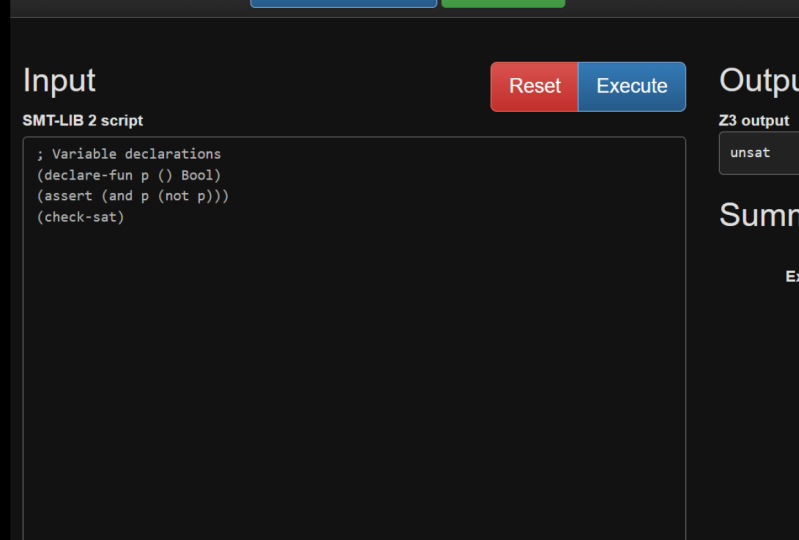
by asserting our formula. So assert and eventually checks out. To ask the program
for satisfiability. Let's press execute. The answer is answered. Indicates as that default
molar pn naught B is not satisfiable. There is no value of b for
which the assertion is true. Equivalently, the negation
of P and not P is true. Not B and not B is a tautology.
12. 12Tutorial Z3 Math Problem: Today's problem
consists in writing acid free solver script
to find the values of x and y based on the
given equations. X plus two multiplied
by epsilon equals 20. X minus y equals two. Actually, well,
asking the program to say satisfiable or not, whether there is a solution
to those equations or not. Whether we can give to x or y some values and we
can get the result, the equation. Let's
actually proceed. First of all, we need to
declare our variables X and Y. Declare funds X, no
variables of type integer. The same goes for y. Then we need to assert our
equations, our goods strains. It's a third, x plus
two multiplied by y plus x multiplied by y. Sorry, y multiplied by two, actually equals to 20. Our last assertion is
that x minus y equals two equals minus x y. Jak-stat. Let's see what the program says. That there is an error on line six expected. The solution is sat. As you can see, if you
forget to put a bracket, then it's a problem
because it's very hard to see at least the
program that you wear, you forgot the bracket
or rather stakes. But just put
attention. The result. The problem that we did
indeed have a solution, but did not say what
the solution is. We got a SAP and swear, but now, what's the solution? To find a solution, one must set a couple options and the
news to get value calm and after checks out, Let's use the getValue command. Get value actually devalue the variables that you give. In this case, we asked to
get the value of x and y. And the program told us that
x equals eight and y six.
13. 13Tutorial XOR3 Function: In this problem, I'm
going to ask you to write a function that
given three objects, chooses just one out of three. How can we do that? Let's go into our compiler. Let's start writing some code. In this case, we don't
need to declare variables. We are just creating a function with three imaginary variables, free variables that will be
swept with the real ones. Just prototypes of Bibles. Let's see how to
define a function like that defined function. Let's give it a
name, x over three. Because this function
is going to choose just one element out of three. Just calling it, she's
gonna get the result. So let's give it 23 arguments. Three is case sensitive, so remember to be very careful. And these returns the bowl. We're going to say that we're going to give
to the function x, y, and z to both variables. And we're going to ask whether, whether to choose
between X, Y, or Z. But we're not done yet. We need to specify not true, to not choose two variables, we just need one. So let's say that we
get x and epsilon. X and epsilon. We don't want this
kind of problems. We're done. I forgot the brackets. As always. This bracket goes
just to resume, where it created a
function with name. Free, free that accepts three
variables, x, y, and z. But it could be every letter. They are just prototypes
for our real variables that we are gonna
swiping dysfunction. It takes three by three
Boolean variables and just returns one. Then we ask, take the variables and we want just one variable
out of the three out of it, x, Epsilon, y, and z. So don't choose same time, two of them, just one.
14. 14Simple Assertion Problem: Here we have a new problem. We need to assert that
B and NOT Q implies R. First of all, we need
to declare constants, then proceed with
writing our assertions. Check for satisfiability. Let's go to our program. We need to first
declare our constant. Proceed. Glare columns of type
bool, just like that. Copy and paste,
and then q and r. So we have a circuit, all of our variables. Let's proceed with certain them. What's the formula? List black notation
implies not q. What we just implies is R. Then we close our brackets. Like that. I missed one. Nice. Let's ask the
program for checking satisfiability and hope
that we get the result. The answer is,
maybe we could get modal fall of them are false. Then the result is satisfiable. Get value for q and r. Let's see. False. False, but not Q. X experiment. Not Q is true and R is false.
15. 15Distinct Variables Peoblem: In this new problem, we
need to assert that P, Q and R, P1, Q1 and air are not the same. How can we do that? How can we tell the program that two elements are
not the same thing? Let's see. First we need to declare
our constants of dipole. Then that's borrowing. Let's just copy and paste six times P1, Q1, our R1. We have the glare,
our variables. Now we need to serve
our constraints. Our constraints
that we want to say that P0 and P1 and Q1, air and Irwin are
different things. Assert not be equals b1, NOT Q equals Q1 equals R1. Then we need to
close everything. Basically what we just said. We need, we said that apart from everything, we don't want that P0 and
P1 are treated as the same, as the same thing. They are two different things which will different values. So if it happens that Q
and Q1 at the same value, then it is unsatisfiable. Let's check for SAT,
satisfiability. Get full. So a model.
16. 16Complex Problem: You already saw how to express richer concepts or more
complex successions. You need to introduce richer, new and richer language. And so even in the free
programming language, we introduce a new tool. Name is sort n-bit creates
a sort of world apart. We'd assume variables
and functions. In fact, if you try to make two variables of two different
sorts interact together, each other, then
you get an error. Hope you got the idea. Let's proceed with the problem. With the syllogism problem. It's States before humans are mortal and Socrates is human. Then check whether the assertion Socrates
is mortal volts. Obviously, we can do that by asserting simple statements or simple variables,
constants. Actually. What's the plan? First, we need to declare a set. Our sort, of course
in this problem, maybe it's not essential, but it's very important
that you learn how to use. Let's proceed by declaring it. The glare sort. Let's call it d, or
maybe I don't know, K. Then let's declare our
constant for sovereignty. And that is a constant
because Socrates is a person. It's not a variable. It doesn't change. Declare const mode. For Socrates, he
needs to belong. You need to tell two which
sort it belongs in this k. K. Then let's
proceed by declaring. Now. Previously in the theory part, you saw how, for
example, and cooling. For example, declaring
on humans or motor, it's not possible to
declare it through a single letter p. You
need the function. Let's create the function for 4 million that
given a certain x, that x is martyr, the glare of the sort k, return that, which
returns a bool. And the same thing, given x as a variable. If these variable
belongs to the function, then x is human. Later obviously, we'll put
inside of that variable, our Socrates, to tell
if mortar and is human. And a lot of combinations. What we have just
asserted, declare fun. M and h is a unitary predicate
for mortal and human. Let's proceed by asserting. We need to set that all
humans are mortars. We need also to introduce new
symbols, the fluorophore, which means that for
all possible axis, then x is mortal. Let's proceed. Served. For over. It's written like that. We need to declare the element, which will be Socrates. If the sort key, then all humans are motor. So all x for all x implies that it is mortar, that x is mortal, that x is human, and x is also more mortar. Then we close bracket. Then we need to assert
that Socrates is human. Quality is human. To type like the
cert that Socrates, socrates then is not mortar. Then we can proceed by
checking for satisfiability. It's, in fact,
Socrates is mortal.
 Davide Agostini