Transcripts
1. Welcome All: The word Mandala
comes from Sanskrit, which means sacred circle. Mandalas are circular symbols that are part of a lot
of different cultures. Buddhism, Hinduism,
Christianity, and some more indigenous
tribes all along the world, use them as a kind of artistic outlet to help
people find themselves. It is a meditative process where every one of us
tin peacefulness, calmness, serenity, by attaining symmetry
in these patterns. In this class, we will dive into three such mini Mandalas, which will help you heal your chaos that is happening
in the outer world. Hello, everyone. This is
Balsari an artist educator, and environmental
planner by profession. You can reach out to me as
issuer Underscore art in Instagram and Isuary Art
in my YouTube channel. I always love experimenting
and hence I always try various mediums and challenge myself in experimenting
something new. In that way, I found
a very much bond with water colors and mandalas
at an equal pace. So I thought, why not combine both of these
elements and make beauty sort of these and hence I come up with this amazing
class for you all. In this class, we will
go through in detail about three projects which are having very unique patterns. I will take you through all the materials that are
required for making all of these and also explore
on the combinations of colors to choose color palette or color combinations for
your Mandala backgrounds. We will see how the
touch of watercolors add so much depth and meaning to the mandalas
that we are going to make. On this note, I
welcome you all to join my class on mini Mandalas. In the coming lessons, we will go through in detail about the materials required, the techniques, and
the basic patterns, grid making, and how can you
build up your own patterns. Looking forward to see
you all in my class. Happy creating and stay safe.
2. All about materials: Let us have a look
at all the materials that are required for
this minivan Dalla class. I will be using coal pressed watercolor
paper from Menora. This is a square sized paper
of 15 by 15 centimeters. It is cold pressed, it is paper made made in Europe. It is available
in India as well, and it is almost shipped
to other places. I mean all the places, mostly, you can check it up in
their website, Menora Okay. And it is 100% cotton. It has 12 sheets, 300 GSM dual texture
as mentioned. And most importantly,
it is 100% vegan. This is the reason
why I have chosen this particular brand to explore my watercolor journey
with Mandalas. As we have seen in one of
our first classes of main, Mandlas will be at the center
part mostly of the paper, and we have covered it up at borders since it is
an A five sheet. But now we are doing
in a square book, which is a little
smaller exercise. This is bigger than a six size. You can cut your
paper into 15 by 15 centimeters if you have an A five sheet or a
bigger sheet of AP size. If your cold pressed paper
is very textured and grainy, go with a hot pressed paper. This particular
paper, if you see, It is not having so
much of grain texture. That is the reason why I have chosen this for
Mandalas as well. If your paper is very texture, you cannot do Mandalas
neatly on it. Alternatively, you can go with a son Monteval paper
as well as it is a 300 GSM and suitable for watercolors and does not
have so much grainy texture. If you are using scholar paper, if it is a cold
pressed category, it has a very grainy texture. In that case, you can go
with scholar hot pressed. That is it for the papers
to tape this paper, I am using another book. Instead of using a pad because it will help me in
rotating my page neatly, and that is the reason. Coming to the other materials
that we are going to use in this three days
of mini Mandalas. Therapeutic mini Mandalas. The other materials are, I am going to use similar
Aqua mini set as we are going to go with very
basic watercolors and watercolor washes
and techniques. I will be using this
particular set. And we'll go with different
color combinations. It also has a brush if you want, you can use this as well, the same brush. Okay. And regarding the brushes, I will be using Brostro brushes, Brostro mop brushes
of size number two, and the other one is
size number four. As it is a small paper
of square shape, we just need these two
brushes, nothing much, and we'll be doing
a background washes and some techniques
or textures on it. I have other brushes
as well in my holder, but those are not
required right now. Don't worry on them. And I have a white pen from Brostro to add some
highlights if required. This is it for the
brushes I have. We will be requiring a compass. It is a normal compass or this
is an extendable compass. You can use any of these. This is mostly suited for
A three or A five size. We can go with this one also. I will be using any
of these two to make the grid construction. So far so clear right
now here I am using a mechanical pencil which is already fitted with
the compass here. You can use a normal
pencil as well. There is no hard and fast rule that you have to use
mechanical pencil. Now I have a short scale
and a protractor with me. If you have a round rounder will be a but of
big for the size, so you can just get this very affordable student
grade protractor. Small one, it is suggestible because we are
working on a min mad, smaller details, and a
small scale would do because it's 15 centimeters
and it's exact size. And an eraser. Normal eraser, this is not a nedable eraser. It's just a normal eraser
you can have at your home. And I'm going to use
fine liners from Brostro you can get
them at creative hands. This is from Brostro and it
is a set of six fine liners. We will be having
from 0.05 to 0.8. I'll be clearly
demonstrating the width of all these in the
technique section later. That is it for the
materials we are going to have, and
most importantly, I forgot to see is the scotch
t. This is the scotch tape I'll be using to tape
all the four sides to the diary which I have. These are two smaller
with scotch tapes. These also I got from
creative hands itself. These are empty masking tapes
of very smaller thickness, if you can see the
brand, you can get them. We will be using these for
one of our mini mandalas to get some pattern of the
background. Don't worry. If you're not having these, you can just directly go and use a normal masking tape
which you're having. Of course, the width
is very much varying. But that is completely okay. If I use five or
six strips of this, you can just go ahead and use one or two strips that covers the space. That
is completely all. I just want you
all to understand the technique and have to do it. I need not to be the
same exact replication of what we are doing
in the projects. Since it is a watercolor deal, we are going to have a glass of water and tissue
papers, of course, as we will be using
them if there are any corrections and to dabbing and reaching the
water and everything. That is it for the
material section. Let us dive into some
techniques of making grids, color combinations, and the
sizes of the fine liners, everything in the next section.
3. Arriving at Color Combinations: In this lesson, we will explore the color
combinations that we are going to use in
all the three projects. I mentioned that I will be using the senilio set, trust me, I haven't done the swatches yet, so I will do swatches here roughly and then go with
my color combinations. So I particularly choose this method of explaining
because I want you all to know how to arrive at combinations and how
actually it works for an watercolor
artist to arrive at such color combinations that look very vibrant and beautiful. So this is the set and there
is a brush already provided. We can go ahead and use this brush itself
for the swatches. And getting into
the combinations of colors that we will
be going to use for the particolar
background mini andalati This is a very tiny, tiny brush. I think it's very perfect for the concept which
we are looking for Mini andalas let me just make sure that the binding element
with this is gone. So for that purpose, I will be dabbing my brush like this cleaning and
then kind dabbing. So it's very tiny brush. It's a poet set. If you want to go outside, do auto painting or travel
painting or something. I think this set
is a perfect suit and it's very mini pocket. It will really fit in a pocket. You can see the comparison with the square paper and the set, and the brush is so tiny, which you can hold
it actually here. It has all the basic colors. I think it's really a good set. If you're a beginner and want to start some good
watercolor brand, I think this will be a
perfect for you all. Now. We need a mixing
palette as well. If you have any mixing
palette, go ahead with it. Otherwise, we can use
this as well for now. Now let me solely
see the colors. I am taking a little bit of pigment here and trying
to swatch it over. So I have taken a rough
piece of paper for this. I am taking a bit of water. Now, I will go for
the second color. I'll always keep
my tissue handy. Now I'm going for the
second color red, very vibrant red it is taking
a tinge of water as well. In one of our previous classes, we have done with
a different color, and the pigment is
very bright here. So it differs from
brand to brand and don't take much stress
about that right now. We will slowly arrive at the
combinations. Don't worry. This is how you have to
understand colors and all, and I think this is
very important as well. I thought of covering this step. We have one more nice blue. This is a kind of
Curian blue we have, and this is another
shade of blue. Mostly, it should be Pi blue. I have to see what they
have named in the set. Okay. The one which I'm using as a rough sheet
is also a watercolor paper. So make sure you do swatches in that because that will
give you the best result. I'm because my red
pigment is still there. So I just don't want it to
mix up with my light green. And if your water is turning, make sure you have
another glass of water. Okay. Just that I have a very huge amount of water with me right
now in the glass. The color got diluted and it is not pigment does not carry
heavy for the other colors. Now, it is a darker green. Okay. So I am actually
exploring the set now, and then I will choose the color combinations and
then go on to mini Mandalas. That is how you have to learn. It is a learning process. So I thought of documenting that as well so that
you will understand how it works to get such a perfection neatness
or color combinations. This is one beautiful color. I am getting dry
brush ropes actually. And the last one is, this is not black. This is paints gray. This
particular name I have seen, and this is a dream for
every watercolor artist, and I finally have it. I finally have my
paints gray with me. Okay. These are the swatches we have. I just went with a basic
swatches even you can draw some other leaves or some other element and
then do swatches as well. For now, that is it. That is what we
have done till now. I will close the set
and keep it aside or maybe I'll keep it aside
so that it dried before. And I'll quickly name all of these based on the names
that are given here. So I will quickly take any of my fine liner that
is available with me. So I got 0.8 just beside
me. I'll name with them. So this yellow shade, they have named it
as primary yellow. So it can be a yellow shade. So it's not a lemon
yellow shade. It's a normal yellow shade, if you can see, if you know
the variation between both. So it's a normal yellow shade. I think I have to
wait for a minute so that my paints grade dry. I'll just wait for
a minute and then start naming them. Okay. It is almost dried now, so I will go ahead and
name this as yellow. I'll be a little careful though. Okay with my hand rating. These both are not yet dried, so I am a bit
cautious about this. And this is a vermilion, so it has mentioned
as French vermilion, so I'll go with vermilion. Okay. Let it has
the name as well. French vermilion, and this
is primary yellow. Okay. And these three are
the primary colors actually yellow, red and blue. You might have already known
about the color theory. If not, we'll cover in any of our future classes for short. And this is Senius blues. It is sinus blue. It's like seran blue only, but then yes, it is sinus blue. And this one is French
ultramarine blue. It's French ultramarine. Blue. Okay. Now the next one
is Pathol or light green. I'll go with light green. Actually, it is written
as pale green light. I tweak as light
green for d comfort, and this is Sap green, our Dorist this is burnt umber. This shade is very vibrant compared to the others
I tried till now, and this is paints gray. Finally, I have this color and I'm so excited
to try it out. But we might not be trying
in our project right now. Maybe I'll try it later. So now we have got the colors, How we go with combinations? Don't go with the
regular combinations we go with, let us explore. I have divided the projects
into three sections. One is alternative color
wash or something, and the other one
using a salt technique and the third one
using a color splash, like all the colors. It's a mix of all the colors. In that case, if
you are going with a striped pattern or some pattern using
this masking tapes, we can go with nice
opposite colors as well. So for that case, we can go with either blue
or green or blue or red. That will give a nice effect. When we are working with salt, we can go with burnt
umber and yellow because these two shades can be mixed and brought up with
a lighter shade. I can say that our project
one will be on striped. I will write all
the project things first so that we can
just go with the colors. This is all colors. We are going to drop all
the colors a bit and see how it will work out
beautifully for the project two, we will be using burn
umber Blessed yellow. And then try to
bring that effect of moody or salt related
effect that icy effect. We'll try to bring
with these two colors. And since it is a stripe to
Mnmdala as a first project, I will definitely
go with actually, we can go with three colors, why is two colors. I'll just go with all
these three colors. It is looking like
they are calling me. So we can use a mix
or a combination or a gradient wash of all these three colors and
then come up with something. We will be using vermilion
blue and light green. Now, there is a question. If you're not having
the cenar colors or the same color names. You can definitely go
with alternative colors. I will also mention the
alternative colors. I might not be noting here, but I'll be mentioning
carefully listen. For the first project
instead of French mon, every bot color set
will have a lion. If you're not even having mon, you can go with any shade of red you have in
your color palette. The next one is blue. It is very similar
to Cerullian blue. You can go with the seruan blue in case of this
and a light green. Whichever shade of a light green you have, you can use that. If you're not having
a light green, you can mix a little
bit of yellow with a sap green and you'll
get the light green. These are the colors for
the first project and don't worry if you're not
having the exact colors. You can try it out with the different color
combinations as well. And in the second project, we will be going with
burnt umber and yellow. Yellow, everyone will be having either lemon yellow
or normal yellow, so you can go with
any of these two. In case of burnt umber, most of the color palettes
will have burnt umber. If you're not having don't vary, you can either go with brown or any shade of brown. That's it. For the project three, since we are using
all the colors, if you have even more
colors in your palette like pink or violet. You can use all of them as well and create a beautiful
mixture of it. We will be just trying
to learn the technique, how to drop all of them a
little carefully so that it will not turn into a
muddy color. That is it. We have discussed about the
color combinations also. In the next lesson,
we will see about the different sizes of thicknesses of fine
liners we have, and then dive into making grid and everything.
See you all there
4. Fine-liners and it's Uniqueness: In this class, we will
quickly go through the different types of pen
thicknesses we have and how do we use all
of them to get a beautiful mad or a
well organized mad. For that reason, I
will demonstrate the thicknesses of
each of the pens here. I have also covered
the same topic in one of my previous classes, watercolor mandalas from
basics to masterpiece. If required, you can go back
to that as well and to get a more and clear understanding
of how these pens work. Let us now dive into the different thicknesses
that are available in the set of six and we will see how we are going
to use all of them. First, I will start with
the lesser thickness. The least one which is
available in the set of six, there is also even
more finer points available recently launched by Brusto That is not a
part of this class. Let us discuss what is there and what we
are going to use. This is 0.05 fine liner and this comes in
this much thickness. I will just zoom in a
little bit so that you can identify the difference between all of the thicknesses clearly. As I'm mentioning, this is
the 0.05 fine liner 0.05. We will use most of the
things for details. This is mostly for details or hatching to create some
three D effect stippling. This is the things
mostly we will use this fine liner to give the
finer details of our Mandala. Now, let come into the
next fine liner point, which we have is 0.1. 0.1 is a little bit
thicker than this. As it says, you can see here clearly the difference
between both of these widths. This is 0.1. This
also use for details. Mostly it is same for
both of these almost. You can use the same one. Now comes the next one is 0.2. This is 0.2 fine liner. This will also be
used for details. Additionally, you can do some outlines for
intricate mandalas. And any filling. Filling minute spaces. Now comes my favorite one, 0.3. This is 0.3 thickness, and this is my most used and my favorite one
because this one I use mostly for
outline, double line. And also for the details. Yes, I use 0.3 mo of the
times for details as well. It comes by practice,
don't worry. Okay. And obviously for filling because it is a big fine line bigger
thickness fine liner. Now there are two
more left in the set, which is 0.5 and 0.8. So these are mostly
used for outlines. Okay. So this is sorry. Okay. Now it worked. So this is 0.5 fine liner. It is mostly used for
outlines and filling. Okay. And for the details
in a bigger mandala, like for the details and
everything, only for, you know, A three
or A four madas. Okay. You can see here under
it is not writing. It's just because
the surface and hanglem writing maybe
is not correct. That is it, nothing
wrong with the pens. And this is 0.8, the most
thickest fine liner, thickest one, and this will be mostly used for
outline and filling. Or if you want to add
any touch of coats or some kind of calligraphy
you want to do and, you know, filling any
motifs like filling sellouts, and
additional elements. This is the variations in each of the fine liners
and how it is used, and I think by you
might have got an idea of why there will be so many
different pens and all. Also, I'll tell you
how to see the number. This is the number, and there
will also be a number here. If by mistake, you can have
a number here as well, 0.8, so I hold it in a
different direction. So this is 0.8, and here
also you will have it. Make sure that your placing
the cap for the same one. If it is misplaced also, you can see it here
and figure out. These are the basic fine liners. You can even have more. Actually, there is
0.6 fine liner, 0.03. Now Brostro has
launched not 0.1, one number fine liner and 0.01, which is extreme ends. That is it mostly
about the fine liners. We have covered all the
sizes and how it is used, how it can be used
and everything. Okay. We will dive
into making grid. And then for every mondala, all the three mondas
I will be roughly showing the patterns
in a piece of paper, and then we will dive
into the exact patterns. Without any further delay, let's go ahead and
learn how to make grid.
5. Grid Making: First thing you have
to make sure before diving into Mandalas is
make sure that you know, nothing is very
disturbing for you or, you know, everything is free
for you to rotate and all. So I have cleared my table so far so that it does not
disturbing me and again, doing it so that I thought It is not so
comfortable for me to turn my paper
because I will turn my paper while doing
Mandalas, a lot of times. Now, what I'm doing is I am
taking a paper from this pad, and then I will tape it down here and then we
will make it grid. So we will be following the
same grid for every Mandala, like all the mandalas
we are doing. Will just explore
different patterns. These days, I am much
into these mandalas. I explored a lot of patterns, and I am very keen to teach you those patterns the new
patterns that I'm coming up. This particular paper is
texture on both the sides. It's mentioned dual texture. But any one side you
choose and then go ahead. Normally it is very identifiable
in watercolor papers, so nothing much
to worry as such. As a thumb rule, I will
do this all the time. I will draw a line before taping down the paper.
I don't know why. I will do this every time, so I will just make a
small border so that, you know, my paper
is secure enough. Okay. It's up to you how
much border you want. I am roughly measuring some and then drawing
a line like this. Upon this, I will tape that
I'll get a neat border. Since we are working with
water color on top of it, it is very important for. If we are not taping also, we can go with another method. We can do taping later. For now, we can just
rotate the paper and do the mandala without rotating
the book and everything. Then at the end, we
can actually tape it. You might be confused
what she's talking. In our first class, we have done a
watercolor background, and then we have
gone to the Mandala. But now, in this class, in this particular class, we will be doing Mandala first, and then on top of it, we are going to play
with watercolors. Isn't it seem very interesting, we will do it that way because fine liners
are waterproof. We can happily go
and do it that way. This time we will
experiment that. I'm not right away
taping the paper. I am just identifying the center with the
borders I have and I can easily rotate my paper and draw the grid
and do everything. Since this grid will be same, I will be using this same grid for my project section as well. Okay. Now let us identify
the center point, and I would request you all to make all the three grids
ready if possible, so that it will be easy and
a quicker process for you. It has come 7
centimeters for me as a center point as a total
it is 14 centimeters. I always keep this at
two points so that it ensures me to join
the stright line. I am sk times that it
might go here and here. That is the reason
and it has to be very light because we have
to erase them later. And we will do on
the other side also. It will also be the
same at 7 centimeters, but just that, you
know, making sure. We have got the
center point now. Since the grade is same, just carefully observe
and we will be taking the same grid thumb
rule for everything. Now, what I will
do is I'll place a scale at my center
point at any distance, so I'm taking 6 centimeters. Okay. Okay. And now, what I'm
going to do is I'm putting a dot at every
1 centimeter like this, three, two, one, and zero. It will be 6 centimeters. I'm putting dots like this. We'll come to it later, while we're putting those dots. Now, let us take a protractor
and mark every ten degrees. You can even go with 15 degrees, but let us make
it ten degrees to explore more possibilities
and get with new patterns. Okay. Okay. Just marking every ten degrees, so it is not much
confusing, I hope. There we go. We have
marked on one side. Let me turn the paper and mark
on the other side as well. If you have tape your paper, you have to rotate the
which you have taped on. I purposefully did not
tape because I just don't want to turn it
entirely at least now. It's almost done, and then
we'll join these lines. I'll walk you through slowly. Don't panic, relax and do. And it's same all the sides. So we don't know which
is top, which is bottom, isn't it so nice to have that kind feeling that it's
same from all the sides. All right. So what I
will do is immediately, I will take a compass first and then fit
my pencil into it. You can take a normal
compasse as well. It's completely up to you. Let me take that one so
that it will be easy. Now, what I will be doing is, I will be drawing
the first circle. So here we have taken
till 6 centimeters, right from the center. I will take till 6 centimeters. And then draw. Okay, I have two dots. I'm a bit confused,
which is 6 centimeters. I'll quickly measure. Okay. Okay. This one only is 6 centimeters. We are good. I am correct only. I will just take this
and then draw circle. Just be careful. Actually, this compass point
is not so good. That is why I was about to take the other one, but that's okay. That's my compass issue, so don't don't panic. Okay. For others, I'll use and other compass better.
Not to ruin my work. Once we have done this, we will join these lines first. I'll tell you the basic thumb
role why I'm doing this. I have already fit my
pencil to my compass. I could have drawn all the
circles at once, but listen. I am drawing all these
lines and then when I move my scale all
the circles are drawn, and then when I'm moving my
scale to draw these lines, there will be
smudging happening. I don't want that to happen. I want my paper to be neat. You can see here a little
bit of smudging has happened now because of the scale
movement I have done. I don't know whether
it is visible to camera or not, but this happens. To avoid that, we will
draw the outer extent of the mandala and
then go by joining these and then again
coming back with the compass and drawing those circles,
concentric circles. Okay. You can actually go
with 0.5 as well, but I understand
there are a lot of beginners who are
trying to do mandalas. I don't want it to
be so complex and tough for all of you.
That is the reason. If you are intermediate
level mandala artist who is watching this class, you can definitely go ahead with your own patterns
and explore it. I just don't want to keep
it complicated right now. This is a mini Mandala, which can be completed
in a really quick time, nothing much to worry about it. Just relax and do in
a big peaceful day. You can see here the line
I forgot to connect. Just go in a calm
way. That's it. And make sure these are lighter enough so that we can
erase them later. And it will be good if you
have a watercolor paper for this work so that it will give
that nice blending effect. If you're not having also, make sure that at
least your paper is one 80 GSM or above 200. As we are not going to do major watercolor washes and just it will be one
supplying water, that should suffice the need. Okay. Also, if you're not having watercolors and just
having a brush pens, you can go ahead
using them if you know the technique of how to use it as a substitute of
watercolors, actually. All right. We have
completed this and now let us go ahead and draw
the concentric circles, which I'm talking about
from i. I'll be using the bigger compass only because this one has some issue
with the point tip. I don't want to the outcome. Okay. Here, it has a
interlocking system, so I prefer the s Okay. I am just finding my center
once again here it is, and we have already marked
the points over here, that 5 centimeters
and everything. So I'm just going
ahead and drawing that the 1 centimeter below one, and then reducing it to
one more centimeter below. And then locking it up. Then going by another round. Okay. Then removing the
lock again and just, you know, reducing it to
one more centimeter down. I need not to be exact also, you can roughly measure
that up and it. That is the advantage, and you can rotate
the paper also. For me, drawing this side
is more comfortable. So that is the reason I do that. Now, we will go ahead and draw the next two
circles for that. How I will do is generally, I will see if this is fitting
or not. It's not fitting. What I will do is
I will lose it up, reduce a little bit, this one, and we can actually bend this
by loosening it up here. See, The birds has come again
for this class as well. I think it's we have celebrated environmental
day this month. I think birds have recognized it and came
to say hi for you. Okay. There we go. I am drawing
this circle first. Just be careful
with your compass because if it is a lesser width, it will be a little
bit problematic and I always prefer to rotate my paper in such cases
and even a smaller width. So you just have to
adjust it this way. I hope you understood by nv and reduce the pencil
width accordingly. And of the last one. There we go. I think we are good now. This is the grid we have made. This is the same grid, we will be following
for each and every watercolor modal
with mini model actually. For all the three projects, we will be following
the same grid style, 14147 as a center point and up to 6 centimeters
concentric circles like one, two, five, 6 centimeters and each of
these at ten degrees interval. Now, The key learning
which we take from this entire class
is with the same grid. How can we explore
more patterns? Isn't that very interesting? Without any further delay, let us dive into
the project one, where we will be creating some beautiful
Mundle out of this.
6. Project 1 - Stripped Mandala (Part 1): Hello, welcome to the
first project of the ni d. So after the grids lesson is over here we are with a grid, and now we are going to make a beautiful
madla on top of it. So I think my job with a pencil is done as of now and we might need
the compose handy, but I'll be keeping it aside and I don't want all of them to interrupt our concentration on creating these
beautiful patterns. I have my fine line aside to me and rough paper if required, if at all in between, if they stop working, just in case Now, let us start with small
patterns from inside. So first, we will go in
three different stages, three to four
different stages so that it is easy for all of us. Okay. First, we will draw the outline, like the outlines for
the entire mandala, and then we will start filling the patterns or the
designs or the details, whichever you feel to call it. And in the next, that will be covered
as one part. And in the part two
of this project, we will be covering
the filling of details and it's like the watercolor
background and everything. Okay. All clear right till now. So I will be showing you
the details in a zoom in manner so that you will
understand it more clearly. For now, when we
are starting from the inside always
make sure that you're taking a lesser thickness
fine line or be it 0.05 or 0.1 maximum of
these two sizes only. You can see they are
very thin lines. That is the reason I am
suggesting you to go by those. I will zoom in a little bit
so that you can see what is happening for these
two circles because of, you have to make it all clear when you're
watching a class, right? All right. Now we will go
ahead by using 0.05 actually, and then we will cover
around two grids at a time. These are the two lines we have, and we will be
taking a line from here putting like this
for the two lines. Do this on all sides. This is again, I'm
repeating 0.05 fine liner. You can see it 0.05. You can go with 0.1 as well. If you are not having these
fine liners and using the pen that is available at
you, don't panic. Don't worry. Just do it
slowly. You will get there. If you can get the fine
liners that is well and good, they are very affordable
and they last very long. Okay. If at all, you're watching
this class for the first time, you have joined me now only. There are already two classes that I have released
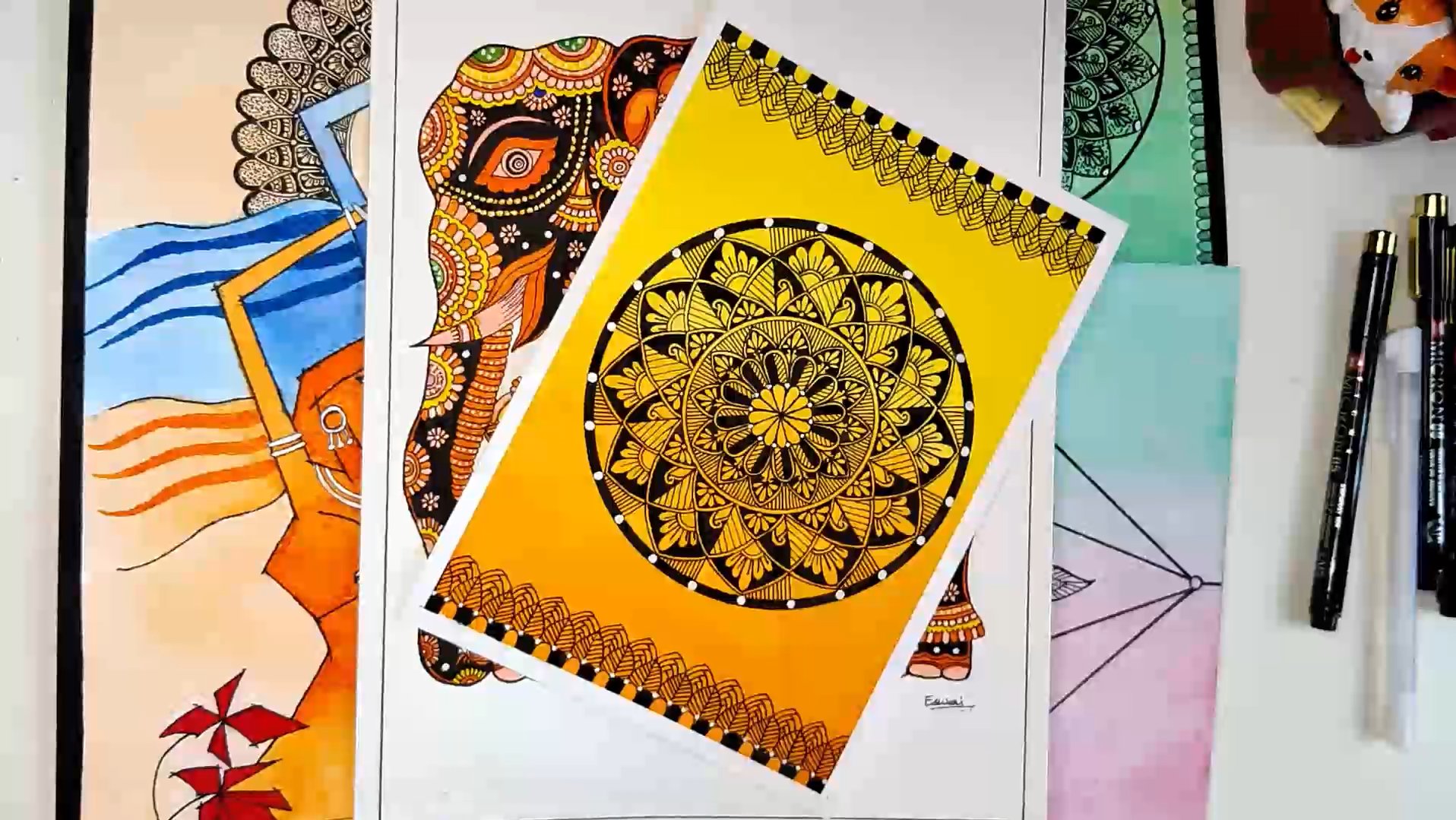
in Skillshare. The first one is on watercolor Mundas itself
on an E five size. The second one is on ice
creams and popsicles. We will be learning
five different types of ice creams and
popsicles in that class. Now in this class, we will be learning
different mini madas with three different backgrounds
with using watercolors. Sorry for searching
for words in between. I'm lost of words. Okay. At times. It happens very rarely. Yeah. Here I am darkening a but at the center so
that it looks uniform. Now, it's looking like a flower
structure at the center. If you want, you
can draw a line on the dot as well inside
this for intricate design. I will draw and show you if you're comfortable
attempt it in your work, otherwise, just
leave it at this. I will just draw a line
like this and put it out. I am explaining very clearly and slowly to the best
extent possible to me. So I hope you are liking
this new art form if you're new to this art form and
enjoying it as well. After seeing a very great
response for my first class and everyone asking me to come
back with Mandalas again. So I thought of choosing
this class in particular. Now, I will shift to
my 0.1 fine liner. This is 0.1 fine liner I am
using to draw my second line. It need not be necessarily
going in this order, but it's good to increase your pen size at
this point of time. I just realize that I
have missed one year. I'll just do it with 0.1 itself. That is all right, I think. Okay. Now, we will build
some more pattern from here. There are multiple options. We can just go with
the same two to grid or we can
include four grid, so it's completely up to us. Let us go into the four grid so that you will know
different possibilities. For that reason, what I will
do is here it is breaking, it is two grids and
here two grids. This complete grid
we will be taking all this four grids I will
not be a strike curve. Just let me grab a rough piece
of paper quickly so that I can show you So here it is. I have the thickness
explanation paper with me. So here we will be
doing this kind of motive for covering all
the four. Don't panic. If you're not understanding, do it with pencil or just
follow what I'm telling. Here, I'll put a dot
like this and even here and now it will cover
like this and come here. So slowly take it very slowly because
once we get this only, we will understand how to
fill in and everything. So take it as
slowly as possible. Okay. We will continue the
same for every like this. If there are little errors, don't worry, don't panic at all. I repeatedly say this
because sometimes we will leave the artwork in between thinking that
it is not coming out. Once you fill everything
and complete the mandala, everything is going to fall in place and looking so beautiful. Never worry about the outcome. Just enjoy the process. Okay. Now just go and draw this. You see me putting the points every time so that
I will not confuse. So these are small tricks. You have to follow. It's not actually a tip. It's a trick, which
we have to follow to get such a beautiful
outcome at the end. Okay. Now we will do filling for
this as well. Now itself. It's looking so beautiful
and I want to do the filling and we'll go
with a very simpler version. Nothing very, you know, complex. I'll just switch my
pen to 0.3 so that I will get a nice flower look. Here, what I'll do is there is already a center line, right? So I'll draw a line, put a dot on this line, a little shorter one, That's it. That's it, we are going to do. We already have those lines. In the center one, you
will be longer here a bit s a bit short. It is looking, the
effect of flower. That is the reason we
are doing like this. Yes, we haven't done a
double line for here, but I'll tell another way of doing the double
line. Just wait. Okay. I am turning my
paper frequently. Observe that and
you don't panic, don't stress out too much. If you are not
getting at this time, definitely at your
second or third attempt, you are going to get
it and you're going to rock and sky is
the only limit. So don't worry if it is not getting you at
the first attempt. Okay. There we go. We
have completed this. I'm using the same
thickness fine liner of 0.3 to draw the outline, carefully observe how
I'm drawing outline in this different method
or a double line. I'll just go outside of this. Carefully go outside
of this with 0.3 fine line that I am doing. I generally don't
use 0.2 very much. It's a very rare case. I use 0.2. If you are
habituated using that, you can happily go ahead. I am being a little extra
careful because I don't have any such grid line and I
have to Grid line is there, obviously, but it's a
little bit tricky here, so I have to go a
little carefully. Okay. And as I mentioned
in the material section, also, if you're using a
direct cold pressed paper, which is having a heavy texture. It might not come this way. This particular paper
from menora is not having so much of texture
like you can see here. This is how it is
looking after we complete two layers
of our mandala. We still have one, two, three, and four more to complete. Now, you can just
tweak in the designer, but it's not like
you have to go in the same part and cover
all the four every time. Now, see how we are going to do. We will just take this pattern, this pattern and then go ahead. So for this and this
in the center one, we will draw like this. First, we'll complete
that all around and see what we have to do
for the other ones. If you start doing like that, you will understand
what to be done and explore new patterns. It's not just like repeating the same patterns every time you should be capable
enough to come up with your own color combinations. You should be capable
enough to come up with own patterns
and everything. That is the reason I am
choosing to teach this way. And if you might have observed, I have chosen the color
combinations just, you know, in the section
of selecting colors. So it's nothing is prefixed. I'm just going ahead
with the instincts. So I want you all also to
reach that level for sure. That is the reason I am choosing this method of
teaching, I must say. And for the other lines, I will just go with a curve. So that is the reason. We have got so many options
if we do like this. Just exploring. The one which we have covered in our first wars class
was very traditional but it is a kind of level up for everyone who is seeking
to improve in this medium. This is what we
have done till now. Let us continue and build
these motifs itself. Now what we will do. I am lost, no. We will build
some of the other patterns. Taking this and this as a
center and joining over here, a bigger pattern will be coming. Observe it very carefully, like the center of this
center of this and here, I have kept it dot till here, we can go almost straight
and then do this. This and this. Till here almost
strike and do this. Then I will put this
the other side. This is some technique I follow. Also, I'll complete
one direction all over and then come
back and do also. There are a few techniques
that you can follow, so you can go you
can go accordingly. Let me show you more
closely of this pattern. So here I'm putting it out, and then I am joining
it like this. Put a dot over here and here, that why this dot method is, it will give you direction. You need not to search
when you're drawing. So like that, it will help
you when you put such dots. You know have to
bend and everything. But sometimes you will get lost to the next one and
you're drawing with pen. You have to be very
careful while doing this. If errors happen
also, don't worry. That is a part of learning, just go with the flow. Don't think too much, don't panic too much. Okay. If you are having
any element of doubt, just just do with a pencil and then on
top of it, do with pen. That will bring you
more confidence. We are almost about to complete this particular layer isn't mini moda so quick
and soothing. Yes. They are a bit quicker than the actual bigger size mandalas. When you have less time or
you want to experiment. I generally do mini moda to experiment myself to
experiment new patterns. This is looking soous already. Here, we will be probably ending with a flower or
something similar. What shall we do? We can actually end up
with a flower as well. So here I want to add a bit of another element as well before stepping into
the next layer. We can actually put this as
a center and join to here. That will give us even more
intricate detailed mandala. This point we already have, join it to here equal to
this next line almost. You can see it clearly
and understand. These small elements
will add a lot of, you know, uniqueness
to our mandalas. There we go. We have completed till here. There is one more
layer which is there. So for that layer, what I'll be doing is just connecting
here and here. This is the final layer
which we are having, and then we will go
ahead by filling and the double layers
or double lines. So we will be completing it. First, I suggest to
build this kind of look what happens is you will get some
motivation to fill them. You'll get actually nice
ideas to fill them. That is how I improved
on my patterns. That is the same I'm
suggesting to you all. If you know any other way, feel free to go ahead
and explore in that way. Also you can share it with
me through my Instagram. It is so beautiful even
if we leave it this way. But yes, we are going to fill
it up with something else. For that reason, before going
ahead and filling these up. These days, I have come up
with this style of working. I'll fill this part with some different patterns so
that it looks more neat. I'm using 0.3 only till now. There is no necessity of 0.5 as such come
yet for me here. Okay. I forgot to close the cap of my other
pen, so I have done that. Now, we will just go and do the, you know, this drop shape here. Okay. Just don't panic much. From here, we are just
going to draw these petals and join them to this
point itself like this. Three petals on both sides. Now, I have to see how
it is coming this aside. For me, this side,
it's more comfortable. Let's see. Okay. It's not so neat as on the other
side, but that's fine. Let me show you a detail. Now, take one drop
like this and then join it here like
this. Just three. Then on the other side, I'm actually figuring out
which way I am comfortable. What I'll do is I'll do all
these three on one side. This is another
thing which I do. I'll do this on all
the sides first Then I'll try to figure
out which side is comfortable for me and then
do on the other sides. So that is how I arrive at a
symmetry on all the sides. You can go a little slow also. I am this side is more
comfortable for me. For this side, I'll
go a little fast, but the other side is
tricky for me now. That's completely all right. Even if it is not very similar
also. Just don't stop. Here it is not similar, but still I haven't stopped. Once it is complete, that minute errors will not
be seen as you always see. Now, if you're not comfortable to some other pattern
on the other side, but since I have done for
one, I have to go with it. I have no other option. For that, I think I will do this as a more comfortable way. Okay. Even this
hasn't come so neat, but it's better, right? Okay. So we just have to go
in that direction and, you know, yeah, this is
comfortable a bit for me now. I am being extra careful and not speaking because I'm not
comfortable in this direction. Oh, my God. Now, you
all know my weakness. But yes. These to it
got up but spoiled, but now here it is coming nice, so don't stop, don't stop
just because it's not nice. Okay. Every one of us have been there, and I'm still there also here. It's okay. It's okay
to be wrong, right? We have arrived at such
a beautiful layout. If you want, you can just draw these lines and put it out. But for now, I'm going
to leave it at it. This is so gorgeous that we
have made and we will start filling the patterns inside this and drawing the
double lines now. Just go ahead and draw
double lines for everything. Everything means everything. It matters a lot. Take your time and
draw the double lines. And I will also draw along
with you sitting here. I'm going no way without
drawing along with you. Okay. You can just carefully go
and I didn't take the paper. So for me, it is a easy to
turn and all otherwise. All these things must have
been going here and there. So purposely, I
didn't do that way. You can either work
from inside to outside. That means from here to outside or from
outside to inside. So this is my kind of
new ossion and my kind of new style that I have been
adopting from a few days. So I thought, Okay, let's
teach this style itself. It looks so beautiful this way. Like for me, I personally
like this way of outcome, the outer side petals
and everything. It's looking beautiful Okay. Successfully, we have
completed one layer. I think I'll complete
all these as well and then we'll
go with patterns because that will
give us more scope like I was telling before. Okay. Let us quickly do the double
line for this and all. Just be careful while
doing double line here. I am presently being of, I should say. Okay. And yes, you might
feel, you know, does tend or stopping in
between thinking that, these are time taking, do we really need to do? But trust me, it is a very
meditative process and, you know, you will
enjoy and you'll get addicted to this
art form for sure. Even it is a small one. So take step by step every day. If you're not comfortable doing, this is a mini mandala as well. So it's as such a mini exercise, but still if you're not comfortable in doing
this entire stretch, draw a double line, take a break, take a break
of half an hour, you know, Have some tea spend some time and then get back to it before
sleep or something. So it really helps. And like I am doing from almost a year now
on a regular basis and I have seen a lot of change in the way
your mind reacts. And you know, it will be very
peaceful and you can see the change in yourself after doing a mandala
and sleeping, you will get a very
peaceful sleep, and it's has become a
And it has become my, you know, daily bedtime routine. So I would suggest everyone to practice this at
your own end as well. If you're liking that. We are on the last one here and we have one
more small layer. I did a double line for this
one in a different way. There are two three ways and if you're constructing one by one like this, you can do this. This gives a flower effect. That is the reason why
I have done this here. Okay. And for this, we will see about a double line. Maybe after filling these, I'll get some idea. So new ideas, that I am retaining them for now
in the way they are. When we are filling
alternative patterns like different patterns for
each of these alternatively, sometimes double lines
are not required. So that is also there. Now we'll start filling
the details inside this. Okay. This is one among my
favorite patterns, I must say. As I said for this side for doing this kind of curse,
I'm very habituated. So I'm mentioning here as well. You can change the
pattern on this side, if it is the same case for you. Right. So for that reason, I will be doing a
similar pattern here. Just observe and
do it carefully. So I am doing like
this one curve, and then on top of it, and then on top of it. I'm just turning
my paper so that I can get it clearly. There we go. I have done a total of five and then filling the space up to
enhance the pattern. And it's not over
from here, again, I will be drawing a line and then putting
a dot over here. Like this. Okay. This is the pattern we're
going to do for all these around all around and
see how it comes. Okay. You might have already
seen the final output. And here I am
sitting and talking that we will do this
and see how it comes. It might sound some
funny for you. It is sounding funny for me
also because I know how it looks after editing,
but that's okay. That's how we all do, right? That is a process. Okay. One, two, three, four, five. I will zoom on a bit and
show for the next pattern, like for the next motif, which I'm going to fill. So you will not get confused and understand it even better. Okay. I definitely feel I am
not boring you at all, but if that is the
case, you know, just drop me a message
in my instead or drop me a mail that or put
it in the review. It's like it's completely
open for you all. So however you want it from me. I'll just tweak it and then try to match your
expectations for sure. So we have completed
four and we have one tothe five five more. So it's nine count here. We have purposefully taken ten degrees because
it will give us more scope of exploring patterns like how
we are doing now. That is the reason. You can
go with 15 degrees as well, but then the kind of exploration with those
patterns will be different. I mean, the distance distance
will be obviously more. So with that distance, the exploration will be
even more different. It's not difficult as such, but it's different
way. That's it. Here we see more possibilities
because it's ten degrees. If you want smaller patterns, you must have gone
a smaller way here. So it's completely up to
you how you want it to be. And please please go
ahead and explore. It's not like you have
to follow the same. So you can explore
your own patterns and put them up in
the project section. Others also will be
cross learning from it. It will be very helpful
to everyone as well. And these are bigger friendly
patterns. Don't worry. Even if they are
a bit intricate, but we are following the
same flower concepts. It's not like tough patterns
to explore and all. Just break your pattern
into different elements. Then I think even all the
intermediate patterns or the very intricate patterns also might look
simple for you all. Just break the
elements. That's it. Don't break your table, okay? Break the elements
of the mod patterns. That's it. Don't break the glass or anything
you have on your table. Okay. Fun part. We have completed this motif or the design
or the filler all around. We will do some No,
I said hatching? I have mentioned hatching or
Spling thing that we can do. So we can go ahead and do that. So for that purpose, you can go ahead with a
smaller fineliner actually. Let me go and switch 2.2. It must be better. Okay. I have grabbed
my 0.2 fine liner. Observe this a little fully. I am just doing these lines. Okay. This gives a nice effect. Just hold on there. I have got a little error, but that's fine, I think. We can go or we can
correct it at the end. Ahead and do this.
Okay. At the end, you just lift you open. There we go. Repeat the same all over. At this point, you make
sure that it is thick. That's it. Repeat the same. I will be doing everything all along
setting with you all. Yes, you can follow
and do all along. Take it slow if you cannot
do fast, take it slow. If you do not have a 0.2
fine liner in your set, most of the sets will not
come with this as well. You can definitely go with 0.1, or you can just do
with 0.3 itself. Just start from here and lift. Start from here and lift. It's giving beautiful effect. It's already started
to look so amazing. Just make sure here such
hair does not come outside. If that is the case,
you can always correct with a white gel pen, which is a save ear actually. But you have to
correct it before putting the water color
on top of it. Okay? All right. We can actually do the filling and shading at the end also. But then I thought, okay, let's go with the floor. So that is the reason
I'm doing it this way. You can do it anyway. It's completely up to you. In our first class, what we discussed was we
will do a outline for everything and then go ahead and do the shading part at the end. So it's up to you.
It's like, you know, Which way you're
comfortable and everything. So go with the flow. Every time, go with the flow. We have three more left. I really hope you all are safe and healthy at this point when you're watching this class. So, it's really bad outside and we are hoping for
this pandemic to get over. So I really hope you all are doing a great
and everything. Please please get vaccinated and stay hydrated,
take healthy food. I know all these things
everyone knows, but still, I just thought of sharing it during the class as
well because it's very important for us to take care of our health and also
home mental health. M is the savior there, right? You're on the last one. Yeah. I hope. Yes.
You're on the last one. My hand is covering
the other pattern, so I couldn't see whether
this is the last one or not. There we go. Almost done. Yes. We have completed
the hatching part as well for the outer part. It's already looking very, very beautiful crust means. It's so cute for me. I am sitting and telling it's
so cute like that. Okay. Now, what I will quickly
do is in the second part, we will fill for these
and do the coloring. In this part, I'll complete
the patterns over here. I told you right, we don't need double line to do some patterns. So I'll show you how
that will be possible. Okay. Here I will be just going
with the strightline. I will draw center line and I will switch
to my 0.3 actually. This is my 0.1 0.3. And then this is the straight
line and then again, I'll draw straight
line here and here, and then a center
of them as well. In that way, I will make
sure it is equally divided. Or you can just go ahead and draw at the center line
and four on the side. Three or four and three or
four on the other side. It's completely up to
you, how you will draw. I think it's just three lines. I am accidentally
mentioning four, the center line and one, two, three, and the same on
the other side as well. A center line, one,
two, and three. I've got a little space, so I have run a
teeny line there. One, two, three, and then
one, two, and three. Center line, one, two, three, and I got a
teeny line here again. That's okay. That's okay. Let it be there. We are not a computers to do the same line exactly,
so that's fine. And that is the beauty when you do this instead of digital. Okay. Now, we have done here. We can actually leave
them like this. Okay, I have missed it here. Just quickly, I'll. Okay.
Just look back in between. So you'll understand if there is any mistake or not just
how I found out now. Okay. There we go.
We have done this. Here, we can go with a small pattern or we can
just leave it that way. So I will just go
with a very simple one and an interesting one
which you all can learn. So with the same fine liner, I am not drawing a very
thin outline, actually, a thicker outline I am drawing and then like this
and then filling this up. Okay. This is some simple one which you can draw as a filler. And then shade this up. This is very simple and
looking so beautiful, it's like it has
gone well with it. So I'm once again repeating
nothing is planned. The patterns are just, you know, I have practiced a few
of these patterns. Not exactly the
same, but recently, I am doing most of
these patterns, so that is why just deciding then and
there and going ahead. You can definitely choose
your own patterns, even more beautiful ones
or lesser complex ones, it's completely up to you. We have three more left. Okay. So we have completed till here. In the next part of
this project itself, we will see what we
are going to fill in these and then tape
down the paper and do something with these
tapes and do a background. Watch me there in
the continuation of this two of the
first project.
7. Project 1 - Stripped Mandala (Part 2): Welcome back to the part
two of the project one. In this particular pattern, we are going to fill details. For that, I have come up with some very interesting element. We will feel a bird. Okay. Small birds. No, it's sounding crazy. It will look like a
peacock at the end. So, we will go ahead with it. So since we already
have curves the side, we will have these feathers
on the other side. For that reason,
what we will do is, we have to make our kind
of structure like this. For that, I will be
making like this. You can join from
this side as well. It's okay, it's completely okay. This is my way of doing curve like this
and then like this. Curve like this and then
what I am talking the other way is you can do like this
and then like this also. But somehow that makes me feel like it's not
coming correct. So that is the reason
I go this way. Let me show you closer as well. It is just like this and then you can do it on the other side also we
have this feathers. I don't want again
to do this way. If we put a beak here, we can do feathers here. That is the only reason
I have chosen this side. So it's a kind of head
and body we are doing. So it's a kind of head and body. Now, we will draw the
pattern for this. Have it will be. One pattern, just like
this, a taller one, and then four, we'll get one more,
I think, five. And then fill the space up. Only then your pattern
will be visible. And once this is done, put a little beak this. And then I Okay. So c d. We will do
for everything. It will look so nice. Now, straight line and this. We have d one, two, three, four, five, for everything, five has to come only
then it will look uniformly and fill the spaces because since they
are very tiny spaces, I am filling it
up before itself. And this be and everything we
put for everything at once. That is how I am
very much handy. I just showed you one pattern so that you get that enthusiasm. Okay. Take it a little
slow. You can see me. I am also going a little
slow. Don't rush. Otherwise, till now
what you have done, the neatness will be gone. Just take it slowly. It's just a nine, it's
mini and you can do it on. That is why I say let's explore patterns
in the mini ones. If it is A four or A
five is also okay. If you're doing on A four or A three and trying to
explore patterns, it will be really tough for
us to explore patterns in such a bigger sheet because we have to draw many
layers. Many patterns. It will be so much. Okay. And at a beginner or
intermediate level, you might not feel so much energetic who draw
such big mandalas or you might not have time, but still you want to explore. So in that case, these mini mandalas are very helpful and a soothing
experience to explore, as well as give your
day a nice ending. We have one to three
four more left. You can really fill
this up plate as well. But yeah, I repeatedly told
also already till now, and I don't want to bore you
all by telling it again. I just want to mention never, ever stop your exploration just because you didn't
get it perfect before. That is a very wrong
notion of taking anything, don't do that. If you're not getting the
be or the e properly, the next step which
we are going to do go with the don't
think too much about it and stress out It might not be good at
the first attempt, but later it will definitely be. So don't worry, don't panic and, you know, stop yourself
from exploding. I have come across very
beautiful arts as well, and they all of them say that their mistakes are
what that taught them. It's our mistakes that
teach us more and more. Now, let us put the beak and high for every bird over here. Every bird is not
same actually here, but that's okay. That's
completely okay. I always say at the start and even at
the end of any Mandala, that the uniformity is what
it makes it beautiful. There are flows. So Just
don't think about it. Every painting cannot be same, it's like, you know, even if it is a watercolor
painting or anything. If the same concept is
being drawn by many people, everything cannot be the same even if they have taken
the same reference. Here it is different
for everything. Since these are through
the guidelines, we have got it nicely, and this curvy part does
not have a guideline. So because of that, every bird
is different, that's okay. That's completely okay. Once if you look
from a dispense, it will seem same. Okay. This is what we have
completed Mini Mandala. I have purposefully left
these spaces empty. If you want, you can
fill them up as well, but I think this
is good this way. I don't want to overload on it. Now, what I will
quickly do is tape the paper to this and then we can go ahead
with our background. I am taking my
masking tape and I am comfortable taping
from one direction only, so I'll be rotating my paper, bear with me for that. Slim rotating. I think the tape sound must have been a soothing
for you all to listen. Are you a person like me
who enjoy the tape sound. I enjoy the, you know, the tape so a Okay. I have no taped
down all my people. N one more thing
which we have to do is erase all the lines
before taking the next step. So all the guidelines carefully. Okay. Make sure that there
are no pencil lines visible. I'm just clearing it up. Okay. All right. So we don't know
which direction it is. But since it is a square, we don't know actually
which direction it is. Now, what I will be doing is, I will be taking this thin tape and let us measure how
much this width is. So it has should be 0.5 or 0.6. So it is 0.6. Okay. Okay. What I will do is since we
have a 7 centimeters sorry, seven 14 centimeters
we have, right? I'll put a dot so
that I will get a strike line or
something like that. I'll put a dot on
the masking tape. You can go ahead and use the
bigger masking tape as well, if you're not having
that smaller ones. Don't I feel bad on using
that or else, there is a tip. If you have such a diary
or a cutting board, you can tape this up and
cut it into half like this, cut it into half
and then use it. So it's completely up to you. Now, let me put a strategy
on how to solve this. So it has become a 14, right? I will mark all the
1 centimeter points at one 1 centimeter and then I will put a strategy
while taping it up. I am marking it on
masking tape so that my page will not spoil and I
don't have to erase again. That is the only
reason I am marking here. You can see right. Okay. So same way, I'll do
it the other side just because I want to make
sure it is coming straight. I am a bit cautious
in this case. I will make sure that it
is straight at least. So I call this as the striped background
da. It's up to you. You can have your
own name as well. All right. I have put the
marks on both the sides. Now, I am taking
this masking tape. And actually, I'll
use both of them since I have both and I have dropped my let us
go ahead by taping. Now here, what I
will be doing is, I will tape kind of T is a bit of hurdle
for me right now. So I will just tape at
the 1 centimeter point. Like this. You can tape on the mandala
as well. Nothing will happen. It's waterproof and it
will not peel off sea. It will not peel off the color. Okay? Don't worry. And then I'll put the other one. Simply only or I'll try on both sides and so that
if required in center, I can arrive at a bigger space. I have put 1 centimeter and my top portion of
the tape is there. In this case, what happens is, my bottom portion of the
tape be above that line, which I have marked
as 1 centimeter. There we go. Now, I am switching to the green one because I had
them, I'm paying with it. I am going ahead. Now what I am doing is. I am placing above the second centimeter.
This is one point. This is the second point I have. This is the third point I have. On the fourth point
here or maybe wait. Maybe we can go here. These are two tiny, first, second, third point. Third point making third
point as a top reference. So I'm putting my top portion of the tape for the third point from where we have
paste it before. It's just random guys
you can go ahead with your own strategy of taping and then use different
colors as well. It's one to three
third one here, the bottom part must touch. I know this might look a little confusing the way
I am taping down. It's okay. Do it with
equal distances? That's it. I am actually leaving one
point and for the next point, I am putting the same way. Other than that, I'm not
doing anything here. If you could grasp it, fine, otherwise, put your
own strategy and do. That's completely okay and it is going to look
more beautiful as. Okay now, why did I
change the color? Okay. Now, this one, we
just have one left, so I am choosing center of
it roughly and then going. So this is the center of
the page we have. Okay. So there we go. Now we have these
stripes really. We have to put colors in this. So for the first one,
we have finalized on red, green, and blue. So we have finalized on red, this particular blue
and light green. So let's see how it works. I'll just roughly write and you can see me deciding right now. So let us suppose one, two, three, four, one,
two, three, four. So there are four things
which can fit in here. Okay. So out of red, blue and green, which color will be looking
nicer at the center. I know. It's I know right. It's a little really
complicated to decide. Okay. At the center, maybe this two parts, we will go with Probably. I will go since
blue is not here. I am planning to
go with blue here. Here will be blue, and then we will have green, and then we will have red, and then this part blue
and here also blue. This must be good. I am not
using any additional color. These things, that's it. We will be using Okay. If you want, you can do a
gradient wash and try as well. But I am going to apply direct colors only
with my mop brush. So I have my glass
of water ready here and just going
to apply it up. Okay. Okay. Let me quickly take my mob size
number two brush I am taking. And then I am just
washing it off. Take tissues handy. I know there is no much
technique involved here, but still it's very important. What I will do is since it is blue on the top here
and in the center, I will wet this portions up. This part, the bottom, as well as I will wet the
center both parts. Okay. And you can see because the pens are waterproof,
it's not smudging. I'm just dabbing it off. I don't want any excess water to disturb and spread
into other parts. N I have taken my cilia set. I will put the mini
brush aside for n. This blue we
thought of taking. So I am taking that blue
directly and applying here. I am not doing any
gradient wash, nothing. I am just applying
color like this. But yes, I have done wet on
wet so that a lot of color will not very thicker
consistency of color will not be there on this after drying and manda also pops. That is the only reason
I am doing wet on wet. You can directly
go and apply also. Without doing wet on wet. I am doing with mob brush
because it has a lot of water and it will be easy
for me to spread it up. This is over. N, let us move to the next color and washing it a little carefully so that
color is not picked. The next color being red here. I am wetting this portion. These two portions,
and I am taking. Just be careful that your
blue doesn't come onto this. It is okay if it comes also, but just make sure. You can see how
nice the pigment is here in the sennelier set. The omlion is very
nice French mon. Okay. The part is
over and I am washing my brush and then wetting the
part green for the green. Okay. I am picking
up my light green now and then going ahead on top of this. I am being a little careful
here because I don't want my blue pigment
or the red pigment come and mix so here as
this is a very light green. I want that vibrancy to
pop up after trying. Maton makes us
easy to blend and, you know, make us
spread it evenly. That is the major reason. So here red has come but
that's should be okay. Yeah. So we have completed our pattern We have completed
our pattern Mini Mandala. We just have to wait
for this to dry before removing the masking tape
and have a final look at it. So it is dry now, and there is a little
bit, you know, water extra water that
have been saved in the corners that must
be okay. Don't worry. Just remove your tapes, a little bit carefully in
one direction like this. Okay. And I'm leaving the
tape over there for now. Okay. I just have my tissue
with my hand to remove that sapage of
water that is happening. Just pull in one direction. I have my tissue handy so
that if anything happens, I'll just quickly remove that excess water that is
going to come on my white. It looks a little funny, the way I am hanging
all my scott taps here. I'll take all of them at once. This is looking beautiful. Let us remove the
other masking tapes as well on four sides. So here a little bit of
C page has happened, but that should be all right. It's a very
unpredictable medium. Just be careful with your because we don't want
it to ruin our work. Okay. Now we have peeled
it completely. You can use this
in any direction. Like this so it's beautiful this so it's beautiful
in any direction. This is our first project, and I hope you really
enjoyed it to the fest. I really enjoyed the
color part at the end. It enhanced the birds
that we have drawn. I am really enjoying the
birds that has come in green. It's so beautiful the birds
that has come in green. So yes. Finally, our first project is done for after so long wait. Met you all tomorrow
in the project two. Till then, stay safe
and stay creative. Okay.
8. Project 2 - Two Toned Mandala (Part 1): Hello everyone, Welcome back to the Project 2. So in this class we will use some different technique of watercolors and buildup background after drying them on della. For this class, you will be requiring a bunch of salt answer. We will be using this after completing the Mandela in our part 2. Now, I have made the grid ready, like I have mentioned in the grid section as well as in the first project. So I have used this same grid of one centimeter gap, six centimeters, and then 10 degrees each. Now, this particular project, project tools really close to my heart. I don't know why. I can tell you. I actually, I recorded this class and in between I found out that it's not saved and it does not, it's gone. So this is how this stage is. I am keeping this aside now and we'll be doing this again. And this time I'm making sure that it does regarded. And he knows that things happen, so just we have to take it positively and move on. Okay, let me now try that same pattern again. It's like I have done it wary nicely. I should say a very, you know, I just got the patterns at the moment. I have not prepared for this one, so I just got all the patterns. Like at the moment I'm deciding them then they're in doing. So, let's see how the replica of this gums, so this dual happens, dies. So it's not easy to wrings out, so beautiful and wonderful content to you all. And I hope you all understand that as Zoom. And thank you everyone was T ends up putting all the time. So now for this, I will go ahead and draw a circle first saw with the smaller thickness pencil, sorry not been said a fine liner. Figuring out which is 0.1 fine liner. So I am taking 0.1 actually, you can go with 0.3 asthma. Okay, Finally, I got my fine liner of pine tree size. So I am just putting it up and this is already nearly one centimeter measured like when I'm drawing this grid. So I think it should be mostly appropriate. Let's see. Okay, It is almost there. I am just bending or very little so that it's accurate. Okay. And I am running my pen and I am rotating my paper. Like you can see for the smaller circles always rodeo paper and you can see my favorite going out or it's not because I'm not pressing too much on device. Hall will be coming there. So I am just extending or let the land drawing one modal line, your next to it. Okay, with a little gap, I am drawing another line like this. Okay? Now what I will be doing is I will not following the same thing that has happened here. This little come as a bonus lesson. So it will be already this much or word when it comes as a bonus lesson, I will make sure that I will upload as a bonus lesson after he was shot. Now we will go and make some new patterns here because as I promised, I will explore with you all. I will explore step-by-step. So I just don't want you all to learn from what is already there. So since it has lost a home with some new idea now and then go, Okay, I would definitely put that as a bonus lesson for now, I am switching up to point to find 90. So with that we will draw some patterns or what your, so we can draw elongated patch and as well, or we can just restrict over here, that's completely up to us. So since it will be too long to extend beyond, it will be a very elongated pattern. If you're comfortable, you can do what are the ways you may restrict yourself to your so let me do it fully on me. I wonder explored it that way. So from here to here, a complete You should come like this. Elongated you. Okay. Since this is a bit of cold press paper and having a little bit of texture, you might not get that ball fixed moodiness that you will get an, a normal people that is all right. And if you're going with that brand other than minora, the whole press will also be having a bit of texture. If it does a scholar, you will be having a lot of textural supplies are just you buy that, go with cans and headed to Egypt for this available with you or just go ahead and do on hot press people. It's completely all right to do on a hot press paper. So Judy has been, again, a busy day on the road. He are. And you may hear a bit of noise. Not a huge one, but Oh, hon, towns here and then I tried to avoid, I'll try my best to avoid such noises. I'll try to take a break and then come back again. But if at all you such noise, even my new to end, if it is disobeying you, please apologize me on that. I always mentioned in most of my classes that I will do or real-time voice over. So that is the reason albedo, you will have your E minute sounds most of the times I baked good of audio quality to give you the best audio and visual quality. That will be some unavoidable situation. So I hope you all understand that and most of you have I'm misheard, ends up boarded me all through my previous classes. So if you have any doubts about the grid construction and anything you can just to hop on to the previous lesson. Bad, I have mentioned to you earlier about grid construction and I always stress on vote through the techniques section before jumping into the projects because I covered most of the basic techniques that we are going to use in the project there itself. And for me this glasses where the space shuttle, because I explored this ending, the offset in one of the lessons and finalize the color combinations Dan and David self with you all. So that does really special to me, but just something unique concept I have come up with and I hope you will also enjoy. And D, given that we now have a B, we'll do a different model for the next feel. For that again, they are not options available. We can join B's both and make a small motifs like this and up one that we can do. So this is, has already new thing for me to do such kind of more depth, I think I should go ahead and explore. That does have you also will learn. So here I am not just concentrating on the outcome or the neatness. I am just letting you all know how to explore different patterns. So I think that does something new and really you make, you can get this from class. Sorry. You can get from this class. Yes. My words at jumbling urine, they are in between. Okay. This small like this, we will draw for a raid 0. Upon a rebuttal v will be drawing this slime using points three fine liner to draw these outlines. And this is one of the most used to find lines by me, particularly, I enjoy using this particular fine liner. And just go with the flow. I am seriously telling, you know, you will definitely enjoy exploring patterns if this is a minim or nulla. So if it doesn't become under law the species and the motives, I know, but the details will be explored a lot. It's not the easy bar step. If you explore them in a minimum, the ally and then combine it in your biggest size, Mandela's on add them in those. It will be very easy for you all to gain that confidence off coming up with new patterns. Sometimes you people approached me like, you know, why everyone are doing the same same patterns, isn't it so boring? How many will do in the same scenario seen style? So that is when the formulas I haven't taught but datas when I taught, okay, I have to explore the patterns and I have to tell people how I am exploring fat. And so that is how I came up with this class idea. And here I am going to draw a double line kind of thing, but with the pattern so you can see me keeping dots already. Okay? I am just going to join like this. So now you might have understood why I didn't just, you know, use the unrecorded but and I didn't just get this thing because that I have got that at the moment. At this particular moment when I started shooting this again, I might have got some new ideas so that as the reason I said that, I will put that in the bonus section. Do give the other one also try other than this three projects, if you feel that it is interesting for you all. If you observe in our previous first project we have gone what that vaguer motifs on Dow 30 PSI eat and very smaller motifs in the inner side. But here we are going in a different way. So we are going with the smaller motifs, like kind of thing he all right. Okay. I think we're good till now. If we want, we can fill this up completely with black or we can just leave it white also. So let us think about it a little later after finalizing the last Leo. So the last layer I want to be, it has to be a BAD off like this. So our different extinction to go with a different shape. So it will be from your own lead, will be joining like this. This is our last layer on last but one we can have one here as well. Let's see. Continue building this patiently. And you can go this way also, which is my favorite way. It's completely up to you. And I have John burned onto this way after a lot of practice, so it's completely up to you, Oh, your hand movement end-all. And you might have known about the Muslim memories. So only with the practice you can attain both fiction. Maybe have message me asking that how view where you get Pulp Fiction for all the patterns. So this is what I follow mostly so far for I have drawn like this. And then now I'm drawing the other leaf or the other side. So this is how I mostly do. So we'll get that Paul fiction. If this tie and sorts you, you can happily follow the style. And there are hundreds of styles in which you can draw. It's completely up to you to choose which is comfortable to you. So just don't rush yourself. Get things habituated to you and slowly you'll understand your, your cell. It will explore on every topic. I think that does help everyone of us has learned even from JD who Jasmine. Okay. We are good to. Hio. And I feel of adding one more leaf motif in these areas as Vin. So for that scene, I am going to make a leave kind of thing from here to here or just a small one like this. We don't have any guideline if you want, you can draw so global here with pencil so that you will get this landing points equally. I am roughly measuring and drawing. If you want, you can add one more pencil line in-between. It's up to you. I have missed one. I'm doing that. You can completely avoid this step paths and outer one and fewer don't feel that it is required. So it's just me kind of person who wants everything to be fully complete and everything. So that is why I go on adding and try to reduce the space that's as much as possible. So He our sins for the first run, we don't have any direction like it can be seen from any of the side for this one, particularly what I want to do is put it drop over here so that in one direction only it's mostly seen. Are it looks good or something. I couldn't do it properly. It's like given effect of reality. So it can be seen from inside as well. But this indicates that a BOT site or the French side. So for that, for quiz, I will start putting a little drop kind of thing, hill like this. Okay? And then assault and BBB filling all this space up with black pen lead to 0. Now let us start filling this ADR. Fulfilling this area I read goal with alternating patterns or opposite patron's method, which I am going to show you now. So I am trying to pick, okay, I have done with 0.2.3, I am going to pick up 0.1. Actually, I'm rooting for it. Yes, this is fine to one. Now we have to draw a double line for all of these. So I am slowly drawing for this one on me, okay? And since we have drawn the spot, so what I will be doing is 0 for this area like this, I will be extending this line itself down and then shading the alternative more depths. Okay, I'll show you, wait. I will complete these lines first. And then I'll show you couldn't go with different patch and as your shading or hatching or stippling anything. But since I am doing a watercolor background later, if I shaded with benzylic might not pop up so much. You can do that as well, but I am going to do some blow away. So you will just have to fill this up. Okay. Let me complete that step very, very quickly. I am switching to 0.3. I think that I have to go 4.85 so that it will be filled up very quickly, really quickly. I am baking 0.8 so that I can pull it up really quickly. So this is what I'm dialing while filling and everything. You can just take 0.8 so that it will be ready quick for you all to Phoenician. Now reason the brute straw has launched one also. So even I haven't tried that yet. That should be when Modoc would call job. Okay. Now what we will do is even Florida one factor for the white bought attached wires and they may follow different pattern for the ones that extra window so that it looks so on meat and oh, good. Okay. So for that, let me quickly go ahead and draw the double line for a retain. At least this layer in, but they glow. And I hope you're drawing along with me because I want you all to draw this along with me and expedience everything in a very real time. That is why I am going very slowly and explaining everything in the day and doing along with you all. Take it very slow, like you can see me and I'll give Lee and recently I am trying to draw this. So only when you do that, it will give that perfect look. So and most of you think, why double line, I think I have repeatedly mentioned on this, it enhances your design, more design or the five fellows everything it enhances it completely. You can see the difference here itself now. So that is the major reason. And I really hope you all are safe and healthy at the moment. We have three more flowers left. I mean, petals actually, these are looking very close to flowable. I am getting remembered of Basie. What we do is we can go with multiple options. So since I have mentioned flower, you can do hatching leg this and make it as a flow. Or you can go with some other option as well. It's completely, completely up to you and I am going to do this method. See it only appears once you understand the button, you can do it by your own acid. So I am just drawing a line, dot, line, dotted line. And the same thing I am repeating. So I will be getting three lines like this in total. And I am doing for that. Wait, I have the black hatchback. Okay. Not enlightened. I'm using 0.1 fine liner only. Let me zoom in and show you. So I'm using 0.1 only you can see. So what I am doing this, what this black part that is already a center line. So line dotted line, dotted line, and then line, dot line. So it's the same thing I am following. It might not be exactly same for all the motifs you have drawn, but that's okay. You can just go with the flow of your able to do in that particular motive. But just make sure that there are only three lines. If there are more, sometimes it might not look neat and uniform all along. Okay? This is one of the simple design, very beginner friendly. Okay. And now for this one I am going to do all hatching. This is a kind of a bird indicate one, but I think it's an easy and the symbol 1. So nothing much to worry. Like these lines you make, okay? And just turn your paper little bit and you make no cross hatching of this. So this v you will attain up but off for fiction and neatness and it looks very intricate. So what I will do is this is my veil. Doing this. I will do one direction for at all the patterns that are there and then come back doing the other cross hatching so you can follow the scene for me while go like this because I feel angle might change if I keep on shifting from one flower to Dada. Gestural completed. So for that reason, I will do it this way first and then go ahead and do the other line. And if you have a BOP to any of the surface of article on board, just make sure that you are rotating it without any hesitation because there is nothing wrong and rotating a paper while you are doing them on their larvae all do in that way and that is a correct way. Also, only dust if you are doing on a volume cannot rotate wall and you have to bend. By the way, everything I though I is I think it's good to rotate. Here it is windy now I think it does go into rain and wind. Okay, Now I will cross hatch on the other side. So this method is called cross hatching. It is used in many aspects of many art forms as well. Mostly in portraits and all, most of the people do crosshatching at the head area to show that texture, to show the bow and below areas, or to show the highlights on your face and everything. So this is a technique called cross hatching, okay. And it does very similar, like it's sudden grid that just a grid I not cross ways. So everyone must have known about this. And it's easy when brought up, but just make sure your lines are not very shaky. You will get there by factors. Don't worry for me only one angle lines are comfortable. I have repeatedly mentioned even while taping wall its own V1 angle is comfortable for me. So get to know about yourself and which angle is comfortable in which angle you are getting the maximum Pulp Fiction and then try to establish that as your site. Now this is looking so beautiful right? Now, may have to hop on to the next factor. So here let us quickly go ahead and do a double line for all of these lower ones. Take your time. Don't rush at dawn. Do slowly and patiently because double lines are the only ones that enhances your design or you are Biden and make it look more neat and complete. Okay. So just slowly go ahead in New York, comfortable V and direction. Don't stress out yourself if you're feeling like you're stressing yourself. To get this bowl fiction and uniform muddied. Just relax. Have a walk and come and don't get irritated if you ever heard any hard and sound from my video. Because i o hearing those and feeling a bit irritated and telling you all not to ECT. So in related building and Delhi. Okay. So we have completed earlier in this fight and aspirin. And for Diablo patterns, if required, you can go for a double line or for some areas you can see even that we all so only we can decide after filling this. So let me quickly do a batch end for this. So here V will be just drawing the symbol flower like this. So a cough and few bundle, So it is just coming to button. So we will draw those two petals, That's it, which means so just these two buttons and we are not even putting a line if required, just really Patel line naught dot. Okay, I'll repeat the pattern here just to swallow like this small swale joining this. And then you will be able to draw on lead two petals nicely and fully. So just to draw those two patterns and put a line that said, just quickly repeat the same pattern all around and fill limited spaces then and there itself because they are very tiny. If we keep it at the end, no, what happens is we will tend to fall good and those tiny things will pop up and look like incomplete. So just go ahead and fill those back down. So our complete the motive. I lost the hood there, so complete them more deaths at once. I'm just adding the biotin so that sometimes I endured this way. So I am showing you all the possible ways of how to do it. And you can pick one from these and make it your style, or you can mix and match you invoke all these I'm doing. I am hopefully looking forward to you all to enjoy this process and learn something from the way I am taking it forward. And hopefully you are learning or different way. I'm hopefully thinking that and I would love to see all your additions to this. You can come up with the new color combinations as a backbone or you can draw your own patterns as well. If you are watching all the classes before drawing and then starting to draw, you will definitely come up with your own patterns for a shy. Because there is a bonus lesson also at the end, which is completely the event. Which is actually supposed to read this project. But yes, sometimes it's a destiny and calls it out that way. How bird has come in again today. So I think you all have some connection with me and mine bird as it's not my word as such, but it comes a time when I started recording this Skillshare classes are any of the classes, even for my u du bar, any of my live sessions and everything does burn, mostly keeps on going. It's good that birds are coming in the house. So yes, there is a greenery here and there are very less, but these days that comes home, particularly here in the, I don't know about the situation of other countries right now. But in India and in my place there used to be very less boards, but in recent times, they are coming in the mornings and evenings because of the greenery that has developed recently. Okay, We have completed taste HIO. Now, let us take one more pattern and then go into the next part for filling these two. Okay? So in this pattern you can simply go ahead and draw the straight lines as well. So that's tried lines from here to here or a call V1's. So what we will be doing is we will draw a petal or some drop like this and then doing the scope, okay? So what I meant is like this. And then following this call, we will be drawing like this. And at the point where it meets like that, we will fill it up. Like, let's see 1. So it has 1, 2, 3, 4. We will try to get four on the site and the stone may be poor. 3, 4. Okay. We worked for and this can be a straight line like this. Okay? We will continue with this pattern. So since here it doesn't straight line, we can actually put it up like this. I purposefully then to draw before because we don't know what we will finalize here, 1, 2, 3, 4, and if it is coming one more also let it come since we have some printed already with the line. Okay? And just to draw our drop like this, just drop your and we didn't go with a double line here if you see good for me. Okay? This is how I walk on multiple patterns at once and make sure it is uniform. So now I have drawn backdrop for five to six patterns. And now I am drawing these lines on one side, okay? And then I come back and draw on that side. So this is my most have intuited way of doing buttons to get it uniform and perfect. You can try this method out and let me know in the feedback how it has worked for you. Or through the message or anything. Don't worry if you're getting five lines on one side and six lines on one side, we will get there. That's okay. Once we complete all those minor, minor mistakes. Okay, cool. It's a lot VCM. So here also there is a gap or what their will heal or that has formed. You can just fill it up. I am continuing the same button all over. And this is mostly buildup that the lines, okay. Now I will draw our drop for everything at once. It does very windy here. Very windy. Okay. There are even more than I thought this is the last one. That's, that's fine. So this has become a bit in Brigade project. Now, I will draw lines on one side first and then on the other side. So it's just the bar lines for these, I think. No, it shouldn't be so tough to understand and does play with the different sizes of penance and you will all get there. So this is 0.1 I am using, okay? 0.1. If you use 0.3, we get different thickness of views a point you can use 0.2 also for this one, since via have a lot of gap and everything, 0.3, I don't suggest and recommend much at this point. Because we are dealing with very thin lines. Even inside here we have dealt with very thin lines. So that indicate pattern look welcome only when you shift to 0.01 or 0.2 or even 0.05 actually is left in a hurry. Ions on as LIGO a guide. Okay, I compete on the other side as well now. And the next 5 we will continue in the second part off right away and we will be filling these and the same spot. And then doing the watercolor extra effect as a background to pop up the odd well. If you want, then the central bigger drop also you can fill something but I think it has turned out indicated already and I don't want to fill anything more and make it look messy. Because in some open spaces, some GAD, some breathing spaces are really important when you are drawing a Mandela. If you fill everything up, sometimes it looks up v. So that does YE, we should know. So are you using that rule and B? So that is the reason we shouldn't make it look, is that the color make it looked so also would think. So such small, small gap. See here we have left a gap, here we have left a gap, and this will be filled with black. So I'm not considering this. So those small gaps is what makes though indicate patterns pop up out of your Mandela. So make sure that you're not filling up everything with Biden's if required, you can actually hatch this up. I mean, shave this up completely, fill this up in black holes or byte. We will do another pattern on top of this and it shouldn't dominate that. So every time make sure you are doing more intricate patterns either in-between are in the outer ones, so that it makes your work look, compete and pop up. So we have completed till one part of the continuation of these two layers here and the border, everything we will see in the next five. Join me there.
9. Project 2 - Two Toned Mandala (Part 2): Welcome back to the bot to hope for day 2. So, yes, so this is a kind of refreshing because we kept this as a bonus. And I got out from that mood ASM. So if you're not ready with a glass of water, get your glass of water and be ready because we are going to play with watercolors as well after completing this. So in this ADRs, we can just go with the double line with 0.1, et cetera. Okay? Here are a double line for this completely. So strapping from here on are just free to him. So why did you vote for it on the line? I I really believe that it does not require as such. So for that reason was I am doing is I am just doing a double line for this one. So this is one of the technique I covered in the project tool therefore. And this five. So since I couldn't explain it, I am doing that here. You can clearly see me deciding it PR itself. So with this I didn't flanges, I thought, Okay, I will do, since I want to do in the second project, I think it's better to do it here. So I am just drawing a double line for this one is not double-blind, so it is a double-blind, but indeed it's not. So even fill this up with complete black by leaving of but of reality mark like this. I will tell you how in a while. So just go ahead and draw this double lines as precisely as possible as humanly possible to you. You know that like you can do all of these at once. Yes, you can do all these buttons at once on all the directions. If it doesn't, then they'll Mandela. I will try to cover that topic as I get my high-fat ready to me. So if you are a digital Mandela tests and taking this class, you are free to explore this in on your digital form and then upload in the project. I will be happy to see that we ask them. So here are some Azure has happened. That's, that's completely all right. We will be filling this up anyway, so we shouldn't be so much wiling know. So there are two types of filling run. You can leave space like this are the one Nu Bu, our highlights on top of it. Okay, there we go. Now we will be filling this spot and this spot after erasing everything. And for this area, we have to fill up with a pattern. You can do stippling as well if you are aware of it. I am going to choose with an add-on New York. So I hope you will love this one as well. It's just an overwhelming. Okay. So collect this. Oh, well, she and a joining this 11 more here. Same on the other side. If you want to append goal in an alternative, we also put this one, so a different pattern here. So we will try alternative method for this particular one to see and explore the maximum of which is Andy's pond symbol. So the alternative button would be awesome below one with a paddle. So it will be this scene motif draw. And then we will continue with the pi thirds like this, 34. And we could stop it here if required. We'll put a small soft collect this hill and then we will do the same on this side as well. I am just turning my paper for my convenience. 1, 2, 3, 4 and a small So collect this hill and we have to fill all the negative spaces. So let me first complete everything are, let me show how the Python looks here so that you can draw for those as well. So VR, following the alternative by John method here in this wheel, It's all you can make your Mandela look unique and beautiful in your own style. Okay? If you want, you can draw a double line and explore this pattern. I just don't want to draw, maybe because I am really easy enough here now. But anyway it has coming God, so, yes, there we go. It looks so beautiful. Form. Hi. You feel want to again draw a line over here or you can just see what that bags all since VDB having that side effect, I don't want to fill this up. Now. In this particular Mandela saw a sock over and 0, 0, 1, and 3. So mostly it will be three are mine maximum, like one more on this side, so smaller ones. But mostly it will be three on me. Like I have drawn this pattern few times in my other Mandela's and for me there's always like one sentence alkaline to one the other two sides. So I am completing this factum forced. Ready when you are coming to the part two, because we will be doing the technique after completing this. If you have seen my ice creams class, you must have known by now how we can use salt to get a texture on watercolor. And if you remember the color selection class, in this particular class itself, Scala selection, listen. And you already know what colors I am going to use. So it's going to be a low-end bond on ball. It will turn out as a view different combination meal just to drop in some mixing and then drop in though. Salt. Don't worry if your overlays not fall for PR and there we will shade it up, then you can correct that if required. Thank you for joining me and enjoying this process along with me. So like this and the buttons, I will be turning my paper multiple times to get perfection of these by those because that does read them. Bod is lying. So don't get confused. By the way I'm doing it. Let us do this flower for everything and then fill up the negative spaces as men. Okay. Just be a little cautious and careful while filling up the spaces. And these spaces. They could slow, don't rush at all. If you're Russia and accidentally go on some other factor, just remember that you have this white pen, handy Docker x such mistakes. Just leave them mistakes, ignore them and continue. It's better to be careful before that self rather than worrying later. But I always see this repeatedly that don't give up on your art will give for this fade or if it does not coming properly. Completed, completed short to everyone because everyone needs to know how to improve your. So how have you have improved from before? So don't ever hesitate to show you of a loose to any one. We all have learned from it and see Dustin then starting of this class also, I was mentioning that there is a failure. It's not a walk failure as such, but there is a failure in recording, so it's completely okay. We have to accept our mistakes otherwise we cannot go from there. I am giving so much of wisdom words. I think. So. This has been a very nice and intricate design. Now, I somehow feel that we should not fill this out. So instead we can go ahead and draw some vertical lines are real fill it up. And who I am do less at this point right now. What to do for this one. But let me fill this up first so that we will get some idea what to do there. If you want one to price on new pattern, just go ahead and try it out. And I am not switching my pen psi is just because it's very small, tiny gaps. And it will be very difficult for us to fill them up if we switch to a bigger size Ben. Effects generally I mentioned brush somewhere, please ignore that. So I feel all of us to blink your eye B, we'll do stippling in these areas. Okay? We will shift little, bigger size of 0.2 or three and then do stippling the VS C. Now I got an idea. So it's just that, you know, going step-by-step, layer by Lee or no one has an export. Everyone is experimenting and every day is a learning. You have to be good as that we all need. Then we will put efforts to improve our knowledge. No one is born and not the store. No one is born with so much of knowledge of creating everything. So don't worry, don't panic, and they're not dawned on the motivate yourself from trying new things on the practice, practice and Brock piece gives you new ideas, speak inspirations from references. And please just, just don't copy paste or just don't know that along, learn the technique learned to the full list. That does want maximum. I can see. And since this shading is taking too long, I think that I get back. Once this shading is done. I have competing shading everything hanging rack. So I didn't complete this and divide by 0 plus v. And I am feeling to leave it like this without filling anything, just stay in these spaces. So I'm good like this. Otherwise these designs or these pathogens will not pop up. So I'm good here. And now I am going to tape down the people and then erase the lines because I19 Bordeaux effect. Okay. Get ready and I am donning my baby. So I don't know why I am comfortable only one day being in one direction. So it's up to you. You might be comfortable in any of the Direct Share. Okay? Now, what we will do is we have find less this hands-on direction because of this shape over here. And that is why I'm keeping it in that way itself. Now while digging a reason would either use a reading all the lines. This is a very important step. That is why you should have drawn your lines very lightly, if not also fine. You can either use them like this. Make sure there is more line visible to the maximum extreme pose. Gently learning more low wall. And it could be gain this up. Okay, now we have radii, I've removed all their Dustin. So there is one more final thing that we have to do before getting into the coloring, but I am picking my zero-point eight fine liner to fill those in DOS base off. Just quickly fill this up and then we will hop on to the background color. But I hope you have got all your tissue. What DO brushes follows ready to have some fun and especially solve for this project. I would be going ahead and filling this up. If you have a sketch, you can go ahead and do. But what happens is, you know, like a value, put water on top of it. It might have high town to solve reading. So that is the reason do it slowly with the fine liner that you have on me. Okay. And you can see how over this popping up those L-Dopa after it is filled with the column. I mean, the black. Black is also a color. Is it called the color or not? I don't know. I'm confused. I think if there's a color, sometimes people say black and white are not considered as a condos. Where why it cannot be formed by mixing anything and black can be formed by mixing a lot of colors. So I don't, I don't know in this aspect radially, so yes. There we go via done little there. And now let me take my mom brush of size 20 only I will go with and Domine set and the shoe people glass of water. I am just dipping into the job and just going to write this up completely. Okay? Make sure it does even make sure there are no poles of what? Right. Do make sure that okay. Now we are going to take two colors. So for that is for a child go with the loan B and then drop it in some ADRs. Okay. I am trying to take the co consistency as much possible. So like this, Hi, I'm dropping in some ADRs. You can see Howard does coming nicely. I am thinking even more color and dropping it here like this. Okay? Now I quickly wash my brush and taking bond umbo, and dropping it all along water is more than the colors. So I reduced to water a bit so that I will get nice pigment of the Apollo. I am dropping it in all other places like this and on Udot, yellow part as well. Okay. Just take Naive Bayes consistency offered. There will be transition here and there, so that does okay, Let it be like that. Does drop a dot. Now we know, Raj, I am digging even more yellow again and then dropping it up. You might see that clearly and lawyers not seeing that is seen as a mixture. That is completely okay. Just play with it. Okay. I'm just playing with it. Trust me, this will look absolutely beautiful. Very beautiful after it has dried. Now, before it gets some greedy drain led me to pick up some salt and drop and you'll get dropped randomly or you can follow up by donuts are Bu, completely undo. Okay. I am randomly dropping and let it bleed its own magic. But at the same debar, or some areas I am dropping more. Some areas I am dropping more, some areas I'm dropping less. So it's completely up to you. So this far I'm dropping more than this bar. I have drawn mood, this bond I have drawn more. So it's up to you. Okay? I have dropped more soil so that it gives nice texture to the background. So now we have to wait for it. Just didn't wait for it to completely dry. I said this not to use hairdryer when you're using salt because it's not holes are distributed. So we have to make sure we wait until it does dried naturally, okay. Okay. Now it looks completely dry. Don't take this dish, does a little wet pick up fresh tissue and remove all the salt with it. Or if you have an old brush, you can use that as well. So I will use this and just to do more with this. Okay. I've ever done stood off and then come back. I have dusted it off and see how it has done so beautifully. Lot of textures and I'm a lawyer does not so prominent just because of the color. But if you see and have a closer look, you can see that. And the best part is you can achieve the textual here also without removing the pigment of the ink. Isn't that so we would never do or that color after doing all right, I completely enjoyed this way of working. Let me quickly remove the masking be by the 19 gauge, like I am doing now. So just folate as an opposite angle like this. And it does done. I think this is one of the best projects. Didn't know I enjoyed so much making this, It's in this direction because of this. If we want to turn any direction. But up to you, I loved the color combination also yellow and bone number has turned out so nice. Yellow and burnt umber we have used. So I hope you also have enjoyed making this end goddess and malaria output with this side. Let us meet in tomorrow's project, the final project, the third project, and I hope you all are safe. So stay safe and stay creative until then.
10. Project 3 - Color Play (Part 1): Hello everyone, Welcome back to the third project. So we have successfully completed two of our projects. This is the first one and this is the second one. I think it does a bit rough here. Because of the size that we have used there. It is very dried-up. Now you can see how the state of the yellow is obeyed. So nice. Now we will dive into another minima. Now, I have my grid ready. So you can go back to the construction. Listen and watch again if you have any doubts on constructing the grid. Let us now have diarrhea, those some Phyton thinking, procrastinating and doing itself. So I have made the same grid, one centimeter, 23456 tendon degrees on each side. So we will find a suitable fan. Obviously it is going to be pointing to one because it does the inner ADR. Okay? Now here we will go with four pointer with inside this AD only. Let me zoom in and show this part. So this can storing us into point. Let us take a form of iso from your arm. Maybe you can start it from here itself. And then 1, 2, 3, 4, this line. So this line and this line. And then me go back to link this joining at the same dose. And then from your 234 this line it should be. Okay, Take your time, make it slowly. Don't rush this line. That means u, we get a total tree in the CTO. Okay? This line, you can see me, I'm begging time and figuring out which line it has to be. So light. You also do the same process so that it comes need done both fret. This is the only way to attain both fiction. And we have one mole of water left now. Done. We are done with the enough law wall. And now for this area, we can draw on a no motive. Now, I'm procrastinating right here. Okay. Maybe do Naive Bayes. This she like we have done in our first one. She, let me grab the piece of people quickly. So this sheep. Okay. We will do that. So from here to here, or we will consider all four points, but here this going to be assigned to 0. So from here to here, probably on you can consider the same points as well. So let us not confuse you. Let me not confuse you too much. We will take the same points, the four set which we have considered for our previous flower, and do this. Okay? So in-between there will be two lions and the honor to lines will be connecting like this. I am continuing with my point, 1 by n only dormitory. Our bonus lesson is still there. I have secured your bonus lesson for U-Haul. It is secured. Nice tea, I'll explain before stepping into everything, so everything is sorted. I am looking forward to all of your take on the bonus lesson because I haven't explained step-by-step. That will be a very nice practice session for you all for sure. I am being a little bit extra careful here because once this layer is done, we can feel a little bit confident. To go into the next step as there are no much thinner area has okay. We're almost done here. We have got a nice double budgetary flower here as well, like in our previous projects, but we're not going to keep when retained in the same way, right? Yes. So now we will draw one more, which is going to be from here to here of big O, U like this. Okay. Like this. Long It, it, it's like an elongated or you more deaf. Okay. I am presently drawing it continuously. Okay. That means it ends here. And again start from here and n here like that. Don't worry about the shape of the bottom flower where it is touching and everything just be the how would these and for every door lines just join this and make a u. Okay. Take your time, do it patiently and continue the process. Don't bother weather. Which point it doesn't meeting the bottom radii and everything. Don't think too much. We will shade it up and make it real. I don't really don't think at all in this line. Just do what you are doing. Joining these bolder lines and then making OU along you to do. Okay. They have equals. I'll write non devi, go into the next level of fatten. It is looking so nice to know. So we will make two of these and make one big apart than okay. Here that has an extra pencil marks. Just ignore it. Now, let us suppose we are going to make a point here. So from your VR going to D and making by connecting both of these. This is very similar to what we have done before. It can go with the midpoints are it can go without them also, don't do a read, don't stress out. Just put those dots so that you connect at the right point rather than going at a different one. Okay. Just continue doing it all along. As I'm mentioning, that would be the lead. The spine helps me draw, get aligned properly so I will put such dots and then connect them. So thereby need not percentage where I have to connect next is I directly start sometimes I feel like I'm losing that brac. Thank you for being so patiently and doing it all along with me. Give me half to complete the site. There we go. In this one we should have got nine Petals, 3, 3 and 3 9 by those. Now, we have a place over here where we can do a similar pattern like we have dominant post exercise. Or we can even explore and come up with new patterns. As with now I'm switching to 0.3. And then we will do one sided by doing so not make on both sides like we have done in our first class. But on one side, a more beautifully. Okay, let me show you how to draw back. So on this only we will draw in this area. I am not going to make any kind of thing here. I'm just going to join all of them. Yeah. Oh, okay. Like this. And from your it does like this. All of them from one direction only. And this will be the last. Okay, 12345678. We have drawn. If required, we can put a line under dodge or else we can leave it at eight on. So, so I prefer to draw a line here to show you the variation from the previous projects. So just draw a line and keep it on. Okay? We will do an occlusal v here as well. So that to get the grip of the patterns, I always prefer teaching this. We maybe go 12345678. Okay? We're not going to shade any of these. V will be leaving it that way only. And you can see meat or dating the paper constantly on lead, then I will be able to get the ball fiction on all the sides. That does the main reason. I didn't pay the people. And we are doing the bygone wash Leto. Okay. I didn't show you one more time and a closer. We've won by the like this. Then second, 1 third, 1 fourth, fifth, 678. You can see how I am bending my hand when it is going this side. Don't worry if you're not getting just practice do with pencil forced 51 out to buy those. Venule, gain confidence, you can go ahead and do four of those. Okay? We will now complete the same pattern all along for the outlines and then go for the double line and other feelings. As that is more shading and anything for this bar. Being extra careful why you are doing this. And make sure you're not crossing the outline of the pencil which you have autosomal Conference of six centimeters. Okay. Now I'm going ahead and drawing these lines as well. I'll just slowly do. Enjoy the music, enjoy the surrounding need. Gd, just embrace the moments. The moment I told surrounding nature the results shouting from outside. She's selling jasmine flowers. And I force myself to stop. Those also you have to enjoy because you're not regarding as that. So I think you should enjoy those sounds as I enjoy though. Just that the UV will go, didn't get it. Because I shouldn't compromise on the audio. To give you all the very best experience possible. From my end. 456782345678. Okay. Last one of this motive for the z. Okay? If you're not comfortable doing this in one direction, you can do like similarly do the first project. We have now completed this much. And now Viva start building up on the inside ADRs. So for diet, I will be drawing a double line here. But the same point 3, I'm going ahead and drawing the double line for all the nine motifs that we have drawn, your ego lines. Okay, I am gainfully going one side for us and I'll come back to the other side. So on. Just drying the double line on the other side, we will do a nice feel for this. So then the more deaf pops out as it is now, one and a big O1 as well. You can always choose your Biden's go with your own style as well. Now, here what we can do is if you want, we can break this into one MOOC, biotin as if required. If you think you, it is very big for you, are we can even continue with this as well. So it's totally up to you and you all come for zone. So here what I'm going to do is come up with a mix of different leaves, soils are in-between. So for that is, what I am going to do is I put a small circle over here like this, okay? And then draw the basic flower that we will draw all ways. So generally it will fit to unmoored at times. So in this one it does just do. And then I have given an outline for it like this. Okay? And I am going to bring one line like this and put a dot over here. So like this, we go dot and the line like this. I actually thought of a leaf, but then I think places knowledge enough so I am limiting myself to this spot. Okay. Then we go on. I am filling up this area. So it will be like this only we are not going to do much this area. Okay. Now of DKA, so Felder, noun barge and of law wall, Basic flower wall and then centerline and DOT 4 it outline for rich. Okay. And then a call like this partly on both the sides and just Dove soap can end up in it. Okay. It looks simple, right? Let us have a closer look of this scene, so I'll show it here because there is an extra line you may get confused. So assault been pulling this part. And then anomalous law more that redraw regularly for one della patterns. And then an outline like this. Okay? And the line. Then we'll continue this pattern all over with before getting into the next layer of patterns. And this one I am doing with 0.3 as the area is. The more defense very big. So because of that, I am doing with 0.3 fine liner itself. Five more left eye, then you have to fill that down, but nothing is of the Motif. Okay? Try to draw as neatly as possible this level because we're not filling it up. And it will be seen evidently once we complete everything. So it is very important for us to make it neat. I am a wet concentrating HE or that is high. You may observe me not speaking much while doing this particular barter. That is no filling rate. So in that case, we have to be a little bit more carefully so that we will not miss out on anything. And I definitely think that you have learned something unique here now. Our different pattern than the regular ones. Draw these all four once again, I mean, all at once. Okay. I am drawing this line all along for the four at once. So as I was mentioning, for every factor then I will do like this if there is failing or any other original element other than the motive. So I will generally do like this. I feel like jumping between my duns. Okay, Now v half-full made the inner part turn sources already looks so compete and let us not be too much heavy fact owns in these abs. Okay, we can draw the number line with any of the thickness pen to point, sorry, 0.2 or 0.1. So I switched to zero-point due I don't want to use 0.1 now. So I will get fully draw a double line for this use first elongated use, and then jump into the patterns. I am leaving a bit more thickness than the regular ones because the pattern already looked so full, so I don't want to make it messy. That is why I'm giving enough gap, a bit more gap on the MRC. If you're choosing any different pattern instead, if you have gone any different motif instead of this, you can definitely go ahead in your way of exploring mandela patterns. This is my way of exploring these patterns and you can see clearly that all the are very unique and I have chosen all the patterns at the moment and decided to work on them based on the convenience CAN how they are falling in place with each other and everything. I hope and I definitely wish you all to reach that state someday for sure. Then I can say that you have watched the class thoroughly and grasp the techniques. And instead of hiring about completion of the project and everything. So it does talk Brazil he order, but I hope that does not disobeying new oil. There are few people who likes rain sound, who doesn't like rains home. So we are, I have completed my double-blind, so I'll complete for this flower as well, or we can leave this flower that way. This is looking really beautiful and vibrant. So what I will do is I just Candace ADR bit so that it is seeing a redundantly. Okay, I am running my pen just at the Bordeaux. And this technique I have covered for the bonus part which they shoot so which I couldn't record due to some technical issue. So this is how we have done for one of the Elementary in bonus pack, which I will explain in detail there before going ahead with any other steps in the bonus lesson. Okay. So I am just running a darkening or thickening it so that it pops out as a flaw wall. And then we will do some, we will be doing some hatching Lars v. Let's see shading techniques we will use and do so that it looks like a flower. So it increases the beauty. And since this is going to be a multi-colored watercolor Magdala, it will be very evident for it and it will pop up for definitely. If you have different colored pens with you, you can go ahead and use them as well. Okay. Now the thing which I am talking your is v will be just hatching this like this from the two calmness and leaving the same dark, boggy like that only. I'll just do it. I am just kind of giving it the extra o, do that flaw wall and say end up OK, you're going to draw 23 lines like this mod much more on the corners. And then the sign Doug, just one or two lines like this. Okay. Just do it all lower so that it gets that effect flow off. This hatching. We have London, the project one via implementing the scene. You can see that I am VLE concentrating on the a just more. And then and then corrective fielding that's not similar everywhere. And then at the center, only ones like that, I'm running it. Okay. They have equal V on God not at the flower. It is giving that effect right to this VM not required. We can leave it at drift and it looks like or 3-dimensional affected is coming now. And for heal, you wouldn't go with some unique pattern. So we want this ADR to be empty, kind of. So put that book bus, we can either go with sulcus are we can come up with new button, which I will be discussing in the next spot. Yes. So we thought of breaking the exercise into two parts, right? So this is the first part of the project three. In the next part we will fill the design here or the pattern here. And then we will do the background watercolor, aspirin. Catch me there.
11. Project 3 - Color Play (Part 2): Yes, we are back onto the project 3, the other half. So he and I will do the opposite patterns that I was talking in Egypt, heavy glass. So here I thought of doing opposite patterns, but I went off doing alternate patterns. So let us try the opposite patterns here. It does going to be the same by edges. So I'm going to be very interesting. This is a point to find. I know that I am going to use. Now. All these budgets will be one side in one, and on the other side is the next one. Okay? We are going to do that right now. So if you want, you can build them or did something like this here, or you can just directly go and do. I am doing directly, okay? Now these two will have to face each other like this. So for that reason, for this one, it has to phase in Word the side. So it will be like this that buttons 1234 and the fifth one just took off. And we will be filling this space. Okay? And we're not going to draw any lines or anything here because we have already enough patterns. And notice we have Docker level pop-up. Now I will do the same for a re alternative, but before getting into the other side. Okay, I ritual Dao the site for two so that we will get an idea and then continue this. So on this side we just have to Lord, in other words, we know I have to figure out which angle is convenient for me, so this must be good. So 341, okay? And we have to fill this up. If you feel this is a bit tricky, just go ahead with us and bulbar term which comes to your mind. Sometimes even I check which angles suits me to draw are those side, one side I can wall but freely, but on the other side it does a bit tricky for me as well. So don't worry, anybody learn and have been at this stage which you ought at present. Okay. Now minus time doing was made to be anyone of these. I won't show all the rest in a Zoom and mannose so that you can clearly see and do along with me. So this spot, Jen, I am continuing your the second one, alternator ones. So it's total gonna be five. But I do make it equally as equal as possible. Don't worry if they're not coming equal and stop just because they're not being equal. Five. So we'll see here, the last one is not equal to the before running but then just just continued on stop. Okay. I am just reading and I get those spaces that in there because they are very tiny and we maintain to forget if we are doing Big-O motives like this. We again, keep the filling part later. Also. One more thing you feel scared to do the opposite side, five done district, do one side and leave the other side, MP Reno. You can find your own pattern or from the previous patterns that I have thought. And also from the bonus lesson and implemented here or wherever you wanted to implement. Okay. I know by now you will have been a pro at these patterns by gaining knowledge from this class for sure. Next I am. I can ensure that you can try everything on your warm asthma. Okay. Now be even start doing dod does side, which is not like this house have ought to do it that way. So we just actually the Adobe which I am figuring out which angles suits me. So this must be the angle that must sort it. Okay? I think if this sorting on, I will do it this way. So these are the two ways which I chose don't do, but the xin come nicely, so I'll choose this way only. So even I don't exactly know which direction, so we need to give the other side very neatly, but just the outline. If you draw them, motive outline and the guidelines for fact, without compromising such small, small errors are not seen a ton and the complete Mandela. So the basics are very important. I mean basics here is the first construction of the grid. And though motifs or the outline first part which we do. So if those UP affect the film, sometimes goal here and there because as I mentioned, we are doing this manually. If you're trying this one digitally, please go ahead and try it out. And of course, if we needed to tell flat phone, you will get it ready for factor because if we draw one more div, it will appear in all the directions. There is also another way like that. There's also another way to explore patterns. Since it is not so much stress for you. You can explore patterns in digital form and then implement those new patterns in your artworks. I don't have a comfortable digital device right now. So that is why I am experimenting on minim analyse and bringing that to you all as well. We had on the last more deaf VR and then we just go ahead by taping, not be using and then foraging or real default colors. Every corner, I should say that does, they are in the set. You can use any additional colors if you have the Silurian blue, or any other value approaching ruin everything. It looks so beautiful, incomplete, right, isn't it? I am totally loving this outcome of this particular project. Now let us quickly go ahead and tape down the paper five our watercolor background, and then erase the lines before putting in the water fellow. I am just making sure data of more obstructions for me to see him down the people. And I am reading it, as I mentioned before, I cannot live down in all the directions. I don't know. Somehow. I think slowly by practice I get there. And it's not just because it is regarding button normally Kaizala, his ideology, this stone and stop. And I always draw lines so I don't know. You can call me as OPO fixedness to also add. Just said they're stable octet the work. I am still learning. I think every one of us still learning. No one can see that we are the pro hottest. Bashar. Learning is lifetime. Okay. If at all you having the grabbed your glass of water, just grab it out and you can run a scale at these corners if require. I am just finding my finger. And then you're using all of the guidelines that are out there for you all. I don't want those lines to pop up and we can it is often watch alert all so my eyes are just to do with Nunavut cell. I'm just running Newton's laws or kilohm motions as well so that if any lines that are left by mistake also will be gone, that does is the reason. Okay. Let me go ahead and remove that dust. Oh, okay. Now, since we are using many colors, what I can do is just write the paper and then play with olives balance. Okay. This is nothing pretty. Decide to then everything just the shoot, just flee with all of the Muses play with all of them. So I am wetting my paper completely. I'm make sure there is no excess of water, okay? Otherwise, it must file. It may deploy a lot of fun. I am removing the excess water. Okay. Okay. I think the paper is wet enough for us now to walk on. And as it does 100 boson be, but it will stay wet for a longer duration. So I will go and pick some blue and just dropping it here and there like this. And it's just a fun Bob. So this was developed particularly this last one. No thought process. Just have you'll find in your V That said, I am dropping bond Dumbo. And then the green. Wash your brush thoroughly when you use dark colors. And make sure you are not overlapping too much with any follow. And now I am taking red. This is actually will meet you on French will meet on it does a bit lucky the French sheet. So I am dropping in your, in the same dog. You can see. And some really does mixing with brown because mixing with the blue, let it be, I am taking dark blue now. Let them blend, let them lead, lead them, let the watercolor do the job. So don't worry, March. Just make sure too much of mandibular is not forming that set. And there are some white spaces on breathing spaces. Thing here that is too much operand. I am just quickly picking it up like this. And then another shade of green and I'm dropping it Kyoto, but I am taking yellow. Oh, hey. And has become so many colors. And the light green eyes I'm liking this shade. So I am dropping it again. And how could I forget Payne's gray? Payne's gray. But this one we are not using directly. I am diluting with water and then using because I don't want black blue pop up because we will lose our buttons. That does the reason I am diluting this particular pallor and dropping your NBA. And we can take overdose yellow and drop here. So it's just a random. So don't go by exactly what I'm doing new bamboo with the odd own combinations. Okay? This is just one way of doing it. That's it. I heard the rainwater, I'm doing this MD brush. I am dabbing urine there and maybe picking up some color like this. And the brush. Even if they went Monday, it's okay. Just leave it as it don't think too much. That's it. We will make sure that it is completely dry before removing the masking the okay. Oh, okay. This is dried completely now. So we can go ahead and remove the masking deep slowly. And I use a hairdryer to make it dry. Could be. So that is the reason that is a pool at the top because of the direction of the law for your children be a problem if you let it dry naturally, me. Here I'm document. And you can see that there is no such bombed a within three prominent leave the cause. We have used a highly pigmented colors. If you're using student grade, there are chances that you will get ohmic sofa but muddy colors. So use it carefully, drop it carefully when you're dropping in. So there we go. This is the third project. And we even have a bonus lesson next to it. So do give it a watch and try it. And I hope you enjoyed making this colorful Mandela at the center. I am loving the blend of this oranges and red, forming orange, green and no red. It's so nice, very wide but entities. So finally we come visit all the three projects and thank you for joining me and supporting me all this long. Stay safe and stay creative.
12. Bonus: Welcome back everyone. And this is the bonus lesson I'm talking about. So accidentally golden record this explanation of all of these patterns. But I will guide you through how to draw all of these for sure with this small, seemingly a brush that we have. So let us walk through that before going ahead and proceeding with the pattern filling in this one, I would recommend you all to give this a try so it doesn't seem great. The 11 centimeter grid and 10, ten degrees. Okay. The CMB, but it's, everything is same. So like in the second project, we have drawn assault girl, right? It's, this seems often. But here I have taken two degrees, and in this case I have just taken 11 degree and mean this shading. And it will be in this direction like we have discussed in this I project due, okay? And now in this part we have extended till the next line. And the other one here, immediately there is a line, right? So for that we have extended, I have drawn a double line and drawn this simple pattern. You can get it quickly, don't worry, you can easily draw the spot general. So I'll just show you how I have drawn. Just watch my nib gainfully. So have I have drawn, is I have put soccer small, small circles here and then up. And then join it here and fill this empty space. I'll join it here. And then for listen DSpace, that does the feeling I have done here. And in the next Leo, what I have done is taking two of them as a reference. I have drawn all more deflect this. The doors open. And from there for this patch and what they have done is there is a point where it is touching that these both areas. So from Dana I have made them more deaf, build a fort point or the fourth circle and drawn or double line for it. And here, there is a point over he ought to and hear from Dana, you have made it more difficult if the line for the concentric circles. And we have all these spaces along. So for that I have just, again, this one forced. So the joining of the photons and tricks. Okay, let these two ends and the concentric circles St. Joe point and made this motif. After that, I have thrilled this IU of big O U on top of this and made this basic flower of the Mandela and outline it with dot 0.8 pen so that it pops out in the packaging. Okay? Now, as we discussed in the second project itself, like here we have done or double line, but the inner double line. So the same thing. I have done a double line for this ADR, for this part, okay. That is the basic construction and Mandela I have done till now, let us finish it as opponents spot. You can fill it up with your own unique ideas as well. This is just as a reference one I am doing for your SWOT now. He all be even though our rewards flavours. So which I will go ahead with my point 3 itself or maybe point through. I'll go. I am taking various points. Do I have gotten my point? Door reverse flower in the sense, I mean, we are going to do a flower like this. So one petal and the second one, and this is the third one, okay? And then fill this up. Also put in line like this and a dot. Okay? We are going to do that similarly for all these, you can go with 0.3 as well if you're not having points to, actually I will associate of 2.3, it will be a bit quicker and easy job I see. Okay. Just collect button or low wall after completing all the double lines and everything. And I really hope to see this particular walk in the project section because I wanted to know how much you have learned from my glasses so that it helps me to, my next class in depth are even more simpler, R3, which will shunt possible based on your feedback on your projects. So please do give this bonus lesson at dry. It does a bit challenging for you all as well, but try to identify it. If not in the same layout, diode on layout. Okay. Let's just 35 does, and it does a kind of easy task. It's not even, you know, too many calls and everything. Just ready some plots, three buttons back, make sure you draw this double line only then this particular pattern will enhance your simple if I tell Python that you are doing now, okay, we are done with this Leo. I want to keep this layer very simple, this particularly or so for that reason I will just strike line. Very basic factor and the leaves, so it's looking like a leaf form leaves. So we can go ahead by drawing the leaf itself. I am drawing the center line for us, what a reading. And then going a head by drawing these slanting lines, okay? And on that side as well to make sure it does looking like a leaf. It's elongated and almost looking like a leaf on the, that is the reason why I chose this pattern. I will do on all sides ones like I have done foot on her projects by now. You might have understood this highly of me to achieve the perfection. So I just use GAN, did he go with your comfort style? And you can add up this ASL. I cannot see this as a Payton Dawn because that is the technique that is what everyone follows. So yeah. That is a technique to make your hand habit. Do you know, make sure it does not painting. Don't stress out. Do door literary projects in the CMB, the phaco time. Bake your diamond, try. All of these old people say that time heals able to things or similar lead time gets us moldable fiction and gets us happy created asthma. Okay. Okay, now we have completed this leaf fat also. In the next layer we haven't drawn the double-blind purposefully to shave this up or let's see what the goals. So here in this video we can give this India as well. But if you don't want to keep it empty, you can just go with a very simple pattern which I will be showing you now. So he are take-up, bigger, bigger with fine liner may be 0.5 or 0.8. I am going with 0.5, just free will draw the line and DOD thing. Okay? So just a line and Dot and the Line, Still line and Dot and the Line and dark and small line like this. So it's a line and dot and the lines and the smaller line, dark line, dark line. Okay. If you want you can join the slick. This ones. Have a closer look for a better understanding. Okay. Began they've along a line like this dot and then make this longer line dot and then joined a bit shorter line bar. Line dot and then a smaller one. In this way, it looks complete full and even some continue it all along. But one duty does not looking. Okay. I think you all are going great in the bonus lesson also. Okay. This, you can see me that correcting the deciding then in there. So that doesn't how it goes for attaining expedience are what should I see for a dining new patterns and exploring with that form. So there is no hard and fast rule that only this pattern should be there. This pattern should not be there. There is nothing like that. It's just you getting, you know, exploring and everything. So here, instead of filling it directly, I will quickly draw these motifs. So the scores, which I am very much habituated in this class, at least I must say that. So these I will draw and fill in all the same parts, just the three buttons. 123, I am doing with 0.5, et cetera. You can switch to 0.3412. It's completely up to you. Your jaw is you often wonder last. Yes it does. Your Mandela, though you are learning this and enjoying ISA does your Mandela only because I am not sitting with, you know, why I'm not doing your CEO, I'll just seeing this and doing along with me. So yes it is your Mandela. You can proudly feel about that. Does my Mandela, I have made it. We will quickly complete for all the other directions as well. Don't hurry. Mean the momenta is equity. You might think that Okay, she sees that. To relax and do it slowly, take it slowly and every time she sees quickly complete. So that does not have a duty to do it. I am having to my mouth. I don't think so. Don't get it. The exact meaning of it. Here. I mean quickly means before jumping into the next backbone and learning more. I was just thinking, Okay, my hand is painting. Nobody hope this should be the last Patton last one, but still there is one more culprit waiting VO me. Know you didn't free me. You have to pay me to attain the same entry. So I have to fill it. And I fill it up. I will just relax and for a minute. So this one, I'm not really intended to, but don't worry, I just realize I am and putting it aside, that's it. So what I will do is I will just competed with the lines, no big O patterns as such we are going to deal with. So you can go ahead with concentric use R. You can meet this as a point and then make everything meet their lengths. Three lines. So even from heel the lines, okay. If you want to explore, you can explore with this more deaf. But I just want to keep it simple because already full for me heal. And that is why I want to keep it simple, not because my hand is spending okay. Even if it is the truth, even if it is the true time, I'm not going to agree a 100. No, it's not because my hand is painting. I just felt that this will fall in place. If my hand, this painting, I can pause and recorded later also, right? I think you are feeling interesting to work on such patterns. Exploring the NMDA are deciding the NND and coming up with a beautiful output. So I want you all to see at that particular level for sure in the future. And I wish you reach that level by following all the classes that are available at your end? Okay. The last one, I think. Yes, it does. The last one. Okay. My notebook was moving a bit when I'm doing this one. Okay. Done. This is our final bonus, Mandela. We have to fill in here, so I tape it down and then go ahead fulfilling as you know that again by enough. So I am taping down my paper and we will play with some water bellows in this as well and see how it comes. Okay. I definitely feel that bonus lesson is really interesting and different, unique from all others as well. I mean, all three projects. Yes. Now I will turn my book, obviously all my deepest with Jin Hee Haw. Now I am going to erase everything. Okay. I will quickly fill this up with find eight fine liner. For this bonus lesson, you'll be one. I am going to use these dog they upsides to give it some different button like to explore some Assam be off. Patterns when playing with water follows. So we have done a striped Mandela ofs prime the minimum, The Last of Us project you remember right? Using the speeds. So now we will do our dear friend method. Same. Like not seem similar. Okay? We will play with the scotch tape forced and then apply the colors. Okay. I know your width me a Honda's fascia. So letters get into their FTO. Competing this black portion that I am CVS lead who ingrate now. So I asked you to keep white gel pen with your to correct the just to correct them and steaks. I haven't used them in any of the projects. If you feel like highlighting some ADRs after doing the watercolor, you can definitely go ahead and use the highlighter or the white jelly finding which you have a queue. Now since this has a direction like this, probably any of the direction is good. I just simply told that it has to be opposite can be this V0 is okay. Now I am going to play with this scotch tape, so I will just take this operand only, not very randomly. Okay. I just want do you, who's both of them? That's it. You can go ahead with one as the and creating some trapezoids and everything like this. You might have come across such patterns. So yes, this is one way of doing them. Okay. I want yes, link this. I am just figuring out what he want. Okay? Just some random, so don't think too much. It's, it's very random and I am just using two colors just for the fun. So I wanted to pass through heel. And this one. Probably, yeah. There we go. We have made so many boxes now. If you want, you can make more. And I already feel I have made so many, I'm not going to batch anything more. Now. I am just grabbing my hand, pull off the shoes so that I'm not boil the water. There we go. I'm digging this and your followers and just playing with that. I'm not going to apply a new background color. And I am loving this green. I will be with this green. So he all directly I am applying sense. It is a mop brush. It contains good amount of water already as a washed my brush. And he'll maybe so I'll just play with them. And maybe one more place where we get. Ok. Now, red. Red is this. I, this is my favorite alone, so I love putting everywhere. So this is read and heal. And also Hill. Hi, I'm purposefully choosing vibrant colors so that it goes a look. And now I am digging the law does donning to be a different color so I can wash it again. This has a baby height big mundane thing. Okay. No, I am baking yellow and drop it here. And we did read or read. I'm a beanie, Bob is there. So David, I am dropping in yellow. I have extended the bourdon drain. And then this particular part. So he ought it has much Dilbert. That's okay. I am just going on top of it via just having fun with the fellows. So don't think too much. And heal. I am doing this wet on dry. I did not read the bag down. If you're B allele absorbed. And I am taking this vibrant blue now, I think there is some body of law that does they put the brush and that doesn't really does giving them different shade onto ghetto. Oh, no, I manage to remove that and get the blue that I wanted. Again, this is one symbol method of obtaining this combinations. This is a very reasonable method of watercolors. It may look reddish by asked me, you'll will love playing like this. Blue was very dots or that does vary. I am mixing it more with more though. And he ought. I will go again with the blue. Okay? Since we have undoes the scholar and this is not black as such directly. I am using Payne's gray in a very diluted wash at some boys. Do show the beauty of it. Okay. And probably heel. There we go. We have two more areas left, so maybe we can go with a different shade of green, the sap green, so that it doesn't look like me have repeated the same, same colors. So I going with sap green here, I purposefully didn't rot bond. I'm warning please, because burnt umber then fields or white button for me in this particular set. That is one of the reasons. And generally, all these four fellows goal value with each other. And the movies. We have to wait for it to completely dry. If we want, we can go sprinkling on this, but I'm good now. I am just having that the shore and my hand sorry, my hands or that by removing if there is any issue like CB age or the other color falling who were on a low collar like that. See, now, in this kind of cases. I have my Be sure handy. It sees my rescue. Okay. I am boom here. All right, no worries. Me, I should remove this 1 first and then this one. And this. Okay. These MDD observed really nice for me to get such dexterous. Here I was mentioning, right? The red has been on from the deep. So that is what happened here. And you can see I have pulled a burgdorferi Read, Only God. Now I'm have to fix that. I will just take a little bit of red. I don't want it to look like that. And the final one, completion one, I am just taking a little bit of red and then putting it there. This is unexpected disaster it off a scotch tape. How much good for that I am ever. Then. Let it be that way Now. For now, at least. Okay. Now we have to remove the others. Watch the class really. I mean, this legal ones, it's not die, That's not right. Okay. Yes. So this is the bonus lesson with some bonus factored all some bonus gallows. And that those looking so vibrant, I totally enjoy coloring this particular one. So here is the bonus one and other three lessons out there. Thank you for joining me and I hope you enjoy it. I definitely suggest you to try this bonus lesson for short.
13. Final Thoughts: Thank you everyone. Thank you very much for joining me in this beautiful journey of making four mini Mandela's. Yes, if there's four, not three, right? Because of the bonus lesson we had. And we beautifully done all these four Mandela's by exploring various patterns and learning some techniques and enjoying the process. I am very thankful to all of you who had joined me in this beautiful journey of making for minimi and allies. Thank you so much for joining me. You can reach out to me at East where you underscored odd and Instagram is very odd to new tool and valleys Suri here in Skillshare. I hope you definitely have learned some techniques, either the solid technique or you're not getting not to get them or DKA loss and how to use a masking tape. Don't get such beautiful patterns and the vibrant colors of this immediate sec. I am looking forward to you all to try many or more patterns on your own and come up with the frame color combinations. Once again, I had fully thank you all for joining me in this beautiful glass and for any doubts you can have believe each off to me for my Instagram handle is really underscored, odd and express any of your doubts and questions, anything or were there I know there are unique color combinations that we have learned and a repaying. I completely wish that you all are safe and healthy at your places. And let us catch up in my upcoming classes. Stay tuned and thank you once again for joining me in this beautiful glass of making the minimum dahlias with amazing watercolor backgrounds, but a boldness. His till then take gate, stays safe and stay creative, happy creating to everyone. Thank you for joining me.
 Bala Eswari, Eswari Art