What is Pareidolia? How Artists Use it to Spark Creativity and Self-Discovery
What if the next character you draw—or the next idea you uncover—was already hiding in a wrinkled scrap of paper?



Looking up in the sky and seeing clouds in the shape of a horse jumping through a meadow, or a man walking his dog isn’t your brain playing tricks on you. The ability to perceive meaningful images in random or abstract shapes is a psychological phenomenon known as pareidolia.
While you might not realize how seeing a face in the tiles of your bathroom could have a meaningful impact on your life, pareidolia can be a powerful creative tool. By learning more about pareidolia, you’ll discover how you can use it to find inspiration, spark creativity and gain insight into yourself as a creative.
After diving into the history of pareidolia in art and science, you’ll also have the chance to complete an exercise that can help you use your own pareidolia-inspired abilities. Artist Brent Eviston will show you how you can turn a few pieces of crumpled-up paper into a work of art.
How Humans Experience Pareidolia
Pareidolia is the human brain’s tendency to perceive familiar patterns in abstract shapes. A common example of pareidolia that you may have already experienced is seeing certain recognizable shapes, or even a face on the moon when looking up at it on a clear night.
What you see in its craters and shadows will depend on your own way of seeing the world and your previous memories and experiences, as well as the object you’re looking at. You might not know this, but people around the world see different figures on the moon’s shadowy face just depending on its orientation in their part of the world.
In the United States, skygazers tend to see a man’s face, whereas those in East Asia see a rabbit mixing something with a mortar and pestle. In Japan, they think he’s making rice cakes. In Korea and China, he’s whipping up an immortal elixir.
In New Zealand, locals see a figure of a woman on the moon who is named Rona. She is a Maori maiden who disrespected the moon and now has to spend eternity there as punishment.
Leonardo da Vinci famously encouraged artists to tap into their pareidolia in order to discover new creative ideas. In his book, A Treatise on Painting, he said,
“Look at walls splashed with a number of stains, or stones of various mixed colours. If you have to invent some scene, you can see their resemblances to a number of landscapes, adorned with mountains, rivers, rocks, trees, great plains, valleys and hills, in various ways. Also, you can see various battles, and lively postures of strange figures, expressions on faces, costumes and an infinite number of things, which you can reduce to a good integrated form.
This happens on such walls and varicoloured stones, which act like the sound of bells, in whose peeling you can find every name and word that you can imagine. Do not despise my opinion, when I remind you that it should not be hard for you to stop sometimes and look into the stains of walls, or the ashes of a fire, or clouds, or mud or like places, in which, if you consider them well, you may find really marvelous ideas. The mind of the painter is stimulated to new discoveries.”
Da Vinci knew what modern neuroscience confirms. Your brain features a pattern recognition machine that can help fuel inspiration for your stories, artwork or sketches. Pareidolia can inspire Maori myths as the New Zealand people look up at the moon, just like it can help artists come up with new ideas. When your mind is confronted with chaos or randomness, it will attempt to make sense of it.
Why Does Pareidolia Happen
According to astronomer and author Carl Sagan, humans are biologically wired to see faces in the world around them. He theorizes that the ability to recognize faces in nature can offer survival advantages. It’s better to mistakenly think a shadow is a predator or an enemy than to miss the real thing in the darkness.
According to neuroscientist Nouchine Hadjikhani, the brain is a predictive organ that tries to make sense of the thousands of pieces of information it receives throughout the day and one of the ways it does this is through pareidolia.
Pareidolia and the Default Mode Network
Neuroscientists also link pareidolia to the default mode network, a system in the brain that activates during rest, daydreaming, and imagination. Creative connections are often made in this system because it focuses less on analysis and more on connection. When you’re observing something in this brain mode, you’re exploring, projecting and imagining.
It’s no surprise that this network is also responsible for your storytelling, memory, and insight abilities. So you might be more predisposed to experiencing pareidolia when you’re relaxed or in your creative brain. This might also be why so many people see images in the clouds when they’re lying down and relaxing in the park while looking up at the sky.
Pareidolia and Art History
Pareidolia has a long history in the art world. Researchers at the departments of Archeology and Psychology at Durham University found that Ice Age cave art from 40,000 years ago was partly influenced by pareidolia.
In their observation of cave art, they found that over fifty percent of cave drawings were inspired by the cave wall itself. For example, the curved edges of the cave were sometimes used to represent the backs of animals like wild horses and natural cracks were used as bisons’ horns. This strongly suggests that pareidolia inspired their works of art.
Some art critics believe that Impressionist artists, like Cézanne, deliberately painted with pareidolia in mind. Pulitzer Prize-winning art and architecture critic Philip Kennicott thought he saw a human figure hiding in one of Cézanne’s plainest watercolor scenes titled “Road in Provence.” While he couldn’t be sure that Cézanne deliberately painted what seemed to be a nude figure, sitting cross-legged on the ground, Kennicott believes that Cézanne paints knowing that humans make their own images out of abstract shapes.
Artists like Cézanne might create with pareidolia in mind, allowing viewers to enjoy making their own discoveries within a work of art and interpret it in a personal way. Roberta Schofield, an American artist, shared that she taps into pareidolia by playing with metaphor and imagination in her creative process rather than reality.
In one of her most famous paintings, titled Valse de l’Eau, she manipulated pieces of fabric until the fabric figures reminded her of Botticelli's The Birth of Venus. Then, she painted the figures to get her final piece. She used pareidolia to see the fabric as goddesses.
Self-Discovery Through Pareidolia
Now that you know what Pareidolia is and why it happens, it’s time for you to discover how to use pareidolia with your unique skills, personality and goals in mind. Perception is personal, meaning that what you see in an abstract image will depend on the way you see the world and your own memories.
The Paper Specimen Drawing Project
In Brent’s class, The Pareidolia Project: A Creative Drawing Experience, he shares how artists and creatives can connect with their pareidolia by observing crumpled, twisted, or torn pieces of paper. These scraps, which he calls “paper specimens” are not selected for what they are but rather for what ideas they might inspire.
This drawing method isn’t just about how you physically draw, but also about how you perceive your subject and translate your unique perspective onto paper. By making your own random paper forms, you’ll be able to lean into ambiguity, train your observational skills and tap into any inspiring, subconscious ideas.
Why Pareidolia Matters for Your Creativity
In Brent’s class, he shares that the paper specimen drawing project is like a workout for your creative mind. Within the project, you’ll have to use multiple skills at the same time. You’ll have to observe like a scientist but imagine new possibilities like a storyteller.
By combining both the technical and expressive aspects of drawing, you’ll be able to improve your drawing abilities and discover more about how your mind processes information into new ideas. No matter if you want to draw or build a new character for your graphic novel or get ideas for your next painting, pareidolia can help you better use the world around you for inspiration.
What Pareidolia Might Mean for You
When you interpret a random or abstract image into something familiar, you’re getting a glimpse at the inner workings of your mind. Ideas related to your fears, obsessions, day-to-day life or memories might come up as you take your time observing your paper specimen or any other abstract object.
Diving into pareidolia-inspired projects can help you:
- Identify your unique creative instincts
- Release old drawing habits
- Better understand your perception and analysis processes
- Surface subconscious ideas
If you want to focus solely on improving your drawing skills, pareidolia can help you practice hand gestures and further develop your line quality and composition.
Time to Put Your Pareidolia to Paper
Now that you’ve had a deeper look into pareidolia, it’s time to learn how you can complete the paper specimen project yourself. This is one of those creative exercises to help you break out of a rut. You don’t need any ideas to get started. You just need a few pieces of paper, a drawing utensil of choice and an open mind.
Creating Your Paper Specimens
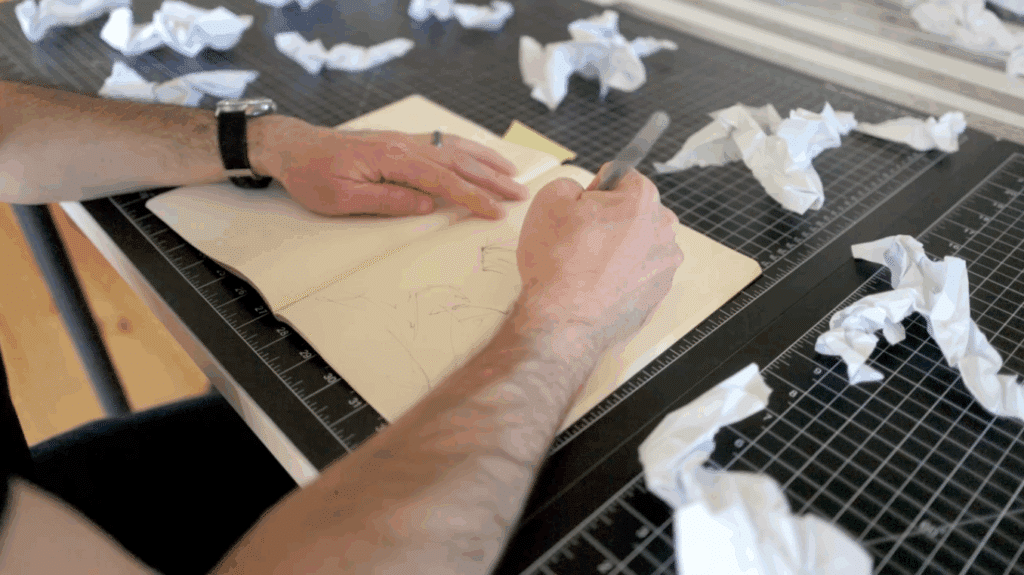
To get started, pick up your piece of paper and randomly crumple, tear, twist and fold it. You don’t want to try to sculpt anything in particular. “The goal is randomness,” Brent says. “We want to be surprised by what we see.”
Brent suggests making at least a dozen paper specimens to start, but you can take the project at your own pace as well.
Selecting Your Paper Specimen
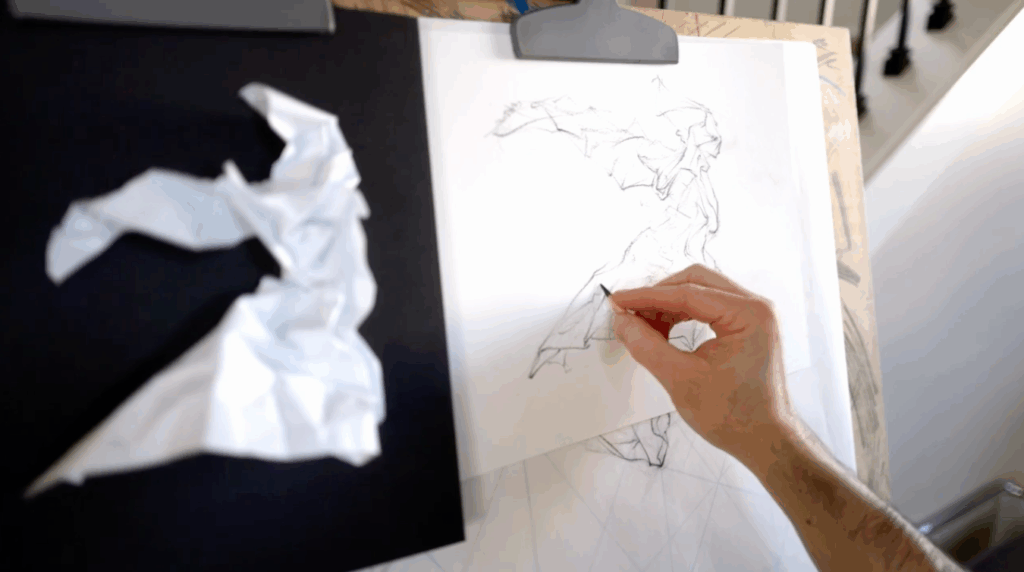
Now, lay your crumpled paper specimens out on a dark surface, such as a wooden table, black poster board, or dark blue bed sheets. Take your time to sift through each paper specimen. You can hold them in your hands or leave them lying still. As you observe them, see if a form emerges. It might be a figure, creature, structure or object. Maybe it reminds you of something you’ve seen before.
Once you begin to feel inspired, photograph your paper specimen in its current position. Brent uses a foam board and some specimen pins to keep his specimen at his desired angle. If you don’t have specimen pins, using your phone camera to capture your specimen in time is also acceptable.
Drawing Your Final Creation
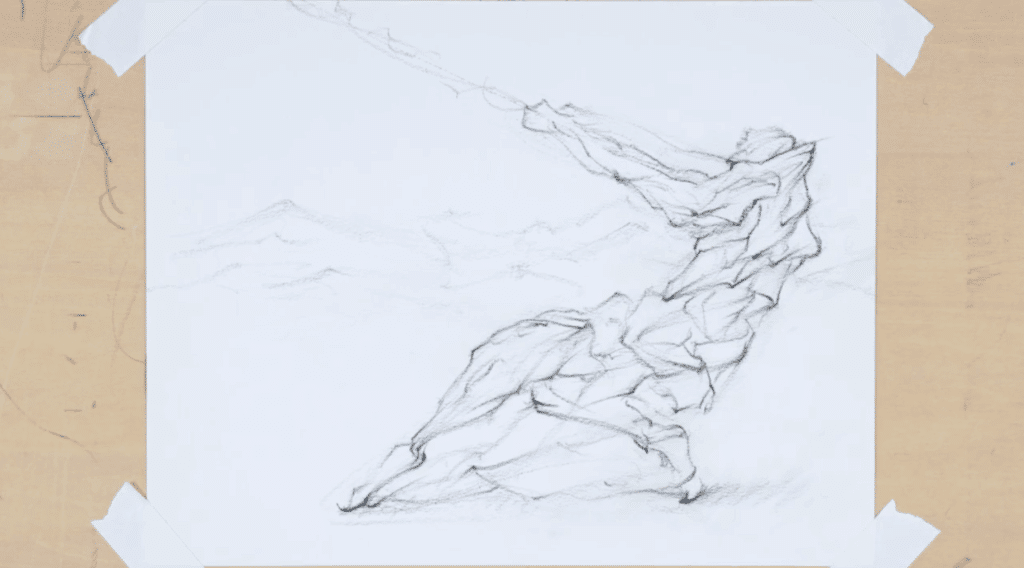
It’s important to begin with a gesture drawing. This drawing will capture your specimen’s form, action and pose. If it helps, you might even visualize your specimen in a specific environment. If your paper specimen looks like a ballerina pointing her toes, you might imagine her inside a light-filled studio. If your specimen looks like a slow-moving whale, you could visualize it moving gracefully through the depths of the ocean.
Once your gesture drawing is finished, you can continue building on that form by experimenting with expressive lines, exaggerating any shapes that stick out to you and focusing on any aspects that feel the most lifelike. As you identify what you find the most interesting, you can also work to soften any lines that distract you from the shape you’re bringing to life.
While working, you can ask yourself questions like:
- What story does this figure tell?
- What mood or energy does it carry?
- What if this wasn’t just a scrap of paper but a living, breathing being instead?
Once you get the hang of observing and drawing your paper specimens, you can move on to exploring others. Each of your specimens might live in entirely different worlds, but you can also see what happens when you bring them together.
When you combine multiple paper specimens into one scene, you can create drawings that show relationships, conflicts or entire imagined worlds.
Your Future with Pareidolia
Now that you understand how to get in touch with your pareidolia and how pareidolia can be a powerful tool for your creativity, you’ll be able to continue using it throughout your creative life.
Here are a few ways that you can tap into your pareidolia in the future:
- Look at old paint palettes, a stained shirt, tree bark, or ceiling textures for inspiration for characters or scenes.
- Keep a sketchbook filled only with visions found in abstract images, such as bathroom tile, a sky full of clouds, or light reflecting off water.
- Use the paper specimen project as a warm-up for your current creative projects.
- Explore collages and inkblots as a way to further explore random forms.
- Come back to your paper specimen drawings and write stories about them.
- Bring inanimate objects to life through expressive exaggeration.
- Dive into psychological experiments using pareidolia, like the Rorschach Inkblot Test.
- Make your own list of 100 things to draw, but only using abstract forms as inspiration.
If you’re ever feeling blocked or stuck, now you’ll be able to just grab a piece of paper, crumple it up and feel the drawing ideas start to flow in effortlessly.
Consider Where You’re Off to Next
Pareidolia can be used as a bridge between your mind’s perception and your creativity. You can use it to move past a blank page, escape perfectionism and find inspiration in some of the most unexpected places.
If you’re looking to improve your ability to draw line art faces, explore new forms or reflect on who you are as an artist, digging into pareidolia can do just that. Brent believes that pareidolia projects aren’t just about drawing crumpled paper or the stains on a well-used tablecloth; it’s about drawing what you see and learning what that says about you.
Related Reading
Calli Zarpas
Producer & Writer by occupation. Ceramicist & Newsletter Editor by avocation.
Try Skillshare for free! Sign up for a 7 day free trial today!
Get Started- Unlimited access to every class
- Supportive online creative community
- Learn offline with Skillshare's app