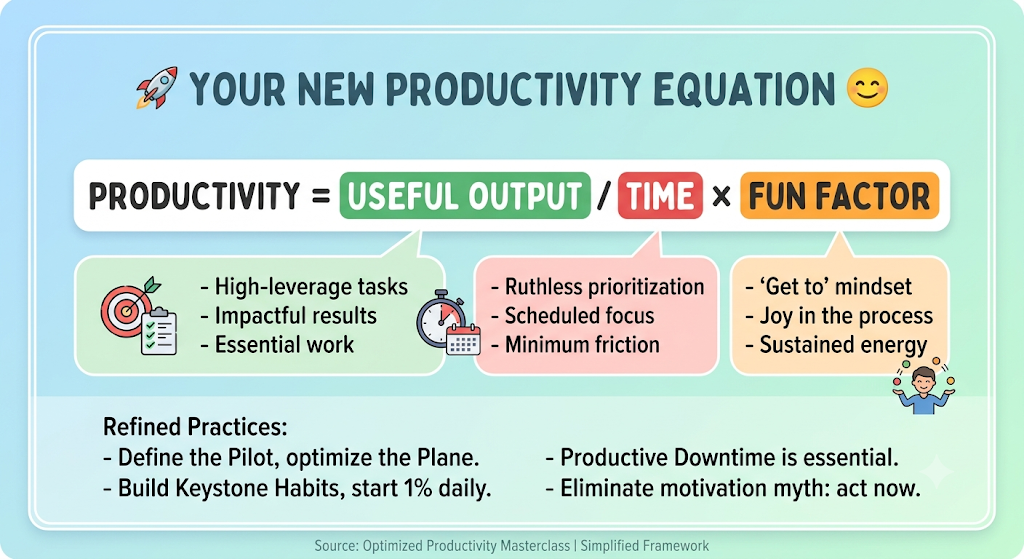
My reflections
-
The Problem: I frequently struggle with the daily execution phase (the "Plane") and keeping momentum when tasks feel monotonous.
-
The Mindset Shift: Transitioning from a "Have to" to a "Get to" mentality instantly injects a happiness quotient into mundane tasks, reminding me that execution is a privilege.
-
Energy Management: The framing that "Time is like a muscle" resonated deeply. It reminds me to train, pace, and protect my energy capacity rather than expecting infinite stamina without conditioning.
-
Incentivizing Action: Waiting for motivation is a trap. I love the concept of attaching money to inaction—creating real loss-aversion anti-charities or stakes to break through initial paralysis.
-
Momentum Loops: To maintain day-to-day drive, I am focusing on baking in short feedback loops so progress is visible, rewarding, and immediate.
-
Parkinson’s Law: The thought experiment of compressing a 10-year goal into an ambitious 6-month timeline is a brilliant framework to ruthlessly eliminate fluff and find the most direct path to output.
-
The 80/20 Pareto Principle: A vital reminder to isolate the top 20% of high-leverage tasks that yield 80% of my impact.
-
The 2-Minute & 5-Minute Rules: Simple friction-killers. If it takes less than 2 minutes, do it now. If a task feels overwhelming, commit to just 5 minutes to cross the starting line.
-
Continuous Compounding: Drawing from Atomic Habits, focusing on a 1% daily improvement removes the pressure of overnight transformation and yields massive compounded results over time.
-
Accountability Systems: Leveraging social contracts adds an external layer of commitment that makes habit formation far more resilient.
-
Keystone Habits: Identifying and prioritizing foundational habits that naturally cascade into breaking negative routines and building better ones.
-
Productive Downtime: Realizing that structured, intentional rest is an essential component of sustained high performance, not a waste of time.
-
Productive Procrastination: Embracing the fact that when I am avoiding a primary task, I can channel that energy into a secondary, low-stress but valuable project instead of falling into mindless scrolling.
True efficiency isn't just a function of high-leverage output over time; it is exponentially multiplied by the Fun Factor. If you lose the joy in the process, the system collapses. By maximizing execution systems while protecting my happiness quotient, productivity becomes both sustainable and enjoyable.