Transcripts
1. Idea Generation Introduction: 50 50. If you want to write a
standout picture book, you have to have
a standout idea. Hi. I'm DK Ryland, children's book author
and illustrator. This is part two in
a four part series all about writing picture books. In this class, we are
tackling idea generation. If you are here right now, that means you have
taken part one in this writing
picture book series. I crafted these classes
deliberately in a certain order so that you
can get the most out of them. But if you haven't
taken part one, definitely go back
and check it out. In this class,
we'll be exploring three different exercises to generate as many creative
ideas as possible. I personally think
idea generation is the most fun part of the
entire writing process. But when I first started
out writing picture books, it's the part that made
me feel the most anxious. I felt like, What if this is
the only idea I ever have? I'm here to tell you, ideas are everywhere, really good ideas. The hardest part really is turning those ideas
into a good book, which we will get into later. Have fun with this process, and don't let it intimidate you. Put away your internal critic. There are no bad ideas here. Generating ideas is mostly
learning how to pay attention, and it's like working
out a muscle. The more you do it,
the easier it becomes, and the stronger and the
more viable the ideas get.
2. Tools and Project: For this class, you will need some form of pencil and paper, whether that's literally a
pencil and paper or whether that's Word or Google Doc on your computer is
completely up to you. You are also going
to need to print out one copy of each of the four worksheets in the projects and
resources section below. And you will need
your binder from class one to put
those worksheets in. Everything we do in
these classes can be useful to you all along
your writing journey. It's a good idea to keep
it all in one place. For your final project, you are going to pick a book
title that already exists, but you have not read it
and write a pitch for it. Then you will read that book and rewrite the pitch to match
the real manuscript. But the first exercise we
are going to do is mining your kid life and current
life for picture book ideas. Print out worksheet one, if you haven't already, and
let's get started.
3. Exercise 1 - Mining for Ideas: Okay, we're onto the first
exercise, mining for ideas, and we're going to
mine your kid life, as well as your current
life for ideas. And we're going to let the
experiences that you've had guide you in
doing this exercise. So I'm going to fill this out as if I was filling
it out myself, but obviously fill this out
the way that you would, and it should be a lot different obviously than the way I would. So when we look at
mining my kid life, the first category is
moments that impacted me. And this can be positive
and this can be negative. It's impacted you in any way. It could be as difficult
as divorce or death, or it could be as positive as the first time that you danced and
fell in love with it, or the first time you did the thing that you
became the most passionate about or Maybe when your parent told you that
they're proud of you. There's so many different things and ways that you
can go with this. So whatever comes your
head, start there, and then just keep listing
until you can't list anymore. So you know, I would start with divorce that
pops into head into my head and maybe the
first time I threw a ball. And played softball. Then I would just keep going and going and
going with that. But just keep listing until you can't list
anymore with that. Things that I loved. For me, I loved playing sports. I loved school, I loved reading. I loved poetry, I loved
jumping in the pool. I loved riding my bike all
around the neighborhood. These are all just
very kid things. I'll just put a couple of those
down sports, bike riding. Ice cream, you know, whatever. So these are just the things that you think of
when you think, Man, that was good
part of childhood. And then things I hated. First thing that comes to
mind for me is weeding. I never liked weaning. There are some chores
that obviously were just, you know, not the favorites. Vacuuming was one of them. So maybe chores are in there or maybe being
told what to do. I was very stubborn kid and I did not love being
told what to do. Or maybe it's I mean, it can really be anything. Maybe it's that your parents watch sports and
you didn't want to or maybe you had to
go visit grandma, you really didn't
want to or whatever. So things as a kid
that made you say, Oh, we have to go do that or, I really don't want to
whatever, clean my room. Whatever that might look like. Things I thought were funny, The first thing that comes
to my mind is Farts, which I think, pretty much
all kids think are funny. Far, my sibling, my
brother was very funny. He was older than me,
so I looked up to him and I thought he was hilarious. So keep listing all of these categories are
just take yourself back in time to those moments and put yourself in those
moments as a child, and what would have
made you laugh? Then where I lived is going to be significant because
depending on where you live, there's different things
that impacted you, right? Like if you lived on a lake
and you grew up fishing, that's a huge childhood
core memory, right? For me, I grew up
in a beach town. There were squirrels
that lived on the beach. This is so random. And I don't
know that everybody knows that there are beach
squirrels and beach bunnies. I loved these squirrels
and I would feed them and go visit them and I
thought they were the coolest. And the fact that I lived near these beach squirrels made
this core memory possible. Now other people obviously
that I grew up with either served or maybe trained to be lifeguards or
things like that. The environment dictated
the experience. So think about where
you lived and how that maybe impacted your
experiences growing up. Things that were
unique about me, m One of the things that was unique about me was
that I was highly athletic. And so I pretty much only
hung out with and played sports with the boys and like all growing up
in elementary school. And I was total tomboy. I dressed like a boy. I didn't want anything
to do with being, you know, girly or perceived as girly or doing girly things. And that was a
significant impact. Think about the things
that made you who you are, or you in the theater or singing or maybe chess or something that was unique to you that you could really get
into and that you know a lot about and maybe was
pretty formative for you. Now, mining my current life and thinking about what
you're watching on TV, it's not that significant what the TV show is or
anything like that, but what's significant
is that you've chosen to spend
time with a series, or maybe movies or
something like that. Think about why you like that TV show. What
is it about it? Is there a theme in
there that's impactful, or is that it's like a
suspenseful show and you like to you like that feeling of not knowing
what's coming next? Or maybe it's the way
the story is told. Maybe it's documentary,
and so maybe non fiction is something
that you're interested in. So start thinking about
the type of entertainment you're consuming and why you're consuming
that entertainment. Why is that something
that you enjoy? That's going to inform
the entertainment that maybe you want to
put out there as well. Now let's think about
what you love to do now? Do you have hobbies
and interests that are the same as when you were growing up
or that are different? Have they changed?
For me, personally, I still play a lot of
sports and love sports, golf, and pickleball and
tennis, things like that. Hobbies for me that's like art, and I'd love to get into
pottery, haven't done it yet. Food, do you like to cook? I personally love baking. Do you like to garden? What are the things that
when you have free time? If you have free time that
you want to spend it doing. Then this last one is
what makes me mad? What makes me mad is going to be a thematic guide because something that makes you mad is something that
you care about. For me, things that
make me mad are like mistreatment of
animals or children, obviously, I care about that. That's going to make me care
enough to get angry, right? Then, things that are mildly irritating can fit in this
category as well, right? As a parent, it
irritates me when people live vicariously through their kids and push their kids, even though it's not
something their kid likes to do or
something like that. And so even the mildly
irritating can show up. There can be a theme
in a picture book about a kid going against the will of their family
and doing what it is that they truly lights them up
and being fully themselves. These are things that can pop up and sometimes
they're going to pop up organically because
they're subconsciously things that you believe in. But sometimes being
aware of them and looking for the
theme in your work, those things can intersect, and you can see the deeper meaning before you even realize that
you're writing it. Go ahead and just think of all the things that you
can and list the things that either make you angry or make you even
mildly irritated. I hope you had fun with
that mining exercise. Exercise two is
all about charting out inspiration for
your next picture book. Pronto worksheet two,
and let's get to it.
4. Exercise 2 - Chart it Out: All right, we are moving
on to Exercise two, which is called Chart at Out, where we are going to chart different interesting
aspects of a story and try to mash them
together and just brainstorm some new
and interesting ideas. The first category in this
chart is interesting settings. Go ahead and set a timer for
a minute or so and just list as interesting settings
as you can think of. Even if they're uninteresting, that's okay too, as many
settings as you can. If I were going about this, I would just start listing
whatever came to my mind. Outer space, the
moon, the deep ocean, a boat, a tree house, a cave, a school or classroom. Then I would just keep going
and going and going and going until this was
completely filled out. So go ahead and do that and then and then we're going to look at
interesting characters. Interesting characters,
you're going to think of characters that
are kid relatable. Usually, you're not going
to have adult characters. Sometimes you, maybe you could have a zookeeper
or something like that, but they do have to have kid qualities to them when
you actually write the story. Keeping that in mind, obviously, let's say, a troublemaking
girl or something like that. Something that
makes her stand out or or maybe like a ballerina. Maybe someone a girl who is a little bit more stereotypical, I guess, a sensitive boy. Let's say, maybe a witch. We can get a little bit
more like mythical, a ghost, something like that, something more Halloween, even go like Santa
Claus or something. We can also go with things like inanimate objects like a pencil. Is inspired here. Or let's say animals that
we find interesting, maybe a cat, or maybe a
little bit more exotic. We could do like a I don't
know. I doesn't really matter. A 000. If you've never seen
a kudo, they're really cool. They have these spiral
horns. They're awesome. Just keep going with
interesting characters and if you tend to want to write books about
actual child characters, then go along that line. If you'd rather
write about animals than go along that line or just mythical creatures
or anything like that. Fill that out with characters
that you find interesting. Then we're going to go
over here to kid problems. Think about any problems
maybe that you had as a kid, things that you struggled with. That could be things
like making friends. That's the big one. It's hard as an adult, too. Making friends, maybe fitting in and maybe something like
school related, like reading or having a hard time with homework
or something like that. Then just keep going with things that maybe you struggled
with or maybe you see your kids struggle with and keep going until you have a nice long list
of kid problems. Truths, you believe
deve in your soul. This relates back to the previous exercise when we were talking about things
that make you angry. Just things that you
really believe in. So and maybe thinking back on, really big lessons you
learned in your life. One of those things for me personally is that I grew up in a really
competitive environment. Sports were very highly celebrated and I did
really well in sports. So there was always competition, and it was always
trying to be the best. And so something I
learned along the way is that if other people
have success, it doesn't diminish
my own success. So continually being supportive of other people and genuinely
wanting others to succeed. So others success doesn't
diminish your own. Think about things like that in your life that were these
moments of like, Oh. Oh, k, that makes sense. That's going to make life
easier and more peaceful, and it's going to
make me a better person, that type of stuff. They can be simple things too, learn from your mistakes or maybe you have to fail in order to learn how to succeed,
something like that. Or maybe you feel
like being a part of a team can get you further than doing things on your
own, or something like that. You really believe in teamwork
and being a team player. Keep going, keep thinking, and just write down anything that comes to your mind
that feels true to you. Once you have a good list, and I would recommend having this whole chart
fully filled out. You have plenty to choose from. Then you're just going
to randomly pick, close your eyes
and randomly pick. A cave is my setting. This story takes
place in a cave. Then same thing with a ghost, a ghost wants to get along
with their siblings. Get a along with siblings. But can't because that's the
part that you would make up, I I have this ghost
character and they live in a cave
with their family, obviously with their siblings, and they're fighting, what
might they be fighting about? Why is it hard for
them to get along? What's happening here to
create that conflict? Whatever you come up with is
what you would put R here. Then the main character learn
from their mistakes. Okay. Probably would have
made more sense to land on to be a team
player. But that's okay. It doesn't matter. Now,
when you fill this out, it might be really,
really random. But it's a good exercise
to see how can I take these things that seem random and put them together
and make them work? It's a really fun exercise to see what you can come
up with because this is going to bring a story to you that you probably wouldn't just randomly come up with, and it's an interesting
brainstorming and also writing exercise. I highly suggest that
you try to write this manuscript and see
what you can come up with. Now, maybe you fill this in and there's a piece of it that's just not working and you're
like, you know what? It would just make
a lot more sense if the conflict wants
to make friends. Let's get rid of that
and let's make friends. You can always change things if whatever you randomly chose
doesn't work for you, but it's a good place to start.
5. Exercise 3 - Play with Titles: P. And for our final exercise, we are going to play
with interesting titles to inspire some
interesting stories. So print out worksheet three
and follow along with me. Okay, so now we are
on Exercise three. We are going to use titles to play with different ideas and to brainstorm different ideas. So what I've done for you here is made up three
different titles that are pretty generic and
vague that you can kind of take A which way. You could go in 1 million
different directions with these specifically. I'm going to show
you what I would do with these and obviously, I want you to see what you
can come up with as well. The first title is
called Let's eat cake. The character that
comes to my mind is a little mouse who maybe
sees this cake being made, maybe it's at a birthday party, for a child, or maybe there's a parent making a cake for kids or
something like that. Then the problem would either be how the mouse can
get to the cake. Maybe they have to come up with clever ways to get to the cake, and there's all these obstacles because they're in a kitchen and there's this tiny
little mouse and they can't be seen
by these adults, or maybe they get to the cake, and the human characters freak out because there's
a mouse on their cake. And then madness ensues. They are trying to
catch this mouse, they're chasing this
mouse, the mouse just wants to take a
piece of cake with them. And then obviously that can
be the conflict as well. So Maybe we just I mean, either way is fine. And then you can
explore your ideas further if it becomes a manuscript that
you want to write. The mouse has to come up with ways to get to
the cake. Undetected. And then, thinking about words that use, like,
undetected, like, maybe the mouse like goes
undercover or maybe you know, there's different things are going to come up
and let those ideas start to flow as you
start to flesh out ideas. Now, this next
title, pitter patter makes me think of two
different things. One, it makes me think of rain, like the sound of rain. It also makes me think of a little animals footsteps,
like the pitter patter. But since I already
did a little animal, we'll go with rain. Our character is
actually rain itself. What's cool about picture
books is that it does not have to be a human or an animal or even
something that's alive. You can do something
as Just interesting, I guess, as rain or the sun or air or wind
or something like that. I'm envisioning with this maybe something
that's nonfiction. This format might be a
little bit different as far as there being an
issue a problem. I'm thinking about
the water cycle and how water goes from
rain and then it comes down and it feeds
plants and animals and runs through streams
and evaporates and that whole process. This is a thing that
kids learn in school, so it could work really well for the school and library market. But maybe thinking about how rain affects
different plants, animals, people all that along the way through
the water cycle. Somehow following the pattern of the water cycle and maybe the cause and effect
of the water cycle. Okay. Maybe I could think of ways that there is a bit more of a problem or a conflict or something that really grabs the reader in the way
that I tell that story. Now the next title,
the brightest Yellow. The character that comes
to mind for me is like a canary, a yellow bird. And this canary thinks that they are the
brightest yellow, maybe they see a flower
bloom and it's a daffodil. I'd have to look up really
bright yellow flowers, but it's a bright yellow flower, and they realize maybe they
aren't the brightest yellow or maybe there's feelings
of jealousy or competition, and maybe there's all these
other yellow characters, a yellow butterfly,
things like that. This canary has to work through maybe
feelings of jealousy. So the canary is jealous of other characters, I guess, characters
that are also yellow. These titles are so open ended that you could come up with multiple pitches
for each one. You don't have to just
stop at the one per title. If you have more ideas, then just keep going with
it and keep brainstorming. Then down here, once you're
done with the made up titles that I provided is space
to make your own titles. What I would recommend is just
like going on a long walk and clearing your head and taking maybe a little
notebook with you, writing down the things you see, and creating some titles from just things that you see out in nature or
in your neighborhood. Then trying to make those titles maybe a little bit open
ended or a little bit vague so that you can brainstorm
as many characters and problems and story
ideas as possible for each of those titles. Go ahead and go do that now. Have fun with it. Not all of
these are going to be great. Not all of these are stories
that you're going to write, but it should get the ball moving on some
interesting ideas.
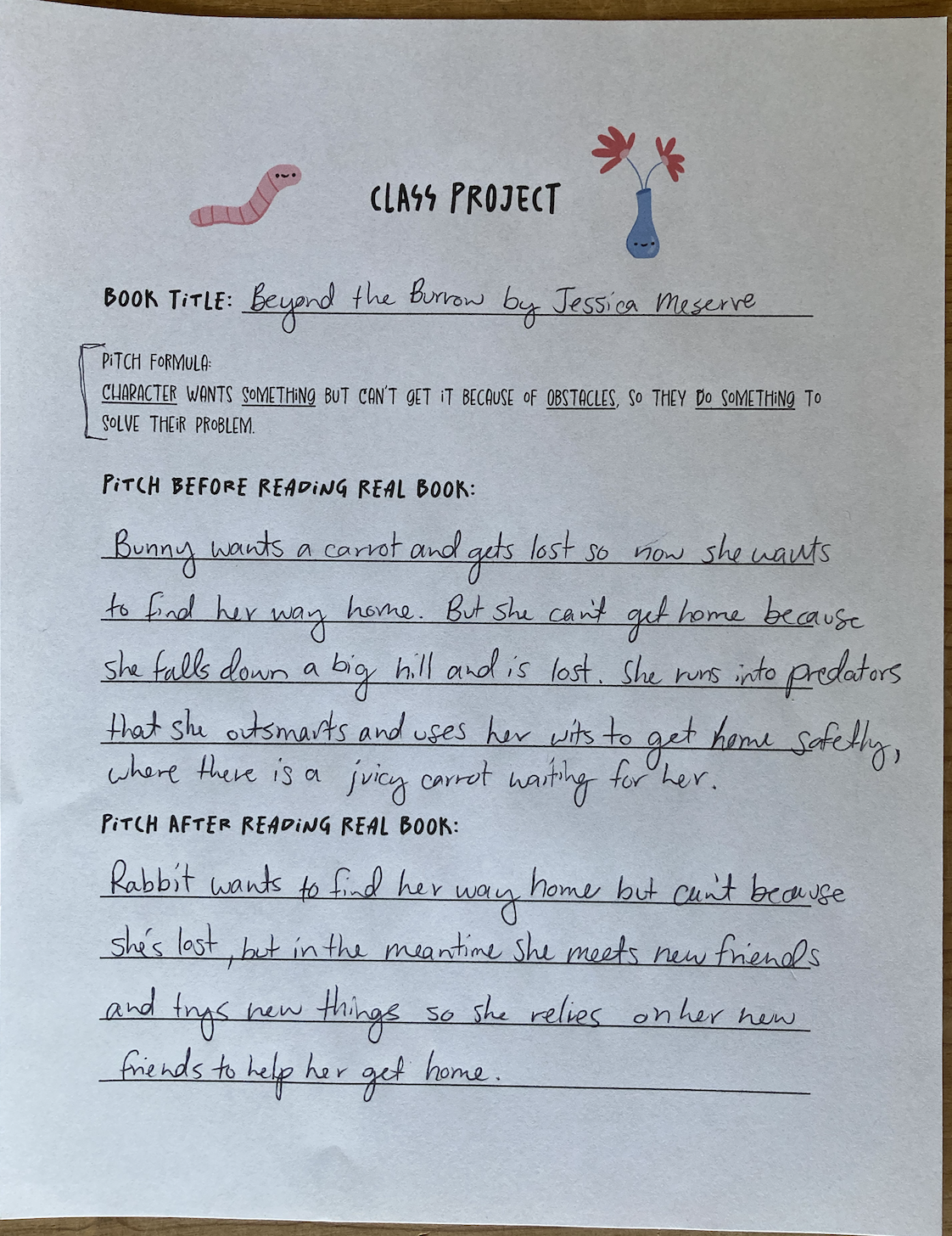
7. Final Project Part 2: Okay. I've now read the Super cute book beyond the
Borough by Jessica Masser, and I'm ready to write the
pitch for the real book. The character is the Rabbit, and her name is Rabbit. Rabbit. And interestingly
enough, she does. She wants a carrot, and she gets and she goes
to grab it and she falls down a hill through a different burrow
and into some water, basically, almost
like off a cliff. And so she's very, very lost. So we k nailed that part. The setup at the beginning
is that these bunnies or these rabbits stick together in their
burrow, where it's safe. They don't really have exposure
towards other animals. They're pretty suspicious
of other animals. So this is a problem. She's beyond the safety of
her burrow and instantly, she runs into a anteater. She doesn't know what it is, but it looks scary
and different. Rabbit wants a carrot. That's not the big want, but that's what sets
off this adventure. Wants a carrot and gets
lost when trying to get it. She wants to find her way home. We can go straight to Rabbit wants to her way home. Now, when she is lost, she's also hungry because
she lost this carrot. The aunt eater does something
nice for her and gives her a piece of fruit or a
nut, something like that, and the rabbit tries
it and realizes that things that are different actually
might still be okay. They might be good. She
finally meets this aunt eater, who's very nice at eater, he introduces her to other
characters that are friendly, and she gets to know them and
she learns a lot from them. In the meantime, she's
learning that things that are different or
new might be good, and that we don't
have to be scared of things just because
they're different. That's the theme here, which is really quite lovely. She wants to find her way home. She can't get it because she's fallen down this
huge cliff thing. Robert wants to
find her way home, but because she's lost and so we're going to
add something in here. But in the meantime, she meets new friends, new friends, and
tries new things. New things and so they do something to
solve their problem. At this point, she realizes that not everything and everyone that's different
from her is scary. Now she realizes she can rely on them to
help her get home. She ends up to
solve her problem. She relies on her new friends. To help her get home. Then once they get
back to the burrow, the other bunnies also realize that these other animals
are not a threat. By the end of the story, the rabbits are better off
than when they started. That's a very
satisfying resolution where these bunnies are
now in a better place. They didn't know
what they needed, but they got what they
needed from this adventure. Now, if I was writing
this pitch to sell or to pitch to an
agent or to an editor. I would try to
figure out a way to weave the theme in because the theme of the story
is really really nice. But what I want you to
notice is that we use this formula and we just made adjustments based
on the story arc of this particular story. We can use this as a
jumping off point, but if it doesn't quite fit the story or what
we're working on, then we can adjust
the pitch from there. But it's a good
base to go off of, but don't feel like you have to stick with that
exact formula. Okay. Go ahead and read your book that you picked now and then write
a pitch for it. When you're done with
this assignment, go ahead and post it to the Projects and Resources section. It's really fun to see what
other people have read for this assignment and what
they thought it was about, what it's actually
about, how close are we, how far away are we,
that kind of thing? If you want to write down here, your takeaway from it, what was the theme of the book? Or what was similar, what was different in your
pictures, things like that. That's totally cool too. Go ahead and post
your assignment and you're done with this class, and I will see you
in Part three when we will go ahead and write
our own manuscripts.
8. Final Thoughts: Now that you've finished
all the exercises for idea generation, I have some final
thoughts for you. Idas are everywhere. The writing part is the
execution of those ideas, which we will cover
in the next class, part three in the series. I hope that this
class showed you useful ways of exercising
the muscles that will help you see stories in everyday life and inspire
you to pay attention. Maybe even take a notebook
with you everywhere you go. Write down anything that pops into your head
throughout the day, or conversations
that you overhear, or funny things that you see. There's inspiration everywhere. For more fun exercises and ideas straight from
published authors, I highly recommend Tara
Lazars story storm. I'll leave a link
under the about tab below. That's
it for this class. I'll see you in part three when we finally write
our first draft.
 DK Ryland, Illustrator, Surface Designer