Transcripts
1. Intro: Do you ever wonder where
all your time goes? Or do you spend
evenings and weekends answering e mails instead
of enjoying your free time? Leaving you with no time to work on your own side projects. What if there was
a simple way to find more time for the
task you want to do? Here is the truth. If you
want to accomplish anything, you don't have to
reinvent the wheel. I believe that achieving
your goal is all about effective time management
and sustained productivity. Hey, I'm Ana, a
full time manager, blogger and inspiring teacher. In this class, I
will share with you a handful of effective
strategies I discovered when I
decided to train and coach in alongside my
full time management job. Look, achieving goals can be real challenge
if you don't have a roadmap schedule and a clear
task management in place. It's like going on journey
without a map or compass, where you wonder endlessly and feel uncertain about
which way to go. Having a roadmap
helps you break down your goals into smaller tasks
and create the timeline. It keeps you focus on the bigger picture and prevents you from getting overwhelmed. And here's the real secret. Knowing what tasks to work on is crucial when you have
clarity and focus. Allocating specific time slots
for different activities, setting priorities, No
one when to say no, and establishing a steady rhythm of progress leads
to productivity. This class is broken
down into four parts. In part one, you
learn how to assess your schedule and answer
every sub burning question, Where does my time go? In part two, you get your hands full and get straight
into your project work. You will need to apply
what you learn in first lesson and conduct
your own time audit. I'll help you assess and update your schedule so that you can make the most
of your minutes. In part three, you create your own plan of
action, your roadmap. In part four, you'll apply three tools that make difference
to my own productivity. I'm very excited to
share them with you. This class, you'll
have the tools and know how to take charge of your time like a pro and handle
your workload with ease. And still have
enough time to be in George Netflix when
you feel like it. If you're a beginner to time
management and productivity. But the idea of
being productive, effective, and accomplished
interests you. Grab a coffee and join
me for just 1 hour.
2. Assessing Your Current Situation: Hi and welcome to lesson one. Here is what you're about
to learn in this path, you will learn how to
assess your schedule. I will show you exactly how
in detail demonstration. Then you will learn
how to identify typical time wasters
and distractions. So let's begin assessing your current situation is essential step towards
effective time management. In this section of the training, we will spend 10 min reflecting on your
current situation. Identify the biggest challenges
with time management. What law? I will introduce them to
time management techniques. They can transform how you manage and carve out your time. Are you ready? Let's start by taking a moment to reflect
on your typical day. Think about how you spend your
time at work and at home. Ask yourself, what things
do you do regularly, the take-up, a lot of your time. Any specific tasks that you find difficult to complete and
put up until last minute. Then ask yourself, how can I effectively manage my time and prioritize tasks
toward procrastination and then show important
tasks are completed on time. I've included some
additional questions to help your thinking juices
flow and you're going to find them in this
class workbook. Most people avoid
assessing down schedule simply because they believe
it's time consuming. I don't believe that
and neither should you. You can be done in
10 min or less. Let me show you how
when this video, I'm going to show you the
assessing of schedule can be as easy as hard
as you make it. Let me demonstrate that it can
be done in 10 min or less. Let's open up the calendar
and let's get to it. Let's start by taking a moment to reflect
on your typical day. Think about how you spend your
time at work and at home. Quick warning. At this stage, you should
focus on mapping out the data has already
occurred in the past. How to work in an open schedule will be covered later
on in the class. First, let's think about the activities that take
up a lot of your time. For me, that's usually
work-related tasks. I'll block of my work hours
from 05:00 A.M. to 15:00 P.M. This helps me
visualize the time I spent on work-related
activities. Usually when I'm
getting ready for work, Allison to the audio books. When I got back from work, I went to the cinema instead of cracking on with this
demonstration, Vidar. Often we procrastinate
when we faced with daunting or
challenging task. While out, I had a dinner. I go back at the round
07:00 P.M. had a bath. And whilst at Bath, I did my 15 min reading because that is what I do and
what's important to me. I went to bet at 10:00 P.M. and time after Bob
and before bedtime, I spend setting up videos
should areas for this class. There you have it That's
one day schedule assessed. It's important to
understand the purpose and the objective YOU
assessing your schedule. Usually because you
are experiencing lack of time in some area, whether it is work or you're lacking pamphlet and
personal project. Creating this class
for Skillshare is important to me when it comes to working on daunting or challenging task lag
shouldn't middle. It's easier to procrastinate
by going into cinema, right? Let's take this a
bit further now. If I needed to
create more time for some important project
within work hours, here is how it would work. Let me map out how I spend
my them and walk or sixth of June between 06:00
A.M. and 07:00 A.M. I. Prepared daily plan, seven to eight reports. A. Tonight's meeting,
mine, ten emails, 1011 daily performance checks 12, 13 review's 13 to 14
daily figures and reports. It looks like the only free time for additional
project or task was 11-12 and then you have
it in just few minutes. I've assessed my schedule, which helps me see
how I'm allocating my time and event
adjustments are needed. Remember, assessing your
schedule does not have to be complicated by simply
blocking off time for your regular
activities and priorities. You can have a clear picture
of how you spend your days. So take a few minutes
out of your day, open up your calendar and
start assessing your schedule. You'll be surprised by how
much inside they can provide. Remember, as easy, as
hard as you make it. Would you have just seen is a technical time blocking? Yes. You can use time
blocking when assessing your schedule to cover
more time for yourself. Or you can use stand, walk into plan out your daily tasks. Let's talk more in detail about time blocking and timeboxing. These are the two
techniques we will reliable heavily
in this training. In essence, time localization technique where you allocate
specific blocks of time for different tasks and activities in involves
dividing the day into predetermined intervals
and assigning specific tasks or category
of task to each block. Timeboxing is a
method where you set a fixed time duration of box for particular
task or activity. Instead of assigning
tasks to specific swab, you allocate
predetermined amount of time to complete each task. What's great about these
two techniques is that they both can be used as
a form of to-do-list. You can minimize the amount of strategic management
plan tools you use. Next, let's talk about common time wasters
and distractions. Social media, email, and procrastination are some of
the most common cold friends. They can eat up your time and
the real your productivity. Social media, for example, it can be huge time-saver. It's easy to get lost in scrolling and most
chunk of time. Similarly, e-mail can be
constant distraction, the bilinear attention away from important tasks and making it
difficult to stay focused. Procrastination is
not a big challenge when it comes to
time management. Remember the example from 6 June when I went
to the cinema, instead of working
on this class, it was much easier to
spend some time relaxing after a long day of work
rather than do even more work. Once I had bit of rest, I got on with the
important tasks such as setting up the area
for this recording. Manual. Struggle with putting off important tasks
until last minute, which can lead to
stress and burnout. It's important to
recognize when you are procrastinating and take
steps to address it. How I'm glad you asked for all these time wasters
and distractions. I have simple tool that will help you handle it
more effectively. Remember in the
previous section, I shared with you to time management
techniques that can be an absolute game
changer for you. And books and in particular, isn't the ideal strategy to
use when you're looking to limit your time on certain
unwanted activities. Good news is, you don't have to eliminate distractions
because as we identify the already provided
you with some type of payoffs in order for
you to stay productive. We do want to limit them so they don't soak up all
the available time. Now I encourage you
to be honest with yourself about your current
habits and behaviors. Reflect on areas
where you may be wasting time or
getting distracted. And think about what
changes you could make to improve
your productivity. Remember, there is no shame
in admitting they need help. Or they, you could be doing
things, different things. By identifying your
biggest challenges and being honest with yourself, you can start making
meaningful changes that will improve
your time management. Oral productivity. Bake a few minutes now to write down your thoughts
and reflections on your current situation and the biggest time
management challenges. When you're ready, we'll move on to the next
section of the class, but we will start to form a strategic approach for managing your time
more effectively.
3. Project: The Time Audit: It's time to get
your hands full. It's your turn to
assess your schedule. I want you to conduct
your own time audit by keeping a time
diary for all week, and analyze the data to identify your biggest time wasters and areas where you can be more
efficient with your time. Trust me, you will be
tempted to skip this part by strongly recommend you follow through and get it done.
Here's what you gain. Let's take a look
at our objective for the next section
of this class. Taking part in this project will help you identify
your biggest time wasters and pinpoint areas where you can
improve efficiency, make most of your time. This exercise serves as valuable practice
of the concepts you learned in the
initial lesson, which focused on assessing your current situation and understanding the time
available to you. If you will, gain
hands-on experience in evaluating your time usage. The project offers practical
learning experience, enabling you to apply
your knowledge, develop critical
thinking skills, and cultivate effective
time management habits. As I mentioned that a
startup, this lesson, I want you to conduct
your own time audit by keeping a time diary for a
week. You might want them. What does that even mean? What does the whole clock? Well, in the next demonstration, I'm going to introduce the time audit worksheet
you all tomorrow for the week with examples and tangible results I'm
expecting from you. Let's take a look. In this video, I'm going
to provide you with some details about what is expected of you
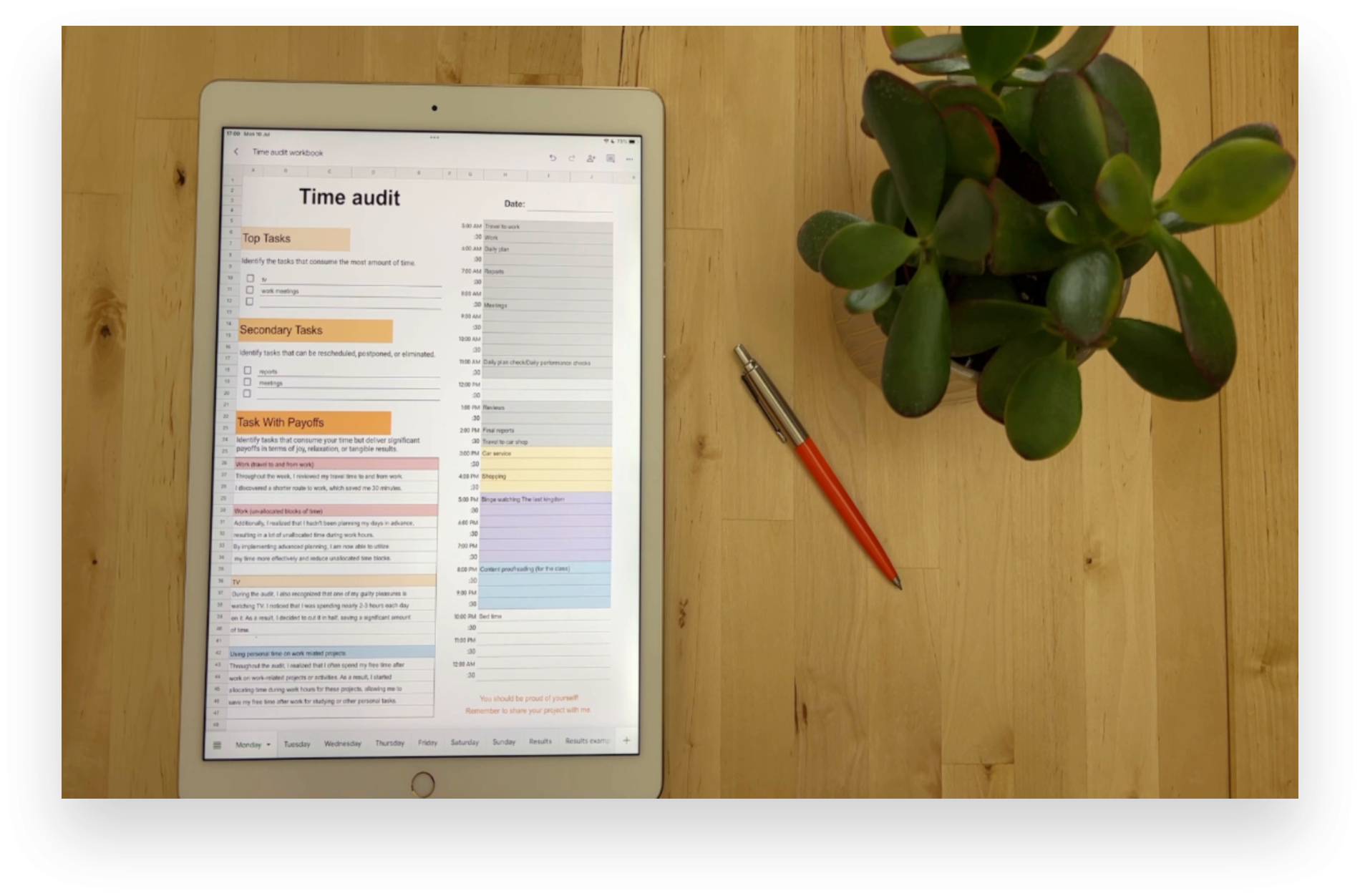
for this project. Inside the class workbook, you will find a link to Google document for
the time audit. Once you click on
the provided link, you will find a time audit sheet for each day of the week. Be sure to make your own
copy of this document. Please use the Sheets
throughout the week. Once the week is
complete transfer, you gather data to the
Results worksheet. To facilitate this project. I have included a
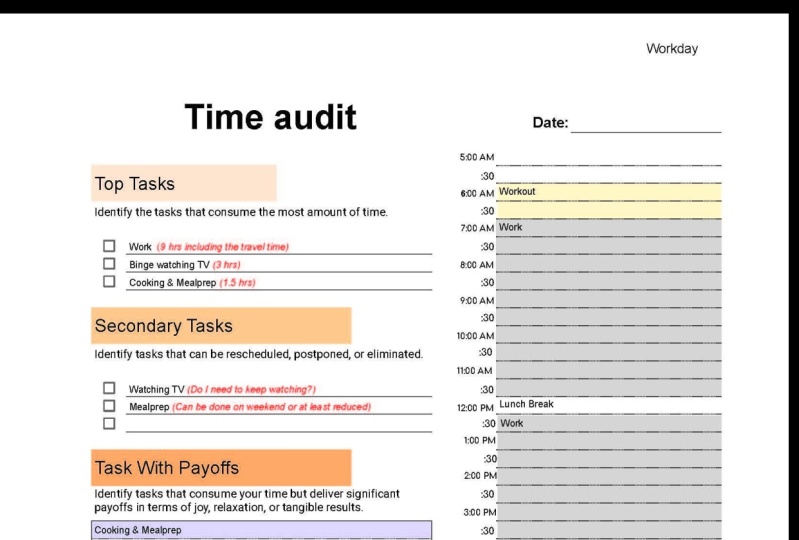
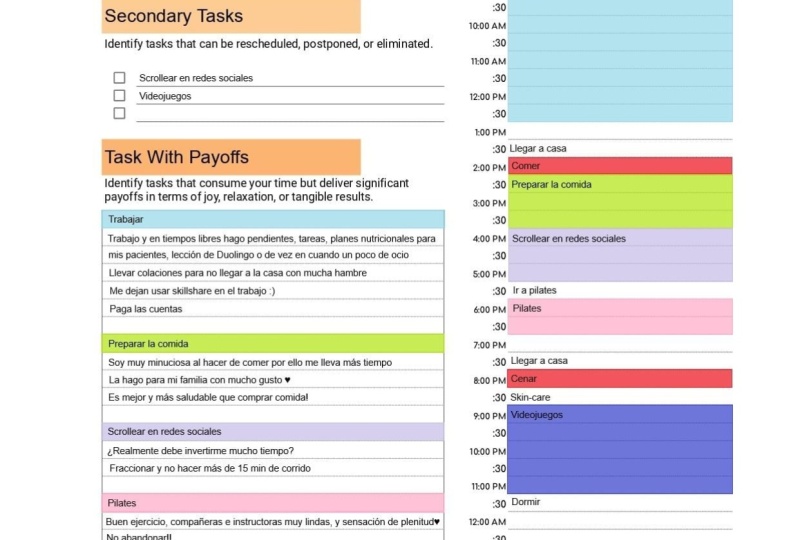
couple of examples. Let's examine one of them now. In this example,
I have mapped out my daily activities and
tasks throughout the day, both during and
after work hours. I have identified
the top tasks that consume most of my time
throughout the day. I have also identified
secondary task represented by time blocks
with no assigned tasks. Remember, unplanned time
can often be easily wasted. So he pays off to plan daily activities in advance
to avoid wasting time. Furthermore, I have
listed tasked with payoffs and provided
ideas for consideration, such as allocating different
times to work on tasks, or reduce the time
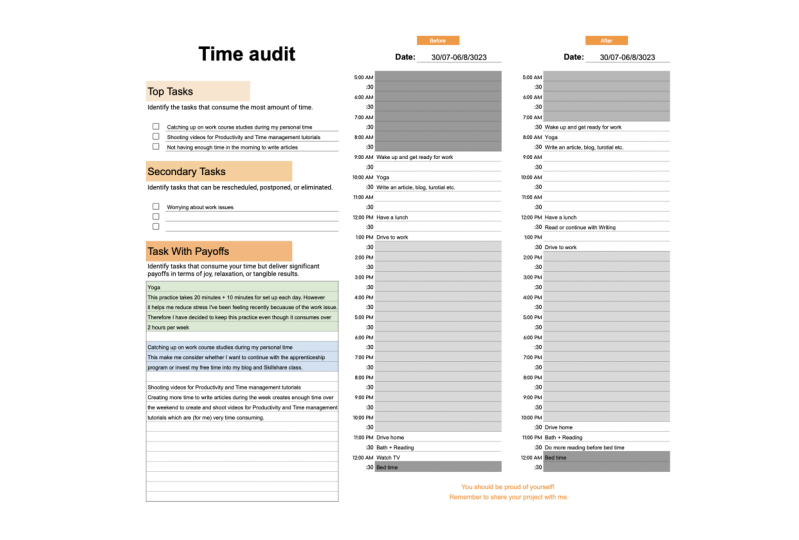
allocated to certain tasks. Finally, I have included an example of the
Results worksheet. This is the expected
project deliverable. Anticipate that
throughout the week, you will gain insight on how to better
allocate your time. Identify areas where you're spending an excessive
amount of time, and explore ways to
reduce it if possible. This will allow you to
create ample time for your studies of other
desirable activities. Remember, your objective
for this project is still Identify the tasks that consume the most
amount of your time. Identify tasks that can be rescheduled, postponed,
or eliminated. And Identify tasks that
consume your time, but deliver significant
payoffs in terms of joy, relaxation, or tangible results. Easy right now, zero term. Once you conduct
the weekly audit, be sure to share your
results sheet with me in the Project
section of this class. I cannot wait to see
your work heads-up. I'm giving you the whole week
to conduct this project. But as you extend from the
previous demonstration, and they review can be
dumped in less than 10 min. So you can easily complete
this project in one sitting. How much work you've put into
this project is up to you whether you decide to analyze pH that as you learned
in the first lesson, or you decide to batch it
and complete the whole week of 1 s. That is after you choose one way that suits you learning about effective
strategies and one thing, applying the fresh
knowledge and taking their action is what
makes the difference. I can't stress enough
how important it is. Complete this project. Once you're done, remember
to share your project and Results worksheet in the
Project gallery on this class. This will allow you to get the valuable feedback from me and also from
your classmates. The key principle of
the project work is to assess, sees an allocate. Once you've completed
your project. Don't forget to
ask for feedback. Share your project below
this class or email me
4. Creating a Plan: So far are shared with you, why and how to assess your schedule and you've
tested it out yourself. Now, it's time to create a plan, a strategic plan of action. Your roadmap. Here is why, when it comes to managing your time effectively, it's crucial to
have plan in place. In this section, I'll introduce a symbol
planning framework that you can use to schedule your studies around
your other commitments. Here are some key
steps to follow. Number one, send your priorities number to create the schedule. And number three, be flexible. Before I walk you through each of these steps
in more detail, Let's talk more about clarity. Before you can make
an effective plan for anything in life, you first need to be crystal clear on what it is you
want to accomplish. Through out this class. I will be used in 12 to 18 month intensive course as an example. So we keep this class
specific and focused as someone who has
taken a couple of apprenticeship programs
alongside my full-time job, I get how non-negotiable
it is to create a structured schedule to
make consistent progress. So let's pause and consider
what you want to accomplish. What would newly found available
time help you achieve? Now that you are crystal clear on what you're
wanting outcome S, Let's talk about
your priorities. The first step in creating plan is to identify top Priorities. This will help you focus on
what's most important and avoid getting sidetracked by less important tasks
and activities. Take some time to think
about Yukon commitments, including your family
responsibilities and any other
obligations you have. Write down the list of
everything you need to do and then rank them up
in order of importance. For more help, at least the top three prioritizing
tools that might help to get access simply follow the link
included in your work. But what often affects
the sequence of Priorities or makes it
hard to decide what is priority I'll need and wants. It's obvious and to be expected to want to soak
up all of your time, wouldn't it be great
if you spent all of your time on things and activities you'd
want to prioritize. Let me share with you
a recent struggle I had when preparing this
particular training for you. I came across a new template
for the left side, again, thinking about upgrading
website for awhile, and this one isn't
perfect and clean. My focus totally shifted. Instead of working on
the training material, finalizing slides, and setting up the
area for current shoe. I'm going to consider
why need to do to switch from current website
and play the new one. I can tell wait for
farm that if I started transfer and my content
and upgrading my website, I will not be here right now teaching you about
time management. Do you want to know
how I stopped myself? I consider the payoffs
and consequences. When it comes to
prioritize and task, it's simple process as considering the payoffs
and consequences. Let me be totally honest video. This is the second time
I'm trying to publish the online class simply
because the process, of course creating is
harder than it might seem. Don't get me wrong. I practice time management
tools I share with you was I never have hard time managing number of big projects
at the same time. My problem is actually shouldn't and edit
the video classes. Because I've never done
something like this before. Because I'm aware of it. I stopped myself, referred
quickly to consider in payoffs and consequences and
get back to real priority. And no, I did not
update my bedside. The point of my example is that getting this class
together and sharing the techniques that can make a huge difference to you and
help you manage your time more effectively
so you can achieve your goals was way
more important to. Let me be super clear. When it comes to
setting priorities. It's tricky. It's hard, and often
it's a battle. Whenever you don't know
how to prioritize, consider the payoffs
and the consequences. Consider what's important. And at the same time, he arrived the top three
prioritizing tools that you can use reached
for the relevant blocks. I include the links
in the workbook. If you still struggle, I've just get in touch with me. Don't forget, I'm
here to teach you, so give me a shout and we will
work through it together. Once you have identified
your priorities, it's time to create
your schedule. Start by mapping out your
day-to-day activities, including your work meals, exercises, and other
regular tasks. Then identify blocks of time that you can
dedicate to your studies. Now the good news
is you've already saved your schedule in
the previous lesson. If you took the easy way
out and skip the lesson, you have some work to do. If you are thorough
student and you have completed
your project work. This part will be super easy. Let's take a look
at demonstration. In this demonstration video, I'll show you how to add specific tasks
into your schedule based on your priorities. So let's get started. The good news is you've
already assess your schedule in the lesson tube when you
conduct a your own time audit This part will be
super easy for you. There are a few things I need to mention before we start
with this leader. First and foremost, to make
these videos super effective, specific, and focused, I will be using an example of complete
and coaching qualification. Aim to complete
coaching training in the next couple of months. This comes with
specific requirements. I need to get down to
get myself qualified. Remember, it's essential to know what do you want
accomplish to gain clarity, and it's equally important to create your
roadmap and strategy. How are you going to
accomplish your goal? In this specific example, there are a number of steps
I need to complete for the training provided to award me with the culture
and qualification. As we have learned so far, when it comes to a large Goal, you need to break them down into manageable chunks in
order to stay productive, carve-out enough time and to continue making
consistent progress. You will also need to apply
good level of prioritizing. Some task will need to be
completed before others. Let me just give
you example here. You don't want to
be started with the practice coaching
session before you attend a single
live session training. Though we're just not be
effective as you will not be applying learning
materials in practice. Let's take a look at
some other requirements from coaching training provider. Here is the short version. I will need to complete
six course modules, conduct 39 coaching sessions, prepare three
practical assessments, prepare coaching overview
statement from each client, obtained client
testimonials, and complete the relevant final
assessment paperwork. As I mentioned, to complete
such qualification, It's not an easy
task or small goal. Therefore, I break it
down into smaller steps, and this is my strategy. You could take it even
further and break down small steps
into small actions. You will need to open
up your calendar to appropriate week when you want
to stand your scheduling. During lesson 2D, you
will have conducted your own time audit where
you assess your schedule. Therefore, by now, you have a good idea where you can make adjustments
to your schedule. What tasks or activities
can be adjusted, change, All completely
skipped in order for you to create the available
time for your studies. Once again, start by
mapping out your day to day activities,
including work, meals, exercises, and
other regular tasks than identify blocks of
time for your studies. As you can see on my calendar, these blank slots could be
filled in with studies, whether it is reviewing
London materials, complete inland
and record Sheets, conduct in practice coaching
sessions and so on. So don't be afraid
to stay flexible. We just schedule, for example, to create more study time and
longest study session gap. I could choose to run on
Wednesday aftercare service. This will leave me with 4 h available studied
Time on Thursday. Later on in this class, you will learn about identifying when is your
most productive time. Exercise rises the energy level and increases mental alertness. So I could decide to keep a
running block on Thursday. Use the remaining three to three-and-a-half
hours for studies. I will share with you
another productivity tool later on in this class, which encourages you
to work in short, increments and integrate
breaks in between. It's not feasible to
maintain focus and energy levels for 4 h
long blocks of time. So be short avoided. As we covered in lesson one, you don't have to eliminate all the time wasters
you identified. You can go ahead and use timeboxing method to limit
the time you spent on these. For example, you can
see on my calendar, I treat myself to some Netflix each day in combination with having dinner the same as I'm combined in reading
and taking a bath, test out different combinations and see what works for you. What gives you the
results you want. Remember, effective time
management starts with setting priorities and
creating a schedule that reflects those Priorities. This is how you conduct your
daily or weekly schedule. You can repeat the
same process and plan your schedule in weeks
or months in advance. Thank you for watching. And remember if you have any questions or need
further guidance. Don't hesitate to reach out. When scheduling your study time. Be realistic about how much time you can devote your
studies each day. Consider factors like
your work schedule, family commitments,
and other obligations. It's better to start with a
small amount of study time and gradually increases as
you get more comfortable. We just schedule. Next, create a
weekly schedule that includes all of your
regular activities, as well as you study them. We shot include any deadlines, an important dates
for your coursework. Find the liquid, a
monthly schedule, the outlines, your goals and priorities for the coming weeks. This can help you stay on
track and then show that you are making progress towards
your long-term goals. Remember, your schedule should
be flexible and adaptable. Unexpected things will come up and you may need to
shift your priorities. Are just your schedule. Be open to making changes as needed, and
don't beat yourself. If things don't go
exactly as planned. One way to stay flexible is to build in some buffer
time between the tasks. This can help you stay
on schedule even if one task that is
longer than expected, something unexpected comes up. Another important
aspect of flexibility, it's been willing to just get priorities is something more important or urgent comes up. Be willing to read prioritized, and shift your
focus accordingly. Remember my example about
upgrading my website design. Stain flexible around
your priorities can help you stay
focused on what's most important and avoid getting bogged down by
less important tasks. Being productive also means knowing when you can
do your best work. It's important to note that everyone's productivity
patents can differ. Some individuals might be most productive
during early morning, while others may hit the stripe in the
afternoon or evening. Personal habits, work schedules, and lifestyle factors also influence individuals
productivity. When is your most
productive time? Not sure. That's fine. I've included
ten questions that can help you embrace your
unique productivity patterns. And then questions you can
ask to help you manage your time with tasks and
optimize it productivity. You can find them in a
workbook for this class. There's more. I've also included some of
the research behind Mastering morning energy and the brace and your
unique common type. I've also included
the key takeaways from the vessel invoked when the scientific secrets of perfect timing
by Daniel Pink. By following these steps and creating a solid plan
for managing your time, you can feel more in control
and less on one buyer. Many commitments. That's the end of
the lesson three. In the next lesson, I will share with
you three tools and strategies that will help you
use your time effectively. Let's get to it
5. Tools and Strategies For Time Management: Hey, So we made it
to the last red, we're at the last
lesson of this class. Look when it comes
to time management. Having the right tools
and Strategies can make significant difference in
how well we use our time. In this section, we
will explore some of the most popular tools and strategies for time management. You know, by now, I'm a huge fan of calendar. I've been preaching about them
in the past three lessons. So let me recap on
the key benefits, calendars and essential tool
for managing your time here at whether you prefer a paper planner or
digital calendar, It's important new choose one or one your
calendar to become your best friend from
this moment onwards. As you have seen from
previous demonstration, it will keep track of all
of your appointments, things, deadlines, and so on. In addition, using
talent that helps you identify periods of time
when you have free time, which can be dedicated to studying or other
important tasks. To do this, another
effective tool for managing your time. They allow me to break down
large tasks into smaller, more manageable steps, making it easier to prioritize
and complete your work. Make sure you're prioritizing to-do list by most
important or urgent tasks. Number of different
types of to-do list, which one you choose,
that's totally up to you. I would recommend you use
timeboxing and time blocking versions as this is what I
use and it works for me. I will say and I
want you to hear, if you get into habit of
scheduling your to-do list straight into available time
slots in your calendar. Your to-do list will no
longer be something to fear, overwhelm you and make you feel measurable about yourself. Instead, it will be one tool. They will keep you on track. For more support. I've included the links to
additional resources on how to make productive to-do list in the workbook for this class. The Pomodoro Technique is a time management
strategy that involves working in a
25-minute increments followed by a short read. This technique can help you stay focused and avoid burnout. You can use timer, all free productivity app to implement this technique
into a big thing. Here is the reason
why I'm sharing particularly this
technique, look, working full-time and carving out in that span for studies and other personal project around countless personal
commitments is a challenge. You might end up with
only short period of time in any day. This is why Pomodoro is great. As I said, it's technique
designed to make your work and focus in a short burst of time and how to make
steady progress?
6. Conclusion: We reached the end of
the class. Well done. Let's recap what we
covered in part one. You've learned how to
assess your schedule and answered ever sub
burning question, where does my time go? In part two, you got your
hands full and got straight into project work and you
conducted your own time audit. Well done. You've
done an amazing job. In part three, you created
your plan of action, your roadmap that
will keep you on track to consistent progress. In part four, I've
shared with you three tools that
made the difference to my own productivity. And they'll be equally
effective for you, trust me. So keep on using them. Here are four key
takeaways from this class. Whatever you're
planning to accomplish, you don't have to
read when the will. Apply simple strategies from
this class which help you manage your time effectively and also sustaining
productivity. Use time blocking and
time boxing as to the list to ensure you allocate time to the most important task. And limit time spent on those less important
activities to maintain focus and sustain
high level productivity. Apply pomodor to
your daily routine. Keybusing, the time
audit worksheet, whenever you short on time
to assess your schedule. The main objective
of this class was to equip you with the
necessary tools and strategies to create
a schedule that suits your needs and helps you manage your time
more effectively. Remember, the journey
does not end here. For more support, please visit my website or get
in touch with me. I welcome your feedback.
Leave me a review. What were the highlights
and what were the laws for you
throughout this class? If you enjoy your time with me, be sure to follow my profile. I will be adding more
advanced time management and productivity classes in
the upcoming months. If you enjoyed my content and more support with
productivity time management, personal effectiveness,
visit my block. I publish new content every
week where I breakdown and give you step by step process on how to use some
of the well known, but also not so
long, productivity, time management and personal
effectiveness tools, strategies and frameworks. If you have a goal,
aim and purpose, this is the perfect
block for you. I also do other training and coaching or focus on
personal effectiveness. Once again, well done for
completing your project work. If you haven't
applauded it to project gallery for this
class, please do so. Thank you for taking my class. I will see you next time.
7. Bonus Module : Welcome to the bonus model of the time management boot
camp for beginners. This is where the
fun stuff happens. This part is more
than just training. At first, I thought it was
impossible for me to give personalized
coaching session and spend one on one time with you. But then I had an idea for
this bonus coaching session. I, a self assessment test. They should make
you feel like we have a chat over coffee. I'll ask you some
quality questions. We'll work together to
overcome obstacles you face in this ballot is
going to push you harder. The self assessment is not
just about assessing yourself, but also contains some
tough questions that come with practical tips and options you
can actually use. It's pretty cool, right?
I bet you enjoy it. Let me take you
through the session now in a big more detail. In this session, we'll work together to figure out how
you're spending your time, what distracts you, and how to overcome some time
management issues. You'll be asked some
thought provoking questions and given activities to
identify areas for improvement. It's going to be
interactive and reflective. At the end, you'll have a
better idea how to get most of your time just heads up. This sub assessment is meant to feel like
coaching session, it's going to take
longer than 5 minutes. Usually coaching session
lasts around 45, 60 minutes, sometimes even more, and cost a fortune. Try and spare at least
15 minutes to finish it. Just try to answer
the questions. Even thinking about the
answers could help you move forward no matter what obstacles you face when it comes
to reaching your course. Whether it's time management, procrastination,
planning, or distraction. This assessment will help once you answer a few questions. I'll get back to you
with personalized tips and tricks to get
you back on track. It's perfect opportunity to get action plan in place and has
some support along the way, while also holding you
accountable for your progress. Are you in? Here's what you've
got to do to get yourself assessment
coaching session started. One click on the link below. In addition to testing your time management skills
and wrapping up this class, this assessment has
some coaching questions to support you in
achieving your goals. If you are for it, you can take this assessment
to the next level. You can get some personalized
coaching support from me. Let me tell you a bit more about it in case
you're interested. One of the main reasons
why people choose coaching is to get
extra support. They want someone who
will guide them through the process and support them until they
achieve their goals. When you have a coach, you've
got someone to keep you on track and help you explore
why you didn't take actions. If you're interested, opt in using the form at the
end of the assessment. Now that you know
everything there is to know about self
assessment, let's begin. You can find the link to your self assessment in
a class of resources.
 Jana Smandrova, Productivity & Time management trainer