Transcripts
1. Introduction: Hi, My name is Alex. I'm a UX designer and researcher. Today I would like to talk about information, architecture or that's known in the trade I A. I want to talk about what it is that we mean with I. I want to talk about why it's important and I will show you how to define your eye for a project. We will discuss the different types of I A and approaches that you can have. We will go through a couple of real life good examples of I A And of course, I will cover pitfalls and challenges when it comes to defining I A. This course is meant for people in new X. This is cause is meant for people who want to get into UX. This course is meant for product managers who have to structure a small amount or a large amount of information and just don't know where to start. Come and join me
2. What is IA: So what is information? Architecture? Two words. It's really quite simple. Information and architecture. Let's do one at a time. Information normally refers to all the content that you have on your website or your app or your Internet or any other things that your users or consumers are supposed to be using. It could be things you're selling. It could be things that you've written. It could be things that you uses her written and uploaded. It can be pictures. It could be takes that could be videos. It could be all of these things That can be quite Q and A's questions and answers. It can be all sorts of stuff. This is generally could be functionalities. This is generally referred to US information. The other word architecture has to do or means that we are architect ing this information. We're putting this multi various types of information into a relationship with each other. Sometimes it's inclusive, sometimes its exclusive. Sometimes they belong together. Sometimes they're they should be separated. Um, the word architecture is boring from real life architecture and has to do with the fact that certain things in real life architecture fanatically related. Sometimes they're separate. Let's look at some examples. Real life examples of information architecture. Let's think of a house, a typical place where people stay. There are exclusive spaces. A living room is not a kitchen is nor the bathroom is not. A bedroom is not the carriage and is not the attic, etcetera, or any number of rooms that you have or don't have. If I wanted to put a bedside table into one of these rooms, I would put it into a bedroom. Equally, if I was looking for a bedside table, I would look in the bedroom. There is a second example from real life architecture to help us understand. I a think of a department store like Macy's in New York or Harrods in London, one of those really big stores. They have departments with different things. Right? Men's shirts are in the men's department. Men's underwear is in the men's depart. Women's underwear is presumably in the woman's department. Tennis records would be in the sports department. Wine would be in beverages. If I was hungry, I would go to the restaurant If I was looking for sunglasses. Would I go to accessories where the sunglasses on Oh, would I go to the men's department and say, Hey, where are the men's sunglasses? Those sunglasses have to be located someplace, and I would need to find them somehow. Andi. Another example. Libraries containing loads and loads and loads of content. Loads of information. I m. All those things in a library are categorized in a certain way. They're grouped in a certain way there so that people can find them. They can be categorized by author by title by genre. You know, genre is thriller, cookery, philosophy, maths, etcetera, etcetera. It can be categorized by or group by age, etcetera, etcetera. There's many different ways of doing it. And the reason why the categorize is to help people find them. Mm. On the last example of real life architecture or real life information architecture. What happens in a supermarket? We go to a supermarket. I personally go three times a week to do some shopping because I'm just not organized enough. There are vegetables there in the vegetable department. They're grouped in the container, the area where the vegetables are. If I'm looking for milk, I have to go to where the dairy products are. Because milk is in a dairy product if I'm looking for yoga. Also, dairy products in the same department equally butter. If I'm looking for cereals toe have for my breakfast, which I would have with milk or with your good. The cereals are not in the dairy product there, normally in the breakfast section. If I need some beer, I go to the beverages. If I need to. Toilet paper, I go to the other household section. They're in different places. If I am looking for something, I know which section to go to. So I think these examples from real life architecture help you understand what information architecture is all about. Were grouping things together in suitable and appropriate categories or containers. This is the answer. I don't have to read this. You can read it. The reason why we're grouping things together is not because it's fun to group things together, but it's fun. F. The reason why we do it is because users are looking for things. We make it easy to find certain things because certain things are in certain locations. That's you
3. Why is IA important: So why is information architecture import? There are five reasons that are worth mentioning. Let's go through them. Your information Architecture is a structure that you're setting up with a bunch of containers to contain content and functionality. The thing is, though, this is the second point. Nobody knows where these digital products are going to develop, so you don't know which content and which functionalities air coming your way. But if you set up your containers, you know where even future content will be placed. Third point. Once you set up these containers and you've given them names, these names become the navigation, the menu items in your navigation or they inform. They don't have to be one toe, one copies, but they they will inform the navigation and the navigations kind of import right? The reason why we're identifying structuring containers to contain content and functionalities. There's no because it's fun to do, but it's to make things findable for your users. You consumers, your contributors who want to contribute things they're coming to, you know, because they like you, they're coming to you to find things. Final point information architecture through the navigation, provides orientation for people so that people know where they are, where they can go unequally where they can't go. What I mean by that is they know where they are or what they can find on your digital product and, by definition, what they cannot find. If you have a fun, if you're in e commerce and you're offering furniture and people are looking for a bedside table, the example from before then they're probably going to look under tables. If it's a bedside table, they might look under bedroom. For example, If your furniture store and people come to you and they're looking for milk, then they're not going to find milk because they can see from your navigation that you have nothing that resembles milk. That's what I mean by orientation. People know what they confined, but equally we know what they cannot find, and that helps. That's why I A is so important.
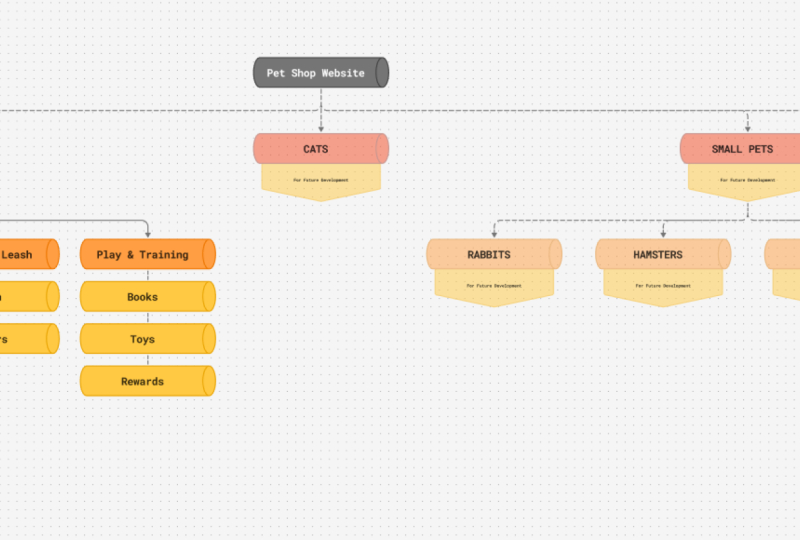
4. How to communicate IA: when you communicate IE, there's a couple of things that are really critical. It's the location. Where is the content in which container is the content and what is the name of that container? And what is the relationship between that container and any other container that's going to be used that's going to be defined in the I A. Let me show you a couple of examples. Two examples. Boxes top to bottom. The name of a container, bigger or darker on the content that is in that container is below it. The one on the right is a bigger project and has many more containers. But it's pretty much the same principle that's being applied. Third example. Using in this case word with indents and spaces between the containers, it could equally equally be done in Excel or any spreadsheet program, using the pre defined boxes and different colors and spaces, etcetera, etcetera. All those this good old fashioned method where you print things, you cut them out. You put them on a table and you shuffle around your bits of information so that they come together in one container and you give that container a name. Then you take a photo of it and the photo is your digitalized version of the I A. You. Then you're free to send it around that particular versions a little bit more difficult for all those other members in the team. Because it's not. There's no copy and pasting that they can do, Um, but the whole point of communicating I is exactly that. You got to make certain things clear when you communicate it, and you should choose which ever method for use the most comfortable, the fastest easiest, that's it.
5. How to create your IA: So how do we go about defining our I? If we group and cluster information content and functionalities into containers? There's three things that we need to ask ourselves. Here we go, which things belong together that are thematically related to each other, which things don't belong together. Which things are separate, Um, and once we have a container, what is the group or container cold? If you're doing this on your own, then there's a date there. I think two dangers. One of the dangers is that your not using the language that the end consumers would be using on the other danger is that you're not thinking the way that the end consumers would be thinking right. You might group them differently, and you might name them differently to deal with this second point. We have something called card salting, which you can do in an analog fashion with bits of paper on the table and and users called in. Or you can do it digitally remote with users someplace else. The point is, you really want tohave users that are as close as possible to the type of users who will be using visiting, consuming the content the idea with card sorting is you want to find out how they think, how the group thinks together on how they would name things. So the two ways of doing card sorting is one pre defined. You pre defined the cards for the information, and you pre defined the names of the containers where the information should be contained. And you ask up to seven users who are representative of the types of users that you're targeting to sort the information into containers the other way of doing it. But I know that is relatively easy is that you have and cards with the information, content and all the functionality, and you ask you users, your representative users to sort them into containers, and then you ask the users to name those containers. The idea is that you get an indication off the type of labeling that makes sense to most people. You start to recognize tendencies, and that's the foot point. In this list, your card salting will help you with tendencies. It is not a for want of a better term. It is not science. It is not mass. There is no right, and there is no wrong. There are simply tendencies. Fourth point. Remember the sunglasses I talked about in one of the previous videos? The sunglasses could be grouped in accessories, Onda or men's fashions on door, even luxury items. There is no right, and there is no wrong. The point is, you want to find those tendencies that make most sense for your type of target audience. Third point. All of this is fine. If you don't get a job where you have existing content that you have to basically check, what's the problem with existing content? Existing Kanda is difficult to change, but there are some steps that you can undertake to change or adapt existing content. One, of course, is you have to take inventory. What is the what is the information? What are the labels? Are they clustered in a way that makes sense for most of the end users? You can double check that using card salting right where you have pre defined cards, prettified containers from your existing content, and you ask up to seven users to kind of sort out it. That way, you can recognize whether the existing information architecture is okay. Good, brilliant or useless and has to be changed, but the point of using that, I think that the killer argument with the card sorting with a bunch of people is that you have a number. You can turn that into basically a number that says 80% of the people of our target audience cannot find product X or, conversely, 80% off our target audience have can find have no trouble finding product X. Once you take inventory, you have to order. You have to evaluate it based on what I was just talking about the grouping. The clustering doesn't make sense can be card sorted. You can also check your server logs for relevance or really for irrelevance. You're trying to find irrelevant information that a website might contain or an app might contain but has never visited by anyone. Then you don't really need it. These are the steps that you should go through to define your A or rework your I A or just validate that your eye makes sense for your target audience. That's how you define it.
6. Types and Examples of IA: So we're in the process of defining our I A. And I want to show you some different methods for clustering 1st 1 you can Cluster, according to products, has the obvious disadvantages that people need to know the name of the products in order to find the thing they're looking for. Let's look at a couple of examples. The most obvious example that occurred to me almost immediately was Apple, who basically have clustered things according to certain products. As you can see here, if I'm interested in looking for something for an iMac pro, then I would go into MANC, I guess, because it's certainly not a phone. And it's certainly not an iPad. It's certainly not on my watch. Another example would be Microsoft, who have basically categorized things into four products, which is quite natures, or their office suite or the Windows operating systems that sofas laptop and the ex boxer gains ever above that, they've discovered that deals and support seem to be really important. Okay, let's go back to this. The 2nd 1 would be clustering according to topics or segment where people don't need to know product names. An example of that in the offline world issue, remember, would be the supermarket devotion. Where I said, milk and yogurt is in dairy products, dairy products is a topic or a segment. So let's look at some examples. E Bay is a very good example off a topic or a segmented A where people don't know the names of products, and they simply split things into things into names or into category TNA add all the wrong words into segments. Okay, if I'm looking for sunglasses, I'd probably look in fashion. I guess another example would be something like Amazon, who, as far as I can tell, have simply listed everything into this drop down. They have pretty much the same thing. If I was looking for sunglasses here, I guess I would do men's fashion pretty much the same thing. This is also very good. This is, I'm sure everybody knows that this furniture store this they have turned things into products. If I was looking for a bedside table would be the example for a piece of furnishing. If I was looking for a bedside table, I would be looking for I have no I would go into the bedroom right bedroom bedroom. I would like to find a bedside table. It is taking a while, but it doesn't really matter. Bedroom furniture. There we go. Chest of drawers. Wardrobes. I guess it would be bedroom furniture. I guess it would be. It's none of these. It would be whatever. Explore bedrooms. Okay, it doesn't really matter. I don't wanna criticized the second level on the third level of information. I'm just saying that if categorized their stuff according to rooms, which is definitely topics and segments. Another good place to look for a look to see how people segment according to topic or segments or newspapers. The guardian of a wonderful online version off off of a huge amount of information, news, opinion, sports, culture, lifestyle and access to more. So they have categorized according to their 123445 most prominent or most looped for topics or segments. In this case, the BBC's probably pretty much the same Mawr Mawr segments topics, I guess pretty similar BBC has I think of a, I think, a bigger problem than the garden, because the garden is only in air quotes only news. The BBC has news plus radio shows plus TV shows, so it's a kind of three times the problem. Okay, so we go back to this. There's 1/3 1 which is a very good one, which is user needs. You got to know what user needs are. If you can recognize would user needs, then you could describe those needs in short, succinct labels with one or 23 words. Then you can ignore the topics and ignore the segments and ignore the products because you've addressed users needs which you can only find out. Of course, by talking to you needs the example of that, of course, would be this. I found autotrader. I'm looking for used cars. No, that's not a product. Is that a topic? Is that a segment year? It's kind off new calls. Is that a topic? Segment? Yes, kind off. Sell my car. That's a need volume I call. That's a need. Find a local dealer that's in need research. I want to trade in my car. That's a need. A car payment calculator. That's a need and affordability calculator. What can I afford? That is a need that I have. So this is definitely needs orientated for the observant among you. I have no more tabs. Open the 4th 1 and I have to warn you about this is more than a warning. This is not something usually aiming for. This is the departmental structuring off information where an office structure is reflected in the I A and the navigation, where it is apparent that department A doesn't work with department B. But that has nothing to do with the user or users needs. There may be overlapping information there may not be. It is the worst type of I A and consequently the worst type of navigation that you can have . If you come across that well, you can really only scream because it's really very difficult. That's a very, very difficult on a long journey to convince the stakeholders whether it's somebody who has given you a job, whether it's it's somebody in your department has asked you to look at a job if you're in agency. If it's your own department, if it's your own office, you're going to have problems with this, Okay? Because if you think of the thing I told you before, you gonna have to. This is a case where existing content is a bit of a problem, and you're gonna have to evaluate a lot. You're gonna get have to get a lot of feedback from users from prototypical users to supply some numbers that explain or demonstrate that users are having trouble finding information . It is no what you want to do. This a bad example. But it is something you will come across. Okay? The top three or three. Very good. Very important methods for clustering your content on dure functionality to produce something that is of value and easy to use for your users, Andi or your consumers, Okay.
7. Pitfalls & Challenges: so we're aware of how to define her. I A and we started defining I A and we're going to have some challenges along the way and there are some pitfalls that you have to be aware off. So let's look at those. The number one pitfall when you're working for a client is it declined, insists that their structure, the way they're set up, simply is repeated in the information architecture Andi there for the navigation. This, of course, is mentioned in the previous video actually a catastrophe, because only the people who work in the office with their internal view know where things are, know why they're there. If you take an external view, the view of a potential customer who's coming to the website, the Web, the potential custom, we will not know and not understand. The way to deal with this is to insist on a handful of users. Seven representative users perform either card sorting or usability test to find basically so that you can establish that the internal view from the company isn't good for new customers or external customers who are not aware of these. The way the officers set up pitfall number one pitfall. Number two is that you may work for a client who has a marketing department, and they may have a marketing a buzzword or buzz name something for their product. And the marketing department insists that the brand name is always used even in the navigation. The trouble, of course, with using a brand name and navigation. Is that somebody who comes to a website or an app or a game or whatever it is that you're actually making your digital product but doesn't know what this brand name is? They're lost. It's the difference between calling a breakfast cereal, breakfast cereal or calling it. No, I have to make up some kind of bizarre brand name Goody Goody Day Start, which is some hair brained marketing name for a breakfast cereal. Call the breakfast cereal Breakfast cereal. Most people will be able to deal with it, but you will have some trouble. You will get some flank from the marketing department because they insist on a brand name, but brand names have no place in navigation and no place in information architecture. The third pitfall, also quite tricky, is you might think that you're creating redundancies because you're having content repeated and certain places. If you think back to the very first video, I talked about men's sunglasses in a department store. Those men's sunglasses can be in accessories. They can also be in the men's department. They could also be in luxury items. That means the department store would need to have three locations where it has sunglasses . The big advantage of the digital world is that we can have the sunglasses located in one place and have easy shortcuts to get to them from other places. The department store doesn't have that luxury. The point about redundancies is that they only seem to be redundancies. You really want to support different ways and different paths to get to content. So I think I'm saying, Worry less about redundancies, make a decision based on the tendencies that you've seen with your potential users and locate content in a certain place, and that should not stop you creating quick paths to get to it from other places. Okay, I just had to add this little bit because I forgot The one of the major challenges is the imbalance, and that's where you have your content unevenly spread you have containers with content and functionality, and one container may be very, very full up, whilst other containers maybe almost empty. That is not a good thing toe have, because it will have implications in your navigation and the mechanics of your navigation later. And although you don't really need tohave, perfectly balanced containers, you should think about having at least evenly distributed content. The way to deal with it is go back to the drawing board. You're very full container has to be split into two containers or three containers, each containing less, and you're almost empty. Containers need to be added together and on receive a new name that describes the contents of the aim of it. Basically because of the implications and navigation is toe have evenly, reasonably, evenly spread content. Okay, that's it for pitfalls and challenges.
 Alex B., UX Designer by choice, and by commitment