Transcripts
1. Intro: Hi, I'm Jordan, and if you
love electric dance music, then you're in the right place. Today we're going to
be using sampling to create the perfect
danceworthy EDM. First, we're going to be finding music sampling from Sematics, an excellent source
of music sampling for a variety of genres
including lofi EDM, house trap, plenty of genres. From there, we're going to be looking for some vocal sampling. First, having a look at AI, which will be
sourcing from Suoi. From there, we're going to find some human vocal sampling by having a look at Tiktok and
seeing what's on there. Using a variety of sources to sample from to create EDM is where a lot of tracks
get their start and where a lot of DJs and
producers get their start. Before you go hand making
all of your beats, take this class today
and learn how to make your beats
through sampling. This class is perfect
for anyone that has a DAW already, which is software with which
you can make music. We'll also be using a few different
plug ins and we'll be sourcing from a few
different websites. If you have music
producing software, which is a DAW such
as Ableton Live, you'll be able to follow along. I use Ableton Live 11. You can just get the
light version if you need something for
free or if you have any music processing
software that you use regularly Anyway,
you can use that. It's fine. Whatever you use
will be applicable here. If you're someone that is just
getting started on making EDO music and you need some
guidance to get going, well then this is going
to be perfect for you. Or if you've already been
making it and perhaps you're just looking for
another way to do things, well, then it's also
perfect. I'm Jordan. I am a music producer
and composer. I also teach music as well as other performing arts
here in Shanghai. And I really hope that
you will have fun joining me today and
making some music along with me using the
samples that we stumble across and apply to today's
electronic dance music. Thank you so much
for joining me. Why don't we get started.
2. Downloading & Using Music Samples: To get started, we're
going to look up and then get going on Simatics. Sematics is a company
that supplies sampling as what they
do, that's what they do. They make sampling
with their producers, then they bundle it up into
huge packs and sell it. But luckily for us,
a lot of what they have on offer on their
website is free. I encourage you to spend
some time on their websites. If you're someone that
doesn't really like sampling or using samples,
that's totally cool. A lot of people go on there
and get some inspiration for melodies or especially
bass lines, which can be hard to think of and which an entire
song revolves around, especially in this genre. Whereas for other
people like me, who love using samples, it's an excellent place to
find them and download them. Cinematics has been criticized because their samples are
very complete sounding. There are other
sources of sampling where what they make
sounds a lot hollower, less complete, more vague, something that you can build on, and it can make it
more of your own. There's a lot of where we
don't really crave that, we're just craving a good beat. The risk though, is using
sampling from Sematics or anyone else that gives you much more complete
sounding samples. The risk is your song
could sound more like someone else's than it
otherwise would, such as, I made a beat recently
using a complete sample, and when I uploaded
it to Youtube, Youtube recognized it as
belonging to someone else. It didn't copyright
strike me though. It just recognized it. So you can use samples ethically in your songs
when you source them well, such as when you get permission
or when you buy them or download them from companies
that just make samples, it's what they do,
such as Sematic. So you don't need
to worry about it. A lot of people that
I interact with really get scared using
sampling in their music because they feel like
they're going to get called out or that
someone's going to come after them or
get mad because they didn't make a beat that
they're utilizing. But you really just
have to go clubbing once to understand that this isn't something
that matters. There isn't a club
song being played in any dancing nightclub today that isn't sampling from someone using a beat
by Riana Madonna, Brittany, or somebody like that. Because people dance
to what they know. Anything that you
hear a DJ being played that isn't
instantly recognizable, the vast majority of the time, it's still being sampled. It's just not being sampled
from anyone that you know, if you're dancing to a beat, you don't know what it
is and you're thinking, wow, the DJ totally thought
of that he or she may have. But just as likely, if not much more likely, they've sourced it from
a website such as this. Download these beats and
don't worry about it. Luckily for us, these beats, there's so many of
them, which is great. I've made so many
tracks that no one had ever vaguely
recognized before. I've actually re, used samples a few times where someone said, hey this sounds like you're are the track, here's
the reason why. But what's great
about this website is it gives you a track
broken up into pieces. So it'll have like
the lead line, the baseline, the courts, and a Midi file all broken up. So you can just use part of it. Or you can do what we're
going to do today and build up on it where you
start with one part, then you add a second part,
then you add a third part. The great part of having
the Midi section is that you can use your own instruments in the
Midi section and edit it. There are some people
that will just use the Midi section of
a Sematic track. That way they can
add their own music and then chop and change it. It's amazing how different
a chord progression can sound when you just
swap a chord around, invert it, change up
some of the notes, or just change up
the syncopation. Change a chord that goes dad, and you just move around
so that it's dad. That can be the whole
world of change. And you've still used a sample. You've still gained the benefit of someone else's good idea, but you've changed it
enough that almost no one alive would be able to tell
where it ever came from. You could do it like that today. We're not going
to do that today. We're going to use the
samples exactly as they come. This is kind of the absolute
fastest way to make EDM. We're going to
utilize one sample, build on it, add creativity with the way that we use the
Midi a little bit. Then add samples.
And add samples. And add samples, build
it up, change it a bit, put on some plug ins to sort of change up the
sound as much as we can. And then that's
it. Once it's all put together, it gets exported. And that's a track. There
are days working today where they don't put more
than 1 hour into a track. Because they're working every
Friday and Saturday night, they've got sets, and
every week the set has to change at least 60% on what
it was the previous week. One track gets an hour, and that track might
be four or 5 minutes long and they need to fill up the night they're just making
and make it making. This is a fast moving
way of making music. It's got to be, it's
practically got to be. I'm going to show you
my way of doing it. So let's get started.
3. Building a Foundation with MIDI Samples: I've downloaded a
bunch of samples from cinematics and I've arranged them into a folder
that I like to call select. It's the particular samples
that I thought were interesting and could be useful for what we're doing here today. I'm using the one called
sunrise in minor. We've gotten here a super
cool baseline chords, a lead, super nice lead and a diphile mipiles are awesome because there's
a lot you can do with them. This is a weird one. We've got all that information
right at the back. Why I ask, let's
delete that part. Put all the good stuff
at the beginning. Now it's from this Midi file that we're going to extrapolate
a lot of information. Now a Mi can't make
any sound by itself. Press Play, nothing. We've got to assign
an instrument to it. I'm going to break
it into pieces. I'm pressing, copy and paste
and paste. Copy and paste. Then what I'm going to do is I'm going to cut off the lead. Because we're just going
to play with this part. Then I'll deal with
the lead leader. This is our full version. Including the lead onto this, I'm going to put, I have a skill share class on sum if you want to
know how to use it, but I'm going to
turn a way down. It is awesome for making
your own sound with. Okay, let's repeat
that over and over. Let's get the second oscillator. We're going to increase
the unison so it sounds like a tune second. It's already on as well. Maybe filter. Filter. Okay, on to that. I want to add a
little bit of Hello. It's just a little
bit of reverb now, we can get that volume
more up. All right. That's pretty good. All right. Now using this, we can get what I call
vanilla baseline. I don't know if we're
actually going to use it, but it's just useful to
have you want to have sustained notes that are an
undercurrent from your track. Sometimes you'll make this and then you'll just
totally delete it. Sometimes it's just useful when it's slightly over
the note like that, then it deletes next. That's so annoying when it's
like a uneven like that. I know why they've
made it all uneven because it's like super
creative to have it all even have the note not quite ending on
the exact moment. Well, I don't know
how creative it is, but it makes it feel more like it's being
played or performed. Because actual performers, they don't play the not
exactly at the proper length. Their performers, their fingers touch the piano at
different dimes, but we are not that,
not in this context. Anyway, some people who make music in this way
are performers. We filled it out completely. Filled it out completely, then we can apply
serum over top of it, which we may change
our minds on. Now what I'll do is I'll
put both oscillators on again and I'll rack
them up again. And I'll rack up
that tune again. But this time I will put the filter on quite
heavily and I'll add the sub that'll just give
it a stronger base feeling. Maybe I'll make it
lower. It's now, maybe I'll delete that high
line. That's a bit better. Anyway, so that's our Midi. Let's see what the
sample came with. That's the full version. Maybe we'll run into that. We'll start off with
the version we made. Hmm. Something feels off. It might be the vow. Hello. Oh. All right. From
here we'll repeat it and we'll get that
drum sample in there. Gosh, can't come soon enough. Okay, let's check what
drum we've set aside. We've got some claps,
or here's some drums. Hmm, nice. Let's put this second
drum in first, right here, along
with the second one. So EDM and any kind of electronic music really is
all about the build up. So you start off
with a little bit, then you add a bit more,
then you add a bit more, then you add a bit
more until you drop it down and then you bring it all back
with a vengeance. Don't okay, when that happens, double click it go
down and take warp. What it's done is it's warped the drum to suit in with
our BPM, which is no good. Let's instead bring
this up to the drums BPM because Midi could adapt. Oh, this is also
meant to be 128, so everybody will be
friends of this BPM. And then we will
just layer again. Just copy and paste that
drum and everything else. And we'll add that second drum that is a very
interesting drum sample. Let's get that right in there. I wonder if it will fit in. It may not. I think it fits well. But it's not the drum
that should come in next, It's the drum that
should come in third. I'm going to drag in
the other one first. This one should be second. Let's check. I don't have a really
good reason for that, except to say there's a
feeling of development. The other one feels like
it's developing too fast. We're going from a
basic drum sample into quite an advanced
one too quickly. Let's copy these across. Okay, we've got quite a
nice development here. We've got the mid. We've got these Midi samples
that we've got is like a baseline that's building
up with a drum sample. We haven't even used any
of the wave samples yet, which means any of
the original samples from cymatics that are meant to be used exactly
as the art that comes next. You'll see on the bottom
right on the master stem, we're already blowing it out. Massive blowing it out. It's completely blowing out. We're going to need to get
something to control this. This is where I love to use a mastering plug in
called ozone nine. I think ozone is just great. Ozone listens to your
track and then changes all the levels itself
using its own algorithm. I'm just going to make it repeat over the busiest part and
have ozone level it out. All right, that's a good start. Let's start to
build on from here.
4. Working our Way to the First High Point: Now it's all about
that lead line. Remember we copied this over. Now let's copy it again. It's the vanilla version, so I don't really want
to delete it completely, but I think it'll get deleted. Let's delete this part, which we've already used, and now we have our lead line. We're going to yell,
let's delete it. We can always drag it
back over if we need it. I'm going to put it here.
I'm going to get our old boy serum back and try to
make myself a nice lead. Sound Now here we've
just been playing with the waveform that we start with, but you
don't have to look. There's tons of other ones. Let's see, I'll get that a lot. Play it. We just keep going until we get
a sound that we like. Do we want more versions? I don't want too much. Do I want reverb?
Maybe a little. Alright, cool. How soon
do we bring it in? Probably as soon as here it is strong, but I don't
know if it's stronger than the version that
Maddox gives us. So why don't I just put that
one in two so let's here. Yeah. So I can have them
at the same time. Why not? All right, cool. That's great. You'll notice
I turned to that warp off. I don't know if I needed to. I just had a feeling that the drums were
lagging. It says 128. So there's no reason
why they would be. There just is like a weird
lag to it, but I don't know. I don't know if that's
in my imagination. Maybe we see without
the second drum more traditionally,
but with a drum can, it's a game of making
sure it all works. That it's got to be danceworthy. Okay, so we've built up enough, definitely by this point, that we can start to
lessen the energy. Yeah, we can start to
lessen the energy. We can let it take a breath. Andrew Lloyd Webber has a philosophy with
his musicals that when everything builds up to a certain point of high energy, and it's been maintained
for long enough, this song needs to slow
down again to breathe, or else you're just going
to exhaust the audience. I played the same philosophy
to electronic music as well. I let everything simmer down, let everyone catch their breath, get as low as we can before
coming back with a vengeance. Coming back properly,
this is like our first peak,
our first climax. We'll peak again later,
like the proper peak. The question becomes, how
far do you scale it down? You know what we haven't
had yet is a rise. I really want to rise. I actually may delay everything
to get a riser in here. So I'm just going to
pull all this back. I will explain what that is, which is just a drum
that builds up to the beat and that's just going
to help with our energy. I think I planned a rise. I did. Yeah, that's a cool riser. Do I have any other risers? No. Yes. Oh yeah. I got to use these
claps at some point. Oh, yeah. That's cool too.
Oh, man. They're all cool. Okay. I'm going to put
that one in first. God, I feel like a kid at a candy store with all
this stuff to play with. Okay. So that's one riser. Let's get one of those
drum risers in there. Maybe that one. I love claps. I'm so into claps. Let's copy and paste these over. Paste them here in a good spot. Alright, let's see how we go. Is that rise with the right one? I don't know, but I'm
gonna put some claps in there at that critical moment. I love that maybe both of them, one of them's kind of a clap backwards and then the other
one's just a regular one. How will they sound
together? Oh my God. At the end of this, we're
gonna have 18,000 audio clips and they're all just gonna have like one tiny
thing on them. Mm. Not bad Trouble is that it makes the other
drum sound so quiet now, everything's got to get leveled. The thing is, it sounds
weird how it just ends. I'm going to cut this
and then paste it, and then have it happen twice. No, that's going to sound weird. I'm going to do instead copy and paste it and have it just end again
a second later. Nope, that's bad. Instead I'm going to add a reverb to the first one right here. I'm going to All right, I just press command J to
put them back together. Okay. I am going to put in its own area and I am
going to give it a reverb. I don't want the whole
thing to reverb or else it'll start to
sound out of time. Maybe beams. I love beams. Gosh, that was too much brass. Copy and paste our bad boys over here going into our breakdown. That is too late. I meant here, I still got the repeat on. I was so confused. It's not bad. All right, And then we
get that drum riser back. Maybe both rises. Actually, maybe that
mellow riser again, but not the drum riser. Maybe instead we use
that other drum, that one this time. Where is it? Here you are so loud, but the level might be
right for the other one. So I'm going to give
it its own thing and I'm going to tone it down. Let's get these boys
in, join the party, then we copy and paste
everything into the next part. With all the drums,
this is that climax I was telling you about
with all the drums. And for the first time,
for the first time, we're going to add the
full original sample from cinematics which we've
been saving that one. The full one. Our many, many additions. It's
going to sound like this. We've got to cut. I'm
cutting that one. Let's see. I was hoping I could do three in a row where I'm laying
the tracks before the train, but I couldn't
quite do it right. Here we go, 16. We've got a bunch of bars. How many bars is this? We've got this much but you can't hold
onto it for too long. We've got this for
I guess 16 bars, then again, and
then that's good. Once we've held the
climax that long, it's time to wind it down. Can't belabor the
moment too long. Um, all right, so
that's building up to the climax from now. I want to edit the breakdown and maybe
lengthen the breakdown, and we're going to do that
with a very interesting plug in. Let's do that next.
5. Adding Flair to the Breakdown: What we're going to do is
here in this breakdown, I'm going to copy across this sample into its own track and I'm going to
apply Flex beat. Flex Beat is a really
interesting plug in that changes up the sound of your sample and remixes it in a way that you've
definitely heard jays do, except it does it for you. It's convenient that way. I'm going to do that
with our sample, the one that we were
blessed with from simatics. Let's hear what it sounds like. Oh. That I make this
one. Oh my gosh. That's the Midi. I thought it was the server from Sematic. Oh my gosh. That means we have to apply our own
instrument again. Oh, oh, I can't even
remember what I did. I definitely did more than two. I think I did three, didn't I? I definitely put a filter
on there, I think. Oh, my goodness,
gracious. Let's see. What we did last
time is no filter. It's four oh 88. Nasa. We were almost right. Oh, we did that. Just no filter. Oh yeah. We put Vala on there. Brass black. Okay. So where's the one we were gifted?
It's right here. The yellow one. Okay, so it's got Vala brass. Yep, it's got serum. Yep. What's the tune? Oh, it's down there. I went the wrong way. Whoops. Not one opposite
way. I went in. It's funny. Used to go in all the time, but
not so much lately. Okay, so I'm going to copy
this across. No, I'm not. I'm going to give it its own, it goes up here on its own. It gets the flex beat in the same position as the other one. And let's see what we get. Okay. I quite like it, but I don't know
how much I like it repeating that flex
beat two times. I like it having a
flex beat two times, but I don't know if I like
it repeating two times. All we got to do is have to do a better job
remembering what we did. Put the val back, put them back 23 down, and then just change
up the flex beat. I'm going to go to
that one this time, number ten and number ten. Now you can make it yourself by dragging these dots around until you find
something awesome. So when you have the
time I've done it and you can make some
really interesting sounds, I know what I want,
I wanted to break down, but not so much. So I want to put
that sample back in. Let's get those in there.
For the breakdown. No, no, no. For
the last version, I want to get that
original one in there. That's it. Here, across to here. Webs, uh, that's not the original here. All right, cool. That's a
pretty natural sounding ending. Of course, if you're a J,
never would you want to end? Not with drums, because you need those drums
to carry you out. You need to have drums
on the front end, on the back end
carrying you in from the last song and out
to the next song. But we have right here a fully
complete like base track. We've got an intro,
we've got a first, we've got a breakdown
section that thanks to Flex Beat, got
a lot more interesting. Then it builds up again
and then it gets into our last big climax
that happens with, with the full version of the
samples from cinematics. Then we have a breakdown
and then a play out which if I'm putting it
into a set, needs drums. But otherwise it's okay. From here let's try our hand at getting
some AI into this.
6. Adding AI Sampling: Okay. Right now I
am on the website, so where I am going to
try to create some AI, vocal sampling that we
can use for this track. Now if you don't
know how to use, so I actually have
a skillshare on it, You can go to my skillshare
profile and check it out. I think I called it
composing with AI. I think that's literally
what it's called now, for using AI for
the sake of EDM, with Sono, I get to write
the lyrics that I want. I'm going to create lyrics
that can be used in isolation. Oh yeah. I press Enter now. It's going to make me. Oh,
yeah, No, I don't want. Just want. Oh yeah. Oh yeah, that's right, That's the beat
right there, right there. Dance if you want
to. You got this. Ah, that's that
beat right there. Any of these, in isolation
might be useful. The travel is going
to be getting the vocals out of the AI generation in
a way that I can use. I've done it before, so rolling the dice that they're going to be high
enough quality to use. It doesn't feel likely, world something big. Okay, I was taking a chance by putting it into the
song description. I've yielded some
pretty useful results doing that before,
but I haven't, in this case, notice how the hit of the beat is on the lyric. That makes it almost unusable. Nearly 0% chance that I'm going to be able to get
the lyric out of there. It's very unlucky.
I'm going to coltode, I'm going to put the
lyrics in that way. Now it's going to make it
very literally what I want. Now, you would think
that I would have asked for EDM or that I would
have put EDM in here. But I'm not going to because if you say it's going
to be used for EDM, it's much more likely
that they're going to put the beat of the drum or the kick right on the lyric
and make it nigh, unusable. We're hoping for so
many lucky things. We're hoping for clean, clear lyrics which is
more often associated, or more often successful for me, with the female AI than
the male AI voice. Clean and clear vocals that aren't broken
by the kick drum, that are also not too heavy on the pitch correction right there if you want
that, you got us. That is pretty useful. Baby thepappeart
this if you want to. You got this if you want to. You got this is cross my
fingers and say usable. So I'm going to click
it. Click download. All right, let's get
this into Ableton. All right, so here's our track. I'm going to try to isolate that vocal from earlier therapy. It's warped, golly. There it is, There's the whop. I'm going to drag it over here where the
instruments are not, they're afraid,
disappear at this. Right, there you go. That's the money. We're going
to try to mess with this. I have a few plug ins which can help us with
this from waves. We have reverb, this is really
great with a human voice. I don't know so much about AI when it turned all the way up. I'm going to drag across
this and get it repeating. There we go. Let's
get that repeating. And repeating this got, got, that is strangely
clear for AI. All right. I got
this one as well. It's just a gate. If you got it. Got it, Got it, Got it, Got it. You got this? If you
want to, you got this. You know, I thought it
would need clarity, but clarity made it worse. Sorry. No, thank you. All right, let's let's put
this in. See how it sounds. Um, maybe right before the hit, right there, I want to turn it off that much. So there you go.
That's how I can fit. This one's a little bit slow. Maybe I want to turn that
walk back on actually. It's not bad. It's able
actually, and I quite like it. I think you got this could be used on its own or we could put on that same one from before the flex beat
and have it flex up. Maybe like this one, that was already a massive improvement
that's actually able, but that's the AI sample. Instead I want to
use a Tiktok sample. I actually have the
perfect Tiktok in mind. I just saw it again today. I'd seen it when it came anyway. Let's drag it in Tiktok.
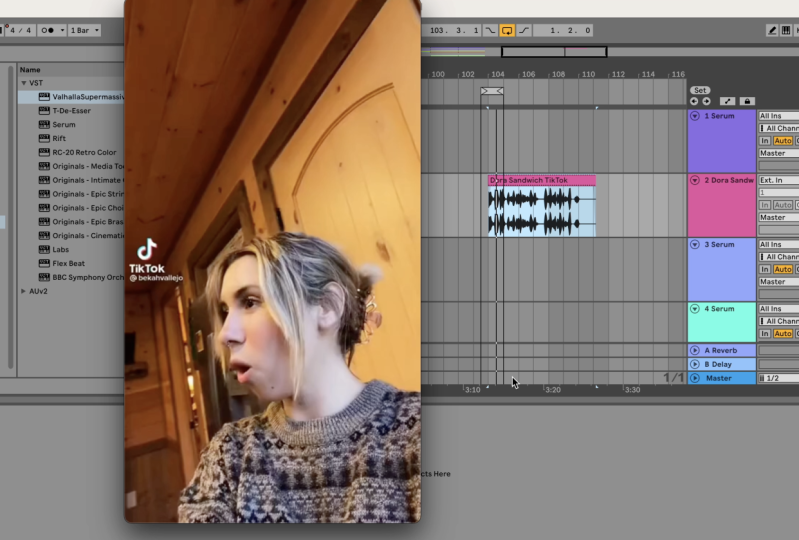
7. Adding & Mixing In a TikTok Sample: Okay, so it's this tiktok. Have you seen this
Tiktok before? Ola. So can you say
puezerme un sandwich? That means can you make
me a sandwich? Inspect. Okay. So that comes
to us from Becca. Thank you for that, Becca, let's clean this one up. And using those same
plug ins from waves, it's got a bit of like a background buzz
that we can get rid of. Let's put that around. So you say sandwich that, can you make me a sandwich in? Soamandwichn make
me a sandwich in. So can you say per sandwich? That means can you make
me a sandwich in splay. Isn't it great?
How could you hear how much those three
waves plug ins helped? It was just awesome. All right, so I'm going
to drag the sample over. I want it playing right
as the song opens. All right. Let's
hear how it sounds. So that's enough. Let's get rid of, let's
get rid of the rest of it. I'm going to make
another audio track. Get the last part
cut and copied. Copied. And put it down here
and get an echo on there. So Val Hall and go to
echoes eighth note. Let's see. Yeah, that's great. That echo is just the best. Is that loud enough Ola? So this one could have a
longer reverb maybe, maybe. I'm not sure about
that. One may have to play with that one Ola. Okay, well, that re is
obviously ridiculous. I will play with that
later, back to what it was. Okay. Okay. I want that repeating. Do okay. That's really good.
But I want to add so when you're doing so, okay, when you're
doing vocal sampling, there's a feel to
it where you wanted to have a certain
level of musicality. I'm treating the spoken
lyrics like the song lyrics. Spoken lyrics, they're just
spoken samples from Tiktok. I'm treating them like their
vocal, like their lyrics. So how would they
fit into the song? How does the
inflection and the way the words sound and
how many syllables they are, how well
does that fit? That's basically how
I'm going with this. Do. All right. I love, do
I want to have that? I'll copy just this echoing one. Okay. I'm going to put here, and I'm going to have it do
that thing where, you know, it repeats every note and
then every half note, and then every quarter
note and builds up that way, way too frequently. For now, copy paste it. Dadada, Ja, ja, da, da, da. All right. Same thing,
but smaller, 12345678. And then again, but
even smaller, 12341344. Let's see. Got to get
the exact right amount. A A ja da da da da da. And then I want the next part of the sample to play after
this build up is finished. Maybe here, can you
see que right there? Just cut her off. Just like
she's totally nothing. Okay. Good, way too quiet. Let's give it its own thing and turn it like all the way up. Can you see us? Why is it so quiet? I mustn't have
needed it earlier, but now it just the build
up just like nothing is, that's so much better. Itala a Dadadada. I think it actually should
be quieter in the beginning, but it needs to get louder. I just press the letter A, which A is for automation, and that just means
I'm going to have it. So it turns up. Yes.
It can start quieter, but it needs to
get a lot louder. Sandwich. What? Oh, whoops.
Where did I put it? Oh, my gosh. It needs to
happen right here like this. You see Queta, Whoa,
we're on the wrong one. Whoops, Whoops. Whoa. I went to that baseline one instead. We don't want that
going anywhere that's already at
the right volume. Can you see que, can you see Queda to love? Can you see quedes, that's better. Olata. Aaaaaaaaaaah. Notice how much energy
the song has now, in comparison to before. Such a difference
a sample can make. Oh my gosh. All right. I'm going to throw a
random Dora in here, but I got to hear it again
to hear that timing. A, a, somewhere go a, um, I think I want the sample
in here for the breakdown. So A, can you see a sandwich? That means, can you make
me a sandwich in Spa? I want that spat
to have the echo. Let's copy and paste
it down here in Spa. We don't want that Tiktok
Sound I'm going to cut that. It needs an echo. But that echo already
that's there is too subtle. It needs a bigger, better echo. So I'm going to
copy this in here. Maybe give it quarter
notes Echo. Hm. Oh, how does that sound? That's definitely better.
That's still going. Soya. Can you say, where is a servi sandwich? That means, can you make
me a sandwich in Spa? Alright, I want the same thing
but I want that flexpait. I'm going to command J
joining together cancel. I want, I want that same flex
beat the lead has. Sorry. I was just thinking
about what I was doing. I'm going to put that there. I'm going to put
that flex speed on. I loved that second
flex speed we did, which I think was ten.
I think it was ten. Let's see, it needs
to line up with the. Can you make me a sandwich? Oh, needs another one? I'm going to just literally
start it again there. I need this Ba to
happen again in Ba. Where did I put it? It's right
there. Put it down here. Yeah, I already know I need to be here. I need it to be right
as it's ending. I'm not sure how
that's going to sound. Uguaitmp really doesn't need
those claps as well. A spin the C, can you say what I wanted? The Ola, I thought I grabbed the right
one. No, it's here. Uh, A, a, a, a, A, I think that's good. I think that's
three solid minutes with a drum lead in
and a drum play out. That's your track? That's
an EDM track right there. That is full and complete. I would be proud to
play this in my set. I'm telling you, actually, it's more I want to do
with a lead up track. Oh my God, Imagine if
you used dash clips. Oh my God, my imagination
is going wild. This is a great 3
minutes, easily, can go into your next
set list, no problem.
8. Time to Go Dance: You have it. We made
an EDM track that was so funny how they
ended up turning out how we use that Tiktok. And it was just such
a happy coincidence that the pitch of her voice went so well with the pitch
of our serum that we used, the serum plug in that we
used with the Midi sequence. And the lead line that came with our cinmatics sample of that lead line went with
her voice really well. It made the Tiktok go like a hand in a glove with that
melody and go with the track. So well, I guarantee that after some time
spent not mastering, if you played that in a
club, it would go down well, I think it needs to be going in and
leading out obviously. Still needs to be lay
it into a full set, but I think it would go down
well and it didn't take too long and if you were
making something for your set, you could easily jump off the momentum from
that into something else. I'm even like thinking of Tiktoks now that
I've seen before. Where I'm thinking I could
easily make this or this, or this or this into a track. There's a track
where a girl squeals really loud or
really high pitched. And I'm thinking of
a lead line that I could use that would
match her pitch. And I could take a piece
of her squeal and then pitch correct down and up and turn it into
its own lead line. It's absolutely something
that you could do. Thank you so much
for joining me. And if you've joined and
you've stuck around this long, I would be really, really
grateful if you would leave a review here on skill
share of your experience. You can't do it in the app, you got to do, you've got to
go to the browser version. If you did that, I would
be extremely grateful. And I would also
be grateful if you stuck around and
took another class. I've done one on AI. We've got music theory, gosh, we've got composing for film and for video games,
all kinds of things. So if you stuck around, it would be really, really
great to have you once again. Thank you so much and best of luck creating your own
electronic dance music. I wish you very well in that journey and I
can't wait to see you again at the
next class. Thank.
 Misici, Music Composer & Producer