Transcripts
1. Introduction: Are you a creative?
That's having a hard time getting your work
seen online lately? It's probably in part because you're not sharing your
work in a meaningful way. Sure, your work is good. I
mean, hell, it can be great. But if you're not getting
eyes on it nowadays, it's sort of useless. I spent the last 12 years as a freelance illustrator getting hired by brands like Google, Facebook, and Adobe, all based
off my online portfolio. I've given lectures,
spoken at conferences, held workshops, and at the end of almost
every one of them, people come up to me and they
ask me the same question. How do you get hired by the clients to do the
work that you love? My answer is always the
same by sharing my work online authentically
and in full context, telling a story with the way
that I'm presenting my work. The difference between being good at your craft and having it be successful for you is,
is it meeting your goal? Is it getting you the views
or subscribers that you want, selling a product,
getting you hired for a job or for a freelance gig? Anybody can make a
beautiful image, but if you can't tell
a story of how and why you made need to step in
front of our work a bit. Showing people that
we worked hard on something goes
beyond just sharing a picture on Instagram on a blank white page with no
caption or title or anything. I build a car. It's fine. But I build a car
that goes zero to 60 in 4 seconds for under $2,000 in my
grandmother's basement is a hell of a lot more
compelling of a story. In this class, I'm going
to show you how to take your work and
present it in a strong, interesting, and meaningful way. We'll look at some of
my old projects and try to dissect them
and understand what made them so successful. Course is totally beginner
friendly and should work for anybody that is
dedicated to their craft. Again, that could be
writers and poets, photographers, art
directors, illustrators, three D designers, you name it. By the end of this
course, you'll have taken a project that you've
worked on in the past or something you're working
on now and packaged it into a presentation
that has a story. In the next video, I
want to dive deeper into just what I mean
when I'm talking about intentional ways of sharing
and what a couple of examples of really
strong case studies and project
presentations look like. So I'll see you over there,
and let's get started.
2. What is a "Case Study": Okay, welcome to
the first video of this course where
we're going to be defining what I mean when
I talk about a as study. I know I mentioned
a couple of times, but I'll try to be precise. So from here on
out, I'm going to refer to strong portfolios, really cool projects, engaging
ways to share your work. All of those are going to be
defined now as a case study. For me, a case study
is just a full look into a project or something
that you've made. This has been the
main tool that I've used in order to get work as a freelance illustrator
for the last ten years. It doesn't need to
be a giant project. It doesn't need to be
a really tiny project. It can be anything in between, as long as it's
something that you feel like you can add
some context too. Way too often, I see
these beautiful, beautiful images online, and I'm so excited to
learn more about it. And I go to click on
somebody's portfolio and I click on the
image that I love, and then all it does is just open up a bigger version
of that same image. Like, Man, what a
disappointment. Like, I wanted to learn
about why you made it. What were the time constraints? What was the deadline?
Was it a tight budget? What went wrong? How did
you fix those things? Like, I just wanted to know
more about the project, and I just got left
kind of hanging there. I think one thing that
I haven't mentioned yet is what is your job in this? What are you going to do? You just need to
choose something that you're passionate
about that you've worked on or are working on. Ultimately, your goal is to tell a story about that work
and why it was so special. What were the challenges
and all that stuff? And your goals for
whatever you're making can be different from
what my goals might be. For me, I'm typically looking
to get my work in front of art directors and people
that are in hiring power to hire me as a
freelance illustrator. But for you might be to just
get more views on your work, or it might be to get people to see something
that you're selling, could be a way to educate. There's so many different ways and reasons for case
studies to exist. There are things
that can include, like sketches, process, the struggles, successes, stats, numbers, results,
all that stuff. Next video, we're going to dive into something that I
think is really cool, which is basically the
history of case studies, and eventually we'll
start making things. So see the next one.
3. History of Case Studies: So in this video, I
just want to talk about the history of behind the
scenes in case studies. When making this course, I kept getting a little bit
self conscious thinking, Is this a good idea? Like, should I be teaching
people to be doing this? Then I would be reminded, like, every book that I have around
in the studio is this. And every documentary that
we've watched is this. They're all a form of a case
study in one way or another. Hopefully, if nothing else,
just for a confidence boost, like, this is a good idea. And so, literally as I
look around the studio, I describe two random books, but as you open it, and I'll get a better
look of it all, but it's just showing you all of the thinking that went into
all of the characters. All of the sketches, all of the things that
don't get seen in the years and years that
people are working on these pieces of art
and giving it context. Talking about why they made
the decisions that they made. I've also got the art of
the Incredibles here. There are just these,
like, gorgeous, gorgeous drawings in here
of these characters. That are just telling you how they were thinking when
they were making these. And it's so insightful. And ultimately, this is a way for you to go and
watch the movie. These are marketing plans,
effectively, right? Like, they're selling this as a form to want to inspire you
to go out and see the film. The same way we're showing our behind the scenes
of the art that we're making to get people
to want to go and participate and look at
the art that we're making. As I jump into my screen, I just put together some quick things that came off the top of my head that I hope everybody is in some way familiar with. And with film and TV, you know, we have the Pixar Story, which is really
great documentary. The making of Star Wars
is, like, a really, really famous documentary
on how they made Star Wars. They show all the
behind the scenes, how they came up with the special effects,
the story writing. Music. Music is a great example. You know, box sets remember
my dad when I was younger, he used to love collecting
Beatles box sets. Sort of the Beatles come out
with, like, 11, 12 albums. But Dad had to have had 200 versions of their albums because he wanted to
see the liner notes. He wanted to see, you know, the journals that came with
the writing of the songs. And again, ultimately, it was the same music
over and over, given in this different
context and light that would really make
people very interested. So, art, this would
go on forever, but Netflix had a great
Netflix documentary about behind the scenes and how a lot of different
artists make their art. The dreams of Sushi documentary is an awesome one
that just shows the masterful work that
goes into sushi making. Another big one
is art galleries. Like every time we go
to an art gallery, we're impressed by the
art, sometimes, yes, but it's just that much
more impressive when we read the little placard
or the bio about the artist to understand
what they were going through when
they made this piece. Like, what was happening
in the world that maybe is a reflection
of what's on the wall. Again, these are all case
studies, so to speak. Music podcasts that talk
about what songs mean, lyrical breakdowns, interviews,
like, even interviews. Like, on YouTube,
we watch all day, we're watching interviews of
artists and understanding, again, like, what is
every question that an artist has asked of
what does this mean? What were you thinking
when you made this? Like, why did you make this?
What is this movie about? What is the script
about? So that's that. I just wanted to preface this little bit to
say that, like, we're not reinventing the
wheel here with this, and every mega genius
millionaire is doing this. So why are we not doing
this with our arts? Just to reiterate, like, it doesn't need to be a huge deal. It doesn't need
to be not writing a book about a drawing that
you did, although you can. So in the next
video, I want to run through some of my case studies that have gotten
me a lot of work. Things that have proven
to be successful for me. They've helped me sell products
that I've wanted to sell. They've helped certain projects get a lot of eyes on them. And again, they all
come down to sharing this work with meaning
and attention. So that's what we're gonna
do in the next video, and I'll see you over there.
4. Personal Success Stories: So in this video, I
just want to share my personal connection
to Kate's studies. The first one is a tattoo that I made for my dad after
he passed away. This was in 2013, and this was one of the
first times I really saw the benefit to sharing a
story alongside of my art. I think it's a really
simple thing of, you know, I got a piece done on
my arm that I designed, obviously from the heart.
It was out of tragedy. And I could have just
shared the final artwork. It would've been fine. Maybe people would have
liked it, maybe not. But they wouldn't
have known what it was and why it was important. This case study, I
think, is also really special because it's
very low fidelity, and I can share my
screen and show you. So this was it, you
know, 118,000 views, 9,000 thumbs up, which on Behans is a really,
really large one. And in fact, Wired reached out and wrote
an article about it, and it really did well on the Internet,
especially in 2013. I just wrote simple things.
I wrote, My dad got sick. I got a tattoo because it was kind of his last thing that he said, I want to get a tattoo. I said, Well, if you
don't get it, I'm going to and then he died, and the first thing
I started doing was drawing out this tattoo. It kind of goes through
this whole story of how he got sick and how everything was kind of changing around him and
how this really helped me. Everything about the presentation
is really low fidelity. But ultimately, at
the end of the day, I'm just sharing the story and sharing why it's
important to me. As a result, I saw
articles written about it. Lots of people reached out that were really
touched by the story, which was really meaningful. And kind of on the
more business front, I ended up making a lot
of tattoos for people. But what was really
special about that was it was something that I felt
really passionate about. Obviously, I very
directly owe all of that success and that enjoyment to writing that
little case study. Last one, I think it'll
be the last is more directly connected to the
fact that the case study and showing the process
of the project that I did really directly spoke
to a business owner, and they contacted
me and said, Hey, I saw this case study that
you put on your website, really intrigued
about the process that you brought
that client through. We'd love to kind of go through that whole
process as well. So this was the case study
that I put together. And again, the story is simple. So this whole brand kind of
was built around this idea of people doing what they love and the reason why they started their small business
to begin with. I'm writing a lot
about all of that in this case study about why we made the
decisions that we did. What's the story
that we're telling and showing a little
bit of behind scenes, some of the process
and stuff like that. That project turned from something that might
have only been, you know, a couple thousand
dollar suddenly to, like, a $20,000 project
because they wanted to be brought through
the entire process. That's that. In the next video, we are going to dissect some of these and figure out
what the components are to them. And
it's really simple. It's going to be like
three or four simple steps that these case studies break down into. We're
going to write them out. We're going to get
you a checklist, and then we're going
to get started on building a new
case study together. Like I said, I'll be working
on my Scully wooden toy one, and hopefully you're
working on something that you're really passionate
about and excited about. Yeah, I'm just excited
to get into it. We're getting really
close. I'll see you next video as always.
5. Breaking Down a Project: In this video, we're
going to look at some case studies that I really like as a good examples and rip them apart and
try to dissect them enough into what
I've already done for you is broke it down
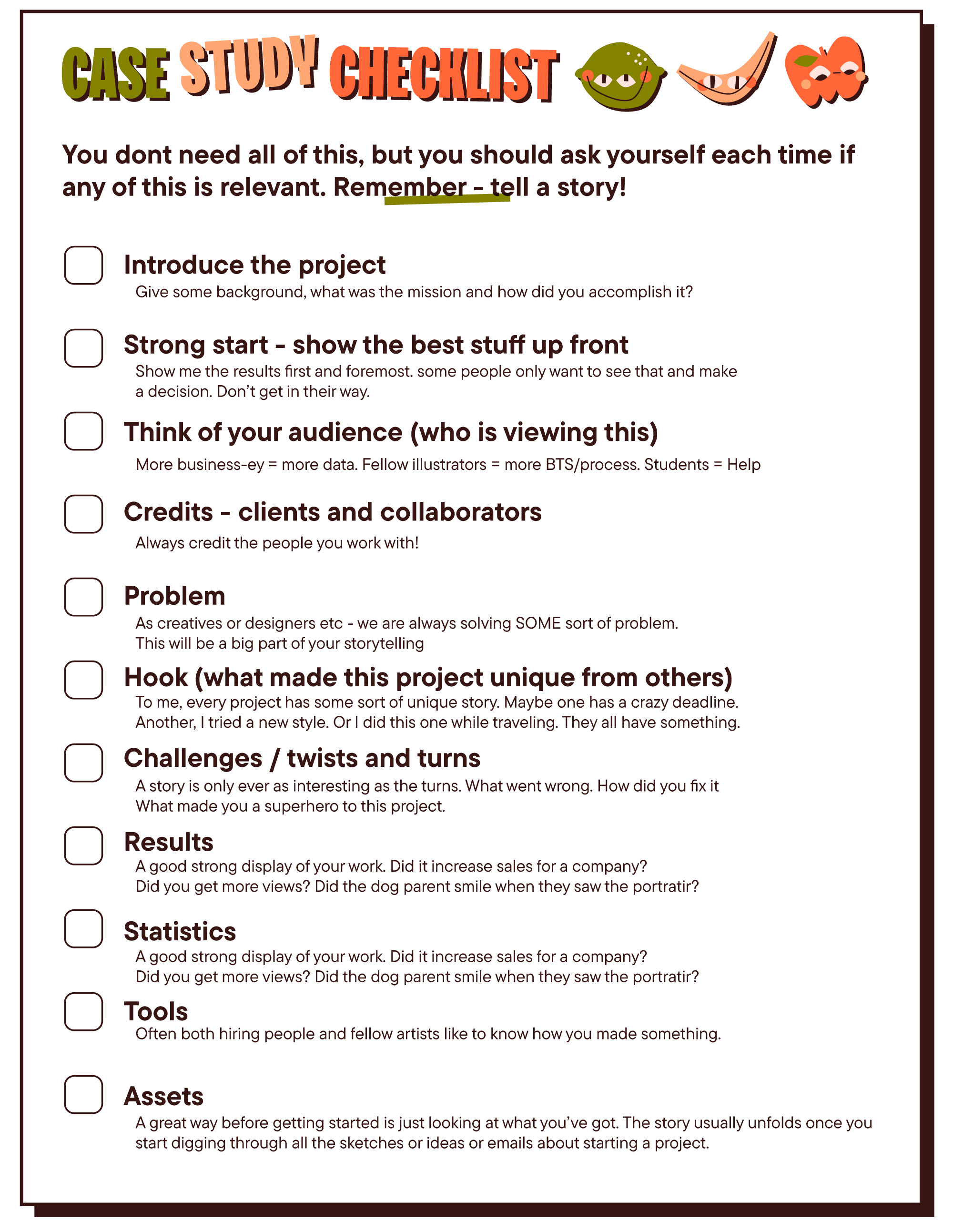
into kind of a checklist and just basic things
to be keeping your eyes out for when you start
making your own case study. So we'll look at
some case studies. We'll break them down. Some are going to
be mine because I can speak really well to them. And then this should be the last video for this
kind of first section, and then we're
going to dive into actually creating a case study. Let me jump to my screen
and show you what I got. This is what I
broke down for us, so I'm trying to
keep things really, really simple for you. And more importantly, for me, this is the same process
that I basically developed for my
own case studies. So every project every
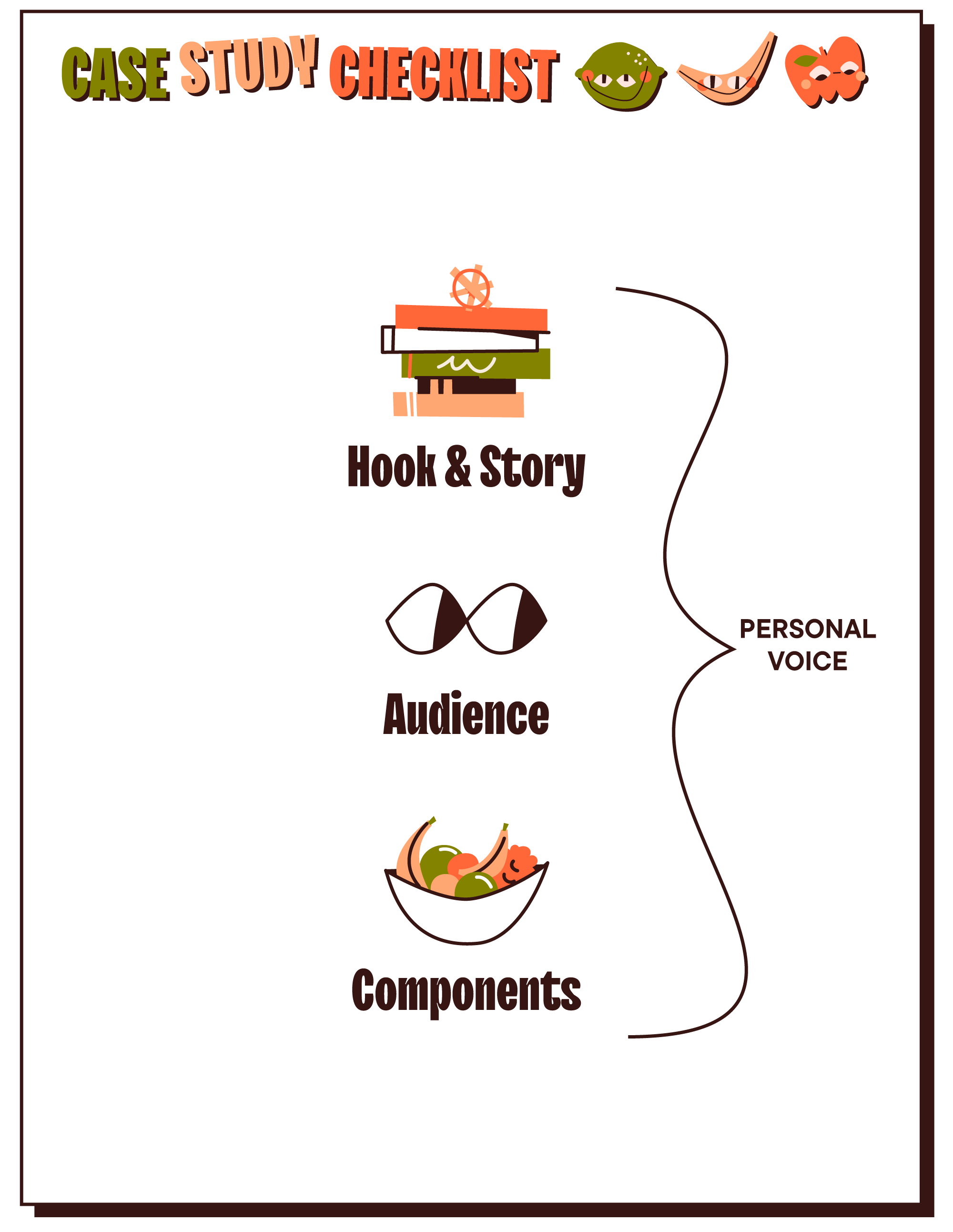
Kase study should have, I think, at least these things. You have a hook and a story. So for me, every project
that I've ever worked on, I can rant and ramble about something unique and
special that happened. There's one project where
the licensing was really intense and the budget tripled without doing
any extra work. And that's a really
great educational thing if I'm talking to more green designers and I want to help them understand
things about licensing. I've got projects that came
in a really quick deadline, so I had to make really
quick decisions, and it was a little bit
sloppy, but then as a result, it came out really cool
because those constraints bred a lot of cool creativity. I've had projects where I've worked with new tools
for the first time. I've had projects that I've had really great collaborations. Again, every project
for me has some sort of special little sauce to
it that I can speak to. And so, to me, that's always the starting point for any case study or writing of a project. Once I have that hook and story
figured then I move on to my audience because now I want to specify it
for a certain type of person that's
going to view it. And this audience it
could be students. It could be people that are going to buy something from me. It could be somebody
that's going to hire me. And then the last here
is the components. So now we know
what our story is, we know who we're appealing to. Now we kind of dive
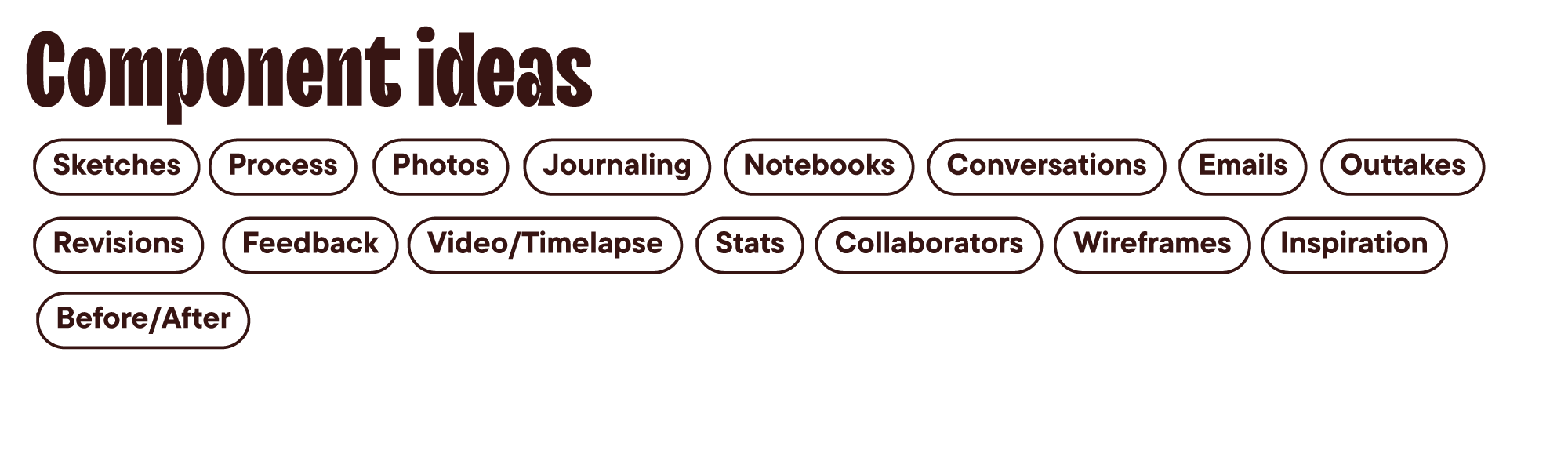
into our components. And those are things like our
images that we have text, blog write ups, maybe we've got email exchanges that we've
gone through with the client. Like, you kind of start diving into what you've had
from that project, assuming the project
is finished. So for me, that usually looks like diving back into
the first email, seeing how the
conversations went, making notes about that,
looking at my folder. Do I have photos on my camera roll from the
experience? Do I have sketches? Do I have early
journalings and drafts? And now I got all these kind of puzzle pieces and components. I can move them around to
build the perfect story. The last bit of this that's really important is that all of this should be done under the umbrella of your
personal voice. So you shouldn't be
trying to fake anything. You should be trying
to come through as authentically as possible.
We are creatives. We don't have to be
perfectly spoken. We can be whatever
we want to be, we should shine
through our work. So everything we're doing should be through
our personal voice. Over here, we don't
have to dive into this, but I'm going to attach
this for you for reference. And it just dives a little bit deeper into all of these things. This is what I've
kind of ripped out of my case studies as I've
dissected them for you. And again, I'll attach that, but I'm probably
going to talk through this as I go through
the case studies, so I wouldn't worry a whole lot about me boring you with
reading it right now. Stopping this video here
from the overview of it, and then we'll section
on another video of each case study so that you can skip ones if you
don't want to see them or you could revisit
certain ones that you like. It'll just make organizing
a little bit better. So I'll see you in the next video where we'll
dive into one specific one, and we'll go through
them all individually. All right. See you there.
6. Example 1 - Rocket League: This is my case
study for a project an animation project that I made for a video game
called Rocket Leak. I was hired by Intel
to work on it. Again, thinking about my hook, this one was very collaborative. The timeline was a
little bit tight, and there was a lot
of creative freedom, which was a little
bit stressful, but it made for sometimes a
little bit of a challenge, so I had to narrow my own story. So I'm really kind of trying to tell the story through
this project here. So right at the top, I'm showing the video and big, big screen. Okay. As I move down, like, if nothing else, I want them to see the video because that is
the final product, that's the final result. After that, I'm going into
my metadata as usual, and I'm talking pretty
briefly of, like, Collegiate Rock League
32nd animated Intro. I'm talking about the
client that I worked with, giving a little bit of context
that this is client work. I'm always giving my credit to artists that I worked with. One of the other big hooks
to this project was, it was based off some
fan art that I had done seven years earlier that
ended up coming back around, um and they saw that fan art, and they hired me as
a result of that. So I actually I am
mentioned at the top that I made some fan art in 2015, and then they asked
me to do My audience, in this case, is
not other gamers. My audience is art
directors and animators, so they're not always going
to know what Rocke League, so I'm explaining
that a little bit, because I don't want
to just only appeal to people that already know
what the video game is. Diving into the
concept in the story, my concept of my story
is that this hero, the purple car is
late for school. It's got to get to class, and it's spent too much time
choosing its different hats because you can choose
different outfits for your car and the video game. And it dashes off and
has to get to school. I'm saying that
stylistically want warm things, friendly feel. This was all stuff
that the art director kind of mentioned
and we agreed on. And so this reference
came to mind. So I'm bringing some references, some mood board,
some inspiration. And I had this visual
from this movie, an extremely goofy
movie where Max is trying to get to school
and he's jumping over cars, and he's like late for class and like his bookbag is like, spilling papers out
and all that stuff. Statistics. This is something
that I've mentioned before, but showing the results. I got a ton of views. It
was really successful. And more importantly,
I'm explaining that this project was trusted to me by Intel to be seen
by a lot of people. So I'm not necessarily saying that I helped them get
these views. Not at all. What I'm saying is
that they trusted me to make something that they knew was going to get
a lot of eyes on it. For me, I'm trying to
educate a little bit, people that might not exactly know how much
work goes into animation, but they do want to
hire me as an animator. So I'm showing, like,
this is why these things cost so much money because look at all of the work
that goes into it. As a result, that's
also really helpful for earlier designers or animators that don't really
know the process. It's helpful for
that, too. It's more sharable if I'm sharing
more education around it. So here's my storyboards. I'm talking about
some cool stuff where the pink line is used
as a focal area, so that's kind of where the eye is going throughout,
which, again, to a really seasoned animator
or designer, this is goofy. Like, they know this, but
that's not who I'm speaking to. That's not my goal here. So I'm okay with kind of dumbing down a little bit
of the process. Another big project
was that these cars in the game are really
well known cars as almost like characters
in a video game. And so how could we flatten
these designs down a lot, but still let them
be recognizable. And that was a really
fun challenge. And so I have some images here of this is what
the car looked like, and this is what
I got away with, and this is kind of how
I got to that point. That trust was really important
that I got to do that. Honestly, I could afford to even have a few more screenshots of the game to show the connection
that I have to the game. Like, this scene is entirely from the Rocket League world. In fact, let me just type
that in so you can see. So these are the
sort of stages or worlds that they
play the game in, as you can see, they're
like these arenas. I think I actually
should probably add some more of that so people can see that these
were inspired by that. This is a layout of all of the
different university areas that were important that
we got included because there's all these
different teams and collegiate leagues
that are going to be playing that they wanted to
make sure that they included all these different sort
of landscape buildings. So that's why I
have these in here. And then, as always,
I have more work, if you want, and then got
a project let's contact. My own honest critique
of this is that I think it's really and I would probably actually show a
little bit more reference to the actual game, and I would probably want
to also talk a little bit more here about why these
buildings are unique. But that's the Rock
League project. Let me do another one for you.
7. Example 2 - Readerly: This is the case study
that I worked on. It was an illustration
project called Reader Lee, and I will share
that with you here. So the overview of this project was somebody came to me a
brand called Reader Lee, who was kind of trying
to reinvent the way book recommendations and star rating systems
and stuff are done. So many of them on things like Amazon or New York Times
top bestseller list or sponsored or they're kind of AI generated
or robot reviews. It's just not a very authentic way for reviews to be happening. So it's not very
trustworthy. So that was kind of the core
of what we were doing. So right at the top, I'm strong with the
work that we did. To me, this was
the most important and special image
that I created, which was just somebody
handing a book to somebody. And, like, is that not the best recommendation
you've ever gotten? Like, an old beaten
up, tattered? Maybe it's all got
notes all over it. Like, that book going
from hand to hand is like the best recommendation
you can get for a book that you know it's going to be a good book to read. So to me, this is the most
striking image, which, again, you know, you want to show your work right
up front, final image. And then I dive into
some basic what I'm calling metadata
or description. So I'm saying this is
the name of the project. It's a branded
illustration system. I'm saying 12 animated
illustrations. So I'm being quick and punchy, and my hook to this project, there's maybe two hooks that
I really like about it. One is that we did
scalable illustrations. So we did illustrations
that were for super wide screens as well as really narrow
mobile screens. And the other thing that we did was we did a little bit of cool systematic
programming where we were injecting book covers into the illustration
with a little bit of code so that the illustrations
were kind of dynamic. And so those are some
of the things that I'm talking about
throughout this project. Book recommendations redefined. So I go straight
into the work and I show all of the work
right out of the gate, and just want to
start with the work really strong.
Strong and simple. Then I'm moving down,
and I'm talking about the brand pillars
that we built around. And I'm talking about
that we built our own community, disruptive
and inspired. So now I'm showing a
little bit of process. So this is basically now I'm getting into
my components, right? I have process. I'm showing a little bit of
behind the scenes. I'm telling people how I was thinking, how we
came up with this. This is an educational
component. And I'm talking
about a little bit of strength that I had with the project where this was the visual library
that we came up with. And the reason why
was because there was a lot of handoff
to this project. And so other artists
needed to be able to use these assets to create
things. Generated imagery. So this was one of
my hooks, basically, was that we used some CSS and
masking to be able to put different books into the style, and that was a cool challenge
because it wasn't perfect. They were cropped, so it
lent itself to the style, and that was a fun thing that I wanted to
kind of brag about. This is the responsive
design part that I'm talking about. This is for wide
screen, smaller screen, and smallest screen, and
they kind of all have those. And then diving into
more process and just showing the way that
I was working with it. So if I were to jump back
over to my checklist, my hook, we defined, right? That was the generated
imagery that was neat, as well as the
responsive things. Those were the main
things I wanted to talk about in the project. So I kind of framed the whole
case study around that. My audience was to other art directors
that might hire me. So I'm being brief. I'm
respecting their time. The case study is kind
of short and punchy, and my components were
mostly my imagery, but as well as some
behind the scenes. How we came up with it, a
little bit of backstory, as well as showing
off that feature of the generated
imagery and showing off the feature of the
responsive design. And I would argue that I
could actually put a little bit more of the responsive
design into this, but you can see it's like these three different This
is the biggest one. This would be the
smallest one, and this is somewhere in the middle. This is a much more
interesting way to share the work rather than just simply one image or just the images with no text at all. Let's move
on to another one.
8. Step 1: Introducing Our Project: Okay, we made it. We're
finally going to actually start our case study or
I'm going to start mine. Hopefully, you're going
to start alongside of me. This lesson is going to be
introducing our project. It might be reintroducing
it to ourselves and kind of remembering what
made it special or maybe it's a project that's
more on the top of mind. But ultimately,
I'm going to take a couple minutes
just to introduce you to the project so that you understand why
it's important, and then you can follow along with, you know,
the whole thing. So I've mentioned
a couple of times, but for what I'm
going to focus on for my case study is this
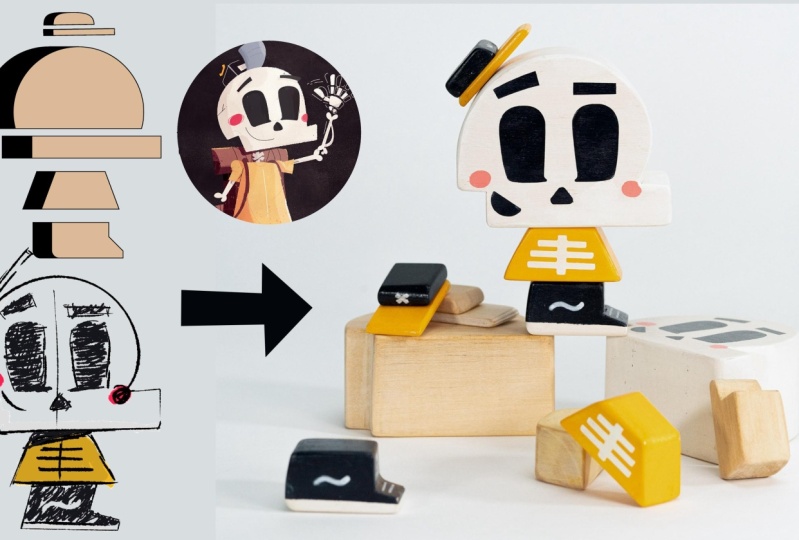
wooden Scully toy project. In fact, I have it's this wooden toy that I've
loved so much that I made, and he's got five different
pieces that I'll stack up, and I'll share my screen and
show you more in a minute. But this project is really important to me for a bunch
of different reasons. Two main ones are that it was really
personal and really fun. It was really difficult.
I didn't know a whole lot about what
was going into it, and it sold out really good, and it was a personal
piece that I shared. Normally, I share a lot
of my commercial work. The other thing that
was really nice and important about it is
that I want this case study to kind of encapsulate
all of what I went through. It took me, like, almost
a year to make it. And I also want the case study to potentially get me more projects like this
maybe on a commercial basis. Maybe a brand can
hire me to make a toy for their Christmas gift
or something like that. So that's what the project was. The project basically was like me figuring out how to
make these wooden toys, having never really
worked with tools before, having never really
painted before, and just sort of piecing
it all together and figuring it out and finding
a way to sell them. And so much of the magic
sauce that came into the project was that
I realized halfway through that these are
not going to just sell themselves because
they're really well done because they
weren't that well done, but they were worked
on really hard. And so I decided,
Okay, I'm going to have to kind of
shift my focus on sharing a lot of
this and showing people how much effort
is going into this, and they'll want to kind of buy the process, not
necessarily the product. So let me share my
screen and show you so this is the project, and this was the
shop page that has a pretty good summary overall
of what the project was. And again, just quickly trying to show you what
I'm going to work on, and then we'll kind of dig into, like, the beginning of the
process of building this. But I'm basically, you know, I've got this project
that feels really good. I shared a lot of the process
when I was making it. Here's some sketches, and these are things that
I'll be thinking about as I want to
build a Kas study us this page is not a Kase
study by any stretch. This is just the selling page. It just so happens that I shared a lot of
the process during the selling because that
was sort of the point. But I made, and this is what
I want to make a project of. And I want something that
is pretty encapsulating. I want it to show all the
effort that I put into it. I want it to potentially help me get hired for new projects. And I also just wanted
to be sort of a capsule to remember this
really great project that I worked on
that I love so much. And so just capturing
that moment and that energy is also going
to be an important one. But yeah, we'll get
into all that next, but that's the project that
I'm going to be working on. I want you all to figure out what the project that
you're going to work on is. Again, it can be a
little tiny project of just one drawing that you
did that you're proud of, or it can be a really huge
blown out thing that was, you know, a whole bunch of billboards across
the whole city. Whatever the project is, as long as it means
something to you, the goal is that we're just
going to share it with that intentionality and build
a really cool case study. So that's what we'll do
in the next project. We're going to go through
our list that we remember, and we're going to
kind of run through this whole process with my
Scully project in mind, and we're going to
build the case study together and sort of figure
it all out as we go. And by the end, we'll have
a really cool project. So see the next video where we are going to
dive into this hook and story audience and
components for MSculiPject, and you're going
to be doing that alongside with whatever
your project is.
9. Step 2: Retrospective: Retrospect. So anytime I'm
starting a new case study, the easiest way
for me to get into the mindset of it
because maybe it was a project that I worked
on six months ago or a year ago, or two years ago. I like to do a retrospect. I like to dig through the
files and the folders. Like I've said,
maybe the emails, the chats that I've had with
friends about the project, and just get back
into that mindset of what made the
project so special. The easiest way to
do it is just open up the folder of the
project that you worked on or to go back
to the notebooks that you were writing if it
had something different. But for me, I'm just going to
dive into my Scully wooden toy projects folder and
start looking at things. Start trying to
piece together a bit of a story just
in my head there. And this is almost
like the step zero. You know, step one is next, where we're going to
start writing things down and putting stuff together. But right now, we're
just sort of taking inventory of all the
things that we've done and getting back
into that headspace. So it'll be a quick little
lesson, if you will. And really, at this point,
we're in the process. I'm going to show this
is how I would do it, and you're right
alongside of me. So hopping here, I've got
my Scully wooden project, and it's a folder that is
relatively unorganized, but there's some
stuff going on in it. And I've just got things
like the process, concept imagery. These
are three D things. I've got a whole three D folder, thinking about, like, oh, this was like some
really ugly stuff that I was working on just
to get the ideas going. Some of the texturing
that I did for some of the three D models. Again, these aren't all
things I'm gonna be using, but I'm just going
through and looking. I had packaging ideas, so I had this
certificate card that I would give that would number
them. Bags are really cool. This was, like, the dielines of the screen printing that
we did for the bags. Embroidery that we did. There's
so many different things. I'm just thinking like,
Oh, yeah, that packaging. I almost completely forgot about the packaging aspect of it. YouTube videos that I made,
I got all these thumbnails, different YouTube making ofs. So these are going
to be helpful. This will definitely be a
chapter for me is, like, helping get it sold
or marketing it, so to speak, would
definitely be a chapter. So it's kind of like
starting to write down some of these things and just
jot down ideas like, Oh, yeah, the making
of the YouTube videos. It's definitely, like,
a section of this. Again, continuing to think
about what's my hook, what's the audience,
looking at this list, too. All these different
things like, Oh yeah the problems
that popped up. Like, I know under process, I've got the skull magnets. Like, this was kind
of a twist in a turn, the hat wasn't sticking
to the head right, so I had to figure out these
cool magnet situations. Like, this is definitely,
to me, going to be a chapter or I say chapter, just a little section with
a heading that says, like, magnets or problem number one, and just talking about how
I worked through a lot of the problems because
that's important to me. More photos of it in use
from people that bought it. I made just, like, random promo things, or
just so many things. Even in my photo reel or
whatever he gets called, it just like random
pictures of, like, this was when I was trying
to figure out how to paint, and it was coming
out really bad. These are just going to be handy because it's
just a reminder of what we went through
when we made the project. You always want to
be capturing things because you never know when
it's going to be handy. Like, I didn't even end up using this cardboard box concept. We ended up going
with the soft bag, but it's just cool to
see this and talk about, like, the way that kind of thought of all these
different things. So photo like this
is cool, right? Like, it's striking in
that it's a nice photo, but the photo is so much
nicer when you see it in context and in contrast to
those ugly process photos. Like, to know how you got here makes this photo
that much more striking. So I'm going to make
sure with my case study, yeah, I'm showing this up front because I want to show
the final product. But then very quickly, I'm showing something
maybe closer to, like, this where like,
This is how we got here. And then all of a sudden,
the question of, like, how did we get there and how challenging was it is that
much more impressive. The project as a whole is a more impressive
thing to read about. Context and contrast, I think, for me, is going to be a big
part of this case study. So as I'm doing this,
I'm jotting down notes. I'm writing down I'm seeing those photos of me down
in the studio with Jeff, and I'm like, Oh, yeah,
there were some twists and turned in late nights. And also, like,
there's a cool chapter to transforming his
basement into a workshop. So I'm going to make all of these sort of almost
like posted notes. Like, I got to post a
note about animation. I get the post a note
about the packaging. I got to post a note
about learning the tools. I've got to post a note
about Stop Motion. And I'll start kind of putting those posted notes and seeing
which ones are important, which ones are not. Once we've compiled,
like, we've taken, like, a good look and we remember
the project really nicely. We should start having an idea in our head
of what our hook is, and I'll get into that
in the next video with the video called The Hook. But I'm starting to already
realize, like, Yeah, I want to show a lot
of behind the scenes, and I want to show
all the effort and energy that went into it. And I really want to show
the twists and turns, like, the things like the magnets or not really being able
to paint the face well, so coming up with a cool
engineering process around that. So anyway, I'm going to start
writing down some notes, and those notes are going to be, like I said, the kind of
posting notes of just thinking about themes
and ideas, chapters, titles, sections, thinking
about the project, getting refamiliarized with it, reacquainted with it,
getting ready to start writing about it and to start compiling some
of these things. So, bear with me. Follow
me into the next lesson, and we'll keep it moving.
Alright, see you over there.
10. Step 3: Finding Your Hook: Hook of our project is a
story. It's the core of it. It's what makes this special. And again, every different
project has a different hook. For me, I think about a project that was a really
tight timeline. That was the hook that
we got it done in time. There could be a project
where I had to manage a team. That's a hook. A
hook can be simple. It doesn't need to be
a really big deal. For me, and the hook with this project with
the Scully project, it's going to be I didn't
know what I was doing. Somehow I managed
to make it work, and I shared a lot of the
process out in the open. That sharing actually,
I think, is what helped these products sell.
That's my hook. So I want to show you how
I kind of got to that, and I want to help
you get to your hook. We remember this is step
one. Here's where we're at. We're gonna talk about
our hook. So I pulled in these as a reminder as I'm in my kind of
Kase study document, and this is the
document that I'm using and will use to
build the K study. It's not the prettiest,
and it's kind of ugly, but it's the way that I do it. I will put a disclaimer. I don't think I'm
the best writer, nor do I have the best
method for writing. And I trust that
you all probably actually have better
methods to that. So I don't need you to mimic
my way of getting ideas out. This is just the way that
I do that. And hopefully, it's a very universal approach. So I'm starting to
write things down. And basically what I'm
doing is I'm dumping. I'm just dumping text, and I'll make this
a little bigger so everyone can see
that much better. But I'm just dumping this
stuff out, and I'm writing. I've already done this
because you don't need to watch me I'm not
good at typing. You don't need to
see me doing that, but I just did it
a half hour ago. My hook is becoming I didn't
know how to make these, but I wanted to, and so
I did it in the public. And in fact, it was actually
the way and the reason that was the reason why they sold by bringing people in
on the process. So I'm going to start
bolding things that I like. I might turn things green,
I might turn things red, but I'm just going to mark
this document up for myself. People saw how much
effort went into them and why they
were a premium price, and they sold out in a few days. This might be a cool statistic that I jumped to eventually. And then I kind of start
diving into my audience. The components, my
overall thoughts. And again, sort of a stream of consciousness that's
happening here. I wanted to make
wooden stackable toy that's collected by my
closest supporters. That was the goal
of this project. I want to try selling a physical product that was
a premium price. That's definitely a part
of the story as well. So I'm figuring out the hook. Trying to find out what
makes this interesting. So what were the constraints? Well, I'm learning
something totally new. Never used wood before. I've never painted
before. I also haven't sold anything
at this price point. So these are the new things.
These are the twists. These are the turns.
The solution? Well, be scrappy, figured out, operate in the open
transparently, authentically. Your answer is going
to be so different. Your answer might
be, how did I get the car from the garage
into the basement? Well, I had to get friends, and we had to make
a pulley system, and we had to take
the doors off. Like, I don't know
what your project is. I don't know what your case study that you're building is. But the questions should remain. What were the
constraints? What was the problem? What
makes it interesting? How do we solve those problems? For me, the results is
another great question. Well, I learned a lot of things. We had twists and turns, and I made content that was
inspiring to people. That was really the goal. The inspiration for the project, this might be something
that I'm going to end up writing about, talking about how
Scully can fall over, and his head can
flip upside down. So when you rebuild the toy, you can stack his
head upside down, and that will help
inspire you to think of new ideas and think a
little bit differently. I want to give a
little bit of context about the toy itself, the same way if you
were working on a design for a beverage company, you'd want to at least
give that context. You would show the design
for the beverage package. But you would also want
to just say, like, Hey, this is what this
beverage company is all about. They are geared towards kids
or they do this or that. Like, you want to
give a little bit of information that way the person seeing it has context of why it's
impressive that you did it. Maybe this particular thing is only going to
be screen printed, and so it needs to be a
certain amount of colors. If you didn't give that context, people might be saying, Why
did he use so few colors? Like, it's not that striking. But then if they see,
Oh, it's because he was only supposed to
use so many colors, then suddenly it's that
much more impressive. So giving context is really
important to any project. Now, I'm basically writing
this again, right? So I've written a bunch
of my nonsense notes, and now I start
repeating myself. I do this a lot in these
types of documents. What was the hook
for the project? And I'm making it
simpler. Every time I'm repeating myself,
I'm making it simpler. Hook the project was I've
never done this before. I'm going to be doing
it in front of you all to show you
the whole process. They sold out quickly
in record time. They were a premium product. That is the hook.
I've got issues. This is more questions,
asking myself questions about the project, interviewing
myself, basically. What issues occurred? Well,
I select the painting. So what was illusion, we use stentils. That's a cool chapter. That's a cool section. The hats were not balancing on the head, so we put magnets in. That's a fun solution. That's a really fun
solution to me. I wasn't great at woodworking, so, I mean, the
design's super simple. People might wonder, you know, why was the design so simple? Well, here's the context. This is the first time
I've ever done it. I would tell people that often so there's
another problem I had. I would tell people like, Hey, I'm making these wooden toys, and they'd be like, Oh, nice. Like, where are you
getting them printed or like, is someone
three D printed? I'm like, No, no, no, no,
I'm making these toys. That was a problem.
So my solution was, I need to show people
that I'm making these. It was when I was telling friends that I was
making toys and they were asking me who's making them or who's printing them. That I was like,
Oh, I need to make sure I take photos of me, like, actually chopping away at the wood because
people's default, I'm learning is that everyone's getting things made three
D printing or whatever. I'm not doing in any
particular order yet either. I'm just putting notes out, thinking of them
like sticky notes. We can rearrange them.
What do we learn? Key takeaways? What can you
learn from this project? And I tell a lot of my
friends that I'm working on a new T shirt drop or
a new whatever it is, I get to tell them this takeaway that I have for my
Scully project, and I'm for me, what I learned is
it's best to share early, often and transparently. So now I'm kind of formulating
a bit of a structure. I'm basically going
back into my questions, bolding things, and making
little statements out of them. And I think I'm getting
somewhere where I'm like, Okay, so I'm going to start
with the story and the concept, manufacturing woes. It's gonna be things
about the magnets in the head or the stentils. That's going to be a section. Communication failure, which is what I was just
talking about up here, people are saying,
Who's printing them? That's a chapter to me. Like, that's me
saying, like, Yeah, this was almost a turning
point in the project. Like, this is a really
important thing. Colaboration is a huge part of this project that
I want to make sure I have just to give my
attributions to all my friends, but also the project
wouldn't have worked without all of the friends
helping me work on it. So that's a section. I
can always delete these. I'm adding more sections to
start than are necessary. Another section is, Okay,
now I've made them. How do I sell them?
And that's been talking about making
the YouTube videos and, like, explaining and
showing the process. So this is feeling like a good structure
for the most part. What I want you to do
for your homework on this lesson is to take a
look at the checklist. You can go off script of
it, but let this guide you. And think about all
of these things, all the problems and
solutions that you had, the context of why
this is relevant. Let me know a little bit of
background about if it's a company that
you're working for or whatever the project had. Like that context is important for me to understand so that I can better know writing
a poem about something. Let me know what you were going through when
you wrote that. Or if you took these black
and white photos on a trip, let me know what
trip you were on. What was special
about that trip? Just a little bit of context is always going to be special
and important for me to know. I say me, anyone that's
viewing this case study. Your only goal, really, with this step is just ramble,
write a bunch of stuff down. We've already kind of
gotten reacquainted with our project in the last
video, thought about it. Now I want you to just
ramble things out, try to start maybe giving
yourself some bolded areas, maybe some headings,
things like that, circle things that are
extra special to you, and toward the end
of this document, maybe make you know, almost a duplicate of it and then delete some things
that you think are maybe duplicated or aren't as
important or whatever. But essentially all I
want is for you to have a Google Doc or some
sort of document that has a bunch of ramblings
of why this project was important and start building a little
bit of the story, a little bit of the hook and what made the project special. Start thinking about your
audience a little bit. Who do you want to
be seeing this? And then the next step
we're going to do after this is going to be
tidying that down, pairing that down a little bit, and then looking at our components and start
actually building this thing. And basically, at that point, it's just taking the ramblings, concising it, rearranging
it to make a good flow, and then putting
on the Internet. But we'll get there next. So see the next video.
11. Step 4: Writing Copy: Time to start writing our copy. Basically, start
building the case study. I'm going to build it loosely
first in a Google document, and then I'm going to be translating that
pretty one to one into my website on Squarespace or even in the Skill Share editor. Mine might look a little
bit fancier on my website, but I don't want that to feel like an unfair
advantage or anything. Ultimately, this is just
about text, images, videos. Storytelling. So here I am. Once again, I'm a
Google document. I've gone through and basically
just cleaned up what I think is going to be the flow of my project and how
I talk about it. I'm going to start
writing some of my notes, and what you might end
up doing is doing it and copying and pasting some
stuff you've already had. But the story is that Scully is a wooden toy that is a friendly reminder
for you to take a break. He's a stackable wooden toy. He might fall over on your desk every once in a
while, and that's a good thing. I want that to happen when
you purchase this toy, and I want it to be a reminder
for you to take a breath, take a break, and just maybe think about things
a little bit differently. So I'm gonna write that
out, and I'll fast forward through this so you don't have to hear my keyboard typing. But Scully's a friend of the
reminder to take a break. He comes in a
stackable form that will require some
simple building. Sometimes he will
fall over your desk. That's a good thing.
Scully's a superpower. You can flip his
head upside down. So if you're feeling stuck
creatively with something, you can always flip his head upside down
when you fix him up. This is also my first time
making anything like it. That's the other big
punch that I want to it. And then simply I just
bold it at the end. He's a physical reminder
to take breaks. So that's the context of
this, and he's a wooden toy. Who is this for? I think it's both for art
directors for me and also for fellow designers or fellow creatives to get
inspired. I'm gonna write up. Simple. So an art director or somebody can see it
and say, This is great. I want Kirk to make
this for our brand. But I also for the creatives, I want there to be lots of depth and extra pages of
them to go into. So that's gonna be an interesting
way of the way I kind of show simple images upfront, and then as you dive in,
you can kind of dig deeper. So my challenge or
my solution is, I don't know what I'm doing. I've never done this before. I didn't go to art school. So my solution was I start
doing what I know best. I know how to make a
little three D mockup, and I know how to make two
D kind of cad drawings. So I start with what I know, and I want to make sure
that I tell people that. Manufacturing woes,
I want the magnets, and I want to talk
about the stencils. So I wrote, when we
started the prototype, we realized it wasn't
going to work out, so we had to implement
these magnets. It was a fun challenge,
and I'm going to make sure that I show the
way the magnets work. This is a great point for videos or some images to show it. And the other one is stencils
for faces. Same thing. What was the problem? Once I started actually
painting the first face, they realized, like,
I'm not very good at painting, period. So how am I going to solve this? Well, I'm going to
use a cricket machine to cut out a stencil that I can put on the face
and then paint inside of that stencil
and then peel it off. So, again, the visual
is right there, and I'm just going to
write a little bit about how it became a problem
and how I solved it. So I may also just put, like,
visual notes for myself. I know that I have because I did that sort of retrospect
at the beginning of this, I know a little bit
about what I have. So I remember there's
photos of the stencils, also the design files. So I have these, like,
pink and white versions. So while you're
going through this, make sure you give yourself notes because then
it'll be easier for you to pull in things later. Communication
failure. Okay. This I think I'll just have
sort of a simple quick call out across the case study that just will be kind
of like a quote of like, Wow, sounds great, but who's
actually printing them? And then discuss a
little bit about, like, this was a
turning point for me. So I'll have a big
quote that says, you know, who's
printing these things? I'll say it's me.
It was always me. And the solution was to make sure that people
saw that it was me. And so I will make
sure that I show lots of photos when
I'm presenting this project of me making them because I want people to know that it was
me that made them. There's also a really
cool little benefit to this is that, as a result, that actually
is what helps them sell. And I think bringing
that up is good. Cllaboration. This is
going to be a section that's going to be
like four little mini sections with all
the different people. So, the first thing
I'm going to do is write down the people
that I collaborated with, and that's gonna remind
me of what we did. So next section,
another twist is basically like, I made these. Now, how am I actually
going to sell them? And to me, this is the part
where I talk about YouTube. And I want to show
all the different thumbnails to the
videos that I made. And just talking overall
about how, like, my sale, my marketing pitch was basically showing how I made them and
trying to inspire people. I think this is a good
point right here. Rather than telling
people that these are expensive and that
they're valuable, I'll show people that they're expensive and
they're valuable. And I'll do that through
all the videos that I made. So for this section, I'm
going to have all of the I'll put visual here. All the thumbnails
to the videos, I think will be a
really great thing, and I know that I
have them all, again, from that retrospect
and that sort of gathering of information. And I'll show a little
bit of behind the scenes, the setup, setting up the
camera, all that stuff. I think it's just
fun for people to see that. The
results were simple. Results are basically they
sold out in a few days. I will have a visual idea. I'll show everybody
sent me a photo of the toy when they unpackaged
it or unboxed it, and they were really
excited and they were sharing it on social media, so I'll share that. I remember somebody reached
out and said, like, when I saw the toy, I wanted it. But when I saw the
process, I needed it. And I want to make
sure that I am able to capture that and write
that in the results. And I think that's
really special. And then for my call to action, I'm basically gonna
say, like, Hey, do you want to work on
this project with me? You can hire me?
Or do it yourself. Like, again, I'm dealing
with two audiences, right? I want to both be hired
by an art director to work on a project
similar to this. But also, I want
people to know that they can work on a project
like this themselves. That should work. I
mean, to me, now, this is a pretty well
laid out with lots of bad spelling mistakes and
not the best writing yet, but I can punch that up
easy. But I've got my flow. I understand my story.
I know my hook, I know who I'm speaking to, and I know why it's interesting. And I have all of my images. And now it's just basically every section has
to have a kind of companion image or two or five or video or some sort of rich media that
goes along with it. We'll be in really
good shape. So I'll try to trim this video
down a little bit, but this is really
the core of it all. This is figuring out our
flow of the case study, getting our copy
written into it, and giving ourselves
visual ideas of what we want to
incorporate alongside of it. At this point, you
should basically have your case study written
out pretty well. You should have the flow of
it pretty decently and you should have a good idea of what you want to show in
each of your sections. So in the next video, I'll
show you how I actually built mine out in my portfolio. Ultimately, like, we're close to done because the core
of the story is there. Now we just need to add
really beautiful visuals and make our copy not as
nonsensical as what I wrote. But yeah, we're getting
there. So let's actually start building it and getting to the visual part next.
12. Step 5: Final Assembly: Here's my site. I
started out real strong. So again, recapping and
thinking about all of the stuff that we've talked about is I want to show my work strong
and big right up front. I want to show the final result, but I also want to hint at
the process pretty quickly. So I've got this
video is what I made. I made a quick 1 minute video, basically showing
the entire process in sort of a mysterious way. There's nothing too linear or honestly even
legible about this. It's more just showing, like,
here's the cool product. Here's what I made.
I talked about it. I did this, I did that. Here are all the different
ways that I made it. Sacablesculi is what
I chose for my title. And my kind of subtitle
here is Wooden Toy. I put it under merchandise, and I wrote handmade Toys. Stop Motion. So this is me just basically listening
out what I did. Again, we talked about, like, that quick metadata at the top, just talking about what I
did, giving my credits. The client is myself.
And then my summary. So this is where
I'm starting to try to entice the story, right? So I'm saying summary, 20
wooden toys all handmade with absolutely no idea how to use a saw or really how to paint. How am I going to
sell these at 150 apiece with having never
told anything before? Well, by bringing people
in on the process and the struggles with
having no idea what I'm doing by sharing
authentically. So that is kind of like my quickest pitch
that I have, right? And that's what we
talked about. Those are the twists and turns
that I thought about. It's all this stuff in Google
Doc from the previous one. And actually, why don't I pull that Google Doc up just
so that we have it? So it's all in here, right? It's all by bringing
people in on the process. They sold out in
a couple of days. I didn't know how to make
these, but I wanted to. I did it in the
public. It's all here. It's all in our kind
of questionnaire. It's all pulled from this
stuff that we thought of. I wrote it out, and
then I'm really just basically translating
it over to my site. So I came up with a cool image. I just like to kind of break up sections just
because legibility, like, again, I'm not
the strongest reader. I don't comprehend, like,
long things super well, so I try to break it up
into digestible chunks, and that's sort of the nature of the Internet anyway, right? So I have titles on the left, the concept, a
creative reminder. Scully can flip his head literally to look at
problems differently. The stack toy is a
physical reminder. Again, really simple here. And then I'm showing the work. Like, this is my first shot of, like, boom, here's all the work. Really impressive. Art director, want to hire me?
Let's do this thing. Like, I can do this. I can
make shirts. I can make pins. I can take photos.
I can do packaging. I can think of everything from concept, all the
way to execution. That's a really powerful
statement for me. And then another
really compelling image that I thought
was really cool. And now I've got my concept. The wind will blow the toys
over every once in a while. That's your firm and
miner to break and realign. So I have two images. Now, I'm telling a story,
right? So he falls over. He humbles, and you
stack him back up. And you can stack the different ways you can
stack him with the set upside down or we set
up, telling a story. And then I also just wanted to I will say that I probably
packed a little bit extra into this case study because I'm so excited about it, and I'm really proud of it. I think simpler definitely if I had to give
myself some feedback, maybe a little bit
simpler would be good. But matching twins, I wanted
to show off the shirt. And then this is my results bit that we have in
here somewhere, right? We talked about I decided to move it up a little
bit, but the results. So I moved some things around, which is easy enough
to do, right. I'm just copying and pasting. But there was something about
this that I just wanted to move the results
up quickly, again, because I was thinking
more in terms of, like, the art directors that
might be using this. So I wanted to say,
like, these sold out. These not only are
they fun and cool, but, like, they worked. Sold out in a couple of hours. The rest of them went on
the next couple of days, and I'm showing the
results of the work. And then the story starts,
right? The challenge. I don't know how to use a
saw. I don't know how to use a paintbrush. How
do I get this done? And I show. I'm showing lots of process here. And this is
what's compelling. This is what's making it
an interesting thing. You want to learn more. You
want to see how it's working. At one point when
describing the project, this is the thing I
talked about that problem of my friends being like, How are you gonna get them made? I'm like, No, no, no,
I'm making these things. And so then I'm showing just a really big
captivating picture of, like, look, making them. And then more stories,
right, manufacturing, what we talked
about the magnets, magnetic hats, showing a bit
of the process around that. Simple copy. All the
copy all the way down is real simple,
pretty basic. And also, again, you don't
have to follow this format. You don't have to be you can be more text heavy if
you want or less. I think, in general,
simple is always good. But you don't have to do exactly what I'm
doing by any stretch. But a combination of imagery and storytelling is really what we're
aiming for here. Talking about the stencil
faces as we go down, and then collaboration, which
is another big chapter. I'm color blocking
my chapters, again, just because the
designer in me and also just my brain
doesn't do well with long pages of all white. I want to break it up so I
know and it's easy to skim. So collaboration.
Talking about people I collaborated with,
showing stop motion. And then, again,
behind the scenes. So I always try to
start with, like, show the interesting
stuff that is strong, show it at its finest. Comes in, plays
easy. Simple, loads fast. We can share
this separately. And then process. Same thing,
packaging, boom, simple. It's telling you everything
I want to tell you. Promo animations, I have I've got all sorts
of different stuff. And then new problem, right? And a brighter problem for
me so I made a yellow. How am I gonna
sell these things? Marketing 70% of the battle. And I hit with the video
that I've shown before of, like, Okay, here's
how I make them. And I think that's a
compelling way to show it. And then some behind
the scenes. And then just showing all of
the work I did too, I made a bunch of
thumbnail design. Like, I just want
to show that I did everything as a part
of this project. Like, no stone went unturned. Talking about how I did
it, I built an email list. This is how it went, 17
orders. And then I end. So I end with, like, the final results,
and then a thank you. And then as I go down a
little bit further, as usual, I have more work if
you want to see, and then a call to action
if you have a project. So that's that in Squarespace. You should be able to do this similarly if you're using WIX, if you're using Squarespace, if you're using WordPress, like, whatever it is
that you're using, you can do this on. I also made it in Skill Share. So this is how yours
can look, as well. Not quite as fancy, but it's still telling
the same exact story. So I quite literally
just copy and paste it from my square space
site over to here, so I won't show much new, but just showing that it's the same thing and
it's just compelling. In fact, maybe even less
distracting with, like, less fancy way of showing it, um it really breaks
it down even simpler. But again, the point of this is it's just showing
the process and the project in a more compelling and interesting way for
you to engage with. And I mean, again, this is something that
somebody would share. If I showed just this image, not a whole lot of people
are going to share it. But if I shared this, I mean, quite frankly, even
if I shared this, I think this image is
actually more interesting. Obviously, my results are
the thing I'm more proud of, but this is how I want to
get people to show it. The same way a band comes out with a documentary about how they made their album, it's not because they want
to show you documentaries. They're not documentary makers, but they know that it's a
great way to get you to listen to their album by
watching the documentary, because it deepens the
connection that we have with the art. So
that's what I'm doing here. I'm just deepening the
connection with the art. Again, all the same thing, so I don't want to repeat
myself too much, but I do want to also
show that you don't need a fancy website on Squarespace or something
like that to get this done. Like, this is a very
interesting thing. And in fact, if you
think about back to that tattoo project
that I did for my dad, that was on Behans where it was, like, there was no fanciness. It was just like, picture text, picture text. And that blew up. That was one of the most popular projects on Behans of that year. Again, it was low fidelity, but it was heartfelt. So don't get cought up on fancy is what
I'm trying to say. So the homework for this
lesson is to paint it. You have your black
and white version. You have your Google Doc
version of your story. You have all the images
that you know you want. Now you got to put it
together, assemble it. And don't let the
design get in the way. Just like a good magazine, it's simple, or a
good book, right? Like, we don't the text sideways or upside down or don't get the design in the
way of the story. Just tell the story
and let any images or videos or sketches or
photos enhance that story. That's basic design, right? So just keep it
simple and paint it. And, quite frankly,
at that point, you're done. You're
done with the project. In the following
lessons that I'm going to talk about
is now that we have this big kind of masterpiece of a case study,
what do we do with it? How do we break it down? How do we share it
on social media? Like, we can't share this
giant thing on social media. It doesn't work that way.
How do we chunk it out? How do we keep using
this content in many, many ways and kind of even milk it for months
or years, right? So that'll be the next
lesson. Bear with me, and I'll see you over
there where we will talk about now we
have this big thing. How do we break it down and use it? Alright, see you over there.
13. Bonus Tip: Interviewing Yourself: They've got a mini
quick tip for you. When you are writing out this document to start figuring out your
hook and your story, if you get stuck, just
write yourself questions. Interview yourself
about the project. Try to kind of split your
personality a little bit, write down what made
this project so special and just answer
it. Answer it truthfully. And then you'll say
something interesting in that and then say, ask another question,
Okay, well, why is this relevant
or what is that? And I have a lot of these
questions that I have in mind that are what
were the results? What were the
constraints? What was the difficult time for you? What was the
hardest part of it? What was the easiest part of it? What would you do
differently next time? Just start interviewing
yourself to get you spewing out some answers. It's a really helpful tip
and a really useful tool. If in doubt and you're having a hard time figuring
out what that story is, think about the friction. Think about the thing that
happened that needed solving. That's always a great
way to get started.
14. You're Finished, Now What?: We finished our case study.
We've got it all uploaded. It's all clean, polished, beautiful, and sort of big. Now how do we share it? So this video is
basically, now what? And mostly you're
done with all of your homework and all of
the task at hand here. This section is sort of
just a bonus section of now that we have this
beautiful piece of content, this K study, how do we actually share and how
do we get eyes on it? This won't be super exhaustive, but I have some thoughts on it. I think of our case
study as, like, the master copy.
It's the Holy Grail. It gives us so much content, but it's overwhelmingly
too much. If we wanted to make our
whole case study or if I wanted to make my whole scully wooden toy case
study into a video, it'd be a 20 minute video, and just that doesn't work on TikTok or YouTube shorts
or reels or whatever. So how do we take
this big, beautiful, polished piece of
content and now break it down into
smaller chunks. And that's the key to it, right? Every question and answer
that we've done in our sort of earlier
stages of the process, every problem we solved, everything that we ran
into, every hurdle, every turn, every feature of our case study,
that's a video. For me, the magnets
in the Scully head. That could be totally, like, a 1 minute YouTube short or
a TikTok or whatever it is. It could be a blog post. It could be a newsletter. And I can probably think of ten just in this case study
that I could very easily and quickly pull out to make content that can be
shared on social media. And the goal is always to have those kind of be I think of social media
and things like that, to be like octopus arms that
are going out and, like, reaching and grabbing
people and hopefully ultimately pulling them back to my website or to my case study. That's what I want us to
be thinking about next. Basically, how do you plan
out all of your content? And it shouldn't be too intimidating now because you've already done all the hard work. Now we're basically just taking this big piece and just chopping it down into smaller
things and sharing it. That's the way that we can
share things with longevity. And I know it's
embarrassing, or, like, it feels cringy to, like, share a project more than once. Like, I already
posted about it once, so I can't post about it again. Like, 1,000% you can. There's a great video
that Tyler the creator, there's a talk that he gave. And there's just, like, a quote that I
remember out of it. I'll try to find a link
to it so I can share it. But he's basically saying, Kids nowadays make something they're super passionate about, and they share it once in their stories and never
talk about it again. And he's like, Me, I'm
so proud of my work. Like, I'm going to be
sharing this thing forever. That you're gonna be
passive with your own and just put it
on your story once? Are you thinking crazy, bro? I'm still promoting my album
that came out in June. It's a year. And that's
what artists do, especially like
musicians, right? Like, they come
up with an album, and they spend two
years promoting it. They go on tour
with it. They come up with music videos for it. They come up with rereleases, remixes of song, collaborations. They're not coming
out with merch, so you buy the merge.
That's the point. The point of the
merge is to remind you to go listen to the album. Everything is to go back
to listen to the album. So, for us, we should
be making a bunch of different content
TikToks and things like that to go and
bring people and say, Hey, check out my project. I'm really proud of
it. I want you to come see these wooden skeletons. That is why I am making a YouTube short about it or why I'm sending out a
newsletter for it. The cool thing is that it's
tough to keep saying, like, every morning waking
up and being like, Hi, go check out my project. Hi, go check out my project. No, what we're saying is, Hi, here's a different aspect of the project that you
haven't seen yet, the magnets in the head, using the cricket machine to cut out the vinyl to the stencils for the face, collaborating
with friends. These are all short form pieces of content that I can make, and they feel like
new pieces every day. But ultimately,
they're all pointing back to the main case study. So it's a refreshing way
to have lots of content and to be able to share a lot
and often use ultimately, on the Internet nowadays, like, that's what we have to do. We got to break our stuff
down and share it often. So I just think that, like, seeing things as, like, a pyramid is a
good way to see it if, like, you've got the
case study at the top, and how do you break it down into a bunch of little
tiny things and then schedule that out and make sure that you
can share, you know, if you can share
about your project three times a week for a month, like, that would be a huge deal, because I think maybe
a lot of us currently are sharing about
a project once and then letting it kind of fizzle out because we're intimidated or nervous or cringing at the idea of asking people to see
our work. That's all. No homework out of this video, I don't think, other than, like, my challenge would be
to how can you take your case study and
break it out into ten different pieces of
content and share them? Um, so there is homework. I've done that homework. But otherwise, yeah. I got a couple other
little boos videos, but we're mostly done, and now I just got little tips and tricks and things like that. So see you in whatever
video is next, and thank you as always.
15. Fitting Social Media Standards: Alright, we're coming
up on the last couple little quick bonus videos here. It's important that we you know, now that we do have this holy grail that I keep referring to it as is the main
content, our case study, we're gonna make smaller, more digestible pieces of content to pull out of it to share on social
media and stuff like that. And I think oftentimes what people will do is they just take those and they kind
of duplicate it, copy it and paste it
across Instagram, Tik Tok. Even the difference between
like, YouTube, shorts, Instagram reels and
TikTok TikToks. There's a different culture,
and we want to make sure that we're fitting that
culture if we care about it. I mean, there's nothing
wrong with just, like, throwing it up on YouTube
and hoping for the best. But if you're really
going to do it, there is a difference. And I don't really know what
that difference fully is, and this isn't a
social media course. But in general, you know, TikTok is more about
storytelling and conversations and sort of very transparent
and low fidelity. And so maybe you're, you know, editing your short form
content in one way for that. And then for an Instagram reel, you're making it a
little more polished, edited to the
music, more upbeat. And then YouTube shorts. I don't know what
the heck those are. But my point is that,
like, we are artists. We are creators. So we should be creating art for each canvas. So whatever we're posting on
these different websites, we should be understanding that there's a certain
vibe that we're trying to blend in with
or, you know, newsletters. Like, that's a whole other
thing or a blog post. These are ways that may be
written in different ways for your different
types of users and viewers and your fans and
your audience, as well. Kind of know your audience
and know where you're uploading things
and understand that every different website and
social media platform has a different user base and what people are interested
in seeing and hearing. And you kind of
want to make sure that you adapt to
that a little bit.
16. Thank You!: That's it. I think this will be my last video of this course. I hope that by the end of this, you feel empowered to share
your work in a really fun way that is maybe a little bit more valuable than the way you've been doing
it in the past. And I hope you also feel like you've got a little
bit of a template in a format to be able to do it each time, so it's
not intimidating. And yeah, I've got
other courses. I have a really great
course on character design, and I get another one
basically just on, like, digital
illustration process. They're both staff pick and they've been really well
received and reviewed. So feel free to check those out. Comments, things like that. You can message me on
Instagram or you can email me or you can
message me through here, whatever is fine by me,
but I just want to help. So let me know if
there's any ways or questions that you have
or ways that I can help. I'd be happy to. Reviewing
the course is really, really helpful for me, as well. So if you enjoyed it and
you want to review it, that'd be huge. I don't know. I'm still trying to get used to all this stuff and teaching, so hopefully this is useful, valuable and fun, and I can't wait to do whatever
I'm going to do next. And thank you very, very
much for taking the course, and we'll see you
soon. Alright, later.
 Kirk Wallace, Freelance Art Director & Illustrator