Transcripts
1. Intro: Well, if I'm brutally honest, there's nothing I like more
than creating portraits, mostly of people, but
equally of dogs having spent the past decade working with
hearing dogs here in the UK. And I've won as many awards, and I'm as well
known for our dog portrait photography as
I am for the human form. And in this class,
we're going to take five ideas for photographing
dogs and their owners. I'm Paul Wilkinson, an award winning photographer
based here in the UK. And in this class,
we're going to take the simplest of kit, one camera, one lens, one dog, one owner, a bag of
treats as it turns out. Quite a lot of dog slobber, and we're going to go
out and see what we can create just using daylight, the environment, our
eyes, and our ideas. For this class, we have Elton, who is a hearing dog
stud, lucky boy. And we have Sarah, his owner, and we're going to
take the pair of them out into the village, no more than a couple
of hundred meters from our studio door and just
see what we can create. The weather today, well, the weather today
is up and down, but what we do know is
it's going to be hot. It's gonna be over
24 degrees. Now if you live in other parts of the world with hot climates, 24 degrees doesn't
seem like much, but that is the threshold
for dog welfare, where we have to start
being just a little bit careful of how
much time we spend, particularly on hot tarmac
or out in the open sun. So we're going to
keep an eye on that. And what I want to capture in this class is the
joy of the dog, the beauty of dogs.
I've got a dog. I love being around dogs. And so it's it's a really
lovely thing to be able to create unique
and stunning portraits. So today, I want to create interesting and beautiful
pictures of Elton, he's a gorgeous dog, but also
the relationship between Sarah. Four years ago, I worked with Sarah to take
pictures of Elton as a puppy. I was working with hearing
dogs. We were out in the open. It was during a lockdown, if you remember, a small
little thing called COVID. We were out in the
open taking pictures. And little did either
of us know that that one puppy would become
Sarah's lifelong companion. So I want to create
some pictures that capture just a
little bit of that. We're going to find some
interesting lights. We're going to find
some unique locations, and we're going
to do it quickly, and we're going to do it safely, but we're still going to
create some amazing images. Without any further ado, let's leap straight in to
the first of those ideas.
2. CH1 - Using An Alleyway To Create Depth: So for this first idea, we're just going to
use an alleyway. Now most of us have some
kind of alleyway near us, whether it's a green lane, whether it's a
footpath, or whether it's a brick alleyway in a town. This particular
alleyway is cobbled, and it has some pretty
old walls in it, but it's in our village and it's less than 100 meters
from the studio. And of course, timing
is part of the puzzle. We need to do things
that the dog is comfortable with and that
we are efficient in doing. So I've seen the alleyway, and the way the
light is running is absolutely Perfect. Oh, nearly. We've got a bright overcast day. But what do I mean by that? I mean, there's
cloud, plenty of it, but it's quite thin cloud. So we're getting
shadows. We've got shape to the light. You
know where the sun is. If you look at the
sky, you can see it. But it's cast in these
really soft edged shadows. And when the overcast just increases a little,
the contrast levels, the difference between
the shadows and the bright spots diminishes,
which is perfect. So the alleyway is pretty good. They're going to frame along the path. I'm going
to take the dog. I'm going to put it in a
position where all of the lines, the lines of the
edges of the cobbles, the lines of the
tops of the plants, and the lines of the
walls all sort of form this corridor that disappears
into the distance, and that helps bring
the eye into the shot. Now, the problem here is
that the sun is coming from camera right
across the walls. So one wall is in shade and one wall is in bright sunshine, at least it is when
the clouds pass by. So we're having to kind of just think that through a little bit. So what I've done is I've found a position where the camera
is low on the ground. I'm going to climb
into the dog's world. I always think that's
more exciting. So the camera is down
low and I've pushed it across to the side of
the path into the sort of foliage and things that
are down there to try and eliminate any of the wall
that is lit by the sun. Why am I doing that?
Because if I include that in the frame, it's
going to be bright. It's probably going to blow out. So I don't really
want that to happen. I don't mind a few bits and
pieces showing through, but I certainly don't
want as much wall on the left hand side of the image
as there is on the right. Got the camera down low. Now, that gives me
another slight problem. It's lovely down there.
It's a different view. It's the view of the world
as the dog would see it. But now if I tip the camera
back to point it at the dog, I've got sky in the distance, and the trouble with
a bright overcast day is that just goes to white. So I'm going to have to
just figure my angles out. And if you in the video, you can see me sort of
moving the camera around, trying to find that spot
where it's still low. It still has all of
the lines I wanted. It still feels like I'm
in the dog's world, but that bit of sky hasn't
dropped down into the frame. It's a balancing act as it
always is in photography, but those are the things
that are going on. I've got the leading lines,
the floor, the dog's world, that sort of
anthropomorphic thing going on with the
characteristic of the dog. But I'm trying really hard
not to let the sky creep in. For this shot, we've
got Elton's collar off. Now, when we're working, we will work with the dog's
collar on as we move around from scene
to scene because the dog's safety is paramount. But as soon as
we've got the shot set and everyone's happy, Sarah is really good with Elton, and Elton will do
anything for Sarah. This is Sarah, his owner. So there's no danger here, and Sarah's really
comfortable that we have control and
the dog is safe. Soon as we're happy, the
collar can come off, and then we can start to think
about getting the picture. Now, the dog is dark. Elton
is a chock lab, chock lab. Now when you have a dark dog, one of the tricks is to allow the image to expose just
a little bit brighter, to bring out details in the fur. The extreme, of course, would be something like a black lab, where the only way
you're going to get any detail in the dog at all is if you over expose
the image ever so slightly. But I'm still trying
to keep an eye on it. I'm still trying to make sure
my histogram is contained. I'm not blowing out any
of those highlights, but I'm just going to lift
the exposure a little bit. And then it's relatively
easy to get a sitting shot, a lying down shot, and of
all things, a slow walk. I have never, ever
photographed a dog that can do on command a slow walk. Now, I have a dog who's quite
capable of walking slowly, but usually when
you're trying to take him somewhere he
doesn't want to go, it certainly isn't
because he'll get a treat for plodding along
at the pace of a snail. Elton will do it, and of course, we've taken advantage of that. To get the dog's
ears forward, again, I'll keep coming back to
this throughout this video, anthropomorphism. You want the dog to look cute, preferably almost humansque. And in doing that, one of
the tricks to doing that is to get the dog's
ears forward to get his attention and also with a big slobbery dog like Elton, to get his jaw to snap closed, because if I can do that, then it just kind of
looks better overall. He's not one of those dogs.
Some of the Spaniels have a smiley face when they've
got their mouth open. Elton doesn't, really,
so we're going to try and keep his mouth closed. And so the trick
is to get Sarah, who's now right behind is to get her to do things that
he will pay attention to. So usually it's to get a treat, pretend to throw
it, wave it around, put it down behind the camera. So we're trying to
get him engaged. We're trying to get him to pay attention because the
minute he sees that treat, the minute he doesn't
know where the treat is, the minute he thinks he might get it if he can work out where the treat is, his ears
will come forward. He'll be attentive.
He'll snap his jaw closed, and I can get my shot. It's a very easy shot to do. It's done within, like I said, 100 meters of our studio, and this is just one idea
of the next four or five.
3. CH2 - Looking For Opportunities To Include The Owner: So this is idea number two. Now, as Katie, our
Estwhile film editor, producer director pointed out, I'm being called instinctive as a photographer because it sounds more markety than
easily distracted. But the fact of it is,
I'm easily distracted. So as I turned around, having just photographed Elton, Sarah was leaning against
a wall in the alleyway, and the lights, the
location, the colors, everything about it was the kind of photography that I adore. So, yeah, alright, it
wasn't on the plane, and that's why we might have a few more ideas
in this video than the original five that were listed. But that's
the way it goes. You want to love what you do. You want to create
images that excite you. And if it's there
in front of you, then well, why wouldn't you? So the light is pinging
around on this day. It's really bright, but we're in between two taller buildings when I'm shooting
in this direction. I'm stood more or less in the same place that I
was for shot number one. I'm just 180 degrees rotated. And there are these beautiful
walls to the cottages here. And there are basically four
tones of the same color, and that all seems to just
work for me. It's not perfect. There's our drain pipe, which
is frankly not attractive. But I do like the
little window with it's got bars in it
like a little prism, which of course is
just for security. Just for people breaking in the I assume for
people breaking out. But I quite like
the storytelling. It's really old, it's rustic. I'm not a huge fan of the modern barn like
structure in the background. But if I slip the camera, if I set the aperture
to 2.8 wide open, then that would drop to
more or less a blur. So Sarah's in this shot. I've got her leaning
against the wall. But of course, if she's there, I've got no one
to control Elton. So what we're gonna
do, we're gonna place Elton next to Sarah, and she can do that bit of it. But if I want his attention, then I'm going to have to do that's using some
kind of device. Usually, if you use a whistle, the dog
comes running to you. So you can't do that, but
Elton's better trained. He was, after all,
a hearing dog. He's now a hearing
dog stud Go Elton. But if you whistle
him, he just looks at you because I'm not Sarah, so he won't come to my command, but he is curious as
to what I'm doing. So a quick whistle, he'll
do a look, not a recall. And I think in the end, this shot with all
the little variations will make a fantastic
monochrome. That's idea too of, well, however many we get to.
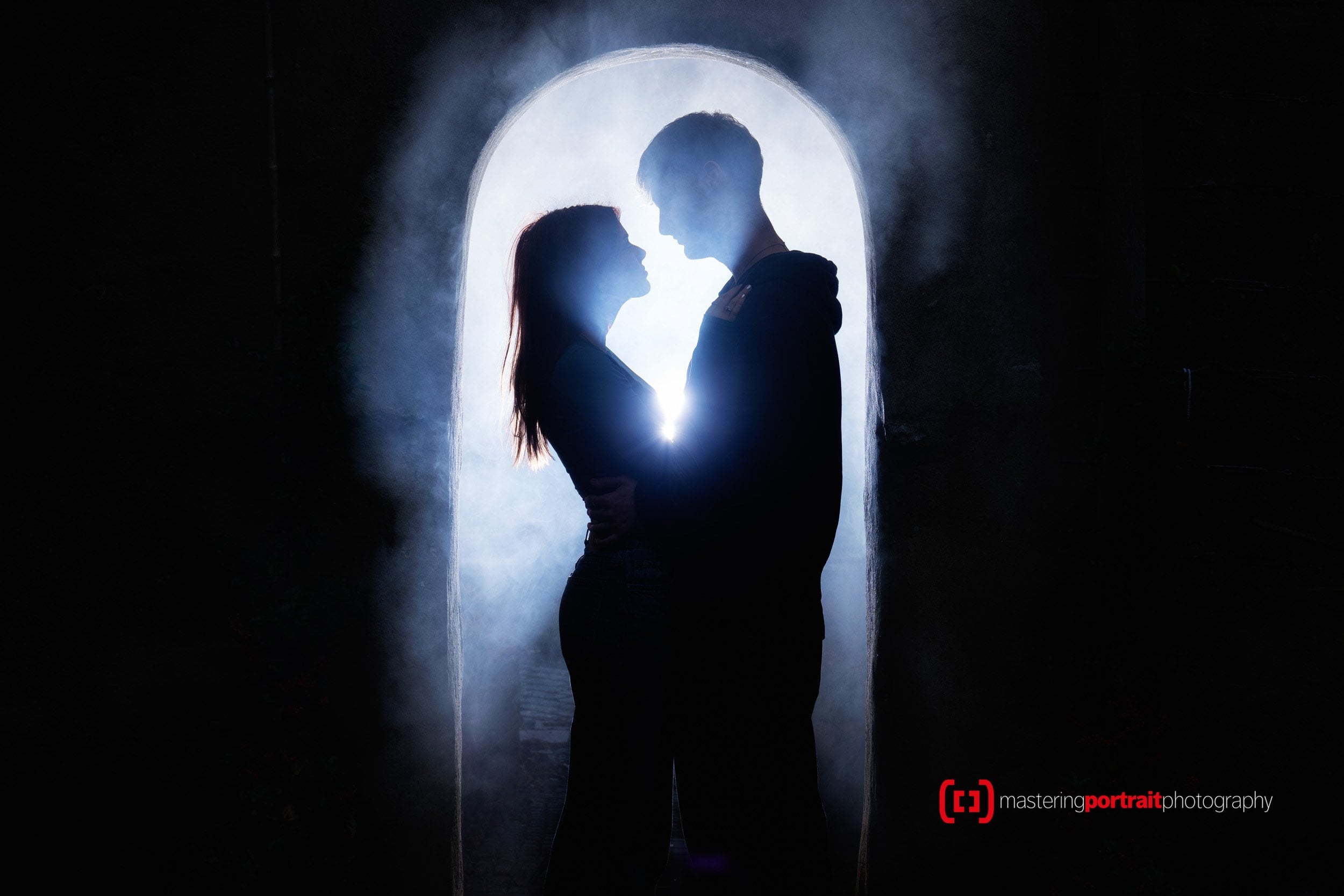
4. CH3 - Using Openings And Archways For Light And Structure: So as is always the case
with a portrait shoot, it's really a little bit
of a journey just as it is with this idea number three. So we've walked
down the Alley Way, turn a corner, and there it is. I hadn't expected to
see it, but it's there. And that's the joy of it,
discovering images or the ideas for images that are right there
in front of you. I've seen this
beautiful arch that's formed by the overgrown hedge
or the overgrown hedges, I guess, reaching across from
both sides of the alley. And it casts its beautiful
shadow down onto the ground. Now, here, if you look along the alleyway, in the sunshine, when the sun is
at its strongest, you can see shadow the light and then shadow than
light, and of course, there's this patch
of darkness where the sunlight cannot
get through the hedge, and I'm betting that that
will make a great photograph. Now, at this point, I've got two possible ways
the shot will work. And right now, even as
I record this video, I don't know which way
that's going to go. It could be that the
light in the background, the sunlight in the background, as Sarah and Elton pass
through the arch will create such a strong backlight
that I can create a silhouette of the two
of them under the arch. Equally, I could expose for them as the light
flattens out a little bit, maybe the clouds just
skidding across, then maybe I can
use the light to drag detail out of
the two of them. I don't know which way
it will go, but both of those ideas have
a certain appeal. So if you notice the way the
sun is moving and changing, the light is
constantly changing. So what I'm asking the guys
to do is repeatedly just walk up and through
this archway, away from me and
back towards me, away from me, and back towards
me. Now, I've got Sarah. So when you're photographing
someone walking, particularly if there's a
feminine sort of look to it, it's best to try and get the
feet to walk along a line. It's easy enough to
show them how to do it. But what it creates is this
nice form down to the ground. It creates sort of a
nicer shape, I suppose. And if you hit the button as their feet make
contact with the ground, you have this lovely
contact as it turned out, the alleyway or at least
the alleyway through the arch is slightly narrower
than I thought it was. And so Elton repeatedly tried to either walk behind or ahead, but very rarely could
he walk beside Sarah. Now, I didn't foresee that, but it still works as a nice image. When he's ahead of Sarah,
it works really well. When he's behind, not so much unless
they're walking away. So we've got them to walk
backwards and forwards, and I'm just looking for those really lovely
little moments. I've taken the camera, and as I love to do when I'm
photographing dogs, I've brought it down to
ground level, and this time, there's so much heads
grow growing out of the top in the distance
that I don't need to worry quite so much about whiteness in the sky creeping
into the top of my frame. So it's given me
options on where I place the camera
without being quite so precise as I was
in idea number one. So I've taken the camera
and I've moved it down to the left, camera left. I've done that because
it's creating this sort of scene where the subject, as they pass through that arch, are going to be somewhere on the right hand side
of the picture, whether low or
high in the frame. I haven't decided when
I took the picture. I'm still just working
it out as I go. But I know from experience
that if I put that into a double page spread
of a magazine or if I place it in a big frame, having that really interesting
off center composition has a certain appeal to it. Now, when I'm working
with the hearing dogs, remember that Elton
is a hearing dog or he is a hearing dog stud. So these are the same guys I've been working with
the past ten years. I know that they love to have options for laying images
out for magazines, for promotional material, for
banners, for the websites. But when I'm selling
to personal clients, I like to have that same
sort of thought process. What would this image look good in because
if I can do that, and particularly if
I can talk about that during the
shoot, who knows, maybe I'll be able to get a
sale, and I'm a business. This is a business. This
is the creative industry. And I know that sounds
a little bit harsh because it should be
about the artistry, and it is to an extent
about the artistry. But we also as professional
photographers, need to be thinking, will I
be able to sell this picture? How am I going to
recoup my costs? How am I going to be
able to make a profit? Hm put food on the table
and my kids in trainers? And so thinking about how
shots going to be used is good from a creative standpoint but also from a commercial one. So the only problem
we had is that Elton kept trying to
walk behind Sarah. It took me a while to
get the shot where Elton walked beside or a
little bit more in front. But there's some
interesting shots here, and don't ignore the opportunity to get a shot where the
dog's quite close in the frame and you
have just the foot or feet of the owner
in the background. It still is quite an
interesting shot, and it tells a story. And certainly, if you're
shooting these kinds of images for commercial use, there's a value in that, too. So with that shot grabbed
on we go to ID number four.
5. CH4 - Using Overhanging Trees For Perfect Light: So onto idea four. So this is a very simple
shot in every aspect. But it's very typical
of what I do is I spot the way light
falls and it forms, and it pulls and it moves. And if you learn to read little patches of
light like this, basically, there are great shots to be had all around you. So the tree is in full
leaf at that time of year, it's sort of the end of August. And because of that, there's an archway
underneath the branches, but there's light coming
in from the back. There's light going
in from the front. It's got this
beautiful shape to it. What actually drew me to it wasn't just the pool
of light inside that opening is the
fact that where the leaf fall has happened,
it's gone golden. Now, I'd expect
to be looking for that once we get into
October, November. However, today, it's dry, it's warm, and there's this
golden color coming through. And I just love those colors. Now, when I got
Elton into there, I'd expected it just to pop. And it didn't. And
I don't really know why. We tried a few bits. It didn't quite work, and
sometimes maybe you bail on it, but if you persevere, I was absolutely convinced
there was a shot in there, and as it happened, I was right, but it didn't come
straight away. What we had to do was move
Elton around a little bit, and then I got Sarah to
move around a little bit, and I turned his head
in different directions to see how the
light was playing. But if you look at the light
in his eyes, it's perfect. So I knew the shot could work. Sitting up is a noise shot. But really, the magic happened when he lay
down on the ground. I say when he lay down, Sarah got him to lay down because we were
trying things out. Then I got Sarah to
move to the left. When a dog's lying down, they move their head across their body and I love
that shape of the shot. If the body is going
slightly to the right, I'll get the head also to turn so he's looking out in
the same direction, similarly to the left. I just think there's more story, there's more narrative to that. I've opened the
camera up to F 2.8, so it's a nice, shallow
depth of field. Beautiful cat size in the eyes, admittedly, gallons of slobber. It's like working
with some kind of animatronic special
effects of an alien. There's just goo
coming out of the dog. Now, fortunately,
that's not my worry. That's Sarah's worry. And she stepped in
and cleaned it up at every opportunity,
which is great. If she hadn't and I
didn't want to do it, it's actually pretty quick to
get rid of it in Photoshop. And, of course, once I've
got a shot at the dog and I know everything's
working and the light is beautiful, well, this was a great
opportunity to put Sarah in the same
shot as the dog, which, of course, we did,
and that's idea number four. Onto idea number five.
6. CH5 - Don't Forget To Let The Dogs Play!: So here we are onto
idea number five. And if I'm honest, this is
a shot that I will do on pretty much every shot
I run with a dog. And the reason is, it gives
the dog a chance to relax. It gives the dog a chance
to just play and be a dog. So up to this point,
we've been controlling Elton and confining his space and making him sit,
making him walk. Where's now? Do you know what? You can go for a sniff
and you can go for a run. It's safe. We're working
in an enclosed ish space. There's a couple of s
out of the orchard, but we know where
he's going to be, which gives him a chance
to just about be Elton. Hard bit is working out what line I'd like him to
run towards or away from. Usually, I will
find some kind of alleyway or some kind of
pathway through a field, or if I'm in a truly
wide open space, what I will do is I'll get
the dog settled on a weight, hopefully, if he'll do a weight, and I'll get the owner or the trainer to come right behind my camera and ask the
dog to come towards us. And that way, the dog will
track straight to the lens. If the dog's weight
isn't that strong, what I might do is get the trainer or the owner
to stay with the dog, and then one of us
will call a dog over. That works most of the time. Occasionally, you'll have a
dog with attachment issues, and it gets a little
bit trickier. But what you can then do is
get the owner to run towards the camera and try and stay separate to the dog,
one side or the other. And that way, you'll get
at some point, a shot. Now, in the old days,
these shots were not easy. But with modern technology, and I'm shooting on a Z nine, I've put it into
animal tracking mode. I'll lock onto
Elton like nothing. 20 frames a second. So now I can concentrate on making sure that my compositions
are where I want them. I can put Elton at the side of the frame, in the
middle of the frame. I can just time those bits with the
dog motion. It's good. With a labrador, you get
that kind of jumping, it's very slow
paced sort of lollp Elton's doing his slow walk like a dog and a catwalk you've got
all the time in the world. Obviously, with poodles,
spaniels, the smaller breeds, they tend to be a
little bit more electric, a little bit
harder at the time. So but at 20 frames a second, the camera will lock on and
I can then get the shot. And even at F 2.8, I know that sufficient of these images will be banging focus that I've got
a nice soft background. The sun is behind the dog, so it picks Elton out. Elton's dark coated. So having the sun behind creates a little
bit of separation, a little bit of
rim light against those dark leaves
in the background. With Elton, we got
him to walk slowly, and then he broke into a run, but both of those were
really, really good. I'm down on the ground. I don't know how
many times I got bitten while down in the ground. But I like that camera angle. You'll have seen in
some of these shots, I'll just sit and
use the flip screen, but I find it much
easier when I'm tracking a fast moving
animal or a car or something if I'm
doing any kind of motion work is it's easier
through the viewfinder. I just find it I get better isolation
from my surroundings, so I can see exactly
what's going on. I can pick out the detail
that I'm interested in. So for me, I'm lying
down in the grass. I'm trying to pick the
height of the camera. If it's too low, I just get this kind of fudgy green
in the foreground. So I'm just lifting
it a little just on my elbows to separate it
from the ground a tad. That way, I get the same
sort of sense of being inside the dog's world right
there as it's happening, but I haven't got too
much interference. I've got a nice soft
edge to the frame, but it's not going over
and around Elton too much. Really easy shot to do, and the dog will love it. So if you're working with a dog, this is a great way to not
only let the dog have fun, but also get
incredible pictures. So that was idea number five, but as is the way with me, well, we're going to have a few
bonus ideas onto the next one.
7. CH6 - Looking For Things You Hadn't Noticed: Stop. So we've done five
ideas, but well, the shoot simply never
stops. So this was a shot. We've been discussing
through the hot we'd like a shot of Elton peering around a corner,
looking through a gate. Some of it just a
little bit different. Anyway, we'd stop for lunch, and as it happens, we opened
the back door to our studio, and it occurred to me that if Elton just looked
around the corner, I'd not only had to get
a shot of a peeping dog, but he would also be
reflected in the glass as long as I lined my
camera up correctly. So I'm down on the floor as usual with photographing dogs. I see to spend my life on the floor in one
form or another. I've moved the camera angle really quite close to the glass but not right up against it because I'm looking
for the reflection, but we don't have uninterrupted glass on the side of the studio. There's big wooden frames on it, so I have to keep the
camera out a little bit so they don't
sort of impede. But then the trick was to get Elton to kind of look
around the corner. So a lot of trial and error. I've got some beautiful
shots of just his nose. But the perfect angle felt to me when Elton just came
out a little bit further, there's a shot of his
nose and his eyes and just the chest
and maybe a leg. And if you look at the
tones in the final image, the wall, the floor, the wood, even the reflections in
the glass and, of course, the color of Elton are all chocolate tones or all browns
of one form or another. And that means I've got a
really harmonious image. And I love that. You know
from other videos I've made, that's something I
look for all the time. Because it has a really
cool sense about it. It has this idea or this impression that
it's all deliberate. And of course, it is deliberate, but it's not something
that you can always get. But here, we've
managed to get it. So once we managed
to get that moment, and the trick seemed to be this trick seems to be
is to have the dog have Elton just behind the edge of the door and then have
Sarah by my shoulder, and then she'd make a noise
or something and he'd peer out to see what was going on. So a beautiful bonus shot. But as is the way with these
things, not the only bonus. With that happy note,
we're heading inside.
8. CH7 - Using Studio Lighting: So we've done five ideas. We've had one bonus, which
we spotted during lunch. But of course, where would we be without some
studio photography? I'm really, really well known for taking pictures
of black dogs or really dark dogs and dark backgrounds is something
I've always loved doing. So this isn't really
an idea as such, though it's a
beautiful photograph. So we stepped inside after
we'd had some lunch, and I just took a handful of pictures of Elton using
a dark background, some very simple side lighting, and a very simple key light. Um, I'm looking for
different angles. I'm looking for the
way the dog looks. I'm looking for those
ears to come forward. I'm looking for catch
lights in the eyes. I'm using Sarah to move
around to get his attention. I've lit it top down so you have this beautiful
wash of light. I like to have my
key light quite close to the dog because you get this
incredible fall off. Of course, the
inverse square law doesn't quite apply
with big light sources, but nonetheless, the
light is falling away. And I love that. But that's not the
purpose of this video. Really what we're
doing is teasing you into keeping an
eye out when we do a video dedicated entirely to photographing
dogs in the studio. But we thought we'd include
it here because we did literally step inside from having lunch and thought,
Do you know what? With a dog as
beautiful as Elton, why the hell, wouldn't you? What a happy way to work.
9. Outro And Thank You: So in this class, we've taken
five beautiful moments, so five interesting
and easy ideas to create stunning pictures. And we throw them
in because, well, why wouldn't you a
bonus idea or two. We've used corridors of
stone and hedges and walls. We've used light.
We've used tonee. We've used archways. We've used the
overhang of a tree. We've used the dog's energy, a couple of reflections, and we've even very
quickly stepped inside the studio to create something a little
bit more classical. On that last note, we will
create a video all about photographing dogs in the
studio at a later date. So please do keep your eyes
and ears open for that one. We really, really, really hope
you've enjoyed this class. And if you have two things, firstly, please do create
a project of your own. We would love to see your work. When you've created it,
please submit it down below, and we will get to
it and have a look, and we will enjoy it,
and we will comment on it if you want us to,
you don't have to. But it would be great
to see what you do. Just take one or more of the
ideas we've shown you here, translate it into your world, your taste, your style, your dog, your friends. And we would love
to see what you come up if you have
enjoyed the video, why not head across to mastering
portraitphotography.com, which is a whole
host of articles, actions, presets, mock ups. You name it. It's on there. All dedicated to the
love, the passion, the creativity, and the business
of portrait photography. It's also, as it happens, the spiritual home of the Mastering portrait
photography podcast. Hundreds of episodes all dedicated to this
beautiful craft. But wherever else until next
time, be kind to yourself. Take care. Yes
10. Outtakes: Yeah, you say that. You froze and went, Oh, hello. We're not doing the food bin. That's not in the photograph. Nor was the Amazon
Man. Who, by the way, the most modelsqe Amazon
man I've ever seen. I know. I was like, Oh, my God. Yeah. I didn't want to insult
Sarah, but oh, my God. Amazon Man. Come on in. Oh, it's a headprint. That's like when
the wood pigeon. We're gonna take
them out into the We're going to we're going to I don't know
where we're gonna go. Where are we gonna go?
Yellow Brick Road. I'm gonna follow
it. Do you know, it might go somewhere?
I'm gonna follow it. If only I had a heart, I know a brain Follow the Yomi road. We've followed the
Yellowi road. Follow. It doesn't matter. It's
helpful both creative. Is helpful creativity Cream it, creative creativeret creatively is the word
I was looking for. Hey. Don't you
pull that face up? You're still tethered.
Oh, you've pulled the bloody headphones
apart. Absolute umax. Sir. You didn't write. Okay. Careful with that cable. A Right. I've upset you that much. Hi. Bye, then, Michelle. Well,
you've just gone beep in here. Bye bye now. Bye bye. Tweet. Take one. When I sound like that,
I sound like I who wants to milli we want you to do that? Tweets $1 million. Is it Option A? Option B. Oh, is it? Excellent.
Always knew I could be a child entertainer. This, let's just go into TV
children's TV. Alright, kids. You're lucky you have
the wheels taken though. I behave. Katie h
 Paul Wilkinson, Portrait Photographer